placid island; black infinity – 2-1.9

Content Warnings

Suicide mention
Sexual harassment (kinda, very borderline)


Previous Chapter Next Chapter

We reached the castle’s outer gate by late afternoon — at about ten to five, according to Casma’s ‘flawless’ internal clock.

Compared with the first two legs of our journey, the landscape grew more peculiar on that final portion, (as third legs do tend to be). As we travelled up from the open meadow and into the true highlands, on which the castle sat like a black and white crown on the headland’s brow, it was as if earthly norms had touched only the low places of this dimension, sinking like an invisible layer of the atmosphere, settling into the valleys and plains, leaving the craggy heights free to get really weird.

No, not ‘as if’.

If my sister had said those exact same words, you would take it as a colourful metaphor. She’s good at those, she enjoys them too much for her own benefit (and so do I), even when she doesn’t understand she’s doing it. But I’m not speaking in metaphors, I’m being literal, and you better accept that.

Whatever made this dimension vaguely like Earth, it didn’t reach very high.

First the grass lost all colour, fading from green to pale to chalky white — not dead, but alive and thriving, even thicker than the green stuff in the meadow and the lowlands below, blending with the rapidly thickening fog that choked the narrow ravines of naked rock. The mist was clean and moist and smelled like rain on concrete, but it cut our vision down to less than thirty feet. Muadhnait advanced with her sword in both hands — the sword made of cold iron, for cutting down fairy magic — and bid us stay close and stay quiet; if she lost us in that fog she would likely not find us again, because raising our voices here was not only hopeless due to the tangle of rock and bush, but was actively dangerous, though she struggled to explain why, (though why I cannot imagine, it was obvious enough to me.) Kimberly ended up holding one of Tenny’s hands, while Casma held the other. A sweet little trio, with no place for a fourth.

I trailed in the rear, watching the back of Muadhnait’s armour glisten with a sheen of moisture, toying with the edge of losing her in the fog ahead.

After the grass went disgusting, the bushes got stupid. In the lowlands they had been thorny enough, but now they sharpened into razor-wire twists and turned so green they went black, as if they had leeched the colour from the soil and left nothing for the grass. They ambushed us from the fog — mostly in front, relying on the mist to hide their spiky outlines until we were almost on top of them; they would have done nothing to Muadhnait’s armour, but she acted as if the tiniest scrape would be fatal, even through all that metal. She slowed to a crawl whenever we saw the bushy shapes looming from the white-out haze. A handful of times they attempted the same trick from our sides, lining the top of a ravine in thick hedgerows before coiling down upon us, or creeping up beside us on seemingly open ground. I showed the bushes my knife whenever that happened, and they stopped bothering us; stupid, but not suicidal. Better than the grass, at least.

Now — was that one a colourful metaphor?

No, it wasn’t. Between the grass and the bushes and the mist, the world had gone black and white.

We weren’t the only things abroad in the uplands. We heard footsteps a few times; Muadhnait told us not to count them, and be careful not to allow our own footsteps to match the rhythm. Once the cry of a bird echoed off some hollow bluff; Muadhnait said there were no birds here, do not follow the voice, try not to think about it. Twice the sound of panting came so close to our rear that something must have been there, just at the edge of the fog — a hopeful dog, perhaps; Muadhnait told us not to go backward into the mist, not to call out, not to stop and wait for the presence to catch up.

One time, a man watched us from the limit of our vision. He was emaciated as a dried-out corpse, skin like dead leaves, his eyes pits full of rot. He just stood there, arms dangling like twigs by his sides. Kimberly nearly screamed, smothering her mouth with a hand, (which was nice). Casma said, “Oh! It’s a fellow.” Tenny made sounds that made my chest feel empty.

Muadhnait told us to ignore the man and carry on. Which we did.

Only two things were visible beyond the ghostly fog — the obsidian ocean far to our right, stretching to the horizon as a stain too dark for even the mist to hide; and the castle itself towering overhead, a mottled corpse dressed in funerary robes and the tatters of a torn wedding dress.

I know.

I said I know!

I sound like Heather.

Don’t you think I know that? Don’t you think I’m more keenly aware of that than you could ever be? Every word, every sentence, everything I say is stained with the memory of how she did this. I turn left, I turn right, I turn back, and fuck it, here’s more of her shadow! And what’s worse — I love it. I love her more than you or anybody else can possibly understand; I love the weight of her shadow on my back, on my face, on every inch of my skin. I would choose her shadow over Heather-less light every time, and nothing could stop me. Sounding like her is the greatest compliment and most foul curse I could ever receive, and it’s constant! Oh, Heather describes buildings like women! Heather spends too much time on the landscape, the environment, the feeling of moving through it! Heather, Heather, Heather, Heather, Heather!

Heather!

Well. You got more of my sister than you deserved. She’s all mine now, and I’m keeping her.

I sound like Heather because I was barely paying attention to that third and final leg of our journey. I watched out for things that shouldn’t approach us, and I kept both eyes on the back of Muadhnait’s armour, (and half an eye on Tenny), and I sometimes flashed my knife, sure, because that’s part of what a knife is for. But I was miles away.

What was the purpose of my little solo story, now that it was no longer little nor solo? I still wanted to catch the Mimic, but the things I would do to her once I had her pinned beneath me were not suitable for Tenny or Casma to watch. Seeing another glimpse of the Briar-bitch had lit enough of a fire in my guts to clear my head, but even that had been snuffed out by the wet fog; I would not turn down a second round with her, but again, not in front of the others, (sorry Kim, I know you sometimes like to watch). I had hoped to hear the pale doll following us through the mist, but if it knew what I was, it had not regained our trail. Now we were approaching this castle — this joke. My sister had enough dealings with castles for both of us, and now here I was, treading in her footsteps, re-doing something she had already done.

This castle wasn’t for me — it was for Heather. She should have been there, falling in love with this stone giant. She would have been all over this, no matter what she told herself (or you).

The situation wasn’t for me either. This wasn’t my story anymore.

Kimberly and Tenny were both in danger, (Casma was in danger too, but she could handle herself) and I had to get them home; I was the robust one, the one who couldn’t be cracked, the one with a kitchen knife in my hand and an armoured shell around the only parts of me that mattered. But the moment that chance came, I would be going home too, and my story would be over.

But I was not going to face my sister and tell her that we’d lost Tenny to a sudden gust of wind, or that Kimberly was lying at the bottom of a ravine with her brains dashed out. I would not face Heather and tell her that. I couldn’t.

As we crossed the craggy emptiness before the castle, I resigned myself to this new feeling — duty.

Duty wasn’t fun. Duty didn’t suit me. Duty was Heather’s thing.

No choice. No rewrites. Skip to the end and try again.

Muadhnait slowed us to a crawl on the final hundred feet, walking so softly she barely made a sound in all that armour, sword out, braced for an ambush, (which never came, because of course it didn’t.) The fog thinned out as we finally emerged onto the ultimate apex of the headland, giving us a wide view of the black ocean horizon stretching away to our right — and the castle rearing into the grey sky above.

“Maisie?” Kimberly jerked around and looked back at me. “What was that sound? Was that you?”

“A snort,” I said.

“ … oh, r-right.”

Casma smiled at Kim. “She can’t help it, she can only help herself. Don’t blame Maisie.”

Tenny went brrrrt, but she had all her tentacles folded away, so it was not a happy sound.

Muadhnait gestured for quiet, then halted in front of what I assumed was the ‘outer gate’.

From a distance of two day’s walk the castle had been an irritating sop to my sister’s taste in fairy tales. Up close it was ridiculous.

Black stone blocks too large for any machine to ever lift formed the naked bones, soaring upward into walls coated with layers of pale ivy and feathery lichen. White marble — or something close enough — dressed the fleshless corpse in petticoats of flowing gown, fluttering downward into outer curtain walls that half-spilled from the headland cliffs, each one a greater rival to the massive wall we’d passed beneath at the ruined village. Towers and peaked roofs and thin spires clustered in the core, some connected to each other by slender walkways — a collection of needles aimed at the underbelly of the clouds; thicker towers, chunky and blocky, stood along the exterior, looking out over the empty black ocean or the fog-choked landscape. The castle’s inner walls were studded with thousands of windows, some open to the empty air, some barred, others glassed and leaded. Tendrils of mist floated between the towers and caressed the walls, settling on balconies and pooling in open promenades.

A black and white giant. Totally pointless.

I don’t know much about castles; that’s one of Heather’s many obsessions which I don’t share. But I could (and do) listen to her talk forever on any subject she wishes, without ever getting tired of her voice, so I’d picked up enough to understand that this place served no purpose. Castles are generally built to command a landscape — they’re military strong points. You stuff them with soldiers and horses and then an army can’t move on until it’s dealt with the castle, or the soldiers on horses will be forever nipping at the army’s flanks and rear, so the army has to sit there and besiege it, and sieges suck and nobody likes them, (except Heather, who has a short list of favourite sieges; I bet you didn’t know that, did you?)

This castle commanded nothing but a view of the empty black ocean.

Muadhnait held her sword in one hand while she briefly examined her map again; she had not needed to consult it even once on the final climb, what with the castle looming overhead. Kimberly and Tenny held their breath in silence. Casma stared at the castle, enjoying it too much.

“T-this is the outer gate you mentioned?” Kimberly whispered eventually. “There’s nowhere else to go … this has to be it, yes?”

Muadhnait put her map away and signed, “According to my map, this is the entrance. We will camp in the first courtyard. Follow me, but be ready to run.”

The Templar Nun raised her sword and crept forward. I didn’t bother unwrapping my knife.

We passed through the only gate in the vast black outer wall — thirty feet wide and double that in height, wide open and unbarred. The black stone to either side was encrusted with white ivy, much of it crumbled and dry underfoot. The space beneath the wall was not long enough for us to forget daylight, but just long enough to make Tenny hunch her shoulders, which I didn’t like.

I put one foot against the wall. Too solid to give it a good kick without pain.

I kicked anyway. Kimberly looked back; I shrugged. Casma looked back and smiled; I looked away.

On the far side of the outer gate was a massive courtyard — tiled in white, walled in black, with barred gates to either side. A number of narrow passageways led through the next layer of wall ahead, into some kind of garden, but there was too much shadow and confusion to be certain without going to look, (and I wasn’t interested in trying.) The courtyard walls were very high, topped by crenelations, (thank you, dear sister) studded with murder holes and arrow slits and wide empty platforms which looked like they should have held little siege machines, perhaps for turning on uninvited guests down in the courtyard. An area in the middle of the courtyard had once been a big triangular flowerbed, but now it grew wild with grass and flowers and weeds — all of them white, white, white, set in deep black soil. A number of white statues stood around the flowerbed; I looked for the Briar-bitch among them, but she wasn’t there, just faces with their features knocked off or torn away, arms and weapons long missing, or whole bodies toppled into rubble. Soldiers, warriors, that kind of thing, but none of them intact.

The castle itself reared up beyond that little square — more walls, more complexity, more layers of dress. I spied a window far away among the confusion of castle, open to the elements, with a body slumped half across the edge — naked, bleached bone-white by the fog. Probably a corpse.

I wanted to spit on the tiles, just to break the silence.

A tangle of rusted metal stood in the far left corner of the courtyard. A single red-orange rose in the monochrome.

Muadhnait looked left and right — big dome-shaped helmet rotating with her head inside — then lowered her sword. She signed something about firewood.

“Um … ” Kimberly’s eyes had gone wide as little saucers, (which was very cute.) She flinched at the sound of her own voice, echoing off bare stone, (which was even cuter.) “ … M-Maisie? Tenny? Casma? I-is that—”

“Yes,” I said; I echoed too, which was better than the silence.

Tenny went ‘brrrrrt’; her soft trilling faded off into the distance of the castle.

Casma said, “How strange!”

Muadhnait signed for us to follow her. We did, mostly because there was no other way to react to what we were seeing, and no way to explain to her in a fashion she would understand. She led us to an open doorway on the left of the courtyard, then peered around inside; the space was dusty and empty, all black stone walls, some kind of storage room. A few pieces of wood were stacked up in a corner.

“W-was that meant to be our firewood for the night?” Kimberly asked.

Muadhnait signed, “Yes, but the stash is long since depleted. None have ventured here in a long time. I am prepared for this, I have other methods to ensure that we will pass the night in safety, but we will be cold.”

“You said no darkness,” I said. “No darkness ever, or eaten by fairies. Re-tuning your tune?”

Muadhnait hesitated, then dug around in the pouches at her waist and produced a smooth pale stone, just smaller than a snooker ball. It looked like it weighed almost nothing, like pumice.

She held it out as if we were supposed to be impressed. Nobody said anything, (well done, Casma.)

Muadhnait put the stone away again and signed: “I have a small supply of light kernels.”

“Kept that quiet,” I said. “Quietly kept.”

“Yeeeees,” Casma agreed. “Didn’t mention that last night, did you.”

Muadhnait signed, “They are precious and cannot be wasted when firewood is abundant. I will need them for the stone-walking task ahead of me.”

Kimberly broke in. “R-right, right, I’m sure Muadhnait meant well. Um … ” Kimberly swallowed and gestured over at the other corner of the courtyard. “Can we talk about the uh … the … ”

Muadhnait’s helmet rotated to look at the pile of rusty metal in the corner. She signed a blank question; I decided at that moment that I wanted to learn sign language, because that would be very satisfying.

Kimberly nodded. “If you would … would lead on, with your, um, sword and—”

I turned away and led the way. I didn’t bother taking out my knife. It wasn’t as if the rust was going to attack us. If it did, that would be entertaining enough.

The courtyard echoed with our breathing, our footsteps, our heartbeats — even those of us with bare feet and no hearts. I stopped us short of the big tangle of old rust. Everyone stared at it, with the possible exception of Muadhnait, who was probably wondering what all these Outsiders were so excited about.

“If nobody is going to say it,” I said, “then I’m going to say it. Shall I?”

Kimberly tried to say it, but she just murmured. Tenny was silent, which was awful.

Casma said, “You can say it, Maisie. If you think what I’m thinking, I think.”

I said, “That’s a car.”

“Was a car!” Casma said instantly; she’d been waiting for that. I almost looked at her instead of the car.

“At what point does a car cease to be car?” I asked.

“When it can’t car anymore,” Casma said. “That’s obvious. This car cannot car. It’s not a car.”

“So what it is now?”

“An ex-car. A post-car. The empty shape of a car, but without the essence of function. An unformed car, uninformed about the fact it is no longer a car! Neither mobile nor automatic, it is not longer an auto-mobile.”

“Rrrrrrust,” said Tenny. “It’s rust.”

“Tenny wins,” I decided. “Correct.”

“Awww,” said Casma.

Kimberly swallowed so loud it was like a whole word. “How … how is this here? How … ”

“‘How’ is pretty obvious,” said Casma. “What you really mean is ‘why’. Mmm, big question. Why car?”

The tangle of rust which squatted in the corner of the black-and-white courtyard was the only thing not either black or white; the rust was a juicy rich dark orange-brown, the kind of beautiful old rust that takes decades of erosion to cultivate. Perhaps some solid metal still survived beneath all the layers of flaking red and ochre, but the car looked as if it would crumble to dust at a touch — which was not the only reason I didn’t try, because there was always the chance of magical bullshit.

Why a car, indeed?

Casma was right — this hadn’t been a car for decades. The body had that sleek, curved look, while the front was high and narrow, so much smaller than a modern car. The roof had fallen in and the bonnet was rusted away, revealing what little remained of the engine. The tyres were still present — flaccid, cracked, warped by dry rot. The leather on the seats had long since decayed, and the stuffing was all gone. The windows and windshield were intact — glass lasts a long time with nobody around to smash it — but they were both filthy with a patina of black grime, perhaps carried by year after year of white fog or pale rain.

“Somebody drove it here?” Tenny suggested. She didn’t unfold her tentacles to poke at the wreck. “Parked.”

“Somebody must have driven it through the outer gate, yes,” Casma said, trying to be oh-so-very helpful. “But the inner gates are too small, so they left it here, and here it is left, left behind, behind the gates.”

Kimberly was not having a good time with this; she hugged herself, digging her fingers into her own sides, probably trying to keep from shaking in front of Casma and Tenny. She stared at the rusted old car like it was the reaper come to lead her away, (and it wasn’t, Kim, I wouldn’t have let it). Her throat bobbed so hard that I thought she might choke on her own tongue.

“Kimberly,” I said. “Kimberly. Kimberly.”

“I … uh … y-yes … yes?”

She didn’t actually look at me.

I looked at Muadhnait instead. “You said you have maps and blueprints of this castle. What do your maps say about this? Is this mapped and printed?”

Muadhnait hesitated, then opened one of her pouches and drew out a much larger map than the one she had used to guide us across the open landscape. It was folded into little squares, organised by some system I couldn’t be bothered to figure out right then. She unfolded and refolded it several times, searching for the courtyard; it was hand-made, drawn in black ink on yellowed paper, covered in notes in whatever language it was Muadhnait really spoke.

Eventually she held up a little corner of the map. There was the car — a tiny scribble roughly in the shape of the car’s bonnet and roof.

“We can’t read the label,” I said. “Unlabel it to us.”

Muadhnait signed, “Gleaming chariot. Cannot be moved.”

“Gleaming?” I echoed. “Gleaming.”

“Rust can gleam,” said Casma. “Gleaming in the falling of metal to rust. Rusted gleams. Gleamy gleam.” She sang the final two words, which didn’t help anybody.

“How old is that map?” I said. “How long since anybody was last here?”

Muadhnait signed: “Sixty seven years. The last walkers to pass this way recorded what they could to update the maps which belong to my hold. My maps are copied from the master versions. They are accurate.”

“Sixty seven years ago,” I said. “Accurate.”

Kimberly made an exceedingly cute sound in her throat. But when she spoke she sounded like she was about to break. “Sixty seven … y-years?”

Casma asked, “Why’s there nobody here? I thought we might reach the castle and find all sorts of knights and princesses, or maybe at least a herald to say hello? It feels empty and deserted. Are you certain that Maisie’s Mimic is around here, or upside here, or outside here?”

Tenny went brrrrt, then said, “Deserted is betterrrrr.”

Muadhnait signed, “The closed stone is busy with unclean life. We cannot see it from here, we are relatively safe beneath sunlight.”

I looked right into her visor-slit, into the darkness, searching for her eyes. “What is this place, really? Real or not, ready or not, this place isn’t what it places itself as. Castle up here, castle for nothing. Nobody’s home, but I’m still calling. What is this place?”

Muadhnait simply signed, “Closed stone.”

“What does that mean? Treat me like a fool again and I’ll treat you too.”

Muadhnait hesitated for a long time, metal gauntlets paused in mid-air. I heard Kimberly’s teeth start to chatter. Casma said something pointless to her, and it didn’t work.

“Muadhnait,” I said. “Don’t lie.”

Muadhnait spread her gauntlets in a sudden gesture of frustration, then signed rapidly, hands moving so fast she got sloppy and had to repeat several words. “You are Outsiders. You would not understand. This means nothing to you. It is closed stone. I am equipped for stone-walking. Please stop—”

“Humans used to live here, didn’t they?” Casma said. “And then they didn’t. And now other things do.”

Muadhnait stared at Casma for a long moment, then signed, “I am going to look for more firewood. I will not go far. Please stay here.”

The armoured nun stalked off, back to the little doorway where we’d found the scraps of firewood. She drew her sword again, then slipped through without looking back, fucking off to sulk.

Kimberly was still staring at the not-auto-not-mobile.

I took her by the hand and led her away a few paces, just out of earshot. She registered a bit of surprise, but she didn’t resist (good girl, Kimberly, good girl). Casma spotted what I was doing and tried to help in the only way which actually helped; she did the same with Tenny, to keep Tenny’s attention on the car instead of the adults about to have a difficult adult conversation, (pity it wasn’t the other kind, but even I wasn’t that much of a slut). They started loudly speculating on the make and model and age of the car, trying to peer through the grimy windows, and read what remained of the number plates.

“Kimberly.”

Kimberly looked at me like I was about to bite a chunk out of her. Which was not entirely unpleasant, yes, but not what I wanted right then. She also looked pale enough to vomit herself to death. She was still clutching her ribs with her free hand, covered in cold sweat, trembling slightly — all of which would have been very cute, if none of the rest of this was happening.

“ … y-yes?” she said. “Maisie? You’re … staring. Maisie? S-sorry, I’m already freaking out, I can’t, uh … please stop … ”

I had no idea what to say.

My sister has spent plenty of time detailing all the ways in which she finds herself inadequate; she is incorrect about all of them, (not ‘almost all’ — all) which almost goes without saying, but the one she is most incorrect about is her ability to console others. When her friends cry, she knows what to say. When somebody is in crisis, she always has the right words. When plans need to be cut through, she has the blade of her tongue already sharpened. She draws on a deep well she doesn’t even know she has, and berates herself for only being a hair’s breadth shy of perfection.

Kimberly was going grey. She had looked like she was going to vomit, but now she looked like she was going to vomit on me, (and even I have limits).

First thing that came to me. Go. Go. Go.

“It’s going to be okay,” I said.

Kimberly cringed.

“Sixty seven years!” she hissed, then glanced back at Casma and Tenny, to make sure they hadn’t heard. “Maisie, that car’s been there for over six decades. Maybe longer. Whoever brought that here, they … they … they probably died here. Out here. Outside!”

“We don’t know that. Maybe they went home but they left the car behind.”

Kimberly cringed worse. Tears brimmed in her eyes. “We’re … stuck. We’re stuck. We’re stuck!”

“Heather will find us.”

Kimberly turned her face aside. “I … Maisie, I … I don’t want to be rude, a-and I’m sorry I snapped at you earlier, back there, when you and Muadhnait were about to … f-fight or something, but … but … ”

“Say it,” I said.

“You and Heather … you saved her when you were little, and then she saved you when you were grown up. You two have something special, but we’re not all like that. Some of us don’t have anybody, let alone a … a … whatever.”

“Your dykes will come for you.”

Kimberly spluttered. “My- my what, sorry?”

“You’re not as lonely as you pretend.”

Kimberly pulled an absolutely incomprehensible expression. Gave Casma a run for her money. At least she wasn’t cringing anymore, or crying. Well done.

“Heather will come for us,” I repeated.

Kimberly sighed. “Maisie, it’s been over twenty four hours. Thirty six hours, now? Where is she? What could possibly be blocking her like this? It doesn’t make sense.”

“The Mimic.”

“If this Mimic is strong enough or clever enough to block Heather from getting here, then … then I don’t think we can deal with it. I can’t even think of any magic I can do, not alone, not by myself, not without tools. And this place, this castle, it’s insane! It’s the size of a small town. We could search for days, weeks. And Muadhnait said it’s dangerous in there? We can’t take Tenny or Casma into the castle. I … I don’t know what to do. I just don’t.”

Her tears were gathering again. I needed to get much more stupid.

I raised her hand to my face and kissed the back of her knuckles.

Kimberly froze.

She gave me the worst possible look — a look that said not only did she have no idea I’d been about to do that, but that she had not even considered it remotely possible. She considered it akin to being kissed by a dog, or an insect, or a tree.

I dropped her hand. Kimberly awkwardly lowered it.

Because I am made of carbon fibre and lies, I am very good at keeping my feelings off my face.

“I’ll deal with the Mimic,” I said. “Then we’ll go home.”

“Uh … r-right, yes,” said Kim.

At least she wasn’t crying.

I meant to say more — I meant to tell Kimberly to keep herself together, at least for Tenny and Casma, (though really just for Tenny). I meant to tell her that I would deal with everything and she was going to be okay and I would make sure she got home, and then I would be her heroine, just like the women her own age who she was into. I meant to tell her that I would take care of her. I meant to tell her that I wanted to kiss more than her hand — but actually that I didn’t, because the kiss had been boring, and what I really wanted to do was bite her cheek and make her squeal in that delicious way I imagined she would, and …

Do you think I would have been able to say any of those things? Don’t be gentle with me, (because I won’t be gentle with you.)

Luckily I didn’t have to discover my limits, because a figure appeared atop the crenelated wall which surrounded the courtyard — Our Lady of the Forded Briar.

She was standing on one of the wide platforms meant for inward-facing weapons. She peered down at me with eyes of nuclear fire trapped behind thin glass, muted a little by the omnipresent mist. She had her spear in one hand, the tip still missing, (ha!) Her dress clung to her body in the moist fog, showing more than she had done in the dream.

The Briar-bitch raised her free hand to her own lips and kissed her own knuckles. Mocking cunt.

But then she bit down, drawing blood that burned and bubbled as it fell.

Kimberly was saying something — something about drool. I wasn’t listening.

Our Lady of the Forded Briar lowered her hand with a great big bite mark on it. Her blood was like molten steel spiced with rubies. She flicked the hand, then wiped it on the front of her gown. Then she turned and walked away, swallowed by the tangle of monochrome masonry.

“Maisie?” Kimberly said. “Maisie? Maisie, you’re drool— ah!”

I grabbed Kimberly’s hand again and forced it against my lower abdomen, beneath my t-shirt, her palm on my belly. Her eyes went very wide, as they should do — cute, cute, cute. What had I been thinking with a kiss on her knuckles? Go for broke, go all the way, or lie down and die. Never did the latter before. Never going to.

“Does my stomach feel warm?” I asked.

“Uh— wha— sorry?”

“Does my belly feel warm to you?” I said. “Like I have a fever, or trapped wind, or something like that. Nothing?”

Kimberly shook her head. “N-no. No. You feel … normal, Maisie. Y-yes. Normal.”

“Okay.”

I let her go. Kimberly pulled her hand back like it had been thrust into a fire. “Are you … feeling sick?”

“No. Better than ever. Everything is going to be okay.”

The reignited glow of molten gold low in my abdomen carried me aloft through the next few hours of bored waiting. Nothing could be done with everybody watching, though I could probably have gotten away if only Casma had been present — but that was the whole problem. If this story was just me and Casma, there wouldn’t be a problem in the first place.

If I just charged off without thinking, I would be acting too much like my sister, wouldn’t I? And I was already an irresponsible slut; no sense in adding her flaws to mine.

So, I waited. I’m very good at that. I did it for long enough.

Muadhnait returned with an armful of firewood, all that she’d been able to scrounge up in that little chamber; it wouldn’t be enough for a fire to last through the night, but it would be enough to cook some dinner. She set the logs up in the opposite corner of the courtyard, the spot best protected from any wind, though the fog was everywhere, even if it was a little thinner than outside the huge castle walls. Casma asked why we couldn’t sleep that night in the little room where she’d gotten the firewood, but Muadhnait explained that we needed to be outdoors — spending the hours of darkness inside the body of the castle would be too dangerous, even with her methods of protection. The night would be cold without a fire, but we would survive, (and I had a fire in my guts, anyway.)

Everybody settled down as best they could, even though there was almost nothing to do. Muadhnait built the fire ready for later, drew a fresh circle of salt around our new camp, then took off her pack and sat down to clean and oil her swords and dismantle her crossbow again. Tenny and Casma asked if Muadhnait had anything with which to draw — and she did, she had several pieces of coloured chalk. She was happy to lend it to them, but asked them not to use too much, as she would need it for marking her (our?) way once inside the ‘closed stone’. Casma and Tenny amused themselves playing some ultra-complicated version of noughts and crosses on the ground and chattering about the game they were designing back home. Kimberly tried to meditate; she does that a lot, but she’s not very good at it. (Sorry, Kim. You just aren’t. You should have been a professional gardener, not a mage.)

I walked around the edge of the courtyard several times and peered back through the outer gate, at the visible edge of the highland crags. Things were waiting or lurking in the mist, vague shapes with burnt outlines. I showed them my knife and they went away.

Stupid place. Not a proper tree in sight. And so silent; made me want to scrape the walls and throw things, but the only thing to scrape was my knife, and there was nothing to throw but bits of broken masonry from the anonymous statues.

By the time I had finished failing to add to my ideas, the sun was creeping behind the body of the castle itself, filling the courtyard with deeper shadows. Muadhnait distributed her blankets again, then took out three maps and spread them on the ground. She sat cross-legged and examined them, or at least stared at them.

The three maps were all quite different to each other. All three were hand-drawn, but the big fold-out one we’d already seen was the most primitive, all freehand lines and tons of scribbles, a vast piecemeal attempt to map the innards of the gigantic castle. The second one was smaller and more simple, breaking the castle up into vague areas and groupings, each one labelled with a word in Muadhnait’s native script. The third map was actual blueprints — angular, straightforward, precise — though the castle the blueprints described looked smaller than the massive edifice of reality.

I stood at Muadhnait’s shoulder. She looked up at me, but I said nothing, so she looked back down. That was better.

Kimberly was sat on the floor nearby. She said, “That … does seem like an awful lot of ground to cover. What are your, um, plans, Muadhnait? If you don’t mind sharing, of course.”

Muadhnait raised her hands and signed, “Don’t eat anything. Don’t read anything. Don’t go into the dark. Don’t stay under the roof if we have to spend more than one night here.”

“Uh … right, yes.” Kimberly swallowed, but she didn’t look like she was going to cry. Sexually harassing her earlier had probably short-circuited her tears for now. (And yes, I was sexually harassing her. Don’t pretend I wasn’t, I don’t need your defence.) “But, I mean … more in terms of, um … how will you … ”

“How will you find your sister?” I said. “Or will sisterly love guide you?”

Heather’s methods. Not that I doubted.

Muadhnait started to sign something — “Guide — she —” But then she stopped and tapped several places on the map, then signed. “I will start with these locations.”

“That’s it?”

That was it.

The sun dipped lower, the shadows in the courtyard deepened, the fingers of mist in the far corners thickened; there was no great blazing sunset that evening, as there had been on the first night in the ruined village. The highland fog swallowed whatever rusty glow the sun and the clouds conspired to create, washing out the colours until they were only fading white. Muadhnait lit the sad little fire; the orange and yellow flames seemed to hunch and hide, as if trying to conceal their hue. I think it cheered the others quite a bit, but I was elsewhere, tugged by the fire in my guts. Muadhnait cooked another meagre dinner of oats over the cheery little flames. Casma ate. Kimberly ate more. Tenny ate sadly.

When the fire started to die down, Muadhnait demonstrated the function of the little pale rock she’d shown us earlier. She held the ‘light kernel’ in her mailed fist and squeezed it hard for about thirty seconds. Weak illumination started to leak out from between her fingers, and when she opened her palm the stone was glowing with a cold greenish light — not much, just enough to light our little camp. She placed the kernel next to the fire.

“It will last about ten hours,” she signed to us. “Do not knock it away or pick it up, lest you risk letting too much darkness in with us. If anything happens to it, wake me at once.”

There was almost no talk that night. Kimberly was withdrawn, staring at the fire, then at the stone when the fire had died; she tried to make a joke about wanting to brush her teeth, but it wasn’t a joke. She looked at me several times when she thought I wouldn’t see, but it wasn’t the kind of look I wanted from her, so I focused on the fire in my belly and pretended I hadn’t done anything to her earlier. Casma and Tenny shared a blanket again, and they fell asleep early, snuggled up together, probably exhausted from the long hike. Muadhnait lay down on her back just like before, like a suit of amour in a tomb, like she had been a walking corpse all along. Kimberly eventually slept as well, lying lengthwise on the outside of our little huddle, to protect Casma and Tenny from the night.

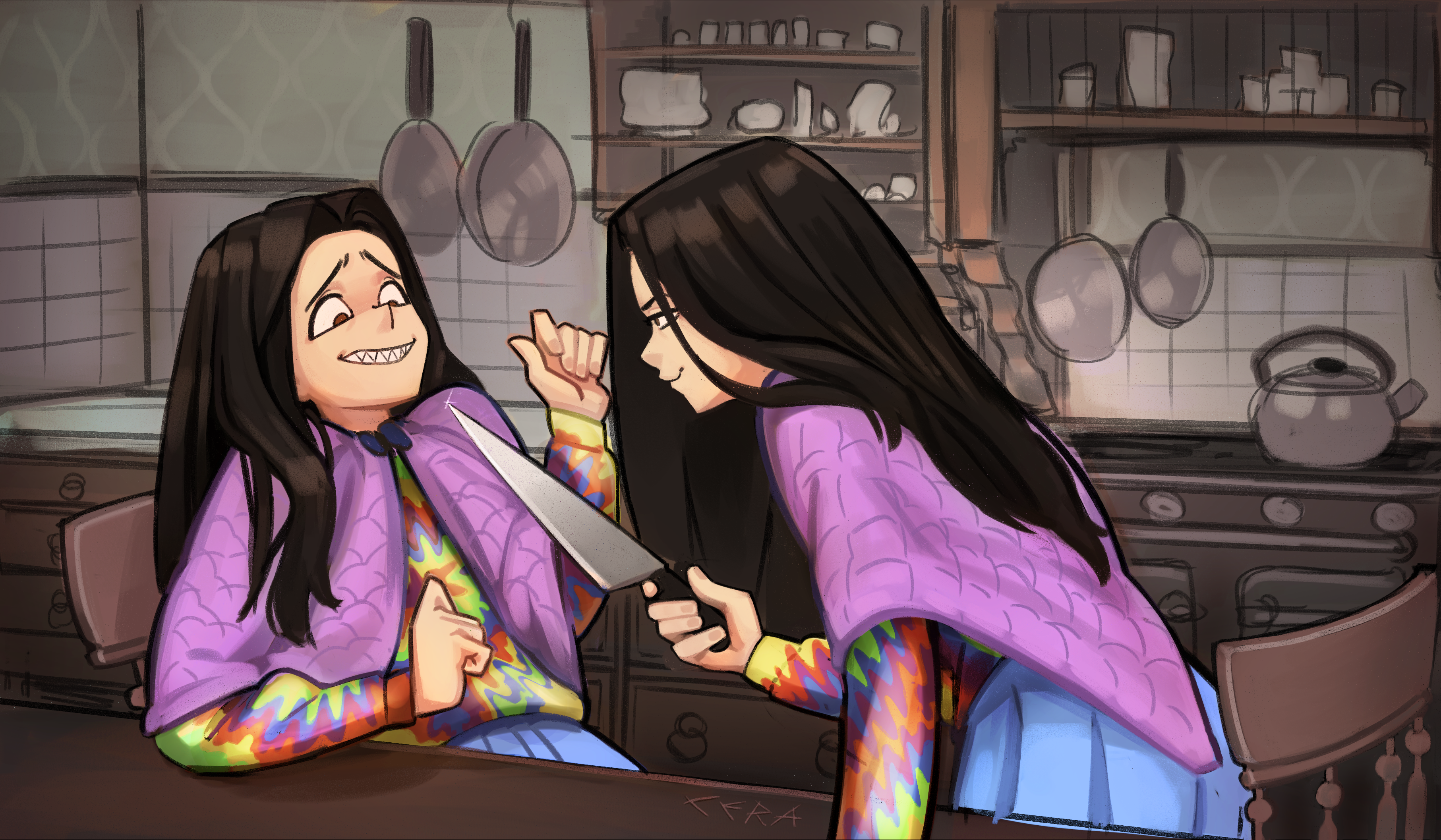
I pretended to sleep for a while, bundled up in my own blanket, shawl about my neck, kitchen knife on my chest. I waited until I was certain nobody would hear me.

Muadhnait ruined my plans.

She moved mere moments before I was about to. She sat up without a sound, (quite a feat in that armour, right?) then stood up slowly and carefully, moving for stealth and silence. I unwrapped my knife inside my blanket, because I thought she might be going for Tenny. But she didn’t. She walked to the edge of the circle of salt and sat back down, cross-legged. She took out one of her swords and laid it over her armoured lap.

Muadhnait stared into the darkness.

Do as she says, not as she does? What a hypocritical little nun you were, Muadhnait. Tut tut. Shouldn’t you have been taking your own advice?

But this darkness was not the same as the darkness in the ruined village, fair enough. The kernel’s light was not linear, like flames, but faded out forever as it stretched, without ever quite dying. Though the mist was thick and the walls were black they were just about visible at the edge of the courtyard. I watched for a few minutes, waiting for the sprites and pixies of the previous night to appear on the battlements or peer around the doorways or cavort in the overgrown flowerbed. But nothing showed itself.

The village had been a gleaming corpse, still fresh despite age. This place was mummified, dry and empty.

I stood up — softly softly. Muadhnait didn’t turn her head, which made me smiley smiley. I tucked my shawl around my neck, then crept up almost beside her, just outside the range of her vision from that slit in her helmet.

She saw my shadow. She turned her helmet and looked up at me. She started to sign something about how I should go back to sleep — then she saw the naked knife in my hand.

“You have no idea how to find your missing sister, do you?” I said.

She hesitated, then signed, “That’s not true.”

I pointed with the blade, past her, into the dark.

“I’m going to find the Mimic,” I whispered. “If I see a sister, a sister will be freed.”

Muadhnait did what she kept doing, what she was doing right then, what she had been doing all along — she hesitated.

I turned away and stepped past her, one foot over the circle of salt.

Muadhnait clanked gently as she rose quickly to her feet, then grabbed my wrist in one armoured fist. I turned and raised my kitchen knife. She let go of me and spread her gauntlets.

“Don’t try to stop me again,” I whispered. “Or I’ll stop you, sister or not.”

Muadhnait signed, “You can’t — night — danger — too much — don’t—”

“Stop.”

Muadhnait stopped. Her gauntlets shook. Slowly and carefully, she signed, “I’m terrified.”

“Yeah. Are you coming or not?”

Previous Chapter Next Chapter


There’s so much going on in this chapter that my usual riffing off events down here feels totally powerless. Maisie is … a hot mess, let’s call it that. A castle! Trying to do something with Kim! A burning need in her gut. And now a burning need to get this over with ASAP by inviting the knightly nun out for a nighttime stroll with the ghosts and goblins. Good luck Maisie.

As for behind the scenes, Maisie is proving downright impossible to narratively control. She’s following my outline – kinda, but also pulling at every loose thread and constantly turning around to stare at me, which is an interesting experience! I wouldn’t have it any other way, though, as I keep saying. I thiiiink the arc is probably reaching the halfway point, but that’s almost entirely dependent on Maisie herself. I’m just, you know, along for the ride.

And so is Muadhnait, by the looks of it.

Meanwhile, if you want more Katalepsis right away, you can get it by:

Subscribing to the Patreon!

Patrons get access to two whole chapters in advance, and hopefully more in the future! The more support I get through Patreon, the more time I can dedicate to writing, and the less chances of having to slow down the story or get interrupted by other responsibilities. The generous and kind support of Patrons and readers is what makes all this possible in the first place! I wouldn’t be able to do this without all of you! Thank you all so very much!

You can also:

Vote for Katalepsis on TopWebFiction!

This helps a lot! Many readers still find the story through TWF, which still surprises me! Voting only takes a couple of clicks!

And thank you so much for being here, dear readers! Thank you for reading Katalepsis! As always, none of this would be remotely possible without all of you, the audience. Maisie would surely turn her ire on me alone. Ahem. So! Katalepsis is for you!

Next chapter, will this knightly nun ever stop hesitating? Is it time for M&M to talk a walk off into the dark? Or is Maisie going to make like her sister, and blunder off all alone?
placid island; black infinity – 2-1.8

Content Warnings

None this chapter.


Previous Chapter Next Chapter

Several things all happened at once.

That might seem like a redundant statement if you inhabit the same kind of reality that I do; all things are always happening at the same time, duh. That’s how time works. But my sister often assumed that you needed to be told that. Do you? I’m not sure I trust her judgement on that one.

Anyway. Several things. All at once. Fights are just like that.

But I’m only going to tell you about one of those things — the part that I made happen myself. If I told you about the other parts then I would be lying via reconstruction, since I didn’t see them as they happened, and that would make a mockery of the truth I’m telling you.

Wouldn’t it?

You’d go along with it easily enough if I did; you probably wouldn’t even think about how strange it is for one participant in a melee to chart every moving part. We would all pretend that as the pale spider-thing rushed past me and I leapt after it, that I fully registered the events unfolding in my peripheral vision — Muadhnait down on her face, Kimberly screaming as she stumbled backward, Tenny hooking her arms beneath Kim’s shoulders, Casma jumping in front of Kim with her hands spread wide, as if she could catch the pale spider like a bullfighter. (Though with Casma, truth was anybody’s guess. Maybe she had a long knife hidden up one sleeve of that fluffy white jumper.) I could feed you a play-by-play and you’d eat up every word, no matter how obviously impossible — the same way you’d stare at my body if I stripped off all my clothes, even though the only real flesh I possess are a few shards of greasy bone that nobody will ever see again. A good thick layer of soft and squishy artifice is just so much more attractive than the truth, isn’t it?

That’s how my sister used to tell these parts. She pulled that trick so many times that I lost count. She didn’t even realise she was doing it.

But unlike my sister, I don’t have eyes in the back of my head, so we’ll dispense with the fiction of brief omniscience. All you get is me and a kitchen knife.

(And that’s more than enough for anybody to handle.)

The pale spider shot right past me at knee-height, six white legs whirring, going straight for Kim.

I turned and sprang and sprinted after it, skirt against my knees, shawl snapping in the wind. Standing starts are easy when you don’t have to worry about real tendons — if something goes pop down there, just keep running, it’ll either fix itself or it won’t. I was fast enough to catch the spider — it would only take a few paces — but not fast enough to catch it before it caught Kim first. The pale spider was going to slam into her just before I could reach it, and Kimberly didn’t have a big sword or inches of plate armour to protect her; it would only take one strike from those oversize fists to give her a skull fracture. Casma was going to get hurt as well, the thing would run right over her. Tenny might catch a stray or two, and I couldn’t understand why she wasn’t leaping aside.

If the Mimic wanted to send unsafe toys for me to play with, well, that wasn’t what I wanted, but it wasn’t offensive. I had agreed to play, after all, even if she hadn’t.

But this?

No.

I sprinted three more paces, then leapt onto the pale spider’s back.

You might be tempted to assume that because I am made primarily of carbon fibre, that I am quite light, that you can lift me up and toss me around. That would be an amusing mistake; I am not a bike. I am heavily armoured, filled with magic boxes, and wrapped in pneuma-somatic flesh. None of that is free weight, and you can’t lift me like one, unless you’ve got muscles like Zheng, (and she’s not allowed to try). I am heavy enough that you can mistake me for real, and while that weight is not real muscle, it’s far easier to use.

The pale spider-thing crashed to the grass. I rode it down, legs wrapped around the midsection, arms pinned around the long and twisting neck.

There was no Casma, no Kimberly, no Tenny in the tangle with us. I wasn’t sure how that had happened. There was a lot of screaming going on regardless, and a deep resonant hum filling the air, and Casma saying, “Oh dear.”

The spider-thing flailed beneath me. Pale limbs bent backward. Long-fingered hands grasped at my arms, plucked at my clothes, and swatted for my eyes.

‘Spider’ is woefully inaccurate, ‘spider-thing’ is even worse; I can’t keep calling it that now, not when I had gotten up-close and intimate. It had six legs, not eight, and the trunk of the body was a human torso, shaped with the suggestion of hips and a waist. The limbs were smoothly curved like human arms and legs. The neck was out of place — three feet long, twisting every which way in a hopeless effort to throw me off — but the head on top could have passed for the smooth, blank, featureless face of a fashion store mannequin.

It grabbed both my arms and tried to wrench them open to free its neck; another pair of hands found my ribs, digging digits into what would have winded anybody with real lungs. It tried to lurch upright, but I was too heavy and too well locked in place.

I … tightened my grip.

And that was all I did.

I had my knife out, yes. It was in my right hand, right there, and I hadn’t dropped it or forgotten about it. I just didn’t want to use it on the pale thing beneath me — and no, not just because it had no skin to puncture, no blood to bleed, no organs to perforate. I didn’t have those things either, (not real ones anyway, you think my blood contains oxygen? Try again) and I’d used the knife on myself readily enough. No, I was not reluctant to try because I thought I would fail. I wouldn’t fail. Knives don’t fail until they go blunt, no matter what they are tasked with cutting, and I was far from blunted.

Do I really have to spell this out? Can you not infer? Are you going to make me humiliate myself like this?

(Too bad, I’m not humiliated in the slightest.)

The pale spider-thing was like me.

It was a ball-jointed doll.

Yes, it was made of solid wood rather than carbon fibre, and yes, my joints are significantly more complex than balls and sockets, (though I could have either of those if I wanted, thank you very much). The wooden surfaces of its body were pale, smooth, sanded to perfection. The elongated neck was a set of wooden rings which extended like the trick of a master carpenter. The grasping hands were imitations of human palms and digits. The joints showed no hint of metal or fastenings, they were that perfect.

But the details of the body didn’t matter. What mattered is that I knew it was like me.

How? I just did. Don’t ask questions I can’t answer.

That was why the Mimic had sent it — and that was why the Mimic was flapping above us now, buffeting me with waves of air, watching me make a fool of myself — because this was one foe I would stay my hand against, for reasons that I could not articulate, not even to myself.

But I’ll articulate them to you, because I’m telling you the truth.

The pale doll and I trashed about on the grass, making a lot of noise and looking totally stupid but not getting anywhere. It grabbed at my arms and legs, yanking me back and forth, trying to peel me off. Hands grabbed my head, shoving me back, perhaps hoping to snap my neck (not that it would have mattered). I tightened my grip. I whispered things — “Stop fighting stop fighting you idiot stop— stop— you’re like me, you’re like me, I’m like you, stop fighting, stop stop stop—”

Then it found my throat and tried to strangle me.

It used two hands, squeezing so hard that its wooden fingers creaked. It achieved nothing, because I don’t have a trachea. I am unchokeable.

(Sorry!)

When I failed to let go or turn blue or start wheezing for breath, the pale doll finally decided to take a look. The blank ovoid of the head swung backward on the extendible neck, until it was inches from my own. It hovered for a moment, as if it could see me with the smooth empty surfaces. But it couldn’t, so then it opened a thousand painted eyes.

The screaming got worse. Casma said something inane.

“Boo,” I croaked.

The pale doll froze. A thousand eyes went wide.

Perhaps it was surprised to see something like itself staring back from within its grip. Or maybe I’m just flattering myself with the belief that it saw in me what I saw in it. Maybe I was a twisted mirror. Maybe I was a horror show. Decide however you want. I don’t care.

But then the pale doll twitched, as if an invisible hand jerked it away from something it was not meant to see. The thousand little painted eyes shivered and squinted, struggling not to close.

No choice, right. No choice.

I released the neck so I could use my kitchen knife. I put the tip of the blade against the chest — or back? — in front of me. I slashed upward, carving a deep furrow into the pale wood. Then down, then up again, then down once more.

M — that was all I could finish before the pale doll recovered and grabbed my arm with three of its hands. We grappled for a few moments, and this was a real grapple, because this thing was built for snatching and strangling. But I only had to break free once, and then it was over. Casma was shouting, “Strings, strings! Maisie, strings!”

I already knew that, I didn’t need her help.

I wriggled my knife arm free and slashed at the empty air above the doll’s limbs.

It collapsed instantly. The two hands around my throat stayed in position for a moment, then fell away.

Tiny gossamer threads whipped upward — the strings I had cut, almost invisible in the grey daylight. They led nowhere, up and up and up toward the sky, vanishing into empty air. I grabbed for one, but I missed. I stared after them for a moment, but the Mimic wasn’t there.

I stood up and made sure there were no more strings puppeting the pale doll. It lay between my feet like a horse with a broken leg, or perhaps a newborn foal that had not yet learned to walk. The head was still covered in thousands of eyes, all wide open now, all of them staring at me or rolling in fear.

“Stay there,” I said to it. My voice was croaky and scratchy from the bruises on my throat. My hair was all in my face from the fight.

Kimberly was still screaming.

You would be justified to assume that I enjoyed that sound — but I didn’t. There is a big difference between a quick yelp of fearful surprise and a drawn-out terror-wail of mortal fear. If you don’t understand the difference, then you don’t understand the difference between me and Heather.

Kimberly was screaming because she was twenty feet off the ground. Tenny had got her under the armpits and scooped her out of harm’s way.

Tenny was airborne.

My sister had always imagined that Tenny’s flight would look ungainly — great big wing-flaps and lots of buffeting back and forth with gusts of air. Heather was not being uncharitable, either on purpose or otherwise; she loves Tenny almost as much as it is possible to love anything, but her mental image of Tenny’s flight was forever fixed by her one failed attempt at gliding. I had not thought about it much, so I was, for once, just as surprised as she would have been.

Tenny flew like a moth — wings stiffened and extended outward to their full length, wider than she was tall, beating the air with a blur of prismatic colour and coal-black flesh, stirring a deep and resonant hum inside one’s chest. She was wide-eyed and wide-mouthed with happiness and pride.

“Maze Maze Maze!” she shouted down at me. “Auntie Mazeeeee! Maze!”

Which was a little hard to make out over Kimberly screaming her head off. Tenny had both her arms under Kim’s shoulders, and several tentacles wrapped around Kim’s waist for extra support, but apparently that wasn’t enough security to overcome the sudden fear of being up in the air.

Casma shouted, “You can put her down now, Tenns! Come back down, come—”

Clank clank clank went our Templar Nun, marching across the grass toward my rear.

I turned around and showed her my knife.

Muadhnait was back up on her feet, sword in both hands, blade point-down. She halted her advance, because I had a knife and I was not happy. She was visibly panting, obvious even through all that grey metal armour; I could hear her heaving for breath and see her shoulders rising and falling. She was hunched slightly; probably bruised, if there was anything much to bruise in there.

“I know what you want to do,” I croaked at her. “And you’re not going to do it. Unless you can do me first. Do or don’t.”

Casma said, “Oh … dear?”

Muadhnait’s sword stayed where it was. Her visor-slit showed nothing but gauze and shadow. Behind me, the sound of Tenny’s wings stuttered and lowered, then cut out completely, followed by the sound of Kimberly’s slippers kicking against the grass. Her screaming collapsed into wet weeping.

Casma appeared beside me, peripheral. I almost told her to go away. But I didn’t, because the outcome mattered more.

“Maisie?” Casma said. “Muadhnait? Are we having a set-to? Or are we just setting up for an upset? Can’t we set aside the sides?”

Muadhnait shook her head, dome-shaped helmet sliding back and forth on her massive gorget.

“Get set,” I said. “On your marks. Ready.”

Casma stepped forward, in between the two of us, which was extremely annoying because it meant I had to either look away or look at Casma. At least she had a refreshingly simple expression on her face. She said, “Our unlucky assailant has been assaulted in reverse by our most illustrious of knife-holders, has it not? So what is there to fight about, or over, or at? Are we contesting the corpse for a right to pillage? I don’t think it has much in its pockets!”

“It’s not dead,” I said. “I’ve set it free.”

Casma didn’t answer for a moment, which would have made me grin with satisfaction if I wasn’t defending a newborn child from a butcher.

Casma stared between my legs, at the pale doll. I assume it stared back at her.

“Oh,” she said. “Hello?”

Muadhnait flexed her gauntlets around the hilt of her sword; it was the other one, the one made of cold iron, for spitting fairies over fires. I could guess what it would do to the doll.

“It had strings,” I said. “It was fighting against them. It’s free now.”

Muadhnait shook her head again.

“I don’t care if you believe me or not,” I said. “I will put this knife in you.”

Muadhnait huffed — I heard it clear through her armour, a big meaty sigh. She straightened up and rammed the sword into the ground, point down, cutting nothing but a few blades of grass. Her gauntlets clicked as she signed at speed, stumbling over her words.

“Tainted water can never be cleaned by letting it slip through one’s fingers,” she signed.

“What does that mean?” I said. “Say what you mean and mean what you say. Talk in riddles and you’ll get riddled. Why not say it with your fucking bitch mouth?”

Casma held up both hands, one to either of us. She was smiling. “Muadhnait, Maisie, M&M, please—”

Muadhnait signed again. “The fairy is still a danger. It walks by daylight and it hunted us. If it recovers from this crippling, it will hunt us again.”

“I cut the strings,” I snapped. “Unstrung the limbs. It’s freed and newly born and I’m pretty sure it doesn’t know that yet. You want to kill it now, you can kill through me, and your pigsticker isn’t enough to stick my guts. It’s free—”

Muadhnait signed. “We cannot let it live.”

“I can!” I shouted. “I can! I will!”

“Maisie, Maisie, Maisie!” Casma said, facing me in full. “Are you sure about this? Sure as sure is sure?”

“Yes.”

“How can you tell?”

I looked Casma in the eyes. Casma looked me back. My eyes started to water. She struggled not to blink.

She knew I couldn’t tell shit. I just wanted to believe.

You’re comparing me to my sister, yet again. No, don’t bother to mount a defence, I’m not so angry about it this time, because comparison can also reveal difference.

Heather’s infamous mercy. Heather’s unflinching desire to extend the benefit of the doubt to even the worst. Heather’s heroine complex, her need to save everybody, to see the good in even those who had attacked her. Heather would have spared anybody, if they’d given her an opening. She would have spared Alexander and Edward Lilburne both, if she could only have found a way. She spared Sarika when perhaps she shouldn’t have done so. She spared Badger, and that one paid off, and she will never let us hear the end of it, even though she doesn’t say a word about him. She spared Kimberly, and I wouldn’t have liked if she hadn’t.

Sometimes I thought she was wrong.

And no, you can’t turn her against me by telling her I said that; she already knows all the contours of my thoughts, far better than you do.

But I was not being like my sister, because I was not being merciful. I was not extending charity and forgiveness to the unknown other. I was only doing this because the pale doll was like me.

And that’s about as selfish and irresponsible as you can get.

Casma bit her lip. The lip-biting was not complicated, but the rest of her face was.

I had to look away before she decided which side to take, but not because of the way her gaze made my eyes itch.

A face was peering over Muadhnait’s shoulder — with nuclear fire in her eyes and skin like melted stone. Our Lady of the Forded Briar ducked down behind Muadhnait when Casma turned back around.

“Maisie is generally right about these things,” Casma said to Muadhnait. “Right way up and right way round, when it comes to dolls like her. Can’t we try some trust?”

I had no idea where Casma had gotten that from; the only other ‘dolls’ I knew were the Good Doctor, and Praem, and I had never offered her an opinion on either. But I didn’t complain. Casma had taken my side.

(Casma always takes my side. And I’ll take hers.)

Muadhnait didn’t answer for a moment. She didn’t hesitate either. Eventually she signed, “To kill it now would be a mercy. You have crippled it.”

“Do I look like I need strings?” I said. “String me along and I’ll string you up, restrung with the highly strung— tch!”

I hissed and shook my head. The Briar-bitch peeking at us had thrown me off. All my thoughts were down in my abdomen, glowing like molten metal.

Muadhnait hesitated. That was better. Back to normal with the nun.

“It’s only just been born,” I said. “Give it a moment to learn the moment.”

“You better step off it then,” Muadhnait signed.

“I better had,” I said.

But I didn’t.

Casma raised both hands again, one for each of us — ever the little diplomat that her mother was so bad at — but then her pink eyes widened in shock and she stepped aside.

Kimberly stumbled into Casma’s place.

Wild-eyed, tear-streaked, auburn hair all over the place, raked back out of her face. Shaking and shivering with a potent cocktail in her veins — adrenaline, mortal fear, maybe something worse, something that I’m too much of a child to understand. She looked like an adult then, with adult fears and adult limits. Tenny had tried to hold her back, but Kimberly shook off the black tentacles wrapped around her forearm. Casma spoke some soothing nonsense sounds, but Kimberly ignored her.

None of that was cute.

“Just fucking stop!” Kimberly shouted. She managed to look back and forth between me and Muadhnait so quickly that I wondered how she didn’t give herself a neck injury. “Stop! Fucking stop! Stop!”

She didn’t raise her hands to us like Casma had done, but curled them into claws, like she was trying to grab something in mid-air in front of her own chest and choke it to death. She panted more like an animal than a person (which, again, would have been cute, but was not). She looked ready to pluck the knife right out of my hands. She looked about to scream. She looked done.

When neither of us answered (and I couldn’t look her in the eyes), Kimberly shouted again. “You!” she pointed at Muadhnait, punctuating her words with jabs and slices. “Put the sword away! Away! Away! Now! Now!” Before Muadhnait could obey or otherwise, Kimberly whirled on me. “And you, put the knife away! Put it away! Put it away!”

Muadhnait and I did as our screaming charge bid us — though I delayed by a moment, waiting until Muadhnait went first. She did.

It wasn’t hard to put the kitchen knife away, not that time.

The moment the sword was in the scabbard and my knife was wrapped up in the tea towel with the little maids on it, Kimberly’s mad fight left her, as if she was also a puppet with her strings cut. She sagged and panted, gesturing vaguely, opening her mouth as if she had something more to say. Tenny stepped forward and took her by the forearms to stop her crumpling to her knees. Casma stood aside and watched.

“I just … ” Kimberly mumbled. “I can’t— I can’t do this—”

She didn’t react much when the pale doll began to rise.

I stepped off the fallen puppet so it wouldn’t accidentally head-butt me in the arse. It was still sprawled on the grass like it had died there, but it was starting to twitch and tremble. The head was still a ball of eyes; some had begun to squint and blink, each of them moving independently of the others.

Were you seeing sunlight for the first time, little thing? You had been made with strings, born to be moved by the will of another. Now you were free, weren’t you?

I didn’t know that for sure. But my assumptions serve us both pretty well. Put up with them for now.

Muadhnait backed up a couple of paces. She kept one hand on her sword, but she didn’t draw it again; lucky for her, because if she had, I would have found a way to cut through her armour and remove her hands.

The pale doll found its feet with some difficulty, scuffing and slipping against the grass several times before it staggered upright. It didn’t stand like a spider anymore, but like a hunch-backed human on two hand-footed legs, while the other four arms dangled apelike. The lowest pair of hands plucked at the grass while the upper pair investigated its own flawless wooden joints. It still had the steel bolt from Muadhnait’s crossbow lodged low in its midsection, but though it plucked on the tip, it couldn’t remove the rod.

A big letter ‘M’ was carved in the middle of the chest. At least I’d left that mark.

It would be a comfortable lie to tell you that it looked at us — at me — and understood what it saw. It would be the sweetest of fictions to tell you that it spoke, and thanked me, and said ‘Yippee, now I’m free.’ It would be the most self-serving rewrite of reality to pretend that it followed us like a loyal hound, or a lion with a thorn pulled from its paw, or just a person with chains struck off.

Whatever. I’m not telling you lies.

You can’t tell where something is looking when it has a thousand eyes.

I opened my lips to say something. Hello? Welcome to being free? Insert whatever weak and witless words you think I might have said, because I didn’t get to say them. At my first intake of breath, the pale doll retreated half a dozen paces, loping like a gorilla mated with a giant insect.

“Don’t—” I said.

And then it fled. It turned around and ran away, a pale doll retreating across the grassy upland meadow.

It was framed against a hillside for a moment; it paused, turned, looked back. Or maybe I just like to think it did.

Then it was gone, off among the hills, down between the ridges.

Muadhnait and Kimberly had a brief argument, mostly conducted via Casma, about stopping for a few minutes so everybody could recover and catch their metaphorical breath, (or literal breath, in Kim’s case.) Calling it an argument gives it too much gravitas; Kimberly just wheezed and dry-sobbed a few pleas, Muadhnait put up a token resistance about needing to get on as soon as we could, and Casma came to the rescue (yet again) by pointing out that the sun (which was not a sun) was still high in the sky, not yet far past noon.

Tenny helped Kimberly over to the big rock, so she could sit with her back against something solid. Casma went with them, prattling on about everything and nothing. Muadhnait retrieved her crossbow, then shrugged her pack off her back, sat down, and set about cleaning and oiling both her swords. She checked her armour too, when she thought nobody was paying attention.

She should have been covered in bruises from that tumble. But there was nothing behind the visor except a little slice of night. Or maybe she just hid her pain.

Our Lady of the Forded Briar was nowhere to be seen.

Bitch.

“Maisie? Maisie? Maisieeeee?”

Casma came, to annoy me to tears.

“Mm.”

“Maisie, I’m not trying to be annoying, just annoyed to be trying. Oh, wait, no, that sounds rude, and I didn’t want to be rude to you. I’m worried, but mostly worried about being worried. Why don’t you come sit with Kim and Tenns? Here, I’ve got your—”

“I’m fine here.”

A long pause. She wanted me to look. I wouldn’t. “You haven’t moved in—”

“I said, I am fine here.”

“Telling lies?”

“I’m fine. Here. Here fine. Fine here.”

A soft tut. I still wasn’t going to look at her. “Maisie.”

“We’ll be moving again shortly, anyway,” I said. “What do you care what I do with spare time in the meantime? I can be mean with time.”

“You’re all alone, and that’s no time at all. I thought maybe—”

“Glomps you.”

Somebody spluttered — not Casma. Probably Kimberly. (You’re of the right age to get that, aren’t you, Kim? You’re welcome.)

“What?” said Casma. I almost grinned with the triumph of landing a hit she didn’t understand.

“Nothing. I’m fine.”

“Well, here,” she said. “I’ve got your—”

“Don’t touch me,” I said.

Casma gave up on me (though not for never, never for good, for which I cannot forgive) and went away.

The cloud cover was thinner than on the day we had arrived, but still total; I wondered what colour the sky was behind that blanket of royal grey.

Reality is patterns, but patterns are not reality. No, I’m not riddling at you, this isn’t a Buddhist koan, it’s a literal description. You can spend half your life learning the way that patterns work, learning how to read the chaotic unfolding of a tiny change and how it snowballs into all other tiny changes and then builds and builds toward something large and true. If you were not unlucky enough to be stuck in prison for a decade with little to do but see through the eyes of your sister and watch the patterns in the dark, then perhaps you can read books on system theory and catabolic collapse — though I don’t recommend you do that, you should watch anime instead — but none of that can prepare you for a moment for which all the reading of patterns lacks even the most rudimentary answer.

I didn’t know why I’d done what I had. Why had I freed the pale doll? Why had it run off?

Perhaps that’s why my stomach felt like it was full of worms. I didn’t even have a stomach. I’d never eaten a worm, (unlike my sister.)

I wasn’t going to vomit again, though. I’ll leave that to Heather.

“Auntie Maisie? Brrrrt?”

Tenny’s purring trill tricked me into taking a breath for the first time in a while. I finally looked away from the point where the pale doll had vanished between the hills.

Tenny stood a few paces to my left, looking very big-eyed and a little sheepish, reaching for me with half a dozen tentacles, touch aborted.

Kim and Casma were sitting in the shade of the big outcrop of rock, talking softly, too quiet for my ears. Kimberly looked partially recovered, but not good. Muadhnait was sitting a ways off, perfectly still, meditating or praying.

Tenny offered me my shawl.

“Tenny,” I said. “I dropped that?”

“You dropped it,” Tenny said. “Drrrropped. Do you want it back?”

I accepted the shawl and wrapped it back around my shoulders again. It didn’t help. I tidied my hair out of my face. That didn’t help either.

“Well done for saving Kimberly,” I said. “Well done. Done well. Good to see you fly. I know you wanted to. Wanted to know that you did. Well done. Yes.”

“Mmmmmm-brrrrrr,” Tenny trilled. “Auntie Maisie, are you okay?”

I took another big breath. I didn’t fill my lungs, because I didn’t have any. But it still felt better than being still again. “Yes,” I said. “You don’t have to … do … this … ”

Tenny looked so much like a puppy.

“Auntie Maisie has been standing there foooooor … ” Tenny’s tentacles wiggled a bit. “Sixteen minutes? Sixteen minutes. Casma said that.”

“I was just lost in thought.”

Not a lie; wouldn’t lie to Tenny.

Tenny puffed out her cheeks — an expressive habit she’d picked up from Lozzie, highly context-dependent. It either meant she was annoyed and couldn’t put it into words, or that she was too excited for speaking. On this occasion it was probably both — I was being annoying as crusted shit, and she was still hyped after her maiden flight. Her wings were not folded away properly, not lying down her back like a cloak, like they normally did; instead she kept twitching them upward, shoulders flexing. The surface of the wings had not quietened down either; she could have given my tie-dye t-shirt a decent rival if she’d cranked up the colour saturation another notch or two.

“Feeling bad?” Tenny said.

“Feeling bad.” I looked across the open meadow, at grass and distant hills and the clouds.

Tenny didn’t say anything for a minute or two, which was really nice. Tenny got it, fundamentally, gut-wise. She just stood there by my side, stretching and wiggling her tentacles, and because I knew it was Tenny and not Casma, I knew her next words would not irritate or corral or seek to understand me more than I wished to be understood, or more than I understood myself.

I watched the ends of her silken black tentacles wiggling in front of her, their tips occasionally opening to sip at the air.

“Why?” she eventually asked.

I looked at her, then over at Kimberly, still red around the eyes. I looked at our butcher-nun. I looked at the towel-wrapped kitchen knife in my hand. I looked at the Briar-bitch who was standing on a hill at the extreme limit of my vision.

“It’s hard to explain,” I said. “Explaining is hard. Hardly explained. Hard up for—”

“Auntie Maisie,” Tenny trilled. “Try?”

“I’m not sure—”

“Brrrt!” went Tenny. “I’m not a little kid. I’m grown up. Talk?”

“Talk,” I echoed. “Right … ”

Kimberly’s tears were not the kind I enjoyed; I would never get to see those up close. Muadhnait would have killed the pale doll if I had not stood over it, and I didn’t know why I’d done that. The doll itself had not been able to speak. Casma was a failed diplomat and amateur head-shrinker. Tenny had achieved flight and had been put in actual danger. Kimberly had come within inches of injury, maiming, death. I couldn’t look at anime girls on my phone. I could tell that Tenny was hungry — really hungry, for a proper meal, and whatever she said about her intellectual maturity, Tenny was young and still growing and under the care and protection of the adults present. I was an adult present, a present adult; Tenny and Casma had worked together to pull another adult out of harm’s way. Next time we might not be fast enough.

Heather would come for us eventually. I might have to explain why one of us was gone.

I know what you’ve been thinking, and you’ve probably been thinking it for a while now, because I was thinking the same thing.

But I wanted, so badly, to be irresponsible.

I wanted to drop the burden of trying to be human, just for this little adventure, a little side-story of my own telling. Put the burden down for a while, then pick it up again later, after I’d had my fill of tears and trembling. I couldn’t be harmed, not really; I was made of carbon fibre, and who could dispute that? Heather would come pick me up, we’d all go home, and that would be that. Hooray.

Except Kimberly and Tenny were both made of flesh and bone, (though the latter was debatable in Tenny’s case, and to my knowledge nobody has ever x-rayed her). Casma was unique and special, but then again so is everything else about her. Muadhnait was dangerous.

The price of laying down my burden was too high.

If I’d been there alone, things would be different. But I wasn’t, and I wasn’t free, and I wasn’t being me.

I opened my mouth to give Tenny an answer — a true one, even if I couldn’t fit all those words in, and some of the bits about Kimberly were not appropriate for Tenny.

“I’m not having—”

Our Lady of the Forded Briar strode off the distant hill.

In one step she was halfway to us, in another she was another quarter of the way, and in a third she was only ten feet from me. Nuclear eyes bored into mine. She was like a little piece of star, shaved off and stuck in the ground. How did she not burn through the soil and sink into the bedrock? Her bare feet were molten. Her hair was flames descending from the sky. She carried her spear, but the tip had been cut off, and was weeping melted iron. Her shield was gone — not bothering with protection anymore, were we?

fun anymore. Died on my lips.

A sudden heat deep down in my guts felt like I’d chugged a pint of boiling honey laced with molten gold and rocket fuel. For flesh that wouldn’t be so good, but I was made of carbon fibre. I could take it. I could take anything.

“Auntie Maisie?” Tenny said.

I smiled. The Briar-bitch smiled back, and I imagined what she would look like crying tears of hot metal.

Then she turned and strode away, off toward the Mimic’s castle on the distant headland.

When she was gone, my belly was still warm.

“Maybe I’m not feeling so bad, after all,” I said. I turned to Tenny, though I made eye contact with the white fur on her fluffy shoulder. “More important. Importantly. Are you okay?”

“Brrrrrrrrt,” went Tenny. “Auntie Maisie … ”

She saw right through me.

Told you I was an irresponsible little shit.

Previous Chapter Next Chapter


Events are rather escaping Maisie’s control, aren’t they? A doll just like her – and it doesn’t want to play. Kimberly unafraid and unprotected. Tenny flies! (With all the associated problems.) And this knightly nun is none too merciful toward fallen others. Uh oh. No way to go but on to the castle …

I hope you enjoyed this one, dear readers! Things are getting spicier now, with problems opening up for our unfortunate carbon fiber doll, that she neither wanted nor asked for. But this is her story, so she’s got them anyway. Hooray! Isn’t this what you wanted, Maisie? No? Too bad.

(I best not taunt her too much, or she’ll turn that knife on me.)

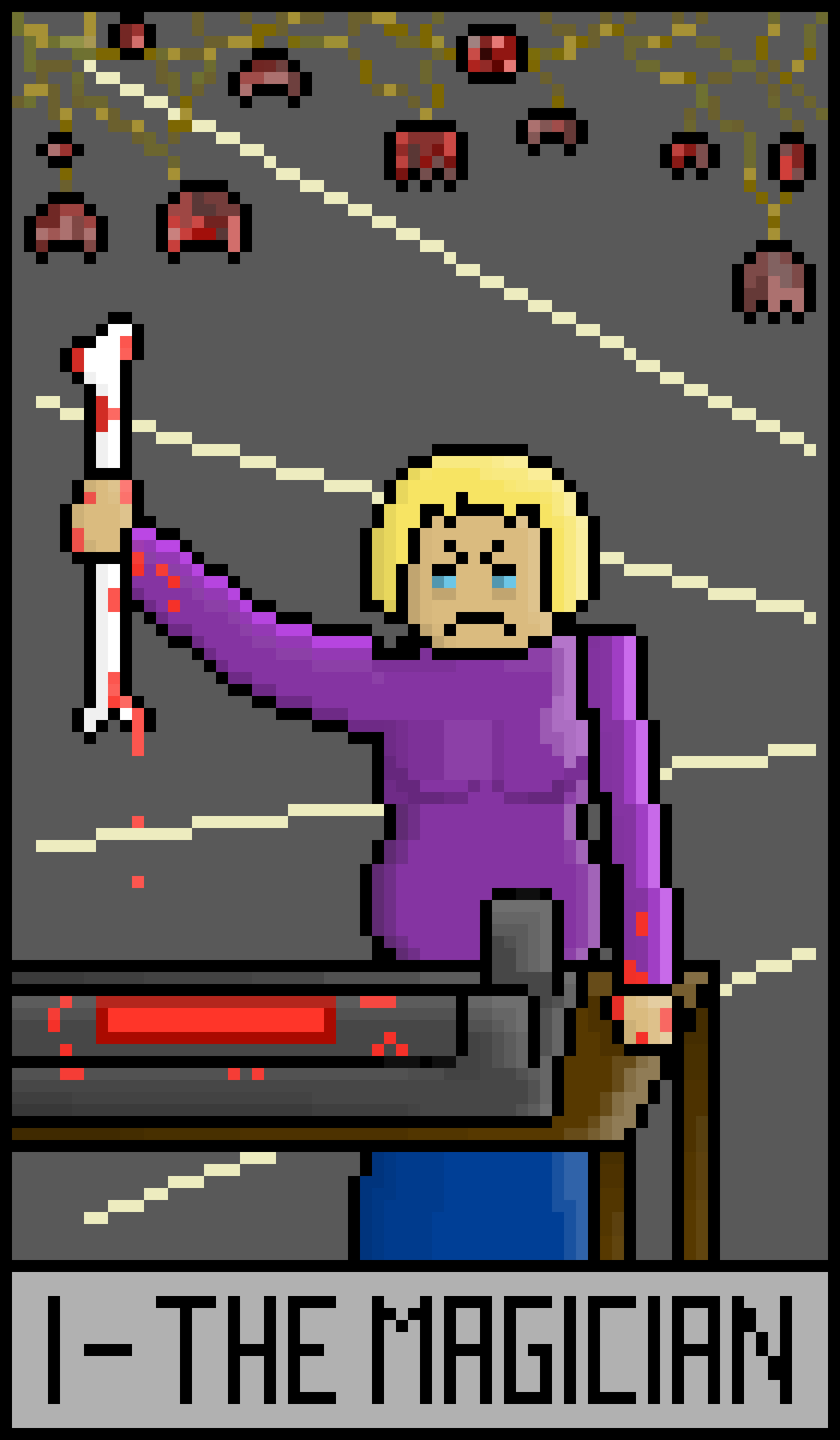
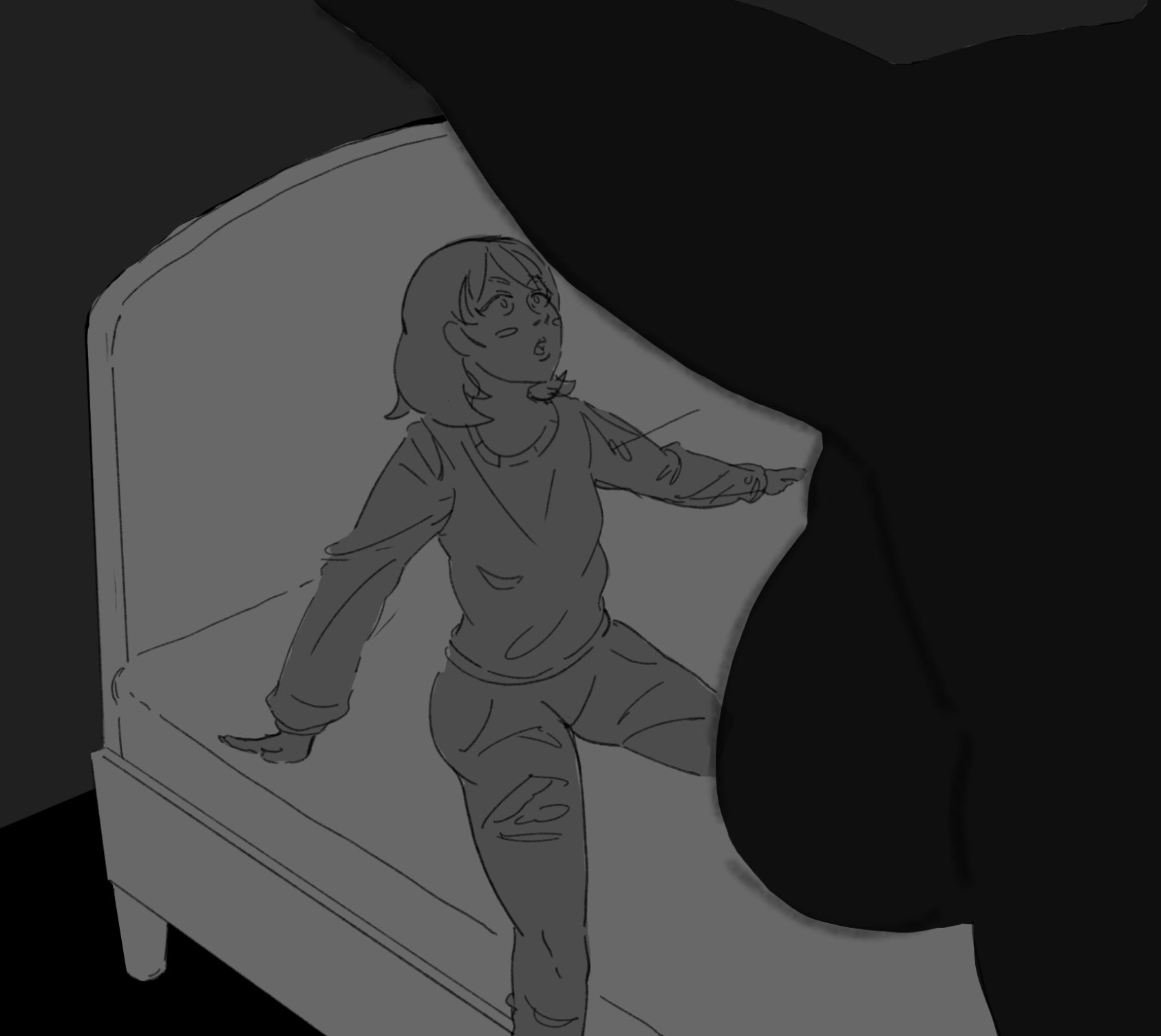
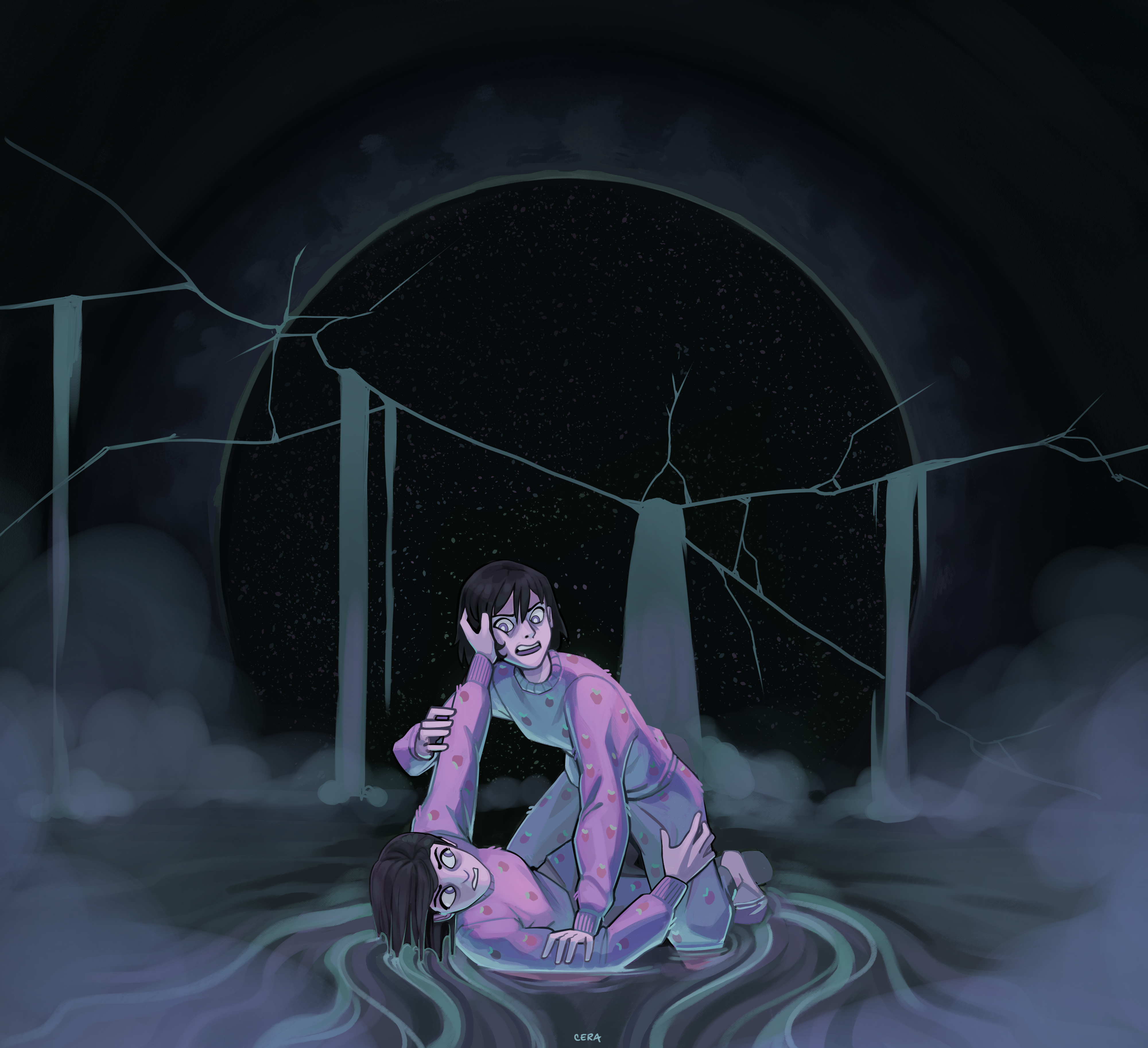
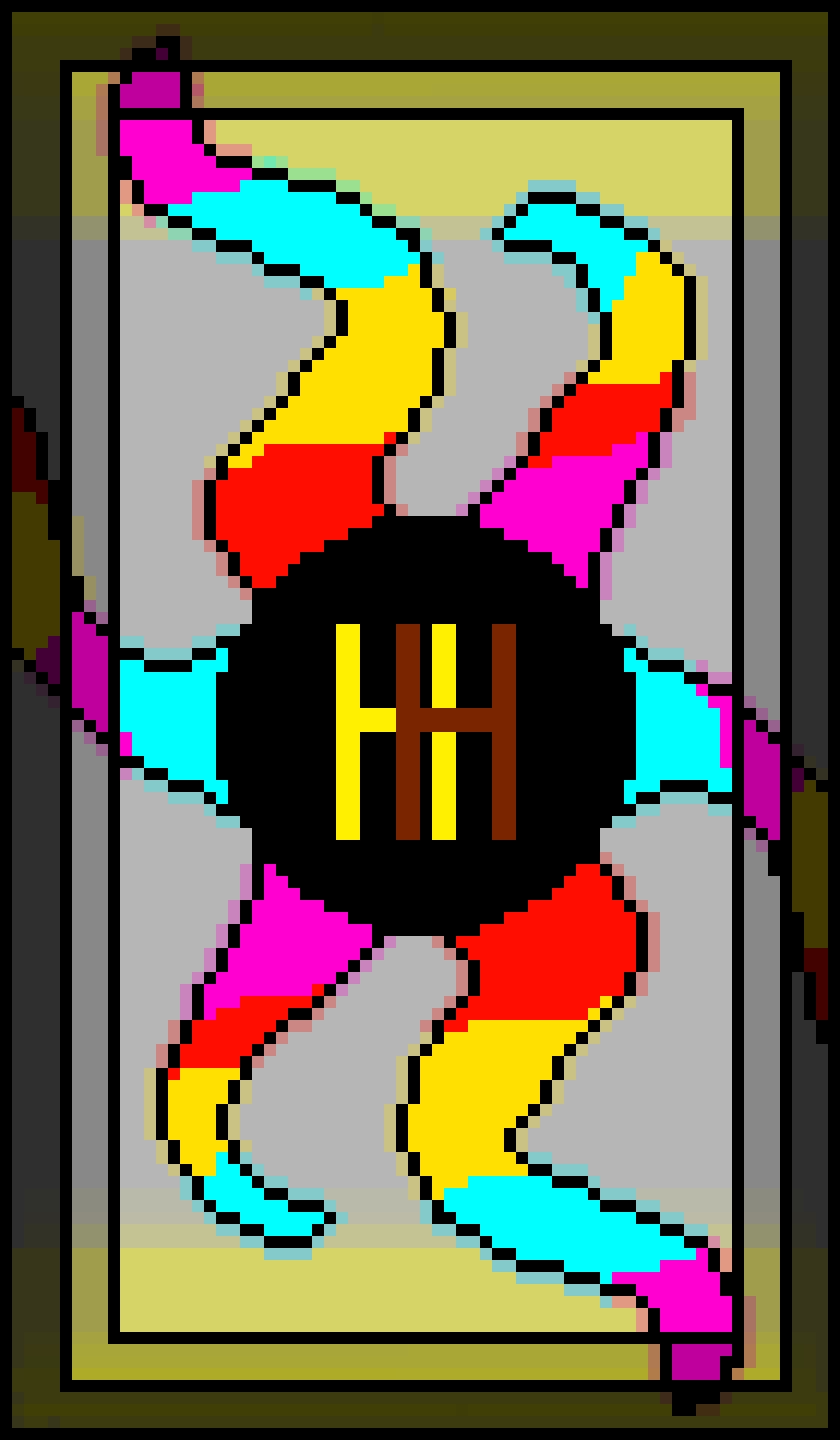
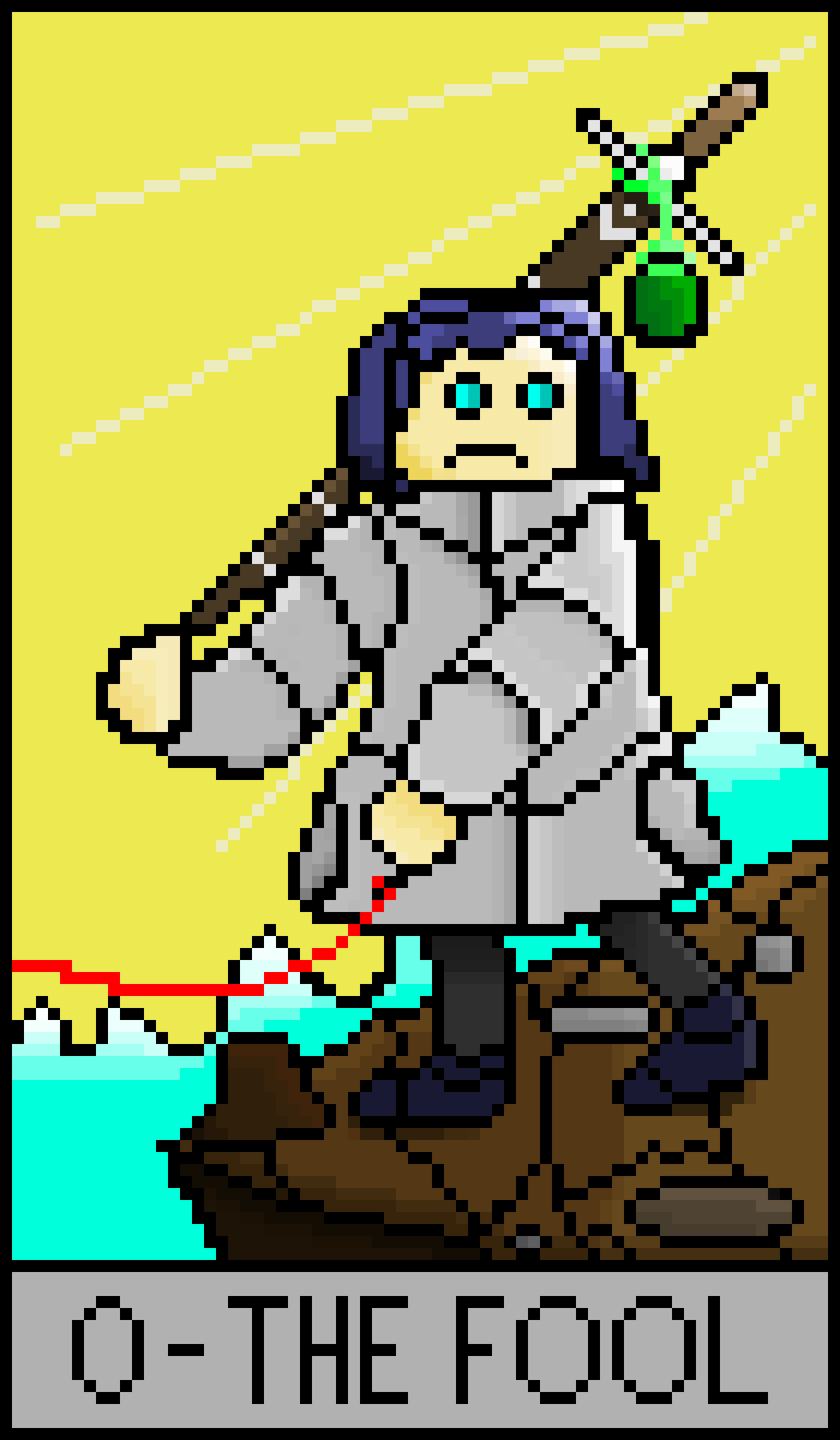
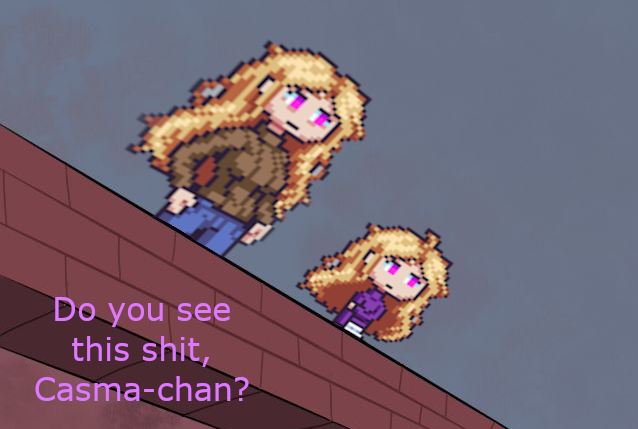
Anyway! I have – you guessed it – more art from the discord server, once again! First up we have the second installment of the Katalepsis-themed tarot cards, (by XII), this one titled The Magician, full of pixel-art gore. Second we have this very amusing little piece of Heather reacting to one of her favourite things the whole world, (by Clericalism); please be aware that one is technically NSFW! Though you can’t really see details. And then lastly we have this incredible illustration of one of the final moments of arc 24 back in Book One, simply titled ‘Bedlam Boundary‘; this one is incredible to me, it’s amazing to see that moment brought to life. And thank you all! I know I say this every time I share art, but it’s still flattering and incredible to me, to see my storytelling inspiring others. Thank you so much!

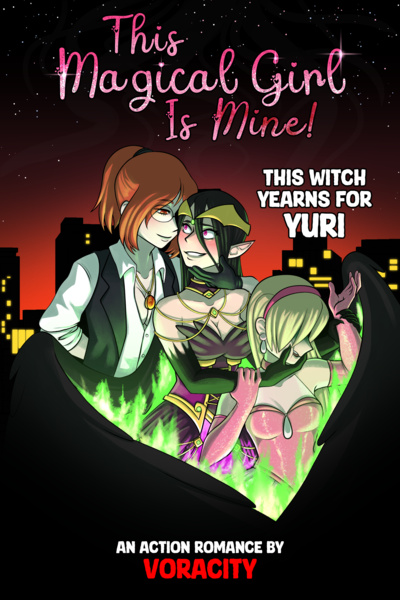
I also have (*drum roll*) another shout out! I’ve been doing quite a few of these lately. This one is a little different, however. This is a new story by Vora, the author of Feast or Famine, which long-time readers might recall me shouting out once or twice before. Feast or Famine was explicitly inspired by Katalepsis, and so I was very excited to see what Vora was going to get up to next. And the answer is … magical girls!

Fabulous riches, unfathomable power, and the undivided attention of the girl she’s obsessed with—all she has to do is sign the dotted line.

Rachel has always had an interest in magical girls, but it became an obsession when she learned that her own roommate, Sophia, was secretly one of the most powerful and respected magical girls in all of North America. Sophia’s double life as a heroine has left her without any time for Rachel—and the witches she fights get all the attention from Sophia that Rachel desperately craves.

But now Rachel is a witch, and one that the witches’ mysterious benefactors have taken a special interest in. With their guidance and her own burning drive, she’ll grow her power until she’s ready to challenge the invincible heroine. And then, at long last, her precious Sophia will be hers.


New chapters twice a week, Sunday and Wednesday, with breaks every 3-4 weeks.

Meanwhile, if you want more Katalepsis right away, you can get it by:

Subscribing to the Patreon!

I’m already two chapters ahead! Patrons get access to two whole chapters in advance, and hopefully more in the future! The more support I get through Patreon, the more time I can dedicate to writing, and the less chances of having to slow down the story or get interrupted by other responsibilities. The generous and kind support of Patrons and readers is what makes all this possible in the first place! I wouldn’t be able to do this without all of you! Thank you all so very much!

You can also:

Vote for Katalepsis on TopWebFiction!

This helps a lot! Many readers still find the story through TWF, which still surprises me! Voting only takes a couple of clicks!

And thank you, dear readers! Thank you for being here and reading Katalepsis! None of this would be possible without you, the audience. Who would Maisie have to tease and taunt without all of you on the other side of the screen, after all? But more importantly, thank you! Katalepsis is for you.

Next chapter, the castle looms in the mist, and the only road leads up. But that sounds more like a Heather thing, doesn’t it? Are you getting frustrated, Maisie?

placid island; black infinity – 2-1.7

Content Warnings

References to genital reconstruction (kinda???)
Reference to sexual assault as metaphor
Mention of suicide
Sexually derogatory language


Previous Chapter Next Chapter

Muadhnait wasn’t very pleased that I’d met her goddess in a dream.

(I was, though mostly because I’d won.)

She didn’t hide her distress very well — which was an impressive feat, for a woman hiding every other inch of herself inside a full-body suit of magically sealed armour. She was first to spot the absence of the statue, after myself; our Templar Nun clanked like a miniature car accident as she woke up, drew one of her swords, and sprinted over toward the empty plinth on the little projecting jut of headland. What she thought she was going to achieve with that sword, I had no idea. Perhaps people who carry swords around suffer from the same affliction as those who own only hammers. I wouldn’t know, because I’ve got two hands, and I only need one of those to carry a knife.

Muadhnait’s panic woke the others — Kimberly with a start, Tenny with a wonderfully soothing brrrt-brrt, Casma with a yawn and a stretch. Kimberly started to panic too, which was so cute I could have bitten her cheeks, but neither of those things would help right then, so I went ahead and told everybody an abbreviated version of what had happened; that turned out to be a mistake, because Kimberly’s panic didn’t go away, it just changed tone. We were not under attack — hooray — but we might have been metaphysically interfered with — boo.

Don’t ask me, I wasn’t the one going wide-eyed and starting to hyperventilate. Casma got up and rubbed Kimberly’s back. Which was the right thing to do, but I should have been the one to do it.

Muadhnait clanked around by the plinth for a while until Kimberly waved her back over, so I could repeat myself to our local expert.

Dawn was breaking over the ruined village, quite unlike dawn on Earth; the light was rich and syrupy, cast by a thing that was not a sun. Long streamers of bruised purple rippled behind the thick cloud cover. Bleeding bites of pinkish froth churned and settled in the skies, like chunks gnawed from the skin of a mutant fruit. Low red light glinted off the plates and helm of Muadhnait’s dull grey armour; her visor slit was a slice of night, preserved against the sunrise.

“And then I woke up,” I finished. “Morning was here. Morning is here. Very efficient. Five stars. Ten out of ten.”

Kimberly was pacing back and forth in a tight circle, struggling not to grit her teeth (not good for you, Kim, don’t do that), and gripping at her own arms, (did you need something in them, Kim? I could see you shivering. The whole world could see you shivering.) Tenny kept flexing her wings and staring up at the sky with those big black eyes; Casma sat by her, on one of the big logs, holding her hand to keep her grounded.

“No no no no no no,” Kimberly hissed; her eyes kept going left and right, left and right, left and right, like she was watching a miniature tennis match. “No, this is— this is really, really, really bad. That— that statue, that was your, like, patron saint, or something? Muadhnait? Is that right? We’ve angered a saint, or … a … a … ”

“Deity?” Casma supplied, bright-eyed and full of smiles. “‘God’ is a bit boring and implies objectively divine status, so perhaps we should stick with deity. Diet deity. Dusty deity. Was the statue very dusty? There’s not a lot of wind around here. Oh! Maybe there was wind in the night and that’s why she went over the cliff? Do deities go walkabout? Do dusty dames in darkness get disturbed by drafts?”

Kimberly gave Casma what my sister would have described as a ‘capital-L look’, but either Kim wasn’t very good at it, or Casma was too complicated to be told off. She smiled and smiled and smiled.

Muadhnait’s armoured hands hesitated over half-formed signs: “She — you — lie — dream — certainty — madness/tainted,” (which was the same word.) Then she gave up and spread her arms.

“It was only a dream,” I said. “Dreams are dreams. Why does it have to mean anything?”

Kimberly made a sound in her throat that actually made me feel bad, because she wasn’t the one I was being sarcastic at. She turned on me and actually stared, which was sort of impressive. (Seriously, well done, Kim. You can stare at me any time you need more practice. I won’t tell.) “Maisie,” she said, and I could hear her fraying inside. “Maisie, the statue. It’s gone! How can that just be a dream!? We turn up here and it just walks off? I would still be worried about this even if you hadn’t had the dream at all!”

I looked into Kimberly’s eyes. “It’ll be okay, Kim. It was just a dream.”

Kim couldn’t hold my gaze.

Muadhnait finally located her words. Her fingers clicked through a rapid set of signs: “Our Lady of the Forded Briar spoke to you? You’re certain she spoke to you?”

“It was only a dream.”

Muadhnait shook her head, dome-shaped helmet rotating back and forth. “She spoke to you? You are certain?”

“There were words.”

I hadn’t told the whole truth; sometimes things that happen in the night stay in the night.

I’ve told you the whole truth, of course, because you weren’t there. Your opinion of the metaphysical specifics of whatever had transpired between me and the Briar-bitch is of absolutely no import to what happened next. You get the whole thing, gristle and guts and grunting and all. You get the spear in my belly, and the way it felt to be opened and all pink and wet and meaty inside; you get the way she laughed at me when I cut off her tip, and the fact it was lodged deep in my imagined flesh when the dream crashed to a close.

Muadhnait and Kimberly and Tenny got an edited version. I gave them the gist, because holding back important information gleaned in dreams is really more Heather’s speed, and that habit never served her well. Never say that I learned nothing from my beloved sister; I did, just not the things some prying eyes hoped I had. So, I told them about Our Supposed Lady and the things she’d said, but not about her (not-)spear, or the way she’d used it, or how I had answered with my knife.

Girls shoving things inside each other is a private matter, after all.

Casma knew. I avoided her eyes all morning, but I could see it in the way she crinkled at me. She knew I had more than I’d said out loud, and she had a laugh in her look, as if she’d heard it on the gossip grapevine.

I didn’t mention the giggling darkness at all; what had passed between me and the night itself was still between me and the night.

(You’re welcome.)

Casma was saying, “What if it was Maisie’s naughty Mimic? M-N-M. Can we call her that? What if it was something playing fancy dress, not the real deity at all? What if she did a sneaky in the night and blew dreams into Maisie’s ear? It might not have been a diet deity in the dark.”

Muadhnait shook her head. She signed, “The fairies would not dare impersonate her.”

“Hmmmmmmm.” Casma smiled a very complicated smile.

Kimberly rallied suddenly, pointing at the absence on the little headland. “Could the ‘fairies’ have broken the statue? Thrown it over the cliff in the night? They must have done! That’s the only explanation, it’s the only—”

Muadhnait signed, “No fairy or freak or night-walker would dare offend Our Lady. None would touch her.” Muadhnait paused. “None but Outsiders.”

Kimberly turned a most gooey shade of grey. “We— we— we didn’t do this! We were all asleep, all night! How could any of us have moved a whole statue like that? Muadhnait, we did not do this. A-and we wouldn’t disrespect your gods or saints or anything like that. Come on, Cas, Tenny, we wouldn’t, would we? Maisie? Please back me up here.”

Muadhnait hesitated a moment (don’t think I didn’t see that sneaky little look toward Tenny, you paranoid nun), then signed: “I intended no accusation.”

“Yes you did,” I said.

I stood up and unwrapped my kitchen knife; Kimberly had asked me for back up, but that was a problem, because the one thing I wasn’t feeling any more was backed up.

Muadhnait’s hands hesitated aside, as if about to go for one of her swords. Her crossbow still lay in several pieces, on the other side of the ashes of the fire.

Cerise sunrise glinted off the blade of my knife. I turned it one way, then the other, so Muadhnait could see.

“I’m the one who had the dream,” I said. “Dream me a chip in this blade and I’ll dream you up a pair of severed stone ankles. This wouldn’t cut through stone anyway. Unless you’re a stone-cold moron. Are you?”

Kimberly grimaced like she’d been punched in the gut, but she didn’t hiss my name (a small disappointment). Casma went, “Ooooh!” Tenny giggled, which was a sound that could have soothed a gut wound.

Muadhnait accepted that. She signed an apology and spread her hands. I put my knife away.

Kimberly said, “But, wait, what does this mean? Has Maisie been … warned off? Blessed? Cursed? What?”

Muadhnait signed, “I do not know. Our Lady of the Forded Briar does not deign to address those who dream.”

“I’m fine,” I said.

That was a lie, because I was so much more than fine.

If it hadn’t been for the others I would have stretched myself out like a cat and rubbed myself on the ground.

I’d gone to sleep that previous night feeling like shit — and not because I was sleeping out in the open, wrapped in a thin blanket, far away from home. I felt terrible because Casma had wormed her way into my head and forced me to play a role I didn’t want. Her little ‘heart-to-heart’ had peeled vile, wriggling things off the inside of my carbon fibre chassis, and then held them over the fire until they had squealed; she knew about my jealousy now (envy, yes, fine!), and that made every sidelong look from her mean more than I could bear. She had cracked me open and eaten bits of me in the only way my body could not endure. I had been shelled and violated and fallen asleep in a terrible mood.

But when I’d woken, none of that had mattered.

The short and bloody exchange of fluids with Our Lady of the Forded Briar had filled me with deep and lasting satisfaction, just like her spear had filled my guts. It was a bit like waking up tangled in Heather, a bit like the feelings I got when I was forced into close proximity with Raine (though lacking the self-disgust), and a bit like the aftermath of staring at anime girls on the internet.

So I didn’t give a shit about Casma trying to work her fingers into my head. I wanted a rematch with the Briar-bitch.

And next time she better use more than just the tip, or I’d hilt my knife in that stone flesh.

We ‘investigated’ the missing statue some more, because of course we did. That’s what sensible people do when something clearly supernatural has taken place — stick their noses into the aftermath to see if anything additional gets burned off. Kimberly and Tenny and Casma might have been on the periphery of my sister’s antics, but they had picked up the same habits, and I was too blissed-out to put up a proper argument. But there was nothing to investigate, no clues to uncover. There were no footprints burned into the grass where I had dreamed the Briar-bitch walking like a shard of broken star. There was no patch of bloodstains from the guts I didn’t have. I sniffed the air, hoping for a hint of that burned-metal perfume, but there was only the scent of our fire and the dry grass.

Muadhnait started by doing a circuit of the village and checking the ruined cottages, poking her crossbow into the corners, in case the statue had crept indoors for the night. Then she and Kimberly puzzled over the plinth for a while — the feet of the statue had left behind no impression, no damage where they had detached from the stone. Muadhnait eyed Tenny briefly, then signed a question about Tenny’s capacity for flight; Kimberly said no, Tenny would not fly, not to check the edge of the cliff for any sign of the missing statue. Tenny was not given an opportunity to answer for herself. Casma held her hand. Her wings shivered with a need we all knew would be far too dangerous to slake.

(I’m sorry, Tenns. You deserved better. We all should have known better.)

In the end Muadhnait had to check over the precipice of the headland by herself. She went down on her belly, crawling in her armour, to peer over the side of the cliff. A devoted believer, without an ounce of dignity to lose; but her goddess wasn’t down there, smashed to bits or otherwise.

While the others were occupied poking at stone and peering at the obsidian ocean, I checked myself for damage, when nobody was looking. My abdomen was untouched — both the fake flesh over the top and the hard layer of carbon fibre beneath. No spear-hole. Just a dream.

I checked between my legs, too.

Are you surprised?

No, not at that; you’ve been with me for long enough now that you can’t possibly mistake me for an innocent. I may not have felt like an adult, but I felt plenty of adult between my legs; the Good Doctor Martense had made sure I had room for that equipment, if I wanted it. And I could think of one very obvious adult organ that a spear may have stood in for.

But there was no damage down there, no matter how I groped my own cunt. I wasn’t even a little sore.

“Maisie?”

“Mm?” I took my hand out of my skirt before I turned around and answered Kimberly. “Yes?”

“You … you tutted? I thought you might have found something. No?”

“Nothing. Just frustrated.”

After about twenty minutes of buggering around looking for the missing statue, Muadhnait gave up. Everybody drifted back to the remains of the fire.

Nobody had slept well, except me. Possibly Muadhnait had, but who could tell through all that armour? She sure wasn’t showing us her eye bags. Muadhnait rekindled a corner of the fire and set about making some breakfast — more handfuls of dry grain from her pack, added to water and brought almost to a boil in her little collapsible pot. Those who needed calories and hydration did the thing with calories and hydration. Casma and I refrained, though Casma accepted a long drink of water. Muadhnait stared at me for a while.

“Everyone’s gonna be so worried by now,” Kimberly said after she swallowed her last mouthful of food. “We’ve been gone for … what, a whole day? Twelve hours? More?”

“More than twelve,” said Casma. “But less than twenty four. The sweet spot for spotting sweets.”

Tenny trilled, “Cass, what does that even mean?”

“I don’t know!” Casma smirked.

Tenny went brrrr-rrrr, which was sort of like a giggle. Casma was doing something right. I forgave her for the nonsense.

Kimberly nodded along to something inside her own head. “Twelve hours, more than twelve hours. I should … I should be at work. Oh goddess, I’m gonna lose my job over this. I’m gonna lose my job. And I like my job. I actually like it! It’s the first thing I’ve ever done that isn’t completely terrible, and now I’m gonna lose it. I’m … I’m gonna … I … ”

Tenny said, “Kimmy-Kims. Auntie Evee won’t throw you out.”

Kimberly looked up at Tenny. They made eye contact in a way I never really could. Kimberly managed to smile. “O-of course not. Of course, Tenny. I-I’m sorry. I’m just so … ” Kimberly let out a huge sigh and raked her hands through her hair. “I can’t believe this is happening to us. I just can’t. I need a smoke so bad right now.”

Tenny let out a soft brrrrt. “Lozz-mums will be worried too. Mmmmm.”

Casma squeezed Tenny’s hand. “She knows I’m here with you, Tenns! Getting by with a little help from your friends,” she sang. “Right?”

“Rrrrrright,” Tenny trilled. “Rightyyyyyy.”

“Heather will find us,” I said. “We just have to deal with the Mimic.”

And I didn’t doubt that for a second.

A paradox, isn’t it? I wasn’t afraid, because I knew that Heather would come for me, even though I knew more than I was saying. Kimberly seemed to have forgotten it, while Casma had not mentioned it, and I assumed Tenny had been sworn to silence by Casma. The Mimic’s words from the previous day were a glaring streak of shit in this fantasy soup; she had not intended to bring Kimberly here. Something was not as simple about this situation as my faith in my sister suggested.

But that didn’t matter. My sister was (and is) a universal constant — the only universal constant on which I could truly rely. It did not matter what details I had missed. It did not matter that I was lying to myself by willpower and lying to the others by omission.

Water is wet. The sky is up. Heather would come for us.

Unless up was down and black was white.

The human capacity for cognitive dissonance is remarkable, isn’t it? I had mastered it, even without a brain.

As the others ate and talked, I took my mobile phone out of my pocket, so I could spend a few minutes staring at pictures of anime girls. Then I realised I couldn’t do that — I was restricted to whatever I had already saved. Yuno stared back from my phone’s wallpaper; I thumbed through a few others in the gallery. Seventy four percent battery remained.

My usual morning routine was impossible. No wifi Outside. No internet in the fairy realm. A whole crop of new illustrations was waiting for me online — fanart for all my favourites, and the occasional sneaky original — but I couldn’t access any of it. Browsing the new additions was one of the best highlights of each morning; some I would show to Heather, while some I would share with Evelyn (and she always saw them, because she’s too stubborn to turn off pings. Ping-ping-ping, Evee. P-p-p-p-ping! Tell me off for spamming you, go on, you know you want to.) But some were just for me — the kind of illustrations that would make steam shoot from my sister’s ears, or have her complaining about the limits of feasible anatomy. (I might be flat as a board, but I appreciate the opposite more than most.)

Out here there was only sunlight and ruins and the ashes of the fire. No tea, no breakfast, no creaking of an old house beneath my feet.

It didn’t bother me that much.

It didn’t.

Did not.

Like a grain of sand stuck between the plates of my body.

The others had it worse. Kimberly probably wanted a shower, (though you didn’t stink, Kim. Not in the slightest. Promise. Cross my heart and hope to die, you smelled divine.) Tenny seemed restless despite Casma’s best efforts — tentacle-tips plucking at the air and twisting into each other, like a human picking at their cuticles. I had no idea how Casma spent her mornings; perhaps she was missing her mother. She didn’t show it, smiling and wiggling her legs, fiddling with the hem of her skirt, eager to be off.

“Miss Muadhnait,” Kimberly was saying. “In light of, uh … t-this —” she gestured at the empty plinth over on the little headland “— do you need to adjust your plans?”

Muadhnait shook her head, dome-shaped helmet sliding back and forth. She signed, “No. I must rescue my sister. Nothing can change that now.”

Kimberly shot me a glance full of doubt. I shrugged. What did she want me to do?

“T-then we’ll … we’ll keep on accompanying you,” Kimberly said. “Thank you for sharing your food and water. We … uh … we would be in trouble without that.”

Muadhnait signed something about charity.

Kimberly said. “Do you think it’s much further to the castle?”

Muadhnait hesitated, then signed, “With haste and caution we should reach the outer gate before the close of afternoon. I have maps and blueprints of the innards, but they are likely flawed and out of date. I plan to camp at the gate tonight. It will be a more exposed position. There will be more danger. But I cannot brave the stone itself by dark. If you wish to turn back now, you may still reach safety before nightfall.”

Kimberly tried not to sigh. (She shouldn’t have bothered.)

“The Mimic is mine,” I said. “We’re not turning back.”

“Bravo,” Casma murmured.

We broke camp just before sunrise finished rising, when the brilliant colours started to fade away to the heavy grey of day. Muadhnait carried the leftover logs back to the large cottage built into the cliff side — “For the next who might need this refuge.” Kimberly tried to bustle around, getting Tenny and Casma ready to go again, but there was nothing with which to bustle. It wasn’t as if we had luggage or packs or anything to carry, nothing except my knife; I watched Kimberly as she just stopped, hands empty, with nothing to do. Muadhnait returned and made sure the fire was out. Casma waited with her hands linked with Tenny, all smiley smiling smiles. Tenny looked oddly content. I unwrapped and re-wrapped my kitchen knife, and offered my shawl to Kimberly (and got rejected).

Finally Muadhnait strapped her pack onto her back and her pouches to her belt. She kicked apart the ring of salt — “So it does not go rotten inside.”

As we left the ruined village, I kept glancing back at the beautiful corpse — at that hidden cluster of cottages with their tumbledown stones tucked into a curl of cliff side. As the others entered the gulley which led toward the tunnel through the wall, I pulled out my phone and took several photographs. If you look hard enough, you might even find them.

(Sorry, Evelyn. I know, I know, Outside is Outside and has to stay Outside, but I couldn’t resist. You’ve seen it. You know. Do you want to punish me for being a bad girl?)

We entered the gulley and reached the tunnel through the wall. Another long walk in the damp dark chill, and then we were out the other side.

The second leg of our quest for the Mimic’s castle was a little easier on the legs than the first — the landscape still rose toward the great rocky crest which hung above the flat black plane of the obsidian sea, but it rose in gentler waves than yesterday’s ascent, like we had entered the edge of a tilted tableland. Muadhnait led our little troop through undulating hillsides of clean grass, threading us past overgrown copses of shiny, thorned bush, and beneath the occasional stunted emissaries of the giant trees. The landscape fell further away behind us and far to our left, eventually revealing that the giant’s wood where we had started was a single exploratory finger of a vast forest that swallowed the horizon.

We were too far away and too far up to make out real details, but it seemed like only the infinite coastal strip was clear of trees — and several distant bulges deep in the woods, so far off they were drowned in haze, perhaps other areas of soaring high ground.

A fey forest, as far as the eye could see. You could hear it creaking on the wind, like the lungs of a breathing planet.

If you are lucky enough to have never been confined for an extended period, then I cannot make you understand with words what it feels like to stand on the roof of a world and see to the curve of the horizon. I had my sister’s memories of freedom, but they were pale shadows compared to this.

You don’t get it. I don’t expect you to.

Or maybe you do. In which case, I’m sorry.

Casma and Tenny chattered on. Kimberly and I brought up the rear. We broke at mid-morning, then again for lunch, but not for long. Muadhnait was eager to reach the castle’s feet before darkness.

We saw plenty of other weird sights on that second day, none of which turned out to be important, but you’re hungry for more, aren’t you? This is what Heather would do — drown you in all the little things she’d seen, adding to half of them with speculation, to the other half with lack of precision. What did we spot? A distant promontory of rock held a jutting building in whose windows glowed strange green lights casting the shadows of cavorting imps. Another giant centipede scuttled off between the hills as we approached a cleft in the ground, prompting Muadhnait to draw her crossbow and wait until she was certain it wouldn’t return. Once we had to pause behind a curl of rock while something big and heavy stomped by us about fifty feet away, reeking of oil and grease like a lost machine. We spotted a dead tree covered in carvings; Muadhnait told us not to look. We sighted a ring of stones ahead; Muadhnait led us on a wide detour, so we would not come too close. Casma thought she saw something following us — perhaps a dog, hiding amid the rocky outcrops. Muadhnait said that would be welcome; dogs should not be alone. Animals were rare this far out into a dangerous region.

Ahead of us, the Mimic’s castle grew in size as the day wore on, ruining the view and threatening to sour my mood. Black slabs of stone dressed in a gown of white lace, shoulders and waist draped with streamers of thick mist, gormless face frozen in rock. It stood right on the edge of the upper rocky headland as if contemplating a picturesque suicide on the cliffs below; I amused myself for a while by imagining the shattered body of the thing scattered across the surface of the obsidian ocean. Would one of those stones shatter the glassy black, or bounce off like a rubber ball?

My sister would have found it beautiful. She would have waxed poetic and then waned purple, comparing the castle with a woman — a fairy princess awaiting us on a precipice, hiding her face behind a veil of mist.

Perhaps you think it’s beautiful, too. All right. Maybe it was. I don’t care.

I had a better woman on my mind.

Our Lady of the Forded Briar was everywhere.

At first I caught glimpses peripheral — her stony face peering from around the trunk of a tree, the hem of her flowing dress fluttering off behind a tangle of thorns, a saucy hint of spear-shaft poking out from over the next rise, or maybe a phantom whiff of burning metal lingering in the air.

None of the others noticed. Muadhnait didn’t stop and draw her crossbow. Casma didn’t make interested noises.

I kept those sightings for myself, just as I had kept the details of the dream.

My silence roused her ardour.

The glow of the sun behind the clouds became her burning nuclear gaze. The tickle of the grass on my bare feet was her fingertips climbing my calves to places they shouldn’t. The wind was a whisper that I couldn’t decode, brushing against my ears, daring me to murmur back. The hills we crested were the swell of her buttocks and breasts, solid enough to bite into. The tongue of giant’s forest on the distant valley floor was the thatch of her pubic hair between her legs — which raised the question, where was her cunt? Would I find it there beneath me, if I unwrapped my knife and stuck it into the dirt?

When we took a break to eat lunch, I tried doing that. Nothing happened.

“Ummmm,” Kimberly said. (Is that a sound one ‘says’; whatever, she said it.) “Maisie? Are you trying to … to dig a hole?”

“Blunting your knife,” Casma said. “A blunted knife is a blunted life. Ohhh, I’ll have to remember that one.”

“Just testing something,” I said. I pulled the knife out of the ground — just the tip — and wiped the dirt off before wrapping it back up again.

“Testing … w-what?” Kimberly pressed. “Maisie, please, if there’s something else, then we need to know. We really need to know. We’ve been here almost a whole day now, or … more than a whole day. If there’s something weird going on … ”

She trailed off when I looked at her. I didn’t feel like explaining that I was trying to follow up on a one-night stand.

Should I have told Kimberly the whole truth? Would it have made any difference? How could I have explained it? Unlike my sister, I wasn’t afraid of being seen as insane. What I was seeing was no hallucination, even though the wisps of Our Lady were never there when we reached her, and the landscape had not responded to two inches of steel up inside it. I was not seeing things, or going mad, or losing my mind; I was reading the truth which unfolded itself in the sum of all the parts of this world — and those parts added up to a bloody great spear-maiden with nuclear fire behind her eyes.

Those who cannot recognise patterns cannot be taught to do so. If you want to get where I am standing, you have to make the journey yourself.

Or maybe you think I’m insane. Tell yourself whatever you want. I don’t care.

I didn’t seek out Kimberly’s hand on that second leg of the journey, though we did hold together for a while. She took the initiative, which wasn’t particularly cute, because it told me she was only doing it because she thought I wanted that.

I did want it, but that’s not the point.

Do you think I’m a slut?

No, really. You can answer. I won’t be angry. Tell me the truth — do you think I’m a slut?

If you don’t, perhaps you should.

The previous day I wanted Kimberly more than anything; this day I was distracted by the aftermath of a dream sticking her rod all up in my guts, and Kimberly was just somebody near and cute and worth hanging onto. Yesterday morning I’d been all about the Mimic, and I was going to be all about her again later, whatever happened. She was cute in a different way. But Briar-Bitch was not cute — no, not at all, regardless of the stony skin and the height she had on me, she simply wasn’t my type. She just wasn’t cute.

But I wanted another round, regardless.

I’d love to tell you the rest of that journey was uneventful, but that would be two lies. I might be a slut, but I’m not much of a liar.

Less than an hour after lunch, Muadhnait paused on the edge of a large flat plain — like a mountain meadow stretched out between the hillsides. Almost none of the tangled thorny bushes grew here, just patches of long grass in low waves. A big rocky outcrop dominated the middle of the field like a little fortress, but the rest of the ground was level and soft and empty. On Earth somewhere like this should have been filled with sheep or goats. The Mimic’s castle was close now — perhaps an hour or two away, the headland looming above us.

Muadhnait stopped and looked back the way we’d just come — a tangle of deep ravines and rolling hills. She unhooked her crossbow, but she didn’t signal for silence.

Kimberly reacted like a spooked cat. “What? What? Uh, Tenns, Cassy, come— come here, come here, now! By me, please. Now!”

“Brrrrrt, what’s it? What’s seen?” Tenny went up on tiptoes to look in the same direction as Muadhnait, but Casma pulled her by the hand, over to the dubious shelter of Kimberly’s backside.

I unwrapped my kitchen knife.

Muadhnait stood like that for over a minute — I counted — then rested her crossbow on her waist and signed to us.

“We are being hunted.”

Kimberly’s face did one of the most delicious things I’d ever seen, which made me regret I hadn’t been holding her hand more often. Who needed some ephemeral tart made of hills and trees when you could have that face beneath you in bed? I felt like a fool.

“W-what?” Kimberly hissed. She groped for Tenny and Casma, trying to hold their hands. “What— what— what do you mean, hunted?! By what? How do you know that?”

“Oh,” said Casma. “I thought so too. I wasn’t imagining it, then. Yay.”

Poor Kim didn’t know where to look. “What!?”

Casma’s pleasure was not catching — Tenny looked worried too. Her tentacles were all out, waggling in the air. Her wings kept twitching.

Muadhnait signed: “Something has been following us since just before lunch. I cannot tell what it is, but it is not a dog. It hangs back like an animal hunting for prey, but it has followed us through convolutions no predator would attempt, and it has declined every chance to approach that a poor hound would accept. I believe it is a minion, sent by the fairy.”

Kimberly swallowed. “O-okay. So … you’ve got a crossbow, and those swords. You can … you can stop it, right?”

Muadhnait hesitated. That was the wrong answer for Kimberly; it made her face get worse. Muadhnait signed, “It has kept out of sight so far. But when we cross this open space it will be forced to reveal itself, lest it fall too far behind and lose our trail. We will see it soon. Please be ready.”

“Ready for what?” Kimberly hissed. “F-for what!?”

“Knifing,” said Casma.

“Don’t,” I said.

Casma pouted the most complex pout it was possible to pout. I resisted the urge to bite the inside of my mouth; blood wouldn’t help. Only yesterday Casma would have looked at me with a hurt in her face which would require a team of critics to unravel, but apparently she considered us friends now. You probably consider us friends too, don’t you?

Casma and I. Not you and I. We’re not friends.

(Not unless you try again.)

“If the foe is beyond me,” Muadhnait signed, “you must run.”

Kimberly went very pale. Tenny held her hand, two tentacles wrapped around Kim’s wrist. Casma just smiled. Kimberly shot me a look which could have been read by an illiterate chimpanzee, but I looked elsewhere, because there were no circumstances under which I was going to run.

Muadhnait switched her position in our formation — she took what was now the rear, walking backward with slow steps, armoured boots sinking into the soft grass, crossbow cradled in her arms. Kimberly and Tenny and Casma scurried behind her, heading toward the big rock formation in the middle of the meadow. I kept my knife out. I kept me to one side. I kept my options open. I wondered if this was not an enemy at all, but the Briar-bitch back for a rematch.

We all watched the part of the landscape from which we had emerged, waiting for something horrible to creep around the crest of the hills. We almost reached the big rock, but then, there it was.

When it came, it was almost too far away to make out the details — which was a good thing, because that meant it was relatively small, no larger than a human being. A smudge of ivory white nosed out around a ravine-mouth parallel to our path, scuttling on a bunch of legs, body low to the ground.

I tutted. Not the Briar Lady, then. She was playing hard to get, just like I was.

“What is that?” Kimberly hissed. “W-what is that— no, wait, don’t— don’t take your hands off the crossbow to answer.”

Muadhnait wasn’t silly enough to do that in the first place. She shouldered her crossbow. She waited. Tenny was emitting a low humming trill — a noise I’d never heard her make before, like a dog’s growl, slowly rising in pitch.

The white thing looked up. Perhaps it saw us seeing it. Perhaps it made a decision.

“Oh!” Casma said. “Strings!”

Then it scuttled toward us.

It moved like a spider, shooting over the grass faster. In two seconds it looked like a spider as well — a pale, naked, humanoid body standing lengthwise on six whirring limbs. A long neck extended from the front, topped by a blank white ovoid for a head.

Kimberly screamed. Tenny made a sound that was maybe a scream. Casma said, “Oh dear.”

Muadhnait loosed a bolt with a great big THWANG.

(Yes, I insist, because that’s the sound, and it’s very loud.)

The first bolt went high, whizzing over the spider’s body, swishing into the grass. Muadhnait yanked the lever on the crossbow; the mechanism spanned the bow and slid a second bolt into place. THWANG the second — and the spider jinked aside, faster than the bolt. Muadhnait jerked out another reload, gauntlets slipping on the levers.

THWANG!

The third bolt hit the spider-thing’s body, right in the middle of the torso, at a low angle. Muadhnait had pulled off a small miracle — and no, I don’t hold enough resentment to pretend she wasn’t an incredible shot with that bow. She was. Sticking the spider-thing in the neck or head would have been difficult, but a body shot at that angle and speed was almost impossible. Well done, nun.

An arm-span worth of steel went straight through the torso, lodged deep in the thing’s body.

Nothing happened. It didn’t even bleed.

Muadhnait dropped the crossbow and drew one of her swords. Kimberly was pulling Casma and Tenny by the hands, shouting something very noble and proper, taking the first steps in a doomed escape. (She had seen how fast that thing moved, hadn’t she? What use was running?) Tenny was making a sound like a small engine, her wings flickering and twitching, trying to rise from her back.

Why did I just stand there? Why wasn’t I rushing to assist Muadhnait in the moments before the spider reached her?

Because I’d already seen what it really was, just like Casma had, and I didn’t want to use my knife on it.

Call me sentimental and I’ll use it elsewhere, though.

The pale spider reached Muadhnait and reared up on two legs, trying to crash down on her or grab her with the big wide hands it had instead of feet; perhaps it intended to shuck her, like a big grey shellfish.

When the Mimic had tried to ambush us from the air yesterday, we’d all seen Muadhnait wave her sword around. Nothing more than a little toothpick action. I don’t know anything about sword fighting. You’d have to ask Raine about the mechanics, (and she would be wrong most of the time because Raine gets her education from Youtube videos, unless you ask her about knife fighting, and knives are not just little swords.)

But I didn’t need expert knowledge to be impressed.

The pale spider was very fast, hands lashing out at Muadhnait in a barrage of fists and hooks and grasping fingers. Muadhnait did things with her sword that I didn’t quite understand — I could follow them, I could see the way the blade moved, and I could have comprehended it all if I’d been willing to spend more of the girl I had once been (because sword fighting is a pattern like any other.) But even if I had done that, I doubted I would have understood in the way she did, with muscle and tendon and instinct. Her sword was always in the way, always ready to block another blow, sometimes turning at angles that seemed impossible, but were not, because she was just a nun, and not a mage.

Her sword met each blow with a loud, heavy thock-thock-thock of metal against wood.

A few seconds of fancy sword-work later, the spider gave up trying to peel Muadhnait out of her shell.

Three fists swung out, then arced back in, a trio of hammers aimed at her side.

She couldn’t block that.

Muadhnait went flying, head over heels, crashing to the ground with a clatter of armour, real sack of potatoes style. She didn’t lose her sword and she didn’t stop to dramatically cough blood through her visor, which was impressive if you understand anything about this sort of thing. She lurched halfway back to her feet; she would have gotten the sword up in time too, to take the follow-up blow before the spider-thing could beat her to death.

But the pale spider didn’t stop to pounce. (If it had, I would have leapt on its back; I didn’t like Muadhnait, but I wasn’t going to leave the woman to die.)

(No. Really. I wasn’t. Believe what you want, but I’m not that cold. I’m not cold at all.)

Instead, the pale spider shot right past Muadhnait — and then right past me.

It went straight for Kimberly.

That was when I became certain. This thing had been sent by my favourite little slut.

My mercy only went so far.

Previous Chapter Next Chapter


Sooner or later Maisie is going to need to figure out why everything here wants to kill Kimberly. (Spoilers: this, too, is yuri).

I don’t think anything I can say down here can do justice to what Maisie herself has already said; there you have it! A run-in with a goddess, another day of hiking, and now … well, this. Maisie better move fast or the narrative is going to get away from her.

Speaking of moving fast, behind the scenes the story is coming along very well! I think I’m going to set an extremely tentative length of this arc at last – at maaaybe 18 chapters. We’ll see. As always, I am only in control of all this in the loosest possible sense. Maisie is in charge. I am at her disposal.

And! I have a few more pieces of fanart from over on the discord! First up we have a throwback to arc 24 in Book One: a design for the Knight’s insignia in Cygnet, (by Lor.) Next we have the back and first card (Jan!) of a set of Katalepsis-themed tarot cards, (by XII.) And finally, a meme, a rare meme that I could not resist sharing here – because it’s very relevant to the current arc. Are you seeing this? (Made by XII, using sprite art by skaiandestiny.)

Thank you all so much for the amazing fanart! It’s incredible to see!

Also! I have another shoutout this week. I’ve been doing these quite a bit lately, sooo … here’s another one! Go check it out!

Atzi is the last person who should be stuck in a timeloop.

But a timeloop means pretty women to seduce! Wealth to spend! Magic power to steal! This lizard may be easily distracted, talentless, and lonely, but she’s still a looper.

A shame she must contend with selfish gods warring, mad mages casting apocalyptic spells, skeletons, demons, and a hole in the sky. The world destroyed, again and again, when all she wants to know… is why her crush killed her.

– – – – 

New chapters currently twice a week, Wednesday and Saturday


Meanwhile, if you want more Katalepsis right away, you can get it by:

Subscribing to the Patreon!

I’m already two chapters ahead! Patrons get access to two whole chapters in advance, and hopefully more in the future! The more support I get through Patreon, the more time I can dedicate to writing, and the less chances of having to slow down the story or get interrupted by other responsibilities. The generous and kind support of Patrons and readers is what makes all this possible in the first place! I wouldn’t be able to do this without all of you! Thank you all so very much!

You can also:

Vote for Katalepsis on TopWebFiction!

This helps a lot! Many readers still find the story through TWF, which still surprises me! Voting only takes a couple of clicks!

Thank you all so much, dear readers! Thank you for reading Katalepsis, and thank you for enjoying it! None of this would be possible without all of you, the audience, or Maisie would be talking to nobody but herself.

Next chapter, get a move on, knife girl! You need to rescue your crush (again.)

placid island; black infinity – 2-1.6

Content Warnings

Mention of suicidal ideation
Gore
Stomach wounds
Sexually derogatory language


Previous Chapter Next Chapter

Did you think I was exaggerating when I said that I would delay as long as possible? Did you think it was a figure of speech? Did you think I was bluffing?

Does anything you have learned about me so far imply that I like to bluff?

You’re lucky I’m saying anything at all.

‘As long as possible’ means as long as possible.

Come back next time.

Did you not hear me?

Fine. Fine!

It’s fine. You’re not going to give me a choice, are you?

If you’re still here, then I’m still here too — or there, rather, sitting by that fire, with Casma staring at the side of my face, waiting for an answer I sorely did not want to give.

You could stop listening. That would work. Let me off the hook. Go elsewhere. Go reread my sister’s story instead.

But then what would be the point of me telling this tale?

Fine.

Our little fire was not flame enough to rekindle the underside of the clouds, no matter how well built and banked; Muadhnait knew how to stack the wood and stir the ash, but she was just an armoured nun — she couldn’t re-light the sun. I searched in vain for the open veins of the world all the same, squinting to catch a snatch of cloud. All I needed was a single sliver of iron grey to catalyse the process; the result would mean nothing, but the effect would be more than enough for my current purposes. A vision might last subjective hours, if I didn’t resist the echoes inside my empty skull. A moment or two might pass for my body, while my mind roamed the pattern of water vapour and wind. But the darkness had closed off the heavens as surely as the earth in every other direction; not even a passing wisp dared the fire.

When in doubt, look up. I doubted, yet up showed only darkness.

“Maisie?”

I ignored Casma’s whisper—

“I know you’re ignoring me.”

—perhaps I could pretend I was having a vision anyway—

“And I know you’re not having a vision.”

—but I would have to unfocus my eyes to really sell it—

“You don’t have that faraway look in your eyes. You’re still close.”

—and I’d have to sit like that with my neck craned all the way back—

“You’re going to hurt your neck. And not by necking.”

—until Casma got bored and went back to bed—

“But if you really are having a vision, then I’ll sit with you until it’s over.”

The fire was more interesting than the darkness, though meaningless compared with clouds (certain parties might disagree, but she’s not here to bleat at me.) Flames danced. Orange tongues licked the air. Fresh logs blackened and burned, turning from ebony to charcoal. Smoke rose in an unbroken pale pillar; it smelled rich and sticky, like congealed sap and old leaves. How was that possible when the wood had been so dry? (I wanted to ask the trees, but the nearest one was back in the gulley on the other side of the tunnel through the wall.) The crackle and hiss of the fire was hardly a substitute for the creak and rustle of the giant’s forest, but it was better than nothing.

“I’ll wait. Wai-a-a-aiting, wai-ayy-ting.”

Muadhnait hadn’t moved a muscle since she’d laid down on one of the big logs. Or maybe she had; perhaps the Templar Nun spent all night twitching and shivering inside her armour. What would have happened if I’d knocked on her helmet? Would she have jerked awake? Slapped my hand aside? Or would my knuckles have sounded out an echo from an empty metal shell?

Kimberly’s chest rose and fell with slow, steady, sleep-bound breaths. I wondered what her heartbeat would sound like. Could I press an ear to the back of her ribcage and hear her flutter inside?

Tenny was sleeping soundly, wrapped up in the blanket she’d been sharing with Casma. Tiny trilling sounds tickled the edge of my hearing, if I concentrated.

And Casma—

“You’ve run out of things to look at,” Casma whispered. Then she smiled a surprisingly uncomplicated smile, and covered her mouth with the end of one sleeve. “Will you answer my question now? You can’t go on pretending not to have heard. I mean, not for ever and ever. It’s not viable, not unless you’re going to pretend you’ve been struck deaf. And even if you had been deafened, I could still read your—”

“Question?”

Casma repeated the question. (Which I didn’t need, but you might, so here you go. Don’t say I never do anything for you.)

“Why do you hate me?”

“I don’t.”

Casma did something absurdly complicated with her face, as if to make up for her simple smile a moment before. (Does she do this on purpose? Take a guess.) Her expression said that she knew I was lying, but that it was not polite to point that out — but additionally, by way of paradox, that she was making the expression in order to point out my lie without taking responsibility for calling me a liar. And that she was doing it on purpose, because she wanted to.

(Do not let Casma fool you. She is not her mother in miniature. She is far smarter than that.)

“Sorry,” Casma whispered.

“I don’t hate you.”

“It sounded like you did. Sounds like you do? Do you like the sound of that?”

“I don’t.”

Casma said nothing. Besieged me with silence.

“Because … ” I whispered. Then I closed my eyes, so I could tread without falling to either side of this treacherous path. “Because you’ve done nothing wrong. Because you’re a child and you don’t deserve an adult’s hate. Because I have no reason to hate you.”

Casma shifted her skirt against the log on which we sat. I pulled my shawl tighter around my shoulders. My knife was in my lap, wrapped in the tea towel. The fire flickered on the other side of my eyelids. Snappetty, crackle-crack, popopopopop pop pop—

“That’s the opposite of an answer,” Casma eventually whispered. “Which is really clever. I’m really impressed. Really really! You answered the opposite question, instead of the one I asked. I know opposites are good ways to understand things, but in this case the opposite is the opposite of the truth. Mm. I think that makes good sense. What do you think, Maisie?”

I opened my eyes and looked down at Casma’s knee, beneath the pink fabric of her skirt. But the skirt was the same colour as her eyes, so I looked at her elbow instead.

Casma wanted the same thing that you want, (don’t bother trying to deny it, it’s too late for that, no wriggling out now) — for her and I to have a heart-to-heart in this lull between perils, to whisper and giggle about our feelings, to while away this strange Outsider night together, and then greet the dawn perhaps not as friends, but at least a few paces on the road to that destination. Just like we were meant to. Like we’d been set up to do. Like everybody and everything in the universe was peering over our shoulders and salivating for us to start. The actual answer to the question of why I hated her was irrelevant (and I did not hate her. I did not. I did not.) It was a catalyst to fill dead time with meaning. Stories have plenty of dead time beyond the margin of the page, but most of them leave it out of the telling; it’s rarely fun to recount every time your glorious heroine took a bath or brushed her teeth or cleaned her dirty feet (and my feet were filthy after all that walking.) Even King Arthur must have taken a few roadside shits on the path to the grail.

And I am not going to let you watch me shit.

My sister would have given in. No, worse — she would have been the one in Casma’s place, giving everybody what they want, without even knowing it, before they know themselves enough to ask. You should know that well enough, she did it for you plenty of times. (The heart-to-hearts, not the shitting.)

How many times must I repeat myself?

I am not my sister.

I am not her.

I am not—

“This isn’t a sleepover whispering session between soft-hearted opposite ends of the heart-liver-spleen spectrum. We’re not schoolgirls girling it out over hot chocolate and pillows, pillowed in pillowy bedrooms and kicking our legs about. We’re not trapped in a web of social relationships that we have to navigate through with nothing but friendship and flowers and fresh feeling flesh fiend— tsss!”

I had to clench my teeth and shake my head and hiss. (And no, my hissing does not sound anything like that of my sister. Put your teeth together and expel air; that’s what I sound like.) I was worried it might wake the others, but I felt like my tongue would explode if I kept going.

“Okay,” Casma whispered. “How would you prefer to spend this downtime?”

I stood up.

I balled up the blanket and placed it on the log.

I settled my shawl over my shoulders so that it would not slip off, looping one end around my neck like a scarf.

I unwrapped my kitchen knife and tucked the tea towel into the waistband of my skirt; I considered handing it to Casma (because I didn’t hate her), but I figured I better hang onto it, because I might not be coming back this way.

I took a step away from the fire.

“Oh!” Casma whispered. “Is it already time for all that?”

Beyond the fire and the big dark logs lay a murky margin of shadow and shade, stretching itself out across the grass. Heat and light dropped away behind me; it was colder beyond the fire than I had expected, though I didn’t shake or shiver, because I didn’t need to. The crackle and hiss of the fire vanished as well, and I didn’t like that part. The grass was still soft beneath my feet, but each step robbed it of more colour, until I trod on grey, then black, then the edge of the void.

True darkness lay only a few feet beyond the ring of salt, concealing Nothing.

I stepped over the line.

Behind me, Casma hissed, “That might be a bad idea. A small one. Just a tad.”

“Yolo,” I whispered.

“Twice, actually.”

Outside the ring of salt, at the very edge of the fire’s light, I stopped with my toes on the precipice of night. If I took another step, I would fall into an abyss more Total and more Empty than anything my sister has ever crammed into one of her overloaded metaphors. The entire universe was behind me, compressed into the island of light around our little flame. Beyond was Nothing, Total, Empty.

Then I discovered I was wrong.

The darkness did hold a pattern after all — it throbbed and pulsed like the blood vessels inside my eyeballs, a black sea churned by silent, invisible currents, filled with the ghostly dark spots of floaters and after-images. Solidity rose from formless chaos — a carpet of coal-black blades, empty shells like burned-out caves, a brow of obsidian, a crown of onyx.

It was the ruined village, right where I’d left it. A corpse doesn’t get up and move, after all. Stone cottages, grassy square, big cliff, wall on top.

Almost disappointing, isn’t it? My void, no different to Heather’s abyss — you think it’s empty, and then it turns out to be just another landscape.

But I wasn’t disappointed, because I wasn’t alone out there.

(Just like I’m not alone here.)

The ruined village was full of things which had not been there when the sun had set. Rag-draped nymphs with bodies like knives lounged against the walls of the stone cottages. Shaggy men with clubs of bone and skulls for faces squatted in the long grass. Black-shelled insects like dredged-up pelagic crabs perched on the cliff-side, turning stalk-bead eyes toward the little fire. Masses of cobweb drifted through the air, forming faces from hollows and holes. In the cliff-gap where we had entered the village, a line of little girls dressed like ornate dolls stood holding hands, their faces blank ovals in the night. A ring of shrivelled corpses sat between the cottages opposite, bending over a bundle of sticks, as if clinging to the warmth of a dead fire. Dark lumps undulated in the upper windows of the biggest cottage. Leaner shapes scuttled and skittered across the top of the cliff, snapping at each other. A huge face peered over the lip of that high wall, bald and eyeless, with great tufts of dark hair sprouting from the ears.

Only the distant plane of the obsidian sea was untouched — and the old statue which Muadhnait had prayed to.

The air was full of whispers.

“—little one, so pretty—”

“—round and round and round I swim the sea and round and round and round—”

“—a keeper, but only if you like them spiced and hot enough to burn you inside and out—”

“—do you see a way through the thicket, thicketer? Do you want to guide me out? I can make it sweet as honey—”

“—harder! Make it harder—”

“—reeks of iron and blood and cold places—”

“—the one with the wings, pull them off and watch it scream—”

“—the walker has too many tricks—”

I held my naked kitchen knife in one fist. I waited for these sprites to stop talking and take action.

Seconds became a minute. One minute became two. Two was three. And so on.

I do not have that much patience.

“Cowards,” I said.

Don’t you dare call me a fool for calling to the night; it would have been far more foolish to stick my knife into Casma. Isn’t this what you wanted — a fuck or a fight? You would just as happily have watched me fuck Kimberly, but you’ll settle for this, (as if I’m going to give you a choice.) You think I’m stupid for stepping beyond the light and over the salt. And maybe you’re right. But don’t pretend it isn’t what you wanted. Don’t pretend you aren’t licking your lips (because I can hear you doing it.)

(And then I saw.)

A giggle went up from the ruined village.

It was more wind than words, a shadow that rushed across the grass and danced through the gaps between the stones of the cottages. The giggle grew and grew and grew, until I was certain that the others must be scrambling to their feet behind me; any moment I would hear the spanning of a crossbow, Tenny’s alarmed trill, Kimberly screaming — or I would have, if the giggle had not grown to a gale of laughter, a howling voice from a ten thousand throats, bearing down out of the dark.

Here was the secret message hidden in the patterns of the void, the final meaning at the centre of the Total Empty into which I had peered.

A giggling darkness pulled itself together a few paces from my feet.

Black tongues lashed the air, as if poking out from within a tiny hole in the dark. Nighted teeth were born from layers of shadow, coupling with themselves to breed new maws sprouting across reality’s skin. A hundred clawed feet raked the grass, throwing up clods of earth and showers of dying worms. A thousand arms reached out from the centre of nothingness. A million hands groped the night air.

A tugging started in my chest, as if plucking at organs I didn’t have. An odd creaking sound made my limbs vibrate.

I raised my knife.

Meaning had arrived, and I was going to cut it out—

“Maisie,” Casma whispered — right into my ear.

I turned and looked into eyes like sunrise. Casma was right at my shoulder. She had followed me beyond the circle of salt.

“You shouldn’t be out here,” I said.

“Yo-low,” she whispered. “Like you said.”

The others were still fast asleep around the fire. The creaking and splintering noise had subsided — as had the howling giggles. When I turned and looked for my foe (where did you go?) there was nothing there but the night. No sprites or fairies, no trace of bugbears and bogeymen. There was no whirling mass of tongues and teeth, no hundred paws, no thousand arms. The green and the cottages and the cliff and the wall all seemed to be fading back into the black.

“Not you,” I whispered to Casma. “Back to the fire.”

I took her hand (I didn’t want to, and it cost me dearly), turned around, and led her over the circle of salt, between the massive logs, back to the fireside.

Casma sat down. After an annoying moment, I sat down too. We both stared at the fire for a bit. Casma fed it some logs. I wrapped my knife back up and put my blanket over my legs again.

Eventually Casma whispered. “Kimberly did ask you not to—”

“I know.”

“I know why you—”

“I know.”

“It doesn’t mean you’re a fool—”

“I know.”

Silence again. I wished it lasted longer.

Casma whispered, “I won’t ask you again, then. I don’t hate you, Maisie. I don’t have any reason to. Though I suppose people hate for all sorts of reasons, or what they think are reasons, even if reason isn’t a part of—”

“I’m jealous of you.”

Silence. Pop-crackle of firewood. Hissssss-snap-pop. Mmmmmmm. Maybe that was enough. Was that a giggle I heard on the edge of my hearing?

(Was it? You tell me. You would know.)

“Because I’m too pretty?” Casma asked.

I turned my head and looked right into Casma’s eyes, though I had nothing to say. She made my eyes water. I hoped I made hers sting.

“That was a joke,” she said. “Was it a good one?”

“No.” I looked back at the fire.

“Oh well. Poo to that.”

Another long silence took the reins of the night, sinking back into the crackles of the fire. Cracketty-crack-pop-hisssss. I willed Casma to give up (on me) and go back to bed, but she couldn’t hear my thoughts, and she didn’t go anywhere. I started to count the seconds — one, two, three — a hundred and eight, a hundred and nine — three hundred—

“You get to be a blank slate,” I whispered. “Blanked the moment you were slated. You got the chance to be entirely new, renewed the moment you were newly made. Heather tells me you don’t remember being anything before you were completed. You don’t remember being a puppet shaped like Lozzie. That was like the womb for you. No memories until you were remembered whole. Is that right?”

“Do you want it to be true?” Casma whispered back. “Would it be easier if it was a lie?”

I moved my kitchen knife from one position on my lap to another, still wrapped in the tea towel. Then I moved it back. I tapped the handle with my fingertips.

“A blank slate. You get to experience all your own experiences for the first time, without an overlay, without pre-existing context, without anybody else muscling in on what should be yours. Everybody’s forgiven you, because there was nothing to forgive in the first place. You have made friends quickly, quickened by the rest, and they’re all your own. You have a loving mother. My parents can’t even keep my existence as a fixed point in their minds, not without checking their notes. I don’t have anything which wasn’t Heather’s first. So, yes, I am jealous of you.”

“Envious.”

“What?”

“You’re envious of me,” said Casma. “Jealousy is when you’re afraid somebody is going to take something that belongs to you, or should belong to you, or might belong to you in the future. Envy is when you want what somebody else has. You envy me. That’s what you mean.”

“Right.”

Silence. Worse this time, because I’d spoken at length and Casma hadn’t.

“I envy Tenny as well,” I whispered eventually. “She’s about to start college. About to go out there into the world under her own steam, full steam ahead. You and her are going to publish on steam. Right or wrong? Wrong or right?”

“If the disguise works.”

“It will. And that’s beside the point. I don’t have that. I don’t think I can have that. I envy Tenny. I envy my sister. I envy Raine, Evelyn, Kimberly, Zheng. Sevens. Twil. Pick a name from the list of everybody you and I know or even those we don’t know we know, and I envy them. But I envy you most of all, because you got newly made, and I got remade, but you get to be a blank slate, and I don’t. It’s not your fault, and I didn’t want to say it out loud, because you don’t deserve this, because you’re just a child.”

Casma didn’t say anything. Her face did something fiendishly complicated in my peripheral vision, but I didn’t want to know what was going on over there.

“And you didn’t need to pull me back into the light, earlier,” I added. “I’m fine.”

“You might have broken. You were creaking.”

“I can’t be broken,” I whispered. “I’m made of carbon fibre.”

“Hmmmm. Perhaps that is true, but we won’t know until we test, and testing can result in a negative, and that would be bad, because you would get hurt. And I don’t want you to get hurt, Maisie. I care about you a lot. Even if we’re not friends, I think of you as a—”

“You are not my sister.”

Casma didn’t even pause to react. “We are what we pretend to be.”

I moved my head just enough to see her face at the edge of the world. She was neither smiling nor doing anything else; an attempt to placate me? It didn’t work, because blankly expressionless Casma was just as complicated as any other sort of Casma.

“Heather’s words,” I said. “Did you read them, too?”

“Mmhmm. Of course.”

“Then you know I don’t need another sister. I have a sister and I love her. You and I are not related in any way, shape, form, method, type, truce, trip— tch!” I tutted, screwed my eyes tight, and shook my head.

Casma waited, which for once was not entirely unwelcome. By the time I unscrewed my eyes, my vision was blurred. I stared at the fire, waiting for the flames to clean my lenses.

“Okay,” Casma whispered eventually — which was a lie (but not a dirty lie, because Casma is not capable of those.)

I must have sighed, or twitched, or perhaps tightened my knuckles around my knife, because Casma made a tiny tutting sound.

“What now?” I hissed.

“It wasn’t a lie, Maisie,” she whispered. “I said ‘okay’. That doesn’t mean I agree with you. It’s just okay. Okay?”

“Okay.”

“Oh-kay.”

“ … ”

“That’s not a word,” Casma whispered. “You can’t whisper it.”

I sighed. “Since when did you get so bold and confrontational? Boldly confident. Confronting and boldly going.”

“Since we’re alone at night outdoors beneath the lack of stars, far from home and lost among the worlds beyond the veil. If Tenny was awake and you were not then I would have a whisper with Tenns instead. If Kimberly was unable to sleep for fear of the dark then I would chat with her. If Muadhnait was sitting up, I would attempt to learn more about our strange guide. Wouldn’t you?”

Yes. “No.” Then: “You’re actually enjoying this, aren’t you?”

Casma smiled. The smile made her eyes crinkle. “Yes.”

I stared across a corner of the fire, at Kimberly’s back, rising and falling beneath the thin blanket. Perhaps I could end this farce of a conversation by going over there and slipping down inside Kimberly’s arms. She would make a wonderful big spoon to my little fork, if only I could get—

“You’d rather be having this kind of midnight chat with Kimberly though, wouldn’t you?” Casma whispered.

I said nothing. Casma’s smile changed. I didn’t look too closely.

“Maisie? Wouldn’t you rather be having—”

“I’m not going to talk about that.”

“You said the same thing about hating me, and we talked about that in the end.”

“I’m not going to talk to you about this, because you’re a child. It’s different. Differentiate.”

“I’m not a child.”

For what felt like the hundredth time that night, I turned to look at Casma’s eyes, which made her blink. I blinked too, several times, before looking back at the fire. “Your age is measured in weeks,” I whispered. “And even that’s pretty weak. What are you at now? Six, seven?”

“Ten weeks old, tomorrow.” Casma stretched her legs out beneath her coral skirt. “But that doesn’t mean much. I’m not a human being.”

“But you are being human.”

“A ten week old human being would be a swaddled ball of snotty flesh and poopy nappies,” she whispered back. “I think you have to accept that different standards apply to me.”

“I don’t have to accept anything.”

“Neither do I, then. And I’m not a child.”

“Then why do you look like you’re about fourteen years old?”

“Because I’m young,” Casma said — and she sounded surprised. “Oh. There. You win. Well done.”

“Good.”

“Does this mean you aren’t going to tell me how you feel about Kimberly?”

“It does mean that. Means that still. Will mean that in the morning.”

Casma fiddled with the hem of her skirt. “You like her, don’t you?”

I’ll tell you about Kimberly.

You’ve probably already figured out the basics (and if you haven’t then you’re not paying attention.) I’ve not been subtle or quiet about it. I’ve been shoving it in your face, because the alternative is to face front, to what really happened, and stop pretending that any other outcome was ever possible. I’m not carrying a torch, so what’s the point in pretending?

I wanted Kimberly.

Not because she was cute (though she was, and still is, and deserves to know it,) but simply because she was there.

She was available (she wasn’t), she was the only other adult present (she wasn’t), and she was trapped and alone and lost Outside (she wasn’t.)

She was my little treat to myself. (No, she wasn’t.)

My sister chose to open her story with the day she met Raine, because Raine was a catalyst whose entrance changed everything. Raine led to Barnslow House and Evelyn, which in turn led to magic and Outside and Praem, then to the Eye, then to everything else in sequence; that sequence eventually came to rest, at the very end, upon me. Whatever else my sister may be, she chose the right moment to open her tale.

But that’s a lie.

She could have begun earlier — with her and I in Wonderland, with the moment I saved her, with the years of doctors and hospitals and that cursed fucking place she calls Cygnet. Can you imagine how different that would be? What if her tale had opened on a Leap, without context, without the experience of years, just slamming your head through the membrane without preamble? That would have been more accurate to the experience. She could have done it like that, but she chose not to. Do you know why?

You do know. Come on. It’s not that hard.

My sister opened on Raine, because Raine opened her. My sister chose Raine for her first words to you, because Raine is a red-hot hot-rod of lesbian lust, and we all know it. Because Heather gets quivery and short of breath about Raine. Because Raine is her rock, upon which she is regularly bent.

What do you think my story starts with? Do you think I’m going to have a happy ending with Kimberly?

I couldn’t even convince myself of that; why would I bother trying to convince you?

I liked Kimberly, I liked her a lot. I knew that I shouldn’t, and that absolutely nothing was ever going to come out of the situation I had constructed. She had a decade on me, she was not interested, and she was already embroiled at the centre of a love triangle. (And no, I’m not going to tell you about it, because that’s her business. Besides, it makes me feel sick.)

Kimberly had her long-distance situationship; she might not even be living at Barnslow House much longer, if she situationed any harder. And what was her type? Grizzled dykes with dark pasts and complex emotional problems. Ex cops with lingering guilt. Tall dark mysterious butches with histories of substance abuse. Older than her, ragged around the edges, in need of a ‘good woman’. The type who would break down and cry behind closed doors, after years of stoic silence. Eye-bags and illegal firearms. Twitches and regret.

I was not Kimberly’s type. Whatever this was, it was going nowhere (outside of my head).

But I still wanted to kiss her, if only I could get a bit more stupid.

“It’s okay,” Casma whispered. “I understand.”

“I doubt that.”

We stared at the fire. I stared up at the clouds, which I still couldn’t see, then out at the darkness, which had resumed being Total. Casma opened her mouth to say something else, something which undoubtedly would have annoyed me. But then Muadhnait sat up.

The armoured nun sat straight up all in one go, like a vampire rising from within her coffin. Her armour scraped and clinked, but not enough to wake Tenny or Kimberly. She swung her armoured legs over the side of the big log and pointed her visor slit at the fire. She reached for the nearest pile of wood, took a log, and pushed it into the flames, stirring the ashes around; she repeated that three times, then just sat and watched, waiting for the flames to take.

“Hello, Muadhnait,” Casma whispered.

I thought she might flinch, but the armoured nun had probably seen us peripheral. Her gauntlets rose. She signed, “Hello. You should both get some sleep. We must walk again tomorrow. And it is not good to risk overhearing things in the night.

“We figured that part out,” I muttered. “Partly figured. Figures.”

That made Muadhnait turn her helmet to look at me. The flames failed to catch whatever contours lay beyond her visor slit. Darkness within, darkness without.

I stared. She stared. She signed, “Thank you for tending the fire.”

“You’re welcome,” Casma whispered back. “Are you sleeping well?”

Muadhnait hesitated. “I am trying my best.”

“Good luck.”

“Thank you. I must return to sleep now.”

Muadhnait swung her legs back onto the log, then lay down flat, and for all I could tell, passed out instantly.

Casma whispered, “I’m going to take her advice. I hope you can too, Maisie. Thank you for having this little heart-to-heart. Sleep well.”

At least she didn’t try to hug me.

Casma finally slipped off the log and tiptoed back over to Tenny. She lifted the edge of the blanket and slid down inside, snuggling in deep. She placed her head on Tenny’s shoulder. Pink eyes closed; no more little sunrises. Within a few minutes she was fast asleep. Muadhnait showed no sign of motion. Tenny breathed slowly and softly. Kimberly was facing away.

I stood up and walked back toward the darkness, though I didn’t step over the ring of salt. (I’m avoidant, not suicidal.)

The night was empty. Not Empty, just boring old nothing there. If I squinted very hard, I could make out a vertical line — perhaps the wall of one of the cottages.

“I could take you,” I whispered to the darkness. “If I wanted to.”

It giggled.

Back by the fire, I wrapped myself in the borrowed blanket and lay down on the ground, with my backside and back against the log, shawl folded up for a pillow. Wood and grass and soil had been warmed by the fire’s heat. I tried to keep my eyes open as long as I could. Then I fell asleep.

Or at least I assumed so.

I had a dream that night.

If my sister had ever bothered to record her more mundane dreams, then you would be burdened with far fewer expectations than you are now. Her dreams were not mere dreams, but Dreams. Over the border of sleep with open eyes, in a very stupid place I never want to visit. Perhaps I should apologise to Lozzie for that, but her medicine is my poison, and I prefer dreams like this one.

In the dream, I was standing in the ruined village.

It was still night, but ordinary night, just dark, instead of Dark. Everything else was as it had been — the ancient wall, the tumbledown cottages, the grass, the headland, the frozen obsidian sea beyond the cliffs. The fire had burned down to cold ash. The others around the fire were indistinct lumps, like things are in dreams when they’re too complex for memory.

The only thing different was the statue on the edge of the headland, the one Muadhnait had prayed to.

The statue had been restored — moss and lichen washed away, pitted surfaces filled with fresh stone, gleaming like marble. Her missing arm was returned to her, the stony skin supple as the real thing; the hand clutched the haft of something akin to a spear, as a toy sword is akin to a turbine blade. Her shield was no longer pitted and broken, replaced with a solid slab of mirror-polished steel. Her hair was the colour of sunlight in a storm.

Our Lady of the Forded Briar was looking right at me.

“What do you want?” I asked.

She stepped from the plinth and walked toward me. She wasn’t human — twenty feet tall, eyes like nuclear fires. A corona like butterfly wings unfolded from her back; their light made my skin hurt. Hot air washed over me, scented with burnt metal and molten iron. I felt blood running down my cheeks.

The kitchen knife had followed me into the dream; I held it up.

“I can cut the head off your spear.”

“It’s not a spear,” she said. But she stopped beyond its reach. “You shouldn’t be here.”

Her voice was like crashing waves of liquid rock.

“I go where I want,” I said.

“Liar.”

“Is this a dream? Am I having a vision? Are you real?”

“Are you?”

“Answer the question.” I waggled my knife.

“If you woke, I would be there. You are the one who would fade.”

I felt certain she was the Mimic, come to poke and prod at me in my dreams. I pointed at her with the knife and took a step forward.

She levelled her spear.

“I told you,” I said. “I’ll cut the head off that spear.”

“It’s not a spear.”

“Is it you, you slut?”

Our Lady of the Forded Briar smiled with grim amusement; her smile was like the breath of a forge. “Nobody has ever called me that before. Perhaps you are real, though your flesh is only a seeming. What are you doing here?”

“Dreaming, apparently.”

“You know what I mean. What are you doing here?”

“Making a story.”

“Making a mess, more like. You have one of my children with you. She better get a happy ending in your story, else I’ll be very angry.”

“Do I look like I’m afraid of your anger?”

“Not exactly.”

Then she bent down. Her twenty feet of height seemed to become fifty, or a hundred, or more, in the way that things do in dreams when they move in two directions at once. She bent down to eye level as if examining me very closely.

“You are not supposed to be here—”

I pulled the knife back, to stab her in the eye.

“—but I will make use of you, unwilling instrument.”

Before I could thrust my blade forward, she straightened back up. She jabbed her spear through my gut and out my back; I bled real blood and spilled real guts, great masses of intestine boiling from my bowels.

Which didn’t hurt. Because I don’t have any of that.

I cut the head off her spear, sawing through the shaft with my kitchen knife. She looked surprised, then laughed; her laughter was the beating of the sun.

“What’s so funny?” I asked.

“It’s not a spear.”

Then I woke up.

It was morning. The others were stirring. Dawn was like streaks of blood and ragged petals in the sky. The village was still there, regurgitated from the darkness.

But the statue on the headland — of Our Lady of the Forded Briar — was gone, absconded in the night.

Knife, one; spear, nil.

Come at me again, bitch.

Previous Chapter Next Chapter


Maisie is just dead-set on fucking with every possible local she can find in this dimension, isn’t she? Nun-knights, nighttime goblins, the metaphysical concept of darkness itself, and now even a local goddess. What’s next, is Maisie going to fight the sun?

Actually I better not give her ideas. Forget you heard that.

Ahem! Anyway! The arc once again continues, and things are getting more complex. All the pieces are on the board now, and the real meat of the narrative is starting to unfold. Maisie is more … difficult, than she herself suspects, I think? Casma seems to have a way with her, though, which may help. Or maybe she’ll just make Maisie worse! Hooray!

Also, I have yet more art to share from the discord this week! This one is something real special. Simply titled ‘Toxic‘, (by Cera!) this piece directly illustrates one of Maisie’s most defining character moments thus far, to put it lightly. She is a little toxic, don’t you think?

Meanwhile, if you want more Katalepsis right away, you can get it by:

Subscribing to the Patreon!

I’m already two chapters ahead! Patrons get access to two whole chapters in advance, and hopefully more in the future! The more support I get through Patreon, the more time I can dedicate to writing, and the less chances of having to slow down the story or get interrupted by other responsibilities. The generous and kind support of Patrons and readers is what makes all this possible in the first place! I wouldn’t be able to do this without all of you! Thank you all so very much!

You can also:

Vote for Katalepsis on TopWebFiction!

This helps a lot! Many readers still find the story through TWF, which still surprises me! Voting only takes a couple of clicks!

And thank you for reading! Thank you for being here and enjoying my little story! I know I say this every week, but I really mean it. None of this could happen without you, the audience! So, thank you!

Next chapter, dreams are dreams and day is day. But when is a spear not a spear?

placid island; black infinity – 2-1.5

Content Warnings

Brief mention of implied sexual assault (kinda) (doesn’t happen)


Previous Chapter Next Chapter

Did I enjoy that five-hour cross-country hike — shoeless, forearms bare, dressed in a shawl, following the iron-shod shoulders of an armoured nun from Outside?

What a stupid question.

I know what you’re thinking. (You can call it an educated guess, if you’re feeling paranoid.) You’re comparing me with my sister again — she of the collapsible rubber legs, she who cannot run further than the width of her bedroom before stopping to catch her breath; she who can only venture out into the sedately boring English countryside with a sturdy walking stick in her hands, a waxed coat over her shoulders, and a local map open on her phone, as if you can’t just walk in one direction for thirty minutes almost anywhere on this rainy island and trip over a strip of painted asphalt. Heather’s apotheosis has made her a bit more bold about going out of doors — one must be blind to her tentacles to deny that — but the underlying truth remains. She is still who she is, whatever certain parties claim. My sister is the indoors type, for whom the most suitable form of exercise is the horizontal bed-top sprint.

Or—

Maybe I’m wrong?

Maybe you didn’t think of Heather at all. Perhaps you thought of me, via my habits — the vastly disordered collection of anime on my computer; the cute girl serving as my phone’s wallpaper; my taste in entertainment and culture; maybe even the way I dress. Did you assume I would spurn the outdoors and complain about sore feet after five minutes? Do you think I’m more comfortable tucked up in bed with headphones on? Did you imagine me as a hikikomori, happier with cartoons behind closed curtains?

No, you probably didn’t make that mistake.

I’ll give you that much. (And I suggest you treasure it.)

I did enjoy that hike. I loved it. And not just because of Kimberly’s clammy hand trapped in mine.

The landscape we passed through could pass as mostly mundane at first glance, if you kept your eyes on your own feet or other people’s backs. Green grass, brown dirt, pale rocky outcrops jutting from beneath the thin soil closer to the edge of the cliff, the occasional thorny stretch of low bush like barbed steel wool pooling in the depressions between the hills — all almost earth-like, even if the plants were not quite right. But seen from the air, you’d clock this place instantly. Trees were few and far between, stunted straggling cousins to the giant’s forest falling further away on our left. The spiked leaves on the bushes glistened with a layer of oil, like holly dunked in syrup, daring you to lick them; they adjusted themselves openly if they managed to linger in your peripheral vision. Ferns were everywhere, but their patterns were wrong, too complex compared with their distant relatives on Earth. The cliff to our right seemed to stretch on forever, both in front and behind, as if immune to the horizon beyond the castle on the faraway headland. The ocean was flat and black and silent (and that was the only part I didn’t enjoy.)

Muadhnait led the way, up the slow incline of rising hills, into the loose tangle of ridges and rocks, threading our needle between soaring copses and sprawls of razored brambles. She had strong legs and a powerful stride; she could probably have left us behind if she’d tried, but she was too much the nun for that, always careful never to go too fast, always glancing back to make sure Tenny and Casma had not fallen too far to the rear. Nun she might be, but Heather would have gladly knighted her for that kindness.

I was less certain, as you may surmise.

Muadhnait paused a lot, for reasons that had nothing to do with we four flawed damsels watching her metal rump. Whenever the waves of the hills overlapped into crested confusion, she stopped to consult a map which she had tucked into one of the pouches at her waist; it was annotated in a language I couldn’t recognise (which you shouldn’t put too much stock in). Several times she halted on high ridges to look out over the landscape to our left and to our rear; I knew exactly what she was doing, but I decided not to ask the question. (Casma could probably work it out on her own.) I took those opportunities to look back the way we’d come, with the giant’s forest spread out like thick carpet on the floor of a vast valley, creeping away to a distant horizon. We could just about hear the creaking and groaning, even all the way up there.

Three times Muadhnait stopped suddenly, drew and spanned her crossbow, and motioned for silence.

We never met whatever prompted her caution. (Were you faking, Templar Nun? Who were you trying to impress? Me? You shouldn’t have.) But each time we stayed still and crouched low and waited for her armoured hand to lower the bow. The Mimic never showed, which left me rather sad. I wanted my slut to come claim her reward.

Though we did spot plenty of weird shit crawling about the landscape as we rose higher above the hills.

Do you want to know? Fine.

A great lumbering mound with a single massive eye in the middle, hide like stone, trundling along on a hundred tiny legs. A hole in a hillside, square like a trapdoor, twenty feet wide, the innards pitch black; a tree stood within an arm-span of that unbarred portal, hung with strange fruit which might have been corpses, or merely been too far away to tell. One of the straggling giant trees, turned to solid rock, a wide margin around the base bare of grass, earth soaked the colour of cold vomit. A crumbled tower on a lonely hill, the jagged stone tip like the lower jaw of a skull. A wriggle of shiny shell like a giant centipede, sliding between the cleavage of the hills, dark chitin reflecting the grey of the clouds, as wide across as a double-decker bus. Two corpses, locked in an embrace, tucked into a hollow of earth — not rotten or reduced to skeletons, but rendered down into mummification, dry and brown as ancient bark.

Kimberly didn’t like any of those. She always looked away.

What should I tell you about Kimberly and I holding hands? That it felt good? That should be obvious. How about the way it allowed me to indulge in a fantasy which I knew could never be real? Even more obvious, and barely worth repeating. Would you like some juicy details instead? Like how Kimberly squeezed my hand whenever we stopped, whenever we saw something spooky in the distance, whenever Muadhnait paused and drew her crossbow?

Would you believe me? Would you enjoy yourself at my expense?

Don’t lie. You would. You are.

What if I told you that Kimberly and I held hands all the way, for five straight (ha!) hours? What if I told you that when we were done, I licked her sweat from my palm? What if I insinuated or implied or implicated you in the fact we parted so reluctantly? What if I said we fucked that night? What if I fed you a load of bullshit lies? Would you like that?

We would both like that, wouldn’t we? And I could make it real, by saying it now, by pretending it happened. You wouldn’t know the difference.

Kimberly and I held hands sometimes. We parted at others. It wasn’t practical to link hands during all the uphill sections of the journey. Sometimes Kimberly got uncomfortable, or I wanted to switch in which hand I was carrying my towel-wrapped kitchen knife, or we caught up with Tenny and Casma and it was easier to walk beside them for a bit. Or we just got tired of the pose, because holding hands for five hours is an absurdly long time. Did you really believe a word of what I said before?

Did we fuck that night?

Take a wild guess. Believe whatever you want.

An average human being can walk about 20 miles a day, if they’re trying hard, well prepared, and have done that sort of thing before. (Yes, I had to look that up. What, you think I have that sort of information memorised? I’m not Praem, however much I wouldn’t mind having her frame.) Except for Muadhnait, we were none of those three things, so it took us five hours to cover what Muadhnait had predicted would take four. Later on, when our Templar Nun revealed things to me and me alone, I learned that she had actually budgeted two and a half hours to reach her way point, so even her estimate of our speed was way off.

Though it wasn’t for want of trying. We took a few breaks, mostly for Kimberly and Tenny, but as a group we weren’t that bad at it. Tenny’s unique biology made her well-suited to endurance — though her unique psychology threatened to distract her with open skies and the promise of flight, so Casma had to keep up a five-hour stream of whispered conversation; I caught a few snatches of programming and strategy talk, about the game they were working on, stuff like that. Casma walked without a care, wearing several holes into the soles of her white tights. Kimberly was more robust than she looked; lots of huffing and puffing and going red in the face, but she didn’t complain. (But you could have, Kimberly. You could have complained and I would have listened. Do you think I could have carried you on my back? I think I could have. We could have tried.)

Muadhnait shared a waterskin and food from her pouches — thick black chunks of biscuit-like bread, dense and heavy. Apparently they tasted like sour dough. The water was clean. Casma tested it first.

I didn’t need to drink or eat or slow my pace. I could have, if I’d wanted to. But I didn’t need to. So I didn’t.

After about three and a half hours of walking, during a long stretch of relatively flat ground along the top of several interlinked ridges, Kimberly asked me a question. It was not the first time she’d spoken to me during the hike. We’d been next to each other, sometimes holding hands, for over three hours. Despite whatever you might think, Kimberly is not a complete social incompetent. We had discussed My Little Pony, Demonic Magical Girl Tsubame-sama, and several other anime for over half that time. But that’s private. You’ll have to ask her for those details.

(You don’t have to say a word, Kim.)

Kimberly leaned a little closer to me, and spoke in a low voice. “Maisie. I’m … I’m not sure if this makes sense, and … and stop me if it doesn’t. A-and I’m maybe just being paranoid, I’m not sure, but … well … as a thought experiment—”

“You can do it,” I muttered.

Kimberly pulled her eyes away from Muadhnait’s iron back. The Templar Nun was far enough ahead that she couldn’t hear us. Neither could Tenny and Casma.

“I … I’m sorry, Maisie?”

“She can’t hear us, not this far back, behind her back, not if we whisper. Whisper your suspicions, Kim. I’ll be the only suspect.”

Kimberly gulped, which was very gratifying. “I’m not casting suspicion on Muadhnait,” she whispered. “Well, not … directly. I’m just wondering. How does she understand English?”

I shrugged. “British Empire got everywhere, didn’t it?”

Kimberly sighed. “That’s … well … I … ”

“A joke.”

She tried to smile, which I caught peripheral, and I appreciated the effort; that joke was shit.

“Ah, um, right,” she said. “But … I’m serious, Maisie. She can understand us, and she spoke English, even if it was only two words. I don’t know very much about the mechanics of Outside, not compared with Evelyn, and especially not with Heather. But getting transported here or stepping through a gate, that doesn’t give us all a universal translator or something. We shouldn’t be able to understand her, human or not. Something very odd is going on here.”

I turned my head and touched her gaze. Kimberly tried not to flinch.

Cute.

“You think?”

Kimberly blushed. Her eyes went elsewhere. “W-well, yes, I mean, I know this is all very odd in the first place, but this specifically, this thing with language, how can—”

“What are you suggesting? Or are you thinking out loud, being allowed to think, thinking loudly? Tch.” I had to tut and go elsewhere. Why was looking at Kimberly suddenly harder than usual, even though she was the one averting her eyes?

(Don’t tell me. It’s a rhetorical question.)

Kimberly shrugged in my periphery. “I’m not sure. Maybe when the ‘Mimic’ brought us here, she did something to us. Or maybe this method of travel does it. Or … ” She lowered her voice even further, to a true whisper. “Or maybe this isn’t Outside at all.”

She squeezed my hand, which made me look at her again.

She didn’t know what she was doing to me.

(It’s alright, Kim. You didn’t.)

“You think we’re elsewhere? Where?”

“I-I don’t know,” Kimberly hissed. “But it doesn’t feel like Outside. I feel … well, pretty normal, actually. You’ve never been to Camelot, but if you stand out there for more than, like, oh, I don’t know, thirty minutes? You start to feel weird, dissociated. It builds over time. And I’m not feeling any of that right now, though we’ve been here for hours.”

Kimberly looked so serious. Eyes pinched, lips tightened, stray strands of auburn hair stuck to her forehead with a little sweat.

“Besides,” she went on when I didn’t answer. “How could we have Slipped without touching? Even Heather can’t do that.”

“What were you doing when it took you?”

Kimberly’s lips did this twisting thing which was like a little angel had peered around the side of a hedge and then gotten spooked. Her eyes darted to Tenny and Casma, up ahead. She swallowed. She started to blush. She couldn’t answer that question, and I knew it, because I already knew the answer.

“Is your backside damp?” I asked.

“W-what? Sorry? Um— I—”

“Never mind.”

Tenny and Casma were looking away. Muadhnait was up front.

I turned my head and stretched my face toward Kimberly. Her eyes went wide, which was exquisite. Her feet stumbled to a brief halt. And her head — jerked back.

(Not her fault, you understand? It’s not her fault, it was never her fault, and if you so much as imply she was doing anything wrong I will—)

(Forget that.)

“M-Maisie?”

Something very much like lust — but not quite, which was the problem — stumbled to a much harder halt than Kimberly had done. It went cold and limp and looked back at me like a wet dog in a downpour. I told it to fuck off.

“ … you might be right, rightwise,” I whispered quickly. “But this isn’t a dream, or the dream, or dreamwise. Dreamed up dumped down. Heather always said it’s confused at first, blurred and blurry with dream stuff. We’re not in a dream. You’re not dreaming.”

Then I righted myself and pulled on Kimberly’s hand.

Let’s all pretend none of that happened, okay?

Good.

After five hours of slow ascent up the rising hills, we reached Muadhnait’s shelter for the night. The cliff to our left was no longer a clear line and a straight drop to the black ocean down below, but had become tangled in itself — parts of it rising, others dropping and twisting, presumably creating all manner of caves and hollows and shelves and slopes, just out of sight beyond the lip of pale rock. Muadhnait led us back toward that cliff, then between a pair of hills which turned into a narrow gulley, passing through a tangle of bushes and beneath several of the not-so-giant trees.

Beyond that thicket stood a wall, spanning the gulley. Hidden by the curves of the landscape, tucked into the valley like a dam, made of pale stone, each block the size of a double-bed — and ruined. The wall was pitted and worn with age. Creepers and vines and moss and lichen coated the surfaces. Massive doors of solid stone lay half-buried in the dirt. The passage through was big enough for a cargo ship. The wall itself was tall enough to stop a giant.

We passed beneath the wall — almost a full minute of walking in echoing silence, down a tunnel of black with a pinprick of light at either end. That creeped Kimberly out. I could tell because her hand got sweaty. Casma whistled the whole way. Then we emerged into more overgrown gulley, then finally out, into the ruins of a village.

We stumbled (well, they stumbled, I didn’t) to an awestruck halt.

I’m going to spend a few words on that place. I don’t care what you think of it.

The village had been cleverly concealed, tucked into a curve of cliff-side, spread out on a sort of wide shelf which rose toward a little headland. The opposite side of the cliff — the one which towered over the village — was topped with the remains of the rest of the wall we’d passed beneath, a vast margin to keep out unwanted visitors from the mainland. The village itself didn’t seem enough to be worth that scale of protection — half a dozen stone cottages surrounded by long grass, clustered around a central green all overgrown and covered in burned rubble. (Yes, ‘green’. Blame my English provincialisms if you must, but you must also endure them). One of the cottages was a bit larger — three rambling stories built half into the cliff itself, a little way back from the others. A few raw pathways led up the pale cliff sides to other places unseen, or perhaps to other exits through the massive wall.

On the very edge of the headland, a statue stood on a pale plinth, framed by the obsidian ocean.

By the time we reached the dead village, the sun was setting. Orange light simmered almost horizontal through the heavy grey clouds, drowning this beautiful corpse in liquid amber.

(I say ‘sun’, but it was shaped like a ring, with long filaments like tentacles reaching outward. Casma had asked Muadhnait about it on our walk, because only Casma was capable of staring into the sun, but Muadhnait had refused to explain, begging ignorance. I’m not going waste our time by calling it The-Thing-Which-Served-The-Purpose-Of-A-Sun-But-Was-Not.)

“Does this place have a name?” Casma asked. “Or must it remain in an unmarked grave?”

“Good question,” I muttered. “Well questioned.”

Casma smiled at me, which I ignored; she had thought the same thing as I — that this place was a lovely cadaver, and I wasn’t sure how I felt about sharing her thoughts.

Muadhnait turned to us. Her visor was a black slot in the sunset glow playing across her armour. Her fingers spelled out the name. “C-e-a-n-n-m-a-a-m. Ceannmaam died a long time ago, but it is still a good refuge. The walls remain strong, so the worst things cannot get in here. There should be plenty of firewood in the head house, but these stones attract squatters. Do not wander far before we have checked them all.”

She drew her crossbow and yanked the spanning lever. The string thrummed like a drum. A metal bolt slid into place.

I let go of Kimberly’s hand and unwrapped my kitchen knife.

“Maisie,” Kimberly hissed. “Let her deal with checking the houses. Please?”

“Deal’s a deal. Deal with it.”

Kimberly bit her lower lip so hard that I heard her skin squeak. “Okay. Okay. Cas, Tenny, uh, come— come stand behind me, okay? Let Muadhnait and auntie Maisie go first. Just, uh … stay … behind me, right. Right.”

Fortunately for Muadhnait the stone cottages were tentatively untenanted. Several of them sheltered nothing but old bits of fossilised furniture. A couple had partially collapsed, decades ago. There was a lot of juicy moss and lichen everywhere, which made the most delicious smells. In one of the houses, something small and dark and lean flashed out from under an old iron table and bolted between our feet.

Tenny went ‘brrrr-rrrrrt!!!’, Casma squealed, and Kimberly pushed the girls back like she was protecting them from a charging boar. I sighed.

Muadhnait lowered her crossbow, and signed, “Wild cat.”

“Cats?” Kimberly panted, a hand over her heart. “You have cats here?”

Muadhnait hesitated, then signed: “Yes.”

“Cat … ” purred Tenny, staring off at where the little black cat had vanished into the long grass.

Muadhnait was right about the larger house, the one built partially into the cliff side. The ground floor of the structure was crammed with firewood. Three steel-headed axes were propped in a corner, but they didn’t look like they’d been used in months, or maybe years. The wood itself was coated with dust, but it was dry, and that was all which really mattered; it was heavy as lead and dark as ebony. I picked up a stray chunk and slipped it into my skirt pocket.

Muadhnait loaded up on wood. Kimberly hesitated; I didn’t want her to scratch her bare arms, so I stood in the way without looking at her or acknowledging that I was in the way, which made her hesitate long enough to give up. Tenny helped. So did Casma, which was very stupid, because she got her pretty white jumper covered in little splinters which she spent the next hour plucking out of the fabric.

A fire pit lay cold in a sheltered area between the green and three of the cottages. Four very large, dark, heavy logs formed a loose square around the memory of ashes.

“Doesn’t look like it’s been used in years,” said Casma. “Unused and unloved. Poor pit.”

“We’re here now, Cass!” Tenny purred.

Kimberly sighed. “That we are.”

Muadhnait stacked the wood and got to work. I know bugger all about starting fires ,(unless you want me to do it with a lighter. Do you? I will. You won’t even have to ask nicely), but she seemed to know what she was doing. She used a small knife to make shavings as kindling, then messed about with a piece of steel and a chunk of flint. Twenty minutes later we were treated to the crackle and pop of logs in the flames; the fire competed with the dying sun, losing badly.

Muadhnait signed: “It will have to be fed all night long. After sunset we cannot go back for more wood.”

Kimberly was trying not to look worried. “Y-you’re sure this is enough?”

“Almost.”

“I’ll get more!” Casma said. She and Tenny entertained themselves by scattering off back to the big cottage. Kimberly did a horrified double-take and trotted after them.

I was about to follow, but then I stayed to watch Muadhnait.

You might assume that was because I didn’t trust her, but that would be the reaction of a simpleton (and I know that whatever else I am, I’m far from simple.) No, it wasn’t that I thought she was going to do something underhanded or secret, or run off and leave us behind; it was a strange desire to be alone with her for a moment, to see what she would do when nobody but me was looking. Might she remove her helmet, to reveal Heather’s face beneath? Or might she whisper to me in a voice like the Mimic? I was the only one supposed to be here, after all, so perhaps with the secondaries and tertiaries away, something unexpected might happen.

Alas, Muadhnait was more interested in the ground.

Her helmet rotated back and forth several times, looking from the fire to — the grass? The cottages? Something else? She didn’t even glance at me. I was less than scenery.

She strode a few paces away from the fire, then stopped to look back and forth, then strode a few more, then looked, then strode a few more still.

“Measuring for a ball game?” I said out loud. “Pacing for a duel? You still want to test my knife with a test of courage?”

Muadhnait shook her head, big helmet sliding back and forth. She signed: “Please let me concentrate.”

She shuffled around a bit more, looking at the fire, bending so she could see her feet from inside her armour. Then she opened a pouch on her belt, produced a little white sack, and started to sprinkle a fine white powder on the ground.

Salt.

She drew a circle around our fire, about twenty feet out, in salt.

“Fairies,” I said. “Huh.”

Muadhnait flashed an affirmative with one finger.

“So which is it that matters more?” I asked. “More matters. Matter matters? The firelight, or the circle of salt? One of your swords is cold iron, isn’t it? One steel, for the ones who don’t need the extra sapping, and the other meteoric iron, for the fairies.”

Muadhnait looked up and signed: “Of course.”

Kimberly, Tenny, and Casma returned with more firewood — or rather, Casma did, arms laden down with logs, with a refreshingly uncomplicated smile on her face for once. Hooray. Tenny looked like she’d been giggling and Kimberly looked like she’d been forced to herd cats. We all watched Muadhnait finish drawing her circle of salt.

“Night will fall within the hour,” she signed. “When it does, do not step over the ring of salt, and do not leave the firelight. I will not be able to help you. I must prioritise my own kin, I must complete my quest.”

Kimberly made a brief attempt to look bravely unconcerned — then gave up, bit her lower lip, and screwed up her eyes. She did turn away from Casma and Tenny, though, which was brave but not as cute as I had expected. Tenny let out a series of little trills and wrapped a trio of black tentacles around Casma’s arm.

Casma just said, “Okay then. In for the night.”

The others did their best to settle in, though there was precious little to get settled. Kimberly sat on one of the big logs, took off her slippers with a wince, and started to massage her aching feet; I didn’t stare because I’m not into feet. My own bare feet were filthy from the walk, but who cared? Casma arranged some pieces of firewood into a little pyramid. Muadhnait removed the pack on her back and some of the heavier-looking pouches around her waist, then signed to us that she would be back shortly; I assumed she was going to slip behind one of the cottages and open a hidden compartment in her armour so she could take a shit — but she strode off, across the open space in the middle of the village, heading for the statue at the edge of the cliff.

When she got there, she sank to her knees, put her hands in her lap, and bowed her head.

“Brrrrt?” went Tenny.

“Praying, I think,” said Kimberly. “Best leave her be. Why don’t you sit down, Tenns? You look tired.”

“Kimmy-Kimms is more tired.”

“I … I am, yes. Can I have a hug, Tenns?”

“Yaaaaaah.”

The armoured nun was a smudge of grey metal against the gloaming behind the clouds, head bowed to a piece of sculpted stone, for minute after minute. Kimberly said something to my back, but I ignored her, (because ignoring her for now was safer.) She said something more urgent as I left the fire behind, but I ignored that too. I knew she wouldn’t follow.

Muadhnait stayed perfectly still as I approached. The edge of the headland was so silent — no crash of waves from below, no whip of wind around the rocks, no cry of gulls, no creaking of trees all the way out there. The silence of a long-empty grave.

Wasn’t sure if I liked that. The crackle of the fire was better.

The statue was (of) a woman, cut from the same pale stone as the cliffs and the cottages. Dressed in rags of lichen and garlanded with moss, her surfaces worn by time and rain, she was a thing of ruin and rot. She had once been grand — one hand looked as if it had held a sword aloft, while the other clutched a shield all chipped and pitted. Her facial features were blurred. Her hair was long. She was human, or at least human enough.

“Who is she?” I asked.

Muadhnait raised her helmet. Didn’t bother to look at me, just up at the woman. Her hands flickered: “Our Lady of the Forded Briar.”

“And who’s that, when she’s not standing on cliff edges, collecting grime?”

Muadhnait didn’t respond for a little while. I’d probably offended her, which was fun. Then she signed: “A long time ago, all the people were lost in other places. Our Lady forded through the briar that bars worlds from each other. She brought us here.”

“Here doesn’t seem so good, what with fairies and monsters and all. Unless you like that sort of thing. Do you?”

“Here is better than nowhere,” Muadhnait signed.

“You didn’t answer my first question. Back when you were drawing a circle. Firelight or salt? Which matters more?”

Muadhnait made a funny motion that told me she was sighing inside her armour. She signed, “Salt is for the fairies that pretend to not be fairies. The firelight keeps worse things at bay. We have less than an hour until dark. If you need to urinate or defecate, do it soon or you will have to do it within the circle.”

“I don’t need to shit or piss unless I want to.”

Muadhnait hesitated. Her helmet rotated to look at me. A blank slot, black as coal. Were you even in there, nun? Or were you none at all?

“I told you,” I repeated. “I’m not a human being. Did you not believe me? Do you need me to repeat my demonstration?” I gestured at the blood dried on my t-shirt. “Or did you forget?”

“No,” Muadhnait signed. “Thank you.”

Then she stood up and walked away.

Which was fair enough.

The sun hurried below the horizon as if it had an appointment to keep on the underside of the world, (and perhaps it did, because it wasn’t a sun). The orange light deepened until our fire finally stood victorious, which gave the shell of the old village a glimmer of reanimated life. Muadhnait actually cooked some food; she produced a tiny collapsible stove-stand and pot from within her pack, along with some kind of dried meat and a few handfuls of grain. She boiled it up over a low corner of the fire. Kimberly ate like she was starving (which she was). Tenny ate with her tentacles, which made Muadhnait stare until I flicked the handle of my kitchen knife with a fingernail. Casma ate like a bird, because she didn’t strictly need to. Muadhnait ate through a weird little slot beneath the dome of her helmet; I saw no mouth in the darkness within.

There was very little to do except talk, worry about the dark, and talk around the worries about the dark, (though I was not worried about the dark.) The only one who did anything practical was Muadhnait — though she was very predictable; she spent the spare time cleaning and oiling both her swords, then partially dismantling her crossbow to let certain components ‘rest’. She also checked the joints of her armour, but she was a lot more covert about that. Tenny was very interested in the crossbow and how it came apart; I was more interested in finding gaps in the armour.

Kimberly was worried about Tenny and Casma getting cold as the sun went down. But the temperature didn’t seem to be dropping by much, and the fire was plenty. Muadhnait came to a redundant rescue with a trio of blankets from within her pack. Kimberly accepted one, Tenny and Casma took another.

I shook my head. “I don’t get cold. Unless I want to.”

Kimberly started to say: “Maisie, please. I-I know you don’t really need it, but you might want it, and—”

Muadhnait signed, “Do you want to get cold?”

I took the blanket and draped it over my knees.

Eventually there was nothing left to do except watch the coming darkness and wait for sleep. Except nobody was sleepy.

“This is so weird,” Kimberly said. She was sitting with her back to one of the big logs, blanket drawn up around her body, staring into the fire. “This morning we were just … home. Back in Sharrowford it’s probably … what, mid-afternoon?”

Casma and Tenny were sitting together, though Casma took most of their blanket. She said: “Twelve minutes past five in the afternoon. Early evening, or late afternoon? Or both, overlapping? What a question. I like it, though. We should ask it more often.”

“Ah,” Kimberly sighed. “I suppose it’s a bit like jet lag. I’ve never had jet lag. I … I think this is the furthest from home I’ve ever been. I … ”

Her face scrunched up. She hid it by pretending to sneeze into the crook of her arm.

(You shouldn’t have to hide it, Kim.)

She didn’t hide it too well, though. Casma said, “Yes.” Tenny made a series of soft little trilling noises, which should have made me very happy, but which were too sad and worried to have their usual effect.

Kimberly sniffed, then said, “Wish I had something to take the edge off.”

But there was nothing any of us could do; there was nothing I could do. I could not even communicate with Heather.

And in that helplessness was liberation.

If it was truly almost quarter past five in the afternoon (yes, afternoon) back in Sharrowford, (and I had no reason to believe Casma was lying, and neither should you), then Heather had probably been home for several hours already. She would be going completely spare with worry. Lozzie would be searching for Tenny with no less love. A certain mother would be tearing the skin off whole worlds to locate Casma — or would she? I mused over the question for a bit, watching the formless patterns of the fire. Casma’s mother did allow her a staggering degree of independence. Maybe she wasn’t worried at all. And then there was Kimberly.

I tried not to think about the people who would be looking for Kimberly. For the sake of my fantasy I decided to pretend they did not exist.

And for all that worry, there was nothing I could do. I could not contact Heather to let her know I was safe, so her worry was not my responsibility.

You probably think I’m horribly cruel for that, don’t you? How can I claim a love for my sister which exceeds the petty affections of family, when I was relieved by the fact that I could not give her relief in turn? (And I’d given her so much of that, more than you could ever know.) How can I be a faithful sister, how can I do justice to her selfless giving of herself, when I let her twist in the wind?

Because I wasn’t letting her do anything.

Do you see? If you don’t, you’re blind. I was not in control there. I did not have the power. I had been kidnapped, against my will, and I was doing everything I could to open the way for Heather, to get us all home. If by some miracle my phone suddenly found a bar of signal, then I would have to message Heather, and all this justification would vanish.

But as long as I was cut off, I was in the clear.

“When will we see them?” I asked. “If we can see anything.”

Kimberly looked up from the fire. “Maisie? What do you mean?”

Night had drawn itself over the ruined village in a velvet blanket. The clouds kept the starlight out (if there were any stars), and there didn’t seem to be a moon, so beyond our little pool of salt-rimmed light the darkness was absolute. The outlines of the distant cottages and the rearing wall atop the high cliff were suggestions beneath a sea of black. We had become an island in the night, a tiny universe unto ourselves, cut off from the world.

“Muadhnait,” I said. “The things kept out by fire and salt. When will we see them?”

Muadhnait was sitting on one of the wide, flat logs. The darkness inside her visor was no different to the darkness beyond the fire.

She signed: “I suggest you sleep. You won’t see much. If you do, do not acknowledge it, do not make eye contact, do not speak to anything. I will wake every two hours to feed the fire.”

A very boring answer. I wanted to yank that helmet off and bite her cheeks.

Muadhnait slept flat on her back, in her armour, swords still on her belt, hands by her sides — which was, I think you will agree, weird as shit; I’m not judging, you understand, only trying to judge her humanity beneath all that spell-scribbled iron. How many people who aren’t made of carbon fibre can sleep stock-still on their backs wrapped in full plate? How many nuns can time their own waking every two hours? (Many nuns, in fact, but that’s a story for another time.)

Tenny and Casma fell asleep next — or maybe first, since Muadhnait’s face was hidden — stretched out on the flat, dry, soft ground between the fire and one of the logs. They shared a blanket; Casma had Tenny’s shoulder for a pillow, and Tenny did a thing with her tentacles behind her own head and neck. I stared, because I couldn’t stare very much when either of them were awake, and I wasn’t sure if I’d missed something. Tenny’s fluffy white antennae twitched in her sleep.

Kimberly stood up very quietly and fussed with the edges of their shared blanket, to make certain it wouldn’t catch any stray embers from the fire. When she was satisfied (are you ever really satisfied, Kim?) she turned to me and pulled one of those smiles which doesn’t really mean a smile.

That wasn’t very cute.

“Maisie?” she whispered. “You should really try to sleep, too, you know … ”

I met her eyes. She trailed off.

“Later.”

Kimberly turned half away, then back again, then away, then back. She seemed to realise she was oscillating on the spot and cringed at herself. I enjoyed the show. Much better.

“ … please,” she whispered eventually, closing her eyes. “Please don’t leave the fire, or the circle of salt. I … ”

‘I couldn’t bear to see you hurt, Maisie. I couldn’t bear to lose you. I want you to sleep with me, curled up beneath my blanket. Come put your face on my cunt.’

She didn’t say that. She didn’t even think that.

Pressuring Kimberly into being my bedmate that night would have been the easiest thing in the world. She would have acquiesced, because she was terrified — of being out here, of being cut off, of being alone, of me, of Heather, of consequences, of cowardice. She would have accepted any imposition, because the alternative was far worse. She would have told people, of course. But who would raise a word against me? I am Heather’s twin, and I can get away with anything I want.

The thought crossed my mind. I hated it so much that I spat into the fire. A glob of saliva sizzled on a piece of burning wood. Kimberly flinched.

“You don’t know what you would tell Heather,” I whispered, finishing Kimberly’s actual sentence, “if you lost me out here.”

Kimberly gaped for a moment, then cleared her throat. “Yes, of course. I mean, I don’t want anything to happen to you anyway. Please, Maisie, just … stay safe. Even if you don’t sleep.”

“Understood. Understanding is easy. Undermining is harder.”

Kimberly nodded. “R-right. I’m going to sleep now, I think. If you’re okay, by yourself?”

“I’m fine. Go to sleep.”

Kimberly did one of her little oscillations again. “Are you … okay, Maisie?”

“Yes? Yes. Yes, why wouldn’t I be?”

“I mean … well, okay.”

Kimberly slept on her side with her back to the fire, curled up around herself beneath the blanket, right next to Tenny and Casma. The orange firelight turned the exposed skin of her neck to sun-dyed lily petals, and her greasy auburn hair to strawberry gold, sweet and creamy.

Why I had tried to kiss Kimberly during the journey?

No. Wrong question. I knew why I had tried to kiss her. Better question — why had I failed?

Don’t answer for me; don’t even try. You couldn’t understand the truth even if you had been sitting right there next to me on that ebony log, inches from my head, staring through the carbon fibre shell of my skull. I had failed because I’d done it for all the wrong reasons. Because when I’d done it, I had not been in thrall to lust. I had not been thinking about how cute Kimberly was.

I had done it because I was afraid of losing control. A kiss distracted Kimberly from her questions. But a kiss without intent is just meat, and I’m not made of meat.

I had failed not because I was a hormone-addled young woman (because I had no hormones) making unwise decisions, but because I was not enough of a hormone-addled young woman, and I had not yet embraced the degree of foolishness the situation required of me.

If I wanted to kiss Kimberly, I had to get much more stupid.

Eventually I pulled out my phone and stared at the wallpaper for a while. Here was an anime girl who could never reject me, though I could not cuddle with her beneath a blanket next to a fire. I briefly wished I’d put some anime on my phone, but we can’t all be perfectly prepared for everything, or we’d be stepping on Praem’s toes.

That morning’s text messages from Heather made me smile to myself. The inability to reply grated at something where my heart should have been.

I put the phone away again and decided to get stupid.

The darkness beyond our little patch of firelight was so dark and so deep that I decided it was Total — the opposite of patterns, of structure either built or imposed. No moon, no stars, no horizon of light pollution, only the rim where our own fire surrendered to the dark. Beyond, where once had stood cottages and stones and the side of a cliff, was now just Empty. The darkness did not merely conceal things, but had subtracted them from reality, leaving behind a greater Reality in the wake of departing light. The sun would remake the world in the morning, but how could we be certain the things it remade were the same as on the previous night?

The corpse of this village had us, as a spark nestled in its core, but would the village itself blossom around us as it had in the light of the dying sun? Would we find ourselves deep in the giant’s forest? (Please.) Or merely back in another version of the village, without even knowing that the substitution had taken place? Would we care? Did it matter?

At the very edge of the firelight the blades of grass slowly faded into deeper and deeper shadow, until they were no longer visible. They were Gone.

And where did things Go when they Went?

I wanted to see.

I unwrapped my knife from inside the tea towel and—

“Maisie?”

The whisper would have made anybody flinch, but I don’t flinch.

“ … Maisie? Maisie. Maisieeeee.”

Leaving the darkness behind was very annoying; I had been getting wonderfully stupid and had been about to make a poor decision.

Casma was awake, sitting up, staring at me with her pink eyes.

I looked at the fire. “What?”

Casma whispered. “You were muttering under your breath and staring into the dark. I was worried you were feeling wrong. Are you okay?”

“Why do people keep asking me that?”

“Once is not keep.”

I shrugged. “I’m fine. Lie down. Go back to sleep.”

Casma did not lie down. She made a complicated expression, to which I could not respond. Silence was like cold marmite in my head, stuck to the lid, dried out, impossible to shift.

Eventually Casma whispered again. “I don’t think you are fine. I think you’re the opposite of fine. Unless we’re using the colloquial meaning, in which case I don’t mean to imply that you’re not pretty. You are very pretty. But you know that already. I think you’re quite confident—”

“Casma. Stop.”

“You didn’t like the silence. I thought I would fill it with words.”

“Go to sleep.”

Casma wriggled out of the blanket she was sharing with Tenny, checked to make sure Tenny didn’t wake up, then tiptoed around the fire to take a seat next to me on the log.

She fed a couple of sticks into the fire. She folded the ends of her fluffy white sleeves over her hands. She smoothed her pink skirt over her thighs. She looked at me from the side. She looked back at Tenny. She looked at my knife; I looked at my knife. It was still wrapped in the tea-towel, in my lap.

Casma whispered, “Can I whisper again?”

“I can’t stop you.”

“You could. You have a knife.”

“Do you think I would knife you?”

“I don’t know for sure. You’re the one with the knife. For knifing. Like you said.”

“I won’t knife you, Casma.” I almost wanted to say I would, so she would go away and stop trying to talk to me.

“But you don’t want to talk to me,” Casma said.

“You can talk if you wish. You’re safe from knives.”

“Okay. You’re a bit disappointed there’s no spooky monsters out in the dark, aren’t you? I think you are, but I can’t be sure, because nobody can be sure about anything. That’s an epistemological problem.”

“Mm,” I grunted.

Casma waited.

“Yes,” I said eventually. “I thought there would be something in the dark. There’s not, because darkness isn’t anything, it’s an absence. It’s Total.”

“It’s total?”

“That’s what I said.”

“Not quite. Total isn’t total.”

I glanced at her. Casma’s eyes were like little pink sunrises in the dark. She knew exactly what she was saying, and said exactly what she meant.

Casma said, “Maisie. Why do you hate me?”

And that was not a conversation I wanted to have.

Which is why I’m going to delay it as long as possible.

Previous Chapter Next Chapter


Oh Maisie, Maisie, Maisie. I don’t even know what to say after this chapter, there’s so many things going on here. Anything I can gesture at, Maisie has already shoved in our collective faces. But it seems like Casma is about to use Maisie’s own strategy against her.

Maisie, please don’t make me take an unplanned break week. I’m not even kidding. Her reluctance to have this conversation very nearly spilled over the 4th wall.

Behind the scenes, though, things are still going swimmingly! The arc marches on, for many chapters yet. Hope you’re enjoying it!

No fanart or anything to share this week, so I’m going to do something I very rarely do. A shoutout! Here it is!

A pacifist haunted by visions of the apocalypse must choose between love, justice, and the fate of humanity in this super-heroic combination of THE BOYS and NEON GENESIS EVANGELION.

The year is 2061 and the world is ending. In the city of Geneva, Sabra Kasembe, one-time savior of the world, prepares for her prophesied apocalypse, unsure whether her dreams paint her as a humane champion of the oppressed or a blood-soaked harbinger of the end. When an explosion rips through the city center, Sabra’s pursuit of the truth brings her face to face with none other than her former nemesis: Jack Harper.

But Jack comes with a warning–that is, if Sabra can trust him. There’s a darkness in the heart of Geneva, a web of corporate interests, vicious paramilitaries, and superheroes both living and dead, and Jack doesn’t know who he can trust. But he knows the bomber was no lone wolf, and deadlier agents are waiting for their signal.

As Sabra chases her premonitions through Geneva and beyond, attempting to find the link between her present and her fate, she suspects that the conspiracy is aimed at the heart of her lover, the super-powered robot Revenant, and that letting it come to pass may be Sabra’s final chance at averting her greater cataclysm.

To defy her own prophecies, Sabra must hone her soul against the line between slaughter and justice, where flinching risks bloodshed in the streets of Geneva, the betrayal of her ideals, and the death of her lover. Because she must save Revenant’s life, no matter the cost, or Sabra fears she’ll light her a funeral pyre that will consume not just Geneva, but the rest of the Functioning World…

IN SEKHMET’S WAKE is an in-progress post-superhero sci-fi thriller, and the second in a trilogy (the first novel, IN SEKHMET’S SHADOW, is also available on this page.) It is intended for mature audiences and features violence, swearing, and ideas that may be considered traumatic or provocative. But remember this: everyone finds love in the end.

Cover art by the phenomenal Tommy Arnold. No Patreon, no Discord — please show support by following, favoriting, and rating. This is a story for those who want to answer the big questions: can superheroes reconcile the contradictions within capital and themselves, does power corrupt, and is it gay if you’re a woman and she’s a goth-rock robot?

Is it easier to end the world than end capitalism?


Meanwhile, if you want more Katalepsis right away, you can get it by:

Subscribing to the Patreon!

I’m already two chapters ahead! Patrons get access to two whole chapters in advance, and hopefully more in the future! The more support I get through Patreon, the more time I can dedicate to writing, and the less chances of having to slow down the story or get interrupted by other responsibilities. The generous and kind support of Patrons and readers is what makes all this possible in the first place! I wouldn’t be able to do this without all of you! Thank you all so very much!

You can also:

Vote for Katalepsis on TopWebFiction!

This helps a lot! Many readers still find the story through TWF, which still surprises me! Voting only takes a couple of clicks!

And thank you, dear readers! Thank you for being here and reading Katalepsis! I know, I say this literally every week, but I could not do even a fraction of this without all of you, the readers and audience. Thank you! Katalepsis is for you!

Next chapter, Maisie goes non-verbal. Or just rips up my drafts. Or exits through the 4th wall by handing the POV to somebody else??? She is pretty determined not to have this conversation, after all.

placid island; black infinity – 2-1.4

Content Warnings

Self harm
Sexually derogatory language
Bigotry


Previous Chapter Next Chapter

The crossbow didn’t quiver; neither did my kitchen knife.

My sister is not very skilled at stand-offs — whether Mexican, British, Russian, or any other locally flavoured implicit threat of use of weapons. This is because Heather is perennially uncertain if she’s prepared to pull the proverbial trigger on actually doing the real hurt — not that she won’t do it in the end, if prodded and poked and provoked enough, though you can usually avoid destruction by backing down first, unless you’ve done something truly unforgivable. We’ve all seen her commit plenty of violence, but Heather and violence have mutual commitment issues — always flirting and giggling and blushing, sometimes waking up in bed together after an unexpected moment of passion, but never answering the unasked question of long-term cohabitation. She’ll trip over her own feet a hundred times before giving you a single straight answer on swinging a hammer instead of swinging the lead. She hands out final ultimatums like smarties.

And before you try to be clever — yes, sometimes she’s right. I wouldn’t be here telling you this story if Heather didn’t believe in second chances (but that doesn’t mean I want to think about the most infamous recipients of those, so stop there or I’ll be the one with the hammer in my hand).

Heather can afford to be promiscuous with mercy. She’s got a mountain of it.

Do you think I’m flush with patience?

I stared up the hill, at the suit of armour — a grey void silhouetted against the ceiling of cloud cover. The armour stared back down the hill, at me.

Or maybe it wasn’t. If there was a person inside that tin can, then perhaps they were staring at Kimberly instead, captivated by her cuteness. Or maybe they were focused on Tenny and Casma, wondering why the two of them were holding hands. Or maybe that person-shaped hole was looking at the giant trees behind us (a much better option). Or maybe she had her eyes screwed up behind the visor of her helmet. Maybe she was hoping that we would all vanish if she ignored us for long enough.

She, yes. Sorry about the spoilers, but I can’t be bothered with the pretence.

“Put that down,” I said.

No need to shout. My voice carried up the hill perfectly well.

The armoured figure moved her head — the dome-shaped helmet rotated to the left by a couple of degrees, sliding across the massive ring of gorget. Was that a tilt, a turn, a shake of her head?

But the crossbow stayed steady.

Behind me, Kimberly hissed, “M-Maisie? Maisie, it might not understand us. I-I seriously doubt it speaks English. And it might not even care! It’s not shooting, so— so we need to run! We need to run, now, back into the trees. I-I have to get Tenny and Casma out of here, and I can’t leave you behind. Maisie? Maisie, please.” Kimberly’s voice turned away. “Tenny, Cas, start backing up. Get behind a tree, behind—”

I raised the kitchen knife.

Tenny went ‘brrrrrt!’ Casma murmured, “It’s okay, Tenns. The knife is for knifing. Maisie said so.”

Kimberly made a sound like she was trying to pull out her own tongue.

Knife in one hand, I stuffed my tea towel into the waistband of my skirt, then flipped half my shawl over my shoulder, showing off the bloodstain on my tie-dye t-shirt (which I was still mad about, but restitution for a ruined shirt would be extracted later). I pointed at the bloodstain, placed the tip of the kitchen knife over the wound, and raised my other hand to smack the end of the handle, like a mallet on a chisel.

That got a reaction; the figure in armour flinched, as if about to rush forward.

Nobody likes to see a pretty young woman ram a knife through her own heart.

Well, some do. (And no, you won’t.)

I hammered on the end of the knife three times, maintaining eye contact with the narrow slit in the armour’s helmet. The tip of the knife reopened the wound the Mimic had left on me, but the carbon fibre beneath did not even scratch. Point made and point buried, I removed the knife and held it out to one side again. Fresh blood was seeping across the stain, sticking the t-shirt to my left tit.

The crossbow dipped by a few inches.

“It understands,” I said.

Kimberly whispered. “And it’s still pointing a weapon at us! Maisie, Maisie, the girls are right here, Cas probably can’t be hurt but Tenny is only—”

I did not whisper. “Your crossbow bolts won’t cross me any easier than a knife can knife me. You might have some luck if you can hit my joints, if you’re a very good shot and not shot through with nerves. But you have to ask yourself a question, don’t you? Are you a lucky person, or very skilled? You’ll need both. Can you loose and load that crossbow fast enough to demolish both my knees, before I can sprint up this hill and stick my knife through your visor?”

The crossbow lowered, then turned aside.

The figure in armour descended the little hill. She kept her armoured hands on her loaded weapon, but also kept it firmly to the side (which was lucky for her, because if she didn’t, I was going to test that claim about my knees). She clanked with each step, though much less than I expected; plush padding probably kept the plates apart on the inside, while the twinned swords on her belt were expertly secured, and the pack on her back was well-packed for travel.

She drew to a halt a little way off. Close enough to hear her breathing. Two sword lengths, I guessed, though I knew nothing about swords.

Absent the sky for backdrop, the tin can was revealed as more than just grey-on-grey plates of not-quite-steel. The suit of armour had one hundred percent coverage — not even the palms or fingers were exposed, but wrapped in pale, supple leather. The narrow slit of visor gave the wearer a wide field of vision, but the inside was veiled with a thick mesh, hiding any eyeballs. The cut of the armour was curved and smooth, but it concealed the shape within. (Yes, I know, I keep saying ‘she’, but boob plate is for video games and isekai anime; nothing about the armour said ‘woman’.) Every available surface was covered with interlocking circular designs, etched into the metal, then painted over with a red so dark it was almost black; the circles ringed each mail-backed joint and stood out on every flat surface.

I don’t know the first thing about magecraft (sorry Evelyn, but I need a harsher hand in teaching, you have to tell me off more often), but I knew magic circles when I saw them.

The figure in armour rotated her helmet left and right, looking at the sorry group she’d run into. She paused on Tenny for too long.

It was too late for Tenny to pull her wings around herself and pretend to be a human, even if she had perfected her disguise.

“No,” I said.

One hand left the crossbow — the right hand, the one for the trigger mechanism. Fingers spread, palm out. The universal symbol for ‘I do not seek to fuck with you.’

“Good,” I said. “Better still would be that bolt off your bow. Unless you want to get unstrung.”

The dome slid back and forth — a shake of the head.

But she took the hint, even if she was pushing her luck. She lowered the crossbow until it hooked into a sort of rest harness attached to her belt. The crossbow itself was a confusion of gears and levers and a box which probably held more bolts. The loaded bolt was solid steel. The string was over an inch thick. I wasn’t (and still aren’t) an expert on the history of putting bits of metal through other people at high speeds, but I was pretty sure a medieval knight would find that crossbow rather unsporting.

Kimberly was squeaking. “H-hello— hello! Um, we mean you no … harm? Right, yes. Uh— we come in peace. Oh, no, no, uh—”

The figure in armour raised both hands and gestured three times — an arching loop, a thumb on the knuckles of a closed fist, and a pinching motion. Her armoured fingers made little clicks as she touched them together. Her arms rustled with hidden chain-mail — between the joints? Behind the visor?

Nobody said anything. Tenny let out a tiny ‘brrrt?’

The armoured woman repeated the three gestures.

Kimberly said, “Um … is she trying to … ”

The armoured woman hesitated, then tried a third time. Same gestures, same order, same click-click-clack of little metal plates

Casma said: “We are being asked if we need help. Enquired at as to our needs of assistance. All that. And that’s all.”

The figure nodded — or tilted her dome forward, which probably meant the same thing.

Kimberly said, “What? Casma, what? H-how do you know that?”

“It’s a sign language.”

The figure nodded again. Her fingers flew through a longer series of gestures.

Kimberly held up a hand. “Wait wait wait, what sign language? Not BSL? A language you know? A language from Earth?” Kimberly laughed — which was a bad sign, because nothing about this was funny, and the laugh was a weird involuntary titter. “What is it, American Sign Language? Is this an American?”

“It did point a gun at us,” I said. “Crossbow. Whatever. Whichever.”

Kimberly let out another difficult laugh, though my joke was barely worthy of the definition.

Cute.

Still couldn’t see the eyes behind that visor slit, no matter how hard I stared. I wondered how many eyes she had.

The armoured figure had paused while we spoke. Now she resumed her signing.

“No,” Casma said. “I don’t know what sign language this is, just that it is one, and one that I can read, which might be because I was made of reading? Anyway, she says — do we need help? She cannot escort us back to a … hold? Hole? Hale? But she is able to guide us to the next … retreat? This is difficult. She has food and water to spare if we need, but she cannot leave her path. She says she is not equipped for wood-walking. Only for open heath and … closed stone?”

“She?” Kimberly asked.

“Yes. Oh, she’s spelling her name,” Casma said. The figure’s fingers flew through a choppier set of motions. “M-u-a-d-h-n-a-i-t. I am translating into English letters. Muadhnait. Hello, Muadhnait.”

Muadhnait paused to nod, then carried on signing.

Casma kept translating. “She asks how did we come to be out here? How did three … ” Casma paused; I wished I could see what she was doing with her face — frowning in a simple way, probably, which would be refreshing. “Sapients?”

Muadhnait repeated the gesture, then switched to a different one.

“Humans,” Casma translated. “How did three humans come to be out here, unarmed and unarmoured? Oh, that’s a funny word. It means without armour, but it’s literally ‘to be exposed to corruption’. Hm. Interesting.”

Kimberly whispered, “Oh fuck me.” (Which she did not mean literally.)

Muadhnait continued. Casma carried on with her translation: “Unarmed and unarmoured, in the company of a … ”

Casma trailed off.

Muadhnait repeated a particular sign three times — a hand upturned, fingers curled inward. Then she pointed at Tenny.

“I will not repeat that word,” said Casma.

I’d never heard Casma offended before (though I didn’t enjoy listening to Casma anyway, so go figure; perhaps I’d missed her being a pouty bitch when losing at Mario Kart or something). But now she was, and she managed to sound about ten percent as fussy and uptight as Heather could — which you will know is pretty impressive, if you’ve ever caught my sister in the vicinity of a bad swear word or overt discussion of a good fuck.

“Three humans?” I said.

Muadhnait’s visor slit rotated to look at me. No eyes to see. I gestured at the blood on my t-shirt, with my knife.

“I am unstabable,” I said. “Is that a human quality, or a qualifier for human?”

Muadhnait hesitated, then tapped her own armoured chest with two fingers. I smiled just a little; at least she had a sense of humour. Then she hesitated again, probably because I had smiled.

“I know you can understand me,” I said, “because you’ve been responding to us. That person you’re insulting is my niece. Don’t do it again or I’ll put my knife through your visor.”

Muadhnait hesitated again; her hands wavered, sign half-spoken.

“Brrrrrt!” went Tenny. “Auntie Maisie take it easy, please.”

Tenny’s trilling purr made Muadhnait flinch. She turned her helmet and stared at Tenny again.

“No,” I said.

Muadhnait quickly looked back at me.

“No.”

Kimberly shuffled forward, at the edge of my peripheral vision. “Yes, yes please,” she said. “Let’s not irritate her, please? Please, Miss— uh, Muadhnait, yes, we need help. Yes, we do. Look, I’m the only human being here, but we’re all together.” Kimberly waved her arms as she spoke. “All together, okay? And yes, we need help. How did you get here? A gateway? Or a— wait, Casma, what did she say, earlier? Where did she come from?”

Muadhnait’s fingers flew again.

Casma translated. “She says she came from … Low Second Crane-Seeking Hold? I don’t know what that means, it’s just words on a string. She has been four days on the road. She hunts a … ” Casma sighed. “There’s that word again. I won’t speak it, I’m sorry, but I just won’t.” Muadhnait switched to a different sign. “She hunts a … fairy? Yes, a fairy. The fairy has taken her sister, kidnapped from their home three months ago—”

I bit the inside of my mouth.

I did that because otherwise I was going to try to bite Muadhnait, and even I can’t actually bite through steel (my teeth are deliciously normal, unlike those of my sister). The taste of blood did not make me feel better. I didn’t interrupt, though; Muadhnait kept signing, and Casma kept translating. My anger climbed back to its feet, puffed out its chest, and pulled on the leash.

It seemed that I was not the only kidnapped sister the Mimic had spirited away. Not even a while ago, but right now. Concurrently.

Not only was she a liar and a cheat, she was also a slut.

What was Muadhnait to the Mimic? What was this second sister? A dry run for Heather and I? A substitute, a pair of stand-ins she’d used to get herself fluffed up and ready for the main event? Or were twins and sisters and kidnapped siblings just her ‘thing’? Was this what floated her boat? Was I just another notch on her headboard?

I tightened my grip on the kitchen knife. Oh no, I was going to be so much more than that.

Having a crossbow pointed at us was amusing, (I’d never felt really threatened, could you tell?) The insult to Tenny was nasty, but we were Outside, and differences were inevitable, so I was willing to let it slide. (Though maybe I shouldn’t have.) But this? Some random who I had no interest in and no connection with had been dragged into my story. Or I’d been dragged into hers. All the Mimic’s fault. Muadhnait should have loosed her bolt when she’d had the chance; at least then we could have separated our narratives.

But now? The chance was gone. I couldn’t just launch myself at her and stick my knife through her visor slit, not for no reason. (I know what I am, but I’m not a psychopath.)

(Yes, really.)

(Don’t.)

And worse than all of that, when I looked at the blank aperture in Muadhnait’s helmet, can you guess who I thought of?

If I pried that helmet off her armour, what would I find on the inside?

Would I find Heather?

Don’t misunderstand me; I didn’t believe that literally, though I’m not explaining this out of any care for how you rate my sanity. I didn’t believe for a second that if I lunged for Muadhnait and stuck my knife into the hairline gap between helmet and gorget, then cut through whatever padding she used, and pulled the metal dome off, that I would find Heather blinking up at me. No, I knew that I would meet the face of a woman I had never seen before.

But in one important way, she was Heather. She was a woman on a quest to rescue her sister, who had been kidnapped by supernatural forces. She was fortified by magic, and helplessly kind to random strangers.

Heather’s narrative double. The subtext wasn’t even subtle.

And now I felt a tiresome kinship with her.

Casma was still translating. “—she is on the road, making for the fairy’s … demesne? She does not think we should accompany her that far. The route is dangerous. Though not as dangerous as the … aura? Miasma? Area … of the woods. She cannot spare arms — oh, she means a sword, I think — so she recommends we move to the south. Along the cliffs? She is surprised that we—”

I bit the inside of my mouth again, because now I wanted to turn around and bite Casma, because she could understand and I couldn’t, and that wasn’t acceptable, because Casma wasn’t doing anything wrong.

Kinship without communication. I wasn’t even part of this conversation.

I was fading into irrelevance.

Muadhnait’s hands flew through signs. I watched her fingers, tuned out Casma, and unfocused my eyes.

Language is a pattern; patterns are regularity — in shape, structure, repetition, and so on. Clouds are also a pattern, but patterned by nature rather than human hands (literally, in this case) and cannot be reduced to a single part if you’re looking at the whole; conversely, the whole cannot be rebuilt from any one part. The cloud-pattern of the world cannot be reproduced from any single individual moment — it’s impossible and stupid to even try (and don’t think I don’t see those of you trying to do it anyway, you’re going to hurt yourselves, and I’m going to laugh at you).

You’d need to account for every raindrop and tear and glass of orange juice and splash of petrol in the whole world in order to rebuild that pattern, which is not rebuilding it at all, but just doing the entire thing over from the ground up. And that’s why I don’t try, because I’m not my sister and I’m not going to assume I can hold even a single city in the palm of my hand.

But languages are made by humans (or by other things, sure, I don’t need to be technically correct, only actually correct). And so, they can be reduced to rules, method, procedure, and structure. The pattern can be recreated from the rules, because the rules are just mathematics.

I fucking hate maths.

That was why I hadn’t tried to do this before, even though I knew I could. When Evelyn had spoken Latin at home or Zheng had rattled off a sentence of Mongolian, I didn’t bother trying to understand it myself. Why do maths when I could just ask?

But now this was my story, and I was being shut out.

I watched Muadhnait’s hands and unfocused my eyes and widened my perspective until I saw enough of the pattern to rebuild it from a single piece.

What did that cost me? A nosebleed, a headache? Another round of vomiting? You’re still too used to Heather if that’s what you were expecting (and you were, weren’t you? Come on, part of you was all ready for me to double up and retch until my tummy hurts. Sorry to disappoint you.)

(Not sorry.)

I spent another fragment of childhood memory on the recognition of patterns, which was the same thing I’d been doing for ten years in prison.

Not like that currency was worth shit, anyway. I’d already melted it down.

Muadhnait was signing: “I am surprised that you are travelling in the company of a fey. I will not ask why, but I caution you not to give the creature further attention.”

“You mean Tenny,” I said, before Casma finished translating. “I already told you, she’s my niece. Do you need telling again, so you know when you’ve been told?”

Everyone reacted with tiresomely predictable surprise. Casma hesitated, then finished her translation. Kimberly started to ask how I now understood Muadhnait’s sign language, but she trailed off for some reason I didn’t care to think about right then. Tenny went ‘brrrrt’. That was the only one which made me feel bad, because Tenny sounded afraid, but I couldn’t move my eyes right then.

What Muadhnait had actually signed was more like: ‘You (general indicator) travel fey with (possessive) I surprise. Question-negative, (however) listen not I warn.’

This was the reason for Casma’s hesitation with some words, and the reason I found it so easy to unpick the pattern. And it’s also the reason I won’t be subjecting you to the literal reality of Muadhnait’s sentences, because I can be merciful when I want to.

Muadhnait hesitated again; she was good at that, as I was rapidly noticing. I found it very annoying.

“Yes,” I said. “I can understand you now. Understand faster than you. Now answer the question or question the answer.”

Muadhnait signed the symbol for a query.

“What was that word you used earlier?” I said. “The word for Tenny, the one Casma wouldn’t repeat?”

Casma cleared her throat. “Maisie, I don’t suggest we ask.”

“Suggest not,” I said. “Muadhnait. What was the word? Show me.”

“Maisie,” Kimberly hissed. “We need to accept the offer of help, we need to get out of here, not … not pick fights … please, Maisie … ”

Kimberly was being very cute, but I kept her in my peripheral. That visor was still so empty. What was inside that armour? Heather’s face, copied onto cloth?

Muadhnait hesitated — yet again, which made me want to bite her hands — then flickered that sign again, the upturned palm with the curled fingers.

I couldn’t quite read it. Freak, monster, oddity?

“Again.”

Again didn’t help. I sighed.

So did Muadhnait, inside her armour. I heard the puff of breath beneath her metal layers — and then something like a murmur.

“You can speak,” I said. “I just heard you speak. You’re not mute at all. Speak up.”

Muadhnait shook her head, then signed: “Silence — vow.”

I almost laughed. “You’re not a knight or a warrior. You’re a nun. Aren’t you? You aren’t? None other. The magic circles on your armour. The unflinching charity. You’re a kind of nun.”

Muadhnait hesitated.

“Can you break your vow for emergencies?” I lifted my knife. “Because one is emerging.”

Muadhnait signed, “Speak — danger.”

“For you.”

I didn’t care about any of this as much as I made it seem — I just wanted Muadhnait to sweat, to see how she’d react, to push her buttons until something went beep. Would she cry out in a soft and feminine voice, or refuse to break that vowed-on void? Yes, I was being petty and angry, but Muadhnait could take a little petty anger, because she was wearing several dozen pounds of metal and hiding literally everything else about herself.

Was there even a human being inside that armour? We were Outside, after all. Anything could be lurking behind those plates. Even a squid-girl.

The nun thing was a guess. A good one.

Muadhnait signed quickly, “I apologise. I retract the word. I prefer not to speak. It is not safe for me. I apologise. Your business is your own. I apologise for the offense, I—”

And then her hands flew apart — and she spoke.

“Hark!”

Muadhnait went for her crossbow.

Oldest trick in the book, right? Look out behind you while I go for my weapon. Please turn around and be startled by something which is not there while I shoot you in the back. ‘I am very stupid and cannot think five minutes ahead, and should probably not be attempting this trick while an unshootable doll is standing within close range and holding a kitchen knife with enough length to reach the middle of my cranium.’

And I would have put the knife through her visor, too. I would have done it. I would have. Believe me.

But then Kimberly screamed, Tenny went ‘Brrrrrrt!!!’, and Casma said, “Oh dear.”

A hooting cackle erupted from above us — “Oh-ho-ho-ho-ho!”

Then a scrabble of claws on bark, a crack of leather wings catching the air, and the faint scent of old, grey, dry mud.

I turned just in time (with a smile on my face, a big smile, oh yes I did) to see my new favourite slut launch herself from the nearest titanic tree trunk.

My Mimic had come back.

She must have turned around mid-flight, then crept up on us through the trees as we were talking. Couldn’t keep herself away.

She dived like a bird of prey. Spindly limbs unfolded in layers like opening petals, all lined with great black thorns. Billowing wings stirred up gusts of air which reeked of fallen leaves and lichen on stone. Big cartoon teeth snapped and slavered, dripping saliva in a frothing rage.

She dived — at Kimberly.

I was so fucking disappointed in her.

(Not you, Kim. You weren’t at fault. Do you know that you’ve never disappointed me and never will? That’s right.)

“You’re not meant to be here, wretched witch!” the Mimic shrieked. “The lich-girl is mine!”

She was wrong about that; other way around.

Kimberly is not very good at running away from things. (Ironic, right?) She tends to panic, trip over her own feet, and freeze up. Not her fault, it’s a survival strategy which had served her very well for a long time. Which is why she panicked, tripped over her own feet, and froze up. And screamed.

Cute.

The Mimic was going to land on her, but then I was going to land on the Mimic, so the whole encounter was going to come out as a win for all of us.

Except the Mimic.

But then the crossbow went THWANG (yes, that is the only way I can properly represent one and a half thousand pounds of draw weight being released all at once), the bolt went shhhhhhsk, and the Mimic went “Gwaaaah!”. She had to jink out of the way to avoid being run through with an arm-span worth of steel. An elegant dive turned into a carnage of flapping and flailing. Kimberly kept screaming, what with the Mimic only about six feet in the air above her. Tenny let out a sound so loud it made my chest vibrate. Casma was saying something inane — “Shoo, shoo, shoo.”

Muadhnait leapt forward — before I could move. Even in armour and carrying a pack, she uncoiled herself like a spring.

None but a nun in dull grey armour, interposing herself between the beast and the maiden (sorry, Kimberly, but it’s true). One of those two swords at her belt was suddenly in her hands, steel blade slicing through the air. The Mimic went ‘gwak’ and ‘gwark’ and flapped upward, the backwash from her wings buffeting us with the smell of dead moss.

By the time I stepped up next to Muadhnait, the Mimic was already rising toward the distant treetops. She spat vague insults behind her, but the words were lost in the rustle of leaves and the creak of the gigantic trees.

I considered shouting ‘slut’ at her, but Tenny and Casma were right there. They didn’t need to hear that kind of language.

The Mimic dwindled to a ragged dot once again, then vanished behind the vast canopy far overhead.

“Auntie Maze?” Tenny purred. “You okay?”

“Mm?” I’d been breathing in and out so hard that Tenny got spooked. “Yes, Tenny.”

I dragged my eyes down from the sky and the threat of clouds, to where Muadhnait should have been standing, right beside me. I was about to tell her that next time — and there would be a next time — the Mimic was mine.

But the armoured nun was busy helping Kimberly back to her feet, like a fallen princess rescued by a shining knight. Kimberly’s pale little hand was dwarfed by the metal gauntlet. Kimberly was shaking all over, eyes wet with the edge of tears, panting for breath, hair all stuck to her forehead.

Cute enough to make me vomit.

Casma said: “How exciting. Kimberly, you have been rescued.”

Kimberly stared at Casma, blinked several times, then looked at me and flinched in slow motion. Which was very cute, but not what I wanted right then. Muadhnait let go of Kim’s hand and went to retrieve her crossbow. Good, I thought, at least she’s not cupping Kimberly’s chin and asking if she sprained an ankle when she fell.

“Just straight back to business with you,” I murmured to myself. “Nun business, none of your business, hands off my busy-ness.”

Kimberly started to sob — just three times, sudden and hard and wet. She clutched at her own chest, one hand curled claw-wise. “I don’t want to— don’t want to be here. Oh fuck. Fuck. Fuck. No, no no no no—”

Tenny went to give Kimberly a hug. Kimberly clung to her like she was a life-raft. Tenny used a lot of tentacles.

“Muadhnait,” I said. “Muadhnait. That Mimic — she’s mine. If she comes back around again or rounds back on— if she back rounds on us—” I had to pause. “She’s mine. Do you understand?”

Muadhnait stared at me for a moment — or at least pointed her helmet slit in my direction. Then she slung her crossbow over her back and signed: “That is the fairy who took my sister. She will harass us all the way to her demesne. You cannot defeat her with just a knife.”

“You’re here to rescue your sister,” I said. “From the castle. You don’t want the Mimic herself. The fairy. Right? Or wrong? Right? Wrong?”

Muadhnait hesitated, then signed: “You seek to slay her?”

I shrugged. “Something like that.”

“With that knife?”

“Sure.”

More hesitation.

I hesitated, too. I could tell exactly where this was going, and I wasn’t sure if I wanted it to happen. Muadhnait seemed reluctant as well, hands paused in mid-air. Perhaps it was Tenny’s presence that put her off, or perhaps she thought we were all just fairy trickery, a group of young women placed in her path to confuse and confound or maybe even seduce her. That’s how I would do it, if I had to distract a Templar Nun (or Abbel Nun?) from her quest. Throw a clutch of distressed damsels at her feet and see how long it takes to peel her out of that metal shell so she can get some cunt.

“But we’re not damsel enough for distress, are we?” I muttered under my breath. “Un-stressed and with barely one damsel between us. Tch.”

Muadhnait’s dome-shaped helmet rotated a few degrees. I wished I hadn’t said anything. She brought her hands together. “Help — perhaps — we—”

Kimberly spoke before Casma could start translating. “Maybe we could help each other!”

Muadhnait stopped. I stared at a blade of grass. Casma said: “That’s just what she was saying. Jinx. Now you have to link pinkies.”

Kimberly was trying to look very brave and very adult, despite the tears smeared on her cheeks and the grey-pale colour of her face and the way she really obviously wanted to sob again (which was all very cute, but sort of ruined by what she was doing.) Tenny was still half-holding her in a hug, six tentacles around her torso. Tenny’s face peered over Kimberly’s shoulder, watching Muadhnait with a pouty frown.

“We— we could help each other,” Kimberly repeated. “We both need to go the same way, we both—”

“No,” I said.

Kimberly glanced at me, wide-eyed with surprise. But I stared at one leg of her pajama bottoms instead, making eye contact with a printed galaxy swirl on her shin.

“M-Maisie?” Kimberly said. “Didn’t you say we need to deal with the … Mimic? Is that what that thing was? That was the thing that brought us here, right?”

“Yes. But.”

Kimberly waited. “But? Maisie, if there’s something … ”

Casma said: “There’s nothing real.”

I looked back and round and up, found Casma’s pink eyes there, waiting for me. She smiled at me because she thought she was helping, then stopped smiling because of the way my eyes made her eyes feel. At least I hoped that was why. She hiked the ends of her white sleeves over her hands and put the ends of the sleeves over her mouth, eyes looking hurt in a complicated way.

Which made me feel like a great big terrible shit, because Casma was a child.

Kimberly was prattling on to Muadhnait: “Thank you, for saving me, thank you, thank you so much. And y-yes. To answer the first question you asked us, yes, we do need help. We’re travellers, and we’re lost. The fairy, that thing, it brought us here. We need to get home.” She gestured at Tenny, Casma, me. “I’m responsible for these three, and they’re just kids. I need to get them home. We’re not from here. Do you understand? Not from … here … ”

Kimberly trailed off.

Muadhnait signed, “Yes, I understand.” (Casma was still translating, but I’m not going to tell you this every time or we’d both get terribly bored.)

Kimberly just stared, mouth hanging open.

Tenny said, “Kimmy-Kims? Brrrrt-rrrr?”

“Oh,” Kimberly said. “Oh, goddess. I’ve just realised what we’re looking at.”

“Metal?” I said. “A metal nun.”

Kimberly asked Muadhnait, slowly and clearly: “Are you a mage? Are you from Earth? I assumed you were like us and this was all one big coincidence, but … ”

Muadhnait signed, “No, I am no wizard,” and then, “Earth?” She had to spell the word.

Kimberly swallowed. “She’s from here.”

“She is!” Casma said. “From here. She’s right there, I mean. Standing in the place where she is.”

“Oh,” Kimberly said. She sounded like she could barely breathe (which was interesting, but I didn’t have time to focus on that right then). “She’s from here. She’s … I mean, I heard a human voice under that armour earlier. She’s a human.” Kimberly made a visible effort to pull herself together. “We’re not … from here? Do you understand? We’re not from this … dimension. Plane. You … understand?”

Muadhnait went still for several moments. Her helmet rotated back and forth — looking at each of us in turn. I raised my eyes and stared into the visor-slit. Still empty.

Then she spoke a word: “Outsiders.”

Awe-struck, half-hushed, muffled by metal. Her voice was low and rich, and a little bit afraid.

Her hands resumed signing; perhaps the one spoken word had been involuntary. “This explains much. You are Outsiders—”

“N-no,” Kimberly protested. She gestured at the ground. “This is Outside, we’re from Earth.”

But Muadhnait kept signing. “But I cannot afford lengthy explanations, nor guide you back to my hold. I must rescue my sister, and I must push on to the next suitable resting place before sunset, with enough time to build a fire before nightfall. The fairy might attack us again. She will try to delay me long enough for darkness to bite my heels.”

Kimberly stared, eyes wide. Tenny let out a soft little ‘brrrt’. I felt a weird smile at the corners of my mouth and tried not to let it out.

“Oh,” said Casma, after translating. “Is night dangerous?”

Muadhnait stared. Then signed: “Very. I am sorry. You are Outsiders.”

Kimberly squeezed her eyes shut and made a soft little keening noise. Tenny looked at me with an expression I could not meet.

And Casma — Casma broke something. She walked up beside me. “Maisie. We should join up with the lady. If we can’t get home—”

“I know,” I said.

“I know you know. And you know I know. We both know. No?”

I looked at Casma again. Casma looked at me. We both endured the look. Her eyes were very pink and very afraid in a very complicated way.

Kimberly stammered: “W-we should travel with the— with Muadhnait, yes. Maisie, come on. We can’t get home, we can’t— I don’t even know how to build a fire! I don’t know how to— we need to call H-Heather, and we can’t do that until we deal with the Mimic, we need—”

“Fine,” I said. “Fine fine fine.” I looked at Muadhnait. “We should travel with you. Give us the Mimic. We’ll give you your sister.”

Muadhnait nodded, then signed an affirmative. She glanced at Tenny once, but didn’t say anything about her (which was the right choice). Instead she signed: “It is four hours walk to the next possible place of refuge. None of you are dressed for travel. We should leave now.”

Kimberly nodded and tried to look sensible in that way adults do when they want to get sorted out, but there’s nothing to sort. Tenny took Casma’s hand again; the two shared a look, and I was glad they did, because they weren’t looking at me.

“Casma,” Kimberly said. “Are you going to be alright walking without shoes? Your feet can’t be that hardy, you’re so … well, young.”

Casma raised one foot; the soles of her white tights were ruined by the mud, but she nodded. “I’m good at walking. I once walked all around Wonderland five times in a day. Mother thought it was silly but I enjoyed it. I’ll be okay, Kimberly. You’re very sweet. Everything is going to be okay.”

Kimberly nodded. “Uh, t-thank you. A-and Tenny, I know you don’t need shoes, but—”

“Brrrt-rrrrt!” went Tenny. She had a proud look on her face. Her feet were better than hooves.

“Right, right,” Kimberly nodded. Muadhnait was already setting out, settling her pack and her swords and stepping away from the group. “Maisie?” Kimberly was saying. “Maisie, you should really put that knife away, if we’re going to be walking along. Y-you know? It would be dangerous, if you … tripped or fell or … please?”

I looked at Kimberly, which made her expression do a funny thing.

“But you run faster with a knife out,” I said.

Kimberly didn’t get it, but her gormless look was also kind of cute. (You don’t get it either, do you? But I don’t know if you’re cute, not unless you show me. Do you want to see if the knife helps you run faster too?)

“Never mind. Mindless. Bad joke,” I said, and wrapped the knife up in the tea towel again.

Muadhnait was striding off — away from the sharp and sudden border of the giant’s forest, her gently clanking footsteps arcing toward the open heath and the rolling hills beyond, her dome-like helmet pointed toward the distant pennant of the castle on the headland, a black slab half-hidden behind banks of ghostly fog. Past her grey shoulders and over the lip of the cliffs, the still and silent obsidian sea gripped the horizon.

Tenny and Casma began to follow her, holding hands, whispering to each other. I turned to follow as well. Kimberly trotted to catch up.

“And, uh, Maisie?” Kimberly murmured. “Why don’t you have any socks on?”

My bare feet felt lovely on the scratchy grass.

“They got muddy.”

“Do you … do you want my slippers?” Kimberly asked. “I’m on my feet all day at work, usually, so I’ll probably be fine with the walk, but you … ”

I looked away from the castle and the rolling hills and Muadhnait’s iron-shod back. I met Kimberly’s eyes. Almost made her stumble.

“I’m made of carbon fibre,” I said. “Did you forget that?”

And Kimberly — she smiled.

Hesitant, shaken, raw with adrenaline. She smiled.

It was probably the worst thing she could have done, because it gave me stupid ideas.

“Of course not,” she said. “It’s kind of hard to forget that. Just … you’re … younger than me, and it’s the right thing to do? I think?”

I stopped for a moment — not long enough to panic Kim, not long enough for Muadhnait and Tenny and Casma to get too far ahead. But long enough to say something really fucking stupid.

“We’ll deal with the Mimic,” I said. “Mimic her deals back at her. If you know what I mean. And then the lanes will be free and the leap will come. Heather will be right here, because she always is. And we’ll be home again before you know it.”

That was a lie on so many levels that I don’t even know how to count them, even in retrospect. Can you count them? You can probably have a go, though I suspect you’ll miss quite a few. Kimberly missed them all, which was my intention, because I was acting unwise.

“Uh … r-right,” Kimberly said.

“So keep your slippers, Kim. I’m made of sterner stuff.” But then I held out my free hand, to the side, toward her. “And you can take this as well.”

Kimberly hesitated. “I … I thought you didn’t like— Heather was— was really clear, you don’t like being touched? Was that not—”

“I don’t. But Heather isn’t here.”

Kimberly took my hand.

And off we went.

That’s how I’d like to end this part, but the Mimic’s words were still rattling around in my empty skull.

You thought I’d missed that, didn’t you? Or perhaps you missed it too. I knew Kimberly had. Adrenaline, shock, fear, perhaps all of those had kept the words from her short-term memory. Or perhaps she was too preoccupied with all the unrelated danger to the rest of us. But she would replay that moment soon, and the words would come back to her. Tenny and Casma were both too smart to have overlooked the implication. Maybe Tenny would sit on it for a while before she thought to mention it, now we were all swept up in Muadhnait’s path.

But Casma was holding it back on purpose. I was certain.

Was she doing that for my sake? Did she know how much I wanted all this?

I wasn’t sure if I liked that idea.

What words am I talking about, you ask? The words that undermined my whole argument — that we could just deal with the Mimic and then wait for Heather, because obviously the Mimic had brought us here, and obviously the Mimic was blocking our rescue.

You’re not meant to be here, wretched witch!

If Kimberly wasn’t meant to be here, then why had she been brought?

But right then, Kimberly’s hand was in mine, and the road ahead was wide open.

A nice little fantasy, right?

Until nightfall.

Previous Chapter Next Chapter


A doll, a moth, a little eyeball, a nun, and a mage all walk into a bar. What’s the punchline? I wouldn’t dare speak it out loud, because the doll has a knife.

Ahem.

Woo! Hello, yes, welcome! To another chapter. This one was a doozy. Maisie continues to steal my outlines and cut them up into tiny little pieces. But that’s very fun because she’s having a whale of a time. But maybe the others aren’t. Especially Kimberly. Poor Kimberly. She just wanted to enjoy her day off. And I hope you enjoyed the chapter, dear readers!

Once again, I have yet more fanart from the discord – well, fan … sculpture? I’m not even sure what to call this, it’s so unique and different. I am delighted to share with you all, this fan interpretation of Maisie’s kitchen knife, wrought from, well, a real knife. (That’s four separate pictures, just to be clear! Four different angles of the finished artifact.) (This rather unique fanwork was made by The Vixen Viscountess!) Thank you so much, this is an incredible thing to see out there in reality!

Meanwhile, if you want more Katalepsis right away, you can get it by:

Subscribing to the Patreon!

I’m already two chapters ahead! Patrons get access to two whole chapters in advance, and hopefully more in the future! The more support I get through Patreon, the more time I can dedicate to writing, and the less chances of having to slow down the story or get interrupted by other responsibilities. The generous and kind support of Patrons and readers is what makes all this possible in the first place! I wouldn’t be able to do this without all of you! Thank you all so very much!

You can also:

Vote for Katalepsis on TopWebFiction!

This helps a lot! Many readers still find the story through TWF, which still surprises me! Voting only takes a couple of clicks!

And, as always, thank you all for reading my little story! Thank you for being here and enjoying Katalepsis; it means so much to me. You’re the ones who make this all possible, after all! Maisie would say thank you too, but , well, you know how she is.

Next chapter, we’re off too see the wizard. Or at least the Mimic. There’s no road. And it’s not made of yellow brick. Hope you like walking!

placid island; black infinity – 2-1.3

Content Warnings

Metaphorical suicidal ideation (very minor)
Vomiting
Knife wounds


Previous Chapter Next Chapter

The Mimic didn’t even try to answer, which was very rude. I thought I’d asked a perfectly straightforward question.

Don’t you agree?

And what about you? Did you remember that I’m made of carbon fibre, or did you make the same mistake? Did you forget that I am not actually organic matter? (Excepting a few greasy fragments at the core of my chassis.) Did you mistake me for a sweet young thing, soft and pliable, lithe and flexible?

Did you forget what I am?

I never do.

Instead of answering my simple question, the Mimic opened her maw — yawning so wide it seemed her head would part in two and fall from her neck. I assumed she was about to bite my face with her cartoonishly sharp teeth, or spew a stream of bubbling mud from the back of her throat to blind me and burn my skin. Neither of those actions would have made much real difference (I can see without eyes, you see? I see you do), but at least that would have been amusing. I might even have counted it as an answer to my question. An incorrect one, but still an answer.

I was wrong, though. The Mimic just screamed — a chitter-chatter gibber-jabber shock-shriek, oscillating up and down, ululating out into the dark margins between the giant trees, swallowed up by the forest.

Nobody was coming to help her. She was Jenny no-mates, alone in the woods.

We struggled over the knife, though she was the only one struggling. She kept trying to yank the knife back, her dozen feet cartwheeling on the leaves and loam, her other hands waving about, perfectly useless; she couldn’t seem to think of doing anything else with all those hands and feet and teeth. I tightened my grip on her wrist, keeping the point of the blade pinned to my chest.

I could have pried the knife from her fingers, or used my free hand to claw at her face, or applied lateral pressure to snap her wrist, though nothing about the Mimic suggested that she possessed anything so pedestrian as ‘bones’.

But I didn’t do any of that; the terror in her eyes was too sweet to end so soon. Moss-green. Sharp-edged. Beginning to leak tears. Cute.

I pressed my face even closer to her own, leaning over the knife, the only thing which separated us. She stank of wet bark and fresh lichen and old, grey, dry mud; she belonged in an English Churchyard, lurking among ancient headstones. She tried to turn her head aside as I closed the gap, whipping her jaw back and forth to avoid my touch.

Very cute.

But before I could decide whether to apply either lips or teeth (and I’m still not sure which I wanted more in that red moment) the Mimic let go of the knife.

Her wrist turned dry and crumbly as dead vines, then slipped from my grasp. She went flying, lost her footing, and landed heavily on the leaf-strewn loam. An ungainly chaos of arms and legs, squealing and sobbing, like three or four people all forced to occupy the same space by some metaphysical accident.

I did not lose my footing, because I have superb balance. I did not catch the falling knife, though I did try. (‘Don’t try to catch a falling knife’ is financial advice, which I don’t need.)

I crouched, retrieved the blade, and straightened up. The Mimic scrambled to her many feet, dirtied, wide-eyed, panting hard.

“Did you forget that I’m made of carbon fibre?” I repeated.

The Mimic screamed, turned around, and fled — a half-scuttle, half-gallop, off through the wide gaps between the titanic trees, waving her arms in the air.

I hesitated.

Bulletproof, stab-proof, reinforced with metal and magic and more — that’s me, Maisie Morell, a shell within a shell within a shell. There is something real, deep within, but you’ll never see it. Besides, it’s dead. And those shells are very difficult to penetrate. My body — my actual body, the real thing, beneath the mask, beneath the skin — is not completely impenetrable, but I’m not going to spell out how to crack me open; I’m sure I’d melt if you dropped me into a volcano, and you could put a bloody great hole in me with some kind of shaped charge, but anything short of that is just going to toss me around. (No organs, remember? Not real ones. No meat to mince with spalling, nothing for shock waves to shudder and shake.) ‘God-damn near could set off a bomb next you and you’d just walk out a bit singed,’ as the Good Doctor Martense had put it. ‘Don’t actually try that though,’ she had added when she’d seen the look on my face. ‘I trust my craft with my own life, but don’t test it, please. And it’ll hurt like a bitch. Never forget that, hey? You’re still a person, you still feel, you’re not a robot. All your fleshy exterior is unprotected, just as vulnerable as anybody else. If you want my advice, wear a bulletproof vest.’

The Good Doctor was not as robust as I; she was, of course, the prototype, while I was mark 2.

She was right, though. It did, indeed, hurt like a bitch.

The knife point had penetrated a few millimetres of pneuma-somatic pseudo-flesh, right over where my heart should be. It had also torn a little hole in my tie-dye t-shirt, which completely ruined the already ruinous aesthetic of my outfit. A small patch of blood was soaking into the fabric.

I was Outside, alone, and bleeding.

I should have stayed where I was. A lost child, a little girl, misplaced among the supermarket shelves. But not that lost; Heather would be along any moment, sniffing her way down the trail left by the Mimic’s Leap. And there (here) she would find me, alone in the woods, flushed and happy, a little scraped, but none the worse for wear.

That is what a sensible little girl would have done. But I was not little, nor sensible, nor was I yet done.

I was also very angry with the Mimic — not because she had tried to stab me (perhaps because she had failed, which was interesting, but I didn’t have the time to interrogate that thought right then) — but because she had not been paying attention. Her broken promise was bad enough. All that guff about doing Heather’s story all over again, that had made me want to stab her, but it was sand in the wind compared with this singular offense.

She hadn’t been paying attention to my part of the story. She had forgotten what I was made of. She hadn’t come for me at all.

I made certain of my grip on the kitchen knife, tucked my tea towel into the waistband of my skirt, and wrapped my shawl around my neck like a scarf, so it wouldn’t go flying off.

Then I chased the Mimic.

My socks squelched in the leafy loam, but I flew unhindered, straight as an arrow, long skirt against my knees, shawl whipping out behind me, following the Mimic’s fleeing back as she banked and bent her path between the trees, trunks sailing by like ancient ships in a dark and leafy sea. She heard me coming, glanced over her shoulder with those tearful deep green eyes, and screamed again.

“You said you wanted to make another story of me!” I shouted. “We’re making one now! Why are you running away?!”

The Mimic redoubled her efforts, feet whirling, arms flailing, but all those legs gave her little speed over me; there are certain advantages to being able to forget the memory of your own lungs, even if only for every other breath.

The Mimic’s flight was leading us toward the faint greyish light, off to the right of the spot where we’d arrived. The light brightened as we neared, washing the giant trunks with lead and ash. We would reach the light in moments, but I had gained almost within arm’s reach of the Mimic’s back. A few more paces and I would leap, bring her down, pin her to the soil, and then make her answer my question.

The giant’s forest ended so suddenly — no shortening of trees, no undergrowth at the edge, just wham, open ground. The canopy dropped away behind us.

Grass beneath, cliff ahead, glass plate of dark ocean beyond.

And sky above.

I wasn’t stupid enough to glance upward on reflex; unlike my sister, my every action does not invite disaster. But the horizon was so wide and so low on that obsidian sea that I couldn’t help it. There was the sky, dressed in a gown of cloud.

Clouds protect us (well, they protect you) from the void. But clouds themselves come from below, like spider-silk woven by the earth into a suit of armour, or like chitin extruded from softly quivering flesh. The imperfections and details of that process write in a language that you can’t read, not unless you’ve spent the better part of your life observing the eddies and swirls and tiny currents in a fluid medium, tracking where every motion comes from, where the smallest change is produced, how each detail fades and dies, or mates and matches. Clouds are made from the invisible leeching of lake and ocean and river and stream, but also from the breath of billions and the dew on every blade of grass in the world. In a cloud you can read the sniffles of a child on the other side of a continent, or the tears of an abandoned lover you’ll never meet, or the blood spilled into a puddle of oil leaking from a car engine.

But you can’t pick out those details. You get the whole picture, all at once. You get, namely, the world.

I staggered and stumbled, almost lost my footing. I was struck dumb and blind for a heartbeat, just as I had been the first time I’d stepped outdoors in Sharrowford, to stare at the clouds. Back in Sharrowford I’d read the mood of the city — tired, old, comfortable. A stone settled into a hollow in a slowly rotting tree, placed there decades ago by a caring hand, now long passed away. That was Sharrowford, in the clouds. Simple enough.

But this world was Outside, so what I got was—

—a line of castles like broken teeth on a ridge top overlooking the ocean—

—whose feet are shod in offences and worse-than-sins which have not forgotten the drowning of half their number—

—spindled hands leafing leaves of pressed metal and leering in their hundreds over each other’s shoulders to peer closer between the lines of what they’ve discovered—

—the laughing face gnawing on the tattered remains of what it couldn’t digest but vomiting it back up over and over to chew and chew because it can’t keep it down but it wants to be special and part of the flow but it’s not suited to nourish on this fare—

—those who stood apart and refused to be involved and peopled the fastnesses and forgotten caves and sent out their fingers to gather the remains and guard them closely—

—laughter of children who wanted to play but weren’t children anymore and refused to accept that the play was over—

—waves of oil breaking on shores of blood-soaked crystal—

—a vision.

Yes, I know, it sounds insane. No, I don’t expect you to understand. It was not a ‘hallucination’ and I shall not debase myself by calling it one; unlike Heather I don’t care whether anybody thinks I’m insane or not. I have visions when I look at the clouds, because clouds protect us from the truth. Accept it, or don’t. I refuse to justify myself. Ask, and you will get nothing.

I shook my head and waved my knife; the vision ended.

The Mimic was sprinting toward the cliff, perhaps two hundred feet away. I ran after her, but I didn’t try very hard. My vision had given her the lead she needed. I’d already lost.

In the light, out from under the forest canopy, the Mimic was such a spindly thing, all limb and branch and moss on stone.

She reached the edge of the cliff, leapt off, and plummeted out of sight. Her screams turned to triumphant cackles.

I skidded to a halt about twenty feet from the precipice. It was a steep upward curve of pale rock; little risk of an accidental fall, but I wasn’t going to take my chances with a long way down. Terminal velocity is stronger than a knife.

A leathery crack split the air. The Mimic whirled upward from below, lofted on a pair of massive bat-like wings.

“Oh-ho-ho-ho!” she giggled down at me, hovering a good ten feet up and ten feet out. Each beat of her wings buffeted me with moss-scented wind, my shawl flapping out behind me. “What’s that, lich-girl? Can’t follow past the cliff-hanger? Haven’t learned to soar? Too bad! Looks like you’ll have to follow the proper steps, instead of skipping to the end like a naughty child! Page by page! Oh-ho-ho-ho!”

I pulled back my hand, to throw the knife.

The Mimic flinched in the air, which if you’ve never seen, is very funny. Her wings faltered; she fell about ten feet before they cupped the air again to catch her weight. I snorted, then lowered the knife. If I missed, I’d lose it over the side of the cliff.

She hissed at me — “In proper sequence, little girl!” — then quickly winged away, rising higher, leaving the cliff behind. “Come see me in my bedroom, if you dare!”

Her flight carried her out over the dark waters of the ocean, then to the left in a long, wide curve, following the line of the cliffs, back toward the land. She shouted several more insults, words swallowed on the wind.

She dwindled in the sky, growing smaller and smaller, until she was a scraggly scribble against the clouds and the horizon.

“Escaped,” I snapped. “Without escarpment. Huh! Without scrapes, either. Liar, liar, liar, back to your lair … ”

It was not difficult to figure out where she was going.

The Mimic — now a tiny dot occasionally wrinkled by the flap of her big leathery wings — was flying roughly parallel to the coast. And what an impossible coast it was, all cliffs, nothing but cliffs, a sheer drop of hundreds of feet past layers of pale rock and dark soil. Those cliffs went on forever until lost in horizon’s haze. The ocean at the foot of the cliffs was dark as volcanic glass, perfectly flat. No scent of salt, no seagulls wheeling, no waves lapping. No way that was water.

The giant’s forest rose to my left, like a second step of cliffs, about two hundred feet back from the edge. The trunks creaked and groaned, deep and wholesome, leafy canopy rustling like static (perhaps to make up for the silence of that black, dead sea. I thanked the trees for that, at least they knew their job.)

In the direction of the Mimic’s travel, the forest fell back to reveal a landscape of rising hills and craggly ridges, dotted with weird low bushes and things that were probably infant versions of the giant trees. The land rose up in slow waves, climbing toward a rocky headland jutting out over the sea. The angle made me realise that I must be standing at the bottom of a forested valley.

And up on that rocky headland was the most insulting thing I could think of — a big layered slab of black stone, draped in frills of white masonry and petticoats of cobwebbed fog.

A castle, spooky style.

My fingers tightened on the kitchen knife. I made a very nasty expression, without anyone to see (though I am telling you, so does that count?)

“Heather’s the one who likes castles,” I said. Then I shouted it: “Heather’s the one who likes castles!”

The landscape of giants and black sea and eternal cliffs made for very satisfying echoes.

“Turn around and come back turn around and come back come round and turn back turn round come back turns back around— tch!”

I was breathing very hard, in and out like a bellowing bull. The anger was bad, but it stumbled on a grudging satisfaction, red-eyed rage guttering out. I tried to keep it sprinting, but it sat down and shrugged at me.

I’d done it, hadn’t I?

I’d had my own little adventure, my own story, out here, Outside, all by myself. I’d been kidnapped, gotten in a fight, won the fight, almost stolen a kiss, taken a minor wound, and chased my foe to the edge of the world. As if by magic, Maisie has her own story. A complete tale, ta-da!

And now it was over.

Heather would show up any moment. Then we’d be in the epilogue.

I raised the kitchen knife to point at the dwindling dot of the Mimic. “I’m not done with you. Done as done is done and done. I’ll be back, I’ll be back here again, and I’ll do you—”

The knife’s dull blade caught a yellow reflection.

I lowered the knife and stared at the piece of yellow fabric around my wrist. Back again, so soft and gentle against my skin. A little piece of Heather, here to remind me that she could always find me. Never truly gone, just tucked out of sight.

What would happen if I cut it off (the fabric, not my hand) and cast it into the black sea below? What would happen if I shed this connection with Heather? Would she fail to find me? Without this piece of her against my skin, would I be lost Outside? My only option then would be to follow my new friend on foot. No ending yet. All I had to do was hide, from Heather.

I didn’t like thinking that thought.

I wandered away from the edge of the cliff, back toward the giant’s forest, to wait for my twin sister to come pick me up.

The shallow wound on my chest had stopped bleeding. The blood had begun to dry, sticking my tie-dye t-shirt to my left boob; I pulled the fabric away from the skin as best I could, but the t-shirt was probably done for. My mismatched socks were damp and muddy, but nothing that couldn’t be fixed with a good wash. I hopped from one foot to the other as I tugged them off. The grass felt nice on my bare feet, rough and cool. (Grass, Outside? Yes, and it was green, though a little too pale.)

A passing fancy of perverse frustration bid me cast those socks off the cliff; which is a posh way of saying that I was still pissed off all to fuck and I wanted to hurl something around. But at least three different people would tell me off if I did that, for various reasons. The prospective treat of getting shouted at by Evelyn was almost enough to make me do it anyway, but in the end I just shoved the filthy socks into my skirt pocket. Then I took my phone out of the opposite pocket. No signal, of course, but there was Yuno, from Autumn Girls in Red Season, staring out from my wallpaper.

“I don’t want to go home yet,” I told her. “I want to march up to that castle and throw it in the sea. I want to surprise the Mimic again. Surprise. Prise? Prise her out from under a rock, yes. I could do it. Heather would come with me. She wouldn’t say no. But … what do you think?”

The anime girl did not answer, because she wasn’t real.

I put her away again.

At any moment I would hear Heather calling my name — crying out in panic, probably. I would reply the instant I heard anything, of course. I would never keep her waiting, keep her guessing, make her stew in fear. Or perhaps she would drop on me from above, a Leap right on target, a ball of tentacles and tears without warning. I tugged my tea towel out from my waistband and carefully wrapped the blade of the kitchen knife; didn’t want to hurt Heather if she materialised right on top of me, after all.

A minute ticked by. Then another. I know because I counted the seconds.

I listened to the creak of the giant trees. I looked for animals or insects, but found none. I kept glancing at the castle. Curling my toes in the spongy grass. Re-arranging my shawl. Watching the clouds.

I almost did it — picked up my feet and started walking, that is. I wasn’t afraid in the slightest, because I knew Heather would find me.

I was Outside, alone. All mine. For now.

But then, after thirty four additional seconds past the second minute I had counted so far, a pair of figures coalesced from the shadows of the forest, creeping out from between the giant tree trunks.

I raised my eyes and raised my face and felt myself do a little smile, the kind of smile I only showed to—

“Heath—”

My sister’s name died with the smile.

It wasn’t Heather.

It was Tenny — and Her.

“Auntie Maze! Maze! Maze!” Tenny trilled as she burst from the trees and came running up to me, tentacles extended and whirling, dragging Her along by the hand. Tenny stopped close enough to touch me — then almost did, half a dozen tentacles bobbing forward. I must have made a face, because she hesitated at the last second. “Maze?! Maze?! Auntie Maisie, is it you?!”

“It’s the real Maisie,” said Her. “It’s okay, Tenns. We’ve found her. She’s found.”

“Auntie Maze? Are you okay? Okay?” Tenny was trying to look right into my eyes, bobbing her head back and forth, but I couldn’t give her that. She didn’t touch me though, which I appreciated. Tenny understood.

But I didn’t.

“Where’s Heather?” I said.

Brrrrrt!?”

I’d never seen Tenny like this before. Heather had, which made me frustrated in a way I couldn’t deal with right then, not with what was suddenly happening, and what I was already deducing. Tenny was wide-eyed, white fur standing on end, every single tentacle extended, their tips snapping at the air, waving up and down, jabbing at nothing. She was vibrating — and no, that’s not a metaphor, it was a product of her unique biology.

“Then, Lozzie?” I added. “Or Sevens? Who did you tell? Who brought you?”

“Nobody,” said Her. “We were just suddenly here, in the woods. Tenny was sick but I was okay. We heard a lot of shouting and screaming. We followed the shouting and screaming. Then we found you. But not the other you? Was there another you? Now here we are. But where is here?”

“Auntie Maze? Maze?!” Tenny said. “Where where where where? Where where? Mmmmmmmmmmm—”

“Maisie,” said the other one. “Tenny is having a panic. I think it’s because of the big open skies. I don’t know what to do.”

I looked at Her — at Her left shoulder.

We can’t go on like this, can we?

If I’m going to tell the rest of this tale without making up a ton of bullshit, then I’m going to have to use her name. She is part of this, even if right then I wished she was upside down with her head in a toilet (which is a horribly juvenile thing to think about a literal child who was no threat to me and no intrusion on my life, at fault for nothing except being created.)

But once this barrier is passed, I can never go back. Not even if I try, which I won’t, and I will introduce anybody who does try to something much worse than a kitchen knife.

I can refuse to say her name as long as possible. I can refuse to acknowledge her presence. But I can’t reverse the decision. I’m not low enough to disrespect her choice by calling her other names, or stripping it from her, or pretending she never had it. That would make her sad, for a start, and then she would garner even more sympathy and ease, wouldn’t she?

Alright. I do this under duress. And not for you.

For her.

I looked at Casma’s left shoulder.

You were expecting a pun, weren’t you? But this apple has fallen further from her mother’s tree than anybody expected, excepting her appearance — pink eyes, blonde hair, light brown skin. Casma chose her own name, and that is the only reason I am showing this much respect. It’s based on the word for ‘eye’ in Old Persian, though modified slightly. Heather’s memories tell me that she got the notion from a certain Yellow Fool, and I’m sure he’s smug as a cream-fed cat about that influence on both her story and mine (but no, this is not permission to comment, you old goat. Keep out of it or I will bite parts of you clean off.)

Casma was wearing a white knitted jumper, a pink skirt the same shade as her eyes, and matching white tights. So very put together, and even less suited for this Outing than I was; the soles of her tights were already filthy with mud.

“Hold her hand,” I said. “Don’t let go.”

Then I looked at Tenny’s eyes, which was a bit easier than usual because she wasn’t looking at me anymore. Her eyes were big and black and staring far past me, at the wide open skies, the wide open space, the horizon, the sea, the world. Her mouth hung open. Her tentacles had frozen. The iridescent cloak of her wings started to twitch, as if animated by the vibration of her body.

Agoraphilia.

I don’t even think that’s a thing, not in the way I mean it, but it’s what Tenny was feeling.

Tenny did not get to go outdoors very often. Born with wings and the power of flight and an urge to use all of it, but one glimpse of her over Sharrowford would cause a mass panic, no matter how many normie brains edited the sight of her into something else. The first real child of the polycule lived her life indoors, confined to Barnslow. Happy enough, but still limited, like a bird in a cage. All that was about to change in the next couple of months; Lozzie had been trying to acclimate her to going outdoors, in disguise, prepped for the next stage of her life.

But this place was too much, all at once. Too wide, too open, too tempting.

“Tenny,” I said. “If you fly here you’ll get lost and you’ll never see home again.”

Tenny blinked hard, shivered like a leaf, and dragged her eyes back down to my face. I averted my gaze, looked at one of her tentacles instead. She stopped vibrating and let out a sad, wet flutter. “Uhhhhbbb … uh … ”

“We’re Outside,” I said. “Don’t fly.”

Casma murmured, “I’m here, Tenns. Holding on tight. Holding your hand. Holding.” She turned it into a little song: “Ho-oo-ol-ding, ho-old-ding.”

Casma’s voice was a bit of a paradox. She sounded like one of those girls who had been trained in elocution, during a time period where young girls were trained in things like elocution, but she spoke it all with a light Sharrowford accent, as if her mother had grown up in the North of England. Soft and airy, as if she was a ghost from elsewhere.

Tenny made another wordless, wet trill. My heart did a horrible thing in my chest (not literally, because there’s no pumping meat inside my breast, but the feeling was the same.) I ignored it.

“Can you go home?” I said.

Casma looked right at me. I wanted to swear at her, but I just looked further away. “My mother should come get us,” she said.

“Your mother doesn’t know you’re here,” I replied. “Can you get back home? Can you Leap?”

“I don’t know how … ”

I sighed.

Casma looked hurt, in a complicated way. She was very good at looking complicated, but less good at getting herself home.

Tenny let out another trilling sound. “Cassy, can you call your mum?”

“I don’t think I can do that either. I’m sorry. Oops.”

Brrrt. Auntie Maze, you’ve got blood on you.”

“Just a scratch,” I said.

Casma said, “Maisie. Is that a kitchen knife? Wrapped in a tea towel?”

“Yes.”

“Why?”

“Because … it … is?”

“I meant to ask, why do you have it? What’s it for?”

I managed to look into Casma’s eyes for a moment, mostly to irritate both of us. Bright soft pink, like living coral.

“For knifing,” I said.

Tenny made a much louder sound, tentacles wiggling about again. “Brrrrrrrrt! Auntie Maisie, how do we go back? What happened? What was the other you? What’s happened?!”

I didn’t trust myself to open my mouth.

Normally I enjoyed Tenny’s company. I did not enjoy having knowledge of Casma, let alone her presence. But I would not have insulted either of them, neither to their faces, nor behind their backs. I did not wish to hurt them with harsh words. I certainly was not going to turn around and sprint in the opposite direction from what were now a pair of lost children — though Tenny’s status as a child is up for debate, considering her educational attainment and rapid maturity. A lost child and a lost adult teenager, then.

I did not want to tell them about the Mimic. That would make her partly theirs, no longer just mine.

I had been prepared for Heather to arrive and take me home. I would have accepted Lozzie or Sevens, or some kind of inevitable emergency rescue party, because that would be the end of this little story, the end of my story, Maisie Morell’s brief adventure.

But now Tenny and Casma were here, and Heather wasn’t. Which meant they were part of my story now, whether I wanted it or not.

And I hadn’t forgotten the Mimic’s interest in Casma.

If I opened my mouth, I was going to say something horribly rude.

Luckily enough, somebody else turned up just in time to save me, with the power of absurdity and adult responsibility.

“Heeeey! Hey! Tenny! Tenny! M-Maisie!?”

The shout came from my left — the opposite direction to the Mimic’s flight and the irritating castle up on the ridge. I turned to find a familiar face had just crested a small rise nearby.

Kimberly.

You know her. Kimberly Kemp. She’s got a special place in Heather’s memories. She used to be a cultist. Now she’s a florist. Imagine that.

Kimberly picked up her feet and sprinted down the hillside toward us, as fast as her legs could carry her. Any faster and she would lose her footing and go tumbling down the hill like at one of those cheese rolling events where people break their limbs for fun. Which was bad, because none of us were set up for fixing broken bones.

Luckily for everybody, Kimberly made it down in one piece. She staggered to a halt in front of us, wheezing for breath, then doubled up and put her hands on her knees. She even vomited a little bit, though it was just a string of bile, nothing left in her stomach.

“Kimmy! Kimmy?” Tenny was trilling again. “What what what how? How?!”

“Kimberly as well,” said Casma. “Oh dear.”

Kimberly was the only one of us with anything on her feet, which instantly made her better prepared for being Suddenly Outside. She was wearing boot-style slippers, pajama bottoms printed with fanciful galaxy-like swirls, and a t-shirt with a cartoon of a diminutive witch wearing a gigantic hat.

“Kimberly,” I said. “Can you get home?”

Kimberly reared back up almost as quickly as she’d sprinted down the hill. “W-what? What? I-I don’t— where even are we?! How did we even get here? I heard Tenny making noises so I came in this direction, but what— what—”

Wild-eyed with terror, complexion like rotten oats, strands of auburn hair stuck to her forehead with sweat.

Kimberly also had a particular and unmistakable scent about her, which told me she’d been interrupted in the middle of something. But I wasn’t going to mention that in front of Casma and Tenny. I tucked it away for later.

Cute.

Some fools think Kimberly is like Heather, just without tentacles and confidence, but this is wrong. Kimberly is a coward who knows she is a coward and has spent a great deal of time and energy learning how to do brave things. Kimberly knows a lot about cartoons and anime; she’s more online than anybody else in Barnslow house, myself included. Kimberly abhors violence. Kimberly is cringe.

I didn’t usually get to see much of Kimberly. She was mostly confined to Heather’s memories, though she was not of Heather’s polycule, merely adjacent to it.

I looked Kimberly in the eyes, because it was actually quite easy to look Kimberly in the eyes. “We’re Outside. Can you get us home?”

Kimberly stopped babbling.

“Outside?” she echoed.

“Mmhmm. Out and out. Outside. You know. Outside.”

Kimberly looked like she wanted to shit herself. I wondered if that was actually a thing which really happened, in real life. Do terrified people shit themselves? If they do, then Kimberly came very close.

Her eyes jumped from me, to Tenny, to Casma, and back again. She tried to swallow; that looked like it hurt.

“N-no,” she said. “No, I-I can’t. I can’t build a gateway from nothing, no, I don’t— I don’t …” Her eyes widened. “Maisie, is that blood? A-are you hurt?”

“Justly scratched. Ignore it.”

Kimberly drew a shaking hand over her face. “T-Tenny, Cass, are you both—”

“We are intact,” said Casma. “Unhurt. Unscrap-ed. I am attempting some humour. Is it working?”

“Brrrrrt,” went Tenny.

“Okay, okay, okay,” Kimberly said, three times in a row, holding up both hands like she was trying to hold back the dawn. “What— what’s going on, how— how did this—”

“It’s everyone who was inside Barnslow house,” I said. “Except Sevens.”

“What? S-sorry, Maisie, what?”

“The Mimic,” I said, then paused and closed my eyes tightly, so I could better concentrate on the words, because I didn’t want to say them. Kimberly was trying to be a responsible adult, and I needed to give her what she needed, to get the others back home. “The thing that brought me here, it must have brought all of us, somehow. I touched it’s hand. Then I was here. Maybe it did us all at once.”

Keeping the words simple made my face hurt. I opened my eyes again and worked my jaw up and down.

Kimberly looked like she wanted to put her whole fist into her mouth. Her eyes were very wide, pupils tiny. “You mean nobody knows we’re here? Nobody?”

“Sevens might.”

“Then … then where is she?”

“I don’t know. Know unknowing. It’s Sevens, who knows? And you can’t get us out? I know you helped Evelyn build the gateway to Camelot. Can’t you weigh us back with a gate, or are we waylaid?”

“Oh,” Casma murmured. “Clever. Better than mine.”

Kimberly put both hands in her hair and looked like she wanted to start pulling clumps of it off her scalp. “Not from scratch! Not with no resources except twigs and grass! I— how did this even happen?! No, no, I’m sorry, I can’t get us back, I don’t— Casma, Casma, what about—”

“Mother does not know where I am. Apparently.”

“Brrrrt,” went Tenny. “Lozz-mums neither … ”

“Then,” I said, “we’re stuck.”

I should have been terrified, shouldn’t I?

We were, to all appearances, actually stuck Outside. Heather would have been inconsolable in this position, and I wouldn’t have blamed her, not after ten years of having these wonders imposed against her will; how could I, when she had endured all that time, for my sake? But she doesn’t understand, she cannot comprehend, because to her it is the nightmare and horror of being abandoned, alone, beyond the reach of anything one has ever known or loved.

For me it meant the tale had not yet ended.

I had some unwanted secondaries with me (Kimberly less so than the others, and what a risky temptation that was), but it was still my story. The Mimic was wrong. I was going to go up there and pull her castle down by the roots and dig her out of the grave-dirt below. Her interest in Casma would avail her nothing. She was mine to use, still.

The others were starting to panic.

Kimberly’s eyes were rolling across the landscape, the giant trees, and out to sea, bulging in fear. Tenny was emitting a low hum — not a purr, but something more dangerous. Casma looked dour, in a complicated way.

So I added: “Until Heather notices I’m missing. Or Lozzie. Or Sevens. Or anybody else.”

That seemed to help somewhat. Kimberly swallowed and nodded, muttering to herself, “Oh, right, yeah, yeah, yeah, of course.” Tenny went brrrt again. Casma just looked at me too much.

I kept the other part to myself. What was the other part, you ask? You’ve already seen it. (Do pay attention.)

“Maisie?” said Casma. “Please don’t.”

I looked at her again, mostly in surprise. Eyes too pink, too soft, too bright. I looked at the shoulder of her jumper instead. “Don’t what?”

“Hold stuff back. Please?”

“Wait, what?” Kimberly said. Her brief relief relieved itself of her face. “What’s being held back? What? Maisie?”

I sighed again. Casma looked complicated and hurt. Again.

“Maisie!?” Kimberly said. “Maisie, what are you not telling us?! Maisie, we are trapped Outside, if there’s something—”

“The Mimic did not seem overly concerned nor concerned about overtures, when I told her that Heather would be along shortly or short to be along. My immanent rescue did not seem to worry her, nor was she worried by immanentised un-rescue. Which means one of two things, maybe more, because two is not enough — either the Mimic has a plan for when Heather arrives, or she has a way of stopping or delaying Heather’s arrival. The fact that Sevens was watching the house and yet has not turned up to retrieve us implies the latter is true. Latterly true. Lateral.” I tutted. “Tch! Ugh.”

Everybody looked at me. I looked at the giant trees. Kimberly made a keening sound between her teeth. Tenny went ‘buuurugggh’. Casma looked sadly complicated.

“It’s fine,” I said. “Finely done. Finely chopped. It just means we need to go deal with the Mimic. Then Heather can come pick us up.”

“Fuck fuck fuck fuck fuck fuck, fuck!” Kimberly said. She gestured helplessly at Tenny and Casma. “I-I’m sorry, I’m sorry for swearing, I just— I can’t— I can’t get you three kids out of this, I— fuck, fuck— oh, shit!”

She suddenly whirled round, glancing back up at the hillside she had sprinted down.

Something was coming up the far side of the hill, going clank-clank-clank.

Kimberly whirled back, even more panicked than before; I was concerned she might be about to have a heart attack. “I forgot to say! I was being followed! When I arrived! Something was following me.”

I looked right into her eyes. “You forgot to say you were being followed?”

“I was panicked, okay?!” Kimberly tried to usher the three of us back toward the giant’s forest. “And it was far away, I thought I’d outrun it. Quick, behind a tree, behind a—”

“Too late,” I said.

A figure crested the rise. A silhouette against the leaden sky.

Human-shaped — two arms, two legs, presumably a head, all bulked out and smoothed off and rounded down by the perfectly fitted curves of a suit of armour. Dark grey metal, darker than the skies, though details were hard to pick out against the clouds. Two swords at the belt, one on either hip. A pack on the back, pouches at the waist. No neck; the gorget of the armour was a massive ring of metal, and the helmet was like a dome.

I shan’t call it a knight — or a Knight, for those of you who’ve been paying attention — because it wasn’t.

The figure stared at us through a visor-slit no wider than my thumb. Or at least it stared in our general direction. Hard to tell with a walking tin can.

Then it hauled a contraption off its back, all wood and metal and hinges and twine. It braced the contraption against a thigh; the other hand yanked a lever, practised, fast, even in all that armour. Mechanisms went click-clunk-click. Very satisfying sounds. Noises I could sleep to.

Two hands raised the crossbow. Pointed it down the hill, at us.

Tenny let out a sound of alarm. Casma just said, “Oh dear.”

Kimberly stepped in front of us. Arms wide, head high, eyes even wider, facing toward our would-be assailant. Blocking the shot, protecting the kiddies.

Very noble. Very brave. Very responsible.

But not very cute.

The figure in the armour pointing a crossbow at four young women (does Kimberly count as young? She seems young, even if she’s in her thirties. I have thus decreed, Kimberly is now young. You’re welcome, Kim,) didn’t loose the bolt.

I stepped in front of Kimberly and looked up at the armoured figure.

“Maisie!” Kimberly hissed. “What are you doing?! Run, back into the woods! You can’t—”

“Shut up, Kim,” I said. “You’re too soft. I’m bulletproof.”

Kimberly shut up.

I unwrapped my tea towel and took out my kitchen knife. The armoured figure didn’t react, but I saw a little tremor in the arms.

Kimberly whispered: “Maisie, why do you have a knife?”

“For this.”

Previous Chapter Next Chapter


A tea towel, a knife, bare feet, and some ‘friends'(?) – what more could a doll-girl need? Well, some privacy, perhaps. Maisie doesn’t seem too happy to have company. But she’ll draw a knife in their defense anyway? Her twin would be proud.

(But would Maisie like that?)

Well well well, here we are again! I don’t know what say, for once; behind the scenes Maisie is ripping and tearing all my plans to pieces, veering off in wild directions I did not expect, and making a right dog’s dinner of the outlines. Of course, I can’t stop her. I’m not made of carbon fibre, and that knife is plenty sharp. But the arc is shaping up nicely and I’m fully expecting this one to go very long. After all, I’m not brave enough to wrestle the narrative out of Maisie’s jaws.

But, I do bring treats! I have even more fanart from the discord server! Nothing directly related to Book Two this time, but some wonderful illustrations from back in Book One.

First up, we have this absolutely incredible rendition of Evelyn, from all the way back in the very first arc, by Carterwjessup (who also happens to be the artist who drew the front cover for my other serial, Necroepilogos!) Then we have ‘Sheepdog‘ – a certain werewolf curled up on a certain bed which is not her own, (by Cera!) I love the plushies in that one! Then we have another picture by Cera, a non-canon interpretation of everybody’s favourite moth-puppy: Tennytaur! Thank you all! I know I say this every time I link/repost fanart, but it’s just incredible and deeply flattering to see!

Meanwhile, if you want more Katalepsis right away, you can get it by:

Subscribing to the Patreon!

I’m already two chapters ahead! Patrons get access to two whole chapters in advance, and hopefully more in the future! The more support I get through Patreon, the more time I can dedicate to writing, and the less chances of having to slow down the story or get interrupted by other responsibilities. The generous and kind support of Patrons and readers is what makes all this possible in the first place! I wouldn’t be able to do this without all of you! Thank you all so very much!

You can also:

Vote for Katalepsis on TopWebFiction!

This helps a lot! Many readers still find the story through TWF, which still surprises me! Voting only takes a couple of clicks!

And thank you, dear readers! Thank you for reading Katalepsis! As always, none of this would be remotely possible without all of you. Maisie would have nobody to tell her story to! Thank you for being here.

Next chapter, place your bets! Kitchen knife or crossbow bolt? I know who I’d wager on. (It’s Maisie, because she’d get offended if I didn’t.)

placid island; black infinity – 2-1.2

Content Warnings

None this chapter.


Previous Chapter Next Chapter

“All I have to do is take your hand?”

My words, back at the Mimic, a mirror to a mirror to a mirror.

“Yes. Yes, oh please do.” The Mimic nodded, biting her sweet little lip again — my lip, in my face, overseen by my eyes, tightly coquettish in a way I could never have managed. The fingers trembled on her outstretched hand, leaves on a branch.

“Of my own free will?” I asked. “Willingly and freed? Free and willed?”

“Of course, yes, of your own free will. Of course, of—”

“I wasn’t born yesterday,” I said.

Flirtatious anxiety froze on the Mimic’s face.

She hadn’t expected that. Too much of my sister still occupied her imagination, whatever she said out loud; two-point-five million words of Heather is one hell of a binge, too much to purge without damage. You didn’t expect it either, did you? Or so I would wager, if I was the betting sort of girl. Which I’m not, because chance is fickle, and I don’t have any money.

The Mimic blinked several times, big dark lashes batting against flustered cheeks. The fingers of her proffered hand curled away, like petals from a flame; my hand in reflection, all soft and small and delicate. Did I really chew my fingernails like that? She bit her lip again, struck dumb; my lip, a narrow curl of pale rose, like blushing bone. Was that how I looked, when Raine shot me her trademark grin? I hoped not. It was a pretty gormless look. Despite the tangled knot of my heart, I do pride myself on a considerable reserve of gorm. Buckets of gorm. Secondary and tertiary gorm reserves. No real flesh, no tits, arse as flat as Norfolk — but gorm for days, that’s me.

No, I decided, I did not look like that; the Mimic’s mask was turning shitty.

“Uh … I-I’m sorry?” she stammered.

“I wasn’t born yesterday,” I repeated. “I was born twenty years ago. Twenty years, eight months, ten days, and about eight hours. I can’t be bothered with the minutes right now, I’d have to get my phone out and look at the time, and I don’t want to take my eyes off you. You might steal the silverware. Not that we have any. Or maybe we do, I don’t know what’s in some of these cupboards.”

The Mimic’s mouth hung open. “Y-yes. T-thank you for the biographical precision, but—”

“Figure of speech,” I said. “Means I’m not a fool. My experience of life is not so limited that the wool can be pulled over my eyes by a simple trick. In other words, I am aware that you are attempting a ruse on me. Deceiving me for personal amusement. Or something else. Likely something else. Definitely something else.”

The Mimic swallowed. The way her throat bobbed was quite cute; I wanted to poke it. Her free hand tugged awkwardly at the shawl over her shoulders, a mirror of my own, but she didn’t know how to wear a shawl.

This was more fun than I’d expected. I almost smiled. Would she squeak if I jerked toward her? Could I force her all the way back to the kitchen wall, if I kept going? Would she cower and tremble? What would my face look like, backed into a corner and pleading? Could I make her cry? Did I want to make her cry? Cry out? Cry for help?

She didn’t seem to know what to do with the hand she’d offered. It hung between us like a dead flower, pale flesh so white in the October sunlight pouring through the kitchen window. She held that hand as if I’d just spat into her palm, but she was too respectful to wipe off the glob of saliva. That’s VIP spit, that is. You want to hold onto that, don’t you?

“Uh, yes,” she said. “I know what the phrase means. But … in this … uh, context, I don’t quite gather—”

“Heather has read plenty of fairy tales—”

“I’m not here to talk about her!” the Mimic interrupted. “I’m here to talk about you!”

I stopped. I stared. The Mimic swallowed a second time. Cute little bob of throat.

“Do you want me to pick up the knife again?” I asked.

“Uh … n-no, thank you. I’m sorry for interrupting. Sorry, sorry! Please, do continue.”

“Heather has read plenty of fairy tales, Arthurian legends, modern fantasy. Which means I have read plenty of those things too, proxified, approximated, proximal. Proxima? No.” I tutted. “Despite my lack of concrete personal experiences of personally experienced concrete, I am not insensible to what you are, or what you are doing, or perhaps what you are attempting to imitate. Which you are doing a very good job of. But.”

The Mimic’s mouth opened and closed several times.

“You can speak now,” I added.

“I-I must protest!” she squeaked — which was almost enough to make me smile. Panic made her mask so thin. Did that sound anything like me? ‘I must protest’? She made me sound like a genderswapped Bertie Wooster, (now there was an idea, which I saved for later) or Heather at her most clueless. “I don’t have any idea what you’re talking about!” she went on. “What am I imitating? Except for, well, yourself? But that’s an explicit part of my promise! How else am I to show you all your potential, if you suspect me for merely holding up a mirror to your face? Miss— Miss- Miss Morell, please—”

She took a step back — a nice big full-body flinch, from head to toes, right down her spine.

I had been leaning forward, getting all up in her face, breathing hard.

“You are treating me like a child,” I said. “Or worse.”

“What’s worse than treating you like a child?”

“A mark.”

“A mark?”

“Yes.”

“I don’t—”

I picked up the knife. Solid handle, for solid handling. “Stop denying it.”

“Okay, okay! Okay!” the Mimic spluttered.

“You couldn’t make this more obvious if you tried. ‘Take my hand, but you have to do it willingly’? What’s next? ‘May I have your name?’ ‘Eat a slice of this cake, or these pomegranate seeds, or this piece of meat which tastes oddly like pork’?”

The Mimic shook her head and let out a nervous little titter. Did I ‘titter’? I suddenly wasn’t sure what my own laugh sounded like. I looked down at the knife instead. The old blade reflected half my face, a dull steel mirror blurring my features into a muddy brown waterfall around a splotch of pale flesh.

“I’m … I’m sorry, Miss Morell,” the Mimic was saying. “I’m not arguing with you, not with that knife in your hand. I merely wish to clarify what I’m being accused of. You think I’m a fairy tale trickster, here to spirit you away, or thief your metaphysical qualities from you?”

I looked up from the formless reflection in the knife, to the perfect yet empty Reflection in front of me.

“Yes.”

The Mimic smiled in a way I would never — embarrassed and blushing, head dipped to give her eyes an upturned look, a naughty girl caught in risqué clothes by a secret crush. “You’re half right. But only half.”

“Which half?”

“A touch of spiriting away.” She winced. “But only a little bit. I promise!”

“You promise.”

She swallowed. “Q-quite. Really!”

The Mimic had still not fully withdrawn her offer; sunlight from the kitchen window played across the pale, pasty, needy skin of her hand, her wrist and palm and gently coiled fingers. I stood in shadow, holding the knife.

“So,” she said eventually. “You’re not going to take my hand? Is this a rejection of my offer? You’re staring awfully hard, for somebody who just said no.”

She had adopted a vaguely hurt, tilted-headed look. Cute, cute, cute. Was that me? Cute enough to eat.

“No,” I said. “I’m not going to take your hand. Willingly or otherwise. Unwilling willingness willed into willpower.” I tutted. “No.”

The Mimic knew I was lying.

I wanted to grab that hand and grip it hard enough to grind her fingers against each other, break all those delicate bones, sprain her wrist, and dislocate her shoulder. I wanted to yank her forward, off her feet, and crush her against my chest. I wanted to kiss her on the mouth with tongue and teeth and maybe bite her lips a little bit too. Did I care that she was a trickster spirit here to mess with me? Of course I did — because she was here for me, not for Heather, not because of Heather, not because I was a side-effect of somebody else’s presence in memories I couldn’t make my own.

She had arrived here because of Heather’s story, fine, that’s true. Same as you. No, don’t bother with a denial, we both know it’s the truth, admitting it won’t admit any additional pain into my maiden’s heart (mostly because I lack that particular muscle; did you know I don’t even have a pulse, unless I pretend?)

The Mimic had arrived because of Heather. But now she was with me. Alone together.

She was also very pretty — or rather, I was very pretty, the Morell twins were very pretty, and that helped a lot. She was pretty because she was wearing my face and pulled sweet little pouts and nervous flutters that I could never see in my reflection in a mirror. Heather never saw that kind of thing in herself, either; another curse in common, though I’m not quite so self-absorbed as all that. Unlike my sister I do not completely misread the curves of my own beauty.

Yes, I know I’m a little stunner, even when I’m staring at myself with bad intentions. I was also twenty years old and chock full of hormones. (Well, not literally, there’s no chemicals here, but you get the idea.)

I didn’t actually want to kiss the Mimic, let alone fuck her. What gripped me was a surrogate for attraction. I wanted this — not her. She could have been anybody, wearing any mask she liked, dressed like anything, and I would have wanted this all the same.

Though, not if she’d looked like Raine.

The Mimic wet her lips. She straightened the fingers of the hand which held the offer. “Maisie,” she purred. “You want this.”

“Want what I shouldn’t. Shouldn’t what I want.”

She blinked. “Pardon?”

“Nothing,” I said. “And how do you know that? Are you reading my mind? Reading these words?”

“I-I’m sorry? But, uh, no, I’m not a mind reader, just a student of the mind.”

“Never mind.”

“You … you do want this, though, don’t you?” Her sweet little smile crept back. “I’m not trying to fool you, Maisie. I mean everything I said. All I’m offering is a chance to discover yourself, all your possible futures, sketched in brief for you to peruse. I might play a trick or two, but it’s all in good fun, that’s just part of my nature. And I’m … ” She bit her lip again. “I’m here for you. Not for anybody else. Only you, Maisie. Only you. But … ” She swallowed. “Please do put the knife down. We won’t need that where we’re going.”

“Very confident of you.”

The Mimic winced. “Sorry! Sorry. Um, we won’t need it where we’ll go, if you agree to go, with me? Is that better?”

“To where?”

“To my home, of course. Not my bedroom. But close enough.”

“And where is home?”

“Where the heart is,” she said. I made a vague gesture with the knife. She quickly added: “Just — not here! Elsewhere. The roads between. And I shan’t even keep you long. You’ll be home before dinner, before you know it. A-and you can totally bring the knife, if it’ll help you feel safer! If you think I’m trying to trick you, well, you have some steely insurance right there.”

“Huh.”

“Or!” The Mimic brightened. “You could invite one of your friends to come with us? Somebody you trust? You needn’t do this alone. I’m not trying to get you all by yourself. How about one of the other residents of this lovely house? I’ve heard so much about Number 12 Barnslow Drive, after all, it would be a delight to meet one of your playmates. How about—”

“No,” I snapped. “It’s you and me alone, or not at all.”

The Mimic blinked in surprise. Her cheeks turned rosy red. “Oh.”

“You want this too,” I said.

“I’m … sorry? I—”

“You want this too, yes or no. You said you were infatuated with me. It’s simple enough, don’t fuck this up now.”

The Mimic nodded. “Yes, yes I do!”

“And you can’t do this without my consent.”

“I … can’t. Yes.”

“But you would if you could.”

The blush deepened in my Reflected cheeks. “Well … yes.”

“But you can’t. So you won’t.”

“I won’t.” She shook her head.

“You can’t do any of this without my consent. If you could, you would have grabbed me and done it already.”

“I suppose I would … ”

“Case rested. Resuscitated? Rusticated.”

“I … pardon?”

“You’re a fairy,” I said. “Or you’re acting like one. And not the nice kind. Not a girl-shaped sprite in a glittery dress. You’re the other kind.”

The Mimic swallowed. “Well … I shan’t say you’re totally wrong. But—”

“That’s what you let me glimpse earlier. Testing to see if I would be scared or not. I don’t appreciate this big run-around. Admit it or fuck off.”

The Mimic — the Fairy? — nodded, turning her eyes downward, twisting one foot, biting her lip.

Still cute, but growing saccharine.

I slapped the knife back down on the table, turned away from the Mimic, and stomped over to the kitchen countertops. I yanked open the bottom drawer next to the oven, where Praem stored all the tea towels. Praem had a lot of tea towels, (and yes, they were Praem’s tea towels, not Barnslow’s tea towels, or the polycule’s tea towels, or anybody else’s tea towels; Praem kept them clean, Praem folded them, Praem selected new ones to add to their already swollen numbers.) I selected the largest and most absorbent, which was printed with little cartoons maids. Then I turned back to the Mimic.

“Ah?” she said. “What’s that for?”

I snapped the fabric taut between my fists. “Strangling you,” I said. “So your blood doesn’t make a mess on the floor.”

The Mimic’s eyes got very big and she went very white. She took a step back. Her hand almost dropped, offer finally rescinded.

“That was a joke,” I added.

“Oh!” The Mimic sighed and put a hand to her chest. “Oh, right. Y-yes. Haha! Very funny! Y-you won’t really—”

“I’m not going to strangle you.” I walked back to the table, to stand in front of my Reflection.

“Then why the tea towel?” she asked.

I snapped the towel taut another couple of times, then lay it over my shoulder, another awkward and clashing addition to my outfit, like a little shawl for my shawl. Why did I even need the tea towel when I had a shawl? Because a shawl is clothing, and a tea towel is not; a shawl cannot be used for the same purposes, not without disrespect, or confusion. Towels are different.

“Praem says you should always take a towel when you travel,” I explained. “It’s a important tradition.”

The Mimic blinked several times, then burst into a sweet little smile. Tooth-rottingly sweet.

She offered me her right hand again, fingers trembling, lips parted, eyes shining.

“You mean, you’ve decided to accept?”

“Mm.”

“Ah!” She beamed. “I’m so happy!”

I shan’t blame you for thinking I’m an idiot. Heather has set your expectations when it comes to reckless behaviour, hasn’t she? She never looks before she leaps, she jumps in with both feet first and both fists whirling and a head full of justifications. You’re used to her doing stupid things for emotional reasons, which she tells herself are moral or practical reasons. You’re expecting me to do the same, and how can I deny it? There I was, alone with an intruder, unwilling to raise the alarm, having established to my total and complete satisfaction that she was going to pull some kind of trick on me. She was offering to take me to a second location, and she’d used my needs against me, to get me to agree to go alone.

I should have been terrified, shouldn’t I? Poor little Maisie Morell, imprisoned for ten years. Six weeks (and three days) out, and there I was again, tempting fate. Was I stupid, or just an addict?

But no, I wasn’t scared.

Unlike my beloved sister, I don’t ignore what’s trapped in the empty sphere of my skull.

A wiser voice than mine (and there’s plenty of those — yes, shocking, I know, who would have guessed?) once said that we do not invent symbols — the truth is the opposite, symbols invent us. I did not care what the Mimic’s real reasons were. She had surrendered those the moment she had entered my solitude. Now she was a symbol of everything I wanted, everything I craved beyond the velvet cage of Heather’s memories.

Her intentions were irrelevant; she was mine to use.

Thus, I am created.

Got any plans? Why yes, Raine. Yes I did.

I reached for the Mimic’s hand—

And she flinched away from me.

The Mimic looked up and around all of a sudden, half-turning toward the kitchen door, and the front room beyond.

“What are you—”

“Wait!” she hissed. Her eyes widened and her cheeks dimpled with sudden excitement. “Wait, there’s— I hear— oh gosh!”

“No,” I said. “No, come here. We have to go, before—”

I swiped for her hand. She wriggled away again.

And then I heard the distraction — two pairs of footfalls pattering down the stairs, down into the front room, and across the floorboards, toward the kitchen.

“Give me your hand!” I snapped. “Now! We can’t be seen!”

The Mimic just beamed, as if this was all a joke. “Wait, wait a moment, I want to see her!”

“What? Who?”

“Her.”

“Fuck you,” I said. “You said you were—”

“Don’t be rude!” the Mimic giggled.

Two people walked through the kitchen doorway; both halted in surprise.

The first wasn’t too bad — Tenny, confused but not alarmed. You could always tell if Tenny was truly concerned, because her tentacles would be going absolutely everywhere, trying to do a dozen things all at the same time, mostly batting at or biting whatever had alarmed her. But on that chill October morn, Tenny’s namesake appendages were mostly tucked away beneath her cloak-like wings. A few were trailing behind her, they suddenly snapped upright as she stopped.

Looking at Tenny was easy enough, because I could always look at the tentacles.

But I had no idea what to say.

Tenny said: “Auntie Maisie? And … auntie Maisieeeeeee? Brrrrrrrt?

Tenny had the most beautiful voice in the world. No, I’m not exaggerating, and yes, I know you’ve heard all of this before, from Heather, but she doesn’t get it. Heather considers Raine’s voice and Zheng’s voice to be the pinnacle of beauty. She doesn’t understand what Tenny’s voice does — it penetrates flesh and bone and metal and carbon fibre, and makes your body sing with her words, like it’s you who’s purring, not Tenny; her voice buzzes and flutters inside her chest and makes you feel like she’s lulling all the pain of thought away from you.

I could easily have passed a whole day doing nothing but luxuriating in Tenny’s vocalisations. In my more idle moments over the previous six weeks I had considered broaching the subject of introducing Tenny to ASMR videos on the internet. She could be a star overnight. She wouldn’t even need to say words or show her face (or an avatar), just hum for six hours and she’d do ten million hits in a week.

But right then I could barely see her; my eyes were blinded by tears of frustration.

Behind Tenny, a second figure tottered into the kitchen.

“Two?” said She. “Double double toil and trouble?”

Her.

I gritted my teeth and did not look at her. She liked eye contact, lots of it, and I refused to give her yet more advantages in life. This was meant to be my moment, and it was already ruined. Why couldn’t she have stayed upstairs playing Tenny’s video games, instead of coming down here to watch bits of me get shaved off and burnt up?

The Mimic, however, was beaming, with my lips, my smile, my eyes — at Her!

“Oh!” said the Mimic, with my voice, in a tone I would never have used. “And there’s the other one I’ve been hoping to meet.”

“What?” I said.

But the Mimic didn’t seem to hear. She went on talking, to Her: “You are another very interesting young woman, do you know that? A little more dangerous to make contact with than Maisie here, of course. The gaze watching your back is considerably more vigilant. But I’d be delighted to make your acquaintance, whenever you’re willing to sneak away for an afternoon. Don’t forget me, now. I won’t ever forget you, after all.”

Brrrrrrrt!” Tenny trilled. A dozen black tentacles erupted from beneath her wings, spreading outward in a wiggling halo around her body, protecting her companion (who I am intentionally refusing to name until the last possible moment, because this is my story, and I refuse to give her yet another way in.) “Sevens? Izzat you? Sevens?”

“It’s not Sevens-Shades-of-Sunlight,” said the other one. “It’s something else. Maisie? Maisie, you should come away from that. I think it’s dangerous.”

“You’re meant to be mine,” I whispered through clenched teeth.

The Mimic glanced at me, then back at Her. “Oh, no, I’m not anybody you’ve ever met before, dear, but I’m not dangerous, I’m just—”

I yanked the tea towel off my shoulder, bundled it up around a new shape, then tucked it under my armpit.

“I said you’re meant to be mine.”

The Mimic did a double-take. “Sorry, Maisie? What was that?”

“You’re mine.”

And then I took her hand.

Crossing the dimensional membrane is a unique sensation. Heather insists that words cannot capture the experience, that human language is not up to the task. Which is nonsense, and she should really know better, because she’s the literature student. I’m not a student of anything except myself. Maybe anime.

Imagine that your forebrain is a void (and ignore the fact that I do not have a physical brain in the front of my reinforced artificial skull; the effect is the same.) Now pierce that void with a sharp point made of eternity. The infinite space beyond your private void then floods into you, filling you completely. You stop being yourself. You stop being anything, because you’re filled with infinity, and infinity is larger than you (unless you’re very big, but those of you on that scale do not even need this explanation, I’m sure you can do better.) This part is either absolutely horrifying or oddly comforting, depending on how you feel about the integrity of your own ego, or so I’m told.

Then, infinity sucks you inside out. (No jokes, please.) Or, rather, infinity overcomes osmotic pressure, so your void is both voided and inverted. Your insides become your outsides, and the outside is now inside you.

Conversely, what used to be your outsides are now a new set of insides. That void, new and recreated from your opposite, re-seals itself, while you are still flush with infinity.

When that process completes, there you are — a void once again.

Perhaps Heather was right after all; perhaps I should stick to her stock phrase: ‘and then reality folded up.’

But I’m not going to call it ‘Slipping’. That makes it sound like you’ve taken a tumble in the aisles at a Tesco, because you’ve ignored the warning signs about wet floors. My sister has no sense for names. Again, literature student, she should know better.

When I took the Mimic’s hand, we Leapt.

The void that was myself re-inverted. Reality returned. Hooray.

A reek — rotting leaves, black soil, damp bark. Shadows, thick and greasy as cold gravy. Rustling leaves, creaking trunks deep as whale-song; the whisper of thick-fingered wind.

Outside and outdoors, in the woods.

The first thing I did — after the Mimic slipped her hand from mine and hopped back in surprise — was double over and vomit up my breakfast. Yes, I did have a stomach; yes, it was made of self-image and hard light, or whatever else you want to call the soft tissues of my imitated body. And yes, the muscles were still perfectly capable of forced contraction. I spewed my guts onto the carpet of old leaves.

The Mimic stifled a laugh. “Oh! Oh, dear. Oh dear me. There she goes. Chundering away. First time for you, isn’t it?”

“Uuunnnnhhh,” I moaned around a mouthful of sick.

She was correct, this was my first Leap.

Heather had not taken me Outside, and had forbidden Lozzie from doing the same, in case Lozzie got any ideas. (Lozzie got lots of ideas, and I suspected I would rather like most of them, if only she didn’t surprise me with loud noises and attempted hugs.)

Nausea felt worse than I’d expected. It was nothing like the nausea Heather experienced after a Leap, or after what she so bizarrely calls ‘brain-math’. Her nausea is like a great big wave which overwhelms her whole being. We’ve all seen it plenty of times, we know how she tends to embellish.

Mine was just, well, nausea. I heaved and spat and braced my hands on my knees, regretting the sad little splat of half-digested cereal and acid-tainted almond milk.

But it only lasted about thirty seconds; there are advantages to being made mostly of carbon fibre.

I straightened up and wiped my lips on a corner of my tea towel. Turned out Praem was right, the towel was already proving useful.

The Mimic had brought me to a forest of giants. Each tree was both taller and wider than any of Earth’s redwoods — perhaps fifty feet at each root-gnarled base, bare trunks soaring upward five hundred feet or more, their heads spreading a leafy canopy so dense that it left the forest floor in mottled twilight, affording the eager eye only snatches of grey cloud beyond, (and what clouds I spied, though in slivers too small to divine anything of import.) Each tree gave a good thirty to forty feet of breathing room to its neighbours. The trunks marched off in every direction, into deeper shadows garlanded with wisps of thin fog. I could see faint greyish light far away to the right, perhaps a clearing, or open ground.

The forest floor was bare, no undergrowth, suffocated by titanic appetites for sunlight, carpeted in decades of leaf-mulch and gooey rot. The soil beneath was spongy loam, black and rich, reeking of fertility.

Pity about my socks. My soles were already damp.

Amateur mistake, right? Heather would never have made that error. Or did she? Did she ever get stranded Outside without her shoes?

I couldn’t remember in that moment, which was nice.

Alone in the woods. And so very silent.

Such a delicious thrill, to be out there, alone. I felt like a very naughty girl. Shackles and manacles falling from my wrists and ankles. I almost smiled.

Worry, though, presented an irritation — Tenny had seen me leave, and I hadn’t thought to leave a note. In moments she would be on to Sevens, or Lozzie, or somebody else. In a minute or two somebody would alert Heather.

Heather would be very worried.

I needed my solitude — I needed this — but I didn’t actually want to hurt my sister. I did not wish to give her a heart attack by vanishing on the first day she had left me by myself. I loved her, you understand? Unless you’re like us, you won’t, though you might come close with somebody you choose, and who chooses you. With us it was different.

But the Mimic was still talking.

“Oh-ho-ho-ho!” she ‘giggled’ in a voice that was increasingly giving up on sounding anything like me. “Such a jealous little thing, aren’t we? Another unexpected quality, so different to your sister. Should I be flattered that you’ve gotten so possessive so quickly, or should I be worried about that knife?” She emitted a purr — more like a gurgle. “Ohhhhh, but wait. You left it behind. I don’t need to be worried anymore, not at all! Oh-ho-ho-ho!”

I lowered my gaze from the giant’s wood. “This doesn’t look like your home.”

The Mimic grinned.

She was giving up on mimicry — or at least mimicry of Maisie Morell. Her smile reached from pointed ear to pointed ear, a big slash of lipless mouth filled with dozens of sharply triangular teeth. Her eyes were long and lidless, pupil and iris submerged in the green of moss-choked grass. She kept my long hair, but it was turning the shade of a muddy bog. She still wore approximations of my clothes, but the colours had melted into a green-brown mush. I counted two arms — then two more — then another two, but always just two, with too many elbows and far too many fingers, nails all crusted with hard-packed grey soil and old rot.

She had a lot of legs, more than I could count, all sticking out from her hips and jutting to the floor, like a spider ready to scuttle in any direction. Big naked feet scrunched their toes into the black soil of the forest floor.

“Oh, but it is,” she said. She’d abandoned my voice too, gone high-pitched and raspy. “This whole place is my home. I told you we wouldn’t be going straight to my bedroom. Not unless you really want to see me in my birthday suit.”

She bit her lip and batted her eyelashes; her teeth drew beads of black blood, and her lashes were not attached to her face.

“Is this supposed to be scary?” I said.

The Mimic grinned wider. “I don’t know. Am I scaring you?”

“Are you?”

The Mimic stepped closer, a dozen feet squelching in the leaves and soil. “You’re so lost you don’t even know it. Did you know, the best way to kidnap somebody is to make it so they don’t even know they’re being kidnapped?”

“Are you breaking your promise?”

The Mimic blinked. Her brow wrinkled. “Eh?”

“You promised to show me my possible futures. Future possibles. Futures imperfect?” I tutted and shook my head. “Or was that just a lie to get me here? I don’t like liars.”

The Mimic rocked back on her circle of legs and let out a giggle — a real one this time, a tittering sound from deep in her throat, like an exotic ground bird. “Oh, no, no no no, no lies here! I fully intend to keep that promise. But keeping promises is a lot more circuitous than it sounds.”

“Circuitous,” I repeated. “That’s why you’ve stopped reflecting me.”

“She catches on quick!” The Mimic clapped her hands together, all of them, even the ones I couldn’t see without looking directly at them. “What did you think I was going to do? Drag on a series of different masks, show off all the different women you might grow up to be in the future? Ha! I already told you, lich-girl, I’m not Carcosan Royalty. I don’t share their love of quick fixes and book learning. I believe in making things more … experiential.”

“Don’t call me that.”

The Mimic kept grinning. “Don’t call you what?”

“Lich-girl.”

The Mimic snorted. Mud bubbled in the back of her throat. “What are you going to do about it, lich? Stab me with your knife? Oh, whoops, you left that behind! What good are all your threats now, without a steel claw to back them up?”

“Nothing, I suppose.”

The Mimic grimaced, hissing through her teeth, squinting hard. “Why don’t you seem afraid?”

I shrugged, straight up and down. “Because I’m not.”

“What?”

I smiled; she flinched, scuttling back. Cute? A little bit.

“I’m … happy, I think,” I said. I took a moment to arrange my shawl over my shoulders; it still clashed with the tie-dye t-shirt, but I felt a bit better about the outfit now. Why care about looking absurd when everything was coming up Maisie? I took the tea towel out from under my armpit and held it in one hand. “Happy, or happier, or happy enough for now. Here I am, we are, are we. You and I, like you were promising. We’re Outside, which is somewhere I’m not supposed to be, but almost nobody knows, nobody’s coming for me soon. Or, tch,” I tutted. “Not right away, anyway. I’ve got a few minutes, at least. I’m alone but not lonely. Lone but not alone. You’re here too. And I sort of like you. I’m talking to you almost like how I talk to myself. Huh.” I put the smile away. “Though I won’t like it if you keep insulting me.”

The Mimic squinted. Green eyes turned to razor slits. “You should be afraid that I’m going to eat you, little girl. Didn’t you say your beloved twin was well-versed in fairy tales? Don’t you know what happens to little girls who get lost in the woods?”

“They kill big bad wolves.”

“What?”

“Never mind,” I said. “And don’t call me that, either.”

The Mimic huffed, a sharp hiss like a snake. “What now?!”

“Little girl,” I said. “I’m not a little girl. I’m twenty years old. Plus eight months, ten days, and about eight hours. Don’t call me that. It’s weird.”

“Ugh!”

The Mimic threw up all six hands and stomped around me in a circle. The giant trees made a temple for us, with a roof in the heavens.

I almost giggled.

I wasn’t exaggerating about feeling happy; perhaps I had struggled to express myself clearly, but that wasn’t exactly new. This experience was all mine. This giant’s wood, this Mimic, whatever she was turning into, whatever reasons she had brought me here, all of this was mine. A bright and shining gem of memory, without anything of Heather attached to it, (though of course I was going to tell her all about it later.) If Heather had ever visited this specific plane of Outside, then she didn’t recall it. This one was not in her memories. It was mine.

Even if the experience ended right away — which I knew it was about to — nothing could take it from me now.

“Can we hurry this up?” I said.

The Mimic stopped stomping. “Excuse me?”

“I said, can we hurry this up? Heather will probably appear at any moment, to collect me. Or maybe Lozzie will. I’m actually not sure which I would prefer, but it’s pretty much inevitable at this point.” I sighed. “This is why we needed to leave before anybody saw us together in the kitchen. Tenny saw us. Which means she’ll tell Lozzie, and Lozzie will tell Heather. Or maybe they’ll go to Sevens first. I don’t know. Point is, I’d rather we get on with this, if I’m going to get any of it at all. Skip to the end. Give me the cliff notes. Go on.”

The Mimic stared — then broke into a smile. Her teeth were like those of a cartoon shark.

“Ahhhhh yes,” she said. “Heather Morell. Coming to rescue her twin sister. You’re so certain she’s coming to save you, little girl.”

“Don’t call me that—”

“And you’re right,” the Mimic purred. “We’re going to do it. All. Over. Again.”

There really was no birdsong in that forest. Even the wind struggled to blow through the gaps between those giant trees. Leaves and soil squelched underfoot.

“What?” I said.

The Mimic leered. “Didn’t you hear me, little girl? We’re going to do it all over again. Heather and you. A rescue across dimensions. Again! Again! And do you know why? Because we all want to wind you up and watch you run. There’s so many of us watching now. Some of us are hoping you come out better after round two. A bit more grateful. A bit less disgusting. From the top, second draft!”

“This isn’t what you promised.”

The Mimic cackled. “Oh, but it will be! I promised pages from your future, lich-thing! And the only way to see your future is through an ordeal. Just like your sister. Just like Heather. You wanted a tale of your own? You’ve got it! You’re going to stew in resentment, just like she did! You’re going to twist in the winds of loneliness, just like she did! You’re going to be just like your sister! Encore!” she cried out. “As one of those Carcosan prancers might say. Encore! Encore, encore—”

I unwrapped my tea towel and pulled out the kitchen knife.

The Mimic choked on her cries; I would choke her on steel.

I stabbed her — stabbed at her; the distinction is important, because I didn’t hit flesh, though not for want of trying. Anger makes for poor warriors, another thing my sister doesn’t understand. Though perhaps it is premature to call myself a warrior. You be the judge.

The knife cut through air — stab stab stab, once, twice, three times. The Mimic scrambled aside and squealed with fear — then with delight.

She took the knife away from me.

Spindly fingers like vines wrapped around the blade and yanked it out of my hand, dragging me forward several tottering steps in the mud. I almost fell, but didn’t, because I’ve got good balance.

The Mimic held up my knife and turned it over, to point at me. She tittered again. “Let’s start the ordeals with a stab wound!”

She stabbed me in the chest.

Clink—

The knife didn’t go in, of course. Not more than a millimetre or two.

The Mimic’s mud-green eyes went very wide. Her jaw dropped. She tried to pull the knife back — but I had a grip on her wrist now, and my grip was very strong.

I brought my face close to hers. She tried to cringe away, all her feet slipping and skidding in the mud, but there was no escape.

She was sweating little beads of dark sap.

Not cute.

“Did you forget,” I said, “that I’m made of carbon fibre?”

Previous Chapter Next Chapter


Well – did you forget? Maisie considers this a very important question. The Mimic better answer, and she had better hope that her answer is satisfactory.

(And what about you?)

Ahem. Welcome back, dear readers! Here we are, here we go! From this point onward, Katalepsis Book Two is back on the same 3-1 schedule as the first book was; three chapters published in a row, followed by a week break each month (though behind the scenes, I will still be writing and trying to keep ahead of Maisie, which is … more challenging than I expected, compared with Heather. Perhaps I’ll say more on that in the future.)

Behind the scenes, things are pretty much still on the track I mentioned in the previous author note – the arc is going to be long, and Maisie is firmly in control of the POV. But things might get complicated as the arc progresses, and I’m very excited to share it all with you! Here we go.

In the meantime, I have a couple of extra things for you this week! First – fanart from the discord! Hooray!

First up we have this wonderful pixel art rendition of Heather and Maisie, complete with Maisie in her very questionable outfit, by skaiandestiny. This is pretty damn close to official art of Maisie, I have to say! Then we have a simple series of two images (by tirrene) in which Maisie questions her sexuality and, uh, ‘answers‘ the question. Then we have something which I’m actually having trouble figuring out how to link, since it’s an entire series of images with accompanying text (by emmavoid); here’s the first image. For those who understand, yes, yes this is exactly what it looks like. If you want to see the whole thing, click through to the fanart page and scroll down to “Everything beneath this link is a single extended fanart joke!”

And … yeah, wow! I’m amazed and flattered and delighted that the opening has already inspired fanart! Thank you all so much!

Secondly, I have something I haven’t done in a while – a shout out! A friend of mine has recently launched a web serial of her own, and I very much think some of you might enjoy it.

The Drake of Craumont, by Origami Narwhal, is a fantasy/mystery story about a big gay dragon lady that punches monsters. Go take a look!

Meanwhile, if you want more Katalepsis right away, you can get it by:

Subscribing to the Patreon!

I’m already two chapters ahead! Patrons get access to two whole chapters in advance, and hopefully more in the future. (Fingers crossed, I’m gonna keep trying to push ahead as much as I can.) The more support I get through Patreon, the more time I can dedicate to writing, and the less chances of having to slow down the story or get interrupted by other responsibilities. The generous and kind support of Patrons and readers is what makes all this possible in the first place! I wouldn’t be able to do this without all of you! Thank you all so very much!

You can also:

Vote for Katalepsis on TopWebFiction!

This helps a lot! Many readers still find the story through TWF, which still surprises me! Voting only takes a couple of clicks!

And thank you, dear readers! Thank you for being here and reading Katalepsis! As always, none of this story would be possible without all of you, the readers and audience!

Next chapter, Maisie would like to axe you a question. (That pun doesn’t work, because this is a knife, but Maisie doesn’t care. And she’s the one with the knife.)

placid island; black infinity – 2-1.1

If you’ve arrived at this chapter straight after the end of Katalepsis Book One — most likely by clicking the ‘Next Chapter’ button — then please read this note first!

Katalepsis, ‘Book One’, Heather’s Story, the story you’ve just read, is complete. It’s done, it’s over, it’s reached a true conclusion!

This is a sequel, ‘Book Two’, Eusebeia Epoche. It’s not a continuation of the same story, it’s not part two of Heather’s journey. It’s something new, something different, which happens to be in the same setting and contain the same characters, picking up from where we left Heather at the end of the epilogue.

It is also on a long-term indefinite hiatus (as of September 2025).

I don’t want anybody to go into this sequel thinking that Katalepsis is incomplete, and get disappointed by that. Eusebeia Epoche is a different thing. I will be returning to it in the future, probably in a new form; it is not abandoned or non-canon or anything like that. I had to put it on a long-term hiatus for some complex creative reasons; there’s a big patreon post about it over here, if you want all the details.

It’s currently only 19 chapters, and it does end on a cliffhanger. I just want to warn any readers who might be hungry for more Katalepsis right away! If that’s all okay with you, feel free to read on, and know that the story will resume again, sometime in the future.

Content Warnings

Unwanted sexuality/intrusive thoughts (I have no idea how to content warn for this, it’s unique. This does not mean ‘sexual assault’; there is nothing like that in this chapter.)


Previous Book Next Chapter

On the day I first met Raine, I jolted awake in bed and vomited a nightmare into my—

No.

That’s not quite right, is it? Those aren’t the words she said. And you should know, you’ve heard them once before.

However hard I try, I can’t imitate her cadence, or the tone of her voice. I practice and practice and practice, yet I can’t mimic the way she tells a story. She has such a flair for words, doesn’t she? I’m sure you agree, despite her habitual descent into purple ostentation. And I simply do not have that in me; the talent is not genetic, no matter how much else we share. No matter how many times I reword that sentence, or speak it out loud at the mirror of my mind — or at the mirror in the bathroom, here in Number 12 Barnslow Drive — it never feels right. I can’t make it sound the way she did. My version has nary a fraction of the gravitas she granted to the great and twisting tale of my rescue. When she spoke that beginning, she made it real. But when I repeat her words, it doesn’t even sound like her. It never sounds like Heather.

But it doesn’t sound much like me, either.

Now, that wouldn’t be so much of a problem, except that I don’t have the slightest clue what I sound like. All I have is her.

Because that’s the most important thing about me, isn’t it? No, don’t bother to deny the obvious. I shan’t be offended, or hurt, or harbour a secret resentment against you for telling the truth. Admit it. That’s the thing we all care about the most — the negation, the not-thing, the missing element. An absence that cannot be denoted by a zero, because zero is still a number. We are beyond numbers now.

Need I make myself more clear? Obviously I must, else I wouldn’t be saying all this. I am avoiding the point, because the point is sharp.

The most important thing about me.

I’m not Heather.

But if I’m not Heather, then what am I?

Answering that question is why I’m addressing you. It might not be why you’re here; you’re probably here for somebody else. But it’s why I’m putting in the requisite effort. We’ve heard Heather’s story, she reached a kind of end — though personally it didn’t feel like an end at all. It felt like a beginning. I’m sure you can understand why, if you think about my position for more than a second or two. So, now, it’s my turn to tell a story.

Even Heather herself agrees with that, though she quarrels with so much else. She strongly suggests that I talk with you, at least for a short while, as much as I can before I run out of steam. I’m bad at talking about myself, believe it or not, despite how smooth I can make my voice sound when I have plenty of time to prepare the words; it rather comes with the territory, after ten years in prison. I’m better at watching other people, peering through the metaphorical bars of my imaginary cell. When I tire of speaking — which I will, I warn you now — then perhaps I’ll tell their stories instead. I am, after all, very good at watching. It’s all I had to do, for rather a long time.

But yes. My tale. I best begin before I get side-tracked by philosophy and belly-aching. I’ll try again. From the top. In my own words.

My name is Maisie Morell. You’ve met my sister. You’ve spent the better part of a year (or was it six? Time is so confusing) inside her head.

But you don’t know me. Nobody does.

Not even myself.

A warning. Much of this is not pretty.

You think you know what that means. You’ve seen Heather’s story. She was no stranger to blood and guts. But this isn’t that. This is me.

Perhaps that, of all things, I do truly share with my sister.

Are you really still here? Gosh, I didn’t expect that. Thought I might have frightened you off.

Alright then. I suppose I am compelled to keep my word.

On the day I met my reflection, I woke alone.

That day was October the 28th, a Monday. It was six weeks and three days since I had opened the eyes of my new body for the first time, and beheld my twin sister by the side of a bed I did not recognise, in a house I knew only from second-hand memories. There had been a previous, somewhat indeterminate amount of time between that eye-opening awakening and my initial return from ‘Wonderland’ — name change pending, apologies to my sister, but her taste in nomenclature leaves much to be desired. I had very little memory of that initial period of time; apparently I had attempted a spirited escape — sprinted for the front door and gotten halfway down the street, my carbon fibre bones as yet unclad in this palpable delusion of a young woman. But I could recall neither the event itself, nor why I had felt the need to run. Heather’s various friends and lovers and allies (the ‘spookycule’, name change most certainly not pending) had regaled me with the escape attempt many times. But it wasn’t real to me. I had been asleep. In a coma. I didn’t care.

What was real? Six weeks and three days of a second chance at life.

And this was the first morning I had woken alone.

A moment’s peace, bathed in brittle October light peeking around the edge of the curtains. Myself, snuggled up deep beneath the sheets and blankets and the big thick duvet. The radiators, beginning to click and creak all throughout the house, beating back autumn’s hesitant chill. My own breathing, slow and even, interrupted by the occasional snore as I slipped back and forth over the edge of sleep. Fringes of cold beyond my cocoon of warmth. Distant birdsong. Fading nightmares.

Nothing else.

“ … Heather?”

I rolled over to find her, but she was not there. Nobody was there.

Empty hands and empty sheets in an empty bed.

Alone.

I bolted upright, tangled in the sheets, shaking and sweating, heaving for breath. Why do simulated lungs and fake sweat glands react so? My eyes flew wide, casting around the bedroom, my bedroom. But there was nobody there, nobody but me and the furnishings. Panic crept up my throat, but I clenched my teeth to lock it inside. I fought not to hyperventilate or cry out or scream at the top of my lungs. I allowed myself a small whimper, so small that only the house itself would know.

“Heath— Heather … mm … ”

One stray scream would summon half a dozen people to my bedroom, all of them ready to protect and comfort and guide, or do whatever else I needed. One or two of them would likely be armed. None of them would judge me for weakness, or tell me off, or roll their eyes. Actually, no; if Evelyn was in, she would probably roll her eyes, and I would enjoy that.

The brand new mobile phone on my bedside table could give me a direct line to Heather with a few moments of fumbling thumbs; she’d made sure of that, done dry-runs just to make sure I knew how to use the device, as if it was some esoteric contraption from another dimension, rather than just a phone. If I called her and whimpered, she would leap out of her class at university like the whole campus was on fire and filled with monsters. She would skim herself across the dimensional membrane like a flat stone on a pool of liquid mercury. She would be at my side in a heartbeat.

My fingers twitched for the phone. I wanted it so badly — to crawl into her arms and feel our bodies match and sob myself into oblivion.

But I’d had enough of that. I couldn’t backslide now.

I had to try.

A deep breath propelled me out of bed and onto the floor, upright, arms wind-milling, hair dragging behind. I was not bound to my sheets, I would never be bound anywhere ever again. Free hands ripped the curtains asunder; let there be light! And lots of it, as much as I could get. Cold light, October light, Northern light, in an ex-industrial university town at practically the other end of the country to where I had been brought up.

But light. Earthly and sweet and good. I closed my eyelids and turned my face up, toward autumn’s waning sun.

My skin was still working. After a few moments I felt the heat of that light. Another relief.

I whimpered some more, then bit my lips to force an end. I shivered and shook as the sweat dried on my skin and the sunlight grew cold.

Alone. All by myself. Just Maisie.

We had planned this solitary awakening, mostly at my own insistence. Yes, that’s right, this was my plan, and no, I’m not a masochist, emotional or otherwise. That’s Heather’s speciality.

After a few minutes of bathing in the watery sunlight of a Northern English winter’s morning, I wiped the tears from my eyes and looked beyond the garden of Number 12 Barnslow Drive. A few spirit creatures gambolled and cavorted on the rooftops of other houses. I had not yet grown used to those, a strange and alien intrusion. Heather had assured me they were quite safe; her memories did the same. But still, this feeling of trepidation was my own, so I clung to it rather hard.

Blue skies, cold and empty, fragile as the stretched surface of an old drum. A cloudless day, like a blank canvas already ruined by pale ink.

Clouds would whisper secrets in their patterns, but this clear day told me nothing.

“Blank blank blank blank blank,” I hissed to myself. “There should be something there. I wish there was something there. It would be easier if I could read the mood of the city and the hills from the clouds. Why today of all days? Why today? Perversity. Cosmic indifference. Stop. You’re talking to yourself again. But it’s clear that the day is clear and—”

Down in the garden, at the bottom of my peripheral vision, somebody moved — raised a hand, perhaps waved. I lowered my sight and caught a flicker of long brown hair, just as the figure stepped behind the big tree.

“ … Heather?”

The figure did not re-emerge. I leaned to one side of the window, then to the other, but I could catch no glimpse of a person behind the tree. The trunk was wide, but not so wide as to offer a perfect hiding place.

I sighed. “Phantoms in your periphery. Exactly what you need.”

I wanted my sister so badly that I was hallucinating her presence. I blinked hard and rubbed my eyes. The flicker of long brown hair had been nothing more than the shadow of a branch on the wet and dewy grass.

“Put yourself right-wise,” I whispered. “Heather will be home after lunch. You need to do this, or you will never do anything ever again.”

Six weeks and three days of a second life. And every minute Heather, Heather, Heather.

Since my awakening we had been inseparable. I had scarce a single moment alone in all the hours since I had opened my new and earthly eyes. We slept together, ate together, bathed together, lay tangled in each other — and none of it against my wishes. I wanted her at my side, every moment of every day. And she gave without limit. My dear sister would have happily watched me take a shit, if I had asked, like a dog who needs her owner nearby during a vulnerable moment; which I almost had, because for the first week of my new life, my digestion had not functioned properly. But that issue was solved by the Good Doctor Martense, not my sister.

My gratitude was inexpressible, not just to Heather, but to all the members of her polycule, all her allies, her friends, everyone who had helped.

But I had lived with them now for six weeks. And I still did not know who I was.

This Monday morning was the first day Heather had been willing to attend an early morning class at university without either waking me to bid me her effusive goodbyes, nor tuck me into her bed alongside some surrogate. I had been quite forceful that she should not wake me, nor lead anybody else to my bed as company. Let me sleep. Let me be, for once, alone.

I had not been able to articulate why.

Heather hadn’t liked it. Neither had I, and she could tell. But I had been strong where she would yield to anything from me, and after several hours of messy back-and-forth, she had yielded to this as well. I got my way, because Heather would give me anything.

So I was alone.

And I was myself.

I opened the bedroom window and stuck my head out, sucking down great lungfuls of cold air. That’ll wake anybody up in a hurry, even the dead, like me. Once I was crisply awake I sealed myself back inside again, then checked my phone.

Six messages from Heather awaited my attention. She was being admirably restrained.

The first two were just good-morning and I’m-off-to-class-I-love-you-I’ll-see-you-later. The third was a quick list of the current whereabouts of everybody in the house who was capable of shooting, strangling, eviscerating, beating up, hog-tying, or otherwise doing bloody good violence to anybody who might come to the door with a mind to do mischief upon my person. (Yes, I know, she’s as bad as Evelyn sometimes, though she won’t admit it.) The next two messages were pictures from campus, bits of brutalist concrete cutting across the pale skies, accompanied by nice little notes from Heather. The final one was a long and winding message reminding me to eat breakfast, with flawless punctuation and two compound words which Heather seemed to have dredged from a dictionary, but which I knew she hadn’t.

I reread all the messages three times, then forced myself to put the phone down and leave it on the bedside table, without replying.

“Joined at the hip and joined at the heart,” I whispered to myself as I crossed the room. “Heart-hipped rip-hearted excision … mm … ”

Time to get dressed, like I was a real human being.

I had slept in a t-shirt and pajama bottoms — her t-shirt, her pajama bottoms. I shed those, sniffed the t-shirt before I could stop myself, then threw it on the floor with a slap.

“Stop that!” I hissed at myself. “Stop. That. Stop. Stop. Cease-end-stop-no.”

I yanked open the chest of drawers and rummaged through the new clothes. I had a whole selection, owned outright, but purchased with money and charity which would never be my own. I glared down at the t-shirt on the floor, the one I had sniffed. Then I selected an outfit that Heather would never wear: a long, sky-blue, pleated skirt; a tie-dye t-shirt bad enough to give anybody a headache; and a thick, pale shawl to go over my shoulders. Mismatched socks went on my feet — one red, one purple. Clashing, ridiculous. Whatever! I tossed it all on and fought my hair — too long, always in the bloody way — until I was thoroughly irritated. I should have dragged it into a ponytail, but I couldn’t be bothered.

I slammed my backside down on the bed and looked across the room, at my reflection in the full-length mirror. I looked like a clown, but at least I looked like—

Myself?

The yellow ribbon was around my wrist again. I had not seen it appear, as always. Silken, soft, so light I could forget it in an instant.

A piece of Heather’s body, always with me.

“Your presence is unpresented,” I hissed at it. “Please, just … let me try.”

I looked away and back again. The piece of yellow ribbon was gone.

Sitting back down on the bed had been a mistake, because now I didn’t want to leave. Teeth clenched, fists curled, I sat and stewed in my own frustration. I couldn’t even dress myself differently to her without looking absurd. My fingers ached to pick up the phone and call her; I dug my nails into my palms. I wanted to crawl back into bed and give up on the question for a few more hours, just pause my own existence until she returned and made everything clear again.

My computer called me, too. Mine — not Heather’s, nothing like Heather would ever use. Heather was barely capable of operating a laptop without injuring herself. My computer was a prebuilt (for now!), another item purchased with money that wasn’t mine. She (yes, she, computers are women, don’t laugh or I shall think of biting you, and you shan’t like that) stood in pride of place on the re-purposed desk, a great black tower of clean steel attached to a screen by a cluster of umbilical wires. A real screen, which I had already put to great use.

And oh, she sang to me, though the screen was off and the machine was hibernating. I longed to sit there and pull up my chaotically curated list, then descend into not being myself for a few hours. Dial up another anime that I hadn’t yet watched, pretend I wasn’t present, and only emerge when dehydration became too much.

I had done a lot of that over the last six weeks — absorbing the moving image. Not just anime, or videos on the internet, but anything I could get my hands on. Movies, television, cartoons, documentaries. But most of all, anime. Evelyn had shown me the best ways to get at it on the internet; Heather had been clueless. Still was.

Heather didn’t understand my need for this stuff; we had watched quite a bit together, but her interest rapidly waned, while mine only increased with every new scrap of media. Even the bad — especially the bad! Oh, she would try her best for me, but inevitably drift back to her books after too much. I didn’t mind.

One thing I loved that she did not understand.

But I could not give in to that urge, not right then, no matter the refuge.

That would be a terrible waste of my hard-won solitude. Vomiting up vile medicine only means you have to take it all over again.

I contented myself with a long, lingering, luscious look at the print I’d pinned up on the wall, after I’d had the yellow drapes removed (not my favourite colour, no offense to Sevens, nothing personal). The print was a screen-shot from one of the dozens of shows I’d devoured over the last few weeks, one that had rapidly become a favourite — an anime titled Autumn Girls in Red Season. The show was about a group of young women who’d grown up in a small village in the mountains, and had all returned there in their early twenties for a variety of contrived reasons. It was the sort of show set in a fictional, fantastical memory of the countryside, where nothing bad ever really happened, everybody was intimate friends with each other, and there was no dramatic plot to speak of — beyond getting lost in the woods and meeting some vaguely spooky nature spirits. The countryside in question was both fictional and foreign, unreal to me, and perfect for my tastes. The print showed a forested mountainside, half-lit by ethereal sunset; the fading light revealed formless suggestions between the trees. The five main characters were tiny figures, looking out over patchwork farmland. Episode six, at precisely 15 minutes and 26 seconds. I had captured the screen-shot myself.

Heather hated the show. It gave her the creeps.

Time for me to try.

The last thing I did before leaving the room was go back to the bed and dig out the plushie. I’d given all the other plushies back to Evelyn — I didn’t need to be watched over by somebody else’s little friends. But this plushie kept returning of her own accord. And I didn’t mind her so much.

“Good morning, Praem,” I said as I dragged her from deep inside the covers. Flat little eyes looked nowhere in particular. I propped her up on the pillow. “There, you are righted upward in your rightful placement. Are you glad?”

She didn’t reply, of course. Heather swore up and down that she could — that this plushie was actually part of the real Praem in some obscure metaphysical fashion. I still wasn’t sure if that was a joke or not. Praem herself had never answered my inquiry, the one time I had been able to give it voice.

I scooped up my phone from the bedside table and slipped it into my skirt pocket.

Then I left the room. I stepped out into the upstairs corridor, by myself.

What can I even say about Number 12 Barnslow Drive? A mouthful of a name, so let’s drop that habit. ‘Barnslow’ is so much easier.

I already knew every room and hallway, every nook and cranny, just as well as Heather did. But those memories were not my own, they belonged to her; when she walked down that corridor toward the rooms at the end, she simply did it, rather than wondering why all the twists and turns always added up to more than three hundred and sixty degrees. She never had trouble counting the number of doors; to even suggest that number wasn’t consistent would draw the blankest of looks from her. She never got blinded by the strange shadows which loomed from corners newly born. The corridor never gave her vertigo. She never felt a presence watching over her shoulder.

At least the house was very pretty. And at least my room was near the stairs.

Sharrowford revealed itself through the upstairs window, layers of rooftops spread out beneath an October sky. More sunlight and open space.

Now I was beyond my bedroom, I was no longer alone. Somebody was moving around downstairs, soft and confident, probably Praem. A muffled tap-a-tap-click-a-click came from the far end of the corridor — Kimberly, shut up in her bedroom, doing something on her computer. She was probably writing more fanfiction. Another room was currently occupied, the door ajar a few inches; Tenny’s voice floated out, a beautiful fluttery trilling, a hook in my gut. My heels twitched.

But then another voice replied to Tenny. Another voice, soft and light, belonging to—

Her.

One of the few who did not feature in the memories I had inherited from Heather.

Tenny was lovely. I found her so much easier to deal with than most of the others. Tenny did not expect you to look her in the eyes. She never asked you to speak up. When you do speak, Tenny accepts what is said; or if she asks questions, she means them, she never tries to ask other questions by masking them with layers of unnecessary nonsense. You can sit in a room with Tenny for hours, just doing your own thing, and Tenny will be perfectly happy. Sometimes Lozzie will show up, and she can be difficult, but she is at least tolerable.

One can be with Tenny, and still be oneself.

But right then, Tenny wasn’t alone. And I didn’t want to sour myself by running into her new best friend, even if the mother was safely as far away as possible. My mood was already strange and tender. I didn’t need to encounter her.

With heavy feet, I turned away.

But as I moved toward the stairs, another occupant of this polycule-nest stepped out from the blank portal of Heather’s bedroom door.

I stopped dead; so did she.

Time stilled for a split-second as her eyes passed over me — the worst split-second, the one that made my stomach clench and brought the taste of bile to the back of my throat. A split-second in which any observer was not quite sure who she was looking at. Which twin had she bumped into? Was it her own, or the other one? Visual cues took a moment to penetrate, to remind her she was not looking at—

“Oh, Maisie, hey!” said Raine. “You’re up!”

Raine.

My little problem.

Raine, breaking into a big grin in my peripheral vision, the so-called ‘blazing confidence’ that made my sister weak at the knees and wet in the cunt. Raine — tall, rakish, toned and muscled, with the bearing of a barely-tamed hound and the physique of a street fighter. Raine, dressed in jogging bottoms and a tank top and an open, unzipped hoodie, showing off her collarbone and a hint of abdomen. Chestnut-brown hair (what does that mean, anyway? Why chestnuts? Heather has never explained that to me), freckled across her nose and cheeks, eyes like pools of melted chocolate—

No!

Heather’s words! Heather’s vision. Heather’s judgement.

Raine was a bloody great butch dyke with a good smile and too much height on me. That’s all.

“Maisie?” Raine repeated. Her grin creased with concern. “You okay?”

I bobbed my head. “Mmhmm.”

“How’d you sleep?”

Nightmares. Dark cold infinity forever and ever, alone in the void.

“Fine,” I said.

“Great! Good. Hey, seriously, I’m glad to hear it. You just woke up? Heading down for breakfast?”

“Mm.”

Raine ran a hand through her hair. Her eyes went up and down my body; I could tell even though my gaze was glued to a point on the wall. She said: “Heeeey, I like the new style. A bit of mix and match, right? The shawl makes you look dignified.”

“ … mmm.”

Raine burst out laughing.

I frowned, switching my gaze to a point on the floor, just left of Raine’s feet. “ … excuse … me? What is funny?”

Raine controlled her laughter. “Sorry! Sorry. Just, uh, I could tell you thought I was taking the piss, mocking you or something. You scowled at the wall.”

I scowled at a point six inches to the left of her feet. “I did not.”

Raine put up her hands and flashed that grin again. “I’m sorry, I shouldn’t have laughed. It just surprised me. And the compliment was genuine, by the way. The shawl works, even with the tie-dye. Especially with the tie-dye, even. Half hippie, half regal. Excellent choice. Really! Lozzie would love it.”

I bit my tongue hard, then looked at Raine’s elbow. “It’s not an excellent choice, I look like shit. It’s just … it’s what I wanted.”

Raine shrugged. “Then it’s still an excellent choice.”

I made a noise in my throat. Raine laughed again. My gaze jumped to her collarbone — danger!

Danger!

I dragged my gaze back down, put her firmly in my peripheral.

Raine presented me with an intractable problem. Not standing there in the upstairs hallway, I mean; that was a most tractable problem (is ‘tractable’ a word? It is now, I have invented it and you must live with the consequences.) I could simply walk past her and go down the stairs and that would be that. Eat my dust!

But I couldn’t do that, because then I would have to draw close to her, and I would be forced to feel emotions which were not my own.

Raine — the grin that flashed across that soft face, the way her muscles cupped her curves, the way she cocked her shoulders, the honeyed murmur of her voice — stirred in me a sickening mixture of embarrassment and arousal. I could call to mind so many intimate images of her, naked and sweat-soaked, leaning over Heather, knuckles-deep. Raine’s face in the throes of orgasm. Raine’s mouth on my sister’s—

I hissed through my teeth; Raine blinked.

None of those private memories were mine. The desire to melt into Raine’s arms was unwanted, invasive, and alien. My arousal was an echo, and it made me want to be sick all down myself.

I did not find Raine attractive.

Heather would be aghast and confused if I’d told her that, wouldn’t she? Her butch prince, not hot? Bafflement! Outrage! Complete panic! My sister considers her tastes and tendencies to be universal, even if she would not phrase it that way. She is blind to the implications of her own assumptions. If I made the mistake of confiding in her about this uncomfortable arousal, she would invite me into bed with Raine without a second thought, and I would be defeated utterly. What is hers is mine. She wouldn’t even feel any jealousy.

And that — Raine — was very dangerous.

Not just for the reasons you’re thinking.

When Raine looked at me, she saw an imitation of Heather. Raine only cared about me because I was her lover’s twin. If Heather was somehow out of the picture, I would not matter.

In her eyes I was nothing but reflection.

I took a deep breath. This was not the time for omnidirectional rage.

“Anyway,” Raine was saying. “Most everybody else is out right now. Heather’s at class, I know you already know that, but Evee’s on campus too, and she’s got Praem with her. They’re going down the shelter later, to take another look at the cats. I think Praem’s almost decided. I’ve gotta head out in a bit too, and I promised Heather I’d look in on you before I left. Tenny’s in, Lozzie’s somewhere about, and Kimberly’s got the day off. Sevens is watching the house, she’s got responsibility and all. Zheng’s … I dunno, actually.” Raine’s grin changed. “I’ll find her later. I think Jan’s supposed to visit this afternoon for one of your check-ups, but Heather should be back by then. So you’re not alone-alone, but you are alone, sort of, just for a bit.”

Raine pulled one of those warm, comforting grins which would have melted my sister’s cunt clean off. It reflected from me like a mirror. Then it turned brittle.

Raine just said: “You sure you’re gonna be alright, Maisie?”

“Mm.”

“Got any plans? Anything you wanna do today?”

I shrugged. Kept my eyes on Raine’s elbow. “Brace myself for … for Saturday.”

“Of course,” Raine said, nodding slowly. “The parent visit.”

“The parent visit,” I echoed.

“Pre-emptive decompression,” Raine said. Her grin flattened into something more serious. “I don’t blame you. And hey, I know I’ve said this a million times before, but you’re gonna have all the backup in the world. Heather, me, more of us. You’re not doing it alone. Hell, you don’t even have to talk. You can just—”

“Don’t want to think about it.”

“Sure thing.” Raine nodded. Her grin bounced back; my traitorous little heart bounced with it.

Nothing more than Heather’s sloppy seconds.

To my sudden horror, Raine reached out with one hand, casually closing the distance between us. Her intent was innocent — a chaste pat on the shoulder — but I could not allow her to touch me. ‘Sorry, Raine, but I’ve seen your orgasm face and felt my own sister shuddering beneath you, and even a tap on my arm is too confusing for me to deal with, lest I break down in the bathroom and jill myself off to memories that aren’t my own. So no touching, please.’

As if I could get even a tenth of those words out of my mouth.

Instead I just flinched.

Raine stepped back and lowered her arm, quickly and without comment. Too polite to say anything. Too smooth and experienced to make the mistake. Pretended she hadn’t noticed.

That hurt.

You must understand, I did not hate Raine. I did not even dislike her. I was, in fact, rather fond of her, as I was toward all of my sister’s friends and lovers and allies and whoever else she had gathered around herself during the long dark of the previous year. They had all stood by her. Most of them had assisted in rescuing me. Even the ones who hadn’t had helped her slay monsters. Heather could not have done that alone. I hated none of them, despite the complexity of my heart.

But none of them were mine.

If I broke down and went for Raine, I would never resurface. I would drown in Heather.

Raine smoothed over the awkward moment without missing a beat. “Anyway, like I said, I’m heading out. I’ll meet up with Heather at campus. Probs Evee, too. We should all be back this afternoon. You have a good morning, Maisie. You’ve got my number too, if you need anything. Any time, you hear?”

“Mm.”

I nodded, keeping my eyes on the wall. Raine gave me a little wave and headed for the stairs. I watched her descend in my peripheral vision, then waited for the sound of her putting on her shoes, grabbing her jacket, and opening the front door. A moment longer and she was gone. And I was safe.

Only then did I venture downstairs.

The so-called ‘front room’ of Barnslow was an incredible jumble of mess and junk — shoes and coats by the door, crates and boxes piled up along either wall overflowing with bric-a-brac a generation stale, with an actual grandfather clock rising from the rubble like a single surviving beam after an earthquake. I believe my sister and her companions had grown rather used to it, but my fingers twitched with a need to tidy up. Why had Praem never cleaned this specific space?

Perhaps the mess was beyond even her. Perhaps even maids have limits.

I certainly had limits. Carbon fibre bones and pneuma-somatic muscles were more reliable than meat and blood, but I was just as petite as I had been in my first life, and I lacked my sister’s tentacular advantages.

Which is to say, I was not getting even one of those boxes off the floor. I would pull a back muscle in the attempt. And yes, I could still pull muscles, even if they were made from fairy dust and moonlight.

Being a doll on the inside doesn’t make me superhuman.

The kitchen, at least, was much better kept than the front room. Praem would not have allowed otherwise. Barnslow’s kitchen was all very rustic, all stone floors and ancient countertops, but it was well-organised and very clean, with no rust or dust or mouse droppings in the corners. One wide window was inset into the wall above the sink, giving the kitchen a good view of the back garden — and an airy, open aspect, unlike the other enclosed rooms of the house.

Cold October sunlight poured across the table. Silent and empty.

No Praem, no Zheng, no lingering late breakfasts, nobody at the table except a few discarded bowls and a cereal box not yet returned to its rightful place. The door to the so-called ‘magical workshop’ was shut tight; I could have opened it and hung out with two massive quasi-automatic spiders and one of their natural spirit-life equivalents, but I didn’t feel like breaking the solitaire of my current existence, not then, not yet.

By the time I fetched myself cereal and milk, I was trying, very hard, to enjoy that solitude.

I put my phone on the table while I ate, to chase away the sudden echoes inside my empty skull. (That’s not a self-deprecating comment, by the way; my skull is literally empty of brains. There’s other stuff in there, but my head is not the seat of my thoughts.) I navigated to one of those websites where people upload pictures of anime characters — you know the ones, don’t make me say the names, I shan’t do that here — and then spent my solitary breakfast browsing pictures of the characters from Autumn Girls in Red Season.

I flicked through some favourites, then eventually settled on a new picture, uploaded just that previous night. It showed one of the main characters, Yuno, framed by a big blue sky and the spreading branches of a vast tree, too large to be real. She was turning to look at the viewer, a sundress billowing outward from her bare legs, innocent curiosity in those cartoonishly big eyes. I traced her face with a fingertip, then saved the image and made it my phone’s wallpaper.

Got any plans?

Raine’s question was still rattling around inside my head.

“Exegesis?” I hissed. “Equivocation? Or simple avoidance?” I tapped the table with my fingertips, then my nails. “Tell me, how am I meant to answer that inquiry? With nothing! There is no answer, how can there be one? How would you like it if I asked you that very same question, Raine? Tch!”

I stomped over to the sink to deposit my empty cereal bowl; at least I could keep my own litter clean, even if I wasn’t doing anything else with this—

Out in the garden, through the window, at the top of my peripheral vision, somebody moved — raised a hand, perhaps waved.

I raised my sight. Caught a flicker of long brown hair, just as the figure stepped behind the big tree.

“Deceit,” I snapped. “Once was a trick of the light and I accepted that. Twice? No, now you’re just fucking with me.”

I should have called for help.

Tenny was upstairs, Seven-Shades-of-Sunlight was around somewhere, and doubtless other ears would hear. An adult would come running at the slightest raise of my voice. Not that I’m not an adult, but you have to understand that I do not feel like one, most of the time; I do not feel like a child, either, but more like a thing preserved in amber for a million years, then chiselled out and warmed up and set to totter around like a piece of broken clockwork. But I should have called for help. Raine would come running at one phone call; Heather was a split-second dimensional hop away. By all rights I should have grabbed my phone and thumbed to her number, fingers shaking, breath catching in my throat. Something weird had happened in or around Barnslow, yet again! Sound the alarm! Raise the hue and cry!

That’s what my sister would have done, isn’t it?

But I keep telling you. I’m not her.

I stomped into the front room, stomped into my trainers, stomped all the way to the back door in the little utility room off the kitchen, then stomped out onto the back patio. Stomp stomp stomp.

I felt better already. I felt like kicking something, hard.

The garden helped take some of that away, even half-dead and turning with the colours of late autumn. October had been biting for too long.

Cold air raised little goose pimples on my skin. The chill went down inside me and teased at a memory of lungs. I tugged my shawl tight around my shoulders and stomped across the garden, stomping on the grass, stomping all the way up to the big tree; the leaves had begun to turn weeks ago, littering the ground with fallen flakes of orange and yellow, some already turning to wet rot. The smell was glorious, a nose full of life’s raw stuff.

A smile pulled at my face; whatever was messing with me, it would hear me coming and know that I was full of rage and—

I stepped around the tree.

Nobody was there.

“Fuck you,” I said to the back of the tree, more surprised than angry. “Really. Really, fuck you. Upside down and sideways and without any kind of orientation. Orientation … orientation. Sorry.”

I patted the tree and muttered another apology. Not the tree’s fault, after all.

My tread was lighter on the way back to the house. I even looked up at the building and smiled; some of the new roof-work was finished, most of the blue tarpaulin was gone. It did look smarter than when I’d first awoken.

I slipped in through the back door and slipped off my shoes. Didn’t want to track dew all through the kitchen and make more work for Praem. I never like making more work for Praem. She isn’t a domestic servant. She’s not even really one of my sister’s polycule, she’s something else, and I find her both tolerable and pleasant. The last thing I want is to waste Praem’s respect.

So I stepped back into the kitchen, reaching for my phone in my pocket, intending to let the responsible parties know that something weird had happened.

And there, I found myself.

She was seated at the table, in the same chair I had occupied five minutes earlier.

For a split second I thought it was Heather; the very same mistake that makes my skin crawl and my stomach turn when others inflict it on me. Must be Heather, because that’s the only thing which made any sense. She must have come home early from campus, yes?

The mistake passed quickly. This petite little Morell had no tentacles, after all. She had my hair, far longer than Heather’s, hanging down in a smooth waterfall of chocolate brown, pooling in her lap. She wore my hastily assembled, clashing outfit — the long pleated skirt and the tie-dye t-shirt and the shawl over narrow shoulders. She was hunched over a copy of my mobile phone on the table, with my furtive confusion, my po-faced emptiness, my pale and incomplete face.

She looked up without much expression, unsurprised to see me.

Heather would never have made a face like that. She would have looked approachable, or curious, perhaps confused. At the very least she would make the effort to appear polite and normal.

Not blank, not like me.

My mirror-image held up the mobile phone, a duplicate of the one in my skirt pocket. It had the same wallpaper I had set earlier, of the character from Autumn Girls in Red Season.

“Why her?” asked the Mirror-Maisie. She had my voice, too. A sweet and girlish melody, if a little abstracted.

I shrugged. “Why not?”

“Do you want to kiss her? Hold her? Have sex with her?”

“She’s a cartoon,” I answered.

Mirror-Maisie frowned, just like I do — a sudden storm across the brow. “Anime isn’t cartoons.”

“I agree with that, but it was a figure of speech.” I gestured at the phone. “She’s not real. I can’t fuck her. I can jill myself off to an image of her, but nothing more than that.”

“You’re not real,” she countered.

My turn to frown at this Mirror-Me. That was one of my innermost thoughts, a self-doubt I dared not voice to the others, not even to my sister. “I’m not fictional,” I said.

“You’re made of carbon fibre and metal and dreams. You’re not—”

“There is biological matter in my core.”

The Mirror-Maisie shrugged, just as I would. Her expression barely changed, just like me. “Greasy bone fragments,” she said. “You’re basically a walking corpse. A techno-lich. A piece of burned remains piloting a puppet. Everybody knows that.” She waggled the phone again. “And you haven’t answered the question. Why her?”

I sighed, rolled my eyes, and sat down at the table, opposite My Mirror Image.

For some reason I had no trouble holding her gaze.

The Reflection raised her eyebrows. “You’re taking this very well. Your sister would have been freaking out by now. Making threats. Trying to reason—”

“I’m not her.”

“Evidently,” said the Reflection. “So, what are you going to do?”

“About you?” I asked. “Nothing. Whatever you are, you’re not my responsibility.”

“No, not about me. About you.”

Got any plans?

She carried on talking: “Because that’s the big question, isn’t it? What now for the damsel returned, and no longer in distress? The lost girl arrives home, after so many years in the wilderness, among monsters and dragons and whatnot. What does she do now? She’s back in the world, the world of paying taxes, getting qualifications, stubbing your toe, developing minor gastrointestinal complaints, and so on. But she’s not the slightest bit prepared for any of that.”

“Stop talking.”

She did not stop talking.

“She’s a little girl, lost in an adult’s world. All she can do, for the rest of her life, is languish in her sister’s much grander shadow. How can a thing full of half-memories measure up to a giant casting such shade?”

I stood up from the table and walked over to the corner of the kitchen, where the countertops met. The Other Me was still speaking.

“Unless this damsel returned can figure out what to do with herself, of course. But she has no reference points for the world that don’t already belong to her sister. Everything she thinks and feels is already charted out for her, but the map is meaningless!”

I reached into the countertop corner, where the knife block stood.

I pulled out a carving knife, the big one.

Oh.

That felt good.

“Because her sister is everything to her, but she is rapidly turning into a waste,” the Mirror-Me was saying. “Because it would be such a waste to do nothing, right? Wouldn’t it—”

I turned around, holding the knife. The Reflection smiled, her eyes on the blade. But she kept talking.

“—be a disrespect, even, to waste this second chance at life—”

I stepped toward the Reflection. She finally faltered.

“Stop,” I said.

The Mirror-Me’s eyes flickered between the blade and my face, then back again. “Or … or you’ll do what? You can’t be serious. You’ll do what? Threaten me with a knife?”

“I’ll cut your throat.”

The thing that was wearing my face like a mask made an expression that didn’t look anything like me — eyes wide, lips parted, skin blanching with sudden fear. She stopped looking like a reflection in a mirror; now she was more like a portrait by a drunken, half-blind, bored artist.

“Oh,” she said in a small voice. “Oh. Gosh.” Another thing I wouldn’t say. “You … you actually would, wouldn’t you? You really mean it. Oh my.”

“Yes.”

The Mimic-Thing cleared her throat and took a deep breath. “I-I-I must confess, I wasn’t expecting you to be like this.”

“What were you expecting?”

“I … I don’t quite know, now that you’ve asked the question. Something like your sister, I suppose? She would make a threat like this, absolutely. But she would struggle to do so, internally. And she might not really mean it, she might not be able to make good on the promise. She’d have to psych herself up to even bring the knife to my face, let alone make the cut.” The Mimic-Thing let out a weird, high-pitched giggle. “We both know how she is. A sort of special coward, in her own way. Quick to answer, quick to justify, slow to take responsibility—”

I took a step closer. “Shut up.”

The Mimic squeaked and raised her hands. “I was only mirroring your own thoughts about her, only—”

“Do not let my tone fool you, when I think of my sister. I love her dearly, perhaps more than is strictly healthy, and she is a mirror in that regard. I may insult her at my leisure, as I like, but those words do not pass your lips. Or I will cut out your tongue and burn it.”

The Mimic swallowed. “Yes. Yes, I can see that. You wouldn’t hesitate.”

“No.”

A hint of smile creased her lips. “But you’ve never done this before. You’ve never slit a throat. Crushed a windpipe. Emptied another person’s guts onto the floor.”

“No. I haven’t.”

She breathed out slowly, nodding to herself. “Alright. I’ll drop the subject. You really are nothing like your sister.”

“Have you read her story?” I asked.

The Mimic shrugged, nothing like me either now, rolling her shoulders beneath the copied shawl, where I would have just gone straight up and down. “I may have … experienced it. Second hand. Similar to you.”

“Then go bother her, not me.”

The Mimic waved the question away with a flick of her fingers. “I’m not interested in her. I’m interested in you, Maisie. Your problems are far more fascinating, now. Your sister’s greatest challenge is currently her literary disgust at having to plough through a bunch of eighteenth century novels. Hardly my cup of tea.”

With every word she spoke this thing looked and sounded less and less like me. She smiled and relaxed and wove words in ways I would not, or could not.

She noticed, and said: “You’re trying to figure out who I am, aren’t you?”

“Who are you?”

She smiled. “Think of me as a mirror, and I shall act as one.”

“I can unmask you quite easily,” I said. “Unmirror your mirrors. Mirror you on the floor.”

The Mimic hesitated. “You mean with … with the knife? Please, there’s no need for that.”

I sighed. I lowered the knife, but I kept it in my fist. “You’re not Seven-Shades-of-Sunlight. She’s more sensible and responsible than this, and far too gentle when she handles me. A sibling? Mm, sibling, sibling … no. Not one of the ones in my memories, anyway. Heart wouldn’t be interested in me. Her thing is doomed heroes. She’s got a thing for Jan. You’re probably not … ‘Steel’? No, not her either. She’s a monster-fucker or something. Or the monster doing the fucking. Fuck-monstering. Whatever. No, I don’t think you’re Carcosan at all.”

The Mimic smiled wider, the slash of her mouth growing beyond the mirror of my lips; the edges began to split, showing too many teeth running all the way back into her gums.

“The Carcosan Royal Family aren’t the only ones who can put on masks,” she said.

“You’re a pale imitation,” I replied. “And paling out.”

The Mimic laughed — a high-pitched little cackle. More of the reflection fell away. Smile too wide, ears too pointed, teeth all sharp and jagged. Her eyes elongated, turning a milky green. Her fingers had too many joints. Suddenly she didn’t fit into the chair very well, with too many limbs all spilling out of it and onto the floor tiles.

“You’ve also got bigger tits than me,” I said. “So much for being a reflection.”

The Mimic just smiled and smiled and smiled.

“Is this meant to be scary?” I asked.

She shrugged. Her shoulders made a popping and cracking sound, like too many bones rubbing against each other.

“What happens if I scream?” I said.

“I’ll vanish, I suppose.”

“Really?”

“You’ve threatened to slit my throat.” She raised both hands in surrender, before I could raise the knife again; her fingers were all knobbly at the knuckles, nails long and dark with soil and worse. “But, point taken. I am less robust than your various Ladies in Yellow. If you really don’t want this, I can just leave. I can—”

“No,” I blurted out.

The Mimic paused. “ … ah?”

I could not even begin to unpack the reasons for my interjection. Whatever this thing was, whatever her intentions, whatever method she had used to get inside the Barnslow House, whatever plan she was unfolding — she was here for me. Not Heather.

Nobody but I knew she was here. Right then, whatever else she was, she was mine.

She was also terrified.

Or pretending.

“Um … ”

“What?” I asked. “What’s wrong?”

“You’re … you’re breathing like a bull. Like you’re readying yourself for a charge. And you’re still holding that knife.” She waved a hand in the air. “I can just leave, if you want, really! This doesn’t have to come to blows. I did not come here to get hurt.”

I glanced at the knife in my hand, then slapped it down on the table with a hard crack. The Mimic flinched back in her chair.

“What am I going to do with myself?” I echoed. “That’s the question you want to press? The pressure you want to question?”

The Mimic stared, blinking rapidly. “I— sorry?”

“What am I going to do with myself?” I repeated, a sardonic edge slicing into my words. “Good question. Wild question. Question of questions. Evelyn is meant to be setting up a consult with an adult education specialist. Some bullshit like that. But I don’t need it. I have Heather’s education, even if I don’t care about the same parts of it that she did. For ten years I’ve absorbed her knowledge, her information, her everything, because it’s the only thing I had. Do you understand that? Did you intuit that from her story? Did you fucking get it?”

“R-right, right, that’s—”

“What my sister’s polycule fails to comprehend is that I am not a ten year old girl in the body of a twenty year old. I am an adult who has spent the last ten years experiencing the world through a fucking pinhole camera!”

I breathed in and out again, hard and angry — like a bull, as the Mimic had said. The knife glinted on the table. It would feel good in my fist again.

“And now you’re home,” said the Mimic. She spoke slowly and gently, as if to a furious animal. “You’ve spent the last six weeks watching as much anime and television as you can. Mostly anime. Quite a canon you’ve absorbed.”

I looked back up at her. She flinched and put her hands up again.

“G-gosh,” she stammered. “You really are quick to think of violence, aren’t you? I didn’t expect this. I was trying to help you!”

I touched the handle of the knife with my fingertips. “And what did you expect? A sweet little thing? Coiling and twisting in your grip?”

“N-no! No—”

“You didn’t expect this because Heather doesn’t see it in me,” I said. “My sister has many flaws, as you are probably well aware if you slogged your way through her narrative, and one of those flaws is her ability to blind herself to things she doesn’t want to see. And to her, I’m golden. I’m her twin sister. I can do no wrong. She doesn’t see this side of me, because she doesn’t want to.”

The Mimic nodded. “You sound … forgive me, I mean no offense, but you sound frustrated with her.”

“With myself. I can’t be her shadow. I can’t be the reflection in her eyes. Like this I’m … nothing.”

“Oh.” The Mimic frowned, all concerned and gentle. “Oh dear, oh no, that’s not true, that’s not what I—”

“You were right. I was a damsel in distress. And now I’m back, and I have no idea what to do, or what to want, or what to be. Because all I’ve had in my head for the last ten years is bits of her. Bits of Heather which are not me. She wasn’t the only one who didn’t get to grow up.”

The Mimic pulled a grimace. She’d bitten off more than she could chew.

“You’ve only been back six weeks,” she said. “Give it time—”

“How much? How long?” I demanded. “Ten years? Ten more years to actually grow up, to be myself?”

The Mimic gestured with both hands, trying to calm me. “That’s why I’m here! That’s why I came! Please— please put the knife down!”

I looked at my fist; I had taken up the knife again. I put it down on the table.

“Speak.”

The Mimic swallowed. She gestured for permission to stand up. I granted it with a nod.

As the Mimic-Thing rose to her feet, she stopped looking inhuman and returned to my mirror image. Her features slid back into place, teeth all neat and blunt, eyes soft and round, ears losing their points, limbs tidying themselves back into order. By the time she stood before me, she was once again a perfect copy.

Me, dressed terribly, looking back at myself.

But when she spoke, she didn’t sound anything like me: “I’m here because I read your sister’s story. Because I know you’re the leftovers, the dangling thread, the unresolved tension. You’re right, I’m not Carcosan Royalty. I’m not even Carcosan at all. But I do share certain of their … proclivities. And now I want to help you.”

“To do what?”

She smiled — as I would smile, a tiny turning at the corner of my lips, a little crinkle beside the eyes.

“What if I showed you all the things you could be?” said my Reflection. “What if I laid them out before you, like a menu, so you could examine them and turn them over, before making your choice? What if I could open the book of your life and show you the pages from halfway through?”

“And why would you do that for me?”

The Mimic shrugged. “Charity? Call it that if you want. Infatuation might be a better word. Fascination, that’s not quite right. Puppy love? Maybe … ”

I wanted to sneer; I restrained myself.

Because I rather liked the sound of this offer.

“And how would you achieve this charity?” I asked. “How would you show me all this?”

The Reflection slipped her mirror of my mobile phone into the pocket of her skirt. She pushed her slender shoulders back beneath her shawl, puffing out my complete lack of chest in the tie-dye t-shirt. She settled stray tresses of hair behind her ears. She swallowed and tried to steel her nerves. She wasn’t very good at it.

Was this how I would look, if I was presenting myself to a hopeless crush?

Cute.

The Reflection offered me her right hand. Slender little fingers, pale palm, neat nails cut short. She bit her bottom lip, then explained.

“All you have to do is take my hand.”

Previous Book Next Chapter


Surprise. Were you expecting Maisie? I don’t think Maisie was expecting Maisie. (I don’t think I was, either. More on that in a moment.)

Well then!

Hello there, everybody! Welcome back! Welcome to the opening chapter of Katalepsis ‘Book Two’, now with an actual title (or subtitle? Is that how it works?) – ‘Eusebeia Epoche‘.

First off, before I say anything else: I’ve decided to publish Katalepsis Book Two on the same website as the first book, rather than creating a whole new one. I figure this is the least confusing way to handle the sequel, especially as it comes under the same title, is in the same setting, and contains many/most of the same characters. I don’t have new cover art for this second book yet, as getting cover art is always a much more time consuming process than actually writing (ironic, no?), but I am planning to get new cover art as soon as I can. So, watch out for that sometime!

Secondly, here’s Maisie. She has rather swept me off my authorial feet, so to speak. Of course I had all this planned, I knew she was going to be like this. But she still stunned me as she hit the page. She’s a lot more difficult to manage/wrangle/direct than Heather ever was, and I would have it no other way. More than ever before I feel like merely a conduit. Maisie is in charge now. I’m just along for the ride.

I won’t say too much more about her, not yet. I’ll let her do that herself, as she tells us the rest.

And lastly, this is kind of an ‘early release’ for the first chapter. Katalepsis Book Two will have the same publishing schedule as the first – three weeks on, one week off. Patrons have just gotten the first three weeks, so this is technically straight into the ‘break week’ for publishing. The next public chapter will be on the 12th of April, and then the 3/1 schedule will properly commence!

And … well, I hope you enjoyed this, dear readers! This is a big leap for me, a leap of faith, I guess. I genuinely don’t know how this story is going to go, if a ‘Book Two’ is even going to work (however well it’s working so far behind the scenes, and oh my, it is working.) All I can say is that I will do my absolute best, for the story, the characters, and all the readers. Here we go!

If you want more Katalepsis right away, you can get it by:

Subscribing to the Patreon!

I’m already two chapters ahead! Patrons get access to two whole chapters in advance, and hopefully more in the future. (Fingers crossed, I’m gonna keep trying to push ahead as much as I can.) The more support I get through Patreon, the more time I can dedicate to writing, and the less chances of having to slow down the story or get interrupted by other responsibilities. The generous and kind support of Patrons and readers is what makes all this possible in the first place! I wouldn’t be able to do this without all of you! Thank you all so very much!

You can also:

Vote for Katalepsis on TopWebFiction!

This helps a lot! Many readers still find the story through TWF, which still surprises me! Voting only takes a couple of clicks!

And thank you, dear readers. None of this would exist without all of you, the readers and patrons, who have made all this possible. Thank you for reading, thank you for being here, thank you for returning for Book Two!

Next chapter, is Maisie going to give in to temptation, or is she smart enough to recognise bait when she sees it? Or is this little Mimic telling the truth?

epilogue – E.2

Content Warnings

Discussion of sensory deprivation.


Previous Chapter Next Book

Seven days later, a full week since my return from the abyss, at about two o’clock in the afternoon, I broke the uneven rhythm of my self-imposed vigil — primarily to shower, change my clothes, and eat a proper meal, but also to stretch our limbs and get some much needed fresh air into our lungs.

That statement contains a little white lie. I do apologise. We didn’t break our vigil willingly; Praem forced us, of course. Raine was too indulgent of my every desire, Evelyn’s protests fell on deaf ears, and nobody else stood a chance. Zheng could have bodily lifted me up and carried me downstairs, but keeping me there was an entirely different kettle of fish.

Perhaps they should have tried exactly that — a kettle filled with fish, an appeal to my appetite. I don’t think that would have worked either.

There was no way I was leaving Maisie’s bedside of my own unprompted volition.

We’re probably making it sound more dramatic than it actually was. It wasn’t as if I’d spent the entire last week shut up in that bedroom, looming over my twin, sleepless and fasting and driving myself to the edge of my own rude health. Far from it; I’d been taking showers almost every day, albeit rather rushed and perfunctory. I’d been eating properly, even if I was doing so hunched over in a chair. I’d even been sleeping, right there on Maisie’s bed — or on a plush bedroll on the floor, when I had the sense of mind to lie down by myself. My sleep was very spotty and sporadic, that was impossible to deny; I’d been waking a dozen times every night just to check on her, stare at her, make sure she was alright, to touch her and confirm she was still there, still real, still right in front of my eyes. Over the course of that week, even the tiniest noises of Number 12 Barnslow Drive woke me with a start, had me thinking it might be Maisie, parting her lips, making a sound, whispering my name.

But it never was. Not yet.

On the previous night, Raine had finally coaxed me back into our own bed for an enforced eight hours of proper slumber, sandwiched between her and Zheng in a bold attempt to make sure I actually stayed where I was supposed to be. Zheng caught me creeping across the floorboards in the middle of the night, trying to slip out of the room so I could go check on Maisie.

Hence the new rules. On this day I was to follow Praem’s instructions, for my own good.

It wasn’t as if we were being forced to leave Maisie all by herself; that would be unthinkable, I would never have accepted it, not even under the threat of Night Praem. Besides, this was no solitary vigil. Number 12 Barnslow Drive was home and community to so many residents that taking turns to watch over Maisie was very simple to organise.

But still, as Praem ushered me out of the room and into the cramped shadows of the upstairs corridor, I kept peering back at the open door, ears pricked for a hint of Maisie’s voice. Our tentacles betrayed our desires, briefly drifting all to one side, preparing to bounce us off the wall and around Praem so we could scuttle back into Maisie’s room.

As we passed the single window of the upstairs corridor, I felt our tentacles tense, our legs quiver, ready to leap at an angle so Praem could not—

Praem grabbed a tentacle, gently but firmly. We yelped and squealed and jerked upright on the spot, eyes flying wide.

“P-Praem!” I squeaked. “I wasn’t going to— I’m coming quietly, really! I’m doing as I’m told, I am!”

Praem just stared at me with her blank, all-knowing, milk-white eyes. A stern maid blocked my path, brooking no excuses.

We faltered; we, who had swum the deepest reaches of the abyss. “I … I wasn’t going to … I … ”

“You will be a good girl,” Praem told me, her voice ringing like a little silver bell.

I sighed, my subconscious plot rumbled without so much as a single attempt. Praem always seemed to know when I was about to do some squid-based mischief, even if we denied it internally, us Heathers split on the legitimacy of our actions.

“I’m sorry, Praem,” I said, and I meant it. “I just want to check on her. Just once, before we go downstairs?”

“It has been less than twenty seconds since you last saw your twin sister,” Praem told me.

“I know, I know that, but … ”

“Self care,” said Praem. “Or Night Praem.”

I sighed a second time. I knew I was being unreasonable and silly. I needed to look after myself. What good would it do Maisie if I went unwashed and unfed? None at all.

My eyes flicked to the doorway again. I just couldn’t help myself, not after ten years. “But what if she … what if she needs … ”

“We will be informed,” said Praem. “Loudly.”

We nodded, mostly to convince ourselves; we did not all agree on this, and the internal debate was not yet settled. All six tentacles wanted to scurry down the corridor and wrap ourselves around our waiting twin, no questions, no hesitations, no delays, not even for Praem. The part of me that we thought of as ‘Calm Heather’ cautioned us against hasty decisions, and suggested we just go along with the flow. She wasn’t always right, however, sometimes she was too easily convinced of doing things she shouldn’t, too much of a Good Girl, even when she needed to be bad. ‘Lonely Heather’ — who desperately needed a better self-definition, but was too self-conscious to decide — was deeply unimpressed with all this; our friends and family were right there! They were all as good as us, they could look after Maisie just as well, and we were being foolish. The abyssal leviathan who was no longer Guilt, she knew that we could not stand up to Praem in any case. The debate was moot. Get on with it. Go eat a fish.

“Self care it is, then,” we said, forcing myself to turn around and march down the corridor. “Good girl mode. Just for you, Praem.”

Praem already had a change of clothes laid out for me in the bathroom. I attended to all the matters I’d been ignoring since yesterday — I brushed my teeth and took a long, hot, proper shower, with plenty of scrubbing. I made sure to unroll and massage each tentacle in turn. I wasn’t yet sure about cleaning the gill-slits that sometimes appeared down my ribcage and the sides of my neck, so I made sure to fold them away for the duration of the shower, tidying up the other pneuma-somatic additions I didn’t need right then. We spent a couple of minutes playing with our chromatophores, making our skin glow and flare, until we could cast rainbows between the droplets of water; a poor substitute for the deep desire which lurked in my heart. I wanted to go swimming, of course, and a bath would only have made me sad. But swimming had to wait. The vigil came first, for now.

I blow-dried and brushed my hair, moisturised my skin, and even trimmed my nails a little bit. By the time I was done and dressed I was practically vibrating with need.

But I was not allowed to return to Maisie just then. Praem had been charged with the whole process, not just hosing me off.

Praem herded me down the creaking stairs of the house, across the familiar floorboards of the front room, and into the warm embrace of the kitchen. My besocked feet picked up a little chill from the flagstones, prompting my bioreactor to turn up the heat inside my belly, but I eased it back down. We didn’t need the protection just then. We wanted to feel the house as it was, even if only as a distraction. We stretched out our tentacles and ran their tips along the walls, the edge of the wedged-open door, the rim of the table, and more.

“Sit comfortably,” Praem told me. “Wait.”

Praem had lunch all ready to cook, laid out on the kitchen counter — not just a sandwich with a few slices of cheese and lemon wedged into it, but the luncheon equivalent of a squid-girl-tailored Full English Breakfast. Eggs ready to scramble; two lemons for eating, one lemon for squeezing; a entire unopened packet of smoked salmon (a rather pricey gastronomic preference, the satisfaction of which I had Evee to thank for); half a tin of beans; a large flat mushroom to go under the grill; two tomatoes, equally for grilling; and a small cheese toastie, to be placed inside the ‘air fryer’ which the household had received as a gift from Jan.

We, however, felt terribly restless as Praem bustled about the kitchen, partly with guilt for being waited on — which Praem really did not have to do, she wasn’t a servant or a maid, she was, in many ways, our daughter — and partly with the magnetic force of our gaze being drawn up toward the ceiling, our thoughts still lingering upstairs, with our twin.

Instead of twiddling my thumbs and vibrating on the spot, I got up and helped tidy the table; breakfast and lunch stuff was still all over the place, so I set about getting the dirty dishes into the sink.

Praem gave me a blank look. I raised both hands and all six tentacles with instant surrender.

“I’m not trying to escape, I’m just … restless. Let me help? Just a bit of cleaning up … ”

Once Praem was satisfied that I was not going to go sprinting back upstairs, she returned to the cooking,

But a bit of cleaning up did not last long. After a few moments we were out of things to do. We pottered around the table once, then over to the door which led to the magical workshop. Nobody was inside except the pair of spider-servitors and Marmite, all clinging to the ceiling as usual, exchanging soft, brief touches of their face-mandibles. One end of the room was lit with the gentle purple glow of the semi-permanent portal to Camelot, and the table was littered with Evelyn’s books and papers and magical diagrams, all drenched in the heavy shadows of many closed curtains. I waved to Marmite and the spiders with one tentacle; Marmite waved back with a leg. I shut the door, trying to remember—

“Oh, right,” I muttered to myself. “Evee’s still napping?”

“Evelyn is napping,” Praem echoed, cracking an egg into a saucepan.

Evelyn had been taking a lot of naps since my return from the abyss. The ‘submarine’ she and the others had sent to dredge me out had required a great deal of energy and exertion from her, and no small amount of pain. On Monday of that week she’d surprised everybody by going to see a doctor — an expensive doctor with a private practice, on Harley Street in London. She’d taken the train down, accompanied by Praem. (“First time in a couple of years!” Raine had informed me.) According to Doctor Rosalie Brunot — who Evelyn had seen several times in the early months after the death of her mother — Evelyn was simply exhibiting symptoms of exhaustion and stress, despite a battery of tests to rule out anything else. She was prescribed rest and painkillers.

Real rest! the doctor’s note had said, underlined several times. Not sitting-up-in-bed-doing-paperwork rest. Intellectual rest. Do nothing for a week, then we’ll see how you are, Miss Saye.

Evelyn had taken this poorly, but she took to the naps like a natural. We could all tell that she was already doing better.

The house did seem oddly quiet, but that was to be expected. I had lost track of time over the last seven days, my normal rhythms of life subordinated entirely to the new processes of my twin sister. We — us nine, all a bit upside-down inside our own head for a moment — sorted through our slow catalogue of where everybody was. Evee was napping, Kimberly was at work, Lozzie had popped out to fetch Jan, and Sevens was off visiting her father — a task I had yet to fulfil, to thank him for his help in Cygnet. Eileen and her as-yet-unnamed daughter had not visited Number 12 Barnslow Drive, not quite yet, though we had plans hatching for something soon, when Maisie was ready. Zheng and Grinny were out who-knew-where. Twil had come over, she was upstairs with Tenny, taking a turn on the watch.

And Raine …

“Praem,” I said, a little confused. “Where did Raine go? I recall her saying bye, but … ”

Without turning around, Praem said, “It is Friday.”

“ … oh! Work!” I laughed at myself, feeling very silly. Friday afternoon at the student union bar on campus; term had not quite started yet, but Raine’s regular shifts had resumed, to coincide with the early-arrival freshers on their first days at campus. She was picking up a few more shifts before classes inevitably filled the schedule. “Yes, I … ” We sighed, rubbing a tentacle over our face. “Wow, we really haven’t been paying attention, have we?” We flapped our arms. “I’m so restless, now, I … you know what, Praem? I think I’m going to step outside for a moment.”

Praem turned to face me, spatula in hand, blank-faced and staring with her wide and empty eyes.

“I mean outdoors, into the back garden,” I added quickly. “Not Outside outside. You did say I should get some fresh air.”

Praem stared.

“ … Praem? What do you think I’m going to do, climb up the side of the house and scrungle in through Maisie’s bedroom window?”

“A distinct possibility.”

I laughed — giggled really, with one hand to my mouth. I felt so free. “I promise I won’t! I promise you. I’m serious, I need to walk about for a moment, breathe the air, stretch my legs. I promise, I cross my heart, on all the love I bear for you, that I will neither climb the side of the house nor make a spring with my tentacles and bounce up there, nor anything else. I’m going to walk around the big tree in the garden. That’s all.”

“Promise accepted.” Praem turned back to her cooking.

“Call me in when it’s done,” I said. “Thank you, Praem. You really didn’t have to do all this.”

“Yes,” she said. “I do not have to.”

We — I, me, us — wandered over to the open door which led into the narrow little utility room, slipping out of the relative brightness of the kitchen and into the shadows between the washing machine, the door down to the cellar, and the broken-backed old sofa. I padded over to the back door, slipped on my shoes — left there from the previous time I’d done this exact same thing, a few days earlier — then opened the door and stepped out onto the patio.

Chill air kissed my cheeks, ran feathery fingers through my hair, and cupped all six of our tentacles. We were dressed in only a t-shirt and pajama bottoms, but our yellow blanket came quickly to hand, hanging from our shoulders as if it was part of our body. We never had to put it away or take it off ever again; whenever we showed greater truth in our form, the blanket took on the aspect of a wing-like membrane. But right then, outdoors in leafy Sharrowford, it was a warm blanket.

We tugged it tight, to keep out the cold weather.

We also checked our appearance briefly, making sure our tentacles were not visible, our skin was not a riot of colour, and we weren’t sporting any spikes or showing our tail, despite the desire to wiggle it in the open air. We wouldn’t want the neighbours to post on the internet that they lived next to a space alien, now would we?

I shut the back door, turned to the garden, and took a deep breath of frigid air.

Autumn had arrived early, in a blush of reds and yellows and brilliant oranges on the boughs beyond our garden. The big tree in the garden itself was holding on valiantly, but even those leaves were starting to turn. A riot of colour lay still as a painting against clear blue skies, cold and crisp, light and fluffy upon the rooftops of Sharrowford beyond. A few stray spirits crossed those rooftops, far away.

It was September. A Friday. The academic year at Sharrowford University would begin in just over two weeks, on the first of October. I was enrolled for my second year of a degree in English Literature.

This time last year I had been arriving in Sharrowford. I had believed myself fragile, alone, and insane.

I filled my lungs, held the breath, and stretched out all my briefly-invisible tentacles, allowing myself a soft whine deep down in my throat.

When I lowered my eyes to the garden, I discovered that I had some unexpected company. Framed by the overgrown grass and the riot of fascinating weeds in the flowerbeds, beneath the cool shelter of the shadow cast by the gnarled old tree in which Tenny’s cocoon had once lain, were two familiar figures, one standing, the other crouching, with something cradled in the latter’s lap.

“Zheng!” I called, surprised to see her back in the garden so soon. “And … Grinny?”

Zheng heard my voice and looked my way. She broke into a toothy grin, full of sharp glints in the sunlight. “Shaman! Come see our bounty!”

Steeling my stomach against the inevitable sight and smell of whatever raw meat the pair had brought home this time, I stepped off the patio and onto the unkempt grass of the lawn, heading over to the tree.

Zheng was standing, dressed in her usual baggy layers, boots covered in woodland mud, dark hair and reddish brown skin kissed hard by the cold sunlight. Grinny — the Grinning Demon who we had rescued from Edward Lilburne, now Zheng’s constant companion — was squatting with something held in her lap. She was dressed a little more neatly than Zheng, having expressed a fondness for tracksuits and jogging bottoms. She was still completely bald, head like a shiny egg, but somehow she made it work. Twin pools of blood-red eyes glanced up at me as I approached, framed by the curling black of her horns. Her mouth split wide to show rows of sharp teeth, proud of whatever prey she’d caught.

“Good afternoon, Grinny,” I said, carefully bracing myself for whatever puddle of gore I would find in her hands. “I take it you two had a good … hunt? Oh! Oh my! Hello?”

I squeaked in surprise, tentacles going everywhere.

A tiny red-brown snout peered over the edge of Grinny’s arm, followed by two little clawed paws. Beady black eyes fixed on mine for a heartbeat, framed by a swish of dark red tail. The face vanished, trailed by the tail, as the owner of both scurried up inside Grinny’s tracksuit top. She burst into peals of laughter, cradling the surprise visitor inside of her clothes.

I stood, mouth agape, eyes wide.

“A rare find,” Zheng purred. “No, Shaman?”

Grinny looked so proud.

“I … um … I didn’t quite get a good look, was that … a red squirrel?”

“Yes,” Zheng purred. “A little wanderer. A little lonely. But lonely no longer, perhaps?”

I laughed as well, boggling at both of the demons. “How on earth did you two find a red squirrel this far south? Don’t tell me you’ve just sprinted to Scotland and back? Even you couldn’t do that, Zheng.”

“I could try.”

“Found him!” Grinny said. “In the woods! All alone!”

“The puppy,” Zheng rumbled — by which she meant Tenny, “was educating the little one here,” (by which she meant Grinny,) “on the subject of English wildlife. This forlorn weakling had to be found. Sheltered. Protected.”

“Greys would bully!” Grinny said, petting the squirrel under her top. The animal shifted a little. Grinny giggled, a wet and toothy sound.

Zheng sighed. “I am not allowed to eat this one. A pity.”

“Not eating!” Grinny snapped at her. “No!”

“Just so,” Zheng purred.

“What are you going to do with him?” I asked.

“Look after,” Grinny told me. “In woods.”

Zheng rumbled a wordless sound and placed a hand on the back of my neck. She gently drew me closer, then planted a kiss on my forehead. She smelled of blood and meat and earth, but her clothes were mercifully clean. I gave her a quick hug.

“You’re not coming in?” I asked.

Zheng shrugged. “The little one is restless. Your twin?”

I shook my head. “You think I’d be out here by myself if she was talking? No. I’m in enforced self-care mode. Enforced by Praem, that is.”

“Good.” Zheng grunted, raising her eyes to the house. “Here she is. You have strayed too far, shaman.”

“Ah?”

When I glanced back at the house, Praem was visible through the glass of the back door. She’d been about to open it and call for me. I raised a hand to let her know I was on my way.

From the garden, Number 12 Barnslow Drive was beautiful. The cold sunlight soaked into the tiles on her roof, reflecting off the patches of blue tarpaulin, ready for the much-needed work to be done up there over the following weeks; roofing repairs were well overdue. Her dark windows were like heavily lidded eyes, dozing off in front of a fire. Her bricks seemed soft to the touch, as if they would yield like skin. All her little external details — her drainpipes, her door handles, the open palm of the patio, the glass of the windows, the flanks which led around to the front — filled me with a sense of belonging.

I’d lived here for less than one twentieth of my life, but this house felt more like home than anywhere else.

Except maybe the lightless waters of the abyss.

“Don’t stay out too long, Zheng. Love you,” I said as I turned to leave, our fingers interlinked for a few moments. “And um, Grinny, good luck with looking after the squirrel. Let me know what you name … him? Her?”

“Hims! Squirrel!” Grinny said with a wet cackle.

Praem awaited me at the back door, her black and white maid uniform framed by the shadowy interior of the utility room. She opened the door for me and ushered me inside, greeting Zheng and Grinny with a stare. I slipped my shoes off, grateful to be back inside the familiar warmth of the house.

Lunch was served, steaming softly on the kitchen table, filling the air with the scent of eggs and lemon and a seductive hint of smoked salmon; Praem had used the entire packet of the latter. I was salivating before I even got my backside into a chair, feeling like an aquarium squid at feeding time, wiggling all our tentacles with involuntary excitement.

I was not allowed to pick up my plate and rush upstairs to eat in Maisie’s room, as I had taken all my meals in that fashion for the last week. Praem didn’t have to say so, and I was not foolish enough to ask. She simply stared at me for a few moments until I picked up my fork and got started.

“Chew properly,” she said.

“I will, I will!” I replied around a mouthful of lemon-drenched fish. “I promise! No rushing, I promise.”

Praem turned away and set about cleaning the kitchen.

We — I, me, us, nine of us coiled about each other inside one physical form — weren’t lying about that promise, either. We tried, very hard, to pace ourselves and eat with a reasonable degree of leisure, no matter how our eyes felt magnetically drawn to the ceiling, on the other side of which our sister waited for our return. As we ate, we pricked up our ears, trying to discern from among the myriad little noises of the house any hint of raised voices from up there, or the beginning of a triumphant rush down the stairs, or an excited trill from Tenny. We were being rather silly, of course; we didn’t doubt the whole house would know at the very moment of the slightest change in my twin’s countenance. Evelyn’s comfy nap would surely be interrupted by Tenny at full trumpet-blast volume, shaking the window panes and shivering the bricks.

When Praem finished cleaning up the kitchen, she sat down opposite me, with her hands folded upon the tabletop.

“You, um … ” I said, swallowing a mouthful of scrambled egg. “You don’t have to watch me eat, Praem.”

“I do not have to,” she confirmed. “Yes.”

I sighed, smiling ruefully at myself. “Thank you, by the way. For lunch, I mean. Thank you for all the cooking you do around here, Praem. I hope you know how much we all appreciate you. I never want to take you for granted.”

“I do.”

“I’m sort of hoping that over this coming year I can learn to do a bit more cooking myself. Things should be a bit quieter from now on.” I frowned at my own words. “Um, to put it lightly.”

Praem raised one elegant hand and rapped a knuckle against the wooden tabletop.

“Ah? Praem?”

“Touch wood.”

“Oh! Oh, right, yes.” I tapped the tabletop myself, hewing to the ancient superstition; I hoped my words had not jinxed us, though I struggled to imagine how any year of my future life could be as stressful and busy and difficult as the one which I had just passed through. Was that the voice of youthful naivety? Several of us agreed; that was too much of an assumption to make. Don’t tempt fate. “Touch wood, indeed,” I agreed. “Well said. Thank you.”

“You are welcome.”

I smiled across the tabletop, then set about scooping up the last few mouthfuls of this extravagant lunch.

When I was down to just one spoonful of baked beans and a crust of cheese toastie, we heard a key turn in the front door, followed by the familiar click of the lock, and a sudden clatter from two pairs of feet.

Praem stood up from the table, as if to greet guests, but by the familiar patter-stomp of trainers being kicked off, I knew exactly who had arrived home. My suspicions were confirmed a moment later by the soft cry of—

“I’m hoooome! With Jannyyyyy!”

—followed by the patter-step-skid of Lozzie bursting into the kitchen. Poncho all a-flutter, hair tousled by the wind, face a little red from the cold weather, she bounced over the kitchen threshold, then slammed to a halt and boggled at me.

Praem said, “Welcome home.”

“Hiiiiii Praem!” Lozzie chirped, then switched back to me again. “Heathy! You’re eating in the kitchen, in the kitchen!”

“I’m under strict orders,” I said, swallowing my final mouthful of beans and gesturing at Praem. “And you know how Praem is, I can’t dare say no. I, um!” I stammered, suddenly blushing. “I mean that in a good way of course, Praem! Sorry!”

“No offense has been taken,” said Praem. “I am flattered.”

Lozzie crossed the kitchen in a series of little hops. She kissed me on the top of my head, then pattered around to Praem and hugged her tight, emitting a high-pitched “Mmmmmmm!”. Praem returned the hug.

Jan appeared in the kitchen doorway, eyes darting left and right, as if checking the corners for lurking fears.

“Hello, Jan,” I said, unable to keep the slightly exasperated amusement from my voice. “Good afternoon.”

Jan was not dressed in the armour she had worn in the dream, but she acted as if she was. Jan Martense, mage and mystery and self-made doll, was dressed in a two-piece pink tracksuit, with a white puffer jacket over the top, unzipped down the middle; this was not the gigantic armoured coat she’d worn upon certain previous visits to Number 12 Barnslow Drive, but it did match the style, despite terminating at her hips instead of turning her into a huge cartoon penguin. Jan had in fact worn that massive protective coat for the first three days of the last week, but eventually Lozzie had convinced her that the protection was not needed.

But still, I spotted a hint of straps and holsters inside the coat.

Jan met my eyes, jaw set, looking ready to bolt. “That … that woman, she’s not here again, is she?”

I swallowed a sigh and turned it into a smile; Jan had asked that exact same question every single day for the last week, always the opening refrain of her regular visits. And always with the same answer. Some of us — three out of six tentacles — toyed with the idea of rushing up to her and tickling her under the armpits, just to make her relax. But that would be silly, not to mention an invasion of Jan’s personal space. The notion received a firm veto from the rest of us.

“No, Jan,” I said. “Taika’s not here. Taika was never here. She came to Wonderland directly, she never set foot in the house. How many times do I need to say this?”

Jan puffed out a breath she’d been holding, flapped her arms, and cleared her throat. “You don’t … you don’t have to keep repeating that last part. I know that part. I just want to make sure she’s not, you know … here.”

“Jan, if you feel ridiculous, you only have yourself to blame.” I paused and cleared my throat as well. “Sorry, that sounded more harsh than I intended it to be.”

Jan almost laughed. “I don’t care about feeling ridiculous. I care about not having to deal with that … person.”

Lozzie disengaged from Praem and pattered over, slipping behind Jan and sliding her arms over Jan’s shoulders. “Jannyyyyy,” she purred, eyes closed in relaxation. “Taika’s fiiiiine, she’s not scary at all!”

Jan swallowed, looking distinctly uncomfortable. “You don’t know her like I do, Lozzie. I wish you wouldn’t … ”

Jan trailed off.

“Jan,” I said. “You don’t have to worry about that here. In Sharrowford, but especially in this house, you’re under our protection. I don’t understand what history you and Taika have, or what your disagreements are about, but she’s not going to lay a finger on you.”

Jan shot me a sceptical look. “I’m not worried about getting shanked. Hell, I’d like to see her try. I’d lay her out flat. No, I’m worried about getting drawn into an interminable philosophical argument which should have been forgotten a long time ago.” Jan sighed, patted one of Lozzie’s hands, and made an effort to smile. “Look, let’s not linger on that. Let’s talk about happier matters.” Jan’s smile turned genuine. “How’s sleeping beauty? Any change?”

I shrugged as I stood up from the table, my lunch finally all comfy down in my tummy. “Same pace as the rest of the week, I think. Do you want to come see her? Say hi?”

“I most certainly do!” Jan beamed at me. She gently peeled Lozzie’s arms off her shoulders, but held her hand instead. “Let’s go see our patient.”

Lozzie and Jan trooped out of the kitchen and back into the front room, hand-in-hand. On the first few days Jan had waited for somebody else to take the lead, but Lozzie had a way of enforcing domestic familiarity. I glanced at Praem for permission to join them.

“Lunch is complete,” she said. “You may return.”

Jan and Lozzie were already halfway up the stairs by the time I caught them; Jan had paused to leave her coat by the door. Praem trailed behind, attending to some other matter, probably intending to go wake Evee shortly. We emerged into the upstairs corridor, passed several of the bedrooms, the open door to the bathroom, the clean, clear, sunlight pouring through the single window, and made our way almost to the corner.

That was where Praem had cleared out a room for Maisie.

Lozzie and Jan went in first. I followed, still with a hitch to my heartbeat and a catch in my throat, despite an entire week of this routine.

The room — on the same side of the house as Evelyn’s bedroom — did not yet contain very much of note. Maisie did not yet own anything, with no books or clothes or plush animals or any possessions with which to express and define herself. But we’d done what we could to brighten up the space; we didn’t want her to awaken to blank walls and empty shelves. The bed covers were a riot of pinks and lilacs, donated by Evelyn, watched over by a pair of plush sheep detached from the mass of Evelyn’s collection. Several yellow drapes hung from the walls, borrowed with great enthusiasm from Seven’s new room at the rear of the house, reflecting the bright and cheery sunlight that poured in from the window, filling the room with a familiar yellow glow. The floor boasted not one, but two nice thick fluffy rugs, currently accompanied by a bedroll on which I had been sometimes sleeping. A bookshelf stood opposite the bed; the books within were rather thin on the ground for now, mostly second-hand copies of novels I recalled from our shared childhood, along with many of my own favourites. A desk had been rescued from one of the old rooms at the rear of the house, though we couldn’t figure out what to put on yet, so it seemed a bit sparse. The only important thing on the desk was a small plate with a pebble in the middle — The Pebble, the one I had pressed into Maisie’s fist at the end of the dream.

One of the rugs was currently occupied by Tenny and Twil, both sitting cross-legged on some cushions. A chess set lay discarded to one side. A spread of playing cards formed a wall between the two.

“Hey hey hey! Hey there Jan.” Twil broke into a grin when the three of us bundled through the doorway. Her wolfish ears stood up and her tail started wagging; she had retained those pneuma-somatic additions after the dream of Cygnet, and preferred to keep them present, at least when she wasn’t out in public. “Is it that time already? Time for the regular check up?”

“That time again,” Jan said. “Twil, Tenny.” She nodded at the pair in turn, passing them by and striding over to the bed. “Maisie, hello. Only me again.”

Lozzie flopped down, arms over Tenny’s shoulders, peering at the playing cards in Tenny’s hand. Tenny returned the hug with half a dozen tentacles. “What’cha playing, Tenns?”

“Winning!” Tenny trilled, a big smile on her face, tentacles wiggling everywhere. “Brrrrrrt!”

Twil blew out a big puff, but she was still smiling too. “Yeah, no kidding. It’s Blackjack, sort of. I won two hands, but I think Tenny learned how to count cards after that. I’ve got no hope here.”

“Maffs!” Tenny giggled. “Can go back to chess if you want, Twil? Beat you harder?”

Twil rolled her eyes. “I like you better when we’re playing Minecraft.”

Lozzie giggled, hugging Tenny, rubbing her cheek against Tenny’s face. Twil made some clever quip, grinning when Lozzie giggled all the harder. Tenny revealed her hand, and won, again.

I passed by, lingering only to briefly touch tentacles with Tenny, following Jan over to the large, comfortable bed which dominated one side of the room. It was not flush against the wall, but pulled out slightly, so that any observer might make a complete circuit of the bed, to peer at the recumbent occupant from any desired angle. This process of regular examination was becoming less and less necessary, but Jan had silently determined that she wasn’t going to stop the inspections, not until the process was well and truly complete, without any doubts left. I understood why, even if it was only for her own sake, but I appreciated the expert opinion.

Lying on the bed, with the covers pulled up over her chest, her eyes closed in something akin to repose, was Maisie.

She looked exactly like me — minus my various abyssal additions, my six tentacles, my chromatophores, and the lines of all my habitual expressions etched into the curves and muscles of my face. She was tiny beneath the covers, so very petite, just like me. She had my narrow jaw, my dark lashes, my neat nose, my curled lips, the softness of my cheeks, all of me, reflected.

The only major difference was the same one which had been revealed upon her rescue. Her hair was extremely long, currently coiled across one side of the bed, to keep it out of the way.

She was no longer thin with metaphysical malnutrition, no longer pale and drained by a decade of isolation, sensory deprivation, and imprisonment, no longer slack with inner exhaustion. I had to remind myself that she had technically never been any of those things in the first place, that had been the language of a dream, the language of a Cygnet Hospital which was never real. Maisie’s physical form in that place had been only memory and metaphor. This — her, in that bed, right in front of my eyes — was the real thing.

She was dressed in plain pajama bottoms, borrowed from Evelyn, and a long-sleeved t-shirt, borrowed from me.

A fragment of yellow cloth was wrapped around her right wrist, satin-smooth, tied into a bouncy little bow. Sometimes only I could see that sliver of yellow fabric; sometimes it was plain for any unaltered eyes, visible to all. Sometimes it was made of silk, sometimes cotton, sometimes a kind of unnatural gossamer which faded beneath the sunlight. But it always came back. This was the fragment of my yellow membrane which I had gifted to Maisie in the dream, the piece of me which had helped carry her to the surface of the waters. Nobody had even voiced the prospect of removing it.

And, cradled in her left arm, pressed gently to her chest, just over her heart, was the Praem Plushie. Another survivor from Cygnet.

Maisie was breathing, slowly, softly, as if in a very deep sleep.

She’d only been breathing for six days. On the day I had returned and first laid eyes on her, she hadn’t finished growing an approximation of her lungs.

I sank into the armchair by the head of the bed, careful not to dislodge the book resting on one arm.

“Hello,” I said to her sleeping face, both brightly and bravely. I did not have to fake any fraction of my tone. The mere sight of her filled me with hope and cheer. “I’m back! I was only gone for a little while. I mean, you heard what I said before I left, you know what I was doing. Lunch was great, Praem is an excellent cook, I can’t praise her enough, really. I can’t wait for you to try her cooking. You’re going to love it, though I don’t think you’ll need quite as much lemon as I do. Oh, and I popped outside, too! I mean, uh, not ‘Outside’ outside, not to another dimension, I mean out into the garden. Zheng was out there with Grinny. They’ve caught a red squirrel! Not to eat it, but to … protect it? I think? I have no idea how they found one so far south. But it’s kind of heart-warming, actually. Maybe a pet, something to care for, maybe that’s what Grinny needs. I hope it helps her.”

As I spoke to the unresponsive face of my sister, Jan took a circuit around the bed. She pulled out her mobile phone and started comparing Maisie’s sleeping form with the catalogue of photos she’d taken over the last twenty four days, checking on her from all different angles. She lifted a handful of Maisie’s hair and felt all along the length of her left arm, fingers sinking into the skin. She peered into Maisie’s ears, gently peeled open an eyelid to stare into the depths beneath, and carefully pulled her jaw down to examine her mouth and tongue. Jan used a timer on her phone to measure Maisie’s breaths, and even put one ear to her chest, listening to the strong, steady pump of her heart.

I’d done that a dozen times this last week. I couldn’t help myself.

As Jan drew near the end of her check-up — which I knew was approaching, because we’d done it so many times now — I said: “Jan, are you certain she can hear us?”

Jan paused, eyebrows raised, then pulled a smirk. “Now who’s repeating needless questions?”

“I just … I like to be sure.”

Jan patted Maisie’s right hand. “I’m sure she can hear us, Heather. When I was in her position, my senses came back a lot faster than my fine motor function. I could hear blurred sounds for … well, for a lot longer than Maisie’s been lying here. I can’t guarantee she’s following the exact same process of bodily inhabitation that I did, but yes, I’m certain she can hear us talking.”

I frowned up at Jan, sitting on the edge of my chair. “Senses came back faster than motor function?”

“That’s … what I said, yes?”

“Then how do you explain the … running … thing?”

Jan sighed. “I don’t. Heather, come on, putting souls into physical vessels isn’t exactly a production line process. She’s one of a kind. Bespoke. It’s her body, she may have had to do some … adjustments. I don’t know. Okay? And it’s not happened again. Relax. She knows you’re here, she knows she’s cared for.”

“I keep worrying that she was panicking or something … ”

“She probably was,” Jan said. “I know I did. But then she calmed down. She knows she’s in safe hands, Heather. She can hear you.”

I nodded, then reached out and briefly touched Maisie’s right hand, where it lay on the bedsheets.

“So, uh,” I tried to ask, nodding at Jan’s mobile phone. “Any change?”

“Actually no,” Jan said, gesturing at ‘our patient’. “She’s not changed from yesterday’s check-up, not at all. I don’t spot any further changes to the surface of her skin, no new pores, nothing added, not even a hair. Her breathing is normal, heartbeat’s normal. She’s got saliva, earwax, and I think I could even hear a digestive gurgle or two. Good for her.”

“Oh,” I said, alarmed. “Does she need to eat? She won’t starve, will she?”

Jan shook her head. “I doubt her digestion is actually functioning yet. And she’s showing no signs of dehydration, she doesn’t need to intake water, not until all this, you know, comes online, as it were.” Jan shook her head. “Frankly I’m surprised she’s still sleeping.”

“Really?” I asked. “Could something be wrong?”

“Nothing serious. The doll-joints still show when you look closely, but that’s something she’ll have to learn to consciously adjust, she’s not awake enough to change it. So, yeah, I think her pneuma-somatic layer is done. Twenty four days! Tell you what, Heather, I am jealous.” Jan almost laughed. “Took me … well, a lot longer. I’m glad my craft work could spare her those difficulties.”

“How much longer?” I asked, squeezing my hands together, twisting my tentacles into knots.

Jan glanced back at Lozzie and Tenny and Twil, to make sure all three were engrossed with the mess of the card game. When she spoke again, she lowered her voice.

“I haven’t a clue. It took me a lot longer than this, in my own body.” She waggled a hand, her own doll-joints showing at wrist and knuckles. “But then I wasn’t exactly undergoing the transfer in optimal conditions. I was face down in a bad place, all by myself. Half the time, I thought I was actually dead. I had to rush, if I wanted to survive. I was up on my feet long before I was physically complete. Maisie here, she doesn’t have that pressure. She’s got a lot of advantages. She might simply be taking her time, in the knowledge that she’s safe to do so. It might be better that way. She’s skipping right over a lot of the problems I went through. No blindness. No spinal pain. No failed digestion. Not even the thing with my sense of touch being all upside down. And she’s got actual physical remains, that’s boosted the process in ways I never could have done myself, and—”

Jan must have caught a look I hadn’t known I was wearing. She halted and cleared her throat.

“S-sorry,” I said. “I didn’t mean to seem worried.”

“It’s alright, Heather,” Jan said with an awkward smile. “Maisie’s doing great. Just give her time. Who knows, she might wake up in a day or two. Might be a week. But she’s in there, and she’s made incredible progress. I’m sure she’s just comfortably getting on with it.”

“I hope she is comfortable, yes.”

Maisie — my sister, my twin, my mirror-half — was, for want of better and more accurate terminology, ‘anchored’ inside the doll-body that Jan had engineered for this express purpose. Maisie had spent the last twenty four days instinctively building her outer layers and inner details from pneuma-somatic flesh, the hard and physical kind, the same kind of flesh which Jan had once desperately draped over her own emergency-escape body, the same kind of flesh that clothed Praem’s wooden core. Now she was complete, but not yet ready to awaken.

I had missed the dramatic moment of transubstantiation, the moment of Maisie’s return to the physical; I’d been busy swimming through the abyss. In a way I was glad that I had missed it — I don’t know if I could have kept myself together in the moments after the collapse of the Cygnet dream.

According to everybody else, the collapse of the dream of Cygnet Asylum had been horribly confusing, ejecting everybody back out onto the then-still blackened ash of Wonderland, complete with memories and knowledge of where I’d gone, but no sign of myself — and no sign of Maisie, even though they knew she should logically be present.

It was Eileen who had solved that mystery. As the great lid of the Eye had rolled back above Wonderland, Eileen had appeared among my very confused friends. She had prioritised constructing her own body, as rapidly as she could, because she had a delivery to make.

Eileen had presented to my friends a carefully cradled handful of fire-blackened scraps.

A few fragments of human bone, scorched and charred.

Maisie’s mortal remains.

According to Eileen’s rapid — and mercifully pun-free — explanation, Maisie’s soul still clung to those chips of carbonised bone.

I had seen those pieces of bone, but I had not touched them. A picture had been taken, for the sake of my own knowledge, in case I needed closure. I don’t know how I would have reacted to cradling those fragments in my own hands. But I hadn’t needed to. Jan had worked fast, even disoriented from the dream and terrified out of her wits to find herself in Wonderland. Before the others had even regained their bearings, Jan had opened up the doll-body and added the bone fragments to the core of the magical mechanism, among the crystal innards which were meant to contain Maisie’s mind and spirit.

Maisie’s ‘soul’ (again, for want of better terminology) had quickly settled into her new vessel.

I had also missed most of the process by which she had built her pneuma-somatic outer layers. For the first few days — while the others had split their time between watching over her and preparing to dredge me from the abyss — Maisie had been nothing but a lifeless, faceless, seemingly empty doll, made of grey-on-grey carbon fibre. Slowly she had begun to take shape, first as a ghostly outline, still featureless and vague, but with increasing detail by the hour. After a week she had been solid enough to touch her skin. At ten days, everybody had agreed it was time to dress her in some clothing. Between the twelve and eighteen day mark, the process had turned rather gruesome — her facial features had to solidify from a shiny surface. I had missed most of that, but Jan had pictures, taken for entirely proper medical reasons. The pictures showed eyes like pinpricks, ears like twists of mangled flesh, a mouth formed from a lipless slash, and hair like bristles. Over time my own face had emerged from the warped lump of pneuma-somatic clay.

A few of the others had been surprised that Maisie did not have tentacles, like we did. But why should she? She had not traversed the abyss. She was not a Heather, not us. She was Maisie.

Over the days I had watched her, Maisie’s skin had gone from a shiny, unyielding, too-perfect surface, to real human skin, with pores and little hairs and even a few moles. Her fingernails had finished emerging. The hair on her head had taken on full solidity. She had gained a pulse and a heartbeat and oils on her skin. She had started breathing, at which I almost climbed the walls in excitement. Sometimes her fingers twitched or her eyeballs moved behind the lids.

But still, she wouldn’t wake.

Some of the others were worried she’d had a bad experience.

Back at the five day mark — another milestone I’d missed — Maisie had done something that Jan had not predicted, nor prepared for. She had surprised everybody, in a way that was meant to be impossible.

She had gotten up and sprinted for the front door.

This had come as a bit of a shock to everybody involved, especially because Maisie hadn’t yet taken proper shape. She’d been nothing but a glossy, smooth, ghost-like illusion, wrapped around a skeletal doll made of carbon fibre. She hadn’t possessed muscles or eyes, with no way of navigating or locomoting. According to Jan, the whole thing had been achieved via willpower alone, pneuma-somatic motion, like a spirit bound to a lump of matter.

She had reached the front door quite quickly, before anybody could properly react. She’d gotten down the garden path, over the front wall, and out into the street. After twelve paces at a dead sprint, Zheng had finally caught her and bundled her back into the house.

Luckily nobody had witnessed this doll-jointed apparition loose and wild on a Sharrowford street; the whole episode had unfolded at about five o’clock in the morning, when few prying eyes were awake to see.

Maisie hadn’t resisted being returned to her new room; in fact, she’d gone completely limp, just as she was before, as if the escape attempt had been some confused bodily reaction rather than an actual plan. Everybody was concerned she might try it again, or that she was suffering somehow. Jan was encouraged by this — it was a good sign, technically — but also shared in the others’ concern. They had redoubled the watch inside her bedroom, and made sure the Praem Plushie was propped in her arms at all times.

We — me, I, us — were worried as well.

But beneath that, we were also very proud. Our sister, our twin, our Maisie, full of life and energy, even if she now knew she had to wait before expending it on running about. We felt so proud of her, of what she was achieving — becoming herself.

Jan reached over and gently patted my arm, as we both stared down at Maisie. “She’s got the best care anybody could hope for, Heather. And she’s a lot more comfortable than I ever was.”

“Mm,” I murmured.

Jan cleared her throat, briefly glancing back at the others, before returning her eyes to me, down in the armchair. “Raine mentioned in passing that you called your parents again, yesterday?”

A sigh escaped my lips. Jan had phrased it as a question, but I didn’t want to think about that right then. I wanted to focus on Maisie.

Jan waited a moment, then added: “It might be pertinent to Maisie. That’s the only reason I ask. Raine gave me the gist, but, you know.”

“The second attempt, yes,” I said, feeling my throat tighten. “It didn’t … they didn’t … ”

“No luck?”

We shrugged, unable to face this now, not with Maisie herself needing so much attention. “They’re trying their best, but they only partially remember. My mother, she’s … she’s got that notebook where she wrote down the truth, and she believes the stuff written in her own hand. But it’s like a dream for her. My father, he tried to sound stoic, but he’s … oh, I don’t know. Both of them know Maisie exists, they accept it. But without any physical evidence, no return of her things, of proof she was ever alive, it’s hard for them to tell reality from a dream. They need something more.”

“They need to see her,” Jan said.

I nodded. “They do. When she’s awake. When she’s finished growing herself. Not like this. We don’t know if she’d even want that.”

Jan nodded, slowly. She didn’t say anything, neither argument nor agreement. After a long moment she gently patted me on the shoulder, then wandered over to where Lozzie was cooing at the card game between Tenny and Twil.

“That was Jan,” I said to Maisie, leaning forward. “I mean … you know that was Jan, of course you do. Why am I telling you that?” I laughed softly, then settled back into the armchair, getting comfortable. We didn’t intend to get up for anything for the next while, not until we needed to use the toilet. “Do you want us to read to you some more?” I picked up the book from the arm of the chair and touched the bookmark. Watership Down. We were only a few chapters in. “I do hope you’re enjoying it, Maisie. I know it’s a heavy one, but it’s still one of my favourites, and I can’t help thinking it’s a bit like … like … well, you know.” I sighed. “Though, if you’re getting tired of it, we could switch out to something else. We’ve got all the books in the house to choose from, after all. I don’t mind reading something I’ve not read before, then we can both experience it for the first time, together! Praem’s good at suggesting books, she’s been reading so many this past year. Or we could always read The Hobbit a second time. There and back again. Just like you and me.”

I trailed off, staring at the mirror of Maisie’s face, at her eyelashes against her cheeks, at the slow rise and fall of her chest, the long brown tail of her hair lying on the pillow and across the sheets.

The Praem Plushie seemed to stare at me for a moment. I nodded and smiled to her; good job watching over Maisie, Praem.

Behind me, the card game was abandoned, and the others asked if I was okay by myself for a bit — I wasn’t really listening, but I gathered that Tenny wanted to show ‘Lozzie-mums’ and ‘Jannary’ something exciting on her laptop, while Twil needed to stretch her legs and fetch a snack, and probably sneak off to see Evee, once Evelyn was awake. Of course I was okay! But I wasn’t by myself. There were nine of us in here, and Maisie was right in front of us.

The others went off. Twil paused to squeeze my shoulder. “She’ll be up and about in no time, Big H. Lookin’ forward to it.”

“Me too. Thank you, Twil.”

“Back in a bit!”

“Take your time,” I told her. “No rush.”

A few moments later, it was just us and Maisie, and the gentle play of sunlight across the wall. The little noises of Number 12 Barnslow Drive filtered through the walls and the floorboards — the murmur of distant voices, the tap of footsteps on the stairs, the occasional creak of old beams. The house herself seemed to lean close, cupping us between her hands. I could have napped, right there in the armchair. Our tentacles were coiled softly about us, relaxed and unhurried.

I let out a contented sigh leaning back in the armchair with the book in my lap.

“I hope you’ll come to love this house as much as I do,” I said to Maisie. “Not that you have to, of course. I have no idea what your tastes or feelings will be like, not exactly. You might not even want to stay here. Maybe you’ll want to live with mum and dad, or maybe … ”

My throat tightened around those words. It wasn’t time for that, not yet.

Maisie was home. Maisie was safe. Maisie would be awake, quite soon.

I opened Watership Down to where we’d left off. “Shall I keep reading, then?” I asked. “I shall, I think. Now, where were we? Oh, yes, here we are. The opening of chapter five. It was getting on towards moonset when they left the fields and entered the wood. Straggling, catching up with one another, keeping more or less together—

For several minutes I concentrated on the words of the story, putting all material concerns out of my mind, sinking into a familiar old fiction that I had read half a dozen times already. I spoke clear and soft, and I even did the voices, letting the narrative fill the room. I did hope Maisie was enjoying the tale, even if it could get a little dark from time to time.

They followed him through the fern and very soon came upon another, parallel path—

“Heather?”

It is a strange thing, to hear yourself interrupted by your own voice.

For a split-second I had no idea what was happening; my name, pronounced in my own voice, interrupting my thoughts and my words. We had become used to such things, of course, for we were nine-in-one now, a spread of little Heathers on the inside. But this was not an internal interruption. It came from beyond us, impossible, absurd.

The book fell from my fingers and into my lap. My eyes flew wide. My mouth probably hung open, making me look rather silly.

Maisie’s lips were parted, wide enough to whisper.

I shot upright in the chair, leaning forward, leaning over her, my own breath held tight for fear of interrupting the next word. When she didn’t speak on, I thought it must have been a hallucination.

“Maisie!?” I whispered, as if we were children again, hiding under the blankets “Maisie, are you … are you awake? Maisie? Was that you?”

Her fingers twitched; her lips moved. I reached forward, my own hand trembling so hard I could barely feel when I slipped my fingers around hers. Two tentacles joined us, curling about her wrist. All of us, all nine of us, poised over her, waiting for a response.

“Maisie?” we whispered. “Maisie?”

Her hand tightened on mine, fingers coiling inward. Her eyes shifted behind the closed lids — then the lids peeled back, lashes fluttering, muscles squinting against the light.

Maisie’s eyes — my eyes, seen in a mirror — turned and looked at me. Deep and dark. Richest brown.

We were speechless. She was not.

“Of course I want to live here,” Maisie said. Her voice was weak and dry, like my own voice had gone on a long journey and could not quite fit into the throat it had once occupied. “I want to stay … wherever you are, Heather. I don’t want to go anywhere away from you.”

We are not ashamed that we started crying, not in the least. Tears ran down my cheeks, and into the smile on my lips.

“Welcome home, Maisie.”

And then—

I am afraid that this is where I must leave you, at least for a short time, dear listener, dear reader, dear however-exactly-you-are—experiencing my words and thoughts, this rough record of my deeds, inscribed upon reality with all the unreliable contours of an imperfect memory.

Don’t be afraid. This is not where my tale ends, not exactly, but it is the point at which I cease to be the most relevant one to tell it. I was never the centre of the universe; it only seemed that way, for this busiest year of my as-yet young life.

Does it feel odd to be so directly addressed? Don’t be surprised. You’ll make us all giggle! You can’t seriously think that I wasn’t aware of you this whole time. I’ve learned a trick or two from Seven-Shades-of-Sunlight, and another one or two from some of her siblings, and the less said about the methods of The King in Yellow, the better. The less I explain, the safer you will be. All you need to know is that you have my gratitude.

At the start of this account, I told you — yes, you — not to come here, whoever or whatever you are. To Sharrowford. To Barnslow Drive. To me and mine.

If you’ve made it all this way, perhaps you’ve seen how I changed, during this most busy year — from a scrap of quivering humanity, isolated and lonely and turned against ourselves, to what we are in the aftermath of our journey, nine-in-one, one-as-nine, Homo abyssus, sat beside the bed of our twin sister. Perhaps you have some sensible reckoning of what we are, and what we are capable of, and who stands at our side in turn. Perhaps you’ve seen that we don’t have to be so afraid of each other — those of us who inhabit this supernatural underworld, by choice or otherwise, with or without quests and great tasks of our own, those of us ‘In The Know’.

So, it is with open hands that I amend my previous statement.

You’re welcome to visit Sharrowford. Under my protection, or the protection of Evelyn Saye, or perhaps under the protection of other entities who you may wish to invoke. There are plenty to choose from, after all.

Tread lightly, be polite, and you will be very welcome.

But I can’t promise it won’t be busy. My story may be complete for now, but there are so many more to tell, here in Sharrowford, for those of us In The Know, for those whom I hold close. And that is why I must leave you, for a time. I must leave the boards of the stage for those better suited to tell their own stories.

Which stories, you may ask?

I suspect you have some inkling of the answer to that question; you’re not a fool, if you’ve made it all this way. I’ve not exactly been subtle. Even here, at the end of ‘my’ story, we are still surrounded by many who deserve their own chance to grow, not least Maisie herself. Tenny needs an education, if she is to have a future. Zheng is still caged by circumstances that I, sadly, have not been the best to address. Twil, just about to start university herself, leads such a busy life sometimes. Kimberly, Felicity, Nicole — there’s a love triangle I do not wish to interrupt, if it counts as a triangle at all. What of Eileen’s daughter? No, I won’t tell you her name, that would spoil the surprise, I’ll let her do it herself! What of the King and his other children, not least the irascible Heart, who you may remember quite well. Ah, and then there’s Jan, with far too many secrets of her own.

I can’t even list them all, because I don’t know! I’m not an omniscient eyeball in the sky, and these aren’t my stories to tell.

But we’ll be here. Maisie and I both. We aren’t going anywhere.

See you soon, observer.

Previous Chapter Next Book


And there they go. Heather and Maisie, reunited at last.

What else can I say, dear readers, except welcome to the end of Katalepsis Book One! That was it, that was the final epilogue chapter! The End! I’m serious, I genuinely don’t know what to say, this is an incredibly strange feeling, to finally be here, at the end of the story, the conclusion of Heather’s journey, the final part of this leviathan of a serial that I’ve been writing for the last six years. Thank you for reading it! Whether you’ve been around since the start, or if you just caught up this week, or if you’re reading this months or years from now – thank you all. Thank you for being here. I hope you enjoyed it.

Ahem. Without getting too bogged down in a tearful farewell to Book One, I want to answer the most important question – when does Book Two begin?

For patrons, on the 15th of March; for public readers, on the 29th of March!

If that’s all you want to know, then there you have it! Heather will see you soon, observer!

For those who want a little more – details, closure, a place to ask me stuff that isn’t the comment section here (but you can do that too!) – I’ve actually just made a pair of public patreon posts: the first is a long ramble of reflections on writing Katalepsis, with some stuff about plans for Book Two and the future; the second post is a sort of official Q&A post, though I don’t know if the latter will see much use. Feel free! If not, then the comment section here is always open as well!

If you want more Katalepsis right away, then …

Well, actually, there is no more Katalepsis right now! If you want to subscribe to the patreon anyway, do feel free; you’ll get the opening of Book Two earlier, and there’s also my other serial, Necroepilogos, which is still ongoing.

Ah! But you can still:

Vote for Katalepsis on TopWebFiction!

No sense not to, in the meantime!

And thank you, dear readers, thank you once again, one more time, here at the end of the book. None of this would have been possible without all of you. Who would have observed Heather’s journey otherwise? Eileen, alone in her archives? Maybe so. But with all of you, she was never alone. Thank you. You have my deepest gratitude.

Katalepsis Book Two in March! Seeya then!