bedlam boundary – 24.10

There will be no Katalepsis chapter on the 27th of April! Due to some minor medical issues, I’m highly likely to be out of action for several days this coming week, (nothing to worry about, this was planned in advance, I’m fine!) Rather than trying to push through and finish a chapter anyway and risk tapping out and leaving everyone with unexpected disappointment, I’ve decided to call a one-week break, announced in advance. I know, I know, it sucks! I live for writing, and I’m sure I’ll be working anyway, but it’s safer like this. Katalepsis will resume as normal on the 4th of May!

Content Warnings

Unreality / gaslighting / institutionalisation (same as the previous chapters so far in this arc)
Torture (psychological/metaphorical)
Blood and gore
Albeism
Medical abuse
Chronic pain
Sexually derogatory language/insults


Previous Chapter Next Chapter

Raine quickly set to work, liberating Evelyn from the torture device.

But even with the memory of Loretta Saye lying dead on the floor, the dream of Cygnet Hospital did not easily loosen its grip.

Within moments we discovered that the chair’s construction did not follow the logic of the waking world; it was not simply a matter of loosening the straps and uncoupling the buckles, freeing Evelyn as if from an overzealous dentist’s chair. The logic of the dream — or perhaps of Evelyn’s personal nightmare, her confinement and abuse at her mother’s hands — had fused many of the straps to the plastic body of the chair itself, or melted the buckles into unbreakable twists of metal, or formed them without any unlocking mechanism in the first place.

The restraints which bound Evelyn’s withered left leg and the unprotected stump of her right thigh were particularly egregious; they seemed to have been constructed around her limbs, glued and welded and stitched into place, with the assumption that she would never leave her torturous throne.

Raine got down to the messy business of freeing her anyway — undoing what buckles and clasps and velcro-strips she could, bending and breaking and snapping what she could not. She freed Evee’s head, throat, and hands first. More than once she had to stand up and kick a piece of the chair, stamping on it over and over, putting her body weight into the task of destroying Evelyn’s prison.

Raine’s bloody hands left behind smears of sticky crimson as she worked, dirtying the clean plastic of the chair, staining Evelyn’s white clothes.

I hurried to explain, as best I could.

“We’re in a dream,” I said. “Sort of like when Lozzie and I go Outside, in dreams, but different. It’s all so much more lucid, there’s no dream-haze, no confusion, no sense of unreality. Total lucidity! Or this might be some kind of extremely convincing illusion, woven by the Eye? I’m not sure, I don’t have enough data to go on, not yet. Or I might have broken reality somehow, back in Wonderland. I—I must have! I must have contributed to this somehow. We all must have! It doesn’t make any sense, otherwise. There’s no way the Eye could do all this, it’s impossible, it doesn’t even understand. It doesn’t know you, Evee! There’s no way it would summon this chair, this room, let alone your mother, it’s impossible, it’s—”

“Heather!” Evelyn croaked my name. “Slow down, for pity’s sake. Start at the beginning.” She flexed her torso against the straps. “Not like I’m going anywhere for the next five minutes.”

Raine popped her head over the side of the chair; she’d been down on Evee’s left, working on the restraints around her hips. “I’ll take that as a challenge, Lady Saye. Four minutes fifty-nine seconds. You’re on.”

Evelyn squint-frowned at Raine, but Raine just ducked her head and carried on.

I hiccuped — a failed attempt at a laugh. “The beginning,” I echoed. “Good question. Where even is the beginning of this? I don’t—”

“Heather,” Evelyn said through clenched teeth. “Just tell me where we are.”

Raine appeared again, with a smirk on her lips. “Cygnet Prison and Hospital,” she purred. “Maximum security for some. Run-of-the-grounds for others. And some Clockwork Orange shit for you, it seems, My Darling Lady.”

She finished with a wink, then set back to work, tugging on a strap over Evelyn’s stump. Raine took extra care not to touch the stump itself; even if she didn’t remember Evelyn, she treated her with exceedingly gentle care.

Evelyn’s expression curdled into a cocktail of shocked recognition, but she was too exhausted and confused to challenge Raine’s words.

Seeing Evelyn like this was not easy. She was awake, coherent, whole of mind — but not in body. She still barely looked anything like she did in reality, in real life, my cuddly soft Evee with her habitual layers of comfortable clothing and her half-sleepy scowl. She was thin and weak from malnourishment, her skin was pale and blotchy, and her left leg had almost no muscle at all. Her eyes were sunken and ringed with great dark circles of exhaustion — not mere tiredness, but the bone-deep bodily weariness that comes when one has not had a good night’s sleep or a good meal in months and months on end. Her hair was filthy, dragged out in long rat-tails of faded blonde. Beneath her thin white institutional clothing, there was so little of her left. Part of me yearned to sweep her up and carry her to safety, to put a big bowl of food in front of her, or tuck her into bed. This was Evelyn Saye as she had been ten years ago, crushed by her mother’s grip, as if nothing had changed across the intervening decade. Evelyn without Raine. Without me.

“E-Evee?” I prompted. “Let Raine work. She’ll have you free in a moment.”

Evelyn shook her head and blinked at me. “Wait, wait. Cygnet? I know that name, of course I do. Heather, isn’t that where you went to hospital, when you were little?”

I nodded. “Yes, yes, that’s correct. But this isn’t the real Cygnet, Evee. It’s some kind of nightmare version, made of all these different influences and spare parts. Like this room!” I gestured at the whiteboard covered in hateful nonsense, at the too-clean walls and bland ceiling, at the chair in which Evelyn sat, at the broken two-way mirror and the trio of corpses amid the glass shards on the floor. “This never would have existed in the real Cygnet, no matter how bad the real place could be! This is offensive, it’s vile, it’s sick! It’s—”

“Heather, for fuck’s sake!” Evelyn snapped, then descended into a dry and hacking cough. Her ribs were so thin and delicate, I was worried the coughing might break a bone. But the coughing subsided after a few moments. Evelyn waved one freed arm, waving off any help. “I can’t—” she wheezed, “can’t— process all this at once. Not right now. Not when I feel like— when I feel like this. I feel weak. Slow down.”

I burst into a beaming smile, tears filling my eyes. Couldn’t help myself. “Oh, Evee. You have no idea how good it is to have you back. I love you so much.”

Raine looked up from Evelyn’s straps again. “Do I love her?” she said.

“Um,” I hesitated, wiping my eyes; my hands were so covered in blood that I had to use my sleeves. “Yes, emphatically, but not like that.”

Raine shot me a wink. “Gotcha.”

Evelyn watched this exchange with mounting confusion, exhausted eyes flicking back and forth, squinting harder and harder. “Heather, just bottom line it for me.”

I took a deep breath, trying to steady myself. I put my hands together briefly, but that just smeared more blood around.

“None of this is real,” I said. “We’re all trapped here, in a dream, or an illusion, or something else. All of us are trapped in personal nightmares. Sort of. This was yours.”

“Okay, alright,” Evelyn said with a huff. “That makes considerably more sense. Thank you.”

“Sorry.” I gestured helplessly with my blood-soaked hands. “I’m a bit … uh, a bit shaken up … ”

All my muscles were still aching, especially my arms and down my back. My knuckles were throbbing, complaining every time I dared to open or close my fingers. My head was pounding, my heart was racing, my knees were weak and shaky, and my breath still came in ragged heaves. My left shin was throbbing extra hard from where I’d cut it on the glass, when I’d clambered into the room; there was nothing I could do about that right now, and the blood seemed to have stopped, while the pain was muted by adrenaline. I’d feel that in the morning, for certain.

Evelyn stared at me for a second, then looked down at the corpse of her mother again.

“Maybe don’t look at that?” I murmured.

“Mm,” Evelyn grunted, tearing her eyes away from the memory. She gestured weakly with a freshly-freed arm, pointing at the corpse without looking down. “She is definitely not real. She is in the ground. She is rotten and full of worms. I know that for a fact because I put her there myself. I don’t … ” Evelyn trailed off as she noticed the state of the scars on her maimed hand — the red-raw flesh, all cracked and dry, leaking pinkish blood plasma. “What?” she murmured, face creasing with a frown. “Why is my hand—”

I scrambled to explain: “Evee! Evee, we’re all in a pretty sorry state. Raine was locked up in a cell. I’m … well, I mean, just look at me.” I flapped my arms and tugged at my yellow blanket, but Evelyn couldn’t tear her eyes off the stumps of her long-ago severed fingers. Her breathing picked up, growing ragged with mounting panic, eyes going wide. She swallowed with some difficulty, then began to look down at the rest of her body.

“Evee? Evee!” I almost shouted. “Evee, look at me! Look at me.”

Evelyn jerked her head around, blinking rapidly. “What? What is it?!”

“I said, we’re all in a pretty sorry state. You included. But it’s not real. You have to keep that in mind, Evee. None of this is real. Please.” I reached out with both hands, bloodstained and trembling, gesturing with a plea for Evelyn to let me cradle her ancient wounds, resurrected by this cruel dream. “It’s not real. I promise.”

Evelyn swallowed again. She could barely choke down the dry remnants of her own saliva. She slowly lowered her maimed hand into mine. I cradled the back of her palm.

She whispered: “That’s my mother’s blood on your hands.”

“But it’s not real.”

Evelyn was panting softly. “Metaphorically it is. If this is a dream made by the Eye.”

“It’s not—”

“It is real,” she hissed, eyes glued to our joined hands. “In the only way which matters. Thank you. Both of you. I … I love you too. Both of you.”

Raine muttered: “Always up for a spot of ultra-violence in defence of a pretty little thing.”

Evelyn rolled her eyes; Raine’s irreverence had broken a spell and broken the embarrassment of Evelyn’s heartfelt words. Her breathing was slowing down, the panic fading as I cupped her hand in mine. She looked me up and down, frowning in her usual way, coldly interested, curious and puzzled. Her eyes were still thick and gummy with sleep and pain, ringed with dark circles, stained with tears. But she saw clearly enough.

“Where are your tentacles?” she croaked.

“I don’t know. This place has reduced me, Evee. I’m missing my tentacles, I can’t do brain-math, and I’m alone inside my own head. I don’t have my bio-reactor, I don’t have anything. I’m just one of me right now. The others must be around here somewhere, but … ” I trailed off and shrugged, trying not to think about the abyssal dysphoria tearing at my insides. “I’m just a human. Alone.”

Evelyn didn’t seem to know what to say. She shook her head, stunned and weak. “Fuck.”

“I know,” I said.

“That’s sick.”

“I know.”

“Are you— Heather, are you—”

“Alright?” I finished the awkward question for her, then forced myself to smile. “No, Evee, I’m not alright. I’m far from it. I’m alone inside my own flesh and my flesh is all wrong. And no brain-math means I’m weak and vulnerable.”

Evelyn snorted; it was forced, but I appreciated the effort all the same. “You just beat a nightmare of my mother to death.” She started to laugh, a wet little chuckle deep down in her throat, like her lungs were clogged with cold mucus. “With your bare hands.”

“Evee … ”

She was still laughing. “That’s pretty far from weak and vulnerable, Heather. That’s like an angel, descending to save me from hell. Like her.” She gestured at Raine with an elbow, which Raine deftly dodged. Evee’s laughing turned to ragged panting. “I’m going to look down at myself now. What am I going to see?”

“Evee, maybe don’t—”

Evelyn lowered her eyes and looked down at her own withered body, her atrophied muscles, her sunken belly beneath her plain white t-shirt. Her jaw tightened as she stared at the stick-like protuberance of her left leg beneath her white skirt, next to the terminal stump of her right. Her throat bobbed once, rasping as she swallowed.

She hissed through clenched teeth, voice dripping with rage: “Where the fuck is my leg?”

Raine looked up and caught my eye, fingers paused on the second-to-last strap around Evelyn’s hips, eyebrows raised in silent question.

“A prosthetic,” I said quickly. “Evee uses a prosthetic, in reality.”

“Yes!” Evelyn spat, head jerking up again. “And where the fuck is it?! Where’s my leg, where’s my walking stick?” She tried to gesture wildly at the wheelchair by the door, one weak arm flailing above Raine’s head. “I am not going in that fucking carriage. I am not! Where’s my stick!?”

Raine finally finished breaking Evee’s bonds; she ripped the last restraint off from around Evelyn’s left ankle, tossing the leather strap to the floor. But she didn’t stand up right away. Raine stayed down on one knee, right in front of Evelyn. She reached out with one hand and hovered it gently over Evelyn’s left knee, not quite touching her, even through her long white skirt.

She said: “Evelyn, Lady Saye, I will carry you if I have to. No burden is too great. No weight too heavy.”

Evelyn did a double take. “Oh, shut up! We’re not fifteen years old anymore, Raine!”

Raine raised her eyebrows, grinning with surprised pleasure.

“Evee,” I said gently. “Do you really not recall anything about being here, before we— I— ‘neutralised’ the dream of your mother?”

Evelyn huffed and frowned, opening her mouth to deliver some grumpy retort. But then she paused. “I’m not sure,” she admitted, looking around the room again. “I feel like I’ve been here for weeks. Months? There were … nurses, yes. And … ” She blinked several times, then squinted at me. “You tried to save me, Heather. This very morning. I was playing some watered down version of Battle of Kursk, by myself. And losing! Which would never happen, I would like to note, if anybody ever bothered to play against me. I remember now, but it’s like a dream. Or like it wasn’t quite right, somehow.”

“And before that?” I asked. “Do you recall anything before that?”

“Wonderland,” Evelyn growled. “We were in Wonderland. Carrying out our plan. And then this.”

“That’s about the long and short of it. It was the same with me. I woke up here, in a residential room for patients, this morning.”

“And now we’re in a nightmare asylum, filled with evil nurses and stupid bullshit.” Evelyn snorted a bitter little laugh. “Great. Now, here’s the important question. How do we get out?”

“Um. I don’t think we do.”

Raine finally straightened up. She shot a wink at Evee. “We’re working on breaking down the walls, pussy-cat. Both the physical walls and the walls in the heart, if you know what I mean.”

Evelyn squinted at Raine like she was mad. “‘Pussy-cat’? Raine, if you call me that again, I will find a way to hit you across the head, even if I have to carve myself a new walking stick from my mother’s fucking bones.” Evelyn gestured weakly with one of her thin and withered arms. “God, this is humiliating! You’re going to have to fetch me that wheelchair, and lift me! I can’t stand up like this!”

“It’s— it’s alright, Evee,” I said, “you don’t have to be embarrassed, or ashamed. It’s not your fault, you—”

“Well I am anyway, Heather!” she snapped back at me.

Raine leaned down and eased in close, so her face was inches from Evelyn’s eyes; she rippled with sudden predatory intent, voice dropping to a husky purr, eyes darken with amusement.

“Want me to pick you up, pussy-cat?” said Raine.

Evelyn scowled at her, put one hand on Raine’s face, and firmly pushed her away; Raine blinked in surprise, eyes peeking out from between Evelyn’s fingers.

Evelyn turned to address me, without letting go of Raine’s face. “Heather, please, what is wrong with her? Why is she acting like a dog in heat?”

“Um,” I said. “She’s never been like this with you, before? Maybe when she was younger?”

Evelyn narrowed her eyes at me. “Not like this, no. Not exactly.”

“Raine doesn’t remember anything from before the dream,” I said. “From before Cygnet. As far as she’s concerned, she and I only met each other today. She has no idea who you are. She remembers nothing. She believes me, she believes that this is all a dream, and about the Eye, and everything else, but she doesn’t actually remember anything herself.”

Evelyn squinted at Raine in disbelief. “And you went along with Heather, with no memories?”

Raine grinned from behind Evelyn’s hand. “Love at first sight. How could I say no to that kind of beauty?”

Evelyn snorted. “You are incredibly lucky that you fell in with me when we were teenagers. The wrong person could have made a monster out of you, at no higher price than a bit of affection. You’re hopeless, Raine. Head empty, no thoughts.”

Raine finally removed Evee’s hand from her face, brimming with curiosity. “So, you and I go way back, pussy-cat? I can see why. You’re all fire and acid, aren’t you? Real spicy. Mmmm-mmmm.”

“Oh, wonderful,” Evelyn snorted. “You’re right, Heather. She did used to be this way, back when we first met. But she was far less coherent in reality. This is like the worst of both periods of her life. Articulate and undomesticated, both at the same time.”

“I think you mean the best of both,” Raine purred back. “It doesn’t get much better than me, Lady Saye.”

“Tch,” Evelyn tutted. “Heather, are the others all the same? All like—” Evee’s face went white, her eyes flew wide, and she clutched at my bloodied hands all of a sudden. “The others! Praem! Where’s Praem?! And Twil! She can’t—”

“It’s okay!” I said quickly. “Everyone is okay! Well, not ‘okay’, but as okay as can be expected. I don’t think anybody has been hurt.”

“And Praem!? Where is Praem?”

“Praem’s here. We’ve seen her.”

I quickly informed Evelyn of everyone else’s current condition. She almost spat in disgust when I told her how Zheng was being treated, then squinted at a total loss, when I told her about Twil’s boarding-school fantasy with her pair of Lilies. She clenched her teeth over Night Praem’s location, and sighed when I finished getting her all caught up.

“And no sign of Sevens? No Maisie, either?” she asked.

I shook my head. “I suspect Sevens might be the ‘Director’ who the Knights mentioned, but I’m not certain.”

Evelyn frowned and screwed her eyes shut. “That isn’t right.”

“Evee?”

“I saw Praem,” she hissed. “I saw Praem, earlier. In the morning? Or another morning, another morning in this place. I don’t remember. Dammit! I won’t leave her to fend for herself!”

“You saw Night Praem? Maybe you were down in the prison, too?”

“No,” Evelyn snapped. She opened her eyes, frowning with exhausted determination. “I saw Praem, not dressed in lace or made of shadow, neither of those. I saw Praem. I remember. Just … it’s fuzzy. Dammit!” She slapped at one arm of the chair. “I can’t think. I feel like I could drink an Olympic pool and eat a whole herd of horses. Get me out of this thing, please, Heather. Please.”

Raine said: “I got permission to lift you, pussy-cat?”

“Stop calling me that.”

Raine cracked a smile. “How would you like me to address you, then? What do I call you in reality? My lady? Madame? Mistress? You seem like the type.”

Evelyn scowled at her. “Where is this coming from?! You’ve regressed, fine, whatever. When we first met you called me ‘you’ and ‘girl’, not whatever this nonsense is.”

“It comes from the heart, my darkling lady.” Raine’s amusement vanished, like she’d thrown a switch. “Seriously, I can’t explain it with words. It’s not like with Heather. I don’t want to pin you against the wall and finger-bang you stupid like I did with her. Somehow I get the message that’s not your jam. But I want you out of that chair and into a safe place, and I will carry you over my shoulder if it’s the only way. I will carry you across burning coals with bare feet. I don’t care how undignified it is. Nude and shivering, wounded, half-dead — none of those could take away your dignity. In you is embodied something that cannot be removed. It’s incredible, I can see it just looking at you.” Raine smiled a little, rueful and ironic. “I’d say it’s like you’re a princess, but I’m not exactly a fan of monarchs. Maybe it’s something divine, instead, or maybe—”

“Alright, alright!” Evelyn snapped. She was blushing; her malnourished body could muster little more than a pale rose in both cheeks. “Fine. Stop. You can lift me into the chair. And just call me Evee. It’s what you always do. Bloody hell. Last thing we need right now is Raine with no limits.”

Raine winked and bowed her head to her beloved Evelyn.

I fetched the wheelchair from the far side of the room, crunching across the carpet of broken glass, trying to ignore the twin corpses of Push and Shove, the two nurses Raine had defeated. Raine’s kills had been far from clean, committed with a cast-iron frying pan. Both bodies were sprawled in slowly spreading pools of blood; my reflection shimmered in the crimson as I scurried past.

The wheelchair was solid and heavy, a metal frame with black leather upholstery. I had nowhere to wipe my bloody hands except on my own clothes, so I did the best I could before I grabbed the handles, but I still ended up smearing them with gore. I wheeled the chair across the room, stopped in front of Evee, then picked up the big grey dressing gown off the seat.

Evelyn eyed the contraption with contempt. “Fucking hate these things. You two have to promise me — promise me! — that you won’t leave me behind.” She swallowed as if choking down cold sick. “I don’t think I have the strength to propel myself.”

“Evee, I’d never leave you behind,” I said. “I promise.”

“Carry you if it comes to it,” Raine added.

Lifting Evee was easy enough; doing so without causing her serious pain was almost impossible, even with Raine’s strength and skill and loving care. Evelyn hissed through clenched teeth as Raine hauled her out of the torture chair, clutching at Raine’s shoulders with fingers curled like claws, whining deep down in her throat at the agony of her twisted spine, her fragile bones, and her ruined legs. We worked together to get her wrapped up warm and snug inside her dressing gown, and then Raine set her down in the wheelchair, very gently.

Evee said nothing for several moments, panting softly, blinking tears of pain out of her eyes, hands shaking as she found the armrests. I hovered at her side, wishing I had a way to reduce her discomfort. I would have done anything to soothe her pain.

She was covered in bloody hand prints now, crimson stains smeared all over her white t-shirt and matching white skirt.

Her eyes lingered on the torture chair.

“Evee?” I murmured. “Evee, don’t look at it. None of this is real.”

“When we get home,” she rasped, “I’m going to have a new one built. A replica. So I can burn it. And have the ashes crushed in a press.”

“E-Evee … Evee, please look away from it. Please.”

“Mm,” Evelyn grunted. She glanced at me instead. “Not the first time you’ve freed me, Heather.”

“I suppose not,” I said. “I love you, Evee.”

“Mm,” she grunted again. “Yes. Yes, you do. Hmm. Me … as well. Mm.”

Raine hopped away from us for a moment, past the corpses and the broken glass. She peered through the shattered portal of the two-way window, then walked over to the door which led out into the opposite corridor. She cracked the door open, stuck her head through, then closed it again and hurried back over.

“Coast is clear,” Raine said to me. “No nurses. Empty corridor. We probably can’t get that wheelchair over the broken window, so we’re gonna have to go out the opposite way.”

“Okay, good,” I said. “We can do that. Evee, you— oh!”

Evelyn was staring at her mother’s corpse, face down on the floor in a lake of blood. Crimson had soaked into the clothes and hair, blessing the dead memory with a halo of gore.

“Oh, um!” I made to grab the handles of the wheelchair and turn her away, but then I hesitated; I realised I needed to ask for permission. “Evee, may I touch your chair? Is it alright to move you? I don’t want to—”

“Shhhhhh,” Raine murmured. “Give her a sec, sweet thing. It’s her mum, right?”

I nodded. “Mm.”

Evelyn stared for what felt like minutes, though it was probably less than twenty seconds. Her pain seemed to ebb away, locked up behind the walls of her heart. She stared at her mother’s pitiful corpse with hardening eyes, then almost cracked a smile — but not quite. She caught it at the last moment, then snorted instead.

She turned her attention to her fellow audience.

The Saye Fox was also examining the corpse.

The Fox hadn’t moved an inch since Loretta Saye had fallen. She was sitting on her haunches, regarding the banished memory with those fire-light orange eyes, ears lowered, mouth open slightly to show her vulpine teeth.

“She’s not real,” Evelyn said, voice almost shaking. “She’s just a nightmare I used to have.”

The Fox looked up. She made eye contact with Evee.

“And I’m still alive,” Evelyn carried on. She swallowed, hard and raw. “And so are you. We have to move on. Come on. I can’t … can’t do it alone, you stupid thing.”

The Fox stood up and padded over to us. She circled Evelyn’s chair once, then sniffed the end of her withered leg. “Yip!”

“Better,” Evelyn murmured. Then she frowned. “How the hell did she get in here, anyway? The Fox, I mean. She wasn’t with us in Wonderland. Heather?”

“My question exactly,” I said. “I can’t figure it out. I don’t think she was with us, no. She appeared earlier, out in the asylum grounds, and then helped lead the way to you. She knew where you were. She unlocked a door for us, too.”

Evelyn frowned harder and harder at the Fox.

“Our Evee’s on to something,” Raine purred.

“Perhaps there’s a way in and out of this dream,” Evelyn murmured. “Perhaps she found it. Hard to keep foxes out of anywhere, you know that? You have to put fences deep into the ground to stop them from digging a way in. Maybe she knows a way.”

Raine said: “If she does, she needs to tell us, ‘cos we gotta move.”

“Ah?” I blinked at Raine. “We do? I mean, of course we do, but do you mean to somewhere specific?”

“That’s up to you,” Raine said. “What do we do now, sweet thing?”

Evelyn snorted in disbelief. “Sweet thing?” she muttered. “Bloody hell. Worse than when we were teenagers.”

I boggled at Raine. “Y-you’re asking me?”

“Mmhmm,” Raine purred. She gestured at the wreckage of the ‘Correction’ room. “We need to get out of here, for a start. We got three corpses on the ground and nowhere to put ‘em. The rules up here are different, not like down in the prison, we can’t get away with leaving bodies behind. We’re covered in blood, at the scene of the crime.”

Evelyn snorted in agreement. “Standing around like a trio of farts in the aftermath of a triple murder.”

“Mmhmm,” Raine grunted. “Two out of three of us are now fugitives, me and Evee here. I’d say we need to hide, hole up somewhere safe, steal some grub. But it’s up to you, sweet thing. You’re the only one of us fully awake.”

“I think I’m quite coherent, thank you very much,” said Evelyn.

I bit my bottom lip and cast about the room. Raine had a point. We were right in the middle of a multiple murder scene, all three of us covered in blood like we’d stepped off the set of a comedy slasher movie. “I don’t know,” I said. “We need to keep freeing the others, especially Zheng and Twil. If we can get either of them, the nurses wouldn’t stand a chance, even if they had guns or other weapons. But Lozzie’s riot might have—”

“Lozzie’s what?” Evelyn blurted out. “Excuse me?”

“Lozzers done caused a riot,” Raine said, with an approving smirk. “To give us cover, so we could get in here and save you, Lady Saye.”

Evelyn shook her head in disbelief. “That girl is a miracle sometimes, I swear.”

Raine purred deep in her throat. “Damn right. I think she had the right idea, too. A prison riot, a real one. Break the walls, take some hostages, throw a party on the roof. But I think she lit the fuse too early, or with too small a payload. If we could cause a big enough riot, with enough girls, and just a pinch of proper organisation, we could tear this place apart, body and soul.”

My heart sang in chorus with Raine’s words; on a gut-deep level I knew she was correct. A riot. A revolution. If only we could all work together.

“Alright,” I said, mouth going dry. “But first we need to regroup with Lozzie. Twil and her friends might be more receptive now, after that riot, if we can find them. And Zheng! We have to get some food to Zheng, we—”

Knock knock knock!

Knuckles rapped against the door which led out into the hallway, the hallway Raine had checked only moments earlier.

We all froze. Evelyn gripped the armrests of her wheelchair. The Fox went stiff, tail bristling, eyes fixed on the door. Raine pressed a finger to her lips, for silence.

A voice called through the door, bright and cheery and all too familiar; I cringed with recognition.

“Hello in there!” the voice said. “I’m sorry to interrupt a session, but we’ve got a bit of an incident unfolding in the main area of the hospital. We’re just checking on everybody. Two staff members in there haven’t answered their pagers.” The voice paused, then: “Hello?”

Raine clenched her teeth and drew her little plastic knife. I clutched my yellow blanket tighter around my shoulders.

The voice called through the door again: “I know corrections are not meant to be interrupted, but these are exceptional circumstances! I’m going to need an answer, or we’re going to come inside! Hello, is anybody present?”

I shrugged, completely lost. Evelyn looked like she wanted to vomit with anxiety. The Fox bared her teeth.

Raine cleared her throat, opened her mouth, and spoke in the most absurdly fruity French accent I’d ever heard: “We are currently occupied, yes!”

Worth a shot, I supposed.

The door slammed open with a bang, smashing into the white-washed wall.

A squad of nurses poured in through the door, crunching across the gravel of broken glass, stepping right over the corpses; four, then six, then a dozen, all of them heavyset and well-muscled beneath their white uniforms. All the nurses were armed with equipment from the riot-control in the entrance hall — man-catcher poles, lengths of rope, and plastic wrist-cuffs. They wore padded helmets and masks like imitation armour, protecting their necks and faces and heads. Two of them carried thin, arm-length metal truncheons with blunts points at the end: cattle prods. The nursing staff were more willing to use unsavoury methods of control, when sheltered deep with the walls of Cygnet Asylum.

The nurses stopped in a semi-circle, blocking the door, barring our exit. Their name tags all said the same thing: AN.END.

Raine glanced at me, then nodded at the broken two-way mirror back into the tiny observation room. I turned, ready to scramble over the shattered edges of razor-sharp glass, willing to do anything to escape.

But it was too late; a second squad of nurses tumbled into the observation room, packing themselves in shoulder-to-shoulder to deny our retreat. It would have been hopeless anyway. How could we have hauled Evelyn over that broken glass without wounding her?

Raine twisted back to the wall of nurses, clutching her little plastic knife; her frying pan was out of reach now, behind our opponents. I bared my teeth and raised my fists, feeling ridiculous. What could I do against a dozen heavily armed people? They would pin me to the wall with those poles and put cuffs around my wrists before I could so much as punch one of them in the face.

All the rage I’d felt toward the memory of Evelyn’s mother was gone now. That righteous anger had been personal, emotional, and raw.

Against the bland violence of institutional control, it meant less than nothing.

Evelyn whispered under her breath. A rapid string of Latin poured forth from her lips.

Magic!

That’s what Raine and I could do, now Evelyn was free. We could buy time.

Horror stepped into the room — A.HORROR, the nurse, the first nurse I’d seen in this unkind dream. Still young and blonde and comfortably plump, still dressed in that clean white uniform. She wasn’t armed like the other nurses. Instead she carried a shiny black walkie-talkie in one hand, and wore a sad frown on her face.

She spotted the three of us and sighed, then squinted at the fox in curious incomprehension. She closed the door behind her, shutting us all in with the heavily armed nurses; I wasn’t sure why, but that small fact made me suddenly and acutely more afraid about what they were about to do to us.

Horror spoke quickly into her walkie-talkie. “Correction room thirteen, east wing, three patients. Also a wild animal inside the building. Call grounds-keeping, get them to bring and snare and a plastic bag. Over.”

The walkie-talkie crackled: “Backup? Over.”

Horror said, “No, we have it under control. I know these three. Over and out.”

“Out,” said the walkie-talkie.

Horror lowered the handset, sighed a heavy and unimpressed sigh, then stepped forward, just beyond the protection of her nursing muscle.

Down at my side, Evelyn’s flow of Latin cut off. “Fuck!” she hissed, then started again. Had she fumbled? Had Horror done something to her?

Horror made eye contact with me, then with Raine, then with Evee. She ignored the Fox completely, glancing around the room, letting her gaze linger on each of the three corpses, then on the broken window.

“Well,” she said eventually. “I don’t know what you three girls have to say for yourselves. I really don’t. I don’t even want to hear it. I—”

“Heyyyy there, you mommy-coded slampig,” Raine purred in a voice that would have collapsed my knees if she’d used it on me. “How’s about you let us walk out of here? Forget about the whole thing. Let us go, and maybe I’ll come visit you after-hours with a ball gag and a strap the size of my arm. Promise I’ll make you squeal harder than you ever have before.”

I blinked several times and frowned at Raine, successfully distracted from the peril of our situation for a second. Evelyn’s string of Latin halted briefly with a splutter. Even the Fox let out a little ‘yerp?’

Horror was not impressed. Nor did she blush, or trip over her words. She regarded Raine with cold inevitability.

“I’ll skip the after-hours visit, thank you,” she said, “but you’re right about one thing. This little scene you’ve made here is going to have to be swept under the rug. Do you have any idea how much work that will be? How much backbreaking, painstaking, difficult, stressful, work that will entail?” She sighed again, put her hands on her hips, and shook her head. “All this is going to have to be cleaned up.”

I said: “I’m sorry? What do you mean, we’re right about one thing?”

Horror made eye contact with me again. “And you should really know better, Heather. You’re a clever girl. A good girl, usually. Well read, smart, bright. You have a future ahead of you, once you’re better. I don’t know what’s gotten into you today, or where it started, but it stops, right here. You should know that Cygnet can’t deal with a scandal like this. Think of all the patients who would be left without anywhere to go, if we had to disclose what had happened here today. The disturbance in the entrance hall, that’s one thing, that’s regrettable. But this?” Horror shook her head. “It will be as if this never happened.”

“Fuckin’ typical,” Raine hissed through clenched teeth. “Can’t even get noticed if you do a spot of murder, these days. What is the world coming to?”

Evelyn’s Latin muttering cut off again. She swallowed hard.

“Evee?” I hissed.

Her eyes were wild with panic. She shook her head sharply. “No magic. No magic! Heather, it’s not working!”

All hope fled my heart.

Horror said: “The three of you are going in isolation while we clean up. No ifs, no buts, no appeals. We’ll figure out what to do with you eventually, after you’ve spent a few days cooling your heads. But nobody is going to know this happened, least of all the other patients. Your little mess will result in nothing. Let that be a lesson to you. Don’t do it again.” She smirked. “Not that we’re going to give you the chance.”

Raine said, “You ain’t built no cell that can hold me.” She raised her white plastic knife and spun it over the back of her hand. “I can put half a dozen of you out with nothing but this bit of plastic. You wanna risk that? You wanna try me?”

Horror sighed, then held out a hand — to me. “Heather. Heather, come here, please.”

“What?” I said. “Sorry?”

“You don’t belong with these two. Raine is a known danger, and Evelyn is highly delusional. You have your problems, you’re a very unwell young woman, but you’ve got a sensible heart. You don’t have to get hurt if you come in peacefully. Come on, come away from those two.” She gestured with her fingers.

“N-no,” I said. “No, I won’t abandon my friends. No, never.”

Horror sighed. “Your sister is waiting for you.”

The bottom dropped out of my stomach.

For just a second, I almost stepped forward. The promise of Maisie outweighed everything else, every loyalty and every love. A week or two in isolation, and then my sister would be returned to me? Why not take the deal? I could always break Raine and Evee out a second time, couldn’t I?

But I knew it was a lie.

“Actually,” I said, “I think I’m fine with Raine, and with Evee, thank you very much. You can … ” I swallowed, braced myself, and broke out in hot sweat before I even said the words, but I did say them. “You can fuck off and die.”

Raine grinned wide. Evelyn huffed out an unimpressed sigh, shaking with adrenaline. The Fox padded in front of me, bristling and growling.

Horror took a step back, behind the wall of nurses. “I really didn’t want to have to do this the hard way, but we’re running out of time. Alright,” she raised her voice. “Try not to injure them. Especially Heather, she’s basically innocent, and—”

Raine glanced at me. “We need a miracle, sweet thing”, she said quickly. “What you got up your sleeves?”

“I … I don’t have anything!”

“—make sure not to let Raine up before she’s bound and gagged. Use the metal restraints on her, not the plastic. Tip—”

“Heather!” Evelyn shouted. “Hyperdimensional mathematics!”

“It doesn’t work right now!” I wailed.

“—Evelyn out of her wheelchair and get her on a stretcher, it’ll make her easier to control—”

The semi-circle of armed nurses stepped toward us. My heart leapt into my throat. I need a nuclear option, something I would never dream of doing under any other circumstances, something too risky, too dangerous, too daring. I would do anything to get my friends out of that room. To break for freedom.

But what did I have left?

“Hastur!” I shouted.

Evelyn yelped, “Heather, you can’t be serious!”

“Raine!” I said quickly. “Grab Evee’s wheelchair and be ready to move. I have no idea what this is going to do!” Then, again: “Hastur! That’s two!”

The line of nurses levelled their man-catcher poles, ready to box us in against the back wall and pin us to the plaster. Raine did exactly as I asked without question or hesitation; she grabbed the handles of Evelyn’s wheelchair and braced as if to break into a sprint.

Behind the wall of nurses, Horror frowned at me with pitiful curiosity, as if I was just another mad girl lost in magical thinking.

“Hastur!” I repeated. And that made three.

Nothing happened. No electrical charge passed through the air. No yellow goo bubbled up from the floor. No rescue arrived from beyond the dream.

The nurses stepped closer. The pair with cattle prods eased forward, weapons extended. I stumbled in retreat. Raine pulled Evee’s wheelchair backward by a few inches.

Raine said: “Heather, what’s meant to happen?”

Evee snapped, “It hasn’t bloody worked! He’s not coming, Heather! You said it yourself, we’re in a dream!”

Horror raised her voice: “Be gentle with them. Remember, everybody, we are dealing with mentally ill young women here. It’s not their fault. Be gentle, if you can—”

Knock-knock-knock-knock-knock — knock-knock!

A second round of knocking sounded against the chamber door.

The nurses stopped, surprised to be so interrupted. Horror frowned in utter incomprehension, turning to the door. She raised her walkie-talkie to her mouth and said: “No backup. We have the situation under control. Don’t—”

The door eased open on creaking hinges.

Dim light silhouetted a figure, outlined by the door frame, his front bathed in shadow. A man, tall and gangly.

Time was suspended for but a moment. He — with his face deep in shadow and darkness — appeared to tower over the room, as if we were all looking upward toward a higher stage of reality.

Then he stepped over the threshold, and into the play.

Thin blonde hair was raked sideways across a knobbly skull, a comb-over so obvious that it seemed to dare the observer into commenting upon the vast pale bald pate in the middle of the man’s head. Beneath this sink-hole of hair was an attempt at a face, narrow and gaunt, with a sunken chin, bulging eyes, and skin the colour of tainted wallpaper paste. The whites of his protuberant eyes were dyed the colour of fresh urine, as if he was falling into the final stages of liver failure.

He wore a suit the colour of rotten mustard, complete with a matching tie and a pair of trousers slightly too short for his long, thin legs. Socks dyed like polluted sand poked out from shiny shoes made of peeling black leather, revealing an under-layer the colour of aged banana peels.

Bent at the waist like his hips were a hinge, with his hands tucked behind the small of his back, he stalked into the room, turning bulging, bug-like eyes upon all available angles.

He did not look impressed. His mouth was the shape of an upside down U.

He walked right past Horror while staring straight at her, then through the wall of nurses. He ignored us and the Fox completely as he made a full circuit of the correction room. He stared at the walls, the skirting boards, the corners of the ceiling. He examined the torture chair, bending even more at the waist until his body was a full ninety-degree angle. He peered at the three corpses, and paused to look at many of the shards of glass on the floor. He even stared at the nurses, examining them as if they were fixtures or furniture.

Nobody else moved. Raine and I shared a glance. Raine raised her eyebrows. I shrugged, unsure exactly what I had summoned.

If this truly was the King in Yellow, my father-in-law to be, then I had no idea what power he held here, if any. Or what game he was playing.

‘Be ready,’ I mouthed to Raine.

She nodded, hands tight on the handles of Evee’s wheelchair. Evelyn just stared, frozen with shock.

Eventually, Horror recovered her composure. “Excuse me, sir!” she said. “But you can’t come in here. This isn’t a public area of the hospital. I’m afraid we’re going to have to escort you out. If you’ll come with me, please?”

The Yellow-Suited Apparition straightened up and looked Horror right in the eyes.

“Quite!” he said, in a voice so high-strung I was surprised his vocal chords did not explode. His whole head vibrated when he spoke.

Horror hesitated. “Then if you’ll—”

“Not a public area,” he echoed. He made ‘area’ sounds like ‘aarr-reah!’ He went on: “But I think you will find that I am not a member of the public. Not at all. Not in the slightest. Not even from a very distant position. I am an inspector, you see. A government inspector, with the Ministry of the Mind.”

Horror blinked. Several of the burly nurses hesitated as well, putting up their weapons or glancing at each other.

“Excuse me?” said Horror. “The Ministry of what?”

“The Ministry of the Mind!” repeated the Bureaucrat in Boiling Butter.

“I’m … I’m afraid I’ve never heard of your ministry before,” Horror said slowly. “I’m going to have to see some credentials, please?”

The Functionary in Failing Flax stuck a hand into the breast of his suit jacket, arm pistoning like a flailing mantis. He extracted a thick wallet — in pale yellow leather, of course. He handed it to Horror, then kept talking.

“I am afraid this facility is not up to snuff!” he said. “I am inspecting your hallways and your rooms, your corners and your cubbyholes. And what should I find? What should I find here, but broken glass all over the floor? A tripping hazard. This is a class seven infraction of habitual and usual and customary standards, under subjection bee-seven-eight submarine citation one-two-three, line twenty five kangaroo epsilon.”

I realised with a kind of terror I’d never felt before that The King in Yellow was improvising as fast as he could — and he was not getting very far. This was not his domain, his area of expertise, or his kind of narrative. He was scrambling to do whatever he could.

Horror juggled the walkie-talkie and the wallet in both hands, trying to open the latter without dropping the former.

“Well,” she said, huffing and puffing, “we’re having a bit of a patient incident at the moment. If you would see to a meeting with my superiors, I’m sure they would be happy to—”

“Oh!” he exclaimed. “Oh, no no no. No, no. Negative. I prefer the direct approach. The Ministry encourages it! Nay, demands that inspections are carried out at ground level. Now!” He indicated the room with a sweep of one arm, indicating us, me and Raine and Evee and the Fox. “Would you explain to me why these three young ladies and one older lady are walking around without their legally mandated hats and jodhpurs and without even a semblance of a joinking stick between them?”

Horror got the wallet open, but then she looked up at the King in utter confusion before she had a chance to examine his ‘credentials’. “Excuse me, what?” she said, squinting. “Their— their what, sorry?”

Raine nudged me in the side, and hissed: “We gotta go! He’s not giving us an opening!”

I mouthed back: “Give him a sec! We can’t break past the nurses.”

“Oh, no no no!” the Corn-Coloured Civil Servant repeated. “This won’t do, this just—” Horror’s eyes flicked back to the wallet again, as if trying to read the credentials at last. The King raised his voice: “It won’t do, madam, it simply will not!”

Horror tutted and huffed. “Sir, if you could just give me a moment, we are dealing with a patient situation and—”

“Tell me,” he said. His voice rang like a dozen broken violins. The air filled with the chemical tang of ozone and chlorine.

“Tell you what?” Horror said.

The Officer in Ochre bent at the waist again, bending toward Horror. Suddenly he seemed to make another ninety-degree angle with his body, but also tower over her at the same time, like he was looking down at a terrified human being, pinned beneath his gaze. Yellow-lit eyes, wide as oceans, bathed her face in stinking sulphuric light.

The hands he kept behind his back flickered once, gesturing toward the door with his long, moist fingers. A signal, for us. For me.

He said to Horror, his voice a jerking screech: “Have you seen the yellow sign?”

The squad of nurses exploded.

Yellow slime burst from beneath clothing and erupted from between the cracks of their padded armour, splattering against the walls and ceiling, gushing across the floor and mixing with the blood. The slop moved as if alive, slapping against the walls like tentacles of pearlescent flesh, shaking inside the bodies of the nurses, turning their weapons upon each other with jerking, stop-motion limbs.

Horror screamed, clutching her head, eyes clamped shut.

The Minister in Molten Gold seemed to tower over it all, a rocky outcrop in a churning sea of rotten urine and jaundiced pus.

“Now!” I shouted.

Raine and I plunged forward, crunching across shards of glass, feet splashing through the puddles of blood. Evelyn gripped the arms of her wheelchair as Raine pushed her ahead. The Fox leapt past my heels, racing for the door on quick little paws.

The yellow madness parted before us, as if it was never there.

We slammed out into the corridor; Raine turned Evelyn’s wheelchair to catch her momentum, so Evee didn’t go flying. Behind us, the room was a screaming, churning vortex of blood and bile, yellow foam like sulphur whirling in a torrent against the walls. The door banged shut, then yawned open, over and over again, like a shutter caught in a storm, showing us the interior of the correction room like the flickering stills of a silent movie.

Horror staggered and lurched amid the bloody froth. The King in Yellow towered over her, deep in his temporary mask.

And then Horror straightened up, reached out, and put a fist straight through the King’s chest.

He reeled backward, suit coming apart like yellow tissue paper, skin flying from bones like a cloud of butterflies scattering into the air.

“Where now?” Raine shouted. “Heather, we gotta go!”

“ … just run!” I said, turning away from my strange and alien father-in-law to-be. “Anywhere, just go! Anywhere we can hide!”

Previous Chapter Next Chapter


Hastur! Hastur! Hastur! Don’t say it out loud, and if you do, well, don’t look over your shoulder, and stay away from mirrors.

Didn’t expect that to work, did you? I don’t think Heather did, either! And maybe the King was a little off-balance as well. He certainly didn’t seem to be in his narrative element. This is hardly his type of story, but here he is anyway, covering for these hopeless humans with their fuzzy themes and unclear trajectories. Horror got a nasty surprise, but I suspect it’ll take more than this to tear down the walls of this playacting Bedlam. After all, this is not the King’s story.

At least Evee’s free now. The trio back together. Time to rock and roll! Or run away, for now.

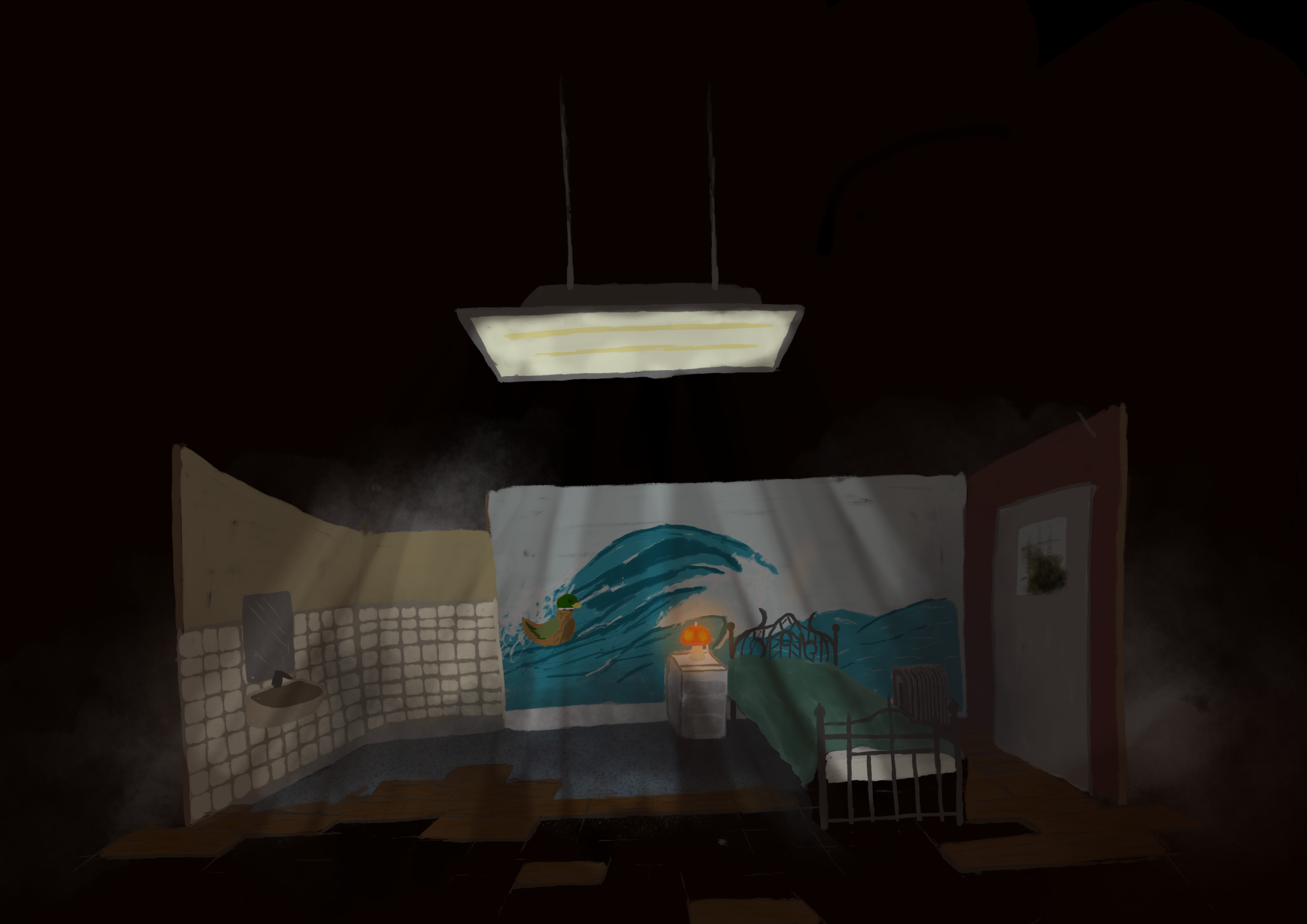
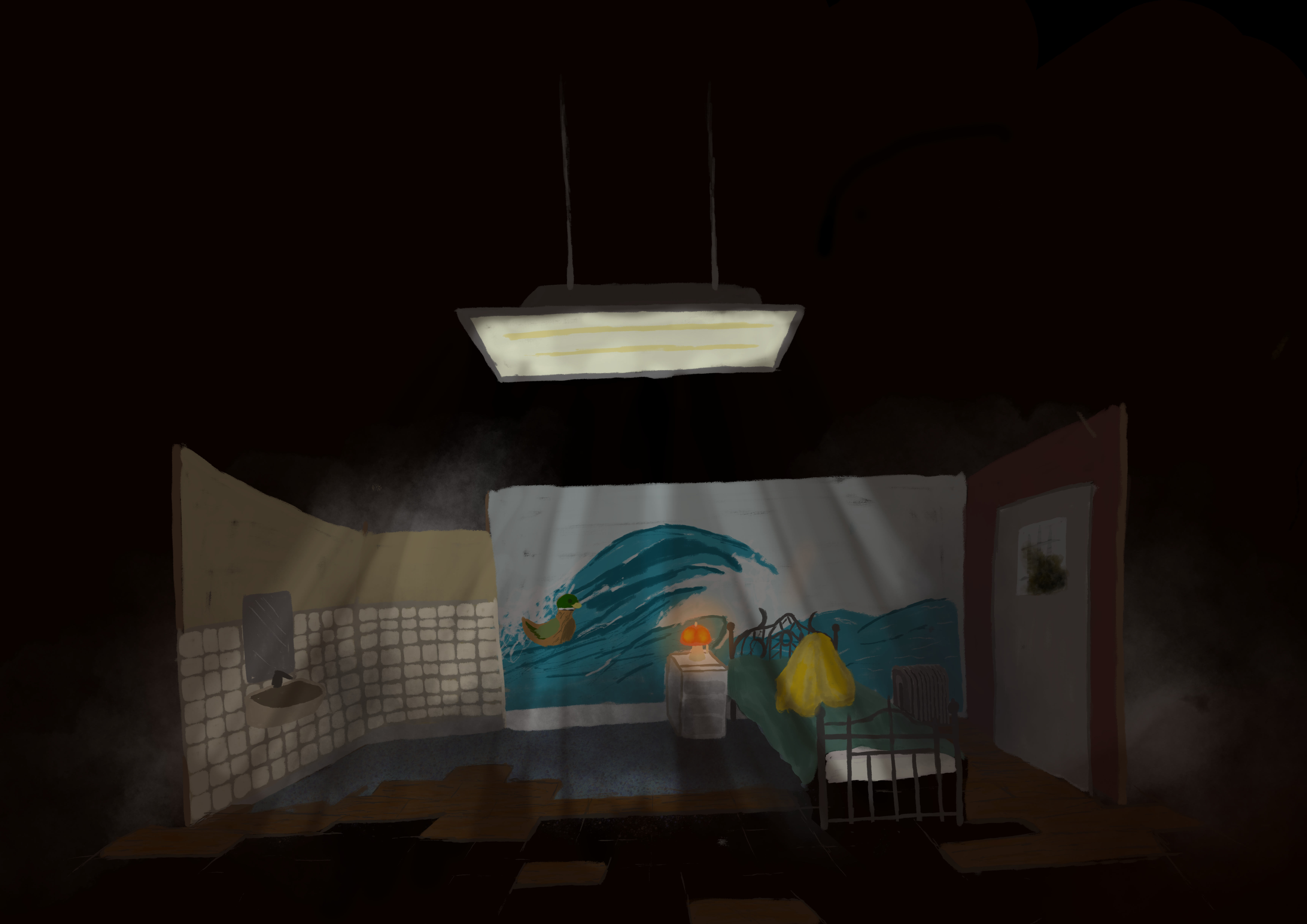
I want to share some art from the discord once again! Re-shared with permission, here is the medical ward beneath the prison, by FarionDragon! Very creepy. Very spooky.

No Patreon link this week, as this is the last chapter of the month, and I never like the risk of double-charging any new patrons. A bit earlier than usual, see the note before the start of the chapter! If you really feel like subscribing regardless, then, well, thank you very much! I really cannot express how much of a difference it makes, how thankful I am for all the support. I’ll keep doing my best!

You can always still:

Vote for Katalepsis on TopWebFiction!

This helps a lot! Many readers still find the story through TWF, which still surprises me a lot! Voting only takes a couple of clicks!

And thank you for reading! Thanks for being here, for following Katalepsis, for having fun with my writing. It means a lot to me! I couldn’t do any of this without all of you, the readers. So, thank you! Katalepsis is for you!

Next week, time to hide, find a bolt-hole, scurry off into the dark corners of this dripping dream, to hatch plans in the secret spaces between meaning and theme. And probably patch up Heather’s bleeding leg, too.

bedlam boundary – 24.9

Content Warnings

Unreality / gaslighting / institutionalisation (same as the previous chapters so far in this arc)
Torture (psychological/metaphorical)
Police violence (sort of???)
Blood and guts and gore


Previous Chapter Next Chapter

A press of patients swarmed the front entrance of Cygnet Hospital — a wall of backs barring the way inside, a baying beast of many bodies, joined together into one collective organism.

Raine and I slowed to a trot across the crunchy gravel of the driveway, then halted at the foot of the steps, joining the rear of the ragged mob.

Young women were crammed shoulder-to-shoulder at the top of the steps, jostling over the front row view. Others peered around the door frame or pressed their faces to the fringe of frosted glass, squeezing past their friends to get a peek of the action. Girls were going up on tip-toes, or wriggling through the crowd, or complaining loudly to anybody within earshot. Shouts of “What is it? What’s happening? I can’t see!” mingled with ribald jeers of “Get her! Get her! Twat her in the head, Minky!”

A cry like a football chant was growing at the front of the crowd, rolling back down the steps and over the lawns: “Hands off! Hands off! Hands off our bitches!”

The noise of the crowd paled in comparison to the wordless screams of outrage coming from indoors — a chorus from at least a dozen throats, all working in unison, filling the shadowy vault of the entrance hall. The cry rose and fell, sometimes jerking and halting with staggered interruption. But it always resumed once again, a split-second later, stronger than ever after each pause. The war-cry drowned out the more practical shouting from the nurses: “Stop that! All of you girls, stop this at once!”; “Haley, you’ll get a week in isolation for this, unless you drop that right now!”; “We need the restraints, somebody bring the restraints!”; “Help!”

As Raine and I arrived, the war-cry and the counter-shout and the crowd-chant were all interrupted by an almighty metallic clang-clang-calangalangalanglang.

Like a box of pots and pans tossed down a concrete stairwell. I winced, ears ringing.

The jarring din stilled the crowd and muted the shouting, but only for a moment. As the echoes faded, some maniac soul took up two of whatever had made all that noise, and started banging them together in a rhythmic clang—clang-clang-clang.

Not everybody was impressed by this, nor interested in rubbernecking the unfolding incident; some girls were leading others away by the hand, drifting apart from the edge of the crowd, flinching from the terrible noise, or steering well clear of the sudden chaos. One younger girl was cringing, red in the face, on the verge of tears. She was quickly rescued by an older patient who clamped both hands over the girl’s ears and helped her away from the noise. A few others were struggling out of the crowd, panting for air, backing away from the commotion.

“Oh!” I heaved for breath after our short, sharp sprint across the lawns. My palm was sweaty in Raine’s hand. Going up on tiptoes showed me nothing except more backs and shoulders. “Oh! Oh my gosh. I-I can’t see what’s going on in there! Raine? Raine, we need to get in there!”

“On it!” Raine said. She reeled me in like a dog pulling on her leash, then pressed me to her side and wrapped an arm around my waist. “Hold on tight!” she shouted above the racket. “Do not get separated in all this!”

“Can’t be as bad as with Praem, I don’t— oop!”

Raine unsheathed her elbows and cut through the crowd.

She sliced her way into the gaps between heaving bodies, dragging me alongside. Suddenly I was surrounded by shouting and chanting, by whirling faces and shoulders like cliff sides, by girls much taller and heavier than myself — or so they seemed, with Cygnet pajamas and unwashed flesh and sweat and stress and excitement in every direction. Raine made herself narrow to force people apart, then simply pushed, shouting as she went.

“Coming through! Make a hole! Hot potato here, ladies, hot potato! Shift or get burned!”

Most of our fellow inmates were content to get squeezed aside, too focused on trying to see what was going on indoors. A few tutted and huffed as we passed, muttering about proper queuing etiquette. A small handful of patients were brave enough to stand their ground, looking back with disapproving scowls, mouths opening to tell us off; but all of them misplaced their courage when they saw Raine, muscled and butch, her tank-top still splattered with blood, her eyes burning with manic light.

I held on hard, one arm around Raine’s waist, my other clutching my yellow blanket, lest it be torn away in the press of bodies. My ankles snagged on other people’s legs, my head was buffeted by hard shoulders, my stomach took glancing blows from passing hips and stray elbows. I almost closed my eyes, trusting Raine to see us through, but then—

A sliver of russet fur ducked and weaved between the ankles just ahead of us. A black-tipped bushy tail brushed against pajama-clad calves, sending a rolling shiver through the crowd. A few girls looked down, but most didn’t even notice.

“Fox?” I muttered. “Fox! Um … Saye! Saye Fox! Hey, hey, it’s us!”

My voice was lost in the growing cacophony. If the fox heard me, she didn’t stop.

Raine mounted the concrete steps, cut through the thickest part of the crowd, and won us a place at the front, just by the right-hand edge of the door frame. We burst from the press of people, stopping at the threshold of the entrance hall.

Inside was chaos.

The distinctive war-cry came from a ring of patients, a dozen girls who had linked arms in a circle, locking their elbows together in an apparently unbreakable union. All of them were shouting, wailing that wordless outrage together. The interruptions came from the nurses; every now and again two or three of the hospital staff rushed at the circle in a vain attempt to break the circular daisy-chain. But the ring of girls absorbed each charge by bowing inward before the impact, drawing each nurse a step or two further on — and then counter-attacking with bites and kicks, shoving each nurse back like a wall of rubber.

Two nurses were on the floor, one with a bleeding ear, another down on her hands and knees, vomiting bile. Another pair of nurses looked like they’d just clambered back to their feet after getting bowled over.

The mobile scrum-fortress was not the only piece in motion. A dozen other girls were darting about all over the place, dodging nurses and throwing things. Unfortunately for them, individual action was not as effective as whatever the first dozen were doing; several of them seemed to have been caught and pinned to the floor already. One was being carried off by a pair of nurses, cackling at the top of her lungs.

“Avenge me, lasses and ladies!” she howled, laughing and kicking. “Look to the east on the dawning of the third—”

A nurse slung a soft gag around her mouth, shutting off the rest of her speech.

A landslide of pots and pans was strewn about in front of the mess hall entrance, as if somebody had hurled a crate full of kitchen supplies through the air; this was presumably the source of the deafening noise earlier. Three girls stood tall amid the clutter, treating it like a minefield. The pots and pans made it much more difficult for any nurses to approach the trio without getting tangled up or slipping over. One of the girls was banging two pots together over her head, shouting, “Free Mina! Free Mina! Free Mina!” The other two were brandishing pans at the nurses creeping closer, bodyguards to their rabble-rouser.

One nurse levelled a finger at one of the pan-armed girls. “Don’t you dare! Don’t you dare throw that, Emily! You’re a good girl, usually. What has gotten into—”

‘Emily’ — a long-limbed young woman with bug eyes and frizzy red hair — cut the nurse off by hurling the pan like a frizbee. The whirling metal connected with the nurse’s ribs with a loud smart smack. She let out a little ‘oof’ and doubled over.

The crowd cheered.

There was no sign of the fox, not in the chaos of the entrance hall, nor slipping into one of the side corridors. All routes in and out of the entrance hall were crammed with crowds of patients watching the spectacle unfold, spilling from the dayroom and the corridors, the press of bodies inching along the walls at the edge of this sudden arena, as more and more joined the audience. Plenty of places for the Saye Fox to hide.

“Bloody hell!” I yelped, then tried to apologise: “S-sorry, I can’t— ah!” I flinched as another two nurses charged at the central circle of patients. They were repelled once again, with lots of kicking and shoving and one very impressive head-butt. That final move drew another great cheer from the crowd.

Raine howled with laughter. “Lozzers came through for us!”

“I-I don’t see her anywhere!” I said. “What on earth has she done here?!”

“Used her powers for good!” Raine shouted. “She’s started a riot!”

The riot seemed to be intensifying as Raine and I watched — on both sides. Some of the girls from the audience of onlookers began to join in, pushing past the few nurses left on crowd-control duty. One unlucky rioter went down, pinned by a pair of nurses, her jaw making a sickening crack as it bounced off the floor; but then she was released a moment later when three other patients jumped the nurses from behind. Other girls dragged the dazed and bleeding patient to her feet, hustling her off behind the edge of the audience. The ring of patients at the centre of the whole thing got louder and louder, shouting themselves hoarse at every fresh outrage and new offense. The staff weren’t slacking either; a group of nurses had succeeded in clearing one of the passages which led off into the depths of the hospital. Now they were faffing about back there, donning thick mittens and fabric helmets, readying long ‘man-catcher’ style poles with padded metal loops at the ends.

Lozzie’s riot was on a time-limit. This brief breach of the peace would be shut down sooner or later, no matter how hard the patients fought.

For a moment I forgot what Raine and I were supposed to be focused on — though heaven forbid I ever truly forget my beloved Evelyn, even in a nightmare. The riot unfolding before my eyes cried out to my deepest desires and oldest fears, to taboos I didn’t even know I’d been holding onto. As another pair of nurses tried to get the central scrum under control again, I felt my lips peel back from my teeth and my eyes go wide and wild, a cheer rising in my throat along with the crowd.

I wished I had all my tentacles, all my teeth and barbs, my spikes and spines, my warning colouration and toxic skin and steel-shod fangs. I could see the logic of the riot and the counter-violence about to end it all. My heart ached to hold back the waves from crashing shut over this glorious moment.

The nurses went down, pushed away by the circle, tumbling onto their backsides, bruised and battered for their efforts. I spotted the name tags: ‘A.FILTH’ and ‘A.PIG.’

Another cheer ripped from the throats of the crowd. I joined in.

Would I have cheered if these were real nurses, real people, with lives and families and wounds of their own? Would I have screamed in triumph to see this happen, in reality?

Maybe. Perhaps not. I’d been too young to hold the concept whole and complete, back in the real Cygnet.

But the catharsis now was real, even in a dream.

Raine was elbowing a girl to our left, a young woman about our age, dressed in a faded t-shirt and Cygnet standard off-white pajama bottoms. She had her hands cupped around her mouth, shouting a suggestion to one of the participants.

“Hey, hey!” Raine said to her. “Hey, how’d this start? Did you see it?”

The girl blinked at Raine, sparing her moment’s attention. “Dunno!” she shouted back. “Some nurse hit a girl! Fuck them, right? They’re not meant to knock us about like that! It’s not legal!”

“Right!” Raine cheered. “Fuck the screws!”

I reached out and tugged on the girl’s t-shirt. She did a double-take, then looked down at me, eyebrows raised.

“Why don’t we rush them all at once?” I asked — and I couldn’t believe the words coming out of my own mouth.

The girl frowned at me like I was crazy. “What?!”

“We’ve got ten times their numbers!” I said. “The nurses, I mean! We could win! Actually win!”

The girl balked, cringing at me through clenched teeth. She gestured toward the nurses in the little hallway — the ones picking up man-catcher poles and slipping restraining ropes over their shoulders. “I think it’s almost over. Come on, what can we do?”

“Everything!” I said.

But she was already turning away, mind made up. There would be no victorious revolt here today, no liberated prison.

Raine put her lips next to my ear, and hissed: “I get it, sweet thing. Trust me, I really do. But riots and revolutions have an internal flow. This one is about to get dammed up, and bad. We gotta move while we’ve still got cover. Eyes on the prize, Heather. Eyes on the prize.”

I whined in protest, but then stopped when Raine pointed at the big steel security door, the one marked V.I.P. VISITORS ROOM. It was over on the right hand wall of the entrance hall, half obscured behind a thin line of patients shouting and cheering.

No handle, no window — and no keyhole.

“Wait, wait!” I said. “How are we going to get in?”

Raine’s eyes flicked back and forth across the chaos of the riot, the baying crowd, the nurses trying to keep control, and the various improvised projectiles flying through the air. She slid something white into her palm — the little plastic knife from the kitchen. “I can try to jimmy the lock. No time for anything more complex. If this doesn’t work, we’re gonna have to retreat and try again. Heather?”

“Y-yes?”

“Keep your head down. Hold on tight.”

Raine darted to the right, sticking to the wall. She pulled me along by one hand, shoving and squirming us behind the thin layers of the crowd. My heels felt like they were made of rubber, like my feet were moving too fast for my brain. We passed one corner, exposed for a moment, then pushed our way through the knot of patients spilling from a corridor.

Pots and pans clattered off a nearby wall — a misfire from the trio by the mess hall doorway, almost friendly fire. Girls scattered out of the way, squealing and yelping as kitchen shrapnel clanged to the floor. Raine and I scurried with them, crammed against the wall for a second, ribs creaking in the press of bodies. For a moment I lost my grip on Raine. I thought we’d been pulled apart. I didn’t know which way was forward and which way was back.

Then somebody yanked on my arm and pulled me free. I stumbled forward, lurching and heaving. Raine caught me and held me steady.

“Easy, Heather, easy. Almost there,” she hissed. “Here, hold this.”

She pressed a small cast-iron frying pan into my hands. How she’d caught it, I had no idea.

“W-what—”

“A weapon! A weapon,” she hissed, a grin splitting her face and filling my vision. “It’s no police-issue nightstick, no foot-long machete, but it’ll do in a pinch. Come on!”

Raine pulled on my hand and led me a few more paces. The security door stood silent and shut at the edge of the chaos. We were sheltered behind the crowd, but it was only a few bodies thick, and we had only moments to spare.

Raine let go of me and whipped out the plastic knife. I pressed myself to the wall, head ducked low, as if I might be able to blend into the brick and plaster. My heart was pounding, my skin was drenched with sweat, and my bloodstream was full of adrenaline. I wasn’t sure if I’d ever been in a crowd like this before; the energy was infectious, an electric charge up my spine and down my limbs.

I wanted to swing the frying pan at somebody or something — preferably at a nurse.

Raine stuck the knife into the gap between the door and the steel frame, but the metal was so flush that the blade wouldn’t fit. Raine forced the utensil inside, wiggling it up and down, bending the plastic and sending little shavings of white fluttering to the floor.

Behind us, the crowd rose into a chorus of booing and jeering. I went up on tip-toes to risk a look.

A squad of nurses had emerged from their little corridor redoubt — wielding man-catcher poles, lengths of padded rope, and anti-spit masks. They had a doctor with them now, an older man with grey hair, terrified eyes blinking behind massive glasses. He held what looked like an electric stun gun in one shaking hand. He seemed much less enthusiastic than the burly, well-armed nursing staff.

The nurses closed on the central scrum of linked girls, spreading out to take them from all sides at once.

“Raine!” I squeaked.

“I know.”

“We have to hurry!”

“I know,” Raine answered through gritted teeth, eyes glued on the tiny gap she had managed to wedge between the door and the frame. She rocked back on her heels, jaw clenched tight. “I know. I know.”

The knife was bent. The smallest touch might snap the plastic.

Angry shouts broke out behind us. “Not fair! Stop cheating!”, “Fucking pigs! Why don’t you all go home and leave us to it!”, “You started it! You started it!”

The crowd was turning ugly now that their side was losing, and I didn’t blame them one bit.

“Raine!” I hissed.

“I’ve fucked it,” she muttered, then lashed out and grabbed my hand. “We gotta run, sweet thing. Mission failed. We’ll be back, we—”

A blur of russet fur darted between my legs. A little black nose touched the door frame, nuzzling the steel.

Click!

The security door popped open by about an inch. Before Raine or I could react, a vulpine paw padded at the side of the door and nudged the gap wider, just wide enough for a sleek and furry body to slip through. Our surprise visitor slithered inside, bushy tail vanishing after her.

Raine grabbed the door a second later, wrenched it wide, and bundled me over the threshold. She slipped through in my wake, then carefully closed the door behind us.

A lock or a catch clicked into place. The sounds of the riot were suddenly muffled behind metal and concrete.

Silence descended, unnaturally thick and potent, like heavy fog hanging in the air.

Raine whirled, fists raised, ready for anything.

“There’s nothing here!” I yelped, panting hard. “There’s nothing here. Nothing here. G-good girl, Raine. Down. Down. Down, girl.”

The room beyond the steel security door — the ‘V.I.P Visitor’s Room’ — was nothing more than a bland and expensive waiting room.

Blue fabric armchairs stood in short rows, facing toward each or glowering over little glass coffee tables. A scratchy blue carpet gave the illusion of softness, rasping beneath my white slippers. Insipid paintings hung on the walls, pictures of fruit or cracked coffee mugs or half-dead trees. A few wilted flowers sat in sad, dry vases on the tables, surrounded by halos of vapid magazines with titles like ‘Wow!’ and ‘Fresh!’

Two doors stood shut on the opposite side of the waiting room, plain pale wood with unremarkable plastic handles. One sported a little brass plate which read ‘Consultation Offices.’ The other was labelled ‘Correction.’

The place was completely deserted, except for myself and Raine.

And the Saye Fox.

She was sitting on her haunches, up on the seat of a nearby armchair, alert and alarmed. Bright orange eyes like the hearts of twin bonfires returned my curious stare. Black-tipped ears twitched and swivelled, perhaps still picking up the sounds of the collapsing riot back in the entrance hall. She looked unaffected by the dream, toned and sleek, fluffy-furred and bushy-tailed.

Raine cracked a grin and pointed at the fox. “That’s nothing, huh? Am I hallucinating now?”

The Saye Fox stared at the end of Raine’s finger, then back at Raine’s eyes.

“No, no,” I said quickly, still trying to catch my breath after our escape. “She’s on our side. I mean, if she’s actually really here, and not some kind of dream construct. I don’t think she is, anyway.” I bit my lower lip, frowning at the fox. “I can’t figure out how she got in here. It doesn’t make any sense.”

“Opened the door,” Raine said. “Nice trick, especially with no thumbs.”

The Saye Fox went: “Yip!”

I held up an apologetic hand — waving the cast iron frying pan around like a moron. Raine plucked the improvised weapon from my fingers, saving me further embarrassment.

“Sorry!” I said to the Fox. “Sorry, I didn’t mean any offense by that. Neither did Raine, she just doesn’t remember you right now, or anything much, in fact. I’m just very confused. I don’t understand how you’re here? You weren’t in Wonderland with the rest of us. Unless you snuck in somehow. Did Zheng carry you in there, in secret? Were you hiding inside Zheng’s jumper?”

The Fox tilted her head, ears twitching. I sighed.

“Well,” I said. “Anyway, whatever, it doesn’t matter. Thank you for opening the door! Thank you so very much. You saved us just now. We were stuck. Thank you. I’m still not a hundred percent sure if you’re real, though.”

Raine clucked her tongue. “You’re gonna have to explain this one to me, sweet thing. You got a Doctor Dolittle thing going on here? That fox talking back to you?”

“She’s more than just a fox,” I said quickly. “She’s related to Evelyn somehow, though I’ve never figured out exactly how that works. She’s either a gestalt entity, congealed from Evelyn’s ancestral home, or she’s the spirit of Evelyn’s grandmother, inhabiting a fox via long-term carrion-based osmosis. Um. Sort of. Maybe. And I can’t hear her, no. She is a fox. She doesn’t speak.”

Raine nodded. “Evee’s descended from furries, got it.”

“Yeerp!” went the fox.

Raine cracked a grin — not for me, but for our unexpected vulpine companion. “Sorry, little vixen, but I can’t help myself. You’re Evee’s familiar, right? Every witch needs a familiar.”

I tutted. “That’s not entirely correct.”

The Fox didn’t seem to mind. She stood up, turned in a little circle on the chair, and glanced at both of the doors on the opposite side of the room. I hurried over, following her lead.

“Do you know where Evee is?” I hissed. “Do you know where they’ve taken her?”

The Saye Fox hopped up onto the back of the chair, then down to a coffee table, knocking gaudy magazines onto the floor. She sprang over to the left hand door — the ‘Consultation Offices’ — then stopped and looked at me, one paw raised, ears sharp and tall, tail held straight out.

“Okay!” I said. “Raine, I think we can trust her on—”

But then the Saye Fox darted the other way, to the door labelled ‘Correction’. She assumed the same urgent pose.

“Damn,” Raine purred. “Guess again, Fantastic Mrs Fox.”

“Yiiip!” went the Fox, much louder than before. “Yap!”

I sighed. “We’ll just have to try … Raine? Um, Raine?”

I realised that Raine was staring at the fox with a look of smug victory. The Fox was staring back, goaded into a silent confrontation.

“Mm?” Raine grunted, but she didn’t look away from the Fox.

“Raine!” I snapped — and she snapped too, head flicking round to look at me, to obey the voice of her mistress. I quickly reached up and took the back of her neck, trying not to show that my hands were shaking, or that my breath was catching in my throat. I held Raine’s gaze and spoke quickly. “You are a good girl. You are very a good girl, Raine. You are my good girl. Just because you couldn’t get that door open does not make you any less of a good girl. The fox has not shown you up or bested you somehow. And you are not in a rivalry with the Saye Fox. Okay? I-I need you to not do this, not right now. Please.”

Raine blinked once, then grinned slowly. “Sorry, sweet thing,” she purred. “Can’t blame me for territorial pissing, can you?”

“This is not the time,” I said. “Don’t be a … a b-bad girl. And no urinating on the furniture.” I cleared my throat. “Oh I can’t believe I said that! Tch!”

Raine purred in her throat, a deep and satisfied little rasp. But she nodded and winked, then pulled away from my hand. She met the Fox’s gaze again, and nodded her head. “We’re cool, little Saye. I got the wrong scent up my nose, that’s all. No hard feelings?”

The Fox turned in a little circle, bounced over to the ‘Consultation Offices’ door again, paused, sprang back to the ‘Corrections’ door, and went, “Yip-yap!”

“I know, I know!” I said. “I’m worried about Evee, too. But which door do we take?!”

Raine said, “Pick either. It’s fifty-fifty.”

“No,” I said. “I think it’s a riddle. It has to be.” I wet my lips, then pointed. “Corrections. Let’s try there. That sounds ominous enough.”

“Yeah,” Raine murmured. “Sounds grim enough.”

Raine took the lead, one hand on the door handle, the other raising the stolen frying pan to repel whoever or whatever might be lurking on the other side. I stuck to her heels, holding my breath. The Saye Fox hopped into position behind us without encouragement.

Raine cracked the door. It opened without resistance. She waited several seconds, listening for voices, braced for a reaction. When none came, she eased it wider. We peered through together, me and Raine and the Fox.

A corridor stretched off toward a distant right-hand turn. The walls were clean institutional white, lined with simple wooden doors. The floor was covered with more cheap and scratchy carpet.

Empty and silent, except for the distant whisper of an air conditioning system.

“Spooky,” Raine hissed, stepping over the threshold. “Too squeaky clean for my filthy tastes. Give me prison dirt over this any time.”

I followed her into the corridor, my heart pounding in my chest. My skin had gone clammy, my palms sticky with sweat, my breath short and my head light. “Y-yes,” I hissed, stammering a little. “Spooky. That’s— that’s right. Spooky. Not what I was expecting.”

Even the Saye Fox did not venture far; she hopped past our ankles, then stopped, ears up, orange eyes wide, staring down the corridor.

Raine must have noticed my discomfort. She reached back and grabbed my hand. “Hey, what’s wrong?”

I swallowed and forced myself to take a deep breath, then tugged my yellow blanket tighter around my shoulders. “This looks too much like a corridor at the real Cygnet Hospital. One of the doctor’s areas, something like that. It’s slightly too real. Just dredging up a buried memory, that’s all. I’ll be fine. We have to find Evee.”

Raine nodded. “Gotcha.” She spoke quick and quiet. “Do we check the doors one by one, or push on until something more obvious?”

“Good question,” I murmured, chewing on my bottom lip. The doors did not have windows or keyholes through which to spy their insides, just grey plastic handles and plain surfaces in pale wood. Upright, sensible, clean. Oh so very reassuring, when you were subjecting a child to the truth behind the tidy facade. “I don’t think we have a choice,” I hissed. “We need to check the doors. Evee could be anywhere.”

Raine hefted the frying pan. “If we bump into a nurse or a doctor, I’m gonna have to take them out, sweet thing. We ain’t got a choice, not if we’re gonna find our Evee. We can’t afford to get caught, right?”

I swallowed down the lump in my throat. “I-I understand. You have permission, Raine. Express permission. Anything you need to do, as long as it’s not to a patient.”

Raine eyed me carefully, unsmiling and focused. “Be ready,” she purred. “We throw open a door, we may have to fight. Not gonna have time to think. Whatever happens, follow my lead.”

My breath came in a shuddering wave. But I set my shoulders and nodded hard. “I’m ready. Let’s go.”

We opened the doors one by one, zig-zagging down the corridor from room to room. Raine always went first, and always used the same technique — she took each door handle and eased it downward, then waited for a response. When none came she cracked the door away from the frame, waited again, then threw the door wide with a sudden explosive shove.

The first half-dozen rooms were nothing more than doctor’s offices, decorated in pale wood and functional furniture, some with examination tables and weighing machines and blood-pressure cuffs, nothing one wouldn’t find in a real modern hospital. All of them were deserted, spotlessly clean, and perfectly silent. My heart was in my throat every time Raine burst over a threshold, frying pan raised in one hand, the Saye Fox hopping past her heels. But these rooms looked as if they had never been used at all, with no rubbish in the waste bins, no stray paperwork on the desks, not even a speck of lint around the skirting boards.

Fake. A thin veneer over the reality. A comfortable dream before the nightmare.

On the seventh door, the truth of this place revealed itself.

Raine opened a door identical to all the others thus far — and then paused, because the interior was different. Dark and dingy, narrow and tight, with whitewashed walls and a bare lino floor. A trio of cheap plastic chairs faced the only light source: a huge window which dominated one wall.

The window looked into the next room.

Raine crept inside, eyeing the massive window and the room beyond. I followed, frowning with incomprehension. The window looked into a clean, white, brightly-lit room, bare except for a single chair and a whiteboard set on a wheeled frame. The chair was huge, a sort of dentist’s chair made of wipe-clean plastic, bolted to the floor, with a mechanism for reclining the back. It was covered in restraints and straps, thick enough to hold a gorilla. A separate door led out of the clean white room, in the opposite direction to the corridor we’d been exploring.

“Oh, this is some real sick shit,” Raine murmured.

A strange feeling crept into the pit of my stomach — recognition, like I’d seen this place before, though there was nowhere like it in the real Cygnet Hospital. It looked more akin to some nonsense one might witness in an exploitative film about asylums and mental illness.

“I … I don’t understand what I’m looking at,” I said slowly.

Raine nodded at the huge window and the clean white room beyond. “Two-way mirror. For watching somebody strapped into that chair.”

“Yes, Raine,” I said, “I know it’s a two-way mirror, I didn’t mean that. I meant the … the … ”

A memory surfaced. My eyes went wide and my blood ran cold. A wave of fury and bile clawed up my throat.

Raine must have seen the change come over me. “Heather? Heather, what’s wrong?”

“It’s the chair,” I hissed.

“What’s with the chair?” Raine almost growled. “You gotta tell me, sweet thing. You see something I don’t, you gotta tell me—”

“Evee’s chair. Her mother’s chair. The chair that Evelyn’s mother kept in the cellars beneath her house. The chair where she used to strap Evee down to be possessed by a demon. This one is all clean and new, not old and rotten, and the real one is sized for a child, not an adult, but it’s the same chair.” I whirled on Raine, feeling my eyes bulging in my face, my lips peeling back from my teeth. “We smashed the real one!” I shouted, gripped with uncontrollable anger. “Me and Praem! We smashed it to pieces with a sledgehammer! It’s dead!”

“Heather—”

“We have to find her!” I said. “Right now!”

“Yip-yerp!” went the Saye Fox, dashing out of the dingy little room.

“We can’t waste all this time searching!” I snapped. “We have to—”

Raine grabbed my hand and all but yanked me off my feet, whisking me back out into the corridor.

We threw caution to the wind. Raine slammed the doors open without pause, banging them off the concrete walls of the sad and dingy little observation rooms. Each one was identical, the same three chairs looking through the same two-way mirror, into the same clean white clinical space, dominated by the same hateful piece of torture machinery, restored to gloating life by the mechanics of this dream. Over and over again we saw that chair, replicated in room after room. Empty, clean, and silent. No Evee.

I scurried to keep up, breath heaving in my lungs. The Saye Fox darted ahead, sniffing at the door frames, yipping at us to hurry up, leaping in little circles as she went.

“She’s not here! She’s not here!” I wailed after the twelfth empty room in a row. “I don’t know why! Evee!” I shouted her name, my voice echoing down the silent white corridor. “Evee, where are you!?”

Raine yelled too. “We’re not too late! Don’t even think it! You’re never too late to help!”

“Evee!” I whined. “Evee!”

Door number thirteen crashed open, slamming into the wall and bouncing back on its hinges. Raine darted inside, just as she had with all the previous rooms. I scurried after her, already grabbing her arm to drag her back into the corridor, to try the next, the next, the next—

Raine froze, staring through the two-way mirror. The Saye Fox jumped up onto a seat. My stomach fell through the base of my guts.

Correction room number thirteen was in use.

Two nurses stood by the back door, meaty arms folded over their chests, hair like helmets, jaws like bulldogs. ‘A.SHOVE’ and ‘A.PUSH.’ They could have been twins. Evelyn’s wheelchair stood between them. Her grey dressing gown was pooled on the seat.

Evee was strapped into the torture chair.

She looked so tiny, wearing nothing but a thin pajama top and a long skirt, both in faded institutional white. She was withered and atrophied and reduced, dwarfed by the clean white room, swallowed by the surfaces of the chair. Her body was engulfed in straps and restraints, criss-crossing her torso and throat, holding her skull in place with a padded leather line across her forehead. Her eyes were dull and empty, tear-tracks dried on her sunken cheeks. Her blonde hair was a stringy mass of greasy rat-tails. The scar tissue of maimed hand was weeping onto the shiny plastic of the chair’s arm, leaving a stain of pinkish blood plasma on the spotless surface.

The restraints were wasted on her withered left leg, like a stick wrapped in chains. Her missing right leg had not been spared the incarceration either — the straps went over her skirt and stump, pinning even the empty notion of her severed limb.

She was facing another one of those wheeled whiteboards. This one was filled with text, with notes spiralling outward from three central bubbles. The bubbles contained the words ‘filial piety’, ‘loyalty’, and ‘sacrifice.’

The rest of the text was a jumbled mish-mash of overlapping mantras, the letters pressed into the board so hard that they had scored the surface.

‘I am your mother I am your mother I am your mother—’ ‘—gave birth to you my own flesh and blood and this is how you repay me—’ ‘—born for one reason and one reason alone born for one reason and one reason alone—’ ‘—murderer murderer murderer murderer murderer murderer murderer murderer murderer murderer murderer murderer murderer murderer murderer murderer murderer murderer—’ ‘—waste of effort if you can’t learn, waste of skin even if you can—’ ‘—have to get better so you can come home and be with me and your father you want to come home don’t you want to come home be quiet when the doctor is here don’t say a word don’t you dare tell them anything or I’ll make it so much worse than it already is—’

Coiled around the chair — crouched on Evelyn’s chest and shoulder like a sleep paralysis demon from hell, gesturing toward the whiteboard with half a dozen feelers of black scribbled static — was the dream-memory of Evelyn’s mother, Loretta Julianna Saye.

She had no face, no recognisable human outline, not even hands or feet or visible clothes. She was nothing but a churning mass of black static, whispering madness and hate into Evelyn’s ear.

Evee looked barely conscious. Her jaw was slack, cold drool running down her chin. The chair’s restraints and straps were the only thing keeping her upright

“Evee!” I hissed. “Raine, we have to—”

“Awoooooooooooo!” Raine howled a wolfish war cry.

The two nurses on the other side of the glass — Push and Shove — jerked their heads around. They looked right at us.

Raine wound back her arm and hurled the frying pan directly at the glass. The window burst outward in an explosion of flying shards, blinding the pair of nurses, drawing screams of surprise from twin throats. The frying pan clattered off a wall as the nurses flailed, clawing at their faces.

Raine leapt through the shattered window and hurled herself at our foes. The Saye Fox followed with a little hop over the fringe of broken glass, growling and snarling and snapping at the top of her tiny lungs.

I followed, driven half by love and half by rage, clambering over the broken two-way mirror. I was neither as elegant as Raine nor as small as the fox, so I cut one shin on the edge of broken glass. When I staggered upright in the correction room, blood was seeping into one leg of my pajama bottoms. I didn’t care. I barely even noticed. The pain was nothing, blotted out by white-hot anger.

“Evee!” I yelled. “Evee!”

Raine darted for the fallen frying pan while Push and Shove were still reeling and blinded by the fragments of glass. She scooped it up and twisted round on one heel — but a second too late. Push came at her like a wrecking ball of flesh, hands outstretched to grab Raine’s throat.

Raine ducked to the side and smashed Push in the face with the edge of the pan. Blood fountained from a broken nose.

Push fell over, clutching at her nose, screeching like a banshee, but Raine didn’t stop there. She brought the frying pan down again, and again, and again. Soft tissues went squelch and splat. Hard bones went crack—a-crack.

Shove rallied, wiping glass fragments from her eyes with the back of one hand, tearing open tiny wounds in her face. She threw herself at Raine too.

The Saye Fox darted between my legs and yowled at the black static enveloping Evelyn, snapping and yipping, darting around the edge of the void-dark mass, trying to nip at ankles which the nightmare simply did not possess.

“You!” I yelled at it — at her, at Evee’s mother, at this nightmare resurrection of Loretta Saye. “Get off her!”

My fists were balled up, nails digging into my palms. My breath ripped down my throat like fire. My face was burning red.

The Memory of Loretta Saye reared up, uncoiling from around Evelyn like a snake from around a rodent. She pointed a scribbled mass toward me, as if I was nothing more than a competing predator, come to steal the kill from beneath her fangs.

“You’re not even real!” I screamed at the thing. “You died! Raine and Evee killed you once already!”

A voice whispered from the black static, low and husky and thick with cold. She had Evelyn’s accent, archaic Sussex drawl tucked neatly beneath modern Estuary English. Evelyn’s voice, but thirty years older, marred by a cruelty that Evelyn could never have mustered.

“Smart mages live forever,” said the memory. “This is my lifeboat, not yours. Leave before I have you kill—”

I screamed and flung myself at her.

I had no tentacles. No barbs and spikes and spines. No toxic flesh, no poison mucus. No armoured chitin, no reinforced muscles, no steel in my tendons. In this dream I was but one, singlet, alone inside my body, and all too human. I had the weak and noodly arms that I’d had most of my life, unfit for lifting heavy objects, let alone having a fight. I had little experience, less strength, and no idea what I was doing.

But something came over me, something I had only felt before in the context of abyssal instinct, pushed onward by extra-human chemicals and Outsider enzymes rushing down my veins and filling my heart with liquid courage.

I lost my temper. I lost it like a nasty little ape, all fists and teeth.

I collided with Loretta Saye’s memory like a chimpanzee set on murder. I punched and kicked and bit and spat, my face full of black static, my fists sinking into rubbery air, my feet repelled by nothing but empty space. I made the most terrible noises, more animal than human, rasping and croaking and screeching.

That voice whispered forth again: “My daughter will always be mine. Even from beyond the grave. You think I’m gone? You think I’m truly dead? Foolish runt. I don’t even know what you are. Begone.”

The static whirled like a vortex in front of my chest, gathering as if to throw me off or ram a spike through my flesh.

I reached in with both hands, with one thought on my mind — and found meat beneath the static.

A face, a skull, with hair and skin and cold, cold cheeks.

The memory of Loretta Saye gasped, trying to flinch away. But I had a grip on her now, sticking my fingers into an eye socket. “How— how can you—”

“Evee loves me more than she ever thinks about you anymore!” I howled into the black static. “Get back in the ground!”

And then I punched her.

I slammed fists into her hidden face and rammed feet into her shrouded belly. I leaned forward and bit down on any flesh I could find, drawing screams from a figure I could not see, spitting out mouthfuls of mangled skin and a fragment of her nose. She collapsed beneath me, going down in a tangled heap; she tried to fight back, but her blows were weak, her arms nothing but dust and rot. I rode her to the ground, feral before we even got there, smashing and shoving and kicking and kneeing and biting and feeling my fists grow slick with blood and bruised with repeated impacts.

I regressed into a state I had never before considered possible without abyssal encouragement.

Eventually I grabbed her skull in both hands and bounced it off the floor. That made her stop moving, so I did it again, and again, and again, and again, and again, and again, and again—

Crack! Crack! Crack! Crack! Crack! Crunch! Crunch!

She wasn’t moving anymore. I slowed, then stopped.

I was straddling the back of a corpse. My whole body was shaking. I was panting as if I’d sprinted a mile. My knees were wet, dipped in a pool of spreading blood. My hands were soaked with crimson, my knuckles bruised and aching, my arms seizing up.

The corpse had blonde hair, matted with gore. She was face down on the floor.

The Saye Fox looked on from a few feet away, staring at the fallen memory. Her orange eyes seemed almost sad.

“R-Raine … ” I croaked. “Raine.”

A firm grip found my armpits and hoisted me to my feet.

“Hey, hey, Heather, Heather, sweet thing, hey,” Raine said, clicking her fingers in front of my eyes, dragging me away from the corpse. “You’re fine. You’re whole. You’re good. Well done. Well done, sweet thing. Hey. Hey, look at me. Look at me!”

I focused on Raine’s eyes. I was still panting hard. My knuckles screamed when I moved my fingers. Raine was covered in blood too — though nowhere near as much as me.

Behind her, the room was a wreck. Push and Shove had also been turned into corpses, both skulls caved in with a frying pan, which now lay on the floor amid the fragments of broken glass.

“How—” I croaked, glancing at the corpse of Loretta’s Memory again. “How did I— I-I—”

Raine grinned. “People do that sometimes, when they care enough. And hey, well done, you did well. I was tied up dealing with the clones back there.” Raine glanced at the corpse too. “She didn’t seem like much in the end. This is a wizard, huh?”

“Uh … n-not in a dream, I think?” I shook my head. “I think I found her weak point. Conceptually speaking. Metaphorically. This wasn’t the real thing, anyway.”

The Saye Fox was sitting on her haunches, staring at the corpse of this dream-memory of Loretta Saye.

“I’m sorry,” I croaked. The Fox looked up at me. “I know she was your … relative, somehow, no matter how bad she got. Even if this is just a dream. Even if—”

Evelyn slumped to one side.

The restraints around her head and neck and upper torso had come loose somehow — perhaps we had knocked them during the fight, but I suspected her sudden partial freedom had more to do with dream-logic than with material reality. She lurched sideways, as if slipping over the side of the chair. Raine and I both darted to catch her, uncaring of the blood all over our hands.

“Off!” Evelyn snapped — her voice scratchy and scarred, but oddly strong.

She finished leaning over the side of the chair, made a snorting sound deep in her throat, and spat on the dream memory of her mother’s corpse.

Raine and I helped her sit back up.

“Evee?” I hissed. “Evee, Evee, it’s us. You’re safe now, Evee? Evee?”

Rheumy eyes looked up at me, squinting with incomprehension, beneath a craggy frown that could have frozen a bonfire. Exhausted, stained with tears, wracked with chronic pain — but those eyes were clear.

“Heather?” Evelyn croaked. “Raine? What— why am I strapped down?” She jerked against the restraints. “Get me out of this shit! I was having a terrible nightmare, that’s all, that … ” She trailed off, glancing left and right, then squinting down at her mother’s corpse again. She froze. All the colour drained from her face. “Or not.”

“Evee,” I whispered very gently. “Maybe— maybe don’t look at that. Evee? Evee, please. Evee! She’s— she’s dead. She’s dead.”

Evelyn looked up and frowned at me again. “Of course she’s fucking dead. Where the fuck are we? And why does Raine look like she hasn’t bathed in six months? And where’s my leg?”

“Oh, Evee!” I sighed with relief. I could have hugged her. I could have danced a little jig.

We’d banished one personal nightmare.

Evelyn Saye was wide awake.

Previous Chapter Next Chapter


Evelyn Saye is free! Free and awake! What magic will she do!?

Ahem. Yes. Riots, torture, and a spot of metaphorical dream-like matricide, with bare fists and a set of nasty teeth. All in a day’s work for our scrungly squid-wife. Quite dangerous even when she doesn’t have tentacles, right? Lozzie must be having fun out there too, dodging the nurses still trying to re-establish control. I wonder if Twil got involved, in the end.

Oh, and there’s a Fox, too. I wonder how she got in?

If you want more Katalepsis right away, you can get it by:

Subscribing to the Patreon!

All Patrons get access to two chapters ahead! No matter what level you subscribe at! That’s about 20k words at the moment. The more support I get through Patreon, the more time I can dedicate to writing, and the less chances of having to slow down the story or get interrupted by other responsibilities. The generous and kind support of Patrons and readers is what makes all this possible in the first place! I wouldn’t be able to do this without all of you! Thank you all so very much!

You can also:

Vote for Katalepsis on TopWebFiction!

This helps a lot! Many readers still find the story through TWF, which still surprises me a lot! Voting only takes a couple of clicks!

Thank you for being here, dear readers! Thank you for following Katalepsis all this long, long way, almost to the end of Book One at last! I couldn’t do it without all of you! I really mean it! Katalepsis is for you, thank you so much.

Next week, it’s time to regroup and recover, right? To dust off the palms, wipe off the blood, and perhaps find a change of clothes. With magic and magecraft, perhaps Evelyn can make a difference? Heather’s out of moves for now. Time to think, and think fast.

bedlam boundary – 24.8

Content Warnings

Unreality / gaslighting / institutionalisation (same as the previous chapters so far in this arc)
Discussion of terrorism
Extreme sexual aggression


Previous Chapter Next Chapter

Cygnet Children’s Hospital — a dreary memory dressed in the dream-guise of asylum, prison, panopticon, and stockade — loomed over the gardens and grounds like the visage of a sun-bleached skull. Dark windows like empty sockets stared unblinking at the verdant open lawns, the winding red brick pathways, and the pretty little flowerbeds. The building glowered down through every break in the leafy oaken canopy, as if searching for those who dared hide from the all-seeing injunction, of health and wellness through obedience and order. A rot-toothed maw hung wide in the front of the fleshless facade, with a desiccated tongue of concrete and gravel unrolling from between the glass front doors, slopping across the lawns and cutting through the grass, before finally terminating in a barred and barbed gate set into the black iron wall. A checkpoint, designed never to be crossed. Barriers and cones stood tall to ward off cars; squat, drab, grey guard huts squinted at the road through narrow windows; a pair of wrought-iron gates made a mockery of escape.

“No exit,” I muttered at the sight of that fortress. “That’s a very unsubtle metaphor indeed. No way out.”

“Car bomb’d do it,” Raine purred with relish. “Blow those gates right off their hinges.”

I sighed. “Yes, well, if you can find the resources to construct a car bomb — one that doesn’t involve blowing yourself up in the process — then feel free. But somehow I think we’d struggle to build an explosive device in the middle of a mental hospital. Even a dream of one.”

Raine chuckled. “You’d be surprised what you can make from common household items, sweet thing. The fruits of the industrial age.”

I swallowed a second sigh — even in a dream, Raine was so very Raine. I focused on the hospital.

Pale brick was crusted and stacked into the fluted forms and curling fancies of a gothic manor house, broken by vast dark windows and four stories of decorative embellishment in sculpted concrete. A ridiculous affectation, chosen to match the impossible landscape beyond the walls and the ostentatious ‘luxury’ of the gardens. The fiction of the isolated asylum, deep in the restorative countryside.

The illusion was rather undercut by the black and wrinkled sky which framed the hospital — the inside or underside of the Eye, the undeniable reality behind the dream.

Raine and I were lurking about a hundred meters away from the front entrance, concealed behind the trunk of a particularly old and gnarled oak tree, shaded by the thickly spreading canopy above our heads. We were poised right at the edge of the tree line, in a tentacle of low woodland which snaked out across the asylum lawns. A few meters ahead of us, the woods gave way to strictly manicured grass and well-tended flowerbeds.

Raine peered around the right of the tree trunk; I peered around the left, trying not to feel once again like I’d stumbled into a silly cartoon.

We’d spent the last ten minutes crossing the asylum grounds — an amount of time that seemed impossibly long for the short distance we’d covered. How could we have navigated by the sight of the hospital’s red brick facade if it was ten minutes’ walk away, across rolling hills, through a forest of oak? A very artificial forest full of widely-spaced trees, yes, tied up in ribbons of red brick pathway, the ground weirdly free of leaf-mulch carpet. But it was still the woods. We should have been lost from the first step.

Instead we’d crept between the swaying boughs, holding each other’s hands, alert to any sign of nurses or guards or supernatural shenanigans. We’d encountered nobody except a few solitary patients, wandering along the pathways by themselves, or sitting on benches to ‘appreciate nature’. Raine and I looked like hell — haggard and rough, one of us stained with blood, both of us filthy with sweat and worse — but nobody gave us a second look. The only time we attracted the slightest bit of attention is when we ran across a pair of girls snuggling on a bench. The couple had sprung apart when Raine and I stepped out from between the trees, as if embarrassed to be found in an intimate embrace. But then Raine had shot them a wink and showed off the fact that she was holding my hand. The pair had blushed and stuttered a “H-hello, good afternoon” — then turned back to each other after Raine and I had finished passing by.

I kept an eye out for any sliver of russet fur between the trees, but our surprise visitor did not show herself a second time. If the Saye Fox had somehow followed us into Wonderland, she’d made herself scarce once again.

Eventually Raine and I had reached the limit of the little woodland, pushing as far as we could down the extended tentacle of oaken cover. The hospital loomed ahead, protected by a No Man’s Land of open ground; any watchful nurses would spot us instantly if we just walked up the doors. So we waited and watched, peering out from behind a tree.

“Tch,” I tutted and huffed as I stared at the hospital, trying not to let the sight overwhelm me. My right palm was growing sweaty in Raine’s hand. “Absolutely ridiculous. Absurd place. Not even remotely real. Completely implausible.”

“Heather?” Raine murmured. She didn’t turn to look at me, eyes glued to the hospital’s front entrance and the massive side-doors which led out into the gardens. “What’s ridiculous?”

“Oh, nothing,” I said with a little sigh. “Or rather, everything.”

Raine eased back into our hiding place behind the oak tree and shot me a focused, unsmiling look. “Sweet thing, I need you to answer the question, for real.”

“A-ah? Raine? Sorry?”

Raine smiled and swept a hand through her greasy hair. The false sunlight filtered through the leaves, falling in dappled patterns on her shoulders and muscles, dancing down the front of her filthy tank-top as she shifted her footing. “If you notice something wrong, or out of place, or ridiculous, you gotta speak up, ‘cos you might be the only one who can recognise that shit’s getting weird. We’re all dreaming, right? But you’re the only one fully awake. You see something wrong, you gotta tell me.”

“Oh! Oh, right. Of course, um, yes.” I peered around the tree trunk again, squinting at Cygnet Hospital. But then I shook my head. “It’s the whole building, Raine. It’s completely unreal. It’s faux-gothic but built of brick and concrete. If you stare at it head-on it’s clearly got four floors, but if you look at it in your peripheral vision, it stretches up into the sky. From inside it had all these other wings, some of them built differently, like the prison, and the high tech part. But from out here, where are they? And it’s … it’s dead.”

“Dead?” Raine echoed.

I cleared my throat and pulled my yellow blanket tighter around my shoulders. My back was still damp with the cold water from the elevator floor. “Yes, dead. I know, I know it’s silly. How can a building be dead? I know—”

“I don’t know,” Raine said, totally serious, without the slightest hint of mockery. “Tell me.”

I could have kissed her for that, but we didn’t have time to rut in the woods. “Buildings often feel alive, because they’re inhabited by people. The walls and floors and spaces all get full of textures and meanings. Even awful McMansions have some life to them, even if it’s kind of sad. Sometimes you can just look at a place and see that it’s alive, or it used to be alive, even if it’s a ruin. But this … I don’t know how to explain. It’s a dead skull, full of lies.”

“Mmmmm,” Raine grunted. She leaned around the opposite side of the oak tree again, peering at the hospital. “That door there, the metal one, can you see it through the side entrance?”

I squinted across the brightly lit lawns and little pathways, into the shadows of the entrance hall, past the bustling nurses and drifting forms of other patients. Raine was correct — there was the steel security door I’d told her about. No handle. No window. Big black letters on the metal spelled out: V.I.P. VISITORS ROOM. The words were tiny from that far away.

“Just about,” I hissed, as if the nurses might overhear us, a hundred meters distant. “Your eyesight’s very good, Raine.”

“That would be all the pussy I eat.” She carried on before I had a chance to splutter. “That door, that’s the one? That’s where they’re keeping our Evee?”

“Well, probably. I don’t actually know what’s in there. It could be one room, or a whole complex. But yes, that’s where she was taken. That’s where I saw her ‘mother’.”

Raine went silent and still for a long moment, eyes flicking back and forth across the hospital’s main entrance. Eventually she murmured: “Two nurses at the reception desk. Half a dozen more in the entrance hall at any one time. Girls bustling back and forth. Two ways in and out, doors on both of them. I don’t like those odds.”

“You don’t think we can slip inside?”

Raine shook her head. “I think we’ll be spotted before we even reach the doors. I wouldn’t mind leading a bunch of orderlies on an afternoon’s chase around the grounds. Could even get the drop on a few, thin out their numbers. But that won’t help get us to Evee.”

“Tch,” I tutted. “That’s what I was worried about. And where did Lozzie go? Wasn’t she meant to be organising a distraction for us?”

“Give her time,” Raine said.

“Or maybe she failed and got caught,” I hissed, my stomach clenching up. “Oh, please stay safe, Lozzie.”

Raine pulled back into the cover of our convenient oak tree and shot me a grin. “Oh ye of little faith.”

I rolled my eyes, trying to take refuge in Raine’s joke. “How can you have faith in her? In this dream, you barely know her.”

Raine grinned wider. “Heather, Heather, Heather. I don’t have to know her to know she’s good at stirring things up. You can tell that from five minute’s conversation with the girl. I trust her to cause some serious mayhem, once she gets going.”

“I do hope you’re right, Raine, of course I do.” I gestured at the hospital’s front entrance again. “But where is she? We need a plan B. We need a way to get in there, which means we need a change of clothes first. And a proper weapon for you as well, right? I don’t even know where to start!”

Raine’s grin turned dark and mischievous. Warm brown eyes twinkled in the woodland shade. “That’s what you’ve got me for, sweet thing.”

“How?! We can’t get back inside, and even if we could, I don’t know where anything is stored. The only clothes I own are those on my body, right now.” I grabbed the stomach of my thin pajama top and held it out. “Do you just want me to give you this? I will, if that would work.”

Raine shook her head, then gestured at the asylum grounds — at the lawns, the little brick pathways, the benches and the flowerbeds and the occasional wandering patient. “Pick a mark.”

“Ah? What do you mean?”

Raine put on a ridiculous robotic voice: “I need your clothes, your boots, and your motorcycle.”

“ … Raine, sorry, what?”

Raine chuckled. “You don’t know that one, do you? Not much of a head for old action movies?”

“You have completely lost me, yes. What are you talking about?”

“If the only clothes are on people’s backs, that’s where we’ll get them from.” Raine pointed — once, twice, three times, indicating three different patients, three different girls, sitting on benches or walking along the nearby pathways. “Take your pick. Go for loners, not those in pairs. We need easy targets. Think of us like wolves in the forest, stalking the herd. Or maybe we could go see that couple we passed back in the woods. Maybe they’ll already be out of their kit and going at each other. Saves us the time.”

“Oh.” My eyes went wide as I realised she wasn’t joking. “Oh, Raine, you can’t be serious. You can’t. We can’t mug other patients for their clothes!”

“Why not?”

“Wh—” I boggled at her, then realised it was a serious question. “What would we even do with the person afterwards?! They’d go to the nurses straight away. What are we going to do, knock them out? This isn’t a video game, Raine. If you bash somebody on the head hard enough, they don’t drop down and sleep it off. They might get a concussion, or brain damage.” I poked her in the chest, though gently, to emphasise my point. “And before you ask, no, you are not allowed to kill any of the other patients. Not for stolen clothes, not for anything. The nurses and doctors, do whatever you like with them. I’m planning to feed one of them to Zheng, myself. But the patients? No. They’re us. They’re just like I was. I don’t care if this is a dream, that is a red line for both our souls.”

Raine nodded, just once. Total unhesitating acceptance. “Got it, sweet thing. No dead patients.”

A shudder of strange relief went through me. Even like this, Raine took my needs more seriously than her own. I could barely do justice to her. “T-thank you. Good girl. Raine, you’re such a … such a good girl. Thank you. I’m glad you understand.”

Raine grinned, purring between her teeth. “I know I am. But we still gotta get clothes. How about a willing donor?”

I shrugged, still vaguely uncomfortable at the notion. “That would be fine, I think. In principle. Maybe. But where would we find somebody for that?”

Raine eased back from the tree and cast her eyes out across the grounds again — over to our right, away from the hospital’s front entrance and the gravel driveway, where the gardens opened out into rolling lawns punctuated by solitary trees. Over there was far away enough from the hospital that Raine and I wouldn’t draw immediate attention from the nurses in the entrance hall. Many other girls seemed to have the same idea; friend groups had gathered on the grass, sitting in circles or pairs, dozing in the sunlight or playing little games, or picking at the ground in listless conversation.

Raine nodded toward the other patients. “Are they real? The other inmates, not just our group or whatever. The randoms.”

“I don’t know,” I admitted. “I’ve been thinking about that since I woke up here, but I don’t have enough data to draw any conclusions. I … I think they must be ‘real’, somehow, in so far as they existed before this dream. But I don’t think they were human beings. That wouldn’t make any sense, the Eye wasn’t kidnapping hundreds and hundreds of young women. That’s not what it does.”

“Not a rubber monster from a 1950s movie, then,” Raine purred. “Mars didn’t need women, huh?”

I wasn’t quite sure what Raine meant by that, but I nodded along. “Exactly. It only ever took a few people, always twins, and it didn’t store them like this. Well, except Maisie. All these girls, they’re all modern, contemporary, like us. I … I think they might be a metaphor.”

Raine raised an eyebrow. “For what?”

“For, well, whatever inhabited Wonderland before I broke reality. We’re all here, in this dream asylum, so I think everything else in Wonderland must have gotten sucked in as well. And they’ve been … compressed, turned into a metaphor that I can comprehend. Made into something … observable … ”

I trailed off, running my tongue over my teeth. I felt like I was on to something with that concept, but I wasn’t sure what, not yet.

“But no killing them,” Raine said.

“Yes,” I said, snapping back to the moment. “No killing them. If this is all a metaphor for the inside of the Eye, built with hyperdimensional mathematics, then they’re all victims too. Victims of … that.” I waved a hand at the ridiculous facade of Cygnet Hospital, backed by the black and wrinkled sky.

Raine nodded. “No killing, no beating up, no hog-tying?”

“Yes, exactly.”

“No knife-point mugging? No veiled threats? No stealing clothes and locking one of them up, back in that concrete room, while we rescue Evee?”

I chewed on my lower lip. “Well … I don’t know … ”

“It might be the only way, Heather. You could give them your blanket, for protection.”

I sighed. “I suppose so. If it’s the only way, then … maybe. But no real violence, okay? You have to promise me.”

Raine nodded. “I’ll be a good girl, I promise. Now.” She raised her head and peered through the trees again, out into the bright sunlight beyond the woods. “If we’re gonna do this, we need to do it right first time. No slip ups, no mistakes, no second chances. We need to pick the best good-girl outfits we can.” She squinted and pointed. “How about those three? The ones in the ridiculous school uniforms. You think I’d look good in one of those?”

“Ah?” I went up on tiptoes. Raine held the back of my head and guided my sight-line. She was indicating a trio of girls sitting under a solitary oak tree, on a red-and-white checkered blanket half in the shade, as if they were having a picnic. At that distance the girls were indistinct grey blobs marring the verdant green of the lawns. But I recognised them.

“That’s Twil!” I said. “I spotted her and her friends from the windows, before I went down to break you out.”

“Ahhhhh, one of us, right. The werewolf, yeah?”

“Mmhmm!” I nodded. “Though she doesn’t need a full moon or anything, it’s just at will. Long story. The other two are … well, I don’t know who they are, but I think they’re part of whatever’s keeping her contained.”

“Hmmm,” Raine purred with amusement. “I think I can guess how. Playing out a Marimite fantasy with her dreams. Complete with uniforms and all.” Raine chuckled. “Wonder if she’s the neko or the tachi.”

I frowned at Raine. “The what or the what, sorry? A what fantasy?”

Raine raised her eyebrows in genuine surprise. “Not seen that show, sweet thing? Maria-sama ga miteru. Famous anime show about lesbians, sort of. Not my type, but you know. A friend got me to watch it, years ago. We … we … ”

Raine trailed off. Her eyes scrunched into a squint.

“With Evee?” I prompted; Evelyn was the only person likely to be showing Raine anime lesbians. “Raine, are your memories coming back?”

Raine tilted her head. “Nah. Don’t think so. I remember watching the show, with somebody. But I don’t remember who. Or when. Or why. Huh. Interesting sensation.”

“Hold onto that if you can!” I hissed, smiling with relief. “That’s a memory, it has to be!”

“Mmm,” Raine purred. “Sure thing, but right now we need to focus.” She pointed toward Twil and her two ‘friends’. “That’s two birds with one stone, see? If we can break our Twil out of her little wet dream over there, we’ve got a werewolf, and plan B doesn’t matter any more. We’ll go in the front doors ripping and tearing. But if we can’t do that, we can steal some uniforms, lock one or all of those girls up, and waltz back into the hospital dressed up like a pair of very sensible and upright young ladies. You with me?”

I nodded, squeezing her hand. “I am! But please be careful with Twil, she’s all timid and nervous. Nothing like she is in reality. Be gentle.”

Raine nodded. “She got a thing going on with any of us?”

“No. Well. With Evee, maybe. And she’s into Lozzie. And you and her had a thing, before you and I met, but I think it was just for a week. Something like that.”

Raine grinned and lowered her face toward mine. “Hey, sweet thing, be honest — was I kind of a slut before we met?”

“Tch! No! Of course not.” I cleared my throat. “Well. Apparently you did go through several girls.”

“And did I stop after I met you?”

“Y-yes. Yes, you did.”

Raine kissed me on the forehead, then on the lips; she kept it quick and smooth. “My little squid wife. Perfect in every way. Come on.” She nodded sideways, through the trees and across the asylum grounds. “Let’s go bother the puppy, see if we can make her snarl.”

Raine started to lead the way, pulling me along by one hand. I scurried to keep up.

“But what are we going to do, exactly?” I asked. “I don’t know how to snap her out of this, I don’t even know how to start. She wouldn’t really talk to me, earlier on, back in the dayroom. Her friends just hurried her away.”

Raine shrugged. “We’ll play it by ear. Force an opening. Bully without mercy. Mess with a trio of femmes, basically.”

We crossed beneath the cover of the outstretched tentacle of woodland, beyond sight of any curious watchers inside the front entrance, then emerged out onto the wide lawns of the hospital gardens.

Raine and I walked hand-in-hand — as much for safety as for comfort. We still had no idea what the dream was capable of conjuring to confound our path, and I trusted Raine’s sense for danger more than my own, without the benefit of my tentacles and my six other selves. If we needed to run, all Raine had to do was yank on my hand and I would follow without question. Like a faithful hound protecting her beloved mistress. But nobody paid us much attention, despite Raine’s bloodied knuckles and the gore splattered up her tank top. The other patients were too focused on each other, on staring up at the wrinkled underside of the Eye, or on their murmured conversations. We walked openly down a brick pathway, then alighted onto the bare grass, winding our way past a few lonely trees, deeper into the gardens.

Twil and her companions were gathered in a little circle on their picnic blanket, half in the cool shade of an oak tree. Three pairs of shiny black shoes stood on the grass nearby; how very civilised.

Twil still looked almost nothing like herself. Between the neatly straightened hair, the extra-thick glasses, the immaculate grey school uniform, and the lack of tight, toned, athletic muscle packed onto her compact frame, I wouldn’t have recognised her unless I’d already known. She was sitting on her knees with her lower legs out to one side, a pose of such exaggerated demure femininity which looked bizarre on her. She was reading out loud from an open book on the blanket, the same heavy hardback that she’d clutched to her chest when she’d chastised me earlier that morning.

Words drifted on the air, spoken by a high, gentle, delicate voice.

“—and when the divines had finished joining hand to hand, they gave their chosen maidens three rules by which to live. First, to never stray from faith in one’s own beloved. Second, to never allow jealousy into one’s heart. And third, to welcome all who wish a place alongside us—”

Her two companions were listening to Twil’s recital with looks of serene bliss on their faces. The first — a blonde girl built like a wasp, with perfectly straight hair down to her backside — was kneeling as if praying, eyes closed, taking deep and cleansing breaths. The second — a tomboyish redhead with freckles on her cheeks and athletic legs poking out from beneath her grey skirt — was lying on her back, half in the sunlight, hands folded over her chest.

All three were dressed identically. Grey, grey, grey, ties and blazers and skirts, with starched white shirts and thick black tights to complete the look, and not a single thread out of place.

Twil’s words suddenly cut off with little gasp; her head jerked up, amber eyes going wide with fear behind the thick wall of her glasses. She’d spotted our approach.

Her bodyguards stirred. The redhead sat up suddenly, blinking in the sunlight, squinting at Raine and me. The queen-bee blonde girl twisted to follow the source of Twil’s gasp, then crumpled her face into a furious scowl. She started to rise to her feet, but Twil put a panicked hand on her knee, holding her back. Twil hissed something to the other girl as well, bidding her not to confront us. All three remained seated, watching us approach like a trio of wary cats. The redhead crossed her arms over her chest and regarded us with open hostility. The blonde wore an expression of contemptuous disgust, like we were a pair of mangy dogs covered in our own faeces.

Twil quickly shut her book and pulled it into her lap.

Raine and I walked up to Twil’s open prison — though I tugged gently on Raine’s arm, encouraging her to stop well beyond lunging range. We had no idea what Twil’s bodyguards were capable of. Raine drew to a halt where I suggested, then carefully let go of my hand. She cocked her hips, raised her chin, and pulled the most insufferable sort of cheesy grin.

“Hello there you delightful creatures,” she purred at the trio. “You ladies having yourselves a lovely picnic in the sun? You come here often? Fancy some company?”

The blonde ignored Raine entirely and shot me a toxic sneer. “I thought I told you not to bother Twillamina again. Are you deaf as well as unschooled?”

Carrot-top was frowning at Raine. “Why … why are you covered in blood? Is that your blood?”

Raine shot her a wink. “All in a day’s work, sweetheart. Like what you see? Normally I’d have to charge for the hands-on experience, but you’re so pretty I’ll let you touch for free.”

The redhead blushed and squinted, one hand fluttering to her throat.

I sighed. “Hello again, you three. Yes, it’s me. Please just communicate like people, please. I’ve had enough of this for a hundred days, let alone one.”

The blonde said: “Don’t even talk to us. You don’t know us. Begone, foul stain.”

I made eye contact with Twil instead. She flinched, hands clutching at her hardbound book. “I know you, at least. Hello, Twil. Can you please tell your friends to stop doing this? It’s hard enough to figure out how to get through to you without the ambiguously amorous girl-squad here.”

“Ambiguously?!” the blonde girl hissed with razor-sharp outrage. “Ambiguously?! Are you trying to be vile and rude on purpose?”

The redhead spoke up again, voice husky with irritation. “It’s not ambiguous at all. Any fool can see. We’re in love.”

The blonde reached out to join hands with the other bodyguard — and then both of them reached back to touch Twil, though Twil was blushing beet-red, eyes downcast in girlish modesty. Both the bodyguards glared up at me and Raine, but mostly at me, brows scrunched, eyes narrowed, mouths set and stern and ready for a fight.

I just gaped at them, lost for words.

“Ahhhhhh,” Raine hummed with appreciation. “A classic trio, very nice, very retro. Hey, you’ve even got the three colours. Blonde, brunette, and redhead. A full set, perfect for the cover art. Lemme guess, one of you is sporty, one of you is posh, and one of you is bookish? Have you got a promotional photo where you’re all wearing wedding dresses?”

“Twil,” I said quickly, before either of her lovers could start to argue again. “Twil — this is your nightmare? This can’t be right. You’re not the slightest bit repressed in reality. What is going on here?”

The blonde hissed at me: “Don’t you dare address Twillamina like that! You keep those disgusting little pet names out of your mouth!”

Raine laughed, ignoring the fiction. She addressed Twil: “Hey there werewolf. Apparently you and I know each other, and I may or may not have gotten a taste of your cunt once before. And trust me, Heather’s right. You can be as much of a big lesbo in reality as you want. You need any help with that, you know who to call.” Raine shot Twil a wink, but Twil just blushed harder, lips hesitating over a mortified retort.

“No, no,” I said quickly, waving a hand at Raine. “It’s definitely not that. She could do this sort of thing in reality with incredible ease. Actually, I think she sort of already does. Or, did, past tense, at her school. Kind of.” I returned my attention to Twil. “Please, Twil, you can do this in reality. And you know for a fact that I approve of polyamorous relationships. I wouldn’t have a leg to stand on if I didn’t!” I huffed at myself. “Oh, look, I’m sorry, I know this isn’t your fault. It’s the dream doing all this. I’m just a bit … confused. I thought I was starting to understand this place. This is confounding me.”

Twil’s throat bobbed. She stared at me with a poison cocktail of pity and horror, blinking in fear behind the thick lenses of her glasses. “I-I’m sorry,” she said in that false voice, breathy and soft. “But I don’t know who you are. I’m not your sort of—”

“Yes, yes, yes!” I snapped, waving her down. “‘Not my sort of crazy’. Why do you all keep saying that, here? What does it mean?”

Twil looked utterly bewildered. “I … I’m really sorry. I know you must need help. But I’m not the one to give it. I can’t heal you. Please, please just go back to the nurses. Please take your medicine. Please leave me alone.”

I huffed and rolled my eyes. “Yes, bloody right I need help, Twil! Evee needs help! She’s trapped with her mother, or a dream memory of her mother, or something worse, and we have to get her out—”

Raine muttered: “Which means I’m here to steal your threads.”

“—of there, we have to break into that part of the hospital and save her! And Praem, too, she’s down in the prison, though she may have backup now, I’m not sure.” I carried on without addressing the core problem of Raine’s demand. “Twil, none of this is real. We’re in a dream, or an illusion, or something else. Look at the sky! It’s the underside or the inside of the Eye. This sunlight comes from nowhere. Look.”

Twil raised her eyes, amber glittering in the bright sunlight. She frowned delicately, eyes searching the corrupted firmament. “I … I don’t—”

“Point at the sun,” I said. “Point at the sun. Just point, vaguely. Point for me. You can’t, can you?”

Our conversation must have baffled her pair of dream-like lovers into brief silence, but goading Twil was apparently a step too far. Both of them suddenly burst into snapping, hissing, knife-tongued assault.

“Don’t you dare bully her like that—”

“—endured this from the likes of you her entire life-”

“Just shut up and go away. You’re not wanted here. You’re not appreciated here. You already have the rest of the world, we shan’t let you invade this corner of it!”

“—people always come after poor Twillamina, what has she done to you?”

“—not another word, not another—”

“—and she’s a complete innocent, the sweetest girl in the world—”

“—you acidic snake, you uncouth pagan, you compulsory—”

“—won’t let a single hair on her head come to harm, never again, never while we draw breath—”

I snapped: “Oh, do shut up!”

My voice rang out across the gardens. Several of the nearest groups of girls paused their conversations and glanced toward the commotion. Raine went tense and checked over her shoulder, staring at the distant front doors of the hospital for a few moments, watching for any nurses. I cleared my throat and tried to ignore all the attention. The curious looks drifted away again after they all realised there wasn’t a fight breaking out.

“Just … just stop this, please,” I said. “None of this is even real. And we’re not bullying Twil. We’re her friends. We’re trying to help her.”

The red-headed tomboy looked like she wanted to spit at my feet. She said: “Are you saying we’re not real? Our love isn’t real? Fuck you.”

“No,” I sighed. “That’s not what I … ”

I trailed off and examined Twil’s ‘friends’ again, making eye contact with both of them in turn, trying to figure out what I was dealing with here. Were these two simply figments of the dream, fantasies summoned to keep Twil placid and calm and distracted, to keep her claws and teeth locked up? Or were they real? Were they denizens of Wonderland, processed into a metaphor? Had Twil’s memories or desires made them real? Were they feeling real sensations, thinking real thoughts?

Maybe. Maybe not. But this might go smoother if I assumed they were people. What a silly oversight I’d been making.

“My name is Heather,” I said, forcing myself to sound gentle. “And this is Raine. She’s my girlfriend.”

Raine winked and clucked her tongue by way of proper greeting.

“And what are your names?” I asked.

The two girls shared a wary glance. The redhead answered first: “Lily.”

“Thank you, Lily,” I said with a nod, then turned to the other. “And you are?”

“Lily,” said the queen-bee blonde.

“Yes,” I said. “That’s what I just … ” I trailed off, then sighed. “You both have the same name. Of course you do.”

“We don’t,” said the redhead. “My name is spelled ‘L-i-l-l-y’.” She indicated the blonde girl. “Her’s is L-i-l-i-i. The difference is easy if you listen to how we pronounce them.”

“Lily,” said Lilii, dripping with scorn.

“Lily,” said Lilly, with a sigh and tut.

“See?” said Lilii. “It’s not hard, if you actually care. Which you don’t. As evidenced by your continued behaviour.”

Raine turned aside, dropped into a low squat, and put one hand over her eyes. Her shoulders shook with poorly contained laughter.

“Raine?” I said. “I mean, it’s silly, but … ”

“They’re both called ‘Lily’,” Raine hissed. “Oh yeah, this is prime bullshit.”

Lilii — the blonde — shot to her feet, eyes blazing at Raine. “I shan’t endure this mockery a single moment longer. I just won’t. If you refuse to leave, then I will make you leave. Do not mistake my choice of proper attire or my faith for weakness or lack of resolve. I will slap you so hard your head will spin.”

Raine snorted into her hand, but she didn’t bother to rise from a crouch. “Sure thing, my-name-is-a-metaphor-for-being-a-dyke.”

“Oh,” I said, frowning with realisation. “Oh! Oh, this might be Sevens’ influence! That would be a good thing, I think. If we could just—”

Lilii stepped off the picnic blanket and stamped into her smart black shoes, then marched up to Raine. Behind her, Lilly got to her feet as well, squaring her shoulders and preparing to back up her partner. Twil reached out with a futile gesture of peace, then scrambled to her feet, panting and wide eyed behind her glasses. She clutched her book to her chest like a shield over her heart, her face tiny and pale beneath the helmet of her too-straight hair.

Twil hissed: “Please please p-please d-don’t fight, don’t fight!”

Lilii sneered down at Raine. “Stand up.”

Raine finally stopped laughing. She uncoiled from her crouch, muscles rippling in legs and backside as she rose, turning to face her accuser. She rolled her shoulders back and raised her chin. A dangerous grin played across her lips. Raine and Lilii were about the same height, though Raine had the advantage of perhaps one single inch, and she milked that for all it was worth.

“You will leave,” Lilii hissed. “Both of you, right— eek!”

Lilii flinched as Raine took one step closer, so their faces were separated by less than twelve inches of air. She swallowed and shivered — but stood her ground.

“Don’t give her the satisfaction!” Lilly called. She reached out and grabbed Twil’s arm, steadying her. “It’s okay, darling, it’s okay. We’ll see them off. We will.”

Raine grinned wider, staring into Lilii’s blue eyes. “Or what? Come on, you walking caricature. We leave, or else what? You gonna break a nail on my skull?”

Lilii wrinkled her nose and looked Raine up and down, mouth curling with disgust. “Oh, God, you stink! When was the last time you had a bath?”

Raine rumbled in her throat, like a dog on a leash. She leaned even closer to Lilii, as if intending to kiss her — or bite her.

“Raine,” I hissed softly. “Remember what I said.”

Raine ignored me, eyes locked onto her opponent. “Don’t change the subject, doll-face,” she purred. “You threw down the glove, pissed on the tree, raised your antlers—”

“What are you blathering on about now?” Lilii said. “Ugh.”

“A challenge,” Raine hissed. “You made a challenge. You gotta put your fists where your mouth is now. Or my mouth. If you like. Wanna try? Or are you gonna roll over and let me wear you like a glove?”

Raine rolled her neck from side to side as she spoke, then flexed her fingers outward and curled her hands into fists. My heart lurched. I couldn’t tell if she was being serious or not. Was this just a display, or was she about to start a punch-up?

“Raine!” I hissed again. “Raine, if we start a fight here—”

“Ha!” Lilii barked in Raine’s face. “You think because I practice proper skincare and wash my hair every day, that you can just push me around? You think you’re big and strong because you smell like a barnyard and show off your arms? You’re not the only one of us who can lift weights.”

Raine dropped her eyes to look Lilii up and down, lingering on her grey skirt and smart blouse and matching grey tie. “Oh yeah? You got some muscles under there, stick insect?”

“Yes,” Lilii growled in her face. “And I would prefer that I not be forced to dirty them through use against you.”

Raine grinned a big shit-eating grin. “Aren’t you a little old for a school uniform? Or is that part of the fetish game you three are playing here?”

Lilii raised her chin, mimicking Raine’s pose. “I’m twenty,” she said, as if proud of the fact, eyes blazing with righteous fury. “I can dress however I please.”

I frowned. “In an asylum?”

The other Lilly glanced at me. “You get privileges for good behaviour, you know.”

“Well, I suppose,” I said with a sigh. “But that doesn’t explain—”

Raine lashed out with one bloody-knuckled hand.

Lilii flinched back, but she was too slow; Raine grabbed her grey tie, close to her throat, then pulled on it so the end slipped free of the smart grey blazer. Lilii squeaked in surprise, but Raine yanked on the tie like a leash; Lilii stumbled forward, arms wind-milling to catch her balance. Raine’s bloody knuckles left a dirty red smear down the front of her clean white shirt.

“Unhand me, you brute!” Lilii yelped. “How dare you!? You uncouth, low-bred—”

“You all bark and no bite, girl?” Raine purred in her face. “‘Cos if you keep yapping, I’m gonna ride you down to the ground.”

Raine snapped her teeth shut with a hard clack, inches from Lilii’s face.

I sighed and shook my head; we’d lost control of this situation. Our fault in the first place, we’d blundered into this with only the thinnest of plans. The other Lily — ‘Lilly’ — started to screech an outraged complaint. We had to retreat and try something else, we couldn’t afford a knock-down drag-out fistfight in the middle of the asylum grounds, we’d get spotted by the nurses, or—

Rrrrrrrrrr!

A growl split the air. Low and deep and dangerous, too canine, too hound-like, too animal for any human throat.

It was Twil.

Her lips were peeled back from clenched teeth. Her jaw was clamped tight, muscles and tendons bulging in her neck, amber eyes thrown wide, attention locked onto Raine. Her fancy hardback religious tome dropped from her hands and landed on the blanket with a dull thud. Her arms started to shake. Her growl got louder.

Lilly yelped in sudden panic: “Twillamina! No, girl, no! Down girl, down, down!”

The other Lily — Lilii — stuck one finger into the knot of her captured tie, yanked it forward to loosen the loop around her neck, and then ripped it off over her own head, freeing herself from Raine’s entrapment and sending a wave of platinum blonde hair crashing through the air. She twisted away from us without a second glance, leaping toward Twil to wrap her in a sudden tight embrace. Raine was left holding the rather floppy and sad grey tie.

“Twillamina! Twillamina, shhhhh, shhhh. Shhh, it’s okay, it’s okay, it’s okay.” Lilii whispered and crooned into Twil’s ear, hugging her even while Twil growled with raw aggression. Twil wouldn’t look away from Raine, so both Lilies worked together to block her view of her new rival.

“Twil!” I called. “Twil, that’s it, lose your temper! Come on, that’s you, that’s you in there! Twil, you—”

One of the Lillies — the redhead tomboy — whipped back around and glared daggers at me. “You’ve done enough damage! Shut up and let us handle her!” She didn’t wait for a reply, but turned back to Twil, focused completely on her lover.

“There we go,” Raine purred, grinning wide. “She really does sound the part, huh. She gonna grow teeth and claws and all that too?”

I could barely keep up. “Raine, we almost freed her! That’s her! Did you know that would happen?”

Raine shrugged and shot me a grin. “I was just doing what came naturally. Can’t blame me for acting the hound, can you?”

“Of course not!” I said. “Good girl!”

Over on the blanket, Twil had apparently begun to calm down. The growling trailed off. I caught a glimpse of her face, framed by her lovers’ grey blazers — red and sweaty, flushed with embarrassment, amber eyes blinking in confusion, glancing at Raine and me with bewildered horror.

Lilii said: “The nasty people are going to leave now, Twillamina. It’s okay. Everything is okay. Let’s all just sit down and hold hands. Here, everything is going to be okay.”

“Raine!” I snapped. “We can’t give up now, we almost had her!”

“Gotcha, sweet thing,” Raine said. “On it.” She unlooped the stolen grey tie with a flick of her wrist, then wrapped the free end in her other hand and snapped the fabric taut between two fists. “Ladies, ladies! Attention, please! Who wants to get hog-tied and donate a uniform? If you’re real good, I’ll throw in a five-minute fuck to sweeten the deal.”

Raine stepped forward. I hesitated, clutching my yellow blanket to my shoulders, ready to leap in or flee as required.

Twil’s dream-lovers moved as if to wall her off. The blonde raised her fists.

Twil’s eyes snapped wide again. Her lips peeled back. Another growl rose in her throat, drumming on the air, shaking my guts with the animal need to run from a large predator who was about to rip me open and—

A roaring scream sliced across the asylum grounds.

The scream acted like a bucket of cold water dumped on a pair of dogs in heat. Raine’s head whipped round, attention successfully redirected. Twil stopped growling, suddenly up on her tiptoes, eyes scrunched with concern. The pair of Lillies did likewise, peering past Raine and me, interrupted by the sudden commotion.

The scream had come from behind us — from back inside Cygnet Hospital.

And the scream was only the start; the noise was quickly followed by angry shouting, the words too far away to make out, then by the loud crack of something very hard and heavy hitting a wall. A chorus of intentional wailing broke out from inside the entrance hall, drifting out of the front door and across the grounds — not screams of fear or pain, but of defiance and protest and inarticulate outrage.

Girls were gathering around the steps up to the front doors, peering inside, rocking back as if to dodge passing combatants, darting away to fetch friends to come see the unfolding spectacle. A couple of patients emerged, waving their arms excitedly, then plunging back inside again. The rubber-neckers crowded around the entrances, then suddenly surged back as a nurse appeared and urged them to disperse — but she was quickly overwhelmed by the press of curious onlookers, swept back indoors.

The shouting and screaming and slamming noises did not abate. Girls started to stand up from on the lawns, drifting toward the doors to see what on earth was happening.

Raine’s face ripped into a triumphant grin. “Lozzers! She came through for us. A grade-A distraction.”

“Oh,” I said, eyes wide, mouth wider. “Oh, gosh. Oh dear. Um.” I glanced back and forth between the hospital’s front doors and our aborted confrontation with Twil’s dream-lovers. “Uh, we’ll need to, um—”

Raine grabbed my hand. “Executive decision. This is our cue, sweet thing.” She tossed the grey tie back toward its owner; Lilii caught it in one hand, blinking with surprise. Raine shot her a finger-gun and a wink. “Don’t think I’ve forgotten you, barbie-face.” She stuck out her tongue and wiggled it back and forth. “I’ll be back later to gobble you up, bones and all.”

“Sorry!” I yelped at the trio. “We’ll be back for Twil! I-if you want to help, you should come with us! Sorry, sorry!”

Raine laughed with wild abandon and led me on.

We picked up our feet and ran toward the hospital, to make the most of Lozzie’s distraction.

Previous Chapter Next Chapter


fans of the little-known survival horror title BEDLAM BOUND for the PlayStation 2 will undoubtedly remember one of the game’s most infamous progression checks, the combat encounter at the end of the game’s second main area where Raine and Lozzie are recruited. Appearing initially as a simple DPS check, the equipment available at this point in the game renders a mandatory combat encounter with the orderlies at the end of the medical ward just barely unbeatable, even with perfect play. Characteristic of the dreamlike and often unintuitive game design unique to BEDLAM BOUND, the only way to pass this encounter is to exploit the behavior of the shadowy prison guard you use to enter this segment of the game, Praem, by kiting her well past the intended route her AI would otherwise take, all the way to the site of the enemy encounter at the end of the level. Progression without this exploit is impossible, even factoring in other sequence breaks available to the player character before this portion of the game, leading the fanbase to argue for years over whether this was an intended feature of the game or if it was simply happenstance that such an exploit would cancel out a poorly polished combat encounter.

(The above snippet was written up by a very creative reader – adrian – after last week’s chapter, and it made me smile so much I just had to include it here! Thanks for letting me preserve the snippet!)

Anyway!

Bark bark bark woof woof woof woof awooooo! Feral Raine almost got Twil to break her leash. Those girls by her side sure are something, right? A little too obvious in their metaphor, a little too blunt in their role. Maybe, on some level, Twil is enjoying this? I doubt she’ll feel the same once she’s free, but for now she’s gonna keep playing out that 90s yuri anime fantasy. Heather only half understands, but she gets enough to follow along.

If you want more Katalepsis right away, you can get it by:

Subscribing to the Patreon!

All Patrons get access to two chapters ahead! No matter what level you subscribe at! That’s about 20k words at the moment. The more support I get through Patreon, the more time I can dedicate to writing, and the less chances of having to slow down the story or get interrupted by other responsibilities. The generous and kind support of Patrons and readers is what makes all this possible in the first place! I wouldn’t be able to do this without all of you! Thank you all so very much!

You can also:

Vote for Katalepsis on TopWebFiction!

This helps a lot! Many readers still find the story through TWF, which still surprises me a lot! Voting only takes a couple of clicks!

And thank you for reading! Thank you so much for being here, dear readers. I know, I say it every week, but I really mean it. I couldn’t do this without all of you, the readers! Thank you!

Next week, Heather and Raine plunge back into the hospital, to take advantage of Lozzie’s sudden ruckus. But what’s she been up to in there? Hope it’s not anything too violent.

bedlam boundary – 24.7

Content Warnings

Unreality / gaslighting / institutionalisation (same as the previous chapters so far in this arc)
Mentions of medical torture and lobotomy (again)
Blood and guts and gore (again!)


Previous Chapter Next Chapter

And so, we ran.

We fled, from ‘treatment options’ and bed frames with leather straps, from the rust-murdered wraiths of lobotomy icepicks and the excrement-stained indignities of filthy mattresses, from greasy unwashed sheets stinking of fear and from the looming spectre of institutional bedtime — and finally, from eight scuttling prison wardens, clicking across the floor and ceiling, grasping for our necks with the elongated fingers and wiry palms of habitual strangler’s hands.

Raine yanked on my arm, spun me away from our pursuers, and pulled me forward; we careened headlong into the darkness of the medical ward.

“Run!” she repeated. “Just run! Eyes forward! Go!”

Behind us, the wardens warbled their wet-moist chorus: “Patients are advised to cease resistance!”

Raine and Lozzie and I plunged between the twin rows of steel bed frames — sprinting and stumbling, heaving and hauling, puffing and pushing. Fluttering curtains and guttering night-lights flashed past, rushing out of the darkness, then swallowed up behind us moments later, joining the ominous clicka-clicka-click of the octet of advancing wardens. We quickly left the monsters behind, scurrying through the thicker shadows to our rear; they seemed to move at a constant pace, neither hurrying nor holding back, embodiments of the inevitable and irresistible force of the dream — or merely representatives of the unstoppable truth of a monopoly on violence. But any delay might give them an opening.

Raine’s bare feet slapped against the floor with confident precision, but my socks provided me precious little purchase on the slippery lino. Less than thirty seconds into our flight my feet hit a patch of slightly cleaner floor amid the sticky residue and dusty remains, as if placed there on purpose to foul my step. I almost went flying, feet sliding out from under me, yelping at the top of my lungs, scrambling for balance; even as my centre of gravity whirled and tumbled, I cringed with horror at the imaginary touch of nightmare fingers clutching for my kicking ankles.

Only the strength of Raine’s arms saved me from a cracked skull or a broken leg, or slamming into the steel foot of a bed frame and shattering half my ribs. Raine caught me with a little ‘oof’, then a ‘hup’ as she hefted me upright and put me back on my unsteady feet. She paused for precious seconds to grab those treacherous toes and pull my socks clean off. Lozzie bounced to a halt on the balls of her feet a few paces ahead, waiting for us to restart, her wild eyes darting into the darkness.

Warden voices gibbered from far too close: “No running in the halls and facilities!”

“T-thank you, thank you, thank you,” I panted to Raine. “Good girl, thank you Raine, g-good girl, let’s— oh God, let’s go, let’s go!”

Raine stuffed the socks into my grip so I could store them inside my yellow blanket. Then she grabbed my hand hard and tight in her own, and yanked me forward once again, into the shadows ahead.

“Just run, Heather!” she shouted.

Lozzie cheered: “Wheeeeeeeeeeeeee!”

“Where are we even going!?” I yelped, struggling to pick up my feet and match Raine’s loping stride. “It’s all just darkness! There’s nothing here, Raine, there’s nothing here! We’re lost!”

“Loooooost!” Lozzie cheered again. “Lost in the sauce! Hahaha!”

Raine whooped with laughter, as if I was the one being naive. “Trust your Night Praem, she’s the one who put us here! You trust her, right?”

“I-I—I don’t know!” I wailed.

But still, I ran.

Lozzie fared even worse than clumsy little me; she was wearing socks too, but Lozzie had no big strong Raine to catch her when she fell. The first time her feet slipped out from under her, I gasped with horror. She tumbled forward, pastel poncho fluttering through the shadows, going down face-first into the linoleum. I swear I heard the sound of flesh and bone going thwack against the floor. I almost skidded to a halt myself, pulling on Raine’s grip, shouting a plea for us to stop and help. We couldn’t leave Lozzie behind — we wouldn’t, I wouldn’t! Not ever, not even—

But then Lozzie somehow sprang off her hands, feet and legs whirling through the air in a messy cartwheel.

One moment she was down, about to fracture her skull on the floor — and in the next second she was up, sliding forward on the soles of her socks, giggling at the top of her lungs like a banshee in love. She didn’t even lose momentum.

“Lozzie!” I shrieked. “Be careful! Be—”

Lozzie looked back and squealed with laughter. “Dreams bounce like rubber if you let them!”

She pulled off the same trick another half dozen times, spinning and sliding, slipping and sprawling, never once stopping or slowing. She bounced off bed frames and spiralled through hanging sheets of curtain, like a trapeze artist showing off her skills, or a hawk slicing through cobwebs. She skipped and sprinted and surprised me with a handspring, bouncing like a child on a trampoline, pastel poncho splaying out in a fan of brilliant colour. It was like the physical rules of this place could not truly contain her.

That almost made me laugh. Almost bottled the fear. Almost made me forget the clicking to our rear.

But the rules still applied to Raine and I.

Raine was breathing hard and deep, steady and strong. The dream of Cygnet Prison had not robbed Raine of her physical conditioning. But me? Little Heather? The scrawny weird shut-in who got winded climbing up too many flights of stairs? I didn’t need a nightmare realm to sap my stamina. Within five minutes I was heaving for each breath, struggling to haul one foot in front of the other, propelled by momentum, by fear, by Raine’s hand in mine. I missed my tentacles dearly, along with my trilobe bio-reactor and all my other pneuma-somatic modifications. I felt reduced and weak and vulnerable, aching to simply bunch my non-existent tentacles and hurl myself through the darkness like a Catherine Wheel of bioluminesence.

And the darkness seemed to extend forever, unveiling nothing but more steel bed frames, more empty mattresses, more hanging curtains and cold white night-lights.

“I— can’t— Raine—” I panted, red in the face, sweat matting my hair and sticking my clothes to my skin. “Raine— can’t— run—! I— have to— wah!”

Raine swept me into her arms, princess-carry style. She didn’t even miss a step.

“Hold on tight, sweet thing!” she said.

I did as my faithful hound suggested, wrapping both arms tight around Raine’s neck and clinging to her front with all my might. The sucking shadows of the ward loomed behind her shoulders, bed frames and curtains and lights swirling down into the advancing gloom, as if draining through a cosmic plughole.

The clicka-clicka-click of the wardens seemed further away now. Snatches of warbled orders were lost to the echoes of the medical ward, too distant to make out. We were leaving our pursuers behind.

“Raine!” I panted. “We’re outpacing— them—”

“Good!” Raine yelled. “Gives us time to jimmy open whatever door we find!”

“No— I— it doesn’t seem— right—”

“We’re just good runners!” Raine shouted. “Nice gams’ on you, Lozzers!”

Lozzie pealed out a giggle, running backward for several paces. She shot a big comedy wink at Raine.

We must have been running for ten minutes — though it felt like hours hurrying through the dark, like a whole night of being lost in lightless woods beyond the fires, like years spent in the worst place that the asylum had to offer — when the back wall finally burst from the shadows.

Dusty plaster over cracked concrete, riven by deep rifts of water damage, lined by streaky stains of rusty red minerals eating away at colourless paint, warping the surface with bubbling flakes of wet rot. A control panel was set into the wall at one side, locked and bolted, a blank expanse of rusted steel. Alarm lights stood along the top in red and orange and yellow, all long dead and dark, their bulbs missing, their wires cut, their glass shattered.

And in the middle gaped a mouth, of stinking stagnant water and dark-red jagged rust, lost deep in stygian shadow.

A lift.

“In there!” Raine shouted. “Lozzers, in first!”

I twisted in Raine’s arms and yelped: “You’re joking!? Raine’s that— that can’t be right!”

Lozzie cackled: “Heathy-Heaths all scared of a little tetanus?! Get up to date on your jabbies!”

We plunged into the lift car together. Lozzie leapt over the threshold first, swallowed by the filthy gloom. Raine and I followed close on her heels. Lozzie skidded to a halt on the damp rust, then did a little twist to face the open doorway. Raine stopped short of Lozzie, tipped me gently onto my feet, and drew the white plastic knife from the waistband of her pajama bottoms.

The lift car belonged to some kind of industrial elevator, wide enough and long enough to carry two small vehicles side by side, with a pair of double doors large enough to admit several people abreast. It was a derelict wreck; every surface was a dense gnarled crust of dark red rust, from the metal floor to the chain-link walls and the dripping ceiling; I doubted any scrap of clean steel was left beneath all that decay. Bare rock showed behind the chain-link walls, like the lift shaft in a mine, stained with rust-coloured run-off. A pair of strip lights were affixed to the ceiling, but the bulbs had been shattered into powder. The only illumination came from back in the ward, from the weak and flickering night-lights adjacent to the nearest beds. With the lift doors shut, the carriage would be plunged into utter darkness.

I staggered sideways, shaking from the sprint and from Raine’s princess carry. Cold water soaked my soles and drew a gasp from my throat. A stagnant puddle dominated the middle of the rusted floor.

Raine’s head whipped left and right, searching for something in the gloom. “You don’t get tetanus from rust, Lozzers,” she muttered. “You get it from deep puncture wounds. Now quick, where’s the— ah!”

Raine darted to one side, next to the door. She pressed her fingers against the wall.

A tiny speaker went: ding!

A small ring of light suddenly blazed from within the rust, beneath the spot Raine had grazed with her fingers. The light framed a little red arrow, pointing upward.

“Butch powers!” Lozzie cheered. “Wake the sleepy-head!”

I was so puffed out, so full of adrenaline, and so in awe of Raine, that for a moment I thought Lozzie was literally correct — my addled brain decided that yes, Raine had somehow exerted butch magic upon the dead body of the lift. Then I realised all she’d done was locate the control panel. Still impressive.

“Oh, it’s the button!” I said. “Oh, right, okay. Good, good girl!”

Raine waited a beat, then hammered the button several more times. “Going up!” she yelled. “First floor, here we come! Come on, don’t tell me you’re sleeping on the job, girl, come on!”

I spluttered as my senses realigned. “Wait, wait! You can’t be serious! Raine, this thing is a death trap! Even if it does move, it’s liable to drop us halfway! Or we’ll go straight through the floor! Or— or—”

Lozzie skipped to the front of the lift and pointed her bloody metal shiv out into the shadows of the ward. She was bouncing on the balls of her feet, pastel poncho bobbing like jellyfish skirts in a rising current. “Prison break tiiiiiime!” she crooned, calling to the wardens. “Come get uuuuuuus!”

Raine leapt away from the lift controls and joined Lozzie at the doorway, holding her white plastic knife loose in one hand. She swept her other hand through her greasy hair, making it stand up from her scalp; then she bounced on her toes, shaking her muscles loose, limbering up. I cowered behind the pair of them, wishing I had just one tentacle, one steel-sharp barbed sucker, one claw or elongated tooth, one anything. My empty hands were shaking. I pulled my yellow blanket tighter about my shoulders, hissing through bared teeth.

Beneath our feet, the lift went clunk — followed by grinding, crunching, sheering noises, loud and painful on the ears. Engines were waking from rust-drowned sleep.

But too slow. The doors did not begin to close. The lift car did not start to move.

Clicka-clicka-click went the wardens in the shadows, growing louder and louder, creeping closer through the dark. The wardens were almost upon us once again.

“What did we even run for?” I murmured, my voice quivering. “Why did we even run?”

Raine was hissing: “Come on, come on, come on. Move, move, move. Come on!”

Lozzie chirped, “Let’s make it a game! How many can you take, Rainey-Raines?”

Raine laughed. “Of eight? More than you, Lozzers. That’s my bet. I’ll leave it at that.”

Ragged breath ripped up my throat; I was panting with panic and adrenaline. “We can’t— we can’t stay here! We can’t stay here! We can’t!”

“Nowhere left to run, sweet thing,” Raine said. She looked over her shoulder and shot me a wink, lips pulling open in a toothy grin. “Just promise me one thing, okay?”

“What?!”

“Stick close to my back,” she purred. “As close as you can, within my guard. I promise I’ll protect you.”

Horror reared up from the depths of my soul, smothering all the hope and determination I’d been riding since the start of the dream. If the wardens caught us, we would be separated once again. They would drag us into the depths of this prison, and there would be no gentle rule breaking like with Night Praem. We would all go to our separate ‘treatment options’. Raine would be isolated and imprisoned. What would happen to Lozzie? I kept thinking about that rusted lobotomy pick.

“Raine … ” I whined.

“I promise,” she repeated. “I love you. Now promise me you’ll stick close.”

“I-I—”

Raine growled: “Promise.”

“I promise! I promise! I promise. G-good girl, Raine. Good girl.”

Raine winked again, then turned back to face the onrushing shadows. Lozzie raised her shiv and chattered, like a cat frustrated by birds she could not reach. Raine blew out a single long, slow, steady breath.

Eight wardens burst from the shadows and crashed into the front of the lift.

“Patients and inmates must refrain from entering staff-only areas!” they warbled.

Raine and Lozzie could not hold the door — the bottleneck would have proven futile against human opponents, let alone these long-limbed scuttling carceral nightmares. Like a gang of uniformed centipedes, they swarmed into the lift, flowing over the surfaces and around the corners; two of them scurried over the rim of the of the door and up onto the rusty ceiling, while another two broke around Raine and Lozzie without attempting to fight. A third pair of wardens pounced directly at my friends, while the final two hung back, reserves ready to exploit an opening.

Lozzie flopped backward as if falling over before her attacker — but her arm snaked out, poking bloody holes in the warden’s grey dress shirt and rubbery pale face.

Raine twisted like a cornered fox, ducking beneath massive multi-elbowed limbs and sliding past huge grasping fingers. She crouched low, then shot to her feet, landing a hammer-blow one-two punch into the sternum of the warden before her.

That was all I saw before two wardens dropped right on top of me.

Grey uniforms filled my vision. Fists like iron manacles closed around my wrists and ankles — and around my skull, locking me in place. I screamed and shrieked, trying to lash out with tentacles I did not possess, desperate to hiss and spit with a throat I did not have. Instinct — so deeply buried that even the dream could not suppress it — tried to flush my skin with toxins and paralytics and turn my chromatophores red and yellow with warning lights.

All I did was stumble and writhe and go down on my back on the floor of the lift; freezing stagnant water soaked through my yellow blanket and my t-shirt in a matter of moments.

I kicked out with both feet. One landed in a shrunken belly. The other glanced off a kneecap. Neither did anything to help me.

Warden paws pinned me to the cold and rusty ground by wrists and ankles, holding my skull and belly in unkind manacles. A pair of shapeless white heads descended toward me, with black pits for eyes and wobbling slits for mouths, flapping up and down as they burbled nonsense to drown out my thoughts.

“—inmates and patients must not mix—”

“—literature privileges revoked for six weeks—”

“—referred to clinical staff for reassessment of pharmacological treatment—”

“—behavioural study suspended pending—”

“—personal improvement program—”

“—oppositional defiant—”

“—borderline personality—”

“—resistance will be noted and tabulated and— skrerk!”

One of the wardens finally stopped babbling at me, because Raine kicked it in the head with her entire body weight. A bone went crack inside the thing’s neck; the warden slithered off me, jerking and flopping.

The other warden swivelled round, keeping me pinned with three hands, swiping for Raine with the fourth. Raine ducked and weaved like an expert boxer, fists lashing out to punish the warden’s clumsy swipe. But two more wardens were advancing on her from behind, with all their hands free. A third lay on the floor in a bruised and bleeding heap, whining and mewling from where Raine had presumably punched its lights out and beaten it to a pulp.

On the other side of the room, another warden lay in a spreading pool of its own blood, throat opened wide by Lozzie’s shiv. Two additional wardens were backing her into a corner, with their massive hands held wide out front to stop her reaching their vital organs, even as she opened cuts on their palms and forearms.

Raine had seconds left. Lozzie would last maybe a few more. I was already out of the fight.

Raine had been right to run; we could not win against eight of these things.

Not without a gun, or big scary knives, or a plausible supernatural win button. Not without more of us to stand shoulder-to-shoulder and fill the doorway in solidarity and sisterhood. Not without tentacles or magic or rule-breaking brain-math.

Because I was powerless, pinned on my back with the hand of control wrapped around my fragile skull. If the system could not keep us bound with rules and regulations, or even steel doors and concrete walls, then it would finally unleash naked violence. And we simply could not match it, not pound for pound. Not even Raine, as she leapt at one of the two wardens sneaking up behind her, as she pummelled it in the face with both her fists, knuckles drawing arcs of blood through the air as she rode the thing to the rusty floor — because then the other warden caught her arms behind her back. Not Lozzie either, as she darted through the guard of one warden and stuck her metal claw into its face, provoking a screech of pain and a scuttling retreat — because then she was inside the reach of the second warden, lashing out to snatch up her poncho and spin her around, slamming her bodily against the rusty wall, drawing a cry of pain from her lips.

We were done.

We had lost before we’d even started.

Even if we had defeated these eight, couldn’t the dream throw more monsters at us? The dream operated on an inhuman scale, like the very system it represented; it called upon resources of vast depth and limitless potential, compared with the paltry muscle power and determined solidarity of three young women. Just like Cygnet, just like the real thing; the only difference was the dream didn’t clothe itself in lies.

I sobbed. Part of me wanted to curl up, give in, stop fighting.

That’s what I’d done as a child, hadn’t I? Back in the real Cygnet?

That was what the Eye wanted, wasn’t it? Acquiescence to observation. Get in the chair, get on the pills, let us write notes to dissect the inside of your head. Don’t raise a fuss. Why are you complaining? We need to know everything about you, so we can put you back together again with all your parts in the right places, mended by bending and breaking until they fit. We need to see inside all your secret cells, so we can fix your ills. Don’t hold back. Show it all. But only in words we can write down. Don’t run in the hallways. Don’t make unapproved friends. Don’t find your own way out.

Despair gave way to fury.

I twisted sideways, straining against the warden’s inhuman strength; something went pop in my upper back, flaring with red-hot pain. I ignored it, writhed like a fish, opened my jaw wide, and sank my teeth into the grey sleeve around the warden’s arm.

The warden shrieked — a nasty warbling sound of incoherent pain — and then slapped at my face with a free hand.

My ears rang. The world spun with the impact. My cheek burned.

And I bit down harder.

I didn’t care what happened next, I would bite and scratch until the very end. I couldn’t see what was happening to Raine or Lozzie, but we were all still part of the same fight. In reality, I had gone down without a struggle, because I’d been a little girl with no choice. Here, I was still me. Lacking my other selves, but I was still us. No tentacles, but I was still Heather, and I knew the choice I’d already made

“You wanna look inside me!?” I screamed through my clamped teeth — totally incoherent, the words were nothing but garble and spit. “You’re gonna have to cut me open first!”

The warden warbled again, winding back a hand and curling long fingers into a many-knuckled fist. That wrecking-ball would split my skull. I bit even harder, screaming into the rubbery flesh.

Darkness swallowed the warden.

The weight of the monster was whipped off me like cold, wet blankets in a blazing dawn. The warden flew through the air like a rag doll, tossed out of the lift doors and back into the medical ward. It landed in a tangle of breaking limbs and shattering bones, crashing into steel bed frames and ripping down sheets of gauzy curtain.

I was free.

I lurched to my feet, spitting out strands of grey shirt cuff, my back soaked with freezing cold water. Adrenaline was pounding through my veins; I shouted an incoherent, wordless challenge, not yet cognizant of what had happened.

A frilled and lace-webbed sphere of undulating darkness enveloped the warden which had grabbed Raine, swallowing the monster whole inside inky black. Raine fell free, scrambling to her feet. For a split-second the warden was gone, trapped within the source-less shadow — then suddenly it was ejected from the dark, back out through the doors of lift, following its dazed and wounded fellow, slamming into the steel beds and breaking limbs against the concrete walls. The membranous ball of night shot over to Lozzie and engulfed her assailant in turn, sucking the beast deep within the layers of fluttering umber and smoky coal. A split-second later the beast was spat out after the others, smashing through the jumbled wreckage of the ward.

Night Praem darted around the inside of the lift, tidying up our mess.

Raine hurried to my side and put one arm around my waist, as if worried I might be spirited away from her again. Lozzie staggered to join us, eyes bloodshot with panic, panting softly, wiping her face on a corner of her poncho.

Beneath our collective feet, the lift machinery stopped grinding. The floor shuddered.

“Heather,” Raine snapped. “You okay? You wounded?”

“Sore,” I croaked, shaking my head. “P-Praem, she’s—”

“Thankeee, Praemeeeeee!” Lozzie cheered through a bloody mouth. She waved her metal shiv, poncho fluttering like a flag.

Night Praem did not acknowledge the thank you. She swept up the last of the wounded wardens and ejected the monster from the lift, then crossed the threshold herself, back into the impossibly long corridor of the medical ward.

Beyond her undulating darkness, several of the wardens were starting to rise, staggering back to their feet, turning black-bead eyes upon Praem.

Dozens more wardens loomed in the gloom-choked mouth of the infirmary, clinging to the walls and ceiling, blind faces peering at Praem’s lightless core.

“Praem, no!” I shouted, almost lunging forward to yank her back into the lift. But Raine tightened her grip on my waist. “Praem! Raine, we can’t—”

“Come with us, Night Thing!” Raine shouted too. “You’re one of us, right? One of us! Come on! Get in the lift!”

“Praemey!” Lozzie joined in. She slapped her knees, like she was calling to a slightly dozy hound. “Here girl! Here here here!”

Night Praem neither turned to look, nor adjusted her position; she filled the doorway of the lift, blocking the wardens’ passage as the machinery finally coughed and spluttered to life. The double doors of the lift began to close with an awful screeching of rusty metal, grinding against their housing, sealing off our one source of light.

Dozens of wardens closed on Praem, hands reaching, fingers coiling, faces gibbering, mouths spouting nonsense.

“—disciplinary action for rank insubordination—”

“—sued for breach of contract—”

“—pay docked for two years—”

“—demoted! Demoted! Demoted!”

The doors narrowed on Night Praem, bracketing her coiling, writhing, fluttering darkness in a cage of rusted steel.

With only a scant few inches of remaining light, I filled my lungs and shouted: “Praem, I love you! We all love you!”

As the doors slammed shut, a whirlwind of black exploded outward, back in the medical ward.

The lift was plunged into total darkness.

The floor jolted once beneath our feet, then began to rise, beginning a slow climb toward what I hoped and prayed would be the surface. Three sets of panting lungs rasped and heaved in the unbroken black. Hallucinatory colours weaved and bobbed before my eyes, filling the emptiness with the ghosts of my mind. A weight settled on my chest, the terrible pressure of a sightless tomb.

“We’re coming back for her,” I hissed into the nothingness. “We’re coming back for her!”

Raine whispered my name. “Heather—”

“We’re coming back for her!”

“Heathy’s right,” Lozzie said. Then she sniffed, as if holding back unexpected tears. She was somewhere to my right, lost in the dark. “Praem … Praem remembered. Like me. Love her too. Love her lots!”

“We are coming back down here with— with a gun!” I spat. “Lots of guns! With all my tentacles and a f-fucking— dammit!”

“Heather,” Raine purred. “Hey. Hey, sweet thing.” I felt another hand against my side and almost flinched; there was no way to see who was touching me in the darkness. But then Raine squeezed my arm and tightened her grip on my waist. “You know what that looked like to me, at the last second there?”

“What?” I hissed. “What do you mean?”

“I think Night Praem was kicking some serious arse.” Raine laughed softly. “I think she’ll be just fine without us. But, but, but … yes, we’ll come back for her. Maybe she can’t go out in the daylight. Maybe that’s why she didn’t join us.”

I took a deep breath and let it out slowly. “I hope you’re right, Raine. I hope she’s safe. All those things down there.”

“She haaaaas to be,” Lozzie mewled. “She’s our Praemy.”

I asked the darkness: “You remember her too, Lozzie? You truly remember?”

Lozzie didn’t answer for a moment, then giggled suddenly. “Forgetty spaghetti, you can’t see me shrug! Of course! Praem’s Praem, right? Praem and her big ol’ Praemies.”

“Um, right,” I said. “I … I suppose that’ll do, for now. Are both of you okay? Lozzie, you got pushed against the wall. And Raine, you were—”

“Doin’ just fine, sweet thing,” Raine said.

“Mmhmm!” Lozzie chirped. “Bruises fade!”

The three of us lapsed into a long moment of uncomfortable silence, filled by the grinding of the elevator mechanisms; rusty flywheels squeaked and rasped, punctuated by the high-pitched vibration of strained steel cables. A steady drip-drip-drip of water kept time behind the machines, flowing down the shaft of naked rock beyond the chain-link walls.

Darkness claimed total dominion over the inside of the elevator car. I couldn’t see my hand in front of my face, nor Raine at my side. Only the tell-tale sense of my inner ear told me we were going up, and that could have been mistaken. A tremor of fresh panic quivered inside my chest. I’d never been somewhere this dark before, not in reality, at least. Shouldn’t I be able to make out the vaguest impression of the far wall, even in the lowest possible light? My throat bobbed with gut-deep discomfort; I longed to spread my tentacles and light up the darkness with strobing chromatophores, and the fact I could not do so made me feel small and wretched and ugly. Raine must have felt me quivering, because she quietly stroked the back of my head with her free hand.

Somewhere away to my right, Lozzie’s feet scuffed against the rusty metal, disturbing the standing water in the middle of the floor.

Raine’s arm tightened around my waist. “Lozzers,” she purred, deep and dangerous all of a sudden. “I suggest you stay right where you are, little friend.”

Lozzie giggled, lost in the black. “I’m not not not doing aaaaaanything!”

Raine shifted her feet, placing herself between me and the source of Lozzie’s voice. Raine said: “Just to avoid any unfortunate misunderstandings.”

“What’s to misunderstand?” Lozzie chirped, her voice lilting with manic amusement. “I’m just creeping up on you from behind, you big show-off butch teddy bear.”

“Come on now,” Raine purred, rasping low in her throat. “Don’t make me play rough again. Or did you like getting pinned earlier? Given you a taste for it, have I?”

Lozzie giggled — several paces away from where she’d last stood. “Maybe I’m gonna be the one pinning you, rubbing your washboard abs with—”

“That’s enough!” I snapped.

Lozzie stopped. Raine adjusted her feet, as if preparing to repel an attack.

“Both of you,” I went on. “Stop it. Stop it right now. We’re alone together in a pitch dark box and I cannot deal with you two if you descend into a fight. Lozzie, don’t rise to the bait. Raine, I don’t need protecting from Lozzie. We’re all friends here. I love you both. And please, please, please stop flirting.”

Raine took a deep breath; I heard her exhale, slowly and steadily. “Heather—”

“Don’t argue. Raine, you’re the one who suggested I should trust everyone. And you’re right. And Lozzie’s more than proven herself. And don’t … don’t yap at her, please. Be a good girl.”

Raine let out a soft chuckle. “Next time just say ‘heel’. Or ‘down girl’. I’ll answer to either.”

“D-down girl, then. Down, girl. T-thank you, Raine.”

Quick little feet suddenly darted across the elevator, splashing through the stagnant puddle. Raine tensed — I felt displaced air against my face. Had she just raised a fist? But then five sweaty little fingers slid into my free hand and squeezed hard.

Lozzie giggled, inches from my ear.

My heart was racing, my skin was covered in sudden flash-sweat, and my bowels were trying to punch their way out through my abdominal muscles. But I squeezed back.

Lozzie whispered: “Still scare-red-diiii?”

“Well, yes!” I squeaked. “But I trust you, Lozzie. Just … just behave.”

Lozzie giggled one more time, then lapsed into comfortable silence. The elevator ground on upward. Raine tightened her grip on my waist. Three sets of lungs drew stinking, foetid air from the dark box of the lift. Somebody swallowed. I sighed. Lozzie made a soft little mewling noise. I could smell the sweaty tang of Raine’s unwashed body, the spice of her skin, and the blood on her knuckles.

Eventually I murmured: “How long do you suppose this thing takes to reach the top?”

Raine shrugged; I felt her shoulders move. “Some mining lifts take hours. But if you’re right, and this is all a dream, or an illusion, or something else, then isn’t this lift just a metaphor? Maybe it won’t end until one of us says the right thing.”

“Liiiiike what?” said Lozzie.

“Good question,” Raine purred, sounding vaguely amused. “Perhaps we should all pledge our undying solidarity to each other.”

“Tch,” I tutted. “I think you and I have already done that, Raine.”

“What about meeee?” Lozzie chirped.

“Huh,” Raine laughed. “It would take a few more steps for me to pledge much to you, Lozzers. But, any friend of Heather’s is a friend of mine. As long as you keep that shiv point for our enemies, I’m on your side.”

Lozzie giggled in a slightly different way to before — far too flirtatiously. I could almost hear the way she bit her lip, twisting one foot back and forth against the rusty floor, preening for Raine.

“Ahem,” I said out loud. “No flirting, please. Don’t make me keep reminding you.”

Raine said: “You the jealous type, sweet thing? Got me on a leash already, you know? All you have to do is yank.”

“Heathy’s jealous!” Lozzie chirped.

“I am not!” I declared. “We’re practically in a polycule. But you two — you are at far, far, far opposite ends of that polycule! In fact, I’m not even sure if there’s a line connecting you both … ” I trailed off and frowned for a moment, staring into the dark, seeing shapes that were not present in the lightless elevator car. “A-anyway! I’m a little shocked that both of you can joke like this, after we just left Praem behind.”

“Praemy will be finey!” said Lozzie.

Raine murmured: “Good thing I didn’t design this lift, then. If it was up to me, we’d have to fuck before it reached the top. Wouldn’t that be a dash of spice, huh?”

Lozzie pealed with laughter. I tutted and prepared another retort — then felt a soft hand against my cheek, gently turning me to face Raine. I let out a murmur of confusion before Raine’s lips met mine, sudden and rough and hard. She kissed me quickly and quietly, filling my mouth with her tongue, smothering my surprised whimper with her lips.

Raine broke the kiss before Lozzie had even finished giggling. I panted, flustered and flushed.

“Say it,” Raine growled through clenched teeth.

“G-good girl. Good girl,” I whispered back.

Lozzie chirped: “Hm-hm-hmmmm? What’s that? Are you two doing a sneaky while I’m right here? Lewd!”

“N-no!” I stammered. “Lozzie, no! I wouldn’t, I—”

Raine laughed. “Afraid you’re being left out, Lozzers? Sorry, girl. Like I said before, there’s only one woman in the world allowed to bite me.”

“Awwwwww,” went Lozzie. Then, suddenly excited: “Heatheries, do I have a girlfriend, back in the waking world? Or a boyfriend? Or something else?”

“Ummmmmm.” I hesitated, then cleared my throat. “You have … several … ongoing … situations. With girls.”

Lozzie let out a breathy little gasp. “Am I a messy bitch?”

“What!?” I spluttered. “N-no, Lozzie, not like that! Nothing like that!” I sighed and gestured vaguely with my free hand. “You’re just, uh … huh.”

“Heather?” Raine hissed my name. She must have picked up on the change of tone in my voice.

I waved my hand back and forth again. The outline of my palm and fingers blurred against the pitch dark background.

“I can see my hand,” I said. “There’s light.”

Weak grey illumination graced the rusty chain-link and brushed naked rock of the lift shaft, leaving the three of us still sunk deep in shadows. Raine’s face was picked out in profile as she turned to look, but her eyes and mouth were still obscured. Lozzie’s pastel poncho showed the darkest possible hint of blue and pink, still desaturated, robbed of true vibrancy down in there dark.

“Do you think we’re near the top?” I whispered. “I have no idea where this might come out, we should—”

Thunk!

The elevator car stopped with a sudden jolt.

Ding!

The big steel doors began to grind open, screaming their rusty torture into the sudden silence.

“Spread out!” Raine hissed. “Be ready!”

Lozzie let go of my hand and bounced away to one side, across the standing water. She crouched by the far side of the doors. Raine dragged me in the opposite direction, spinning me behind her and pressing me against the wall. She braced herself next to the door frame, so she and Lozzie were ready to ambush whatever or whoever stepped through.

The doors squeaked and squealed as they slid back into their rusty housings. Grim grey light filtered through a cloud of rust particles and filthy dust, as if shining through dirty windows, spreading across the puddle of stagnant water in the middle of the lift.

Lozzie’s naughty little grin caught my eyes on the far side of the widening doors. Raine made a signal with one hand — I had no idea what it meant, but Lozzie nodded, making her greasy blonde hair bounce, prompting her to swipe it back and out of her face. Raine wet her lips and tensed her muscles, holding that little white plastic knife at the ready.

The doors finished opening with a clunk-click of unoiled machinery.

Torchlight stabbed through the gloom and into the lift, scanning quickly across the walls and floor, missing Raine and Lozzie and I tucked into the corners. Three distinct torch beams flicked up and down, left and right. I covered my mouth to stifle a horrified gasp; somebody or something had been waiting for us. We’d escaped one institutional defeat only to be faced by another.

Raine held up three fingers to Lozzie, then counted down — three, two —

A trio of towering figures swept into the lift, moving fast, boots ringing on the rusty metal. They strode right past Raine and Lozzie, splashing into the standing water.

Raine lowered another finger — one.

The three figures stopped and turned in unison, to face the front of the lift. All three lowered a matching trio of bulky black firearms, pointing their flash light beams at the floor.

Black, blank, bland body armour; faces concealed behind helmets and mirror-finish visors. Not a scrap of skin shown at throat or hands, just more black, kevlar and rubber and leather and metal.

Raine lowered her last finger and drew a breath—

“No!” I snapped. “No, Raine! Stop, stop!” I threw out both my hands and stepped between my companions and the three black-clad security guards. “It’s the Knights, the Knights! They’re on our side! My side. S-sort of. Just don’t … don’t … um … hello. Hi.”

All three Knights turned their mirrored visors and stared at me. Raine shifted to one side, as if trying to get an angle around me to attack the Knights. Lozzie hung back, thankfully.

One of the Knights spoke; I couldn’t tell which one, because I couldn’t see a mouth or jaw moving beneath their clothes.

“You’re probably not meant to be back here, love,” they said, in that same muffled, androgynous voice as before. “You lost?”

“Should we report this?” said a different Knight. One visor swivelled to look at another.

“Nah,” answered the third. “This isn’t mission critical. It’ll only mean more paperwork.”

“But the Director said—”

“The Director’s orders were very specific. We bring the situation back under control. Patients are the nursing staff’s responsibility.”

“They look like they’ve been down there,” said another Knight. “That one’s got blood on her knuckles. You alright there, miss? Do you need medical attention?”

Raine answered with a chuckle: “Just fine, thanks. Too much shadow boxing.”

“These three are none of our business,” said a Knight. “This is outside of standard operating procedure, but it’s also outside of the designated zone of operation. We’re in transit. No paperwork for that, we’d have to send it up the chain of command. And command is clear, we’re in transit, not ops. These three obviously know where they’re going.” All three Knights turned to look at me again. “Isn’t that right, love?”

I stared, mouth slightly agape, then swallowed and nodded. “That’s … correct, yes. We’ll just … just be going.”

Raine gently took my hand and eased me away from the trio of heavily-armed Knights, as if we were backing away from a pride of wild lions.

Lozzie chirped: “Are you three going to help Praem?!”

One Knight snapped: “Yes mum— I mean Ma’am. I mean no, Ma’am. I mean we cannot answer that question, Ma’am. Please be on your way.”

Lozzie pattered out of the lift, giggling all the way. Raine led me after her, out into a dim and shadowy room on the far side of the doors. The walls were plain concrete, dusty and cold but less dilapidated than down in the prison. Long, narrow, high windows punctuated the top half of the walls, admitting dim sunlight through a grimy film of dirt and lichen. Grey metal boxes stood in rows on either side of the room, bolted to the floor, locked shut — some kind of electrical equipment. All of it was silent and dark.

One door stood shut on the far side of the room, a nondescript metal portal with a simple handle. Boot tracks led from the door, down the middle of the room, and into the lift. Our trio of Knights appeared to be the only recent visitors.

As soon as Raine and Lozzie and I were clear of the lift, the door began to grind shut again, filling the concrete box with the screeching squeal of dry rust. I winced and hissed.

Raine shouted through the narrowing gap of the doors: “Any chance of borrowing one of those guns?”

“Sorry, miss!” A Knight shouted back. “But we are not authorised to pass equipment to patients!”

Raine yelled: “Where’s your armoury?”

“Inside the primary security cordon! Please do not attempt to pass it without proper credentials! You three girls hurry along now. Stay safe.”

The rusty doors clanged shut. Behind the wall of orange-and-red, the lift went clunk, and began to descend.

Raine blew out a long sigh. “Oh well. Worth a shot. Maybe I can sneak into their cop-shop and nick a gun or two.”

“They were lovely!” Lozzie said. “Oh, darlings! Darlings!”

I sighed too. “Technically they’re your children, Lozzie. I mean, sort of. It’s complicated.”

“I love them!” she chirped, then did a little jig on the concrete floor, wet socks slapping. “Eeeee!”

Raine tapped her own chest. “I didn’t much like the insignia they were wearing.”

“Ah?” I said.

She tapped her chest again, over her heart. “Impaled tentacles. Three of them, on a metal spike. Like a unit insignia, on a patch. Didn’t you see? You’re meant to have tentacles, aren’t you? My little squid-wife.”

“Ahhh,” I said. “That. Yes. I saw that earlier, when I ran into them for the first time. I’m not quite sure what that means, I haven’t exactly had time to think about it.”

“Hmmm.” Raine grunted. She was frowning at the elevator doors, chewing gently on her tongue. “Internal conflict.”

“I’m sorry?” I said.

“Internal conflict, within the institution.” Raine shot me a shrewd look. “The Knights working for the Director, whoever that is — but working against the prison guards, down there in the guts? Seems odd. There’s internal conflict here. Keep that in mind, sweet thing, it might be useful for us. You’re the brains here.”

I sighed. “You’re too kind, Raine. I’m just muddling through.”

Raine grinned. “Too kind, eh? Uh uh. What do you call me, if I’m kind?”

“Good girl,” I said, and rubbed her back through her filthy tank top.

Raine purred with satisfaction, then gestured at the steel door. “Let’s get out of here. Both of you stick behind me. Move slow and quiet.”

The three of us crept up to the door, Raine taking the lead. She eased the handle downward and cracked the portal; blazing sunlight flooded through the gap, making all of us blink and wince. Raine widened the door, peering through with one eye, then both, then her whole head.

“It’s clear,” she said. “Come on out. Water’s fine.”

We all stepped outside.

The logic of the dream had disgorged us deep within the leafy green grounds of Cygnet Asylum, upon a narrow rim of weathered tarmac which surrounded a low, blocky concrete building, the sort which usually housed electrical equipment or transformers or other material interfaces with the world which good girls should firmly ignore. The building and the tarmac were contained within a metal chain-link fence; a door in the fence stood wide open. We all crept out onto the dry, warm, welcoming grass.

Ahead of us, the asylum grounds unrolled in little red brick pathways winding between the gentle giants of spreading oak trees. This deep in the gardens there were few benches, even fewer organised flower beds, and no other girls close by. I spotted a few wandering figures off in the distance, but nobody was close enough to examine us or take an interest.

To our right stood a section of Cygnet’s outer wall — incongruous blackened brick and cold iron, topped with razor-wire and fragments of desiccated meat.

To the left, hundreds of feet away over the tops of the oak trees, the wide windows and faux-gothic pale brick cheekbones of Cygnet Hospital loomed over the landscape, like a giant peering out from beneath sea-green waves. Tiny figures moved behind the windows, patients and residents and nurses. Additional wings angled off from the main building, lost behind each other and the profusion of trees.

“Ahhhhhhhh,” Raine sighed as soon as we were clear of the chain-link fence. She closed her eyes and turned her face to the sky — to the wrinkled underside of the Eye. “Feel that sunlight. Daaaaaamn. It’s been months. Years? This is better than sex.” She grinned without opening her eyes. “No offense, Heather.”

“Um,” I said. “None taken. But, Raine, there’s no sun. Really, there’s not.”

Raine laughed. “What are you talking about, sweet thing? Ahh, sorry, I gotta soak in this for a sec.” Before I could stop her, Raine sat down on the grass, lay back, and spread her legs and arms out wide. She took a deep breath, soaking in the ‘sunlight’ that came from nowhere.

Lozzie did the opposite — she ducked and bobbed and peered about, as if expecting to find a sneaky little face peering at us from the trees.

“I’ll be up in a sec,” Raine said. “Promise. Scream if a nurse sees us. Just … just gimme this, sweet thing. Gimme a minute.”

“Of course,” I muttered. “Good girl. You’re a good girl, Raine. You … deserve some … some sun … ”

Lozzie peered at me. “No sun? No sunny sun?”

I cleared my throat, tugged my yellow blanket tighter, and gestured at the sky — at the black Eye-wrinkles, the empty expanse of cosmic flesh. “Can you point at the sun, Lozzie? Point at where it is in the sky right now?”

Lozzie glanced up, around, and then back to me. Her eyes twinkled with dead dark mischief and a promise of violence. I shivered.

“Noooope,” she crooned. “Don’t care! We going? Going going? Goooooing?”

“Um, yes,” I said. “We need to go rescue Evee, that’s the first order of business. I … I think … ”

I trailed off as I glanced between Raine and Lozzie; neither of them were in any state to go waltzing back through the front entrance of Cygnet Hospital, or even skulking in through a back door. One glance from a nurse would have us rumbled, even without Raine’s filthy prison clothes. Lozzie was clutching her metal shiv, greasy hair raked back over her skull and streaked with blood — not her own blood, of course. Additional bloody splatters marked the sides of her poncho, from where she’d killed a warden in the fight down below. Her socks were also both sopping wet. Raine was even worse. Her fists were bloodied and bruised, knuckles looking like she’d joined a no-gloves boxing match against a brick wall — and the wall had lost. She was splattered with more than a little blood as well, plus the filthy, ragged state of her tank top and pajama bottoms.

I wasn’t looking too coherent either. I’d lost my socks, soaked the cuffs of my pajamas, and I had a huge wet patch all over the back of my yellow blanket and my top.

“Need to find new duds first,” Raine murmured from down on the ground, without opening her eyes.

“Exactly what I was thinking,” I said. “And I’m not sure how.”

“Mm,” Raine grunted. “Can’t go running into a dozen nurses and expect another bailing out like that. Rules are different up top, right? No Night Praem to save us. Gotta be sneaky. Ain’t that right?”

Lozzie chirped: “Sneaky! Sneaky!”

Suddenly, far behind Lozzie, a flash of russet fur darted out from the cover of an oak tree — and then vanished behind another trunk before I could get a good look.

A fox?

“I’m off!” Lozzie announced, raising one hand high in the air. She slipped her shiv inside her poncho, then bounced away on feet like springs.

“What?!” I spluttered. “Lozzie, no, Lozzie! We just found you!”

Raine sat up quickly, eyebrows raised.

Lozzie turned around and walked backward for a few moments, still heading away from us. “Mm-mm!” she squeaked. “You need a distraction, yeah yeah? So you can get clothes! Let me! Trust me!”

“Lozz—” I said — but she was off, darting between the trees, heading in the direction of the main hospital building, poncho fluttering out behind her. “Oh,” I sighed. “Oh, great. Raine? Raine, we have to go after her.”

“Hmmm, I wonder about that,” Raine said.

“What? What do you mean?”

Raine shrugged. “I say we let her go. Let her help in her own way. Do you trust her, Heather?”

“Well, yes. I … I think. I mean, I trust Lozzie, yes. I may not entirely trust her judgement right now, in this dream. But that’s different.”

Raine cracked a smile, framed by the soft green grass. “Then let her go. Maybe she’s got her own plan. I don’t think I can contain her anyway, so what else can we do? If we follow her, we’ll be throwing a spanner into whatever she’s trying to achieve, for us.” Raine raised a hand toward me. “Help me up, will you? We gotta go find a way back in, gotta go save our Evee. Ain’t that right?”

Determined clarity filled my heart, catalysed by Raine’s confidence — her special secret alchemy, her blazing spark, with which I had rekindled my own burned-out life.

I reached down and grabbed her hand. “Yes, Raine. Yes, you are so very right. Let’s go get everyone else.”

Previous Chapter Next Chapter


Night Praem to the rescue! Never doubt the maid. She will always turn up when you least expect it, with exactly what you need, whether that’s a cup of tea, a change of clean socks, or a terrifying rampage of lethal violence.

Now Heather just has to turn the dynamic around and rescue Praem. At least she’s not alone down there. The Knights’ll help, for now. And in the meantime, Lozzie’s back on board! Well, sort of. At least she’s trying to help. Raine is free, Heather has a plan, and it’s time to rumble. Evelyn can’t wait much longer, after all. And what is that fox up to? How did it even get here? Mysterious.

No Patreon link this week, as this is the last chapter of the month! I never like double-charging anybody, so feel free to wait until the 1st, if you were planning on subscribing. Unfortunately I don’t have anything special to shout out this month! Go check out the memes page if you haven’t in a while, there’s some real, uh, creative things over there! Or maybe go try out my other serial, Necroepilogos, if you haven’t read it yet. Regardless of what else you get up to this weekend, dear readers, I hope you’re having a very good day, and if you’re not, I hope my works helps, even if just a little.

You can still:

Vote for Katalepsis on TopWebFiction!

This helps a lot! Many readers still find the story through TWF, which still surprises me a lot! Voting only takes a couple of clicks! Thank you for all the support!

And thank you for reading! Thanks for being here, thanks for having fun with Katalepsis, it means the world to me, and I couldn’t do any of this without all of you, the readers. Katalepsis is for you! Thank you!

Next week, Heather and Raine set off to solve problems, of the ‘medical’ variety. But how are they going to get in there? And is there anybody else who can help? Better not let Lozzie get too far ahead.

bedlam boundary – 24.6

Content Warnings

Unreality / gaslighting / institutionalisation (same as the previous chapters so far in this arc)
Mentions of medical torture and lobotomy
Blood and guts and gore
Physical restraint


Previous Chapter Next Chapter

Night Praem — a living wave of gossamer shadow, a rushing torrent of sable velvet, a crashing stream of lightless foam — swept me and Raine before her, as if we had been scooped up in a million lace-frilled arms, cradled against a million phantom chests, and hurried onward with a million clacking footsteps, off into the depths of an unlit house, taken swiftly to the secret place where bad girls go.

She slammed through corridors of cracked concrete faster than any human could have sprinted, swirling us like flotsam carried on a wave of stygian water, racing past hundreds of steel cell doors; she carried us over the sides of rusted walkways and past the edges of bottomless stairwells, dropping straight down into the open shafts and empty voids below — only to cushion us at the nadir of the descent with the shadow-play splay of her own mutable mass; she wormed and wriggled through tight and twisty tunnels, squirming down collapsed labyrinths of crumbled brick, squeezing beneath bent doorways of long-tortured metal; she raced us across boundless galleries of naked stone, their ceilings lost in infinite shadow, their walls streaked with calcified deposits of ice-white minerals.

Raine roared with laughter, her voice echoing off rusty steel and ruddy rubble and rough-hewn rock. I did my best not to wail at every twist and turn, at every sharp angle where it seemed Praem might dash us to pieces against the walls or floor, at every stomach-lurching drop into the dark beneath the world.

Instead I bit Raine all the harder, chewing on her shoulder. I locked our legs together until my muscles screamed with cramp. Raine held me so tight my ribs creaked. I whined and growled and gnawed, wishing for my other six selves, my six missing tentacles, my pneuma-somatic truth.

With six tentacles and a bit of self-modification, I could have swam against even Praem’s sunless current.

Then, when it seemed that Night Praem might carry us down forever until the pounding rush of her waters extinguished the flames of hell itself, she stopped.

Raine and I were tipped onto our own feet — on cold, hard, solid ground.

I would have toppled over and landed on my own backside if not for Raine’s arms around my body, Raine’s determined protection, and Raine’s frankly absurd physical strength; I almost dragged both of us down anyway, clinging onto Raine’s front with all my might and both my legs, teeth still digging into her left shoulder. She staggered forward and caught our combined body weight with a twist of her hips, grunting with the effort.

“Feet, Heather!” she hissed right next to my ear. “Feet down, now!”

“Muuuuunhhh!” I grunted into Raine’s shoulder and wiggled my legs free, kicking for purchase. My feet found the floor, slapping and slipping as I lurched out of Raine’s grip.

“Steady, steady,” she hissed. “Steady, sweet thing. Easy now.”

“Ah— ow! Ah—” I was heaving for breath, shaking all over with adrenaline and shock. Pain radiated upward from my ribs, from where Raine had squeezed me so hard during our dark descent. “Ahhhh! Uh, ow.”

But I was intact and alive. My yellow blanket was still draped around my shoulders. And — miracle of miracles — I had somehow not lost either of my scratchy institutional slippers. They slapped against dirty linoleum as I found my feet.

Raine kept a firm but gentle arm around my waist, helping me to stand. “Take a sec to catch your breath,” she purred. “I’ve got eyes up, eyes on. We’re clear. Just breathe, breathe.”

“Where— where are we— where—”

Raine laughed, soft and dark. “Somewhere I’ve never been before. The end of the line. Ain’t that right, Night Praem?”

Praem didn’t answer.

I did as my faithful hound bid me — I took a moment to catch my breath and get my bearings.

Night Praem had deposited Raine and me just across the threshold of a large double-doorway; the doors were pinned permanently open, affixed to the plaster walls by long nails and thick rusty spikes driven through flimsy grey wood. Praem herself waited just across the invisible boundary between room and corridor, a membranous ball of fluttering, undulating, lace-clad darkness, framed by grey concrete. Doubtless she would push Raine and me back into the room if we dared challenge her decision of our final destination.

Behind us, stretching off into illimitable darkness, was a medical ward.

Dusty plaster walls and a sticky lino floor, with fixtures in dead-sky grey, curdled-cream white, and unflushed-toilet brown. Steel bed frames stood with their heads against either wall at regular intervals, leaving a clear walkway down the middle of perhaps ten feet wide. Some beds showed nothing but damp mattresses mottled with mouldy stains, while others menaced with manacles and restraints and nasty leather straps. Only a few beds offered the true refuge of normal sheets — though thin and scratchy, unwashed and unmade, greasy from the sleep of strange bodies.

Each bed was separated from the next by a pair of thin white curtains on rails attached to the ceiling, just like in a real infirmary or sickbay. The nearest curtains were pulled back to show the empty beds, as if to present new arrivals with their undeniable fate.

Further away all the curtains were drawn, enclosing each bed inside a private niche, creating an endless promenade of blind corners and secret depths.

Illumination was provided by bed-side night-lights. Each one was plugged directly into a wall socket, one for each bed. Many of the night-lights looked half-melted, their inner glow dimmed by damage. Others flickered and guttered, casting cold deep-sea colours across the empty lino floor. Most were curtained off alongside the beds, throwing ghostly sheet-shadows at jagged angles across the grey walls and pale ceiling.

Twenty to thirty feet down the ward, the darkness was too thick to penetrate, lit from within by the weak candles of distant night-lights. Beds and curtains alike were swallowed by thick inky gloom.

The room could have been a mile long. Or infinite.

“Tch,” I tutted, unimpressed and vaguely offended. “This is a very unsubtle metaphor.”

“Recognise the place?” Raine said.

“Yes and no.” I sighed and shook my head. “I think it’s meant to be the infirmary from the real Cygnet Hospital, but all stupid and spooky. Where are the murals on the walls? And the beds were never that bad. The beds in the infirmary were actually better than the beds in the residential rooms. And we got extra treats and stuff if we had to spend time in the infirmary. And there should be three or four nurses just bustling about in here.”

“Don’t jinx us, sweet thing,” Raine purred. “No nurses is good.”

“Oh, um, yes, yes. Sorry. At least it’s empty. And it’s better than the prison, I suppose. If this was reality we’d be miles underground by now.”

Raine nodded at the impenetrable gloom ahead. “You afraid of the dark, Heather?”

“Sorry?”

“This is your dream, right?” Raine asked. “Or your nightmare. So, you afraid of the dark?”

“Oh, no, not at all.” I almost laughed, despite everything. “I actually like the dark these days. And this kind of gloom, it almost reminds me of the deep sea. That’s almost … almost comfy. If only I had all my tentacles.” I sighed. “So, no, it’s not strictly my nightmare. It’s our nightmare. All of us. Plus the Eye. And I doubt any of this is that simple.”

“Mmmmmm,” Raine purred. She clucked her tongue against the roof of her mouth. “Yeah, s’what I thought too. Sure doesn’t seem like a punishment, right? This isn’t no solitary cell. This ain’t the naughty step for bad little girls. Right, Night Praem?”

Once again, Praem did not respond. Raine turned back around and stared at her, with narrowed eyes and a knowing smile. Praem just floated there on the other side of the doorway, totally unreadable, without face or features.

“Raine?” I asked. “What are you insinuating, exactly?”

Raine gestured at Night Praem with the padlock in her other hand — she’d somehow managed to hold onto that thing during our journey through the depths — and said: “I think our prison guard just rendered us some rule-breaking aid.”

“Ah?”

Raine shot a toothy smile down at me, enjoying my cluelessness. “Heather, sweet thing, poor little lamb lost in the dark. But you aren’t. Are you?”

“I’m … sorry?”

“Think about it for a second,” Raine said. “Does this look like confinement to you? Does it make you wanna hide under the sheets? Lie down, give up?”

I glanced back down the ward, into the jagged shadows, past the steel bed frames with their dirty sheets. “It looks spooky. And silly. It’s an unsubtle metaphor, like I said. Confined forever in the darkness, lost in ‘treatment’. It’s using my memories, but clumsily.”

“Yeeeeeeah,” Raine purred. “Exactly. Back then, you didn’t have me to help you escape.” She nodded sideways, down the rows of dimly-lit steel bed frames. “I bet if we walk deep enough into this we’ll find a way out.” She glanced back at Night Praem. “Always trust the maids. They know all the hidden passageways. Ain’t that right?”

I stared into Night Praem’s flowing shadows, squinting to make out the curves of her body beneath the darkness. Hope sparked in my chest once again — if Praem was trying to help us, that was a very good sign, even if she was still trapped.

“But how could she help us?” I whispered. “She’s still not herself.”

Raine shrugged. “Maybe we changed her mind.”

“How?”

“By the way we clung together.” Raine grinned and shot me a wink. “Witness a dyke and her femme pulling off a miracle? That sort of thing can change your whole world.”

I tutted and blushed slightly. “You almost sound like Sevens.”

“Hm? Is that a good thing?”

“Sevens always says lesbian romance is the answer to everything,” I replied.

Raine chuckled. “Good answer.” She nodded at Night Praem. “Try her again, Heather.”

“P-Praem?” I ventured, my tongue faltering, the words like spun glass on my lips. “Praem, please, if you’re still in there, if you’re still aware, please come with us, please help me save Evee, and all the others. None of this is real, you’re not a prison guard or an evil spirit or anything like that. You’re Praem! And Evee needs us right now, needs you, very badly. Praem, please. She’s your mother. You have to remember, you—”

Night Praem floated away.

She ghosted out of the doorway and down the corridor, like inky tumbleweed slipping into a lightless canyon. In a split-second she was gone, back into the darkness of Cygnet Prison.

This time Raine didn’t have to stop me from trying to follow. I was beginning to understand the rules of this place. I just tutted and sighed.

“Shame,” Raine said. “I’d sure like her on our side.”

“We can’t leave her behind,” I hissed. “Praem is one of us. I won’t, I refuse. Nobody gets left behind!”

“Who said anything about leaving her behind? We can always come back for her.”

“I wasn’t talking to you, Raine. Sorry.” I cleared my throat and gestured at the doorway, at the walls, at the darkness itself. “I mean this, this place. The Eye. Whatever impulse this has all grown from. You hear me?” I raised my voice slightly. “I won’t leave anybody behind! Not Praem, not Lozzie, not even a single Knight! And not Maisie!”

My voice echoed down the corridor outside, swallowed up by rotten concrete and rusty metal, returned as a twisted parody of my defiance.

I cringed away with sudden regret. What if my shout attracted something horrible? What if Praem was replaced by a much worse jailer, a shadow-maw inching around the door frame, come to chase Raine and me down the limitless length of this lightless ward?

A terrible suspicion crept into my mind — what if that was the very purpose of this room? One could not see the limit of the space; it might go on for miles and miles, forever and ever into infinite darkness. For a moment it seemed all too reminiscent of something from one of Raine’s video games — a ‘boss fight’ or chase sequence set-up. Hadn’t my earlier efforts with the padlock seemed less like dream logic and more like video game mechanics?

I had a sudden image of Raine and myself fleeing for our lives, tripping over steel bed frames as some unspeakable horror barrelled down the ward.

My moment of courage threatened to recede into terrified silence; I wished I had my tentacles, so I could curl up into a ball.

“Awoooooo-wooooo!”

Raine threw her head back and howled at the top of her lungs, shaking the shadows and hurling the silence back into the void.

I almost jumped out of my skin, but Raine held me tight in one possessive arm.

Her wolfish cry reached down the corridor outside — and off into the shadowy depths of the ward to our rear. The echoes of her voice seemed to go on forever, long after the human ear had ceased to hear them, without the warping mockery of my earlier shout.

Raine’s voice rang clear and true. The dream could not conquer her wordless roar.

“Oh my gosh,” I whispered.

Raine grinned at me. “Better?”

“ … I … uh … y-yes, thank you. Thank you, Raine.”

“What do you say, when I do something smart?” Raine rumbled, purring like an animal, her grin gone sharp and dangerous. “You gotta learn, sweet thing. I can’t keep prompting. You gotta learn fast or we’re gonna get dangerous.”

“Good girl,” I added quickly. “Good girl, Raine. Good girl. You’re my good girl. Thank you. Thank you for keeping the nightmares at bay.”

Raine let out a long shuddering breath of raw pleasure. She planted a kiss on my forehead, then pulled me away from the double-doors and over to the nearest of the steel bed frames.

For a heart-stopping moment I thought she was about to twirl me around and throw me onto the rumpled sheets, to celebrate our successful Praem-based escape plan with a rousing round of sticking her fingers up inside me again. This was absolutely not the right moment for us to have sex again, right on the threshold of an infinite hallway of spooky darkness, on sheets which looked like they hadn’t been washed in six months. But I was not about to say no; I whimpered with anticipation.

Raine let go of my waist, allowed me to stand on my own two feet, and dumped the padlock on the bed.

“O-oh … ” I said, then cleared my throat. “Um. Right. Yes.”

Raine rolled her shoulders and neck, working out the kinks from the journey. She peeled one strap of her tank top away from her left shoulder, to examine a pair of jagged, curve-shaped indentations in her skin.

“Hoooooo girl,” she purred. “You get nasty when you’re needy, huh?”

“S-sorry?” I blinked, bewildered. “What’s that?”

Raine looked up with a grin. “These? These are your tooth marks.”

“Oh!” Mortified, I clapped a hand over my mouth, then quickly took it away again. “From— from me biting you? I’m so sorry, Raine. I—I— that looks like it really hurts? Did I really hurt you?”

Raine growled deep down in her throat; she gave me a look like I’d just asked her to make me pregnant. “Sweet thing, you can leave all the marks on my flesh you like.”

“Tch! Raine! I’m serious. I don’t like hurting you.”

“Ahhhh, don’t worry about it,” Raine said. “Doesn’t really hurt much. You didn’t break the skin. But I like it, a lot. You can bite me any time, anywhere, sweet thing. I’m your chew toy. If you’ll be mine?”

I huffed and pulled my yellow blanket tighter around my shoulders, partly to cover for the incandescent blush on my cheeks. “Thank you for the offer. I think. But no chewing! That can’t be healthy. Or fun.”

Raine winked at me and clucked her tongue. “Hey now, don’t think I didn’t see that disappointed pout when I didn’t throw you onto the bed.”

My blush felt like it might produce actual steam. “I was just— Raine— I meant— I didn’t think—”

Raine chuckled and shook her head. “Even I got limits, Heather.” She nodded past me, at the shadow-filled depths of the ward. “Not here. Not now. If you got all weak at the knees and something crept up on us? I might not be able to protect you. That takes priority. That’s all.”

I took a deep breath to help cool my head, then nodded and cleared my throat. “Thank you, Raine. We can … we can do that later. Again. Right.”

Raine nodded once, then gestured deeper into the ward. “Ready to go find the secret passage out of here?”

“You’re so sure there’s going to be one?”

Raine shrugged. “If this is a dream like you say, then sure, why not? It stands to reason. If it’s not a dream, then there’s gonna be service passages, back ways out, maybe even a lift to the surface, for freight and stuff like that. So. You ready?”

“And Lozzie,” I said. “Don’t forget Lozzie, if she’s here as well.”

“And your Lozzie,” Raine said, lowering her voice and narrowing her eyes. “That could get interesting. Maybe messy, too. Been a while since I locked horns with somebody like myself.”

“Don’t hurt her, please,” I hissed. “She’s like a sister to me, Raine. And you, too. Please don’t. She’s not anything like you, back in reality. She’s sweet and gentle and loving. Please be careful with her. Be gentle.”

Raine ran her tongue over her teeth, behind the sheath of her lips. “I can’t promise no harm.”

“Raine—”

Raine held up one hand. “Not if she’s like me, in here at least. Not if she’s willing to mix it up. But I promise nothing permanent. No broken bones. No cruelty. I might have to twist her arm, though. Maybe give her a nosebleed.”

I chewed on my lower lip. The idea of hurting my Lozzie, my beautiful and bouncy little Outsider jellyfish, it made my chest ache with horror.

Raine waited, silent, eyes on me.

“Y-yes?” I said. “Is there more?”

Raine sighed. “I need you to say it’s okay for me to do that, Heather. I’ll protect you if it comes down to that, but I’d rather be proactive. If you give me permission, that lowers the chance I’ll need to hurt her.”

I swallowed, disgusted with myself, with this entire situation. “Try your best not to. But … okay. You have permission.”

Raine bowed her head to me with utmost seriousness. “Understood.”

“Good girl,” I whispered. “Good girl.”

Raine reached out and took my hand, interlacing our fingers. She gestured at the padlock on the bed. “Mind if I leave that here? I’m more of a knife and blade sorta girl, and it’s too heavy for you, right?”

I nodded. “I think it’s served its purpose. Let’s go.”

Raine and I walked into the jagged cross-cut shadows of the hospital ward, hand in hand.

We crept down the central passageway between the endless rows of steel bed frames, peering into each secluded curtain-cubicle, alert to the possibility that we might not be the only lost girls down here in the dark. Raine moved like a cat, quick and light on bare feet, silent except for the drag of her pajama bottoms against the lino and the whisper of her breath in her throat. My slippers slapped against the floor with every step, despite my inexpert attempts at stealth.

Most of the beds were simply empty, bare of sheets, little more than naked mattresses with vague dark stains soaked into the fabric. A few looked as if they’d been slept in recently; jumbled bedclothes lay dragged aside, open to the air to turn frigid and unwelcoming, as if the occupant had lurched from sleep, fleeing some unseen nightmare. A few beds were completely curtained off into absolute privacy, sometimes with a night-light glowing from behind the fabric, sometimes sunk in total darkness. Raine did not allow any of those to pass unexamined — she crept over and teased the curtains open, always to reveal yet more desolate and abandoned bed frames.

Occasionally we came across worse sights: a mattress stained from tip to toe with flaky brown-black crust, stinking of iron and excrement; a padded leather chair covered in restraints where a bed should have stood, with hookups for power and a drain for bodily fluids; an electroshock therapy table, reeking of urine and fear, with bite marks all over a mouth-strap; a wheeled trolley of surgical instruments, bone-saws, scalpels — and the unmistakable hammer and elongated chisel of a orbitoclast, a lobotomy tool.

I hung back as Raine investigated that last one. I almost asked her not to touch any of the surgical tools, especially not the lobotomy pick, but she needed a proper weapon, so I swallowed my disgust. But when she picked up the bone-saw it crumbled to rust in her hand. The other tools were no better. She tested a scalpel against the trolley and the blade disintegrated.

“Huh,” she grunted with surprise. “Guess even in a nightmare this shit is out of date.”

I breathed a sigh of relief. “Bloody right. Pardon my language. Even in a dream, I wouldn’t allow this.”

Raine returned to my side, peering into the darkness ahead. “Do you think this means your ‘Eye’ doesn’t approve of barbaric medical practices?”

“I don’t think it’s capable of approving or not.”

Raine cocked an eyebrow at me. “You sure?” She nodded sideways, toward the collapsed remains of the surgical tools. The lobotomy pick was nothing but flakes of orange-red rust now. “‘Cos that looks like pretty heavy-handed symbolism to me. If we’re in a dream, the dreamer does not approve of cranial ice-picks.”

“Good! But … yes, I see your point. I suppose that does have implications for the metaphysics. The Eye is too inhuman to care. Only one of us actual people would care about that. But none of us, certainly not me, would subject us to all this cruel nonsense.”

“Maybe we’re doing it by accident,” Raine suggested. “Can you control your dreams?”

“Well, no. But … ” I trailed off and sighed. “This isn’t going to help us right now.” I gestured into the dark. “How far do you think this goes? We’ve been walking for ten minutes, easily.”

Raine clucked her tongue. “As far as it has to.”

“To achieve what?”

“To get us out of the prison, of course.” Raine shot me a grin and a wink, then took my hand, and led me forward. “Come on. Can’t give up now. Never give up, that’s what the bastards want you to do. Grind you down, leave you in the dark. But we ain’t staying here.”

A minute later we found the corpse.

The body emerged from the shadows ahead like the swell of a wave upon a moonlit sea, picked out by the cold white glow of half a dozen night-lights — a humped and mangled mass down on the lino floor, a speed-bump right in our path.

Raine and I halted well short of the body, beyond the bank of a pool of blood, glinting black in the gloom. Raine drew the little plastic knife, as if the canteen utensil made any difference.

“Oh my gosh,” I said. “Um. What is this?”

“Somebody’s been real busy,” Raine purred, with far too much appreciation.

The corpse was human, sort of — or at least humanoid. It lay on its back, presumably where it had fallen. The figure was very tall and spindly, with legs as long as my entire body and arms twice the length of my own, each limb sporting multiple joints and knees and elbows. The legs and arms both terminated in massive pale hands, with fingers twelve inches long and palms thick with muscle. The body was dressed in a light grey uniform — smart trousers, shiny leather belt, button-up shirt, grey tie. The belt had loops for equipment, like a walkie-talkie or a truncheon, or perhaps even a firearm — but the slots were empty. The clothes sat oddly upon the body, sucked tight to a shrunken chest and empty belly and hips all bone and angle.

The face was a white shapeless mass of flesh, with two deep-sunken black pits for eyes, a featureless slot for a mouth, and no ears.

A prison warden, I decided.

The ‘warden’ had been stabbed dozens of times in the upper chest, throat, and lower face. Puncture wounds had torn apart the fabric of the dress shirt and penetrated through the bundle of brittle sticks that passed for a rib cage. The jaw and cheeks had sustained only a few glancing blows, but the throat was a mangled ruin of bloody ribbons and exposed bone, slashed open and ripped sideways, lying upon the floor like a piece of discarded meat.

The corpse was surrounded by a wide pool of its own blood, still and silent. The crimson mess was slowly soaking into a nearby curtain. The hands were raised, clutching empty air in a parody of rigor mortis.

A name tag pinned to the shirt read: ‘A.TRUTH.’

“Lozzie’s work, I expect,” I said with a tremor in my voice. The blood and meat was too real, too fresh and raw for a dream. The air reeked of wet iron and voided bowels. Bile rose up my throat. “Oh. Oh dear. Um.”

Raine poked the corpse with one foot.

“Raine!” I hissed. “Don’t … um … ”

Raine shot me a grin. “Don’t wake it up? No worries, this thing is extremely dead.”

“We don’t know that! It doesn’t even look remotely human!”

“So?” Raine shrugged. “Do the rules of this dream include zombies?”

I tutted and frowned at her. “I hope not! And don’t jinx it by saying so, you might introduce new concepts.” I sighed and forced myself to glance at the corpse again. “Though this does bode well. I think.”

“Hm? How so?”

“Well,” I said, trying to gather my thoughts, trying to see the silver lining. “This was a prison guard. Like the nurses, I think, produced by the same principles of the dream. At least this confirms they can be killed.” I sighed deeply. “Though I wish Lozzie hadn’t been the one to do it. She hates violence. She hates having to be involved in this. If she remembers this when we all get out of this dream … ” I swallowed. “Well. I do dearly hope this wasn’t a real person, somehow.”

Raine squatted down and examined the corpse up-close, leaning over the pool of blood. She stuck her fingers into the empty belt loops and patted the pockets.

“Huh,” she grunted. “This is bad.”

“Ah?”

Raine stood back up and peered into the darkness ahead, then checked behind us, down the length of the ward we had already traversed. The space we’d passed through had been swallowed back up by the crooked gloom, lit by the tiny smouldering fires of the hidden night-lights. The double-doors were long gone, ten minutes back across a sea of subterranean black.

Raine said softly: “If he was armed, your Lozzie has those weapons now. Possibly including a gun.”

I bit my bottom lip and put a hand to my mouth. “She wouldn’t. She wouldn’t!”

Raine shot me a look, dark and unsmiling. “Let’s hope you’re right, sweet thing.” She nodded at the corpse. “You die in the dream, you die in real life? I’d take a few bullets for you, but I don’t think I’m immune.”

“Tch! Don’t say that, please. And don’t treat this like an actual dream, no.” I raised one hand and flexed it several times. “This all feels very real. Like reality has been re-organised. I have no idea if violence here is … ‘impermanent’. Please, Raine, I love you so much, don’t risk that kind of thing.”

Raine held my gaze for a moment longer, then broke into a toothy grin. “Love you too. And?”

“Good girl,” I added.

Raine reached over and ran her fingers through the back of my hair. “Now,” she purred. “I’m making an executive decision. We need to move quieter, just in case Lozzie is waiting for us. Slippers off. Breathe through your mouth. Follow my lead. And no words, not even a whisper.”

I did as Raine told me, taking my slippers off and stashing them inside my yellow blanket. The colourless lino floor was freezing cold against my poor toes, even through my socks. I breathed slowly and carefully, through my open mouth, minimising the sound. Raine rolled up the cuffs of her pajama bottoms, then crept ahead on silent feet, clutching the white plastic knife. I stayed close to her heels, my heart racing in my chest.

The darkness ahead of us seemed to thicken, like mist pooling against a cliff-side in the depths of a lightless forest, though the ward went on and on and on. Behind us, the shadows unfurled across the floor, creeping closer and closer to our backs. In a moment they had swallowed the corpse.

Raine checked every bed, peering into every curtained cubicle, knife held ready.

Minutes passed. Neither of us spoke. I began to shiver with adrenaline and tension and a desperate need to get out of there, out into the light, out of this confined space, before the ceiling fell and crushed my skull, before the shadows ahead and behind rushed in to devour us, before—

Raine was checking around another half-closed curtain; she went completely still, then raised a hand and gestured to me, ordering me to her side.

I picked up my feet and joined her, peering into a secluded bed-chamber; I clamped a hand over my mouth in surprise.

Lozzie.

Fast asleep.

Lozzie had found one of the least filthy beds, climbed under the covers, and curled up on her side. Her petite frame was shrouded by thin blankets, her head pillowed on a lumpy cushion, her long wispy hair trailing across the bare mattress. Her eyes were closed, her lips parted, her chest rising and falling with slow, deep, peaceful sleep.

Her right hand was outside the covers, clutching her metal shiv.

The shiv was coated with blood.

Raine held up one hand to pre-empt any reaction from me, then quickly cupped my ear and whispered: “This is our best chance. We can pass on by and she won’t know. Do we—”

I shook my head, hard and certain, and mouthed: ‘No! Never! Nobody left behind!’

“Alright,” Raine whispered into my ear. “Be ready.”

She pulled back again. I mouthed, ‘Ready for what?!’

‘Anything,’ Raine mouthed.

To my incredible relief, Raine then handed me the white plastic knife. I almost breathed a sigh of relief before catching myself.

Raine darted toward the bed, toward Lozzie, moving with cat-like silence, every muscle pulled taut and ready; for one moment she was poised over Lozzie’s sleeping form like an archaic vampire from a silent movie, hands raised and ready to strike, eyes watching for the slightest quiver of motion in her prey. I thought my heart was going to burst. I bit my own tongue. I curled my toes against the cold floor.

Raine struck like a snake.

She leapt atop Lozzie, slam-rolling her onto her back by one shoulder, mounting her in a flash. Raine sat on Lozzie’s hips and trapped her legs beneath the blanket.

Lozzie jerked and spluttered awake, eyes wild with panic, thrashing with her legs and lashing out with both hands — but Raine had already caught Lozzie’s right wrist in an iron grip, immobilizing her shiv and pinning the hand to the mattress. Lozzie kicked her legs and writhed and spat and hissed and landed a single blow on Raine’s ribs with her empty left hand, but Raine quickly pinned that wrist as well.

“Gettofffff!” Lozzie screeched.

Lozzie bucked, trying to throw Raine aside, but Raine was too heavy and too strong. She slammed Lozzie back down against the mattress

Raine purred: “Down, girl. Down. Down. Ease down. We ain’t here to hurt you. Down. Drop the shiv. Open your fingers and drop the shiv. Drop the—”

“Mmmm-no!” Lozzie spat, raging wild, twisting like a fox in a snare. “No!”

“Drop the shiv,” Raine purred. “Come on, Lozzie. You got no choice. Drop the shiv. Drop the shiv. Drop it. Just let go and I’ll get off. Drop the shiv. Drop the shiv. Come on, girl. We ain’t gonna hurt you. Caught you sleeping. Could’a hurt you bad, but we don’t wanna. Just want you to drop the shiv. Come on, come—”

Lozzie bucked again, trying to wriggle free. She twisted her head sideways and tried to bite Raine’s arm, but Raine jerked out of the way, grinning like the mad woman she was. Lozzie’s teeth clacked shut on empty air. Her wispy blonde hair went everywhere, lying across her face in a greasy veil.

“Ah ah ah,” Raine tutted. “Only one girl gets to bite this dyke. And that ain’t you. Drop the—”

“No!” Lozzie spat again. “No no no!”

Raine snapped over her shoulder. “Heather, here. Left side of the bed, now.”

I scurried forward, heart in my throat, palms coated with sweat. Lozzie’s eyes found me.

She suddenly went still and relaxed, totally focused on my face. I stared back at her, shocked and transfixed. She lay there, panting and flushed.

“Heather,” Raine repeated my name, her voice cracking with command. I jerked as if stung. Raine nodded down at the bloody shiv in Lozzie’s fist. “Grab her little finger and bend it outward. The rest of the fingers will follow. Take the shiv as soon as her grip is loose enough.”

Lozzie whined and mewled and twisted. Her knuckles went white around her pitiful weapon. It was a jagged little thing, perhaps carved from a spoon. But it was all she had to protect herself.

“No,” she mewled. “Nooooo!”

“Heather,” Raine snapped again. “Heather. Grab her little finger, bend it—”

“No,” I said, shaking my head. “No, Raine. No. This— this is all wrong. No. Lozzie, Lozzie I won’t take your weapon. Lozzie?”

Lozzie went still again, staring up at me, panting ragged and raw. She blew her hair out of her face.

Raine raised her eyebrows at me. “Really? You sure, sweet thing?”

I nodded. “Yes. Raine, can you hold her safely, even without disarming her?”

Raine chuckled and flexed her shoulders, still holding Lozzie pinned to the bed. “Sure. She’s all skin and bones.” She glanced back down at Lozzie. “You gotta lift more, girl. Eat a burger. Or a block of tofu, if that’s your thing?”

“Don’t neeeeeeeeeed it,” Lozzie whined.

Raine grinned down at her. “I guess you did do good work with that warden back there. I shouldn’t criticise. Nice work, really.”

“Tsssssh,” Lozzie hissed.

I cleared my throat: “I don’t think she’s taking that as a compliment, Raine. Lozzie, I’m so sorry you had to do that.”

Lozzie’s eyes found mine again. Heavy-lidded, deep dark blue, framed by greasy pale skin. She was all twisted up under the bed covers, showing a hint of her pastel poncho.

She smiled, thin and smug. “Sorry? Har-dee-har-har-har.”

“Lozzie,” I said. “I’m sorry we’ve had to be rough with you. I really am. The last thing I want is to hurt you.”

Lozzie said, “Could’a passed me on by, Heathy-Heaths. Let me sleepy-sleeps. I was having a nice dream. Nicer than this one!”

I shook my head. “I won’t leave you behind, Lozzie. Not down here in the dark.”

Lozzie snorted. “I’m a nasty little monster. Don’t I belong riiiiight here? Shouldn’t you be running?”

Ignoring the blood-stained shiv in Lozzie’s right fist, I leaned closer, leaning over the bed, so we were almost face to face. “You are not a nasty little monster. You’re the girl who believed that I would come rescue you, against all the odds. You’re the girl I committed murder for, with my eyes wide open. I moved heaven and earth to rescue you once before, and I will not leave you behind. Not even when you’re like this.”

Lozzie’s smile curdled into a sullen pout. Her eyes seemed sad. She sniffed. “You’re scared of me. Scaredy cat Heatherrrrr.”

I sighed sharply. “Yes. Yes, you’re freaking me out, Lozzie. Right now, you scare me. But that doesn’t mean I would leave you down here, in the dark, alone, with no way out. I love you like a sister, no matter how you’re acting. I don’t care how messed up you are right now. I know you’re gentle, and kind, and—”

“Ha!” Lozzie chirped a laugh. “I can be sharp too. Really really super duper sharp and scary. Maybe I was always like this. Huh? Heathy? You think of that? Huh?”

“Lozzie, I don’t care if you never stop being this way,” I said. “I would never leave you behind.”

Lozzie stared at me for a long moment, then looked at Raine, then back at me again. She said: “Scared I’ll hurt you.”

Was that a question for me — or a statement about herself?

“You might,” I admitted. “But I have to believe that you won’t.”

Lozzie pouted harder. “Didn’t seem that way, earlier,” she grumbled. “Scaredy-cat Heathy running away from me. Not giving me a hug.”

I crammed my patience down tight. “That doesn’t mean I don’t want to believe you. And, fine, I owe you a hug. You’re all still you — you, Raine here, Praem, everyone! I have to trust you, it’s the only choice. Anything else won’t help fix reality. Breaking us apart won’t help fix this.”

Lozzie tilted her head against the pillow. “Head’s all fucked up. Memories don’t make clean lines. You broke everything, broke the world, broke me inside. You have to finish breaking, Heathy. Break us all the way!”

I eased back and met Raine’s eyes briefly, then said: “Lozzie, what does that mean? Are you asking me to hurt you? Because I won’t do that.”

Lozzie snorted. “No. And you’ll never get it. Nobody ever does. Nobody gets Lozzers!”

“I’m trying,” I said. “I’m really trying. Help me to comprehend, Lozzie.”

Lozzie met my eyes, then sniffed and looked down at her own belly. She seemed sad and lost.

“Lozzie,” I said gently. “We’re in a dream. Or an illusion. None of this is real, none of it is really us. I think you’ve figured part of that out, but you’re still stuck, still … like this. We were trying to—”

“Eyeball eyeball in the skyball!” Lozzie chanted. “Saving twins and twinning saves!” She huffed and gave me a look like a very grumpy teenager. “I know, Heathy. I knows that I knows! And you knows that I don’t have a nose. But we don’t know the way. Do we?”

I nodded with strange relief; Lozzie was halfway back, halfway here, at least in knowledge if not in personality. That was new and different; Raine had her entire personality, intact and whole — so intact that she had fallen in love with me all over again in a matter of minutes. Lozzie had the knowledge, but her sense of self was blurred.

Raine cracked a grin, still staring down at Lozzie. “Your dream theory is rapidly gaining ground, Heather. This is independent verification.”

Lozzie snorted up at Raine. “Bull dyke dumbo. Biiiiig muscles.”

Raine grinner wider. “You just try me, slasher-smile.”

Lozzie bucked — playfully, this time, rocking upward against Raine.

“No!” I snapped. “No, please, both of you, no. You are not like that, out in reality. Neither of you are like that with each other. Please, stop.”

Lozzie bit her lip and smirked at me. “Heathy jealous? Greeny eyed?”

Raine chuckled. “Nah. She knows more than we do. And you ain’t my type, Lozzers. No offence.”

Lozzie giggled; she almost sounded normal. Perhaps more of us gathered in one place was having an effect on our minds, helping to normalise our behaviours.

“Okay, so,” I said, trying to regain control of the situation. “All three of us are ‘on the level’, as Raine here would put it. We’re all on the same side. We all want to break the dream open. We can’t stay here like this forever, with Lozzie pinned to the bed. So, what next?”

Lozzie went quiet, grumbling in her throat. Raine sucked on her own teeth, eyeing the blood-stained shiv. I sighed and rubbed the bridge of my nose.

“It’s your call, Heather,” Raine purred.

“It’s really, deeply, fundamentally not,” I said. “It’s not my choice, it’s all of ours. I don’t—”

From behind us, from back the way we’d walked down the impossible length of this gloomy ward, a warbling voice cried out:

“Patients and inmates must cease fraternising in treatment areas!”

The voice wavered and wobbled, slipped and slopped, slid and slithered, as if the vocal cords were made from a block of lard and the words formed by slapping it with a rolling pin. The vibrating noise echoed off the walls and vanished down into the dark.

Raine jerked upright. Lozzie’s eyes went wide. I whirled, looking for the source, but the speaker was still buried deep in the gloomy shadows through which we had walked.

“Heather!” Raine snapped. “Decide, now!”

“Let me up! Up up!” Lozzie chirped. “Up up! Now now!”

I whirled back to Lozzie. “Lozzie, you can keep the shiv. Promise me — promise me you won’t hurt me or Raine, or any of the others.”

Lozzie bit both of her lips together as if she was trying to hold back a sob. She shook her head wildly, matting her hair against the pillow, getting blonde strands in her face.

Behind us, down in the shadows from which we had emerged, a soft clicking and tapping began to sound against the lino floor — like claws or fingernails, creeping closer through the darkness.

“Lozzie!” I whined. “Lozzie, please, just promise me! I’ll trust you! Promise!”

Lozzie keened: “I caaaaaan’t! I can’t!”

Raine snapped my name: “Heather. We take the shiv or we let her up, right now. There’s no more time. Decide.”

“ … let her up!”

Raine sprang off the bed in a single movement, unleashing Lozzie limb by limb, leaving her right wrist for last. Raine held onto that wrist as she herded me away from the side of the bed, then finally let go, leaving Lozzie free to rise.

Lozzie squirmed out of the sheets and shook herself all over. She shot Raine and I a huge beaming smile, then saluted us with the bloody shiv. “Love you, Heathy!”

“I—I love you, too, Lozzie. Look, we have to—”

That gooey, slapping, blubbering voice called out of the shadows once again: “Patients and inmates will return to their designated treatment options!”

The voice was much closer now, just beyond the shadows, just beyond sight.

And it seemed to call from multiple throats.

Raine grabbed my hand and pulled me out of the curtained-off area around Lozzie’s bed, back into the central clear passage of the elongated ward. Lozzie trotted after us, swinging her shiv through the air like a child with a paper tube, playing at sword fighting. Raine kept herself carefully between Lozzie and I, but we all faced into the gathering shadows, back the way we’d come.

Raine held out her hand. “Knife me,” she hissed.

I pressed the white plastic knife back into her grip. I whispered, “Shouldn’t we be running? I think there’s more than one of them!”

“Huh,” Raine chuckled. “Running? If Lozzie here could take out a warden, I think I can go three-on-one. No sweat.”

“Heeee!” Lozzie chirped. “With plastic?”

Raine smirked back at her and twirled the plastic knife over her fingers, then caught it in a backhand grip. “I’ll beat your score with bare hands, Lozzers. Apparently you ain’t much for a bit of violence, back in the real world. Maybe you need a proper hound to show you how it works.”

Lozzie stuck her tongue out and blew a raspberry. Raine grinned back at her.

“Raine,” I hissed, “that’s not what I mean. Y-you’re a very good girl, but I don’t think it’s just one of them, I think it’s—”

The wardens scuttled out of the shadows.

They didn’t move anything like people; they scurried on all fours with limbs outstretched, their torsos parallel to the ground — and to the walls, and the ceiling too, where more of them clicked across the grey paint and colourless tiles. Grey ties dragged along the lino or hung upside down. Smart grey uniforms were contorted into unnatural poses, with legs and arms spiralling outward in dozen-jointed angles of insectoid motion. Fingernails went clicka-clicka-click as they moved. Their rubbery faces were turned toward us, slot-mouths gaping, dark-pit eyes unblinking as holes punched in maggoty meat.

They burbled in chorus, scuttling toward us. “Patients will return to their designated treatment options!”

There were eight of them.

“Alright!” Raine shouted, grabbing my hand. “Now we run!”

Previous Chapter Next Chapter


Spooky terror and nasty monsters, deep in the prison hospital! Time to flee!

At least this portion of the gang is all together once again, and they’ve got each other’s backs now. Lozzie’s a little dangerous, but I think Heather trusts her to keep that shiv pointed in the right direction. And Raine, well, that flirting was getting a little spicy. Perhaps this side of Lozzie is having unexpected benefits? Any further exploration will have to wait. It’s time to run.

If you want more Katalepsis right away, you can get it by:

Subscribing to the Patreon!

All Patrons get access to two chapters ahead! No matter what level you subscribe at! That’s about 20k words at the moment. The more support I get through Patreon, the more time I can dedicate to writing, and the less chances of having to slow down the story or get interrupted by other responsibilities. The generous and kind support of Patrons and readers is what makes all this possible in the first place! I wouldn’t be able to do this without all of you! Thank you all so very much!

You can also:

Vote for Katalepsis on TopWebFiction!

This helps a lot! Many readers still find the story through TWF, which still surprises me a lot! Voting only takes a couple of clicks!

And thank you for reading! Thanks for being here, dear readers, and I very much hope you’re enjoying this absolutely wild arc so far. I have so much more to show you! And I couldn’t do it without all of you, the readers and audience. Thanks for all your support!

Next week, let’s hope there’s a back way out of these lightless depths. Or else Heather is gonna be in for a fight, with no tentacles to help.

bedlam boundary – 24.5

Content Warnings

Unreality / gaslighting / institutionalisation (same as the previous chapters so far in this arc)
Sexual aggression (extreme) (not sexual assault)
Unhygienic sex


Previous Chapter Next Chapter

Raine — my Raine, my wild and uncaged salvation, my knight in grease-stained clothes and stale sweat, my bolt from the blue on the edge of annihilation, my glorious rippling nephilim of steel-cable muscle and irrepressible vitality, with one arm freed from the breach in her straitjacket, growling with the pleasure of victory — crushed me against her front, dragged me deeper into her cell, and turned her opposite shoulder to repel my pursuer.

For I had found my unquiet heart beating in another’s chest; but the ordeal was not over yet.

The thick steel door of Raine’s high security cell flew open, carried by the momentum of my entry. Rust-caked hinges screamed a banshee wail, strangled by the crack-slam of metal on concrete when the door hit the wall. An almighty clang faded into a tremulous judder of tortured metal, as the door vibrated after the impact.

A roiling cloud of charcoal shadows filled the doorway, like ink suspended in storm-tossed waters.

Night Praem.

Raine bared her teeth behind the metal mesh of her muzzle. Her eyes narrowed and stilled with total focus. Her muscles flexed and tensed beneath the fabric of her straitjacket, preparing to toss me out of harm’s way and leap at this nightmare apparition. I felt the shiver and shudder pass through Raine’s body — the flush of adrenaline readying her for a fight. My knight, my knife, my Raine, ready to throw herself into lethal combat for a girl who — as far as she was concerned — she had only just met.

“Don’t!” I shrieked. “Raine, no! She’s— it’s Praem! She’s one of us! One of us! Stay!”

Raine held.

She went completely still, eyes fixed on Praem, every muscle pulled tight. Like a hound, awaiting her next command.

And Night Praem — that roiling cloud of black-shadow membranes — remained on the far side of the threshold.

The echoes of the door’s rust-streaked wail finally faded away, vanishing down the gloomy corridor outside. Silence descended, thick and cloying and poised on the edge of a knife. It was like the quiet in a dark forest at night, after the scream of a prey animal is silenced by a ruptured throat and a gush of blood. Raine stared at Night Praem, every muscle held in perfect readiness. Night Praem shifted and flowed like molluscoid membranes in an ocean current.

“She’s not— hic!” I panted, hiccuping painfully. “Not attacking us. Raine. Raine, it’s okay, I think. S-stand down? Stand down? Please? Down, girl?”

Raine took a deep breath and finally relaxed her combat-ready poise, straightening up and rolling her neck. She eased up with her right arm, no longer crushing me against her side.

“Ah … ” I winced with sudden intercostal muscle pain, massaging my ribs.

Raine was slowly turning her head from side to side, eyes still glued to Night Praem above the cage of her muzzle, trying to examine her from different angles. Raine said: “Wounded?”

“M-me?” I stammered. “No, no. I just didn’t realise how hard you were squeezing my ribcage.”

Raine chuckled. “Better get used to that, sweet thing. I play rough.”

“I-I know that! Tch!”

“Mm,” Raine grunted. “Now call me a good girl.”

“Pardon? Sorry?” I blinked several times, a little lost. Raine was still staring at Night Praem, who was still hovering in the doorway like a portent of sudden and inescapable doom. I glanced between Raine and Praem, unsure if I’d heard that correctly. “Is this really the time for … well … that sort of … game?”

Raine purred: “‘Stay’, ‘down girl’. You’ve already started, Heather. An obedient hound needs reinforcement and reward. Mostly reward.” She finally pulled her eyes away from the roiling mass of membranous shadow and glanced down at me, her soft brown irises smouldering like banked fires. She wasn’t smiling. An involuntary shudder gripped me between the legs. My mouth went dry. “Now call me a good girl,” Raine repeated. “Or you might lose control.”

“ … g-good girl.” My voice shook. I swallowed hard to stop from hiccuping. “Good girl, Raine. Good girl. Thank you. Good girl.”

Raine broke into a toothy grin. “You don’t have any treats for me, but we’ll address that later.”

“Okay,” I squeaked.

“Now,” Raine said, and gestured at Night Praem in the doorway. “We’re perfectly safe in here. The prison guard got what she wanted.”

I cleared my throat and pulled my yellow blanket tighter around my shoulders, trying to gather my thoughts. “Ah? She— she did? Sorry? What?”

“We’re being good little girls now,” Raine said. “Tucked away in a room, right where we’re meant to be. Safe and sound. Contained. Orderly. You ever think about the etymology of that word — orderly? Why do they call non-medical hospital staff ‘orderlies’? Because—”

“Raine,” I said, gently but firmly. “I am deeply fascinated by and have great respect for your politics and philosophy. I have spent hours, sometimes entire evenings or whole nights, listening to you speak about this sort of thing. But right now, with her in the doorway?” I nodded sideways, towards Night Praem. “This is not the time. Please.”

Raine tilted her head and narrowed her grin with a curious look. “Whole nights, huh? We chew on each other, or just on ideology?”

I frowned at her. “Yes. You once … ‘edged’ me for three hours while basically delivering a verbal dissertation. This is just something you do. And I love you for it. But not right now!”

Raine dipped her head in obedience. “Sure thing, sweet thing.”

“Thank you. Thank you, um … good girl?” Raine smirked when I said that, which made me feel very funny indeed, so I cleared my throat and stared at Night Praem, still hovering in the doorway. “So … so what do we do now? We need to get out of here, but she’s right there.”

Raine stared at the ball of fluttering membranes, and said: “Prison guard here has no reason to cross the threshold. Maybe she can’t. Ontologically. I’ve never tested before. Wanna see what happens?”

“Um, I don’t think— wah!”

Raine stepped forward, closing the gap between us and Night Praem, dragging me alongside. She loosened her arm around my waist, giving me the implicit option of spooling myself out at the end of her grip, holding onto her hand, or of simply departing, staying behind, leaving her to face the danger alone.

Raine had trusted me completely, without proof, memory, or knowledge.

I chose to trust her in return. I stayed at her side, wriggled a hand downward, and pressed it over her own.

Raine walked right up to Night Praem, stopping her bare toes a mere inch from the cell’s threshold. She stared into the roiling shadows, tilting her head left and right, as if trying to catch a glimpse of a face. I peered past Raine’s shoulder and squinted into the fluttering gloom.

A dim and shrouded figure lurked in the core of cloudy murk — no more than a curve of hip, a swell of chest, and a hint of loose hair. ‘Praem’ had no face, no eyes, no identity.

“Praem,” Raine said. “That’s her name?”

“Y-yes!” I squeaked. “Praem. She’s Evee’s — Evelyn’s — daughter. Sort of. I mean, emotionally and socially, not biologically. She’s actually a demon, in the body of a big wooden doll, but … something is wrong, here. Normally she dresses as a maid all the time. It’s not a fetish thing, it’s just what she likes to do. We have this running joke about ‘Night Praem’, about how she makes sure nobody stays up too late, that sort of thing. This is … this is like a twisted version of that. Night Praem, but gone bad.”

“Daughter, then,” Raine said. “That’s all that matters. And Evee, what is she, to you and I?”

“Family,” I said instantly. “Your oldest and best friend. My best friend? We have a quasi-romantic … thing, all three of us. But Evee doesn’t do sex. Kind of. It’s complicated.”

“Family,” Raine echoed. “Which means prison guard here is family too. Huh.” Raine grinned at Night Praem. “Family doesn’t let family do shit like this.”

I cleared my throat. “Considering the various conditions in which I’ve found everybody else, I’m pretty certain this is some kind of reflection of what Praem specifically doesn’t want to be.”

“Mmmmmm,” Raine purred.

She stared into Night Praem’s roiling mass. Praem stared back — or at least appeared to, eyeless and blank.

Seconds ticked by.

Raine eventually said: “Heather?”

I jumped so hard I had to grab the back of Raine’s straitjacket with my free hand to stop from falling over. “Y-yes? W-what?”

“Talk to her,” Raine purred. “You’re the one with the unclouded mind and memories. Try to snap her out of this. See what happens.”

“O-oh. Right. Yes. Good point. S-sorry.”

I stepped out from behind Raine, cleared my throat, and tried to focus on roughly where Praem’s eyes should have been. Membranous clouds of ink and coal floated back and forth, churning like shadows in a lazy whirlpool.

“Praem?” I ventured. “It’s me, it’s Heather. You know me. You know Raine, too. Praem, none of this is real. We’re in a dream, or an illusion, or something like that. The Eye did this to us. We’ve all been pressed into roles we don’t want. This isn’t you, Praem, you were never a ‘prison guard’ or an instrument of control. You’re a maid! By choice! And Evelyn’s daughter. Evelyn Saye? You’re Praem Saye, technically. Praem?” A sudden horrified tremor rose up my throat. “What … what did you do with Lozzie, earlier? When you whisked her away, where did you take her? Praem? Praem, please say something! Anything! Praem? Praem? Do you … ” A brainwave struck. “Do you want a strawberry? I don’t have one yet, but I can—”

Night Praem reacted at last — by drifting away.

Like a knot of inky kelp dragged by the tide, she drifted sideways, leaving the doorway behind and wafting down the corridor. Shadowy membranes brushed against the concrete floor and filthy walls, unblemished and untouched by their passing.

“Praem!” I rushed forward. “You—”

“Hold,” Raine purred. She tightened her arm around my waist and pulled me back.

“But she reacted to that! She—”

“You step out into the corridor, she’ll be on you in an instant. Bad girls out of bed at night, all that. She’s happy as long as we’re in here. But only as long as we stay.”

“But she took Lozzie! I need to know if Lozzie is safe, I—”

“Would she hurt Lozzie, before this? Before Cygnet prison?”

“I … no, never.” I shook my head forcefully. “Never!”

Raine held my gaze with smouldering intensity, eyes framed by greasy hair and the leather band of her muzzle. “I fell in love with you after a few minutes conversation. If you trust Praem, trust her not to hurt one of her own, even like this.”

I bit my lip, fighting down my worries. “I’ll— we could still—”

“And I’m not in any shape for a real fight, not yet,” Raine said. She rolled her left shoulder and flexed her left arm — still confined inside the straitjacket — and shook her muzzle from side to side. “If we need to deal with Praem we can dance in the corridor and make some noise, she’ll come running. But right now you’ve gotta finish what you started, Heather. Free me first. Then we can stage a breakout, as loud and bloody as you like.”

“Of course, of course,” I said, catching myself. “You’re still trapped, of course. How do I get you out of that thing?”

Raine pushed the door halfway shut with one foot, closing us in together, then drew me deeper into the cell, toward the wooden slab-bed. I allowed her to steer me by the waist, submitting to her directions.

“Elbow grease,” she said. “Limber up.”

Liberating my Raine from the straitjacket was easier said than done; the process was less desperate and harried than cutting her collar, but also sweatier and more time-consuming. She sat down on the wooden slab and turned sideways, then had me grab either side of the ruptured collar and pull as hard as I could, straining in opposite directions. I pulled and pulled and pulled, yanking and tugging, jerking and wrenching, popping strands of cotton until my hands were red-raw sore, my arm muscles burned, and my lungs were heaving for breath. Raine added the strength of her own right hand, but she couldn’t put her back into the task — literally, she was confined at the wrong angle to exert her muscles. This was all up to me.

“I’m— sorry—” I panted. “I was— never— very strong. You were always— the strong— one.”

Raine chuckled, grinning through her muzzle. “You’re plenty strong, Heather. Here, let’s make this easier.” She tapped her left shoulder. “Put both hands here, on the back. That’s it. Don’t worry about choking me.” She took a firm grip on the front of her collar with her own right hand. “Brace a foot against my back.”

I gripped the rift in the fabric with both hands, then extracted one foot from inside my scratchy white institutional slippers and braced my sole against Raine’s upper back. Raine leaned forward to give me additional leverage and balance.

“No,” she growled. “Harder. Harder! Press! You’re not gonna hurt me.”

“Yes I am! Raine, if I pull like this, it’s gonna—”

“Then hurt me,” she purred. “Just don’t forget my reward.”

“Raine—”

“Do it.”

“This is gonna hurt you!”

“Then hurt me.”

“And I’ll go flying!”

“I’ll catch you. Promise.”

“I—”

“I promise,” she purred. “Now hurt me.”

“Mmmmmmm! Okay, here I go … ”

With all my meagre might and my featherweight mass, I pulled on the back of Raine’s straitjacket like a monkey tugging at a tiger’s coat, and then—

Riiiiip!

The heavy-woven shoulder of the straitjacket finally gave up, tearing wide open. I almost went flying, crashing into the wall or slamming onto my backside — but Raine shot to her feet and scooped me up with her right arm before I could so much as brush a single hair against the concrete.

She set me on my feet. I was still panting and heaving with effort, clinging to her with one hand.

“Oh, oh wow,” I said. “I can’t believe that worked. How did that work? I can’t— wow— okay! Okay then. Good. Good, um—”

“Let me slip into something more comfortable,” Raine purred.

She stepped back, pulled the ruined straitjacket away from her shoulders, and extracted her left arm from the sleeve. She took a moment to stretch the liberated limb, rolling the joints and flexing the muscles. Then she used both hands to push the entire straitjacket down her torso and over her hips. The hateful thing pooled at her feet in a jagged puddle of heavy cotton, punctuated by little padlocks.

Raine walked free. She stepped out of her one-woman prison, unfettered and unchained.

Beneath the straitjacket Raine was wearing a black tank-top, soaked in sweat and covered in stains, frayed at the stitching and several inches too short at the hem. The tank-top left little to the imagination — her arms were on display, toned and muscled; her collarbone glistened with a thin layer of sweat; her abdominal muscles rippled with motion as she stretched her back and filled her lungs. She wasn’t wearing a bra, either — which was something I’d seen thousands of times before. But in this horrible place of rot and ruin, trapped in a dream of confinement and control, that little detail made me flush from throat to hairline.

Ragged grey pajama bottoms encircled her hips and covered her legs; the waistband rode low, exposing her hipbones and her lack of underwear.

Raine caught me staring. Her eyes found mine and transfixed me like a snake spotting a mouse. She pulled a predatory grin and flexed her stomach muscles again, cocking one leg as if presenting her groin.

“Like what you see, sweet thing?” she said.

I rolled my eyes and huffed. “Of course I do. I fell in love with you, Raine. I told you, we have intimate relations almost every day.”

“Mmmhmmm,” she purred, as if slightly unimpressed. “Intimate relations. You always so clean and clinical?”

“No,” I said. “Raine, we’re in prison. In a dream. I adore your looks, your confidence, all of you, the complete package, yes. You are a walking nocturnal orgasm.” I blushed harder at my own words, then shook myself all over. “But we are trying to break out of a soul-prison right now. Please, can we focus?”

“Mm.” Raine grabbed the front of her muzzle with one hand, penetrating the metal gaps with her fingertips. She turned around to show me the leather straps across the back of her skull. “Get me out of this so we can talk properly.”

Removing Raine’s muzzle was easy, but my body knew what was coming. I reached up and undid the leather buckles with shaking hands. The tension in the mask went slack and the muzzle came loose in Raine’s grip. She pulled the cage off her face and dropped it on the floor with a clatter. Then she worked her jaw up and down and massaged her cheeks where the muzzle’s strap had left imprints in her skin. She sighed with release, running her hands through her greasy mass of chestnut hair.

“R-right,” I said. “Good. Good, that’s good, you’re free, good. I’ll just—”

“Time for my reward,” Raine purred.

Raine spun toward me, boxed me in with both arms, and slammed her hands into the wall either side of my body.

“Ah!” I squeaked.

Burning brown eyes bored into mine, pinning me from above with molten spear-tips. Thin lips parted in a snakelike grin, savouring my little flinches and shudders. Raine grabbed my hip with one hand, holding me in place, cutting off my escape. She towered over me, so much taller than I remembered, a wall of muscle which might crush me against the concrete. She smelled of old sweat and unwashed flesh, of hot arousal and the thick musk of too much sleep.

“Hey there, sweet little thing,” Raine purred. “I sure hope you’re fully cognizant of what you’ve done. There’s no turning back now.”

I whimpered, eyes wide, throat closing up. My backside was pressed against the wall, cushioned only by Sevens’ yellow blanket, framed on every side by the regular black lines of Raine’s ASCII art on the concrete. My guts were quivering. One of my legs was shaking uncontrollably.

Raine dipped her head lower, like a snake slithering closer for the killing bite. “You freed me. Ready to take responsi—”

I cut her off with a kiss.

Clumsy and desperate, needy and lustful, I jerked my face upward and mashed my mouth against Raine’s lips. She let out a grunt of surprise, then parted to let me inside. I stuck my tongue into her mouth, which drew another grunt from her throat. She returned the kiss, drinking me up, our lips sliding together in sudden synchronicity. She tasted like morning breath and blood and meat. She squeezed my hip harder and raked the fingers of her other hand through my hair. She worked a knee between my legs and propped my body weight on her thigh, grinding against my crotch.

I jerked back after a moment, pushing her chest with one hand to part our lips; Raine was panting, red in the face, eyes heavy-lidded with pleasure.

“Holy shit,” she purred. “You weren’t making up a single word of it, were you? You really are my lover girl. You’d let me eat you up, you—”

“Fuck me,” I whimpered.

Raine cocked an eyebrow. “Come again?”

“Fuck me!” I croaked. “Don’t make me repeat it, Raine, please! Right— right here, right up against this wall. Or on that wooden slab. Whatever! Just do it!”

I was panting hard and ragged, quivering from head to toe, flushed all over. Uncaging Raine had uncaged something within me as well, something the dream had kept wrapped up with fear and isolation.

Raine grinned. “Not that I’m complaining,” she said, “but don’t we have a breakout to mastermind? And friends to free? What about your—”

“This might free you!” I hissed in her face, then darted my lips upward and sucked on her mouth again, wrapping my arms around the back of her neck and raking my fingers through her hair. Our lips parted with a wet pop. “It just makes sense to me! I— I need this. Raine, please!”

Raine raised both eyebrows and held up a pair of fingers. “I’ve been locked in this cell a long time, sweet thing. It’s been months since these hands saw a sink, let alone a bath. I’d love to, but I ain’t hygienic right now.”

I growled — a noise I’d never expected to make with an unaltered throat. “This is a dream!” I said. “What happened to ‘I eat girls like you for breakfast’? What happened to poor-little-Heather should be afraid? What happened to chomp-chomp gonna bite me, huh? Eat me up, big bad wolf! Fuck me! Do it! Do it now! Do— yaahh!”

Raine did as she was told.

Good girl.

Twenty minutes later I was left clinging to her front, covered in a thick layer of my own warm sweat, wheezing for breath, mewling and shaking, with both my knees trying to give up. Raine extracted one hand from inside my pajama bottoms and sucked her fingers clean. I whined into her chest, unable to form words. She pressed her lips to my hair, drinking in my scent.

“You’re a real screamer, huh?” she purred. “Should have brought ear plugs.”

“Shut up,” I croaked. “Couldn’t help it. Good … good girl, Raine. Good girl. Good girl.”

“Ahhhhhhhhhh,” Raine sighed. “Yeah, that’s right. There you go. Say it again.”

“Good girl.”

“Mmmmmm,” Raine purred.

I said: “Any memories come back?”

“Hmmmmm,” Raine grunted. “As much as I hate to belittle the restorative powers of making a thing like you squeal and buck for me? Nah. No burst of memories. Which is a real shame. I bet you’ve made some fascinating noises in the past, pity I can’t remember them right now. Wanna try again?”

“Don’t think I— could—” I panted. “Raine, I must sit. Please.”

Raine helped me over to the wooden slab-bed and sat me down. I spent a minute doing nothing but taking deep breaths and fanning my face. She planted her feet before me and began stretching out each muscle one by one, waiting for me to recover. We stayed like that for several minutes, until the strength returned to my legs and my linguistic processing caught up with the rest of my brain.

“No memories,” I muttered, chewing on my own bottom lip. “No memories from that.”

Raine made one of her joints go pop. “You were seriously expecting that to work? You got a magic cunt?”

“Well,” I said, “not really. That was mostly just an excuse. But I hoped it might do something. Ah!” I lit up all of a sudden. “Raine, Raine, I have to draw on you, I need to draw on your skin.”

Raine tilted her head and raised a puzzled eyebrow. I dug around in my yellow blanket, pulled out the marker pen I’d lifted from the dayroom, and then rolled up my left sleeve to show her the Fractal.

“Nice tats,” she said. “What’s it do?”

“This is the first and greatest gift you ever gave me,” I said. “The first time we met, you drew it on my arm, to … to, well, to keep magical nightmares at bay. It’s hard to explain, but it’s a kind of ‘firewall’. That’s the word you use to describe it. I’m not sure, but it might be the reason I haven’t lost my memories like everyone else. I tried drawing it on Zheng — she’s kept her memories too — but it didn’t fix her physical problems. I’m not sure if it’ll work, but it might. But it also might not be having any metaphysical effect at all, it might just be ‘cosmetic’, in here. This is a dream, or an illusion, or reality re-arranged, or—”

“Sloooooow down, slow down.” Raine raised a hand. “You don’t need to explore every nook and cranny, Heather. I’ve already done that, with my fingers.”

I blushed and tutted. “Raine!”

Raine broke into a grin. “Damn, girl. When you react like that, I can see why I tease you. You’re too cute for this. Too much for my blackened heart.” I frowned at her. Raine grinned wider, raising both hands in surrender. “Seriously, you don’t need to explain every detail.”

“I don’t? You’re just taking this on trust?”

Raine shrugged. “It doesn’t matter if I believe you or not. I meant what I said earlier, sweet thing. I’m yours now. I’m your hunting hound.” She held out her own left arm, fist clenched. “My skin is your canvas, my muscles your sword. Draw on me all you like. Go ahead. Just praise me when I do a good job, and keep me fed.”

I bit my lip and squirmed at those words — we really shouldn’t have sex a second time; Evelyn was waiting, trapped with her mother. One round of hanky-panky had not helped to restore Raine’s pre-Cygnet memories, and I doubted railing me up against the cell wall another two or three times would break the seal on her mind. So I took a deep breath and focused on my task.

Drawing the Fractal on Raine’s arm was a strange reversal of our usual roles. She had refreshed and redrawn the symbol upon my flesh over and over again, almost every single night for the entire previous year of my life, in an act of regular care and protection. Now I repeated the gesture, to free her from a prison she could not see. I copied the angles and lines of the Fractal onto the pale skin of her forearm, piece by piece, triple-checking my work as I went. Once I was finished I checked the whole structure once again, then twice, then sat back with a sigh.

“You done?” Raine purred.

“Mmhmm. That’s the whole thing. Do you feel any different?”

Raine’s lips curled into a dangerous grin. “I feel a lot of things about you right now, sweet thing.” She raised her left arm and examined the Fractal. “But I ain’t got any memories flooding back. No dice.”

I let out a huge sigh, then tutted, and re-capped the black marker pen. “Damn. Um, pardon my language.”

Raine ran her fingers across the lines of the Fractal. “I like it though. Skilled work. Well done. And hey, now we match.”

“I did learn from the best,” I said, nodding at the ASCII art all over the walls. “By which I mean you.”

Raine bobbed her head in gracious acknowledgement of the compliment, then thumbed at the artwork all over the walls of her cell. “Do I draw this kind of stuff in reality, or is this just a dream thing?”

I cast my eyes over her improvised art once again. “Oh, you draw plenty of this, but never that size. You send me a lot of it, in text messages and such. But … well, usually with less naked bosoms.”

Raine tutted. “Pity.”

I let out a big sigh and ran one hand over my face. “Dammit, I really did hope that would work. I don’t know how to snap you out of this dream.”

Raine walked over to the steel door of the cell. She scooted the unwrapped package of bacon out of the way with one foot — the food was no good anymore, after she’d rubbed the grease all over her hands to lubricate the knife for her little unlocking trick. Then Raine bent down to pick up the white plastic knife I’d stolen from the mess hall, the one she’d used to shimmy the lock open.

She straightened up and twirled the knife over her fingers. Then she tossed the blade in the air, caught it in a backhand grip, and mimed four quick stabs into the throat and chest of an imaginary foe. Her arm lashed out like a striking snake, the tip of her weapon a razor-sharp fang. She hopped backward on the balls of her feet, lowered the knife, and grinned.

“Still got it,” she purred. “You need me to butcher some nurses? Slay a monster? Fight a god? I’m good to go, memories or no.”

I half-covered an appreciative smile with my fingertips. “With a plastic knife?”

Raine glanced at her ‘blade’, then chuckled and shoved the greasy weapon into the waistband of her pajamas. “A new Excalibur, cast in polypropylene. Better than nothing. I’ve done more with less. But … yeah.” She smiled and clucked her tongue. “I’d prefer something in metal. Keep that in mind, if you get a chance to go all light fingers again.”

I nodded. “I will. Raine, listen, I’m not doubting your skills or your dedication, even bare handed. I’ve seen you do more. But the others aren’t physically confined. They’re locked away emotionally and psychologically. All except Zheng, and I have even less of a clue how to restore her strength. Unlike with you I can’t just break into a bunch of cells and gather our party. I need to find a way to free minds, not just bodies.”

Raine raised her chin and considered me with heavy-lidded eyes. “Mmmmmm. A metaphysical problem, rather than a practical one. Nasty.”

“Yes, exactly.” I sighed again. “You’re by far the most intact of everybody, both physically and emotionally. Except Zheng, I suppose, she’s all there in the head, but not in her body.”

Raine stopped grinning. “Why?”

“Ah?”

“Why me, Heather? Why am I special? Why am I the most intact? Why me?”

I chewed on my bottom lip and frowned hard. My mind finally started grinding into gear. “I’m not sure. I haven’t had a lot of time to consider the metaphysics of this place, not yet. I’ve been too wrapped up in practical actions, trying to find everyone, reach everyone, and then journeying to this cell. It’s been … terrifying, frankly. So, no, I don’t know why you’re the most intact. Maybe because you’re more determined? Because you draw so much of your purpose from other people — from me?” I shook my head. “You’re the only one who’s physically confined like this, except possibly Maisie, or my other six selves. Like the dream couldn’t do enough to your head to keep you contained, so it had to lock you up.”

Raine winked at me. “Can’t keep a bad dyke down.”

“Well, yes, that much is self-evident,” I said. “But I don’t have anything else to go on. I don’t know why you’re most intact. Anything I can say is pure conjecture. Maybe it’s because you were always the woman of my dreams in the first place.”

Raine broke into a grin. “Oh, little thing, you are just too cute for your own good.”

I swallowed and blushed like a tomato, clearing my throat in embarrassment at my own joke. “Dammit, why am I blushing?! You just … just ‘finger banged’ me against a prison wall! What have I got to blush about? Tch!”

Raine chuckled, running her tongue over her teeth.

“Look,” I said, trying to ground the conversation before we ended up having sex again. “I mean, listen. I mean— I don’t know what’s going on here, metaphysically, or spiritually. Not yet, anyway. Do you want me to explain what I think? Maybe we can compare theories.”

Raine shook her head. “Don’t need it.”

“ … ah? Sorry? Why not?”

Raine shrugged. “Either you’re right, and we’re gonna break out of a dream whipped up by an alien god, and then rescue your twin sister — damn, there are two of you, really? Lucky, lucky me, unnnh,” Raine grunted. She carried on before I could raise an objection. “Or you’re wrong, and we’re about to stage the greatest loony bin breakout in all history. Either way, I’m your hound. I’m your good girl. Right, Heather?”

A quiver rose from the base of my guts once again. Raine must have seen my arousal; she walked right up to me, went down on one knee, then raised my right hand to her lips and kissed the back of my palm.

“Raine,” I whispered a gentle warning.

“Say it. You gotta keep saying it, Heather. Gotta keep me sweet.”

“G-good girl,” I murmured. “Good girl. Good girl … ” I reached out with my free hand and stroked Raine’s greasy hair. She purred and rumbled and nuzzled my arm. I swallowed and found my voice again. “Okay, um, first, I need you to tell me what you know, whatever you remember. How long you’ve been here, what you’re here for, what’s outside this place. Anything at all. You might not want to theorise, but I do.”

Raine eased backward, assuming a more comfortable kneeling position. “Been here for years. Can’t remember how many years though, not really a fan of keeping track. I prefer using the walls for art.” She nodded sideways at the ASCII art on the walls again. “What am I in for? Everything. They threw the book at me. Danger to myself. Danger to others. Doesn’t play well with her peers. So on and so on. What’s outside this place? The world. What else?”

I nodded slowly, accepting that I still had nothing to go on. “And you’ve been locked up in this cell the entire time?” I glanced left and right, at the concrete walls and the cold floor, at the wooden slab built on which I was sitting, and at the disgusting toilet in one corner. I pulled a face at the state of that unfortunate commode.

Raine chuckled. “Yup. The whole time.” She nodded at the toilet as well. “That thing ain’t as bad as it looks.”

I raised my eyebrows at her. “Really?”

Raine just smirked.

“Raine,” I said softly. “Look at it. There’s not even any toilet paper. It has no flushing handle. It’s … it’s green and black! How can this be real?”

Raine slid her eyes over to the vile toilet in the corner. She stared for a long, long moment. She started to frown.

“Huh,” she said.

“Have you not been … you know … ” I cleared my throat. “Even prisoners need to use the facilities. Especially if you’ve been in here for months, or years.”

Raine just stared at that toilet. “Huh.”

“Is this … ” I measured my words. “Is this bringing you round? Sex didn’t bring anything back, but a filthy toilet is working?”

“Not quite,” Raine purred. “But that is an interesting thing you’ve pointed out.” Her eyes flicked back to me. “But you need to focus. Stop trying to convince me. You don’t need to do that. Understand?”

“I’m not trying to convince you,” I said. “I’m trying to figure out the metaphysics.”

“Leave that for the magician. Evee, right?”

“Yes,” I sighed. “Frankly, Raine, I’m barely holding myself together. This morning has been terrifying and I’m desperate to understand what is happening so I can break it open. Finding you, freeing you, this is the first relief I’ve gotten. My mind is working again. I need to think!”

“And I need to act,” Raine purred. “Use me, or I might start to bite.”

I sighed — but then nodded. Raine was right, biting or not. We had to act. We had to get Evee away from the nightmare memory of her mother, at the very least. I took a deep breath and told Raine everything I had learned so far.

I kept it short and simple, as straightforward as I could manage: Evelyn was locked behind a security door in the entrance hallway, alone with a nightmare of her mother, her disabilities uncared for, her body withered; Twil was out in the asylum grounds, accompanied by her odd ‘friends’, with no memory of her werewolf truth, meek and timid; Zheng was robbed of her size and strength, but her mind was clear; Lozzie was a cartoon psychopath, free but dangerous, lacking her kindness and empathy.

“The girl who followed you?” Raine interrupted gently. “That’s Lozzie?”

“Yes. And I’m so worried about where Night Praem took her. We need to help Evee first, yes, but I at least want to confirm that Lozzie is safe.”

“Mmmm,” Raine purred. “There might be a way to do that. Let me think on it. Go on, anybody else?”

I told Raine about the Caterpillars in their terrarium, shrunken and diminished; I told her about the Knights, re-cast as armed guards for a quasi-military wing of the hospital.

Raine raised her eyebrows at that. “Guns? They’ve got guns?”

“Mmhmm!” I nodded. “I don’t think they know how to use them, though. Or maybe that’s just wishful thinking. They’re so noble and chivalrous, I can’t believe they’d ever shoot any of us, even in a nightmare.”

“Getting hold of just one gun would change everything,” Raine said. “But if it’s like you say, and the wrong word could tip them over … hmm. Chivalry, I like that. Maybe we can work on them somehow. Hold that thought for now, hey?”

“Quite,” I agreed. I told Raine about Praem over again, in more detail — or rather, ‘Night Praem’ — and about Sevens, and Mister Squiddy, those who appeared to be absent. I told her about Maisie, too, and my theory that Maisie was locked away inside the military wing of the hospital, guarded by the unwitting violence of the re-purposed Knights. I told her that I should have six tentacles, each inhabited by a miniature copy of myself, and how I was currently very alone and very isolated inside my own body.

Raine listened to every word, eyes fixed on mine, storing away each detail for later use.

When I finished and fell silent, she just stared at me for several long moments, deep brown eyes burning quiet.

“Um,” I ventured. “Raine?”

“So,” she purred. “The nurses. The doctors. During daylight hours, they’re the primary obstacle. At night, currently unknown.”

“Yes, as far as I can tell.”

Raine nodded slowly. “Alright Heather, here’s what we’re gonna do. We’re gonna confirm Lozzie’s safety. If I can win a very dangerous game, we might be able to get her on our side, but I need to meet her and sound her out first. If we can’t go all the way, we might be able to turn her loose on the nurses, make a good distraction. Then we’re gonna go for this Evelyn girl. She’s a magician, right? If you need to start breaking metaphysical bonds, there’s our starting point.”

I nodded along. “Okay! Okay, this sounds good.”

“Evee’s mother, what do I need to know about her?”

I blinked several times. “Um. Well. You killed her once already. In reality.”

Raine chuckled. “Really now?”

“It’s a very long story,” I said. “And I don’t personally have all the details, but yes. You and Evee killed her together, back when you were about fourteen years old, I think. To save Evee.”

Raine grinned. “Let’s make it stick this time then, hey? Now, Heather, we’re gonna need three things. One: I need a better weapon than this plastic knife.” She touched her waistband. “That’s non-essential though. I can bluff if I have to. Two: I need a disguise.”

“Oh?”

“I’m a high security inmate. Even if I can get us out of here, I can’t go walking around the regular hospital wings.” She tapped her sweat-stained tank top. “Gonna need new clothes.”

“What about this?” I said, and held out a corner of my yellow blanket.

Raine raised her eyebrows. “Maybe, if there’s no other options. You keep that for now. Maybe it’s from Sevens, right? If she’s protecting you, you need to hold onto that. I need something else, something less attention-grabbing. Just keep this need in mind, for when we get out of here.”

I nodded. “Okay. Okay, maybe we can steal a uniform or something.”

Raine cracked a grin. “You like a woman in uniform?”

“Well,” I tutted. “No, actually.”

Raine narrowed her eyes in shrewd approval. “Huh. Alright then. And finally, number three: we’re gonna have to deal with the guard, if we wanna get out of this prison.”

“Please don’t hurt Praem,” I said. “Please, Raine. She’s one of us. One of our family. She’s practically my daughter-in-law.”

Raine took a deep breath. “Alright then. I promise. I won’t have to hurt her, not if this works. But I do need you to trust me.”

Raine stood up, took a step back, and offered me a hand.

I reached out and took her palm with my fingers.

“I trust you with my—”

“Because I’m about to do some really crazy shit, sweet thing,” Raine said. She wasn’t smiling. “And I’m not bigging this up. I really mean that. You better be ready, and you better trust me. Because if you don’t, if you hesitate, then I can’t protect you.”

“ … what magnitude of ‘crazy shit’ are we talking about, Raine?”

Raine smirked. “How good are you at playing along with a ruse?”

I bit my bottom lip. “Not … not very. I tend to wear my heart on my sleeve.”

Raine chuckled, without much humour. “Then I shouldn’t tell you, or you might give the game away. Scream if you want. Cry and shout and wail. I won’t judge if you wet yourself. I won’t judge a single thing, as long as you trust me. Because then I can keep you safe.”

I took a slow, steadying breath. My heart was racing, because I knew Raine wasn’t exaggerating. Whatever she was about to do was going to place both of us right on the edge of madness.

“I’ve always trusted you, Raine,” I said. “And you’ve never let me down. Whatever you’re going to do, I’m with you. You’re a … a good girl. My good girl.”

“Mmmmmmm yes, you keep that up.” Raine squeezed my hand, tight and sweaty. “Do you need to take a rest, before we go?”

I shook my head. “No. I’m ready.”

“Got everything you need in that cloak?” she asked. My eyes flickered to the bacon from the packet of napkins — now very much transformed into unfortunate floor-bacon — and then to the heavy padlock I’d dropped, beyond the threshold of the cell, just visible through the crack between door and frame. “Mm-mm,” Raine grunted. “Don’t worry about the padlock, I’ll take care of that. Not my style, I prefer a blade, but it might come in handy. You got everything else you need?”

I nodded. “I’m good to go. Do it, please, before I lose my nerve.”

“Right now?” Raine purred. “You have to mean it, Heather. You say yes, and we’re off, we’re gone, no turning back.”

“Yes,” I said. “Let’s get out of—”

Raine yanked me to my feet and wrapped an arm around my waist. Before I could so much as squeak in surprise, she strode toward the cell door, pulling me along beside her. She kicked the door wide open and stepped out into the corridor, with me at her side.

Darkness yawned both ahead and behind. The ends of the corridor vanished into filthy shadows. Cell doors marched off into oblivion.

“Raine?” I hissed. My heart leapt into my throat. I twisted to check over our shoulders, but there was nothing approaching down the prison passageway. “Raine, what are we doing?! What—”

Raine scooped up the fallen padlock in her free hand and banged it against the nearest stretch of concrete wall.

Thoom—thoom—thoom!

Echoes rang out down the corridor, calling into the unquiet bowels of this carceral underworld.

“Heeeeeey!” Raine shouted. “Heeeeeey! Maid girl! Night Praem!”

“Oh!” I squeaked. “Raine, what—”

“Clean up on aisle fuck you!” Raine howled into the waiting darkness. She pounded on the wall with the padlock again. The concrete cracked under the weight of the cudgel. “Big mess here, with your name on iiiiiiiit!”

“Raine!”

Raine tightened her grip around my waist. She lowered her voice for me: “Told you to trust me, Heather. You trust me?”

“I-I do, of course I do, but—”

“This Praem, she’s one of us, right? Your daughter-in-law? Our maid-girl? Evelyn’s demon-in-a-doll?”

“Yes! But—”

“Then we gotta trust her too,” Raine purred. “We gotta trust that every one of us is still on board. Every one of us is still there, inside. Just like I am. You know why?”

“Wh—why?”

“Because I’m not special. I’m not unique. It’s all of us together, or none of us at all. That means her, too.” Raine dipped her head and caught my eyes. “You gotta trust me, Heather. You gotta trust all of us, or this doesn’t work. We’re gonna go find where she put your Lozzie. Solitary, maybe. Maybe something else. Wherever it is, we’re going there. Wherever she takes inmates, we’re about to find out.”

Raine raised the padlock again and slammed it against the concrete wall — thoom—thoom—thoom! She filled her lungs for another shout—

“Praaaaaaaem!” I yelled. “Praem! Praem, Evee needs you! Praem!”

Raine burst into a grin, showing all her teeth. “That’s my sweet little thing, that’s my Heather,” she purred for me, then raised her voice: “Maid girl, we got something for you! Come and get us!”

“Yeeeeeeeah!” I yelled.

“Come get some!”

“Praem! Praem, it’s me, it’s Heather!”

“Special mess on the floor of my cell! Grade-A girl-juice! Big ol’ puddle!”

“Raine?! Ye—yeah! That’s right! Sweat and j-juices and— Praem! Cleaning time! Praem!”

“Woooooo!”

“Yeah!”

“Praem!”

“Prison break underway!”

“Bad girls are up and out of bed and gonna fuck nasty all over your clean sheets—”

Shadows thickened at the end of the corridor, like an explosion of ink flooding a glass fish tank.

A voice rang out, like a bell wrapped in black velvet, sounding down the corridor, drowning out our improvised absurdities.

“Good girls should be in bed,” intoned Night Praem.

I flinched and faltered, my voice dying in my throat. My flushed and sweaty face went cold with fear. I hiccuped twice. Raine stopped shouting as well, lowered the padlock, and wrapped both arms around me, holding on tight.

Night Praem floated out of the darkness — a writhing mass of coal-black membranes and inky-dark frills.

“Heather,” Raine growled. “Arms around my waist, right now. Hold on tight. Do not let go. Hurt me if you have to. Harder. Harder! Grip me!”

“Y-yes, I— yes, okay! Okay! I am!”

Raine squeezed me so hard it hurt. I squeezed back, whining low in my throat.

Night Praem broke like a tidal wave, flowing forward in a sudden torrent of black. Dark waters filled the corridor from wall to wall and floor to ceiling, racing and rushing, slamming past steel doors, reaching for Raine and me with a million frilled feelers of raven embrace.

I swallowed a scream and hiccuped into Raine’s chest. Raine’s lips ripped wide open in a grin.

“Hold on tight, sweet thing!” she roared. “Let the maid do the work!”

“Good girls go to bed,” Night Praem intoned, inches from my ear.

The wave slammed into Raine and me — like a wall of lace and feathers, a tidal wave of tissue-paper and fluff and foam. Pressure swept me off my feet and down the corridor, pulling at my arms, trying to yank Raine and I apart. Raine squeezed and squeezed and squeezed, growling in my ear, digging her fingers into my back. Feral desperation claimed me; I bit her shoulder, hooked our legs together, and drooled onto her tank-top.

Night Praem carried us off, down into the lightless depths of the prison, down further than life had any right to go.

But she carried us together — Raine and I, inseparable once again.

Previous Chapter Next Chapter


Ahem.

Well, that got intense. Full disclosure, I actually didn’t expect Heather and Raine to have sex here; my outline called for a bunch of stuff, but not this specifically. Heather rather took control of the situation. Is this the closest I’ve ever written to an on-screen (literal) sex scene in Katalpesis so far? Maybe! It’s still not on-screen, but it’s barely out of camera frame, to extend the metaphor to breaking point. Anyway! Raine is still Raine, even in a dream! Though she does seem to have developed some interesting needs for praise and reinforcement, but I don’t think Heather is complaining. Gutsy, too. Time to surf via Praem, I guess. Or skateboard? She is a maid, after all.

If you want more Katalepsis right away, you can get it by:

Subscribing to the Patreon!

All Patrons get access to two chapters ahead! No matter what level you subscribe at! That’s about 20k words at the moment. The more support I get through Patreon, the more time I can dedicate to writing, and the less chances of having to slow down the story or get interrupted by other responsibilities. The generous and kind support of Patrons and readers is what makes all this possible in the first place! I wouldn’t be able to do this without all of you! Thank you so very much.

You can also:

Vote for Katalepsis on TopWebFiction!

This helps a lot! Many readers still find the story through TWF, which still surprises me a lot! Voting only takes a couple of clicks!

And thank you! Thank you for being here and reading my story, it means a lot to me; I couldn’t do this without all of you, the audience and readers, I really couldn’t. So, thank you!!!

Next week, surf’s up, Praem’s going down, and Heather needs to hold on tight. What lies beneath the prison? What bedrock of darkness is it built upon? And where did Lozzie go?

bedlam boundary – 24.4

Content Warnings

Unreality / gaslighting / institutionalisation (same as the previous chapters so far in this arc)
Medical abuse / mental health abuse


Previous Chapter Next Chapter

Cygnet Prison was a dungeon for the soul.

A labyrinth unfolded beneath my feet, peeling back endless necrotic layers of rot and rust and ruin, spiralling and spider-webbing outward with every step I took, as if teasing the meat of my heart open with a hundred filthy needles, to play clashing notes of fear and pain upon my naked nerves, dangling Raine’s cell as bait impaled upon a poisoned hook.

Steel doors stood at regular intervals along every wall, rimed with reddish rust. Each door was marked with big black stencilled figures, some fresh, some faded, some ancient and barely readable — BU-47, 98-89-99, J4J, OP7 — but never a number which might stand in sequence with the room I was seeking, HS-1312. Bare light bulbs guttered and fizzled, hanging from twisted cords along the corridor ceilings, fed by thin wires stapled to the walls with metal brackets. Dark grey concrete was stained with water damage, cracked with age and cold, spotted with pale fungus and bloodless lichen; here and there the concrete gave way to rough red brick, as the illusion of some other age peeked through the dream. Patches of hewn stone appeared as well, as if I was descending into an underground jail from some melodramatic nineteenth century novel. My flimsy institutional slippers dragged narrow tracks through a carpet of grime and dirt, skirted puddles of black-stained stagnant water, and tip-toed across seas of crumbling stone.

Concrete passages terminated in collapsed ceilings and landslides of broken brick; rusty walkways crossed pits of stinking refuse, full of black slime punctuated by sharp edges of corroded metal; steel stairways led up into unlit darkness, or descended into flooded depths, stinking of urea and sewage. Corridors disgorged me into tiered common areas, ringed by yet more steel doors, like the main halls of real-life modern prisons — but filled with only sagging benches and rusted railings, haunted by the howling echoes of faraway screams.

There were no windows, no skylights, not even frosted and barred. No hint of sun, no touch of warmth, no promise of dawn.

In prison it was always night.

The cells were occupied. Things were trapped inside. I could hear them weeping and wailing down distant corridors — but always just beyond earshot, their cries always dying off when I approached, so it seemed the nearest cells always lay silent and empty. But whenever I stood still for a few moments I began to hear laboured breathing, little scratching noises, or the unmistakable sound of somebody smothering a sob behind desperate hands.

Were these real people, or figments of this Eye-wrought nightmare?

The thought of Raine being trapped here was unbearable. If these were real people, I couldn’t help them all — at least not alone, not yet, not without allies and arms. I needed Raine.

But there seemed to be no end to the place — infinite petals of carceral entrapment, enclosing me deeper and deeper within shadowed halls of forgotten torment.

And why not? Made perfect sense to me. This was the truth beneath the hospital’s clean white mask.

I’d visited far worse places than this, of course; I’d been Outside, I had spent time in the most far-flung of hell-dimensions imaginable. I had seen the underside of reality in all its glory. Even as a young teenager, I had been cast Out in dreams again and again, to wander through places I could not comprehend, all of them far more threatening than an anachronistic and offensive stereotype of a mental asylum.

But even back then — at ten years old, before I’d realised and accepted what I was — we’d always had each other, me and six other Heathers. Even before we had been expressed and embodied in six beautiful tentacles, we had all existed. We had never faced Outside alone, though we had not known it at the time.

But here? Trapped in body and soul?

I was completely alone.

I gripped my makeshift weapon in one sweaty little fist, holding hard to the bar of the padlock I’d stolen off the gate. I pulled Sevens’ yellow blanket tight around my shoulders, trusting to what protection she could still offer from the wings of this cruel production.

“It’s not real, it’s not real, it’s not real,” I whispered to myself. “None of this is real. And it’s silly. And offensive. And silly. Did I say silly? Yes. It’s not real, it’s not real.”

No nurses patrolled those halls, no patients walked free beyond their steel cells — but I was not the only thing abroad in the artificial night.

Ghoulish figures lurked in the darker corridors, the places where light bulbs had failed or burst. They scurried away beyond my sight whenever I caught the merest glimpse — a loping, all-fours, simian shuffle. Flashes of mushroom-pale skin vanished into the deeper shadows. White, empty, blind eyes stared out from rusty nooks and concrete crannies. They did not seem to be the same creatures which had peered through my cell door when I’d first awoken in this dream. Neither did they seem aggressive or dangerous, choosing only to flee and hide.

No, the pitiful inhabitants were not the cause of my mounting fear.

I became aware of my pursuer after perhaps fifteen minutes — or maybe half an hour, or even a full hour, or the whole afternoon. I felt as if I had stumbled and staggered through those prison corridors all day long. Perhaps true night had already fallen and Evelyn had been released from her mother’s surprise visit, much the worse for wear. Perhaps I was too late. Perhaps I was lost.

I happened to pause in a corridor, just beyond several dead end junctions and lightless side passages. A whisper of feet brushed across the concrete some meters behind me, so I turned to look back, expecting to see one of the strange locals.

A flicker of blue-and-pink poncho vanished around a distant corner, slipping out of sight a second too late.

Lozzie was following me.

I stood paralysed, staring at the crumbly concrete corner, shivering inside the meagre protection of Sevens’ yellow blanket, gripping my makeshift cudgel in one sweaty, faltering hand. The padlock was so heavy I doubted I could swing it with any force, certainly not accurately; I might stand a chance if I could sneak up on a foe and strike from behind. But could I swing it at Lozzie, at all? I didn’t want to. The thought of hitting her, of hurting her, even in a dream, made my stomach curdle. I would rather she stick a dream-knife in my dream-guts than do violence to my beloved Lozzie.

And she was putting herself in danger! We had no idea what lurked in this place.

I gathered all my courage — and what little saliva I had, to wet my lips — and called out.

“I know you’re following me, Lozzie!”

My voice echoed off damp concrete and rusted steel, reflected back in scratching warbles, vanishing into the labyrinth of the prison.

Lozzie did not reply.

I called again: “I saw you, Lozzie. I know you’re there.”

More echoes. I stood in hissing silence, biting my lip, knees weak.

“Please don’t,” I murmured.

Lozzie giggled — high-pitched, deeply amused, and having far too much fun. I’d know that sound anywhere, even in the depths of hell.

Somehow, that giggle helped.

I sighed a big, exasperated, unimpressed sigh, then tutted and shook my head. “At least you’re enjoying yourself,” I whispered, then raised my voice again: “Lozzie, if you’re going to follow me, at least do it out in the open. You can … you can walk beside me. I … I want to trust you. Please.”

No reply came, not even a giggle. Lozzie kept her silence.

I sighed and rubbed my face, praying that Raine would know what to do — and that she’d be able to do it before Lozzie crept up behind me and stuck a knife in my back.

I pushed on, journeying deeper into Cygnet Prison in search of room HS-1312, trying not to feel Lozzie’s eyes drilling a hole between my shoulder blades.

Eventually I came upon a cell door marked with a room number which appeared to be in sequence with Raine’s — room HS-1917. That door led me to a corridor of similar numbers, between walls of slightly lighter concrete, stained by dark patches of glistening black mould. I picked up my pace, counting down the numbers, my heart fluttering inside my chest like a trapped bird; I kept a corner of Sevens’ blanket over my mouth and nose, trying not to inhale too many mold spores from the air.

The numbered doors led to a large stairwell and a set of bare metal steps caked in rust, which climbed upward to reach several additional floors. I sighed and mounted the stairs, then began the laborious process of sticking my head through every stairwell doorway, checking the room numbers.

She was near. My saviour and love, my protector, my one true knight, my Raine.

I almost called out her name, hoping she might hear my voice — but instinct stilled my throat and closed my lips.

When I realised that the next floor up must contain Raine’s cell, I heard a loud rustle from down at the base of the stairwell, six floors below. I tutted and rolled my eyes, though with a glimmer of affection in my heart — Lozzie was baiting my attention. I composed my most unimpressed look, then leaned over the rusty bannister.

A membranous vortex of ebony and charcoal stared back.

Flowing like ink clouding in dark waters, or like lace snapping in shadowy storm-winds, or like an explosion of raven feathers in sudden flight, the thing was all sable velvet membranes and gossamer veils of flesh-like tissue. A living shadow, thickened across countless centuries, now stalking these halls in search of light to smother. It did not walk, but ghosted across the concrete and metal, as if unwilling to sully the perfect layers of lace-like darkness.

Whatever it was, it was mounting the stairs.

I swallowed a scream, almost lost control of my legs, then turned and ran, making for where I knew Raine’s cell must lie.

I burst from the rusty metal stairwell and into another corridor, clutching my yellow blanket, my slippers slapping against the concrete. Room numbers flashed past — HS-1356, HS-1345, HS-1330, counting down toward the inevitable. The corridor turned to the right, past several lightless passageways and empty side-halls; I almost lost my balance, slipping and sliding, then cracking one shoulder into a wall. I hissed with pain as I righted myself and hurled my body onward.

And then, all of a sudden, there it was — room HS-1312. A great big unpainted steel door just like all the others, edges crusted with a film of rust, with the number stencilled across the middle in faded black letters.

Closed and locked, of course.

I skidded to a halt, panting for breath, suddenly at a loss. Stupid, stupid, stupid Heather! Had I become more idiotic, somehow, without my six other selves to correct for my moronic assumptions? Had I just assumed the door would be easy to open? What was I thinking?!

I stared back down the corridor. Was that black-ink-ghost still following me? The padlock was so heavy and my hand was coated in so much sweat. That thing wasn’t remotely human. Even if I could swing my weapon, how could I be sure it would do any good?

But I gripped the lock in both hands and held it ready.

“No no no no no,” I hissed through my teeth. “No! No running now, no! No!”

I might never find Raine’s cell again if I let that thing chase me away; it felt like days had passed just to reach this door.

I bared my teeth and tried to hiss. I flexed my shoulders and pulled a nasty frown. I imagined that I had six tentacles poised and ready, all covered with barbs and spikes and toxins. I imagined my skin flashing with warning colouration, red and orange and purple and pink. I willed myself to feel sharp and scary and squid-like.

It didn’t work so well. I wanted to wet myself.

“You won’t part us!” I hissed to the empty corridor. “Not me and Raine! Not this time!”

Minutes passed. Shadows brewed. Silence descended.

But nothing came.

Eventually I forced myself to relax — which wasn’t easy, because I was coated in cold sweat, shivering from head to toe with adrenaline, and teetering on the verge of tears. Both my hands were stiff from gripping the padlock so hard. I wiped my runny nose on the back of one hand, then bit my lower lip to keep from sobbing.

“I should have … should have gotten somebody else, first,” I said, then hiccuped so loudly it hurt. “Ow! Ow. S-should have tried to free Twil. Or made peace with Lozzie. Oh, oh Lozzie, I hope that thing didn’t get you. Oh please, please be safe, please. I can’t do this alone. I can’t. I can’t.”

Raine’s cell door waited, offering neither comment nor comfort.

Room HS-1312 looked the same as all the other cells. The steel door was mounted with the hinges on the outside, so it would open into the corridor, presumably to preclude certain kinds of escape. A big black keyhole showed nothing but darkness. The bolt itself was just about visible in the gap between the door and the frame, as thick as my forearm, covered in rust.

A metal slot was cut into the door at head height — designed for somebody a little taller than me — and covered with a steel slat.

I had neither the time nor any resources to make myself presentable. I was a sweat-soaked mess wrapped in an old yellow blanket, eyes bloodshot with adrenaline and stress, reeking of fear, visibly desperate, and very alone.

Just another crazy girl, lost in the bowels of hell.

Raine had helped me once before, when I had been exactly this.

I pulled the steel slat aside, opening the metal slot; the cover squeaked, setting my teeth on edge, echoing down the corridor. I went up on tiptoes and peered into the cell.

Concrete walls, rough and raw, were stained and pitted with water-damage — and covered from floor to ceiling in precise, mathematical, measured graffiti. It was all drawn in neat black pen, with each stroke separated from the others by exact distances: swirling squid and sabre-tooth tigers, anime pin-up girls and band logos, a soaring castle and a plunging chasm, and a dozen different sizes of naked breasts rendered in perfect proportion. I recognised the style instantly — ASCII art, the same kind that Raine had sent me so many times in a hundred different text messages, that style which she seemed to generate from nowhere.

A metal toilet was hunched in one corner, in unspeakable condition. The only other furniture was a slab of wood built into the far wall, to serve as a bed.

A familiar figure was lying on her side, covered by a thin blanket, facing away from me.

“Raine!” I hissed into the slot. “Raine, wake up! Raine! It’s me!”

Raine took a deep breath; I heard it hissing through her nose and saw her ribcage expand beneath the threadbare blanket. She started to sit up, oh so very slowly, unfolding herself with the luxurious muscularity of a panther bestirring at the sound of skittish prey.

Chestnut brown hair was swept back across her scalp, unwashed, greasy, artless. Warm brown eyes found mine, narrowed with curiosity and intrigue. She smiled, beaming with a sunburst of confidence — but also with predatory intent. A shiver shot down my spine, of a kind that I knew all too well, a shiver that drew me in, drew me close, and drew my heart from my chest.

There she was, my lethal lover, my dearest, my knife, my right hand, with my life in her palm. I would recognise that smile anywhere.

But Raine smiled from behind a cage of metal; she was muzzled, like a dog.

She was also locked into a straitjacket. Thick white fabric pinned her arms across her front. Her hands were lost deep in elongated sleeves. The sleeves wrapped around her back, fastened in place with padlocks. She was buckled into the garment with a dozen leather straps, her muscles imprisoned.

“Oh, Raine,” I sighed with relief. “Raine, Raine! It’s me, it’s … it’s … Raine?”

Raine held my gaze with unblinking curiosity.

“Raine?”

Raine extracted herself from the blanket and rose to her feet, careful not to overbalance or topple over, constricted by the straitjacket. She padded over to the door one slow and loping step at a time, swaying from side to side as if trying to see me from additional angles. Long pajama bottom cuffs trailed at her feet. Her eyes never once left mine.

“Raine?” I hissed. “Raine, say something, please.”

Raine reached the door and pressed her face against the slot. Her muzzle clicked against the steel, lips trapped behind the mesh across her jaw and mouth, eyes smouldering like coals. The rest of her body was now concealed behind the thick slab of the door.

She grinned; I shivered again. I longed to reach through the door and crush her against my front, but she was—

“Hey there, you,” Raine purred, looking me up and down. Her voice was low and husky, a dangerous rumble. “You don’t look like no nurse.”

“Raine?” I tried one last time, then sighed and winced, swallowing disappointment. “No, I’m not a nurse, obviously I’m not—”

“You lost, little thing?” she said. “You’re not meant to be back here with the real monsters.”

“Raine, it’s me. Please tell me you know me. Please say you recognise me.”

“Ooooooh,” she purred, long and low. “A pretty please from a face like that will get you anywhere with me, you sweet little thing. But I don’t lie to ladies in need. To whom do I owe the pleasure?”

“Fuck,” I hissed — and for once I felt no need to apologise for foul language.

Raine bit her lower lip and let out a grunt. “Uunnh. You’re jumping ahead pretty fast, ain’t you? Not that I’m complaining, but I don’t pump and dump. I don’t even kiss and tell. If you’re in, you’re in for good and proper and I’ll make you squeal for me, you—”

“Raine!” I snapped.

She blinked — not quite a flinch, but almost. Then she frowned with curious amusement, as if she wasn’t certain why that had worked on her. “How do you know my name, little thing?” she said. “Did you seriously come all the way back here, looking for me, personally, all special, just for me? ‘Cos that’s real cute, real flattering, real sweet. I don’t think any girl has ever done that for me before, let alone a girl as pretty as you. But you should know, sweet thing, I eat girls like you for breakfast. Get too close and I’ll gobble you up—”

“Raine,” I snapped again — then reached forward, hooked a finger through the mesh of her muzzle, and held on tight. “Shut up and listen.”

Raine blinked in surprise a second time. Then, quicker than I could react, her tongue darted out from between her lips and licked the back of the finger I’d looped inside her muzzle.

When I neither recoiled nor squealed, she narrowed her eyes at me in curiosity. I gently unhooked my finger from the muzzle and stuck the cold taste of her saliva into my own mouth.

“Alright,” Raine purred. “Any girl who dives this deep just to steal my spit has to be worth listening to. You have my full attention. Go ahead.”

She wasn’t lying. I recognised that look, that absolute, instant, no-questions shift. Raine was listening to me — really listening.

I took a deep breath.

“None of this is real,” I said. “The hospital, the asylum, the prison — whatever this place is pretending to be, it’s not real. We’re trapped inside a dream, or an illusion, or some kind of trick. My name is Heather Morell. You know me, more intimately than probably anybody else in the world. And I know your full name — Raine Philomena Haynes — because you are my lover, partner, and protector. We don’t belong here. We live in Sharrowford, together, with a bunch of other friends and lovers. We attend university together. You’re a philosophy student, sort of. We’re … sort of a … magical coven, I guess? I’m an extra-dimensional squid girl. Usually I have more limbs than this, and more selves, but I’ve been reduced. Our mutual best friend, Evelyn, is a mage. You’re … well, you’re just a human being, but that’s not important right now. We were attempting to … to … oh, how do I explain this? We were trying to hoodwink a sort of alien god, called the Eye. We were Outside of reality, along with all our other friends. Our purpose was to rescue my twin sister, Maisie, who was … inside that god, sort of. I think this — this dream or illusion — this is inside the Eye, in some metaphysical or spiritual sense. Its robbed everyone’s memories somehow, and dumped us into this parody of the mental hospital I used to visit when I was younger. None of this is real.”

Raine waited, frowning with gentle concentration, until she was certain I’d finished. “Is that all of it?”

“Yes.”

Raine raised her eyebrows and tilted her head slightly, as if giving ground to a convincing but novel argument. Her muzzle scraped against the rim of the steel slot. She purred my name, her voice dropping lower with every repetition: “Heather? Heather. Heatherrrr. Why do I find myself liking that name so much? Feels good on my tongue.”

“Raine,” I said. “You have to believe me. I know I’m asking a lot, but please—”

“So,” she purred. “You and I fuck? You let me at your cunt, day in and day out?”

I blinked several times, then almost laughed. “Yes. Yes, Raine, we’re extremely intimate. Often. All the damn time, in fact. I’m sort of … insatiable, sometimes, I suppose. And I’m not apologetic about it.”

Raine burst into a grin — a grade-A, Raine-style, shit-eating grin of blazing confidence, caged behind metal mesh.

“I love your sort of crazy, Heather,” she said, her voice honeyed with glowing passion. “I really do.”

My cheeks blossomed with a blush and my heart swelled in my chest, aching with love for Raine — because her tone left nothing to the imagination. She was not mocking me. She was not teasing the crazy girl with the promise of acknowledgement, only to snatch it away with a backhand compliment. She was being the same Raine had always been, even like this, locked in a filthy cell in a dungeon of the soul. She meant nothing more than the exact plain import of her words. She loved my sort of crazy.

Scrambling for a handhold, I said: “What does that mean? What is ‘my sort of crazy’? Everyone keeps saying that this morning!”

Raine’s grin softened and gentled, touched with distant melancholy. “You’re so vulnerable, Heather. A babe in the woods. A rabbit on an open moor. A mouse—”

“I’m a squid. Or an octopus. A cephalopod, in any case.”

Raine paused, then nodded, grinning with approval. “Yeah. Yeeeeeah, I can see it, I can. Soft-bodied and beaked. Sharp in your own way, certainly, with strong limbs and a special knot of brain in you, but still vulnerable and furtive. Hunted by sharks.” Raine bit her lip and looked me up and down, like she was staring at the most glamorous pin-up model she could imagine. “Oh, damn, you really are my type. Either you’re telling the truth, or you’re a spook sent to seduce me.”

I tutted. “Raine.”

“‘Cos there’s much bigger, badder monsters out there than me, Heather. And you need somebody to look after you.”

“I do,” I hissed. “Yes, I do, Raine, yes. That person is you. It’s always been you.”

Raine met my eyes again — and then sighed with a sad smile. “You really think that? You don’t know what you’re asking for, sweet thing.”

My turn to sigh — sharp and irritated. “Raine!” I hissed, pressing my face closer to the slot, going up on tiptoes, blazing at her with irritation. “I am not crazy. I’m not.”

Raine chuckled. “Sure you are, Heather. I’m crazy, too. You’re crazy, I’m crazy. We’re all crazy, down here.”

“We’re not ‘insane’ by definition simply because we’re trapped inside a dream of Cygnet mental hospital!” I hissed. “That’s—”

“No, you’re wrong about that.” Raine’s grin died. She shook her head, scraping her muzzle back and forth across the metal slot. She leaned against the door as if trying to press herself through the walls of her prison. “You wanna know why we’re all crazy, by definition?”

It was not a rhetorical question, as it would be from any other speaker. Raine waited for my response.

I sighed. “Not really, no. But if it’ll help convince you, go ahead.”

Raine nodded, deadly serious. “Because we’re inside a system where only the insane can truly prosper. They get to set the rules, decide the definitions, and classify people like you and me as ‘crazy’. And they’re a much worse kind of insane — cruelty, for the sake of cruelty.”

“Who is ‘they’?” I asked.

“The entire Zeitgeist. No cabal is necessary. No smoky back room full of plots. No secret networks. Just cruelty. It’s very normal. That’s the point. So, if you and I are classified as crazy, because we’re not like that, why not embrace it?”

I sighed another big sigh. “You once told me that I wasn’t crazy. You were the only one who believed it, Raine. Even I didn’t, not until you showed me.”

“Ah-ah-ah,” Raine purred, smiling wide again. “I’m betting I said something more like you aren’t delusional, or you weren’t wrong to feel the way you do. But, crazy?” Raine winked and made a clicking noise with her tongue. “Girl, that’s a badge of honour in here. Different rules apply when you’re not playing along. You’re crazy alright. You are so very much my kinda crazy. Love it.”

Raine’s words filled me with hope; she was listening, talking mostly like herself, and neither cowed nor beaten by this prison, even if she sounded a little more unhinged than I was used to.

I glanced left and right, down the rows of steel doors, into the cloying gloom of the prison complex.

“Alright, okay,” I hissed. “Crazy or not, however you think of it, I need you to believe me, I need you to—”

“Did I say I didn’t believe you?” she asked.

“ … do you?”

Raine grinned again. “Does it matter?”

“Raine!” I snapped. “This is not the time for philosophical games. I need your help. I can’t do this alone. I need you! And I need you free.”

Raine drew a breath between clenched teeth, wincing hard, hissing low. She looked me up and down again, suddenly doubtful and reluctant, quivering with an emotion I’d never seen from her before — need and desire, barely caged, eating through the bars.

“You don’t know what you’re asking, sweet thing,” she said.

“You said that once already. And yes, I do—”

“You know why I’m in here?” she asked. She tilted her head and clacked her muzzle against the door again. “You know why I’m wearing this cage on my face? Because I eat up girls like you, Heather. And you’re tempting me real bad.” She drew in a shuddering breath. “I haven’t had a taste in longer than I remember. You can’t dangle yourself in front of me like this. You should be running, girl.”

I adopted the most unimpressed expression I could manage, put my hands on my hips, and pursed my lips. “You’re not a cannibal, Raine.”

“No?” she purred. “How can you be sure?”

“Because I know you, in every way it’s possible to know somebody. You’re in that cell because you’re violent, yes. You are staggeringly violent when you want to be. And you were no different in reality. But you’re only ever violent in service of things you believe in, things worth protecting. Your violence, it … well, I’ve always found it attractive, even when it scares me. Especially when it scares me.” I swallowed. “So I’m not afraid of you. And I never will be.”

Raine went quiet. She stared at me, intense and focused. Eventually she said: “Why didn’t you save any of our other friends first? Surely anybody else would be a better option than me?”

“No,” I said. “You are my best option, Raine. Always and forever.”

Raine just stared and stared and stared. I started to sweat. I wet my lips, glanced left and right, praying that Lozzie or that membranous black ghost were not approaching me.

Raine said, “What’s your plan? If you can break me out, what’s the next step?”

“We need to save Evelyn first,” I hissed. “She’s trapped with a memory of her mother. Evelyn is a mage, a magician, like I said, so she might be able to do something about all this. Then there’s Twil — I don’t quite understand what’s happening with her, but she’s a werewolf, she’s strong as hell, she could probably fight off the nurses if we had to. And Lozzie, well, Lozzie’s turned into some kind of … psychopath? I hate that word, but I can’t think of a better shorthand. She’s following me right now, she followed me into the prison, but I think I lost her. Then there’s Zheng, she’s been disabled by this place. Zheng is your other girlfriend, by the way, and mine too. I can’t find Praem, which is either worrying or brilliant, but I can’t decide which. Sevens is … hard to explain. The Knights and the Caterpillars, I don’t know what to do about them. But … Evee first. She’s top priority, because she may be in danger. Even if I can’t snap you out of this dream, I know you can help me save the others.”

Raine nodded slowly, but said nothing.

“Does any of this ring a bell?” I asked.

Raine shook her head. “Nope.”

“Dammit!” I hissed. “I—”

“But it could do,” Raine said, “if you sing pretty please for me. Maybe jog my memory with a kiss. Or a hug? I’d love to give you a little squeeze, squid-girl. Maybe that’ll remind me why I fell in love with you.”

I sighed and rolled my eyes, almost laughing despite the situation. “You really are still yourself. You’re barely any different.”

“Says you.”

“Yes! Says me! Raine, I need you to help me. What do I have to do? Do I need to tell you something only you would know? I can—”

Raine shook her head. “Naaaah. You could have read my files, my session logs with the shrinks. You could know everything, doesn’t prove shit. Here, I’ll hand you the pieces, because you’re so damn cute. Tell me why I should believe any of this? Give me a reason — beyond the promise of your cunt, that is.”

I stared Raine dead in the eyes, framed by the metal slot and the muzzle mesh.

“Because I once believed in you,” I said. “Because you saved me, you rescued me, when nobody else could. Without you, I’d probably be dead.”

Raine ran her tongue over her teeth. The gesture made me shudder with strange arousal. My mouth was dry, my hands were shaking, my heart fluttering hard.

“You fell in love with me?” Raine asked. “With this? Can you still love me, like I am now?”

“Yes, of course!” I snapped. “You’re … well, I was going to say that you’re a bit more of an ‘edge lord’ right now — you taught me that word, by the way — but actually you’re basically the same, you’re still you. You’re just acting a tiny bit different. Less … less … um … domesticated.”

Raine laughed, genuinely amused. She pressed her face hard against the slot, as if trying to reach me. Her lips cracked into a grin behind the muzzle.

“Ohhhh,” she purred. “You wanna domesticate me again, huh? Slip a collar around my neck? Tug on my leash when I’m a bad girl? Is that what you and I have going on? Am I your hound, Heather?”

“Tch,” I tutted, blushing beetroot-red. “N-no! No, we’re not like that.”

“Why not?” Raine clacked her teeth together. “I’ve already got the muzzle.”

I slapped a hand against the steel door, losing my temper. “And I would remove that muzzle!”

Raine’s grin died instantly. She stopped laughing. She stared into my eyes, as if only just realising what she was truly looking at.

“You would,” she murmured. “Wouldn’t you? You really would. You’re not kidding.”

“I trust you, Raine.”

She shook her head, breathing harder, almost panting with excitement. “I could hold you down and squeeze the life out of you. I could eat you alive. I’m in a straitjacket and a muzzle for a reason, girl. You sure about this?”

“I trust you completely. I trust you with my life. Even if you don’t remember who I am right now.”

“Why?”

“Because I have faith in you. Are you mine, Raine?”

Raine bit her lip so hard she drew a bead of blood. She took a shuddering breath, rolled her shoulders back, and broke into a smile of smouldering pitch.

“I’m yours, Heather,” she purred. “Hound or otherwise.”

I let out a shaking breath of my own, which I had not know I’d been holding. “I love you so much, Raine. I knew I could—”

“Executive decision time,” she said, suddenly quick and sharp. She pressed her face and muzzle to the open slot as hard as she could, tilting her head, flicking her eyes left and right, trying to see down the darkened hallway either side of me. “You’re gonna have to get me out of this cell, and fast. It’s not safe out there in the corridors.”

I almost laughed. “Yes, I noticed that. But I don’t have a key. Where can I find one?”

“We won’t need a key,” she said. She eased back again and rolled her shoulders inside the confines of the straitjacket. “If I can get one arm out of this monkey suit, I can get the door open with nothing but a stick and some blood. What are you carrying? Anything with a sharp edge? If not then you’re gonna have to go up on tiptoe and use your teeth.”

“Teeth?! To— to bite you?”

Raine snorted. “No, but that might be fun later. Come on, quick. Have you got anything with a sharp edge?”

“Oh! Y-yes, I’ve got, um … ” I waved the heavy padlock in one hand, but Raine shook her head, so I put it down on the floor and rummaged inside my yellow blanket instead. “I’ve got these plastic knives, I stole them from the mess hall.” I held up one of the flimsy white utensils, with its blunt little serrated teeth on one side.

“Oh you are full of perfect little surprises, sweet thing. No wonder I love you,” Raine said. Then she nodded downward at my other hand, which was busy stuffing all my other acquisitions back inside the blanket. “What’s that?”

“What’s what? T-The book? The marker pen?”

“No, the packet of grease.”

I held up the bundle of napkins wrapped around a wad of bacon, intended for Zheng. “Bacon, wrapped in napkins. It’s for Zheng, later, if I can sneak it to her.”

Raine cracked a grin. “Bacon grease will do nicely. Hold onto that, I’ll need it in a sec. We can always get more bacon for Zheng.”

“O-okay,” I said, frowning inside. Was this more video game logic? Had I brought the correct items to free Raine, or was she just making this up as she went? I stuffed the bacon back inside my yellow blanket, then went to poke the plastic knife through the slot. “Here you—”

But Raine stepped away, turned around, and pressed her back against the steel door. The viewing slot was filled with the dirty white collar of her straitjacket, framing the unwashed pale skin of her neck.

Raine raised her voice so I could hear her through the door: “See the broken stitching around the collar? Lift it up.”

I reached up and lifted the loose flap of greasy fabric. Beneath was a ragged mass of frayed cotton, all torn and ripped, damaged beyond repair — but still strong enough to hold the straitjacket together.

“I see it!” I called back through the door.

“Been working on that for months,” Raine said, laughing. “But all I can do is rub it against the walls and the corner of the bed.”

I tutted. “We haven’t been in here for months. Nothing before this morning was real.”

Raine laughed, loud and happy. “I’m plagued by the deus deceptor, eh?”

“Pardon?”

“Never mind! Cut through the collar fabric, Heather, go on. Saw back and forth. Hurt me if you have to!”

My half-blunt plastic breakfast utensil did not make short work of the heavy-woven, reinforced, cotton collar of a straitjacket. I slipped the blade beneath the layers of fabric, sawing at the thick strands, pulling and tugging, yanking and scraping. Raine helped by pressing her back against the slot as hard as she could, bracing her feet to keep herself steady. The knife almost gave up after a few minutes, bending backward on itself; I resorted to fingers and teeth, jamming my nails under the stringy cotton, ripping and tearing, going up on tiptoe and biting each strand apart with my front teeth. If only I’d had my tentacles — or just one of them! — I could have formed the tip into a razor-sharp steel point and slashed Raine’s bonds open in seconds.

In the end I had a bright idea — I sharpened the bent plastic knife against the concrete wall next to Raine’s cell door, rasping the blade back and forth against the rough surface until I had something with a little more edge.

Raine chuckled at that. “A girl who knows how to make a prison shiv! No wonder you captured my heart.”

“Trust— me—” I panted, working at the collar again with a freshly keen blade. “I— had no— idea.”

After what felt like hours of work, the fabric of the straitjacket collar finally parted; the last few layers of interwoven cotton tore under the pressure of Raine flexing her back and hunching her shoulders. The whole garment suddenly sagged, coming loose as that primary anchor snapped. Raine staggered away from the door.

“But!” I panted. “You’re still trapped! You’re still inside the jacket, how are you going to get out?”

Raine started rolling her right shoulder, grunting and hissing with effort, flexing her muscles and straining at the compromised straitjacket. “All I need is one arm free!” she said. “Gimme a minute. I’ve done this before. Just gotta keep going, keep going, keep going. Don’t go anywhere, sweet thing! Stay right there. I’m gonna need that knife and bacon fat in a sec. Unngh!” Raine grunted as she rolled her shoulder so hard it popped. “Come on, come on, come on,” she hissed to herself. “Come on, unnh! Come on, come—”

“Heathy?”

I whirled away from the slot and the door and Raine’s rippling back.

Lozzie was standing about twenty feet down the corridor, framed on either side by yawning passages of shadow-mouthed darkness. Her pentacolour pastel poncho lay flat and limp against her petite and wiry frame. Her long blonde hair was swept back in a greasy mass. She was clutching a shiv in one tight-knuckled fist — not a plastic utensil like mine, but a gleam of steel-bright metal, sharpened to a long and wicked point.

Lozzie stared at me, frowning with some inner horror that I had never seen from her before.

Raine shouted: “Heather! Stay close to the door! I’ll be free, sixty seconds!”

“Lozzie?” I said. “Lozzie, I—” I glanced down at the padlock I’d abandoned on the floor. My sweaty hands went numb with fear and denial. “I— I can’t hurt you, Lozzie. I can’t. Please, please put down that knife. Please, don’t, please. I’d rather let you stick that in my gut than hurt you. I won’t, I—”

“It’s not for you,” she said. Her voice seemed floaty and faraway.

“ … Lozzie?”

“Heard lots of what you said. Lotsa lotsa wordy words. And you’re right, very right, all right, alright. I think?” She frowned harder. “I think too much.”

“What? Pardon, sorry. Lozzie, what do you mean?”

“My memories are all fucky wucky,” she said. I noticed her eyes were bloodshot. She started to pant. “I’ve been here for months, or years? But there was nothing before this morning, you’re right, super right, mega right. Right?”

She lifted the shiv and pointed at me. I flinched, raising my hands in surrender, letting the little plastic knife clatter to the floor.

Raine shouted again: “Heather, hold on! Grab the padlock, fight back!”

“You—” Lozzie stammered, panting harder. “You broke … all this? Me? I don’t know. How did you do it? How did you do it?!” she shouted. “Heathy-heads, break me all the way, you have to finish it, break me all the—”

A bell rang out down the night-gloomed hallway — a black bell, cracked and muffled, a herald of doom.

And the bell was a voice. Clear and precise. Cold as ice crystals.

Intoning:

“Good girls go to bed.”

I froze, eyes wide with sudden comprehension.

Lozzie looked around, down one of the shadow-filled side passages.

A spiral of umbral darkness exploded from the shadows.

A whirling maelstrom of membranes like a storm of black lace, like a frilled and fluffed sphere of living darkness, like a phantom made of silken veils.

It slammed into Lozzie as if scooping her up in an embrace of tissue paper and foam — utterly soundless except for Lozzie’s chirp of surprise. It did not slow or stop, but carried straight on to the other passageway mouth, whisking Lozzie away in a flutter of pastel poncho. The last thing I saw of Lozzie was a pair of sleepy eyes flung wide in surprise.

In the split-second before that night-black phantom vanished around the opposite corner, I caught the faintest hint of a humanoid form at the core of the shifting membranes — feminine, with heavy curves, hair pinned up in a bun, and the suggestion of a long dress.

And then Lozzie was gone. Deafening silence fell.

“Lozzie!” I shrieked, and ran to the corner — but the side passage showed only darkness. The phantom had carried her away at great speed.

A whisper of fabric on concrete began to rustle at the edge of my hearing.

Raine banged on the door of her cell. “Heather, no!” she snapped, putting the whipcrack of command into her voice. I flinched as if yanked by the pit of my belly. “Here, now!”

I scurried back to the door, eyes wide, panting with panic.

“Raine! Raine, that was Praem! N-Night Praem!? But that was always just a joke about her making people go to bed on time, I don’t—”

“Heather, concentrate, right now,” Raine snapped. I flinched again. “That was the prison guard. She’ll be back for you any moment. Stay right there. I can’t protect you if you run. Stay.”

“O-okay.”

Raine backed up from the door again. Her right shoulder was almost free. She gave one last heave, one last grunt, one last teeth-gritting pop of her joints — and her right arm tore free from the shoulder of the straitjacket. Naked muscles gleamed in the weak light, coated in filthy sweat; her skin was raw and irritated where she’d been rubbing against the fabric for minutes on end.

She clenched a fist and held it up, then grinned like the beautiful mad woman she was.

“Yes!” I squeaked.

Raine stuck her hand through the slot. “Knife and bacon, now!”

I almost fumbled in my haste to hand over the tools. Raine accepted both, then crouched, vanishing below the door’s viewing slot, beyond my sight. I heard her unwrap the bacon, then rub the grease all over the knife. A moment later the whole door shifted by a fraction of an inch, creaking and grinding against years of rust. She was working the knife between the metal and the frame.

A black bell tolled, far away down the corridor, deep in the shadows.

“Good girls should be sleeping,” intoned Night Praem — a far away voice, echoing off concrete and steel.

“Raine!” I squeaked. “Raine, she’s coming back!”

“I know!” Raine said. “Gimme a sec, I’m almost there. Don’t move, Heather. Don’t run! I can’t protect you if you run. Stay right there.”

“Okay. Okay! Okay! Oh— oh no, um—”

That bell-like voice rang out once again, soft and slow, perfectly broken: “Good girls. Good girls. Why are you awake?”

Darkness began to thicken at the far end of the corridor, taking firm shape among the greasy shadows. The hint of a figure was wrapped in a thousand fluttering membranes.

“Praem?” I called out. “Praem, it’s me! It’s Heather! Praem, you have to stop!”

“Bad girls,” Night Praem intoned.

The shadows began to flow down the corridor, filling the space from wall to wall, from floor to ceiling, rushing to engulf me where I stood.

“Raine!” I almost shrieked.

Raine shot upward; her face reappeared behind the steel slot, muzzled tight, sweating with effort. “Heather, focus on me, right now.”

“She’s—”

“Put your hand here — here, now!” Raine slapped the top of the steel viewing slot. “Brace here!”

I did as I was told. My heart was slamming against my ribs. I couldn’t help but stare down the corridor at the onrushing wall of Night-Praem shadow, and the familiar figure within the core.

“Heather!” Raine repeated my name — and got my attention. Those warm brown eyes blazed like a blowtorch flame, focused with such clarity of intent. She was my Raine, there was no question, no doubt.

“Yes! Yes!” I squeaked.

“On the count of three, you push upward on the door with all your strength, all your body weight,” she said quickly. “Do you understand?” I nodded. My hands were sweaty, so I braced both of them, panting hard, shaking all over. “Good!” Raine gripped something down below my sight-line, either the plastic knife or an inner handle. “On three.” She held my gaze as she counted. “One, two, three!”

I heaved upward with all my strength. Raine grunted through clenched teeth. A wisp of night-dark shadow brushed my shoulder.

The lock slammed open with a rusty scream of tortured metal.

Raine cracked the door with a sudden jerk of motion, knocking me off balance — knocking me those crucial few inches away from Night Praem’s shadowy membranes. I yelped, arms wind-milling, about to fall flat on my backside before Night Praem scooped me up and spirited me away.

Raine’s right hand shot through the gap, caught my forearm in an iron-hard grip, and yanked me off my feet.

I tumbled head-first into the dubious safety of Raine’s high security cell.

Into the warmth of her chest. The protection of her arms.

Back together with my Raine, right where I belonged.

Previous Chapter Next Chapter


Feral Raine cannot be contained.

Ahem. Okay, yeah, no joke, you can probably tell how much of a time I was having writing Raine like this. She genuinely threatens the metatextual bonds of the story itself, let alone the dream-prison of Cygnet Hospital. Turns out Heather’s faith in her was well rewarded. Now she’s not alone anymore. What about Lozzie and Praem? I’m sure we’ll get back to both of them soon enough, but first, Heather is going to have to deal with her uncaged hound.

If you want more Katalepsis right away, you can get it by:

Subscribing to the Patreon!

All Patrons get access to two chapters ahead! No matter what level you subscribe at! That’s about 20k words at the moment. The more support I get through Patreon, the more time I can dedicate to writing, and the less chances of having to slow down the story or get interrupted by other responsibilities. The generous and kind support of Patrons and readers is what makes all this possible in the first place! I wouldn’t be able to do this without all of you! Thank you so very much.

You can also:

Vote for Katalepsis on TopWebFiction!

This helps a lot! Many readers still find the story through TWF, which still surprises me a lot! Voting only takes a couple of clicks!

And thanks for reading! Thank you for being here and enjoying the story, dear readers! As always, I couldn’t do this without all of you, the audience, along for the ride. Thank you so much!

Next week, Heather has finally reunited with her beloved Raine, her unshakable protector, her knight in a leather jacket. But … is this feral Raine really safe to unbind? Probably not. But that’s not gonna stop either of them.

bedlam boundary – 24.3

Content Warnings

Institutionalisation / Gaslighting / Unreality (same as all previous chapters in the arc so far)
Ableism/ableist loss of autonomy
Medical abuse
CFS/mistreatment of CFS
Deadnaming (metaphorical)
‘Real world’ violence/violent imagery


Previous Chapter Next Chapter

The Knights of Camelot Castle — bounded by their dream-wrought role, pressed to unwitting service as armed guards for a secret, sealed, sci-fi stockade, inside this grim parody of Cygnet Hospital — wriggled through the hidden loopholes and unwritten gaps in their rules and regulations, to gift me with two room numbers, two puzzled negatives, and one flat, apologetic, regretful denial.

They did their best. Even trapped in the dream they were loyal and true, more chivalrous than any real order of knighthood. But their answers only provoked more urgent questions.

The room numbers were 314-D and HS-1312; the first number referred to a regular residential room, easily accessed, but the ‘HS’ prefix apparently stood for ‘high security’ — one of the steel-doored rooms beyond those chain-link walls and nurse stations, tucked deep inside the hospital’s ridiculous anachronistic prison wing.

The two rooms belonged respectively to those I had least expected to be confined to their quarters — Zheng, and Raine.

The denial regarded ‘Lozzie’, or ‘Lauren Lilburne’ as I relented after the first attempt. The Knights could confirm that she was indeed a patient in the hospital, occupying a residential room. But they were powerless to give me the number, because Lozzie was not currently in that room. How did they know this, how did they know if a patient was in their room or not? When I tried to ask, they couldn’t answer. Both of them just stared at me, blank and mute, more Knight-like than ever.

My heart smouldered with quiet hope all the same. My strongest allies, in muscle and violence, must be either chained or changed — but Lozzie was free?

I prayed that Lozzie was unaffected by the false memories of this offensive illusion. If anybody but me could resist this, then it would be her, Lozzie the Dreamer.

The negatives were refreshingly simple: the Knights knew of no ‘Praem’, neither as patient nor staff. They’d never heard the name before.

‘Seven-Shades-of-Sunlight’ elicited no response whatsoever, just another blank stare from a pair of mirrored visors.

Was that a good sign, or a bad one? I had no idea, and no way to speculate.

I also had no way of articulating a name for the Eye’s Puppet, the fake Lozzie, the half-finished, abandoned thing which had staggered out of the black ash of Wonderland. Nor did I have a proper name for ‘Mister Squiddy’, the clay-squid thing roiling in his bucket, an artefact of Maisie’s communication, or the Eye’s ineffable behaviour. If either of them were present in the hospital I would have to recognise them in some other fashion.

“Sorry we couldn’t be of more help, Miss,” said one of the Knights, in that androgynous voice muffled behind layers of kevlar and black fabric. “We can’t leave our posts, but do feel free to stop by again, if we can do anything to assist.”

The other Knight glanced at the first, and said: “Can we do anything to help?”

The first turned to look at the second. Mirrored visors faced each other, reflecting the steel of the massive circular door behind them, marching off into miniature infinity on the curved surfaces.

“I don’t know,” said one of them. I couldn’t tell which one. Their voices were identical. “Can we help?”

“May we help?”

“Can we?”

“May.”

“Can.”

“We.”

I cleared my throat and spoke up before they could descend into a recursive loop. “It’s quite alright, thank you! Thank you both, very much!”

Both Knights turned to stare at me again. My face was reflected inside their mirrored visors. I looked so pale and greasy, wrapped in a yellow blanket, a crazy girl wandering the halls inside the prison of her mind.

I needed a shower. I wanted proper clothes. And a can of pepper spray.

“Thank you,” I repeated. “You’re doing so well. You don’t even know it, but you’re doing so, so well. I’m really proud of you both, or you all. Well done. Thank you!”

My voice shook with twinned relief and anxiety. Part of me entertained begging the Knights to accompany me on my quest — perhaps the correct Arthurian phrasing and tropes might break through their imposed roles — but I was already on thin ice. The wrong word might run afoul of their ‘regulations’, and plunge them deeper into the dream. I needed to test my theories on people who held no authority over me.

I bowed my head in thanks. One of the Knights cleared a throat, while the other shuffled booted feet. They both reacted like the armed guards they currently were — awkwardly accepting unwanted praise from a passing inmate, a crazy girl out for a stroll.

“Thank you again, thank you, thank you,” I kept repeating, backing away, bowing my head. “Thank you.”

Then I slipped around the corner, twisted on the balls of my slippered feet, and clutched those two room numbers close to my racing heart.

Raine was my first priority; she would trust and believe me against all rational evidence, no matter what. But her room — HS-1312 — was likely beyond my current resources. I needed a way past an occupied nurse station and through a padlocked chain-link gate, not to mention a way of opening one of those steel-doored cells. That meant sneaking and stealing, or killing and cutting.

Murder and mayhem was certainly an option, if I could free the inhabitant of room 314-D.

Reaching that residential room was easy enough. I employed the same technique I had developed to find the inner wings of the hospital — I kept the desired location at the front of my mind and let the corridors of Cygnet take me where they willed, leading my footsteps along squeaking lino and over creaky floorboards, up flights of rusty metal stairs and down dimly-lit back passageways, pulling me into the depths of the dream as an undertow drowns an unwary swimmer.

After about ten minutes I emerged into a bright and airy second-floor corridor, flooded by sunlight from a bank of windows which looked out over the gardens. The sunlight was still a puzzle of absurd dream-logic, for no sun glowed in the sky. There was no sky at all, only the black wrinkles of Eye-skin stretching from horizon to horizon.

But the corridor was bright and sunny, so the logic held. A couple of nurses were bustling up and down with a trolley full of fresh linen, changing bedsheets and cleaning toilets. A few girls wandered in and out of their rooms, heading off to parts unknown. Somebody was singing and humming softly in a bathroom at the end of the hallway; I paused to listen, but I didn’t recognise the voice. It wasn’t Lozzie.

Room 314-D was right next to the stairwell, and neighbour to a disabled access lift. The lift itself was decayed beyond use, a cage of rust filled with broken buttons and a burst light bulb, like something from a horror game. Even in a dream I would not have stepped inside that shadowy, stinking box. The cables would likely snap, turning any occupants into rapidly descending red jelly.

Heart racing, breathing too hard, I almost skidded to a halt at room 314-D.

The door was wide open.

Zheng’s room.

I checked my excitement before peering inside, with one hand braced against the wall, forcing several slow, deep breaths down into my laboured lungs. If the pattern so far was consistent, then Zheng would be no different: she would not know me; she would probably not know herself.

But Zheng was not confined to a high security cell, which meant she was probably not a ‘violent and disruptive’ patient, and therefore not a danger to me. If I could snap her out of whatever illusion held her mind, then no nurse or guard or monster could stand in her way. No wall or door would bar her fists. She would protect me from anything while I freed the others, whatever it took. We would turn the nurses to steaming meat within the hour if we had to.

I had a number of ideas for freeing Zheng’s mind, from the marker pen in my blanket to the taste of my lips. Zheng would have to be my guinea pig.

I almost giggled, smothering a hitching laugh with a corner of my yellow blanket. Zheng would like that. Her shaman’s pet.

We would laugh about it together, when this was over, alongside Maisie.

We would, I told myself.

Whatever this dream was, we would find a way out.

I swept around the door frame and stepped over the threshold, my yellow blanket whipping out like a cape.

“Zhe—”

Her name died on my tongue.

Residential room 314-D was far more elaborately appointed than my own sad little cell. The walls and floor were consistent and clean, unbroken by any mottled intrusion, with Cygnet cartoons painted at child-height — forest scenes of bounding reindeer and friendly bears, amid deep green trees and great drifts of snow. An ultra-modern toilet stood in one corner of the room, with electronic controls for a heated seat and a bidet function.

The toilet was surrounded by white handrails. More rails were set into the walls, leading from the toilet to the bed, and from the bed to the door. An expensive motorized wheelchair stood off to one side.

The bed itself was a nightmare parody of a 19th-century medical torture device, crossed with a modern safety harness. An iron frame was covered in chains and manacles — all lying loose and unused, rusty metal snakes trailing across the floor. The mattress was equipped with dozens of canvas straps and buckles, a built-in hood, and a sort of massive wide belt across the middle, presumably for strapping down the occupant. None of those bindings were in use either, same as the metal chains. They were limp and empty, hanging down and pooling on the floor.

A tiny figure was curled up on her side, huddled beneath a thick duvet. Dark eyes blinked open, bleary with sleep, like clouded night skies.

“ … Zheng?” I said.

The girl croaked. “Uhhn?”

I crossed to her beside and stared in shock. Dark eyes rose to meet mine, faint and fatigued.

It was Zheng.

Without those eyes I would not have recognised her — dark as smouldering pitch, still knife-edged and razor-sharp, even when smothered by a blanket of exhaustion. Zheng had retained the distinctive colour of her skin, a ruddy rich red-brown, though she looked greasy and unwashed, much like myself. Her hair had grown long and messy, a flowing darkness fanned out over her pillow, desperately in need of a wash and a comb, but it was still the correct colour, black as tar.

The rest of her was unrecognisable. Zheng’s face was a different shape, soft-cheeked and round, with a mouth full of ordinary, blunt, human teeth. Beneath the covers she was slender and slight, with little of muscle or bulk on her bones.

She was shorter than me. Not even five feet.

Zheng — as she had been before the slow physical transformation wrought by her abyssal soul, before her body had undergone decades of demon-wrought change, before she had even been ‘Zheng’, when she had been nothing more supernatural than a young Yukaghir woman from Siberia, nine hundred years ago.

All at once, I put the pieces together: the handrails, the proximity to the lift, even the room suffix — ‘D’, for disabled.

The dream had robbed Zheng of her strength and vitality.

I fell to my knees, tears prickling in my eyes. Zheng’s gaze followed me like I was nothing more remarkable than a candle flame. I pressed my hands to my mouth, choking back my horror, then got a hold of myself and touched the edge of Zheng’s bed. I could not afford to freak out, or cry, or fall apart. She needed me.

“Z-Zheng?” I hissed. “Zheng, it’s me! It’s Heather! You— you won’t know, you won’t know who I am, but— oh, oh, this is almost worse than how Evee was. This is a … I can’t … ” I clenched my teeth and focused on her eyes; she was still in there, sharp and clean. “Zheng. None of this is real. I’m going to get you out of this. Do you understand? Even if you were disabled like this, even if I could never make you right again, I would still get you out. I promise. None of this is real, none of this is—”

“Shaman.”

Zheng’s voice was thin and reedy — and surprisingly soft and feminine, with none of her deep purring growl.

But I didn’t care about that. My heart did a back flip.

“Zheng?!” I put a hand on the covers, feeling for her shoulder. Her body was boney and thin, an anchor for wasted muscles. “Zheng, you know it’s me? You—”

“Shaman,” she repeated, so weak and soft. “Heather. Mm.”

I sighed with shuddering relief, almost laughing. Tears gathered in my eyes. “Zheng! Oh, oh gosh. You’re the first one who’s— wait, how much do you—”

“Inside … Eye?” she wheezed. “Dream.” She had to take a deep breath, as if each word was a mighty task. “Not real.”

“Yes!” I hissed. “Yes, Zheng, yes, that’s right!”

I leaned forward and planted a trembling kiss on her greasy cheek, then smiled at her, hard and fierce. She smiled back with a shadow of her usual passion.

“Uh, okay, okay!” I whispered, hurrying and stumbling over my words. “Here’s everything I know so far. Yes, I think we’re inside the Eye somehow. I think this is a metaphor that I built, maybe with Sevens’ help, maybe to make it so we can comprehend the inside of the Eye. But it’s all gone wrong. We’re all trapped. This is a fake, a messed-up, ridiculous version of Cygnet Hospital, where I used to go when I was a child. Nobody else but you and I seem to have retained our memories. I’ve met Evee, and Twil, and the Caterpillars, and some of the Knights. But everybody’s all confused, they—”

“Mm,” Zheng croaked. “Never could. Cage my mind. Only body.”

I nodded, filled with burning resolve. Perhaps Zheng’s immunity was down to being a demon; that also boded well for Praem, wherever she’d gotten to.

“Shaman,” Zheng rasped. “Only one?”

“One?”

“Of you.”

“Ah, right.” My resolve flagged. “Yes. I don’t know why, but there’s only one of me inside my body right now.” I flapped my yellow blanket, showing her my empty flanks. “And no tentacles, either. It … it hurts, being reduced like this, being … ”

“Yes,” she croaked.

“Of course,” I hissed. “Of course you understand. Seeing you like this, it’s an insult to you. To both of us. It’s wrong. That’s why I’m so confused. I wouldn’t have made a dream like this.”

“Angry,” she rasped.

“Me too!” I whispered. “I’m furious!”

“Who is. Doing this?”

“The Eye, I suppose. Or some kind of emergent effect. I wouldn’t have purposefully crafted anything like this. I have very vague memories of Sevens helping, somehow, but she wouldn’t subject any of us to this either. And neither would the other six of me. That’s why I think something’s gone wrong, somehow.” I sighed a deep, painful sigh. “I’m going to free everyone, whatever it takes. I know where Raine is held, too, but I need help.”

I quickly explained to Zheng about the Knights, the room numbers, and everyone else’s current locations — including Evee’s ‘meeting’ with her mother. Zheng barely reacted, only blinking or grunting, soft and breathy. She didn’t even raise her head from the pillow.

“And I’m guessing you can’t get up?” I finished.

Zheng blinked instead of nodding. “No energy. Nothing. Bring meat, shaman.”

“I’ll try! But first I have an idea. This might free you. It’s worth a shot.” I fumbled inside my yellow blanket, located the black marker pen I had lifted from the dayroom, and rolled back my own left sleeve to expose the Fractal. “Give me your arm.”

Zheng could barely move. She wriggled a little under the duvet, flopping one arm forward, but I had to reach under there and help drag it free. Her skin was cold to the touch, covered in goosebumps, wrapped around withered muscle and brittle bones. I held back my outrage at this obscenity, and concentrated on copying the Fractal onto Zheng’s flesh.

It took a couple of minutes to make certain every line and angle was correct. My heart raced as I neared the end, sweat beading on my brow. Zheng stared at the pattern with squinting eyes, willing her bonds broken.

But when I finished, nothing happened.

Identical branching black lines graced our matched flesh, but Zheng remained trapped, cold and exhausted, tiny and withered, coiled beneath her bedsheets.

“Did … did I get it wrong?” I murmured, frantically comparing my Fractal with the one I had just drawn. “The lines all match. It’s perfect, it should be perfect. Oh, damn and blast! I really thought that might do it. I’m sorry, Zheng, I’m so sorry.”

Zheng slowly drew her exposed arm back beneath the covers. She blinked. “No. Apology. Just meat. Meat, shaman. Meat.”

“Meat!” I nodded sharply. “I think I can smuggle you some bacon from the mess hall. I’ll do it regardless, I promise, but Zheng, I don’t think that’ll work. Whatever’s holding us, it’s not actually physical. This is a dream, or an illusion. I need to find somebody I can break out of this, I need to figure out how. If I could only free you, then we could kill every nurse in this building and—”

Zheng grinned at those words, just like her usual self. I choked off and grinned back.

The effort sapped all Zheng’s energy, threatening her with sagging exhaustion. But she gathered everything she had left and parted her lips, about to speak—

And then we were interrupted.

“Oh! Oh dear, oh no! Oh, oh, oh!”

A bright and bubbly voice announced a new and unwanted arrival. I winced with recognition, then turned to find a familiar nurse standing in the doorway of Zheng’s room — young, blonde, and comfortably plump inside her white uniform. She had her hands planted on her hips and a frown on her soft face, regarding Zheng and me with all the indulgent irritation of an adult discovering naughty children stealing from the cookie jar.

‘A.HORROR’ tutted and stepped into the room.

“Now now,” she said. “Don’t give me that look, you two. Heather, you really should know better than to bother a long-stay patient with CFS. You’re so good with the disabled girls, usually. This isn’t like you.”

“Pardon me?” I said; I’d understood her perfectly, I was just offended.

Horror sighed. “CFS. Chronic fatigue syndrome. It means that Blossom here doesn’t have any energy, even if she’s been resting in bed all day. I thought you knew that sort of thing, Heather? You’re always so well-read on these matters. I am surprised by you, I must say.”

I was so wrong-footed that I could barely gather my thoughts; of course I knew a little about CFS — and I knew it wasn’t something treated by the real Cygnet. Whatever Zheng was suffering didn’t seem real either. She could barely lift her arms.

Instead, I frowned in shock at a major incongruence. “ … I’m sorry, ‘Blossom’?”

Horror answered with a sudden bubbly smile. “Oh, yes! Didn’t you know? It’s what her name translates to, in English. Blossom! I think it’s a lovely name, it’s so sweet and girly. You never hear names like that anymore. I think there’s another word in the name too, like it’s the blossom of a specific tree or something, but all the nurses just call her Blossom.” Horror waved away any complaints before they could be spoken. “You don’t mind, do you, Blossom?”

Zheng made a rasping noise. She was trying to growl with caged fury.

Horror wasn’t really listening.

A blush of outrage and sympathetic humiliation climbed my cheeks in a sudden flush of anger. Zheng’s name — ‘Zheng’ — was not her original name; it was Chinese, taken later, during her long period of captivity and enslavement. Her original name — the name of her host body, of the dead sister she had been summoned to possess by her original beloved shaman — would have been in Tundra Yukaghir, the same language that Raine had learned a few words of, as a gift to Zheng.

Zheng had never shared that name with anybody, not even me. Perhaps she didn’t want it anymore, perhaps it was not her name, or perhaps it was simply private and secret, a relic of the past, of a life she could not return to. Perhaps it was offensive, or painful. It was none of my business. I had never asked.

And here it was, mangled by a nurse, into a parody of its original form.

If this had happened in the real Cygnet, I think I would have slapped Horror across the face, and taken whatever punishment came my way. As it was, I barely restrained myself. I could help nobody if I ended up tossed in an isolation cell.

“Anyway!” Horror went nattering on, “Blossom, you should know better than to be spending energy on unnecessary things.”

“Unn,” Zheng grunted.

“Unnecessary?” I said. “I’m her friend. We’re friends. We’re talking.”

Horror tilted her eyebrows at me, unimpressed — and worse, suspicious. “It’s not nice to tell porkies, Heather. I’ve never seen you two together before. What’s gotten into you today?”

“Maybe I like making friends,” I said.

If Horror noticed the acid in my voice, she gave no sign. She sighed and smiled. “Well, maybe that’s for the better. Maybe that’s what Blossom needs — a friend to get her up and get her moving. But, oh, Heather, she’s not your sort of unwell, I’m sorry. She’s on a strict exercise and activity program, to snap her out of this over time. Or so I’m told. If you wear her out now, she’s not going to have any energy left to go for her daily walk around the garden later. Will you, Blossom?”

Zheng did not reply. She was staring at Horror with the carnivorous hatred she usually reserved for mages.

Horror went on without waiting for a reply. “Now, Heather, I’m going to have to ask you to get up, at the very least, and preferably find another new friend to bother. I’ve got to change Blossom’s sheets. So, come on, up you get, up, up!”

Horror clapped her hands together gently, then waved me up like I was a cat in the way of a minor domestic task.

I ignored her for a second, leaned over to Zheng’s ear, and whispered behind a cupped hand: “When you’re free, I’ll let you eat her. Alive and screaming.”

I pulled away. Zheng was grinning again.

Horror tutted. “Come up, I said! Get up! Heather!”

I obeyed, for now. I stood up and backed away, as if thinking about leaving the room. Horror bustled into a whirlwind of activity before I could reach the doorway — she pulled the sheets off Zheng, leaving her exposed and shivering in a set of baggy white pajamas, then bodily lifted her out of bed and deposited her into the wheelchair. Zheng sat there nodding with exhaustion, shivering all over, as Horror set about stripping the bedsheets from the mattress.

Zheng was so very tiny, smaller than me. She needed a blanket about her shoulders, or a warm lap to sit in. I moved toward her, hoping to render what help I could.

Horror paused and glanced at me.

“Heather,” she said with a tone of gentle warning “Do not make me ask you twice, please. If you want to talk to Blossom that badly, you can come back when it’s time for her walk.”

Zheng grunted through clenched teeth. I hesitated.

“Heather,” Horror warned. All the warmth left her voice. She glanced over my shoulder, at the doorway, as if for another nurse.

I backed up and raised my hands. “Fine, okay, alright.” I smiled for Zheng. “I’ll see you later, Zheng. I love you.”

Horror pursed her lips in disapproval.

Zheng opened her mouth just a crack, and murmured a single word: “Mooncalf.”

Horror frowned. “What was that? Sorry? Blossom?”

I glanced from Horror to Zheng, then back again, then spoke up to cover for Zheng’s advice. “Excuse me, nurse, but did you give that message to my sister, by the way?”

Horror tutted. “Not yet. I’m not due in the box for a while yet. Heather, are you absolutely sure you took all your medication this morning?”

“Of course I did,” I said. “I’m sorry for bothering you, nurse.”

“Oh, don’t be silly.” Horror smiled again. “I understand, it’s difficult being in here. And you don’t need to call me ‘nurse’. We’re friends, aren’t we? You can use my name, Heather.”

“Thank you,” I said, pulling a false smile. What would I even call her? ‘Horror’? “Actually, I do have something to ask you, before I go. I was wondering if you could help direct me to a different friend.”

“Oh? Somebody in particular?”

“Lozzie.”

Horror frowned, confused.

I sighed inside. “Lauren Lilburne? Do you know her room number, or where she might be spending her time today?”

Horror let her fistful of bedsheets fall to the mattress. She pulled a concerned frown. “You’re … friends … with Lauren Lilburne?”

No sense in lying; perhaps Lozzie was the local terror, always unlocking her own door from the inside and driving the nurses to madness with her antics. That would suit her wonderfully. If Lozzie was playing that role, I had to find her quickly and get her onto my side. Zheng’s coded advice was clear, and the same as my previous line of thought — breaking into Raine’s high-security cell would be a difficult challenge, but Lozzie might be easy to find. And Lozzie was a dreamer. The ‘mooncalf’ might be free.

“Yes,” I said. “Lozzie. She’s my friend.”

Horror bit her lower lip. “Are you … sure about that, Heather? It’s just, you’re so … sweet, and kind.”

“Yes,” I repeated. “Lozzie’s my friend. Do you know where she would be, this time of day?”

Horror puffed out a big sigh. She went back to pulling the sheets off the bed. “Well, if she’s not in her room, she’ll be in one of her usual spots, probably in one of the AV rooms, I suppose.”

“Pardon? ‘AV rooms’?”

“Audio visual,” Horror said. “You know, the TV rooms. Though if she’s in one, she’ll be alone. She does tend to drive everybody else away.” Horror tutted softly and then muttered, as if speaking to herself: “I don’t think it’s healthy, not at all, but apparently it’s part of her treatment plan, so what do I know. I’m just a nurse, after all.”

“Uh, thank you,” I said, feeling rather puzzled. What on earth was Lozzie doing to provoke this kind of reaction? I’d expected her to be a bit of a menace, but Horror’s tone was all wrong. “I’ll go now. Zheng, I’ll see you later, then.”

Zheng grunted. “Mmm. Shaman.”

I backed toward the door.

Horror shot one last concerned look at me. “Heather, do be careful, if you go looking for Lauren. You’re a sensitive soul. That’s all.”

“Thank you,” I repeated again, and scurried for the door.

Before embarking on a quest to find the suite of AV rooms, I made a quick return journey to the mess hall, preparing to keep my promise to Zheng.

The mess hall was much quieter than earlier, with only a few people left eating breakfast. Most of the hungry girls had departed, either for the dayroom, the gardens outdoors, or other parts of the dream-hospital. The nurses behind the counter had vanished too, but they had not yet cleared away all the food. A little plastic sign stood at one end of the counter, instructing the reader to ‘Help Yourself!’ in angry red letters.

And help myself I did — first to a handful of paper napkins, then to all the leftover bacon I could cram into that makeshift pouch of protective paper. I slipped the napkin-bacon-wad into my yellow robe, for later. I briefly considered returning to Zheng right away, but that might risk Horror’s wrath. Better to give her a wide berth for now.

Raine’s room was still out of reach with the tools I had to hand, so I went looking for Lozzie.

The suite of AV rooms drifted out of the depths of the hospital, just as the strange wings and Zheng’s room had done before, as if I was summoning these places from the dark corners of my own mind. I was building some theories of how this dream worked, but nothing coherent, not yet. I had to save my friends first. Theories could come later, when Evelyn could help me think.

A row of five doors stood along a plain, white-painted corridor, each one labelled ‘A/V ROOM’. Each label was followed by a number — one through four. The fifth and final door lacked a number, labelled instead with the letters ‘TH’.

Every door had a vertical window set opposite the handle, laced with wire mesh, like in a school. I peered inside, one after the other, working my way down the corridor.

A/V room 1 was occupied by a large group of older girls, watching some kind of educational video on a big screen, taking notes in identical books, just like in a classroom. They were all sat at wide desks, spaced far apart. The second room contained a large number of much younger girls, all sitting on the floor, watching some kind of Disney film on an old television mounted on a wheeled car, complete with a VCR set. I waited long enough to confirm the movie was real — or at least uncorrupted by the dream — and not showing a bunch of children some Eye-warped madness. The third room had a small group clustered around a single computer monitor; I couldn’t spy much through the window, but the video on the screen looked like a science experiment, with lots of glass bottles and tubes and smoking chemicals.

Room four was empty, lights off, screens black. I opened the door and peered around inside, but the room was unoccupied. No Lozzie hiding in any dark corners.

The little window in the fifth and final door showed a very different room inside. Flip-up seats marched downward in tiered rows, lit by the cold blue flicker of a distant screen, laid out more like a lecture hall or a theatre than a room in a hospital or school. I couldn’t see the screen itself, as the window was at a right-angle to the depths of the room.

The seats were empty. I pressed one ear to the door, but I couldn’t hear any audio.

“You better be in here, Lozzie,” I hissed. “Please, please, I need somebody at my side. Please.”

I cracked the door open and slipped through the gap, swallowed by flickering darkness.

Rows of seats dropped away toward an auditorium floor, lit from ahead by the anaemic light of a huge projector screen. A single seat was occupied — a petite figure was sprawled in the dead centre of the very front row, nothing more than another shadow in the electric gloom.

“Lozzie?” I whispered, but the figure did not react.

I raised my eyes to see what she was watching.

On the screen, a man was having his leg amputated, apparently without anaesthetic.

The video was grainy, low-resolution, probably old; a modern watermark sat in one corner, in clashing pink and blue. Three other men were holding the poor victim down while a fourth hacked at his leg with a saw. Blood was everywhere, staining the floor in great crimson puddles. The man was screaming, but the video didn’t have any audio.

I looked down in horrified disgust, sheltering my eyes with a hand.

The screen flickered, as if changing scenes. I thought it was maybe safe to look again, but it wasn’t — this new video had a different resolution, different aspect ratio, different colour balance, different watermark — but it was just as gruesome. I looked up just in time to see a car slam into the rear of a truck at full speed. A crumpled rag doll of flesh and blood exploded through the windscreen. Still no audio, totally silent.

I looked down, swallowing a horrified gasp. The screen flickered again. I looked up with sickening inevitability. On the screen a man was jerking and spasming, one hand wrapped around a fallen power line, being electrocuted to death.

A snort of laughter broke the silence, from down in the front row.

With my eyes averted from the screen and one hand sheltering my brow, I descended the auditorium steps, down into the solitary shadows at the foot of this gruesome temple.

When I reached the bottom I instantly recognised the single member of this macabre audience.

It was Lozzie.

And unlike every other fellow inmate of this nightmare asylum thus far, Lozzie looked exactly like herself.

Long wispy blonde hair framed a delicate, elfin face, falling about her shoulders in a waterfall of gossamer, picking out her pale features and sweet little nose — but all was washed out, colours bleached, bled white by the baleful glare of the projector screen. Her petite and slender frame was slouched low in the middle seat of the front row — but with an awkward discomfort that I’d never seen from Lozzie before. She was always so effortlessly boneless and rubbery in reality, easy in any position — but here I had the distinct impression that she would groan and whine when she stood up, all her joints and muscles sore from the poor posture. She was even wearing her pentacolour pastel poncho — but limp and flat, stained here and there by grease or crusted food, the colours faded beneath the electric flicker of her horrible videos.

“Lozzie?” I hissed. She did not look round.

I crept toward her, but some instinct bid me keep my distance. I stopped well beyond arm’s reach.

She was staring at the screen, eyes lit from inside by scenes of violence. A miniature wireless keyboard and scroll-ball mouse sat in her lap; she was flicking through the videos herself, like some real-life repository in one the darkest corners of the internet. I wasn’t totally naive about this sort of thing — I’d heard of the so-called ‘video nasties’ and the sorts of mundane horrors one might encounter on obscure websites. Raine had warned me about that, when I’d started spending more time watching cephalopod videos. But I’d never seen anything like this with my own eyes.

And Lozzie would never have endured this. She hated violence, even when it was necessary.

A fresh video flickered onto the screen.

“Huh,” Lozzie chuckled. She barely smiled.

“ … Lozzie?” I hissed again. “Lozzie, what are you doing?”

She blinked slowly, like a sleepwalker. The projector screen flickered to a new scene, filling the auditorium with a backwash of meat-red and froth-pink light. I dared not look up.

Lozzie snorted louder; she liked this one. Her lips curled upward into a smile, as if pulled at the corners by metal hooks.

“Lozzie!” I snapped out loud, breaking the silence. “Lozzie! It’s me! Stop! Stop looking at that!”

Lozzie turned her head toward me.

She stared at a point over my left shoulder, then at my collarbone, then my belly. She blinked once, oh so very slowly, eyelids like sandpaper rasping across rock.

Her eyes were dead inside. Desensitized. Empty.

Instinct screamed at me to run, in a way I had never felt before.

There was no frisson of sexual tension in this danger, and no question of standing my ground or putting up a fight. My knees went rubbery. My stomach clenched hard. I swallowed a hiccup.

This was not the Lozzie-Thing, the Eye’s creation, the Puppet. This was not that feeling at all. This was not revulsion or disgust or even outrage at whatever had been done to this twisted vision of my beloved Lozzie. I felt only instinctive animal fear, the gut-level warning that I was alone, in the dark, with a very dangerous predator.

But I had to try, for her.

“ … L-Lozzie?” I whispered. My voice came out as a strangled squeak. “It’s me, it’s Heather, it—”

Lozzie turned away and stared at the screen again.

Then she muttered: “Should probably leeeeeeave me byyyyyy myyyyyself.”

Her voice was raw and scratchy, like she’d been screaming at the top of her lungs for hours and hours. Her attempt at a lilting, sing-song tone was sarcastic and mocking.

“No.” I screwed up all my courage. “Lozzie. It’s me, Heather. None of this is real. We’re inside the Eye. This … ” I gestured at the screen, though I did not look. “This isn’t you. You would never do this. Lozzie!”

“Not your sorta crazy crazy cray-zeeeee.”

She turned her eyes to me again and looked me up and down — and I knew she saw meat. A full-body shiver gripped me all over. I backed away, rummaging inside my yellow blanket for one of the plastic knives I’d stolen from the mess hall. Instinct screamed run, run, run!

“Lozzie?” I hissed, still unwilling to believe that gut feeling.

Lozzie smiled, horrible and empty. “Unless you wanna join in?” she said. “You should sit and watch. We could watch together. Role-play some? Wanna join in? Learn something? Come sit down.”

“No. No, thank you.”

Lozzie stirred in her seat, sitting forward, preparing to stand up.

I turned and ran.

I took the steps three at a time, hurling myself toward the exit. I slammed through the door and out into the blazing light of the AV suite corridor. I didn’t stop moving until I was back in the main entrance hallway of the hospital, surrounded by nurses and the wandering forms of other patients, all bathed in bright sunlight.

My heart was going a million miles an hour. My skin was coated in cold sweat. My hands were shaking. I stood there for several minutes, taking slow, deep, steadying breaths, trying not to hiccup.

I kept glancing back at the corridor which led to the AV rooms, fearful that Lozzie might emerge at any second.

I wanted to cry.

Somehow this was worse than everyone else so far. Lozzie, sweet and cheerful and full of bubbly energy, twisted into something genuinely dangerous, ugly on the inside, a predator cast among those so easy to prey upon.

Worse than all of that — I was afraid of her.

“I hate you,” I whispered — and I meant the Eye. “I won’t stand for this. I won’t. We are getting out of here. All of us.”

There was only one source of help left to seek out.

I went in search of room HS-1312.

I needed Raine.

The high-security prison-block rooms lay locked and barred, beyond those walls of chain-link fence and padlocked gates; my suspicions were confirmed as soon as I set my mind to the task — within minutes of setting off to find Raine, I found the way blocked by one of those fences, alongside an attendant nurse station.

Beyond the fence stood walls of grey concrete, corroded metal bars, and water-damaged brick. Bare light bulbs flickered and guttered in the thickening gloom, untouched by the sunlight outside. Heavy steel doors stood at regular intervals. Each door had a chunky-looking keyhole, a rusted handle, and a tiny sliding panel at head height.

Haunting sounds drifted from the gloomy deeps — wailing, manic shouting, the ghostly hint of a lost scream, all buried in a tomb of brick and rust.

Nobody was around, no nurses or patients. This nurse station was unmanned.

“There has to be a way through. There has to be,” I whispered.

I started with the little security station desk, but that turned out to be fruitless. The drawers contained nothing but string and paper-clips, no handy bunch of keys left behind by a forgetful nurse. The desktop itself hid nothing beneath a pair of damp newspapers. There was no secret button under the base of the lamp.

The chain-link gate itself presented even less solutions. The padlock was the size of my fist, attached to a metal bar three inches thick, which threaded through an opening on a metal post the diameter of Zheng’s thigh. I rattled the lock for good measure, but it neither crumbled to dust, nor fell apart in my hand.

“Tch,” I tutted with frustration. “Everything else in this place runs on Scooby-Doo logic, why can’t this?”

Everything in this fake Cygnet was trying as hard as possible to keep me away from my friends and allies, via their own memories, or medical conditions, or the intervention of that one specific nurse, Miss Horror. But thus far the dream had not resorted to brute barriers and physical obstacles, except in the case of Maisie herself.

If the Eye — or the logic of this dream-metaphor — had to keep Raine physically under lock and key, then that boded well for her utility, if only I could free her.

The dream was afraid of me reaching Raine.

“As well you should be,” I hissed.

Tugging at the chain-link wall itself just earned me sore fingers. If I had a wire-cutter or a bolt-cutter or some kind of blade, I could have opened a hole in the fence and just stepped through. I pulled out one of the white plastic knives which I’d lifted from the mess hall, then pressed it to the bare metal wire.

Nothing happened.

I sighed, bristling with humiliation. “If I had my tentacles, my other selves, my … myself, then I could just pull this gate clean off with sheer muscle power. Better yet, I’d make acid and burn through the lock. Or just use brain-math and send the whole thing Outside! Tch. Fine, then! I’ll go find a key, like this is one of Raine’s video games about shooting zombies. This is so … so silly!”

Locating a key turned out to be far easier than I expected, but obtaining it was nearly impossible.

My feet led me away from the chain-link wall, through several corridors of this dream-Cygnet, and then straight back to a second, identical entrance to the high-security prison wing.

One important difference — this nurse station was occupied. A single nurse sat behind the desk, arms folded across a meaty chest, eyes closed, fast asleep, snoring softly.

She was big and strong, with mousy hair tied back in a ponytail. Her name tag read ‘A.WALL.’

A bunch of keys dangled from her belt.

I crept closer, breathing as quietly as I could so as not to wake the nurse. The keys were looped into a heavy brass keyring, and the ring was in turn attached to an extendible line on her belt, so she could use the keys without having to unclip the whole keyring every time. I spied a small, dull, grey key which matched the colour of the padlock, hanging alone at the bottom of the bunch, like a grape ripe for plucking.

It was so obviously meant to be taken, placed there for my fingers. I silently thanked Sevens, or my other six selves, or whoever else had helped slip cracks into this dream of Cygnet.

But how was I meant to take the key?

The nurse was big and strong. She was only napping, not knocked out or sedated. She might wake at the slightest tug on her belt, and then I would be thrown into an isolation cell for poor behaviour, or worse.

If I was oh so very careful and quiet, I could probably get down on my hands and knees and crawl close enough to touch the key, but I lacked the dexterity and lightness of fingers to unhook the prize without getting caught.

A dead end.

I almost tutted out loud, but that might rouse the nurse. Everything I’d done so far, all the junk I’d picked up and stuffed inside my yellow blanket, the scant information I’d gleaned from my meetings with the others, was this all it amounted to? A dead end because I didn’t have the—

I paused, considered the contents of my blanket, and frowned.

“No,” I mouthed in silence. “No, that’s … that’s absurd. That’s … that’s computer game logic.” I paused again, then swallowed a sigh. “Well,” I mouthed. “Raine does play a lot of computer games, and it is her locked up back there. So maybe … maybe … ”

Feeling more absurd than at any other point in my entire life, I reached into the yellow blanket wrapped around my shoulders, and extracted one of the little cardboard tokens that I had taken from Evelyn’s game. I held the token between my lips, got down on my hands and knees, and crawled toward the nurse, in absolute silence.

Heart racing, sweat beading all over my skin, bowels tight with tension, I crawled closer and closer. The nurse seemed to loom over me. I watched the flicker of her eyelids, willing her to stay asleep, lost in dreams.

Finally I reached out with quivering fingertips — and held up the token, to compare it with the size of the key.

More than twice as large. Would that be enough? I had no idea. None of this was reliant on real-world logic. Outside of a dream this trick would be the height of absurdity, it would never work, it was completely stupid. I was about to do something straight out of a children’s cartoon.

I pressed the cardboard token against the key as hard as I could, bending the material and wrapping it around the metal, making sure the cardboard was pressed into the teeth of the key. I squeezed it in my fist with all my strength, until my fingers ached and my palm hurt, until the card had conformed to the shape of the key. I stayed that way for as long as I could bear, watching the nurse for any sign of awakening.

Then, when I could stand it no longer, I peeled the card away from the key. I was careful to press my makeshift copy back together as it parted around the metal.

I crawled away from the nurse, stood up on aching knees, and fled the scene of the crime.

“This is ridiculous!” I hissed to myself as I trotted through the corridors, cradling my as-yet-incomplete prize to my chest, my cheeks burning with embarrassment. “This is actual Scooby-Doo antics. I am a cartoon character. What nonsense! How am I even going to melt the— oh!”

The rest of the plan fell into place. I hurried back to the mess hall with shaking hands and ragged breath.

The mess hall was almost completely empty. No nurses remained on duty. All the breakfast food had been cleared away

Was I too late? I had no choice but to try the experiment anyway. Only about a dozen girls were left in the room, clustered around a distant bench. They wouldn’t be able to see me at work, they were too far away.

All except—

Her.

A lone girl was sat at one of the benches nearest the food counter, leaning against the wall, not eating. Wispy blonde hair. Blue-pink-white pastel poncho.

Lozzie.

Our eyes met. Her lips curled into a lazy smile. My heart lurched to one side. I almost turned and fled — but where would I go? I could think of no other way to achieve this step.

We stared at each other for a long, long moment, as if she was daring me to run.

I turned my eyes from her and marched up to the food counters.

Metal plates were set into the white plastic — hot plates, to keep the food warm while it was served. I held a hand above one of them. Still hot!

Sheltered by my yellow blanket, I pulled out the wax candle I’d taken from one of the corridors, then used a plastic knife to cut off a small disk of wax, and let it fall onto the hot plate.

The wax melted — slowly, so slowly. I dared not check over my shoulder for nurses, nor glance at Lozzie to see if she was standing up and creeping toward me. The moment I showed hesitation or fear, she would be on me, I knew it in my gut.

The wax became a puddle of semi-transparent white goo. As soon as it was ready I used the tip of the knife to slowly transfer the wax into the cardboard key-mould.

The wax filled the mould to the very top. Just the right amount.

I tucked the result inside my yellow blanket and scurried back into Cygnet’s corridors. I glanced over my shoulder only once, to confirm that Lozzie was not following at my heels.

Two minutes later I was back at a security fence, with a chain-link gate barring my way. The desk sat empty, no nurse on duty. Beyond the wall, shadows beckoned from between the naked bulbs. Steel doors stood closed. Voices wailed in the deep.

“This is completely ridiculous,” I hissed as I took out my cooling waxen fake, wrapped in a cardboard shell. “This isn’t going to work. It’s a key made of wax, for pity’s sake. It’s going to snap off in the lock. It’s going to fall to pieces as soon as you try to insert the thing! This is … this is so very silly, Heather. Come on. Come on, you have to try it anyway. Just try. If this fails—”

“What’cha doin’?”

I whirled like a startled cat, all my little hairs standing on end.

Lozzie was behind me in the corridor, about twelve feet away. Her poncho lay flat against her sides. She was smiling like a torturer with a lost kitten, heavy-lidded eyes watching me for any sudden movements, enjoying the way I recoiled.

I opened my mouth, but I couldn’t hiss. I didn’t have the right abyssal parts. I just hiccuped.

Lozzie tilted her head to one side, then to the other. “Where you going off tooooooo?” she crooned.

“Nowhere. Nowhere! Leave me … ” It hurt to say. I had to swallow. “Leave me alone.”

“Hmmmmmmm?” Lozzie purred. “Really really? I don’t thinkee so. How’s about I come with? How’s about we go for a walk—”

I drew one of the little plastic knives and held it in a sweaty fist, shaking badly. Lozzie raised her eyebrows, as if asking what I was going to do with that fragile utensil.

“Lozzie,” I said, as clearly as I could through the instinctive fear. “I love you like a sister. I need you to know that. It hurts to see you like this, and I wish I could risk freeing you first. But right now I need you to leave me alone. Go away. Please.”

Lozzie tilted her head all the way to one side, narrowing her eyes, so her hair and her poncho hung downward.

“Okaaaaaaaay,” she chirped. “Whatever-ever Heathy-heads. Laters! Catcha on the toilet!”

She twisted on one foot, waved with her poncho, and marched off around the corner. I waited a beat, for the inevitable, and Lozzie did not disappoint — she poked her head back around, shot me a very nasty grin, then vanished for real.

I waited until her footsteps receded into the hospital corridors.

Panting, covered in cold sweat, I put my knife away.

“Oh, Lozzie,” I nearly sobbed.

At least the wax was cold now.

Biting my lip, eyes scrunched up with concentration, I slowly peeled the cardboard mould open, blowing away the fragments of brown fibre stuck to the weird little blob of wax that I had wrought.

“Well,” I said out loud. “It looks sort of like half a key, I suppose?”

The padlock was heavy, more dense than it looked. I lifted it in one hand, then pushed the wax key against the hole.

The fake slid inside, like a finger into a lubricated glove.

I turned it — gently, gingerly, expecting nothing, wincing with my whole face.

Click!

The loop sprang away from the lock. I almost dropped the thing as it detached from the gate. The bar slid back with barely a touch.

The chain-link door yawned open on creaking hinges.

Darkness called me forth, from the depths of a prison.

“Oh,” I said. “Um. Okay.”

My mouth was bone-dry. My stomach was roiling. I suddenly needed to sit down for a moment, but there was no time for that, and Lozzie might return, or report me to a nurse, or something worse. I reached back to place the padlock on the nurse station desk — after all, it was a great big chunk of steel, and rather heavy. But then I paused and reconsidered. I clicked the loop back into the body of the lock; now it was a great big chunk of steel with a convenient handle.

Bad odds if somebody called my bluff. I probably couldn’t swing the padlock very hard. But it was better than a plastic knife.

I gripped my makeshift weapon, though surely my arm would quickly tire; I made certain my feet were snug inside the white institutional slippers, though they offered little comfort or protection.

I stepped over an invisible threshold, from asylum to prison.

All I had to do now was find my Raine.

Previous Chapter Next Chapter


How to trap Zheng? Take away her strength. How to trap Lozzie? Take away her compassion. How to trap Raine? Uh, lock her behind a survival horror item puzzle, I guess?

Onward we go with arc 24! Not much else to say this week, except that I hope you’re all enjoying this as much as I am! Behind the scenes it does look like arc 24 is going to be a long one. So. Settle in, and lets follow Heather down into the darkness of this crumbling prison. Raine must be close. I wonder what state she’ll be in.

If you want more Katalepsis right away, you can get it by:

Subscribing to the Patreon!

All Patrons get access to two chapters ahead! No matter what level you subscribe at! That’s about 20k words at the moment. The more support I get through Patreon, the more time I can dedicate to writing, and the less chances of having to slow down the story or get interrupted by other responsibilities. The generous and kind support of Patrons and readers is what makes all this possible in the first place! I wouldn’t be able to do this without all of you! Thank you so very much.

You can also:

Vote for Katalepsis on TopWebFiction!

This helps a lot! Many readers still find the story through TWF, which still surprises me a lot! Voting only takes a couple of clicks!

And as always, thank you for reading! Thanks for being here, dear readers. I really could not do this without you. It is you who make Katalepsis possible! Thank you!

Next week, we should all be glad that Heather’s never played Silent Hill, or she might be more nervous than she already is. Shit is rusty, all doors are locked. And Raine? Raine has been locked away. But for whose safety?

bedlam boundary – 24.2

Content Warnings

Ableism
Ableist loss of autonomy
Medical abuse
Torture (metaphorical)
Institutionalisation (really this applies to the entire arc)
Gaslighting (sort of, again, same as previous chapter)
Unreality (same as above)


Previous Chapter Next Chapter

“Evee? What … ” My voice cracked. “What do you mean? Of course you know me. It’s … it’s me. It’s Heather.”

This hollow shell of Evelyn Saye stared back at me across the little table, over the lonely complexity of her solitary board game. The truth guttered like a smothered candle in the glassy depths of her exhausted eyes; it lurked in the wary recoil of her shoulders against her wheelchair seat, in the hand quivering against her chest, in the wounded paw tightening and twitching down in her lap.

Evee had no idea who I was.

She jerked her head back and forth, then rasped: “No. No, I don’t know any Heathers. I told you, go away. I’m busy, leave me—”

I reached out in blind panic, leaning across the table to grab her by the shoulder and shake her to her senses. But Evelyn flinched away, eyes going wide with naked fear, pressing herself back into the creaking fabric of her wheelchair.

My heart lurched with shame and horror. My hand stalled in mid-air. I hiccuped.

Not only did Evee fail to recognise my face — she was terrified by my attention.

Was this even the real Evelyn?

Did I behold an Eye-wrought parody, a mockery of the woman I knew, placed in my path to torment me with a vision of her isolated and afraid, in pain without support, to sap my morale and insult everything I had built? Or was this indeed the real Evelyn, trapped and confused just like myself, but not immune to the narrative of this false Cygnet? Was this Evee, with her memories and thoughts occluded?

I made a split-second decision: it made no difference.

If this was a fake and I treated her as real, then no harm would be done. But if this was the real Evelyn and I treated her as a fake, then I would be abandoning her to a delusional purgatory. And I would sooner eat glass than betray anyone to such a fate, so similar to my own for ten long years.

Some of the other girls in the dayroom were sneaking covert looks at myself and Evelyn. The trio by the window were openly staring at us. I ignored them all, lowering my voice and leaning forward.

“Evee!” I hissed. “It’s Heather! You do know me. Of course you know me. And the last thing I would ever do is hurt you. Just … just think. Dig deep.” I moved to scoot my chair around the little table so I could sit closer to her, perhaps take this slower. “Look, we can—”

Evelyn’s eyes blazed with a sudden spark of her natural fury.

She hissed through clenched teeth: “I’ll scream for a nurse! I will! Do not test me, you nut-job! Do not! I am not your kind of insane!”

I heaved with relief, half-laughing, half-sobbing. “Oh. Oh, thank God. Oh, thank you, Evee, it is you. It is you. Nobody could fake that. Oh, Evee!”

Evelyn squint-frowned at me like I was mad. She started to hiss another barbed assault, but I quickly tapped the tabletop to interrupt.

“Evee. Evelyn, please, just listen to me. I know what I must seem like to you right now, like I’m just some weird girl invading your privacy and interrupting your solo strategy game. But I’m not crazy. None of this is real. All of it, the place, the hospital, the nurses — it’s all absurd! Look at this dayroom, it’s gigantic. Look out the windows!” I gestured to the massive window which looked out over the grounds, giving the dayroom a prime view of the ostentatious gardens, the wall topped with blood-stained razor-wire, and the sky of wrinkled black skin — the underside or inside of the Eye, with no sun in sight, no source for the blazing daylight, not a crack of blue or cloud in all the firmament.

The trio of smartly-dressed girls were casting sidelong looks at me and whispering to each other.

Evelyn sputtered: “W-what are you suggesting? You—”

“There’s no sky,” I said. “Don’t you see that? The nurses all have ridiculous names. The residential rooms are jumbled up nonsense. None of this is real. Evee, we’re inside the Eye. I don’t know what it’s done to us, but it’s built this whole place, this imitation of Cygnet Hospital. It used my memories somehow, or … or maybe I did this, without meaning to. I can still recall the real world, but you … ” I looked her up and down again, at her missing leg and its withered twin, at her maimed hand with the weeping scabs and angry scar-tissue, at her rheumy, exhausted eyes, at the malnutrition of her starved frame, coiled into that wheelchair. Tears prickled in my eyes. “You don’t deserve this,” I whispered. “I’m so sorry. I’m going to get you out. I’m going to get us all out, I promise. There must be a way out.”

Evelyn stared at me, uncertain and unsettled. The brief flame of her anger was fading fast; her frame returned sagging exhaustion as a gloss of fear crept back into her bloodshot eyes. She kept her body very still, like a small rodent before the gaze of a serpent.

That hurt more than I’d expected.

I hissed her name again. “Evee—”

A bright and lively voice suddenly bubbled out from beside us: “Well well well, what do we have here? What a surprise and delight this is!”

A nurse appeared beside Evelyn, all smart white uniform wrapped around healthy plush flesh, beaming a friendly smile, young and blonde and full of energy. It was the same nurse who had brought the cup of pills to my cold little cell: A.HORROR.

Evelyn flinched much harder than she had from me — a small emotional victory cheered inside my chest — but then she looked up at the nurse with relief. She gestured at me and opened her mouth, but Horror rambled right over her before Evelyn could speak.

“Gosh, you two!” Horror bubbled. “Where did this come from? Not that I’m making a complaint! It’s so rare to see you talking with other girls, Evelyn, let alone playing with anybody. Good on you.” She nudged Evee in the shoulder without asking. Evelyn winced and jerked, trying to flex her uneven shoulders. Horror didn’t seem to notice. “And you too, Heather. Lovely to see you reaching out. So, are you two friends, now? I do hope so! Oh, but don’t let me make assumptions, of course. I wouldn’t want to make either of you self-conscious, of course! Silly me!”

Evelyn croaked: “She was—”

“Which is why I hate to break up this game,” Horror added, with a sad tut and an ironic little smile. “I’m so sorry, both of you, but you can always come back to it later. We can put a blanket over it or something, so nobody messes with the pieces. Evelyn’s got to go for a bit. She has a visitor!”

Evee’s face collapsed into blank horror. She went white. “No.”

“Yes!” Horror beamed at her. “Your mother’s here! Surprise! She’s waiting over in the visitor’s lounge right now. A flying visit, apparently, just until this evening, so you and her will have to make the best of the time you have. I expect she’ll want to take you on a nice little walk around the grounds. I’ll wheel you over there, save you the trouble of pushing. Come along, Miss Saye!”

Horror stepped behind Evelyn’s wheelchair and took hold of the push handles. Evee tried to grip the wheel rims to immobilise herself, but she was too weak. Her good hand slipped. Her maimed hand could not even close properly. Horror pulled her away from the table, wheeling her backward.

Evelyn’s eyes met mine, filled with wordless terror, and found something she did not expect: recognition and solidarity.

‘Please,’ she mouthed.

I shot out of my chair and stood tall, with my yellow blanket hanging from my shoulders like a cape. But I made a pathetic superhero — I couldn’t even stand directly in Horror’s path. Active resistance might arouse suspicion. I may not get punished, but if a nurse thought I was trying to force an issue, it would only strengthen her resolve. My only option was to play along and turn her against her own aims without her realising I was doing so.

I’d done this with nurses and doctors so many times before. One merely had to pretend to be what they expected to see.

“But you can’t stop the game now,” I said.

I kept my voice level and soft, but slightly bewildered and slow, as if this was self-evident, as if this was a universal rule of reality, as if Horror really could not, categorically, halt the game. I wriggled one arm free from the yellow blanket and gestured at the board, as if she hadn’t noticed the nature of what she was interrupting.

Horror paused and gave me a blank smile. My heart went into a nosedive. I knew that expression all too well — a nurse indulging a patient, but without listening. She’d already made up her mind.

Horror said: “Why-ever not, Heather?”

“It’s time sensitive,” I improvised. “And it’s a very complex board situation. That’s how strategy games work. Didn’t you know that? Evelyn has to keep a whole lot of different positions and values in her head, and if she’s away from the game for a while then she’ll forget which ones are important and which ones don’t matter. It would give me an unfair advantage. And then I might win, but unfairly. And that’s not fair to Evee, because she’s very good at strategy and it would be unkind to make her feel otherwise.”

Evelyn jerked her head up and down in agreement. “Y-yes. Very complex board situation. T-that’s right … H-Heather?”

Evee reached out to me with her good hand. I stepped forward to take it; once our fingers were laced together, the staff would have a hell of a time parting us without casual violence, and I was willing to endure a lot of casual violence to keep Evelyn safe — but Horror was quick on the uptake. She jerked Evelyn’s wheelchair back, hard enough to make Evelyn wince, and then started quickly wheeling her out of the dayroom.

“I’m serious!” I snapped, trotting to catch up. “You can’t take her away from the game!”

“Oh, now, don’t be silly!” Horror tutted. She kept weaving the wheelchair through the furniture to keep me away from Evee’s side. “Evelyn’s mother is here, we can’t leave her waiting. I already said it was a flying visit. And you can always come back to the game later, can’t you? It’s only a game, after all.”

Evelyn was panting. Cold sweat beaded on her face. She kept trying to grab the rim of one wheel with her good hand, but she didn’t have the upper-body-strength to hold it in place. Momentum tugged her arm back and twisted her fingers. Horror wheeled her out of the dayroom and back into the lino-floored entrance hall.

“It’s more than just a game,” I rattled off. “It’s our first game. You said it yourself, Evee doesn’t talk to others much. It’s irresponsible to part us from each other right now. We’re bonding. We’re making friends. Let me— Evee- Evee, hand! Evee!”

But Evelyn was inconsolable now, panting hard, almost crying. She seemed to have forgotten I was there. My heart felt like it might burst. I hurried to keep up with Horror as she pushed Evelyn across the entrance hall at a brisk walk.

Horror tutted and gave me a gently unimpressed look. “Heather, you shouldn’t exaggerate. And it’s not nice to tell porkies.”

Evelyn whimpered; her eyes were fixed dead ahead.

Doors and hallways stood all along the far side of the big entrance hall. Some looked like they led to physical therapy rooms or doctors’ offices or waiting rooms. Most of the doors were unlabelled, blank expanses of plain institutional white with grey handles.

But one was a steel security door. No handle. No little window.

It was labelled in big black letters: V.I.P. VISITORS ROOM

“Oh, that’s absurd,” I hissed under my breath. “Not Cygnet at all.”

Horror almost paused. “What was that? Sorry, Heather.”

Evelyn whined. “Please. Please, no.”

I had to do something, anything, any gambit.

“She doesn’t want to see her mother!” I blurted out. “Evee doesn’t want to go! Not without me!”

I lunged forward to grab the handle of Evelyn’s wheelchair. Evelyn reached back and tried to grab me. scrabbling at the seat. But Horror was faster than both of us, turning the chair deftly to one side to keep Evelyn and me apart. She gestured with one hand and nodded at somebody. Suddenly another nurse was in front of me, blocking my way with the threat of an arm.

This nurse was tall and willowy and sharp at the edges. Her name tag read ‘A.SADIST.’

Horror marched off, wheeling Evelyn toward the steel door. She called back to me, all bubbly and bright: “It’s very sweet of you to care so much about a new friend, Heather, but she’s just going to see her mother for a bit, really. She’ll be back before you know it!”

Sadist barred my way. I bit my lip so hard I drew blood, shaking with rage and humiliation, wracked with fear for Evee.

Could I have fought? Oh yes. I could have thrown myself at Sadist and clawed at her eyes, or darted around her and sprinted for Evelyn. But I knew what would happen — Sadist would bundle me to the ground, joined by half a dozen more nurses. They were watching from the sidelines, from the reception desk and the mess hall archway, ready for the signal to jump in. Back in the real Cygnet that would have meant a day or two in isolation, endless reviews with the doctors, interviews with my parents, the bland subject of behavioural review and assessment.

Here, in this dream-mockery, would they jab me with a sedative, wrap me in a straight-jacket, toss me in a padded cell? Probably. One of the nearby nurses held something sharp and glinting — a needle concealed by her palm.

In the real Cygnet, maybe I would have fought, just to exercise the only power I had, to scream my objection in a soundproofed cell for the next forty-eight hours.

But this wasn’t real. None of it was real. The rules were different here.

And I couldn’t help Evelyn from inside a cell.

The V.I.P. room security door swung wide to admit Evelyn inside. I caught a glimpse of bland blue armchairs, scratchy carpet, and a vapid still-life painting on the wall.

A writhing void-dark mass of static lurked in the murky depths of the waiting room, like a ball of spiders at the bottom of a boot.

Evee’s mother?

Horror pushed Evelyn over the threshold, then turned to close the door. The mass of black static drifted forward, coming to meet Evelyn. I saw Evee’s fingers go white on one wheelchair armrest.

I cupped my hands around my mouth and shouted: “I love you, Evee! Never forget I love you!”

Horror smiled with indulgent sweetness. The steel security door closed with a click.

Sadist watched me with eyebrows raised, as if waiting to see if I was going to rush at the door or try to punch her. I shrugged at her beneath my yellow blanket, panting and red in the face. She tilted her head to one side in a silent challenge. Just try it, crazy girl. You want a day in the cool-down hole?

I turned and walked away, stalking back toward the mess hall and the dayroom.

Angry feet carried me through the archway, across the plush dayroom carpet, and over to Evelyn’s abandoned board game.

Some of the other girls stared, or whispered to each other. One girl pointed at me. Another giggled. Evelyn and I had made quite a scene, hadn’t we?

Back in the real Cygnet, ten years ago, I would have felt mortified. Pre-teen or teenage Heather would have been embarrassed beyond words, blushing and apologising and running away to some dark hole where she could pretend the world did not know she was crazy. She would certainly not have returned to the scene of the crime, shrugging off every darting gaze and hushed whisper. I longed to flare my tentacles and hiss at the other girls. But I couldn’t. It was just me, alone. The abyssal dysphoria of missing all my extra parts and other six selves was far worse than any embarrassment.

Cowards, all of them. They should have helped!

There were hundreds of girls in the mess hall, and how many nurses? A dozen within earshot? We could take them. We could take all of them if we had our tentacles. We could run over a riot-line of nurses like bowling pins and rip that steel door from its hinges and—

We could—

We could do nothing. We were prisoners of a metaphor and a dream. Alone, shorn, bereft of truth.

I forced myself to take several deep breaths, then concentrated on the board game, but the pieces didn’t make any sense. The board was very complicated, with little hexes for movement, all coloured to represent different kinds of terrain. Cardboard counters represented infantry, armoured vehicles, artillery, and even a few cavalry units. Evelyn had been playing both sides, but the ones in red seemed to be winning. She had a notebook next to the board, full of little notations about how the campaign was progressing, but it was all in code and numbers and unfamiliar jargon.

Would I have dreamed up this board game? I’d never seen anything like it before. Would I have imagined a scenario that required Evelyn’s torture by the memory of her mother? Absolutely not.

I picked up a counter from a pile of reserves and peered at the artwork — some kind of tank. It was immaculate.

“This isn’t real,” I whispered. “None of this is real.”

“You shouldn’t say that,” said a voice.

I flinched in surprise and whirled to face the speaker.

It was one of the smartly-dressed girls who had been standing by the window. She must have crept up on me, her footsteps absorbed by the plush dayroom carpet, while I was examining the board game.

She was dressed like a teenage girl ready for a day at a posh private school, in a storm-grey blazer over a high-collared, starched, scratchy-looking shirt, complete with a matching grey tie and a grey skirt around slim hips. She had freshly polished black shoes on her feet, legs wrapped in a pair of high-denier black tights, a pair of thin-rimmed metal glasses on her face, and a heavy, hardback book clutched to her chest.

Her two companions over by the window were dressed similarly, both eyeing me with venomous stares.

The girl before me had a face like that of a porcelain doll — soft-skinned, milky-white, angelic. Long dark hair looked artificially straightened, too smooth and neat and perfectly level. Amber eyes squinted through thick glasses, blessing me with misplaced pity.

“You shouldn’t say things like that,” she repeated, high and delicate, with precise, careful enunciation.

My eyes bulged in shock.

It was Twil.

She looked nothing like herself, barring only the shape of her face, the colour of her hair, and the wolfish tint in her eyes. She lacked even her naturally athletic physique, as if that grey uniform had sucked out all her vitality.

I was so shocked. Evelyn had made a cruel kind of sense, but what did this mean? I just stammered: “T-things like what?”

Twil frowned at me, lips pinched in dainty disapproval. “Like telling delusional people that the world isn’t real. That’s very cruel of you. That poor girl.” She shook her head, pulling a face of high-minded sorrow.

“But it’s not.” I recovered and reached out for her. “Twil, it’s me! It’s Heather! We’re inside the Eye, we—”

“Stop, please,” Twil said, soft and mewling, batting her eyelashes like I had raised a hand to a fainting damsel. She retreated from my touch, holding out her book as a shield. “I’m not your sort of unwell, I’m sorry. And we don’t know each other.”

One of her friends called softly: “Twillamina, we’re going to be late. Come along.”

I almost burst out laughing. “Twillamina?! That’s not even your name, Twil! Come on, fight this! You’re better than this. You’ve gotta help me get Evee out of there! We have to break this somehow, but I can’t do it alone. Twil!”

Twil retreated a few hesitant paces. She seemed confused, blinking amber eyes behind her thick glasses. “I-I’m sorry, I can’t help you with your friend. I’m sorry … ”

“She’s your friend, too! More than that, you and her were involved. Maybe you still are, I don’t know.”

“I-I wouldn’t know anything about that. And I’m sorry, but I must go. I’m late for chapel.”

“Chapel?”

Twil nodded, head tilted down, eyes turned up, deferring and submissive even to this crazy girl who she did not know.

I laughed openly this time, shaking my head. “Twil. Twil, look at yourself. You look absurd. You look like an extra from a sapphic boarding school novel. Twil, just, just listen—”

Twil scurried away, hiding her face from my sight, retreating toward her friends. One of them gently took Twil’s hand, fingers laced together. The other wrapped an arm around Twil’s waist, sheltering her from me, guiding her away, heading for the archway. One of Twil’s friends twisted a nasty little squint in my direction.

“The chapel of nature, for your information,” she said, like I was a moron and a snake. “In which we should all worship. Don’t follow us, thank you very much. And don’t bother Twillamina again. Pagan.”

The three of them marched out of the dayroom, arm in arm, Twil in the middle. Twil’s shoulders were shaking gently, as if swallowing tears.

I stood frozen for over a minute.

“Oh no,” I whispered eventually. “Oh, great. Is everybody like this? Trapped in some personal nightmare?”

Many of the other girls in the dayroom were staring at me again. I was putting on quite the show — the second strange scene in twenty minutes. But other resident patients were beginning to drift in from the mess hall, their breakfasts finished, their bellies full, ready to sit down and watch TV or play board games or space out doing nothing. Attention was leaving me, turning towards friends and fellow inmates.

I was just another crazy girl, wrapped in an old yellow blanket, saying weird and upsetting things to people who did not want me.

The Heather of ten years ago, back in the real Cygnet, would have been mortified to the point of absolute self-negation; I had always worked so hard to dress myself every day, to appear as normal as I could, to avoid at all costs those behaviours defined as ‘crazy’ or ‘insane’, to show the doctors and my parents and even my peers that I was normal, that I was okay, that I could be let out. And here I was, talked down to by the closest thing this place had to a trio of ‘normal’, ‘well-adjusted’, ‘sane’ girls.

The Heather I had become did not care.

I did not, as Raine would say, give a single shit.

Pardon my language.

I tugged my yellow blanket tighter around my shoulder; I probably could do with some proper clothes, if I was going to step outdoors and follow Twil, but that was strictly a plan B. Evelyn was trapped behind a steel security door with her ‘mother’, but I would not be able to get in there and rescue her alone, not without serious help. Twil was trapped in a different kind of bind, of religion and decorum and her pair of weird catty friends — I could see myself marching out there and bothering them, but I would need to peel Twil away from her escort first, and I would need a way to ensure I could snap her out of this nightmare.

I needed help! I needed to find somebody who wasn’t lost in the dream. I had to find my friends and—

And do what?

What was I going to do, even if I found Raine? Murder a nurse? Steal the keys? Stage a breakout?

Yes, I realised. I would murder every nurse in this hospital if I had to.

And Zheng? Zheng could easily break down a steel door and kill her way through much worse than a gaggle of nurses. I couldn’t imagine her submitting to this. And what about Praem? The pair of them together would not be held by any of this for long. And don’t forget Lozzie, no oh, not my Lozzie, my darling little dreamer. She might be immune to this, just like me.

But Raine was my priority. She would know what to do. She would know how to free Evee. And once we were all back together, nothing could stop us from finding Maisie.

Above all others, when in trouble, my heart reached out to Raine.

“I need to be smart,” I whispered to myself. “I need to be focused. And I need to find help.”

Quickly and methodically, I glanced around the dayroom, scanning every face and frame, searching for any hint of my friends — especially Raine. There were so many girls in there, and so many more in the mess hall, it would take ages for me to check every single person, but I had to. There was no other way, not unless Raine was searching for me in return.

“And if she’s not,” I whispered to myself, “that probably means she’s lost her memories too. Or she’s confined. Or not here. No, no, don’t say that. She has to be here. She has to be. She … she … what?”

The rear of the dayroom was dominated by a long, low counter top, on which sat two terrariums and two animal cages. Apparently this imitation Cygnet had group pets.

I walked over to the cages and terrariums, jaw hanging open, unable to believe my eyes.

The cages contained nothing out of the ordinary — one had a hamster, the other a tortoise, both of them acting completely normal. The hamster was drinking from a water bottle attached to the side of the cage, while the tortoise was sitting beneath a reptile heat lamp. One of the two glass cases contained a lizard of some kind, all coral-pink with massive round eyes — also normal, though I knew almost nothing about lizards.

The second terrarium contained the six Caterpillars who had accompanied us to Wonderland.

The Caterpillars were reduced to a tiny fraction of their real size, as if shot with a cartoon shrink-ray, each one no larger than a bulky snail. They were going around and around in a ring on the earthy floor of their glass prison. They’d worn a circle into the dirt, going around and around and around and around and around. They didn’t stop crawling even when I bent down to press my face against the glass, around and around. They just kept going around and around.

Their tank contained a little log and a fake plastic castle, lots of crushed leaves, and little else.

“Oh,” I breathed, feeling their pain. “Oh, I’m so sorry. You’re meant to be explorers, wanderers, out there building things and discovering forgotten places. And you’re stuck in a glass tank. No, no, what is this?”

The Caterpillars did not stop, or look up, or react in any way I could see. They just went around and around, like a tiger pacing a cage too small for instinct.

A nearby girl was looking at me with cringing pity, so I shot her a frown, a so-what-if-I-talk-to-animals sort of look.

The old Heather could never have done that. The girl scurried off, pretending she had not even seen me in the first place.

I examined the lid of the Caterpillars’ terrarium and then glanced around the dayroom again, but I decided against a tiny prison break; I could probably get the lid off and scoop all six Caterpillars into a fold of my yellow blanket, but I’d be spotted the moment I made the attempt. And what would I do with them, anyway? Stash them in my room, as trapped as they were right here? And what if they were just as mentally imprisoned as Evelyn and Twil? Would they bite or sting me? Would they even know who I was?

I leaned down and pressed my face close to the glass. “I’ll be back for you. I promise. And the Knights too, if I can find them. I’m sorry. I’ll be back.”

No time for hesitation; if I was the only one free and lucid, then I had to act.

Before I left the dayroom I scooped up a black marker pen from one of the tables and hid it inside the folds of my yellow blanket. The Fractal was still fresh on my left forearm, and perhaps that was keeping me lucid, so I needed a way to refresh the symbol if this ‘dream’ went on for more than a day or two of subjective time. To that secret stash I added several random tokens from Evelyn’s board game, and a book from the shelves — I didn’t pause to check what it was, because the actual title didn’t matter. I just grabbed things that might seem useful later on.

Next I obeyed the demands of my body, real or not — I trudged out of the dayroom and into the mess hall, to force some breakfast down my gullet. I’d rather lost my appetite, but I would need fuel for whatever fight I chose.

The mess hall was impersonal and bland, with terrible echoey acoustics, all off-white plastic and cold benches and sticky tiles. One wall was lined with large airy windows looking out over the asylum gardens.

Many girls still sat in little groups, eating breakfast and filling the room with chatter both too loud and too quiet at the same time, as if the space itself was swallowing their voices. The crowd at the counter had thinned to a trickle; I joined them and took a stainless steel tray from a metal rack. The real Cygnet had always used proper bowls and plates, though made of plastic instead of porcelain. The metal tray was more like something from a military barracks.

A trio of nurses waited behind the food counter, with hygienic face-masks and white aprons. Name tags read ‘A.POISON,’ ‘A.SICKNESS,’ and ‘A.DRUG.’ They beamed at me and asked what I wanted, just as they did for every other girl ahead of me in line. I filled up on bacon and eggs and roasted tomato, with several thick slices of French toast on one side, and a helping of baked beans on the other.

The food must have been safe. All the other girls were eating.

But there was nothing with lemon. And no strawberries.

Tubs of plastic cutlery stood at the end of the counter. I took a spoon and a fork, then three knives at once, hiding my extras below the tray until I could slip them inside my yellow blanket. Plastic knives were not much of a weapon, but they were better than bare hands. My heart raced inside my chest, fearing discovery, but I slipped away before anybody noticed my additional acquisitions.

I claimed a lonely window seat right on the end of one the benches, a little way from a small cluster of girls who looked about my age. I ate as quickly as I could, chewing properly, testing for needles or razor blades or bits of bone, listening to the nearby chatter.

One of the nearby girls was saying a name over and over: “Lidi. Lidi. Lidi?”

Another girl finally grunted. “Mm? What?”

“Do you wanna watch … some more of … Crystal Maze, later?”

A third voice joined in, snorting: “Isn’t that really shitty and old? Opal, you’re such an old lady.”

“She’s not,” said the grunting girl. “She’s clever. Don’t be nasty, Rebecca.”

“I’m not being nasty,” Rebecca pleaded. “Old ladies are nice. Opal is nice. You’re nice, Opal.”

“I just wanna watch the game parts,” Opal complained. “I’ll do it by myself if nobody wants to.”

“Mmmm,” ‘Lidi’ grunted again. “I would, but I’ve got therapy after breakfast. Wanna go shower first. You know?”

Opal made a shuddering noise. “We’ve all got therapy. Hate it.”

“Hate it,” another agreed.

“Hate. It. Ugh,” said Rebecca. “Nasty.”

The chatter continued onward, but changed subjects, revealing nothing of use, trailing off into a discussion about how to figure out which showers had been most recently cleaned, and then negotiations to share some nice shampoo that Opal’s family had sent her.

They all seemed so real, so alive, so complete, not like cardboard imitations wheeled onto the stage by the Eye, just to confuse me and fill out the background. Could I have dreamed up all these people? Or were they inside the Eye, trapped like Maisie?

What was I surrounded by?

I had to get one of them alone, somewhere private and safe, to test what they knew.

I spent a few minutes covertly staring at the faces of the nearest girls, to see if they would warp and melt when I wasn’t paying attention. But their mouths matched the sounds of their words and they chewed and swallowed their food like human beings. They breathed and puffed. They were imperfect and messy. One girl on the next table over had some of the frizziest hair I’d ever seen. Another was crying softly into a bowl of cereal — until a nurse wandered over and asked if she was okay. A third was shaking both legs with some kind of compulsion, bouncing her knees up and down.

All real.

I watched faces and postures, mannerisms and gestures, but I spotted none of my friends.

Through the wide windows at my elbow, the garden grounds of this imitation Cygnet rolled away toward the exterior wall, topped with coils of razor-wire, all beneath the wrinkled black sky of the Eye’s impossible hide. Girls wandered here and there, or sat on the benches, or stared at the flowerbeds. A grey-clothed trio were sitting quite far out, on the edge of some oak-tree shade, a red-and-white checkered blanket spread beneath them — Twil and her friends.

With my belly full and my mind set upon my task, I took my tray back to the counter, to drop it off with the other dirty utensils. I stood there for a moment at the rear of the mess hall, scanning the faces of every girl I could see, one by one.

No Raine, no Lozzie, no Praem. No sign of Sevens, except around my shoulders. No Knights — unless they had turned into young women, but that seemed unlikely. No Mister Squiddy either, though I had no idea what form he might take in this place. No Puppet either, faking Lozzie’s form. And certainly no Zheng. Her size should have made her easy enough to spot.

“Where is everybody?” I whispered to myself. “Come on, Raine. I need you, right now.”

I had three choices, and two of them were not choices at all: break into the V.I.P. visitors’ area and try to rescue Evelyn by myself, without brain-math or tentacles or backup, to pull her from the clutches of her ‘mother’; head out into the gardens to confront Twil, and probably get my eyes scratched out by her friends.

Choice number three was my only option.

With my yellow blanket around my shoulders, scratchy institutional slippers on my feet, and a belly full of bacon and eggs, I strode off to explore Cygnet Children’s Hospital.

The real Cygnet was a boring rectangle of brick and concrete, painted both inside and out in inoffensive white and cream, filled with a warren of simple clean corridors and sensible upright walls and doors that all looked the same. The real Cygnet had jolly little ‘You Are Here’ maps in every stairwell and waiting room; the layout was modern and well ventilated and brightly lit, designed to be easily navigated and understood, even by the small children who so often found themselves within its halls. Pastel animals were painted on the walls at child-height; doctors’ offices sported modern furniture and plush toys; every exterior wall was studded with windows to let in the natural sunlight — to alleviate the feeling of being entombed.

Modern, clean, bright. Sensible. Superior. Straight up and down.

This parody of Cygnet was a shadow-filled, rust-edged, ridiculous labyrinth.

Beyond the wide entrance hallway and the route back to my own cell, corridors seemed to branch and proliferate, multiplying as soon as I stepped off the path of memory. I passed by modern residential rooms warped by the inclusion of nineteenth century bed frames, ancient brick holding cells with rusted doors of iron bars, and rubberised rooms with padded walls and sagging steel portals hanging from their corroded hinges. Modern lino flooring gave way to creaking boards and stained concrete, then crept back again in patches and strips of fraying under layer, like three different buildings interposed onto the same space. Modern electric strip lights competed with naked bulbs swinging on the end of their power cables, overcome here and there by fixtures for gaslights and even a sconce or two for candles — though I found none of the latter, except a single stub of wax and sooty wick; I stuffed that into my yellow robes, just in case.

Each corridor split and split and split again, as if leading me deeper and deeper into the lightless depths of the asylum. There were no other girls in those echoing depths, no feet scuffing but my own. And no nurses.

But try as I might, I seemingly could not lose my way — as soon as I started to feel turned around or confused, I would stumble once more upon a main corridor, with patients in their rooms, or doctors in little offices, with nurses bustling up and down. Windows would open out before me, looking out across the garden grounds, as if to prove that this building was not an infinite depth beneath a fragile skin.

This process of fractal wandering and re-emergence appeared to be infinitely repeatable. I spent perhaps a full hour plunging into the depths of the hospital over and over, taking random corridors into the flickering darkness between the walls, trying and failing to build up some knowledge of the internal layout.

My sense of direction wasn’t that bad, but I could never find the same room twice.

Those oddly abandoned depths sometimes echoed with strange, distant cries, like sobbing or screaming carried down endless corridors. I heard the clank of chains behind stone walls, and the rustle of rotten fabric across floorboards. Would I meet one of those things I’d seen during the night, the monsters which had peered in through my cell window? I clutched one of my little plastic knives in a sweaty fist and kept my yellow blanket tight around my shoulders.

But I never stopped moving. I had to find my friends. None of this was real.

And it was offensive, too.

“This is almost an insult to the real Cygnet,” I hissed as I wandered down one particularly awful, dilapidated hospital corridor, with a sagging ceiling and water-damaged walls. “The real building was at least functional. Do better. Please.”

But no matter how far and wide I wandered, two things eluded me.

I couldn’t find any of my friends. I checked inside every room, around every corner, into every dark hole. In the lighted and inhabited parts of the hospital I watched every face, hurried to catch up with every wandering girl and striding nurse. But no Raine, not anywhere.

Secondly, the nurses wouldn’t answer my questions.

I got that bright idea after I gave up on searching through the depths. If Raine was also a patient here, then surely I could just ask where she was? Horror, for all her cruelty, had told me that Maisie was around here somewhere, so why not Raine?

But every nurse I passed was always too busy. Some of them ignored me completely, some dismissed me with a glance, or a ‘sorry, love! Have to be somewhere else, ask another staff member!’ Some tried to direct me back to the dayroom, or ask if I was okay, or if I needed a lie down.

So I gave up on that too. Instead, I focused on the exterior of the building.

The imitation Cygnet seemed to have multiple ‘wings’ — they jutted out into the gardens, clearly visible whenever I happened across a window. Most of them were made of pale red brick, piled up into faux-gothic facades, like a country house reborn from the flesh of a Northern industrial city. Counting the number of wings turned out to be impossible; I tried to map the space several times, orienting myself by trees and garden landmarks whenever I returned to a window, but the dream-Cygnet seemed to have three wings, then six, then two, then only one.

Three of the disappearing and reappearing wings seemed distinct from the others, unique and special.

One was very modern, like a chunk of the real Cygnet ripped straight from my memories, but larger and more complex. The second unique wing was enough to make me sigh in disgust — a sort of rust-streaked prison visage, all tiny barred windows set into thick wall of bare concrete.

The third unique wing was outside of my experience entirely; it looked more like something from a video game or a movie that Raine might have watched once. Cold grey steel, windowless and windswept, with only one exterior door — sealed behind multiple layers of high-security fence, razor-wire, and guard stations. The roof was studded with sirens, searchlights, and a trio of guard towers, silent steel sentinels with big blocky guns mounted on top.

I pressed my face to the windows whenever I spotted that dark and forbidding wing. Little figures manned the towers and the guard stations, but I couldn’t make out any details.

“Okay,” I muttered to myself when I finally got a good look at that third wing. “Three guesses as to where Maisie is being held. I wish Evee was here, so I could make a wager. She probably wouldn’t accept the bet, though. I miss you, Evee. I miss everyone.”

Once I had seen those three unique wings and fixed them in my imagination, they turned out easy enough to find, inside the hospital.

The corridors seemed to lead me to their scattered innards whenever I set my mind upon the task, as if the outer wings were only a signifier of the chaos all jumbled up inside this place. The modern wing, the chunk of ‘real’ Cygnet, showed itself in brightly lit doctors’ offices and physical therapy equipment, in wide and empty waiting rooms, in inner courtyards and clean modern showers and a miniature library and even a swimming pool — drained of water and empty of girls right then, of course.

The rust-and-ruin prison-complex wing was just as simple to find, but impossible to access.

I’d actually encountered it prior to breakfast, when I’d noticed that little security station with a sleeping nurse, guarding a chain-link wall. Those walls separated the ‘normal’ areas of the hospital from the dark reaches of a prison. I ran into those chain-link, wire-mesh barriers over and over and again, as soon as I started looking. Sometimes the guard station had a napping nurse, but sometimes it was empty. But always the corridor beyond the chain-link was lined with steel doors, poorly lit, and echoing with strange cries and warbling voices.

When I found the fifth such blockage to my progress, I stopped, put my hands on my hips, and muttered: “This is obscene. I hope you know that. If you’re listening. Real hospitals do not work like this anymore. Monstrous nonsense. This isn’t a … a … spooky video game!”

The nurse at the nearby desk blinked herself awake and smacked her lips, squinting and smiling at me. She was heavyset and jolly-looking, with grey hair in a bun, and a box of doughnuts on the desk before her.

Her name tag read: ‘A.BRUTE.’

“You lost, love?” she asked in a sweet-old-lady voice. She nodded sideways at the wire-mesh wall. A little chain-link door stood in the middle, padlocked shut. “You can’t cut through here, you know? Nothing personal, Heather, just health and safety. Here, would you like a doughnut?”

She nudged the box toward me; real Cygnet nurses would never have offered us random confectionery.

I smiled back, made my eyes soft and loose, and shrugged my shoulders — uncommitted, not bothered, slow.

“Just taking a look,” I said, slurring my words ever so slightly. I let my eyes drift down to the doughnuts. “Ohhh. Um. I shouldn’t.” I smiled again, in a different way, and shook my head. “Sorry. Thanks. I mean. Sorry.”

Brute smiled back, convinced she knew exactly what I was.

“You hurry along, dear,” she said. She gestured at the wire-mesh wall and chain-link door. “If you’re trying to get around all this to reach the movie room, you’ll want to head two rights straight in the opposite direction. Then left, then up, then down and left and right again. You got that?”

“Mm-mm,” I hummed. “T-thanks. Thank you. Thanks.”

I wandered off, back into the corridors of this false Cygnet.

Acting drugged and slow came easier than I’d expected. My body remembered the plodding slouch with ease; my face recalled the slack, relaxed, passive mask of just-another-crazy-girl. Whenever nurses were near I gazed down the corridors and into the rooms with feigned disinterest, with lazy curiosity, wearing the look of somebody who had been here far too long, searching for a mote of entertainment in the sunlight on glass and the dust dancing in the air.

Did the nurses ignore me shuffling about the halls because I looked like a lone wanderer, wrapped in my yellow blanket, harmless and happy — or because none of this was real, because they were meant to let me pass, because they were dream-figments of the Eye?

I was not eager to test either hypothesis. I stayed slow and slack and steady. I passed by beneath notice.

And then, when I finally tried to find it, I ran across an interior entrance to that high-tech wing of grey steel and armed security.

A huge circular portal appeared as I turned just another corner, filling the corridor from floor to ceiling. I stumbled to a halt, breath catching in my throat, like I’d run across a bear or a moose. Set on massive steel hinges, gleaming with polished metal, flanked by a bank of control panels like something out of a spaceship, the door was more akin to a bank vault or the hidden entrance of a secret underground military base.

Two men were standing guard — or what looked vaguely like men, from their builds beneath black, blank, bland body armour. Their faces were hidden behind featureless helmets with mirrored visors over the eyes. Their throats were armoured too, covered in a thin layer of black kevlar, or some similar substance. Their hands were wrapped in black leather gloves, so not a single inch of skin showed.

Both men carried firearms, secured across their fronts with shoulder-straps.

Their uniforms showed an odd insignia over the heart — a trio of crossed tentacles, pale and bloodless, impaled on a metal spike.

Both guards turned their heads to regard me as soon as I stumbled to a halt, their eyes hidden behind reflective visors, faces concealed by black armour and fabric.

“Um,” I blurted out.

One of them spoke: “Miss? Are you lost?”

His voice was muffled by fabric and armour, so thick that I couldn’t see his jaw or mouth move, English but impossible to place as a specific regional accent. The voice also wasn’t distinctly male, but somewhere between masculine and feminine.

“I-I was just—”

He didn’t give me time to finish. “Move along, please. This area is off limits to regular patients. If you’re in distress and need a nurse, I can call one for you.” He raised one hand toward the side of his head, as if preparing to speak to a microphone built into his helmet.

“T-that’s alright, sorry,” I said, blinking slowly and nodding in deference, laying it on as thick as I could. “I didn’t mean to come here, I-I don’t want to go in. Sorry. Just a mistake, j-just a mistake.”

The second guard raised a hand to his companion and spoke to me. “One sec. You’re Heather, right?”

He had exactly the same voice — indistinct, muffled, androgynous.

Something stirred in my chest and stopped me from fleeing. “Yes. Yes, hello, that’s my name.”

“Thought so,” he said. “One of the nurses told us you might come and try to visit your sister.” He spoke with an apologetic smile in his voice. “Sorry, young woman, but we can’t let you in. No visitors in The Box. You know that, if you’re family.”

My throat closed up. Was this a trap? Or an opportunity? And what was I talking to? The nurses and doctors I’d spotted were obviously meant to be human — but what were these guards?

Was Sevens pulling strings behind the stage?

I took a calculated risk: “I understand. Sorry. I really didn’t mean to come here, though. But now I’m here … can I at least ask how she is?”

The two guards shared a glance — the kind that adults share when children ask about terminal illness, or disability, or dead pets. My stomach scrunched up and turned over, heavy with too much breakfast, tight with horror.

One of the guards must have seen the fear on my face, because he quickly said: “She’s alive. Maisie Morell, right? She’s alive.”

The other one hissed: “I don’t think we’re supposed to say even that much.”

“We’re not? Why not?”

“Governor’s orders.”

“Oh. Uh. Shit.” The first guard looked back at me again. “Sorry. We can’t. Governor’s orders, apparently.”

“I’m not joking,” said the second guard. “She’ll have our hides.”

I took another risk, and said, “Who … who’s the governor?”

“The governor,” one guard said.

“Governor,” echoed the other.

“Governor.”

They fell silent, staring at me. An odd deja vu crept up my spine and over my shoulders, not entirely unpleasant.

I pushed my luck further, hoping I was right: “Why do you two have those guns? This place is just full of young women. You can’t possibly need firearms like that for a bunch of girls. Do you?”

The guards both looked down at their guns at the same time, in sync. My heart leapt with hope.

I prompted them: “Is it for the monsters who walk the hallways at night?”

Both guards looked up again. One of them said: “Oh. Maybe. That. Yeah.”

“Mm,” the other agreed. “Director’s orders.”

I frowned. “I thought you said governor’s orders?”

“Her too,” the first guard said.

“Are the director and the governor different people?” I asked.

The guards looked at each other. “Yes,” said one. “No,” said the other. Then they switched — “No,” “Yes.”

Then silence.

My suspicion became certainty. But I couldn’t say it out loud, for fear of provoking a rejection.

The ‘guards’ were not human beings, nor imitations of such, nor of anything else.

These were the Knights.

I wet my lips, and worked within the boundaries of the dream.

I said: “Can you tell me the location of other patients? Nobody in ‘The Box’, I mean. Just elsewhere. Are you allowed to do that?”

Both Knights looked back at me. One of them said: “We might have to radio for that request? I think?”

“No,” said the other one. “We can tell her.”

“We can?”

“Regulations are clear, yes. If patients require assistance and assistance can be rendered without leaving station, we can render assistance. Ask away, Heather. You want to find a particular room?”

I smiled at my protectors, my shining Knights, my fellowship of Lozzie’s Round Table — though they themselves did not know it right then, they could still help.

“I need to find several people,” I said. “If you can direct me to their residential rooms, that would be a big help.”

Previous Chapter Next Chapter


The Knights of the Round Table, to the rescue! Or at least to the giving of accurate directions and the assisting of lost girls who have gotten turned around in the dream. They’re not very good at being faceless armed thugs, are they? Too much actual chivalry in their bones. Good Knights. Heather’s going to need all the help she can get to gather her friends and break their bonds, mental or dreamlike or otherwise. Evee’s trapped by the memory of her mother, and Twil is trapped by … well, ahem. We’ll see. But where is everyone else? Raine, especially. And Heather’s other Heathers! If only she was whole, no nurse would bar her way.

No Patreon link this week! This is the last chapter of the month, and I never like to risk double-charging new subscribers, so if you did happen to be about to subscribe, feel free to wait!

In the meantime, I want to share some of the fanart that readers have made over the last couple of weeks! There’s been some very fun stuff indeed. We have this haunting vision of the Puppet-Lozzie (by Brack), these two illustrations of Heather’s hospital room imagined as a stage (by FarionDragon); we also have inu Praem! (by Marie Macrocosmus), a rendition of a slightly different Heather who is about to punish you (also by Brack), and this moody Twil (by FaineantKnight). And last but not least this comedic alternative logo for the story, based on Evelyn’s taste in cartoons (by Diana). Thank you to all the amazing people who’ve drawn fanart for the story, thank you for letting me share it here, and upload it to the fanart page! I’m delighted and amazed that my writing has inspired others to have fun creating things. Thank you!

Ah! But you can always:

Vote for Katalepsis on TopWebFiction!

This helps a lot! Many readers still find the story through TWF, which still surprises me to this day. Voting only takes a couple of clicks!

And thank you for reading! I know, I know, I say this literally every week, but it really does mean a lot to me. I couldn’t write this story without all of you, the readers. Thank you! Katalepsis is for you!

Next week, Heather goes looking for her other missing friends. But will she find them coherent and whole? And what if she doesn’t?

bedlam boundary – 24.1

Content Warnings

Unreality
Gaslighting (sort of)
Mental health / mental healthcare
Institutionalisation / mental hospitals
Dysphoria
Loss of self / loss of alters (multiple system trauma)


Previous Chapter Next Chapter

My eyes snapped open, deep in dreary dread-drenched dark, in a place I did not know.

I jerked upright, clawing at my racing heart, clutching scratchy bedsheets to my heaving chest. My breath came in ragged gasps. My skin was coated in cold sweat, gluing my pajamas to my clammy back and belly. Rusty bedsprings creaked beneath my slender shifting weight.

“What?” I croaked. “Where— wha— what?”

Bare walls echoed back my own voice, tinny and timid. I blinked and squinted and swiped at my eyes to clear my sleep-soaked vision. Lonely shadows blessed with me empty outlines beyond the boundaries of my solitary bed. Far away somebody was crying and sobbing, their sorrow muffled behind layers of brick and plaster; further out a distant night-terror scream echoed inside an empty cell.

My left hand followed a dimly remembered instinct, scrabbling across the thin mattress and slapping at cold plastic until I hit the light switch.

Weak illumination bloomed at my side, from a cheap lamp standing on an even cheaper bedside table.

The shadows barely retreated, hovering at my beck and call. The cramped room unfolded like a dream-flicker amid a sea of darkness.

For a long moment I sat unmoving except for the rise and fall of my chest. My legs were tangled in sweat-soaked sheets. My eyes were wide and staring. I lost my voice to a closing throat, swallowed three times, and shook my head.

“Absolutely not,” I spoke out loud.

I climbed out of bed, slowly and carefully, as if the floor might eat me from the ankles up. My feet were bare, which was very frustrating, because the floor was not carnivorous but it was freezing cold. My socks and slippers were on the other side of the room and I was too shocked to bother putting them on. I scurried to the door and hit the main light switch just to the right of the handle. A single strip-light in the ceiling flickered to life, buzzing with that incessant whine I remembered all too well.

“No,” I hissed, as I took in the room a second time. “No. Absolutely not. No way.”

Cygnet Children’s Hospital. ‘My’ regular room — room number 34, the little cell to which I had returned time and again, whenever I was due for another ‘short residential stay’, as decided upon by the doctors and my parents and my ‘treatment plan’.

Except it wasn’t Cygnet; it was a parody.

The leftmost wall was a true Cygnet wall, exactly as I recalled it — a wobbly blue wave was painted along the bottom, with plain cream-white on top, illustrated with a jolly little cartoon duck promenading from left to right, followed by a line of little baby ducks, all in green and yellow. I had come to hate that stupid duck. The hospital was called Cygnet, not Duckling, so why wasn’t it a swan?

But the right wall was bare brick, brown and red, with water stains running from a spider web of cracks. A pair of chains were screwed into the brickwork, complete with steel manacles at the ends.

Cygnet had been bad, oh yes. For me it was one of the worst places on Earth.

But it wasn’t a nineteenth century ‘insane asylum’. Cygnet was built in 2002.

The back wall was institutional white, plastic and plain, like something from a doctor’s office. It lacked the one window from the real room 34, which should have looked out over the sad little exercise courtyard and tennis court, of which Cygnet was so very proud. The bedsheets were correct — the scratchy, over-warm, too-large Cygnet special — but the bed was a iron frame, painted black, with springs and a carved headboard. The bedside table was not the faux-warm wood that Cygnet had used, and the bedside lamp was like something from the 1970s, a weird round blob with a thick red shade on top.

The floor was half Cygnet’s regular white lino and half creaking wooden floorboards, like from a Scooby Doo cartoon. The door was Cygnet, but the frosted window had bars inside the opaque glass. The light switch was correct, but the strip-light in the ceiling was absurd. Cygnet had those in the common areas, but never in patient residential rooms.

A desk stood against one wall, but it was crooked and twisted, like a stage prop from the room of a stereotypical tortured artist living in a dusty attic. An iron radiator was bolted next to the desk, which was also wrong — that was straight from a school, not Cygnet at all. A sink and a mirror lurked in one dark corner, and they were about right, but next to the sink stood a stainless steel toilet, like from a prison.

“This isn’t real,” I said out loud. My heart was racing, my throat closing up. Reality did not recoil from my words, so I said it again. “This isn’t real!”

But this didn’t feel like a dream.

Whatever this was, it had none of the soothing emotional calm of one of Lozzie’s dreams, none of the sub-lucid fuzzy logic of dream construction and imaginary spaces. My feet were freezing cold on a lino floor, my skin was slathered in cold sweat, and my hair felt greasy and—

My, my, I, I!

Where were the rest of us!?

I looked down at myself and ran my hands over my sides. Smooth flesh, unbroken flanks. No tentacles.

My throat threatened to close up, not with abyssal change but with the lack of it, with the lack of any of my other selves, with the lack of the smallest hint of abyssal biology. I reeled in horror, staggering over to the tiny mirror, slamming one leg into the steel toilet. I hissed with pain and gripped the edge of the sink, then stared at my own reflection.

My skin was white-pink beneath the harsh fluorescent lighting. My eyes were plain brown, bloodshot and ringed with dark bags. My hair was a mess. I looked strung out and exhausted. I looked mad.

My tentacles, my chromatophores, my additional eyelids, my spikes and spines and barbs, all of it was gone.

My other selves were silent — or absent.

“C—c-calm,” I urged myself in the mirror. My voice came out as a strangled choke. “S-stay calm. Stay calm. Calm down, Heather. Heather! Ha- haha- ha- ahhh. Hic. Ow! Ow!” I hiccuped and smiled too hard and realised my eyes were bulging in panic. I slammed one hand against the sink; the pain brought me back. “Breathe. Breathe!” I shouted at myself, manic and wild, on the verge of hyperventilating. “What would Raine tell you to do? Hm? Breathe. Concentrate. Breathe. Come on Heather, come on, come on, we can do this, just breathe. Just breathe. This isn’t real, this isn’t real, this isn’t real. None of this is real. It’s a dream. It’s a trick. It’s not real. Breathe. Slowly now. Breathe.”

Long, slow, deep breaths fought back the encroaching edge of a panic attack. My head pounded with the beat of my own pulse, hard and urgent and rushing through my veins. I wrapped my arms around myself, clinging hard. I started to cry, slow and silent, confused beyond words.

I was so very alone.

Moments ago — or hours ago, or last year, or in a dream? — we had been in Wonderland, standing beneath the Eye, in the middle of a plate of Caterpillar carapace, protected by Evelyn’s great spell. The Eye had tried to close, to trap us inside a sort of black hole of observation, collapsing reality into a single point. I had speared it with a lance of hyperdimensional mathematics, then—

Then.

Then what?

Nothing. I had no working memory of anything after that moment.

The Heather of one year ago would have curled into a screaming, fetal ball if she had felt reality buckle and break and deposit her ten years into the past, back in Cygnet Children’s Hospital. The Heather of six months ago would have broken down sobbing, her heart speared on the assumption that none of her salvation had been real — that Raine and Evelyn and everyone else were products of a delusional imagination, the fruits of schizophrenia finally filling her overtaxed brain with friendly ghosts.

But I was not that Heather anymore; I knew what I was, and I knew I was right.

I lost my temper.

“This is a travesty!” I hissed at the walls and the ceiling — at the Eye. I scrubbed my tears off my face and spat with rage. “This is … it’s … offensive! Do you understand that? Did you make this? To do what, to upset me? To wound me? To— to— to break me? You think this is enough to get me to lie down and give up? You think this is going to convince me that I was crazy all along, that the last year of my life never happened?”

No reply came. A distant sobbing echoed from another room, far away.

I swallowed. Doubt crept into my mind.

“ … did I make this?” I whispered.

Reality — or dream, as it were — did not answer.

“Is this … inside the Eye?” I kept talking out loud, my mind finally working at speed. “A metaphor for inside the Eye? Have I … forced shape and reality on it? I know I said I would break reality rather than die. Or see any of my friends die. But this isn’t what I expected.”

I swept my hair back and tried to calm down — then stared at myself in the mirror again. I had to establish one very important fact — was I still me? I squinted at my own eyes, comparing self-image to reality.

Yes, still Heather. The same mousey brown hair, the same muddy brown eyes, the same awkward little nose and crooked mouth and small chin.

A hellish vision. Not a good look, all sweaty and greasy and exhausted, wracked by the aftermath of wordless terror and confused fear. Still, this was the face that Raine had fallen in love with, so it couldn’t be all bad.

“And I’m not ten years old,” I said, looking myself up and down. “That would be very bad. I still look the same.”

I peered into my mouth, wiggled my tongue around, and jammed a finger against my tonsils. I pulled at my eyelids and looked up my own nose and felt no desire to rip off my own skin. My skin felt real, the sweat on my back felt real, drying rapidly in the chilly air. Nothing seemed out of the ordinary. My body truly was devoid of any abyssal biology; I double-checked, running my hands beneath my thin pajamas and down my sides and even between my legs. That was normal, too.

My pajamas were soft pink, worn from years of use, frayed at the cuffs and the elasticated waistband, sporting a pattern of little red strawberries.

Like Maisie’s pajama top, the one she’d sent with the message.

Abyssal dysphoria crept up on me, now the panic attack had passed. Panic was sharp and hot, but the dysphoria was cloying and slow, like a muddy weight on my back. I hadn’t felt this way in months. No tentacles, no other selves, nothing but a single lonely ape.

I had been reduced.

“Forget the room,” I hissed, shaking. “This is a much worse offense.” I clawed at my sides, at my hips, wishing I could dig my tentacles out from beneath my flesh. “Give me myself back. Give me back! Give me—”

My left sleeve rode up.

The Fractal was intact, right where it was meant to be. Angular black lines coated the skin of my left forearm. Raine had refreshed it last night. I ran my fingers over the sigil, taking slow, deep breaths.

The first and greatest gift Raine and Evelyn had ever given to me.

“Okay,” I hissed. “Okay, Heather, think. What would Raine do? Well, Raine would escape and make an improvised weapon and murder the Cygnet staff, but that’s not really my style. Or is it?”

I went back to the door and tried the handle. It was locked, of course, at this time of night. All the good little girls and boys were secured in their rooms, so safe and quiet. I rattled the knob a couple of times to make sure, then bent down to look at the lock — but the door was designed to open inwards, so I couldn’t even see the bolt. There was also no keyhole. The door had an exterior rotating latch, just like back in the real Cygnet Hospital.

Luckily I didn’t need a key to make a lock go away.

I gripped the handle tight and—

And.

And nothing.

No brain-math. No hyperdimensional equation. No sump of my soul full of black tar and burning truth. I felt nothing where the Eye’s lessons should have been.

“Oh come on,” I said out loud. My temper frayed. “This is … b-bullshit! As Raine would say. And no, I’m not apologising for that one. Am I not even myself!? What is this!?”

Forcing the door with raw strength was also impossible. Alone, as one Heather, without the help of my tentacles or abyssal biology, I did not have the muscular power to pull the door off its hinges or yank the lock out of the wood. I pulled helplessly against the handle for a moment, then gave up with an almighty huff.

Alone. Trapped. Locked in. Back in hospital. Singlet, by myself, powerless.

A creeping terror crawled up my spine. Abyssal dysphoria made me feel wrong inside my own skin. I wanted to smash the walls down and peel my flesh open and scream until my throat bled.

“Don’t let that feeling win,” I hissed. “Don’t let it win. If this is a metaphor, then … then you have to work within the rules of the game. Play along. You can do this, Heather. You did it for years.”

I switched off the overhead light, plunging the room back into single-bulb gloom. The tiny bedside lamp did little to push back the shadows, and I lacked the habitual improved night vision of abyssal biology, but the darkness was somehow comfortable and safe. Better already.

The little frosted window set into the door showed me almost nothing, but I pressed my face against the cold glass anyway, trying to peer through the bars and make out what shapes I could. A dark corridor stretched off to the left and right, punctuated by the blank slabs of other doors. A distant window admitted a shaft of silvery moonlight, but I couldn’t see the window itself or where it was located.

Somebody in one of the other rooms was still crying, sobbing loud and lonely into the night. A second voice was wailing, somewhere far away, perhaps in another corridor. A thumping was echoing off a distant wall — somebody punching their bed in frustration? Those were not unfamiliar nocturnal sounds, back in the real Cygnet hospital.

I sighed. “Other patients? Real, or—”

A darker shadow suddenly swept over the frosted window — hulking, misshapen, towering taller the doorway, hurrying along the corridor with a lurching gait.

I smothered a yelp — but too late. The twisted thing turned and stared at me with a glint of glassy eyes in a plate-sized face.

I pressed myself against the wall next to the door, holding my breath, biting my lip so hard I tasted blood. The horrible thing out in the corridor moved closer to the frosted window of my cell, hovering at the threshold, peering inside. The faint light from the bedside lamp picked out sagging, pale, wormy flesh, a pair of whirling eyes spinning in a flat face, and a hint of ragged white clothing, stained with brown smears and rotten red streaks.

Two more figures joined the thing, two looming faces in the gloom, a trio of nightmares writhing and undulating at my door.

The door had a simple external latch and no internal bolt; if those monsters wanted in then I could not stop them. I had nothing, no way to defend myself, no tentacles nor brain-math, not even a sharp rock. I was covered in fresh sweat. I made a fist, squeezing my nails into my palm.

And then the maggoty figure swept away again, leaving my cell behind. Its fellows did the same, wandering after it.

The shadows thumped off into the distance, down the corridor, and vanished into the dark.

I was shaking all over, clutching at my own ribcage.

“Okay,” I hissed. “Okay, now that, that is some Scooby Doo nonsense. Absolutely not real. Absolutely not.”

The words helped, but only a little.

I padded over to my socks and dragged them onto my feet, scrunched my toes against the cold floor, and slipped them into a pair of standard Cygnet slippers.

Then I set about investigating the rest of the cell, while keeping one eye on the door for the return of the nocturnal watchmen.

In the real Cygnet we had been allowed almost any personal possessions we wished, along with books and board games and other sundry items from the common areas, not to even mention toiletries and clothes. Cygnet was not a 19th century torture chamber.

But this parody of a room was oddly sparse. It lacked any personal touch. No cupboard, no dresser, no little set of drawers. The desk was piled with some of my favourite books from childhood — Watership Down, The Hobbit, among others — but the books looked brand new, their spines untouched by creases. They were not the well-thumbed copies from the shelves in Cygnet. I flipped a few of them open just to see if they contained the correct words. They did.

“At least I’ve got something to read,” I said.

The usual hiding places were empty — under the lampshade, beneath the bed, and inside the toilet cistern. I ran my fingers underneath the rim of the bedside table and found nothing; I felt around behind the radiator and discovered only dust; I crawled under the desk and got nothing but exercise. The absurd manacles chained to the brick wall clanked when I moved them, but they were solid and real and did not conceal anything, not even a silly little secret compartment.

As I straightened up and stood straight in the dark, I heard a faint tapping.

Tap-tap — tap — tap — tap-tap-tap.

The noise was coming from the iron radiator, transmitted down the pipes from some distant source in the depths of the slumbering Cygnet. The tap-tapping was so faint that I could barely hear it over the sound of my own heartbeat. I crouched down and held my ear over the pipes, trying to count the beats or recognise a pattern in the pauses, but I couldn’t make head nor tail of it.

Was somebody in another room tapping on the pipes, trying to communicate?

Hadn’t I seen this in a film?

As an experiment, I tapped back. Just once, with a fingernail against the metal.

The tapping stopped. I waited, shivering and tense, but it did not resume.

I stood up with a big sigh and cast my eyes around the room again.

“Well,” I said, “if you were trying to convince me that the last year of my life was all a dream, then you’ve done a very poor job of making a convincing room. You should probably have cut the monsters in the corridor, too. They’re a dead give away. I would have a lot more books than this. And a hoodie. And Raine. Can I have Raine? Can I summon her from the ether? If I’m going to be stuck in here, then can I at least have sex?”

The Eye did not reply.

“Or did I do all this?” I said. “Did I make this?”

I let out a big sigh and sat down on the bed. Rusty springs complained about my weight. The pillowcase did not contain any secret messages, nor did the mattress reveal any hidden cache when I ran my hands over the sides. My feet were freezing when I removed them from the slippers, so I tucked them below the covers, scrunching my toes and rubbing my calves. What else was there to do? I slid back into bed and pulled the covers up over my knees.

And then I noticed the warm, yellow layer between the bedsheets.

“Sevens!” I whispered, lighting up with a smile.

It wasn’t the Yellow Princess herself, at least not in the flesh, but the colour was unmistakable. I pulled the yellow blanket free from its false sisters and pressed it to my face, inhaling the scent of home. The yellow blanket was warm with body heat and soft with tender care, thick and plush and gentle to my fingers. It was the exact right size to drape over my shoulders and pull tight around my body. It glowed with a ghostly light, golden and green and grey and black, more akin to the lonely shadows than to electric illumination.

I switched off the bedside lamp. We didn’t need it now.

By the soft and spreading light of Sevens’ eternal gift, we sat up amid sweat-stained bedsheets, and scoured our memories.

We ran through every recollection of the past couple of days, from sleeping together with Raine and Evelyn, through to the last moments in Wonderland as the Eye had ‘closed’. We could detect no gaps, no fuzzy definitions, no periods we did not recall properly. We double-checked a list of everybody who had come to Wonderland with us — Raine, Evee, Praem, Twil, Lozzie, Zheng, Sevens, thirty Knights, Six Caterpillars. The Forest Knight had been among the Knights, couldn’t forget him. And Mister Squiddy had been in a bucket, strapped to another Knight. Maisie’s empty vessel had been there too, but that didn’t count as a person, not yet.

I sighed into the false darkness of my cell. “If I had forgotten anybody, would I even know about it? I suppose not. But I feel … well, no, I don’t feel whole. I don’t. But I feel coherent. I’m all here. I’m lucid. Aren’t I, Sevens?”

I pressed my lips to a corner of the yellow blanket, and decided to wait for morning.

Morning was very far away. Moonlight stretched out long claws in the corridor beyond the frosted glass, creeping down the hallway and vanishing into the shadows. The ragged pale figures did not appear a second time, but I heard strange sounds echoing from the depths of the hospital — thumping, wailing, the scrape of bone on metal. I shivered and shook and forced myself to take deep breaths. None of this was real. Not a thing.

Perhaps I slept a snatch here and a few moments there, with my chin nodding onto my knees, but I neither laid my head upon the pillow nor stretched out my legs to the foot of the bed. I had to be ready for whatever came through that door.

Dawn broke hours later, as a haze of undirected light, a brightening of the institutional whites and creams and grey-beige paints.

Little sounds started to filter into my cell from beyond the walls: the murmur of soft voices in other rooms, in the corridor outside; the beeping of an alarm clock; laughter, far off, echoing off bare plaster and lino floors; the squeak of a trolley, the slam of a distant door.

Human sounds. People sounds. Cygnet sounds.

Reality, of a kind, was waking up.

I heard doors start to open — click-click as locks were turned, clack-clack of smart feet following, creak-creak of trolley wheels behind.

The cell to my right opened with a soft mechanical clunk. Soft, warm, gentle voices floated through the thick wall, muggy and heavy. I couldn’t make out the words.

I bunched a fist in my sheets. I still had nothing with which to fight. The sounds seemed normal, but who was to say the sources were remotely human? Anything might be about to step through that door. I had nothing, none of my skills, my weapons, my tentacles. Just fists and teeth and a scrap of faith.

My heart was racing. Cold sweat broke out on my skin.

Wheels creaked closer. A shadow loomed through the frosted glass, huge and misshapen. My throat closed up. My jaw creaked with clenching. My teeth hurt.

Click-click went the bolt on my cell door. The handle turned. I readied to leap, to flee, to run.

And in swept a nurse.

“Good morning, Miss Morell! Good morning! And how are we this very fine day? And it is fine, trust you that. The sun is just wonderful today. Not a cloud in the sky. I drove here with all the windows down in my car. Can you believe that? This time of year, in England? Amazing, isn’t it?”

She was young, and blonde, and comfortably plump. She was dressed in Cygnet institutional whites, not very flattering, but perfectly serviceable. She was all smiles and soft cheeks and no make-up, with her hair pulled up into a smart bun. In one hand she carried a tray full of transparent plastic cups, each one labelled with a name and filled with pills. In her other hand she had a jug full of water.

I did not recognise her, not from life or memory or fiction or anywhere else. She had no place in my mind.

A little name tag on her top read: ‘A.HORROR.’

Miss Horror did not wait for me to answer. She placed her tray down on the foot of my bed, inspected the plastic cups briefly, and located the one labelled with ‘H.Morell’. She held it up and opened her mouth to speak, then finally paused and frowned down at me, coiled up on the bed.

“Heather?” she said, her voice soft with concern. “Honey? I’m sorry to be so familiar, but are you alright? You look like you just woke up from a nightmare, dear.”

I did not trust myself to speak, so I just nodded.

Horror smiled, a little too bright and plump and friendly. She rattled my cup of pills. “So, this morning we have a wonderful menu. Six pimavanserin, four haloperidol, three ziprasidone, a whopping great eight molindone, one teeny little aripiprazole, two chlorpromazine, and three pimozide.” She peered into the plastic cup. “Plus a single paracetamol. They always add that for you, but I’m not sure why. You’ve never complained about pain, have you? Or, oh!” She grimaced. “Is it your time of the month? Do you need a tampon? I can bring you spares, you know? And I’ve got some ibuprofen for handing out, if you need that. We can always fetch you a hot water bottle, too.”

Numb and shocked, I just shook my head.

“You’re certain?” she pressed. “You can tell me if you’re bleeding.”

“No,” I croaked. “I’m fine.”

I hadn’t taken my anti-psychotic medication in years, not since I’d decided it did nothing to make the ‘hallucinations’ go away, but even when I’d been a good girl and popped my pills daily, the dose had been nothing more than one or two tablets.

That cocktail inside the plastic cup may as well have been hemlock.

Horror placed the cup down on my bedside table, along with a second, empty cup, which she quickly filled with water from the jug in her other hand. Then she picked up the tray, stepped back, and paused as if second-guessing herself.

She smiled and shot me a little wink, then lowered her voice to a conspiratorial whisper. “We both know I’m meant to stay and watch you take your medicine, but you’re one of my best behaved girls, Heather, and I’m so very busy this morning. I’m running behind, got in late. My cat was being sick all over the doormat when I got up this morning. So, I’m going to trust you to take your pills, while I go see to everyone else along this wing. Can I trust you, Heather?”

Old habits slipped back over me like a protective leather glove. Lie, fake, cheat, and steal, or survival would be impossible.

I swallowed and nodded, then forced myself to smile. “I-I will. I promise. Just … one by one. Some of the pills are kind of large.”

“Good girl,” Horror whispered. That made my skin crawl. Whatever she was, she did not get to call me that. She raised her voice back to normal. “You feeling up for some breakfast this morning, then? Going to head to the mess on time? Or are you going back to sleep? I only ask because we do have to note it down, you know?” She paused and smiled. “But there’s bacon and eggs in the mess. If you want them. Take my advice, always accept the free food.”

Hunger gripped my belly. I’d been sitting there for hours, waiting for dawn. Confusion and terror were odd bedfellows for an appetite. “Breakfast, I think.”

“Wonderful!”

The nurse swept back out of the room and into the corridor. She had some kind of cart out there, filled with more trays and more cups and endless pills. She grabbed the cart and started pushing it past my door, but then paused and stuck her head inside again.

“Oh, and, Heather?”

“ … yes?”

“Do you want me to take a message to your sister?”

My blood froze in my veins.

I must have looked gormless with shock, because Horror let out a bubbly little giggle. She shrugged. “Just a thought was all. I’m on box duty today, so I wouldn’t have to go out of my way or anything. I know you haven’t seen her in a while, with her cooped up in there, but … ”

Was this a trap? Some kind of trick?

I didn’t care.

Maisie was here.

“Tell her I love her,” I said.

Horror beamed. The smile turned my stomach; it was the look of a person watching a cat do something sweet and stupid, or an adult watching a baby pretend to be all grown up. She nodded, winked, and walked off again. The wheels of her trolley made little squeaks as she went.

I should have asked where my twin was located. But it might have been a trap.

I sat in bed and listened to Horror open the next door along the corridor, heard her sweep into that room and bubble with her bright morning’s greetings. I sat very still and waited for her to leave that room and move to the next, then the next, until the nurse was well out of earshot.

When I climbed out of bed, I kept Sevens’ yellow blanket tight around my shoulders. I grabbed the little plastic cup with the absurdly lethal dose of pills, then scurried to the door and pushed it shut as quietly as I could.

I dumped the pills into the toilet, closed the lid, and hit the flush.

They went down in one go. Rattle-splash.

I covered my tracks with all my old tricks; I made sure to drink all the water in the second cup so the mark of my saliva and lips would be left behind on the plastic. I sat on the bed and waited for a few minutes, to fill the time I would have spent on swallowing pills. I rubbed my face and worked my jaw, making myself look ever so slightly slack and dull. Drugged and bound, slow and steady, numb to the world. I’d had more than enough practice simulating this in the past.

I didn’t care if this was a dream or inside the Eye or a collaborative fiction built from hyperdimensional mathematics. I was not taking those pills.

Maisie was here.

I needed a clear head and a strong heart. I had to act.

The institutional slippers were not warm or comfortable, but they kept my feet off the floor, so back on they went. Sevens’ blanket was not a suit of armour, but it made me feel safe and secure. The door in my cell was no great portal, but I opened it wide and stepped out into the corridor.

Just like my lonely cell, the corridor was an attempt to mimic my memories of Cygnet Children’s Hospital. The floor was speckled lino, rough and grippy on one’s soles — except where it melded into bare wooden floorboards, creaking beneath each step. The walls between the cell doors were painted with bright pastel scenes of happy smiling suns or ponds full of fish or frolicking animals — but every illustration was subtly wrong: the sun had sharp teeth, the fish were eyeless and bleeding, the deer and dogs and little cats had too many legs and joints in all the wrong places. The cell doors themselves were a jumbled mixture of real Cygnet security doors, metal bars, and heavy wooden slats, like something from a horror movie Raine might have shown me.

At least the other ‘patients’ were normal enough.

A few other girls were emerging from their rooms, scuffing their slippers against the floor as they headed down the corridor, presumably looking for breakfast. Some still wore pajamas, others were wrapped in dressing gowns, while a few were fully dressed in ordinary clothes. All were young, either older teenagers or young adults like myself, though I spotted a couple of girls who could not have been a day over fourteen, holding hands and sticking close to each other.

They all looked human, normal, mundane — though tired, empty-eyed, and hollow inside.

My leftmost cell mate trudged out of her room and greeted me with a wary nod. She had long stringy dark hair and flat grey eyes, a build like an abandoned dancer, and the slumped shoulders of eternal defeat.

I didn’t recognise her at all.

“Going to breakfast?” she mumbled at me.

“Mm. In a minute.”

“Cool.”

She turned away and wandered in the same direction as the others. I watched her go, then quickly examined the gaits and faces and frames of all the girls I could see. I peered into the opposite cell — empty already — and into the one to the right of my own. The girl in the right-hand cell was sitting on her bed, staring at a blank wall, lost in thought. Short blonde hair, sleepy eyes, older than me by several years. I didn’t recognise her either.

Were my friends here, deposited alone and confused in cells of their own, in the same manner as I had been? I couldn’t spot anybody who looked like Raine or Evelyn.

What about my six other selves? Were they all locked up here too?

Perhaps if I went to the mess hall.

After all, I’d first met Raine over bacon and eggs.

I tugged my yellow blanket tight around my shoulders and followed the shuffling girls toward the end of the corridor, past all the open cell doors. The corridor turned right and opened out into a wide intersection. On my left, stairs rose toward a second floor, with other girls descending the steps to join the ragged breakfast-ward flow. On my right was a little security station — a low desk with a lamp and some newspapers, guarding another corridor which seemed darker and more forbidding, studded with steel doors, blocked off with a mesh gate set in a wall of bars. The station was occupied by a nurse — fast asleep, arms folded over her chest. Her name tag read ‘A.NIGHTMARE’.

Ahead was more corridor, more girls, more shuffling feet heading for breakfast — and a wash of sunlight.

Daylight poured into the building through a bank of windows on the right-hand side of the corridor. A few girls were stopped, staring out across the landscape with dull eyes, like they’d seen all this a million times before.

I stopped too, and sighed with irritation.

Beyond the windows was the idyllic ideal of a healthsome and regenerative asylum; grassy lawns were punctuated by neat flowerbeds and little wooden benches, topped here and there by the cosy shade of spreading oak trees, weaved together by the warm and inviting threads of brick pathways. A few people were out there already, sitting on the benches or wandering aimlessly. Morning sunshine dusted the gardens with an aura of gentle gold.

The gardens were bordered by a high wall of scorched brick and black iron, topped with coils of rusty razor wire. Bits of rotten meat were snagged in the wire. Past the wall was a rolling landscape of hills and vales and little hedgerows, a cartoon of rural England.

The real Cygnet Hospital did not have grounds, or an exterior wall. It was a modern facility in the heart of London. If you ‘escaped’ then they’d just call your parents, or social services.

The sunlight had no source.

There was no sun in the sky, for there was no sky in which a sun might shine.

The roof of the world was a flat plane of void-black wrinkles, from horizon to horizon.

The underside of the Eye.

“Well,” I whispered to myself, with my lips pressed to a corner of Sevens’ yellow blanket. “If I was in any doubt about this not being real, there’s my proof. Wonderful. How did I even do this?”

A young woman had stopped just to my left. She stared at me when I spoke, a little alarmed. I cleared my throat, smiled and shrugged, and turned to carry on down the corridor, weaving through the shuffling figures.

Were these real people, or dream simulacra?

Were these all human beings and others who had been trapped inside the Eye, or were they just fakes, empty and blank, with nothing behind their gazes?

They all seemed so real, every one of them.

They were also all girls and young women, without a single male among their number; that was probably another reflection of my own memories. Cygnet Children’s Hospital had been gently segregated by gender, with boys’ and girls’ residential rooms in separate wings of the hospital, though we had shared a canteen and some other facilities.

The corridor finally terminated in what I assumed was the main hub of this imitation Cygnet, a wide entrance hallway, walled with more subtly twisted cartoons, floored in slightly more fancy lino. Dead ahead was a walled-off reception area and a set of fancy glass doors looking out on a gravel driveway. To one side of that was an additional pair of sturdy wooden doors which looked like they’d been ripped out of a Church, standing wide open, admitting patients out into the walled garden.

Nurses manned the reception desk, though they had nobody to receive. A doctor — an older gentleman — was leaning over to talk to one of the nurses. I paused long enough to read his name tag: ‘A.HATER’.

Most of the other girls were trudging away to the right. I followed them toward a pair of archways.

One of the arches led to a big mess hall. It didn’t look anything like the canteen in Cygnet; the real Cygnet hospital did not actually have very many patients, certainly not more than a few dozen residentials at any one time, and most of them only stayed for a few days or a couple of weeks. I had been a rare case, in and out often enough to get to know the place more than I wanted. The real Cygnet canteen had been all little desks and a short counter for food.

The imitation was more like something in a military barracks. Row upon row of plastic benches stretched across a massive hall, dotted with lonely eaters and little clusters of quiet friends. Girls clustered around a long row of counters. Dinner ladies — like in primary school — spooned bacon and eggs and oats and sausages and tomatoes and more onto waiting trays, filling bowls and plates and dishes with better food than the real Cygnet ever had.

“Okay,” I whispered, stomach rumbling. “At least the food isn’t weird grey slop or something. That’s a good sign.”

I stopped on the threshold of the mess hall and peered through the second archway. It led into the hospital’s main dayroom — a very large space, like a re-purposed sports hall, carpeted in soft white. It was a cartoon of a real dayroom, much too large and well-appointed. The space was dotted with groups of armchairs and sofas, with televisions standing like mushrooms at random intervals. Bookshelves lined the walls, board games were spread out on low tables, and a bank of obsolete computers sat quietly in one corner. A massive window looked out over the grounds and up at the wrinkled underside of the Eye.

A few girls were already in there, sitting in little groups or by themselves, though they were all very quiet and reserved. A few stared at the televisions, watching cartoons. A trio were standing by the window, staring out at the gardens; all three of them were very smartly dressed, as if ready for school.

And one girl was alone, sitting in a wheelchair, looking down at a half-finished board game.

My heart leapt into my throat.

Appetite forgotten, I pulled free from the flow of other patients and hurried into the dayroom. The thick white carpet soaked up my frantic footfalls. One of the trio by the window glanced at me with an angelic frown, but I ignored her, tutting a silent apology. I darted between the low tables, rounded a sofa and approached the lonely girl in the wheelchair.

Relief flooded my chest. I lit up, almost laughing, and collapsed into the chair across from her.

“Evee!” I hissed. “Evee, it’s me. It’s Heather … it … Evee?”

Evelyn did not look up from her solo board game.

Up close, I realised it was a miracle I had recognised her at all. Evelyn did not look well.

Her hair was lank, loose, and limp, hanging in greasy unwashed rat-tails. Her golden blonde tresses had gone dull and dusty. Her face was pinched and pale, cheeks sunken, eyes rheumy. She wore a thin white pajama top beneath a grey dressing gown several sizes too large, but the bulky robes could not hide her withered frame. She was thin with malnutrition, not her usual plump and plush self. All her fat was gone. Her maimed hand was coiled in her lap, the skin of her scars raw and weeping, leaving a stain on her pajama top.

A skirt lay almost flat against the seat of her wheelchair. She had no prosthetic leg on her right, just empty fabric. Her left leg was so withered that it was almost invisible beneath the skirt, just a line of fleshless bone.

There was no sign of her walking stick, her bone-wand, or Praem.

She did not look up at me. Her cloudy eyes were fixed on the board game — some kind of war game with little hexes and symbols and pictures of tanks.

My voice caught in my throat. My heart ached.

The imitation Cygnet was obscene. Taking away my true body, my brain-math, my abyssal modifications, that was an insult of the highest order.

But doing this to Evelyn was an atrocity which would not stand. Outrage and fury clawed up my throat.

I reached out for Evelyn with a shaking hand.

“Evee!” I hissed again. “It’s me! It’s Heather! Evee, none of this is real, none of this is … ”

Evelyn Saye lifted her rheumy eyes at last, and stared back into my own. She blinked slowly, out of sync. She frowned with a pale ghost of her habitual irritation; I could have whimpered with relief. She was still herself, still—

“This is a private game,” she rasped. “Single player.”

“Evee, it’s me! It’s Heather. It—”

“Go away.” She pulled herself tighter, retreating into the safety of her wheelchair, as if wary of me, as if afraid I might hurt her. “Go away.”

“Evee—”

“I don’t know you. Go away.”

Previous Chapter Next Chapter


Heather kept her oath. She broke reality to protect her friends, smashed it open to deny her own end. And now she needs to unpick this cruel and unusual dream.

Haha! Well, here we are, surprise, it’s arc 24! I always knew this was on the way, I had always planned to separate the final arc of Book One into two parts like this, using that little interlude chapter as a formatting trick. Because, well, Heather has broken reality, right? Including the format of the story. Brain-math truly can do anything. Hope you enjoy! This arc is going to be at least as long as arc 23 was, likely a fair bit longer. We’ll have to see how quickly Heather can reassemble her squad, and what it takes to break free from this prison of the mind.

In the meantime, I would like to shout out another story this week! The Spider Dilemma is a wonderful little LitRPG, by a long-time fan of my own work, Zodiac36Gold. Now, I don’t usually read LitRPGs, but I rather enjoyed this; a slow-burn mysterious progression fantasy about a girl reincarnated in the body of a giant spider. Well! Need I say more? If that sounds like your kind of thing, go take a look!

If you want more Katalepsis right away, you can get it by:

Subscribing to the Patreon!

All Patrons get access to two chapters ahead! No matter what level you subscribe at! That’s about 20k words at the moment. The more support I get through Patreon, the more time I can dedicate to writing, and the less chances of having to slow down the story or get interrupted by other responsibilities. The generous and kind support of Patrons and readers is what makes all this possible in the first place! I wouldn’t be able to do this without all of you! Thank you so very much.

You can also:

Vote for Katalepsis on TopWebFiction!

This helps a lot! Many readers still find the story through TWF, which still surprises me to this day. Voting only takes a couple of clicks!

And thank you for reading! Thank you for being here, oh dear readers. Thank you for reading, commenting, and enjoying my story. I couldn’t do this without you! Katalepsis is for you!

Next week, what’s up with Evelyn? Is this even the real Evee? Or is she trapped and confused, even worse than our Heather?