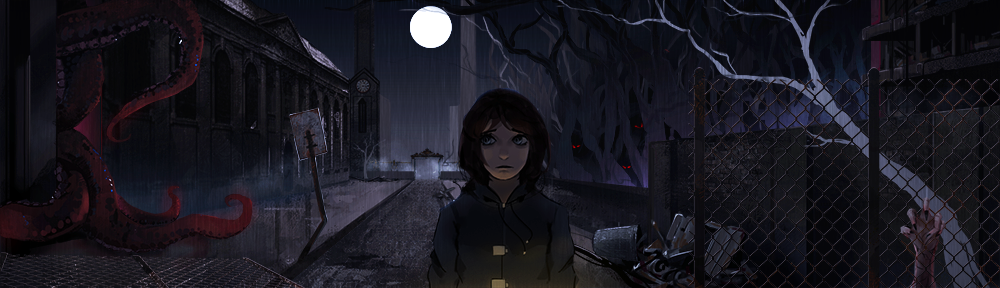
placid island; black infinity – 2-1.19

Content Warnings

Gore
Description of torture
Dead animals / butchery of animals


Previous Chapter Next Chapter

Too much of the night was left for me to while it all away staring into the darkness, especially when the darkness wasn’t staring back. Kimberly needed sleep too — real sleep, not whatever facsimile I’d been sucked into down on the floor. She wasn’t made of carbon fibre and borrowed memories, so I couldn’t expect her to keep me company on the balcony until my knees gave out, and I absolutely should not be doing that alone. She helped me back to my blanket, and I didn’t complain. I was really starting to miss my own bed, with my sister tucked up against me, side by side. That’s how I should have been sleeping. It’s how I should have been sleeping for the last ten years. With Heather.

Instead I had the floor and the ceiling and the pain that was still a long way from going away.

My plan needed chewing over, but the pain made it stodgy and thick, like bad pastry. Bland and too filling. When I was certain Kimberly had returned to sleep — nice smooth even breathing coming from her own blanket rolled up by the door — I considered throwing it all out. Screw the plan, get up again, sneak back into the castle. Make like my sister does, hurl all I have at the problem and hope it works out somehow.

But I’m not her. Maybe, even after all this time, I still wasn’t entirely convinced. Are you convinced? I think you probably are. I think you get it by now.

Thank you.

Don’t make me say that again.

Anyway. Not my sister. Not Heather. I lack more than just her qualities; I also lack her flaws. So I stayed put and stuck to the beginnings of my plan.

Eventually I fell asleep again, despite the pain. Or maybe because of the pain, because the sleep wasn’t any good. Dreams are bad when pain is so total. I dreamed about Briar, and she was very bad (but not in the fun way.)

(Bitch, you were never fun.)

It was just a dream, with no metaphysical meddling from beyond the boundaries of sleep, but it was a very, very bad dream. Briar was skinning me alive. She had me strung up by the ankles in some ancient parish church, the windows all smashed and broken, dark ruddy light pouring in through the gaping stone holes, like the last gasp of a dying star. She used a little curved knife to part my skin from my muscles, then pulled downward, yanking strips off me, cramming each bloody fillet into her maw. Her digestion was a furnace, throbbing crimson through her flesh, consuming each stolen fragment of me faster than she could savour them. She got no pleasure from the process, but she kept going anyway, had to feed the fires. Took chunks out of my belly, my left leg, my right hand and forearm, my scalp and skull and eyes, digging and gouging and eating and chewing and burning.

I came up for air once or twice, spluttering awake, gasping or whining or something worse, patting my face to make sure it was still there. But the dream was just a dream, no trickery from Briar. She wasn’t hiding in the corners of the room or looming over me. This was a solo effort. A Maisie Morell special. Doing it to myself.

(Too much like my sister, I know.)

The third time I went under it was the same dream again, monotonous and meaningless. But then Briar backed away from me, melting into the air as she turned and fled. A deep vibration, like a tiger’s purr, made her fade away and vanish, just dream-stuff after all.

The dream-wounds closed up. My skin regrew. The hurt stuttered, stopped, shrank. The ropes that held me by the ankles slipped loose, and I floated to the floor. I lay there, letting that purr wash over me. The dream was no longer quite so shit.

I woke a third time. Tenny was snuggled up against my side, tucked beneath my blanket, purring away.

Tenny’s purr is a beautiful sound, like a cross between a big cat and the smoothest of engines, a deep, powerful, feathery trill from inside her chest, independent of her breathing, a bigger sound than her body can hold. The vibrations passed from her flesh to mine, or at least into whatever I was using instead of flesh. The pain ebbed away, like blood soaking into dry soil. Tenny had dozens of tentacles out, extended from beneath the roots of her wings; some were wrapped around my bandaged right arm, others lay across my wounded belly, coiled under my bloodstained t-shirt, while several cushioned my skull. Wherever she touched, the pain retreated, waves swallowed into the pattern of her purring.

Tenny Lilburne is better than any over-the-counter painkillers, maybe better than codeine, perhaps even superior to morphine (especially for me, what with no real veins to carry the payload).

(I love you, Tenny. We all love you. You’re going to go so far.)

“ … Tenns?” I croaked, but she was fast asleep, head nuzzled into my shoulder. “Tenny … Tenn … ”

A small face with bright pink eyes appeared over Tenny’s shoulder, like twin stars cresting the moon; Casma, finger to her lips. Her expression was infuriatingly complicated, but I looked for long enough to understand that this hadn’t been her idea, and that it was best to let sleeping Tennys lie.

Casma watched until I closed my eyes. I heard the rustle of her lying back. Tenny purred on. Pain stayed away.

I dreamed of Tenny, twenty stories tall, more moth than humanoid, dancing in the air.

Morning came slow and rough and nasty, and none of those in the fun way. The thick grey cloud cover over the castle — over the whole of this strange crack of a dimension — didn’t bloom with orange dawn as before; desultory light oozed across the sky, sunrise seen through a veil of watery milk and dusty curtains, a stain spreading through old cloth. For the first time since we’d arrived in this dimension, I felt the cold, enough to stay beneath my blankets while the others got up and stretched.

“Maisie?” Kimberly said, bleary-eyed as she leaned over me. “Maisie, if you need to sleep more, you can, you should. In fact, I think … I think you probably should do. That’s it, that’s … that’s good. Yes, close your eyes.”

No arguments there. I lay on my back and dozed while the others talked in low voices, so as not to wake me. Muadhnait went through the contents of her pack, field-stripping her crossbow and putting it back together again. Casma and Tenny swapped soft murmurs; Tenny kept several tentacles wrapped around my right arm, and I kept them close to my heart. Kimberly said I had a plan, and the plan needed the fairies’ help, and it was probably better that I explain it in full, because she would just trip over the details.

(No you wouldn’t, Kim. You knew more than I did. I was making it up as I went along.)

Muadhnait cooked more oats, over a fire made from bits of old furniture. The smell tugged me all the way awake at last, though I hate oats. For the first time in days I was hungry — truly hungry, like my belly was a hole I needed to fill, with something other than Briar’s golden parasite. Tenny and Casma helped me to sit up, get me propped against the wall with the blanket around my knees and chest. I stared at the oats. Treacherous saliva gathered in my mouth with sticky insistence.

During my initial ‘rehabilitation’, the Good Doctor Martense had made it clear I didn’t need food. Nutrients, water, oxygen, a certain temperature range, even pressure — my body didn’t require any of those things to keep me existing. I could go for a space-walk without a suit and I’d be just fine. But she’d also impressed upon me that it was a good idea to eat and drink anyway. Why? Why waste resources, when I didn’t need them?

Because eggs for breakfast taste good. Because water cools and lubricates. Because a bar of chocolate is a nice little treat for a good girl (or a bad girl, in my case). Because I’m not a robot.

I didn’t ask for any oats though, not even when Muadhnait offered me some. We were low on food. Oats taste like wet cardboard. Give me chocolate cereal any day.

For what felt like most of an hour, we did nothing, sitting around confined by the limits of the once-grand suite, waiting for one of our fairy contacts to show up so we could get down to the business of planning our plans and plotting a murder. Kimberly searched the room for anything useful, turning up dust and cobwebs and not a single friendly spider. Casma and Tenny stayed close to me, playing some complex game on the floor with bits of Muadhnait’s chalk. I managed to get to my feet, which was deliciously liberating, then claimed one of the chairs for myself, re-establishing my blanket mode from my new vantage point. I watched the game Tenny and Casma were playing, but it was beyond me, unless I wanted to burn more memories so I could understand the rules, and why Casma kept drawing little cartoony versions of Tenny in some of the squares.

Only Muadhnait seemed totally loose and hollow. She closed her eyes for a bit, apparently trying to meditate, but then abandoned the attempt, staring into space, cold iron sword held across her lap.

“Muadhnait,” I croaked, after watching her for a while. “Muadhnait. Nun knight. Hey.”

“Mm?” That broke her trance, but only the surface tension. “Miss Maisie?”

“You’re not okay. Okay to be not okay.”

Muadhnait nodded. “An accurate assessment.”

Casma looked up from the game with Tenny. “Miss Muadhnait, Muadhnait the Miss, I wanted to say, or say I wanted, to say that your voice is really pretty. It’s a shame you couldn’t use it earlier, but using it might have made you less usable. Is that right?”

Muadhnait stared at Casma. So I did, because that was worse than her usual. I couldn’t follow it either.

Casma giggled, a hand over her mouth. “Sorry! Sorry. This whole situation has me sort of nerved out, and it makes it harder to speak clearly. Clear speaking would be easier with clear hearts.” She beamed at Muadhnait. “Your voice is pretty. That’s all I want to say!”

“ … uh … thank you,” said Muadhnait.

“Your face is pretty too,” Casma went on, “but that’s not a fair thing to say to somebody who was hiding their fairness, so I didn’t start with it. But I’ll chase with it, because you weren’t hiding it for the sake of hiding, only for safety. But you’re safe with us now!”

Muadhnait’s eyes were a thousand miles away. Casma was not helping, as Casma usually did not.

“Casma,” I croaked. “Shut—”

“Up!” Casma finished — and turned those bright pink eyes on me, burning with something like conviction, but too complex for me to unravel when still in so much lingering pain.

How to explain to Casma what Muadhnait was going through? Not the missing sister, or the having her helmet forcefully removed, or even the whole thing about getting thrown into a pit to witness a mad doll carve open her own belly.

How to explain to Casma that Muadhnait was probably having a religious crisis, now that the other crises were on pause?

Casma narrowed her pink eyes at me, then turned back to Muadhnait.

“My mum’s a god,” she said.

Muadhnait blinked. Her eyes were so heavy and bag-ridden she may as well not have slept at all. “I’m … sorry? Pardon?”

“For a certain definition of ‘god’,” Casma rattled right on. “And that’s a huge question, isn’t it? For the sake of this conversation though, let’s agree to define ‘a god’ as anything with a total or near-total level of metaphysical control over their dimension. So, my mum’s a god.”

Muadhnait glanced to me, maybe for help. I shrugged with one shoulder, which was the minimal amount of hurt I could generate. “Sure,” I croaked. “Eileen is a god. Godlike enough. Not liked, though.”

“That’s right!” Casma said. “My mum hurt a lot of people, by being a god, before she understood what it was like to be godlike. Some of them forgave her, like Maisie’s twin sister did, but that’s because she’s kind of her mum too. But lots of them didn’t, and that’s no reason to blame anybody.”

Muadhnait glanced at me again. “Your mother is—”

“Not my mother,” I said. “Not mine.”

Casma said, “Apparently she hurt me too, but that was before I was me, and I don’t remember it, so it’s like hurting me in the womb. Which is also bad, but a bit different, because she didn’t know that I was going to be, or that I had not yet ceased to become. Does that make sense?”

“Casma,” I croaked.

Casma giggled. “It doesn’t, but Muadhnait still understands. Don’t you, Muadhnait?”

Muadhnait blinked slowly. “Maybe?”

Tenny was looking away from the game as well now, tentacles gone quite still, big black eyes watching Casma closely. Kimberly straightened up from her search of the room, still empty handed.

“But your god, Muadhnait,” Casma carried on, “she’s not your mum, or your grandmum, or anything like that. Seems like she’s more of a kidnapper. Do you think you owe her something? Or anything? Or nothing?”

Muadhnait stared at the question, then slowly looked away, into the still-hot ashes of the fire she’d made in the middle of the floor.

“That’s a rhetorical question, by the way,” Casma added. “That means I don’t expect an answer. And I shouldn’t. It’s yours to answer. Or not. As you should.”

Muadhnait nodded. “Right.”

I had no idea how that was supposed to help, but then again I’d never believed in any god but my sister. Muadhnait stared into the remains of the fire, chewing on her bottom lip. Casma opened her mouth a couple of times, closing it again when she came to a similar conclusion as me. Tenny looked from one to the other, tentacles beginning to wiggle and waggle as she thought faster.

“You don’t owe anything,” Kimberly said.

Everyone (including me) looked at her. But unlike usual, Kimberly didn’t quail and quiver under the attention. She stared right at Muadhnait, eyes hard and wide. For her there was nobody else in the room. I’d never seen Kimberly like this before.

“You don’t owe anything to a god that isn’t worthy of the name,” Kimberly said. “And anything that claims to be a god, or receiving a message from god, is always the opposite. Whatever it was, it’s not a god.”

Muadhnait stared, as if Kimberly had suggested setting us all on fire — then nodded slowly.

The moment broke, and so did Kimberly’s courage. She smiled awkwardly, cleared her throat, and fought to keep a blush off her cheeks. She covered for it by turning back to the room, feeling for secret passages like we were all in an episode of Scooby-Doo.

Muadhnait’s eyes looked maybe two percent less hollow. She drew her cold iron sword and set about cleaning, wiping, and oiling the metal.

(Well done, my knightly nun. It’s a hard hole to dig yourself out of, isn’t it?)

Tenny and Casma returned to their game. I watched it for a bit, but there was too much mathematics involved for my empty doll’s head to get itself around. Kimberly sat back down on the end of the ancient, collapsed bed, warming herself before the last of the fire. I shifted in my chair to catch some of that heat as well. I even stuck out my wounded feet, so the warmth would seep through the bandages. A few spires and turrets of the castle’s body were just visible through the open windows, beyond the balcony; they started to darken in long speckled streaks. It was raining.

English weather had followed us. Typical.

Before morning could turn mid, Calderon showed us his bristled face. He knocked on the door of the chamber with the head of his cane, in an overcomplicated rat-a-tat-tat pattern, to let us know it was him. We all knew it was him already; we’d heard him clomping down the corridor. Hard to walk quietly when you’ve got hooves for feet.

Once he had slipped his generous and bulky self inside and closed the door after him, he doffed his hat and bid us good morning, ladies, good morning. He looked exactly the same as he had on the previous evening; I wondered in a dull sort of way if the fairies slept and ate and all that stuff, or if they just existed outside those limits, like characters in a story.

“And now,” he carried on, after receiving a muted chorus of greetings in return. “I apologise for getting down to business so quickly, but I must once again put to you fair ladies and gallant gentlemen … ” He paused in his bleating. “Ah, but there are no gentlemen here? Unless, of course?” He gestured at Tenny with his hat.

“Noooope,” Tenny trilled. “Girl!”

“My apologies, young madam,” Calderon resumed without breaking his stride. “Then, fair ladies! I must once again put to you my heart’s chief-most plea, my pitiful request, my petition at the feet of your throne! It is also the only way for you to return home. Margaret, the magician who holds together the axis of all the tapestries here — will you slay her, for our sake?”

“Where’s Mave?” I croaked.

Calderon blinked, flow broken. “Still … uh … rereading your sister’s tale, I believe. She searches for clues in the text. Don’t let our Mave fool you, she is less foolish than she may appear. Now, please, Lady Kimberly, will you not reconsider your previous decision? Will you not—”

“I need paper,” I said. “Lots of it. Enough for a book, book it. And writing implements, to implement this death.”

Calderon stared at me, his big bushy beard drooping. “Paper? What … whatever for?”

“The mage,” I said. “She eats stories, doesn’t she? Chews them up and spits them out. Something like that. I saw that room.”

Beneath his bright beard and curly hair, Calderon went pale. His eyes widened. “You are going to … join us?! Go through the process of becoming one of us? Why?! Why would you want that? Did you not hear a word I said last night?! Can you not see—”

“It’s just a ploy,” I said. “Deployed to get close. I write a book. You get me in a room with her. Clear the way for everyone else. That’s how we’re going to do it.”

Calderon shook his head. “If you feed her even a scrap of your creative self, she will take the whole, like scooping out a shellfish once the shell is breached!” He made a particularly disgusting gesture with one hand. “Using yourself as bait is too risky. Yes, yes, I know, I know, I am already asking you to put your lives at risk, but … but I would not ask anybody to risk our everlasting fate.”

Kimberly cleared her throat. “Maisie, maybe he has a point, maybe—”

“Can she be tricked with a fake book, then?” I asked. “Faked out with a blank?”

No point in trying, but plenty of point in asking. My plan was another layer deep. Had to keep digging.

Calderon sighed, shaking his head. “She can scent the authenticity of a tale, long before it is presented to her. You would not convince her with a blank book. The only way to get close would be with a genuine fragment of real soul, transcribed onto the page.”

“Brrrrt,” Tenny trilled softly.

“I’s okay,” I said. “I know what I’m doing. Doing what I know.”

“May-Mays,” Casma said. “Maybe there’s another way? A way that doesn’t involve giving you away?”

“It’s fine,” I said. “I won’t be going anywhere.”

“My sister,” Muadhnait said to Calderon. “Has she already undergone this terrible bargain?”

Calderon shook his head. “Only the initial stages. Your interruption yesterday was fortuitously timed. She is due to present her completed manuscript again this evening. Margaret usually sleeps during the day. Her age, I believe, predisposes her to that.”

“Perfect,” I said. “We’ll do it then.”

“Maisie,” Kimberly repeated. “Maisie, I’m not so sure about this.”

“I am,” I said. “I’m sure in the one thing I’m sure about.”

Calderon drew himself up. He cast his eyes around the room, as if searching for further objections. But nobody spoke, nobody dared to believe that I was wrong about this specific and particular element.

“Very well,” Calderon said. “Writing materials. Will a blank tome suffice? I can secure one within the hour.”

“Great. Do it.”

“May-May,” Casma repeated.

“It’ll be fine. You know what I’m doing.”

“And if the plan goes all fucky-wucky?” Casma asked.

(Tenny echoed that ‘fucky-wucky’ under her breath. Oops.)

“Then she’ll read something else,” I said. “I know what I’m doing. I’ll do what I know. What I know better than anybody.”

Then I told them the real plan, the plan beneath the plan, the one I hadn’t planned until Calderon was there, because I had to be sure it would work, and that depended on how Margaret worked, and I didn’t even know her, other than as an eater of tales. I had to be certain she would try to swallow this one.

Calderon told me it would work. Then he went to fetch that blank tome, so I could fill it with words.

He wasn’t gone for long — maybe twenty minutes, though nobody was counting, because the battery on my phone was almost out. That was good, because everyone was restless and bored and cooped up in that room. Except for me, because I was content to sit and move as little as possible, while bits of me tried to re-knit themselves back into the semblance of a girl.

Calderon returned with a big blank book, several pots of ink, and a metal-nibbed dipping pen.

“I can provide more ink!” he said. “As much as you need, though I doubt you will, unless you can somehow fill that whole book before nightfall.” He paused. “Can you, my lady?”

“I won’t. Don’t need to. Just enough to get the job done. Done before the job’s done.”

“Maisie can scribble fast!” Casma said.

“How do you know?” I squinted at her. “You’ve never seen me write.”

Casma just smiled, and suddenly I knew she had.

We were getting me settled — book open in my lap, inkwell on an adjacent chair, pen in bandaged hand — when the Pale Doll made its return. It swung in through the window in near-total silence, like a huge pale ape coming down out of a dying forest canopy, announced by the tap of wooden feet on the floor. Kimberly screamed (not too loudly, bless you Kim), and Tenny went all bristles and hissing, tentacles suddenly everywhere. Casma clapped politely. Muadhnait barely reacted at all — until the Doll held up its prize in one wooden fist. A brace of dead rabbits, freshly killed. Then, Muadhnait was the only one not squeamish about accepting the rewards of the hunt.

Rabbits, Outside? I’d ceased to question; what was the point?

“Well done,” I said to the doll. “Well done and thank you. I made the right decision with you. Decided you right.”

The Pale Doll stared at me with all those painted eyes, body dripping with rainwater. Then it sank down in the corner, squatting like a gorilla, job done.

“Uhhhh.” Kimberly stared at the three dead rabbits as Muadhnait held them up for inspection. They had a little blood on their faces, but not much. “This is … this is good? I think?”

“S’meat,” I croaked. “Told you so. So I told you.”

“Y-yes, that’s— that’s … wonderful. T-thank you, um … does it have a name, Maisie?”

I shrugged. The Doll didn’t respond.

“Not yet, I guess,” I said. “Unless it wants one.”

“And … Muadhnait,” Kimberly said. “Do you know how to … I mean, can you … ?”

Muadhnait nodded. “I can skin and gut rabbits. You don’t have to watch, if you would prefer not.”

I spent that whole day writing, filling an empty tome with words, punctuating passages with little naps in the chair, hoping that by sundown both me and the book would be ready. The story did not need to end, and I would not need to run, but we both had to walk to make this credible. Credibility would be everything. Margaret the mage had to buy my bullshit.

The physical act of writing was not easy; my left hand was uninjured, but I’m not like my sister, I can’t swap pen from tentacle to tentacle. Right it was, and my right was wrapped in bandages. The pen slipped, my muscles cramped, and the script was more cramped still. But I stuck at the words. The words themselves were easy. I knew them by heart.

Muadhnait took over a corner of the suite to deal with the rabbits. She knew exactly what to do, had their skins off and the inedible parts out in under five minutes each. She used my kitchen knife to butcher and prep them — a first blooding with real blood, rather than the fake stuff that came out of me and the fairies. Once she was done she carefully cleaned the knife and put it back within my reach, on the chair next to the inkwell. The chunks of rabbit went into her cooking pot over a rekindled fire; Calderon provided more firewood, filched from elsewhere in the castle. A handful of oats gave the stew some body. The whole room filled with a meaty smell, washing away the scent of blood, making my mouth water so hard that I almost drooled on the page.

(Drip, drip, drip.)

Kimberly, Casma, and Tenny were very thankful for the meat. Kimberly ate like a starving woman. I ate like a doll, but I did eat, because I’d never eaten rabbit, and I felt like I’d never eaten before. Rabbit meat and chewy oats, unseasoned and barely salted, but it tasted like the fruit of knowledge. Went down greasy and thick, made my insides feel like a furnace that finally had nothing to do with Briar.

I wrote, and wrote, and wrote. Did my best not to smear the words. When I got too tired, I napped where I sat, and the others would quieten down. Tenny and Casma made their game more complicated, ended up covering an entire wall in chalky scribbles. For want of anything else to do, Kimberly joined in with them, though I got the impression she understood even less than me.

Calderon didn’t stay. After he and I and Kimberly and Muadhnait had discussed the part of the plan that involved fucking with the lights, he excused himself and left, saying he needed to keep up appearances. He would return for me about fifteen minutes before sunset, and then we would put the plan into action.

(Or would we, Cal? You had no idea what you were getting into. You didn’t know her like I do. You didn’t know her at all.)

Muadhnait didn’t join in with the Casma-and-Tenny game. She cleaned both her swords, went through her pack, and sat within speaking distance of me — though neither of us said anything, since she had nothing to say, and I was too busy going scribble, scribble, scribble.

I wrote. I napped. We ate. The soft murmur of voices kept me company. The chill air from outdoors was kept at bay by the low fire in the middle of the room. When I napped and woke and the pain was fresh, Tenny was there to hold my wounds and purr. When I was hungry, we had leftover meat. I drank more water, and it went nowhere. All used up by my new-found processes.

Halfway through the afternoon, as I was pausing in the work and stretching the muscles of my bandaged right hand, I realised.

This — this space, with people I knew, this warm room surrounded by others.

Was this what I’d been looking for?

Why had I thought I’d needed an adventure? Why could I only define myself by going off on some quest without my sister at my side? The journey across the landscape, the shared dream with Briar, penetrating the castle, the confrontation with the mage — what was the point of it all, compared with this? Yes, fine, I was wounded, I was tired, I wanted my sister, I needed my bed, I would rather be on the computer watching anime or looking at cartoon girls with their tits out. But this was—

Nice?

It was nice. How disgustingly bland can I get? Worse than oats.

With my sister I had only a mirror — a mirror with slight differences, that never showed me in the reflection. A mirror that lied and said I didn’t exist, that I was only a shadow engulfed by my sister’s story, a footnote at the end, defined by my power to speak her name and end the tale.

And out here — what had I been trying to define myself against? Hills and forests and castles and fairies?

To these things I was not Maisie Morell. I was a role, no different to my sister.

But with Kimberly and Tenny and Casma, I was not Heather. I was me.

And Muadhnait had never met my sister.

I must have been staring into space for quite a while, pen hovering over the page, mouth slack, eyes glassy, hearing but not comprehending the murmurs from the other side of the room.

Because Muadhnait said, “Miss Maisie?”

“Mm?” I swallowed and blinked and came around. “Mm. That’s me.”

Muadhnait was seated cross-legged on the floor, not far from me, so she didn’t have to crane her neck to see my face. “Are you growing tired again? We have at least another four hours until sunset. If you want to nap, you should take the opportunity.”

I shook my head. “Not tired. Just thinking. Thinking too much.” I paused. “Or maybe I’m thinking just the right amount now, and I wasn’t thinking enough before. Wrinkling my brains at last. Though inside my head it’s smooth as anything else.”

Muadhnait considered this for a moment, then said, “May I ask you a question?”

“Mm?”

“This plan you’ve made, it has several layers. But if the first two layers fail, then your victory relies on your sister, yes? Heather Morell?”

“Not entirely. Entirely not. Not anymore. No more than me.” I lowered my eyes to the page, covered in my handwriting, all loopy and big and messy, best I could do with the bandages. “There are more layers to this now. Layered to unlay the mage. If one doesn’t get her, another one will. Maybe the biggest of them all. Can’t resist a peek, that one.”

Muadhnait made a low sound in her throat. “I wish I could share your faith. I wish I still had faith in anything.”

“You will,” I said.

Muadhnait raised an eyebrow at me. I smiled, and this time it wasn’t the kind to make anybody flinch.

“I will?” she asked.

“In Heather,” I said. “She has that effect on people. None of us are immune. Not even gods.”

Muadhnait looked away. “I hope you are correct, Miss Maisie.”

“When it comes to my sister, I’m always right. I’m shit about most things otherwise. But her? Can’t go wrong. Wrong is right. With her and me, up is down and black is white.”

“You riddle at me again.” Muadhnait almost smiled. “Half the time I cannot understand you.”

“Let’s hope the mage thinks so too.”

Muadhnait’s smile won.

Calderon returned as the sun was going down, or as the thing-that-served-the-role-of-the-sun was retreating behind the curve of the landscape for another day. I wondered if it ever refused to move, and hung in the sky until some other vast entity went up there to poke it in the side. But this day it dipped obediently toward the horizon, and the clatter of hooves announced that our time was up.

We were ready to go. Muadhnait was re-packed and up on her feet, crossbow in her gauntlets. Kimberly was breathing deeply to swallow her jitters. Casma and Tenny were holding hands. Tenny had stretched out her wings.

I had my kitchen knife in my waistband, wrapped in the maid-pattern tea-towel, and my manuscript under my arm. I was still bandaged and battered and bloody and bruised, but a day of rest had done good for my boneless body, and standing was made possible by pain and willpower.

Calderon brought help — Mave, lurking in the corridor, ready to guide the others in my wake. We would clear the way, distract the Audience, and make sure all eyes were on us. And then Kimberly and Muadhnait would unlayer the most obvious layer of the plan.

Calderon had brought something for me as well. He held it out in one big meaty fist. A walking cane, slender and elegant and old, coiled like a living vine, carved from dark wood.

“I have so many that I have lost count,” he said. “This one is from some three or four dozen or years ago, and I cannot recall why I put it aside. All my stories bleed into each other now, and this … lost all meaning to me. So, here, you take it, young Lady Morell. If it helps you slay our jailer, then perhaps it will find new life.”

He demonstrated the way to twist the handle, to unlatch the hidden mechanism. The sword on the inside was no stage prop; it shone in the dusk, silver like moonlight, sharp enough to cut a grain of dust.

“I’ve got my knife,” I said. “Knifed pretty well with it, earlier.”

Calderon’s eyes twinkled. “It can never hurt to have more than one blade about your person. You never know when you might need to cast one aside.”

He held it out again. I took it in my left hand, because the pressure on my right would hurt. It was light as a feather and seemed to want to jump in my grip.

“Mm,” I grunted. “Walking’s gonna be hard. A cane. Sure.”

Calderon nodded, clapped his hands, and looked up at our assembled crew. “Ladies, are we ready?”

We were.

“Take me to my audience,” I said. “Time for the show. Show’s on time. Time to show off.”

And what did I have to show for myself, scribbled down in that book under my arm?

Want me to show you?

Previous Chapter Next Chapter


And there she goes, off our pages and into her own. Whatever story Maisie has scribbled, I’m sure she’ll be back to show us the tale, all in good time.

Well! This feels very strange. An official ending to the arc, certainly, but a cliffhanger for the rest of the story to come. Even though I am committed to the hiatus and a reworking of the Katalepsis sequel, it still feels very odd, almost unnatural. I will miss Maisie dearly, no matter how committed I am to bringing her back once she and all the others are ready again. Whatever happens next, Eusebeia Epoche, Katalepsis Book Two, will return in some new form in the future.

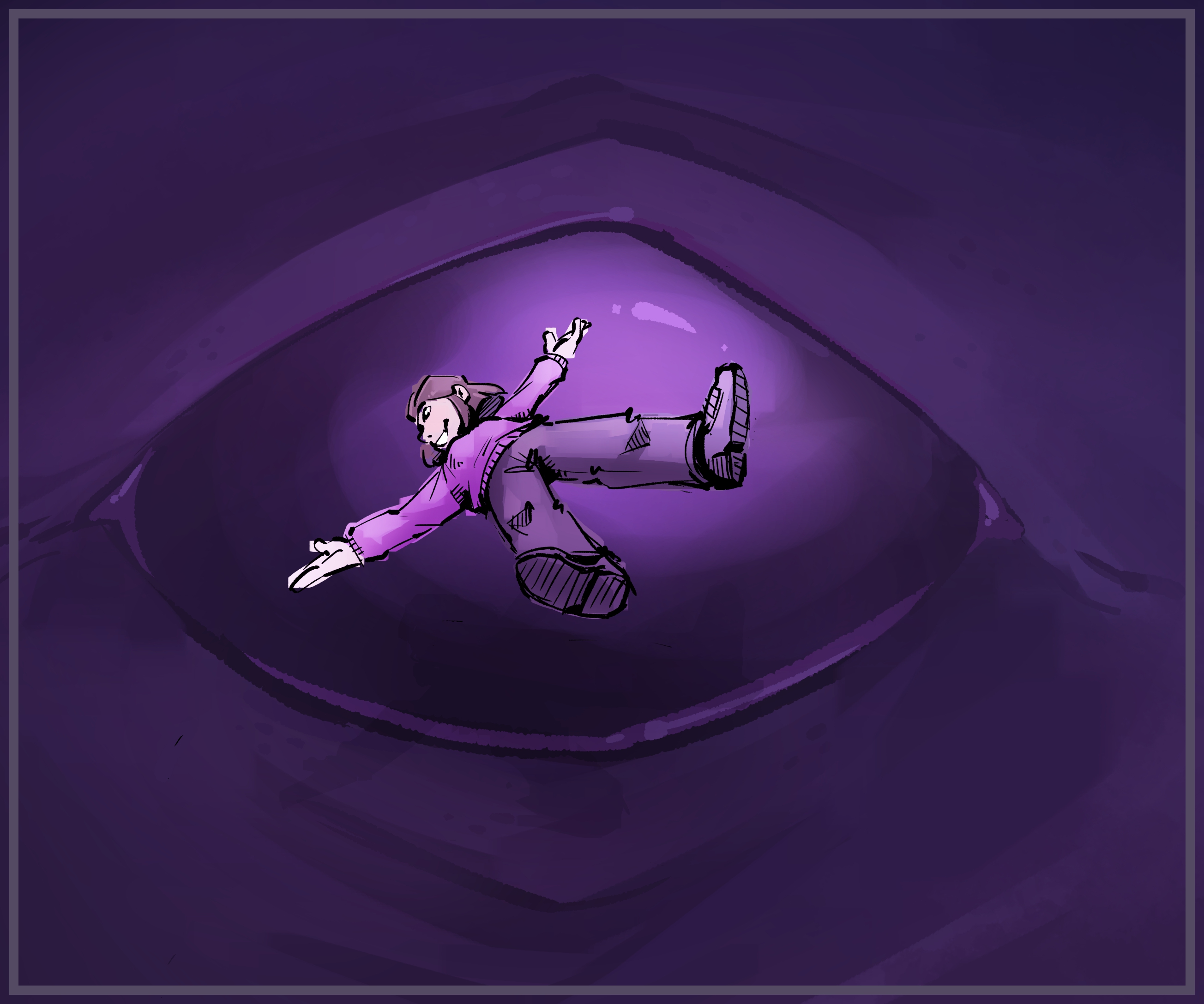
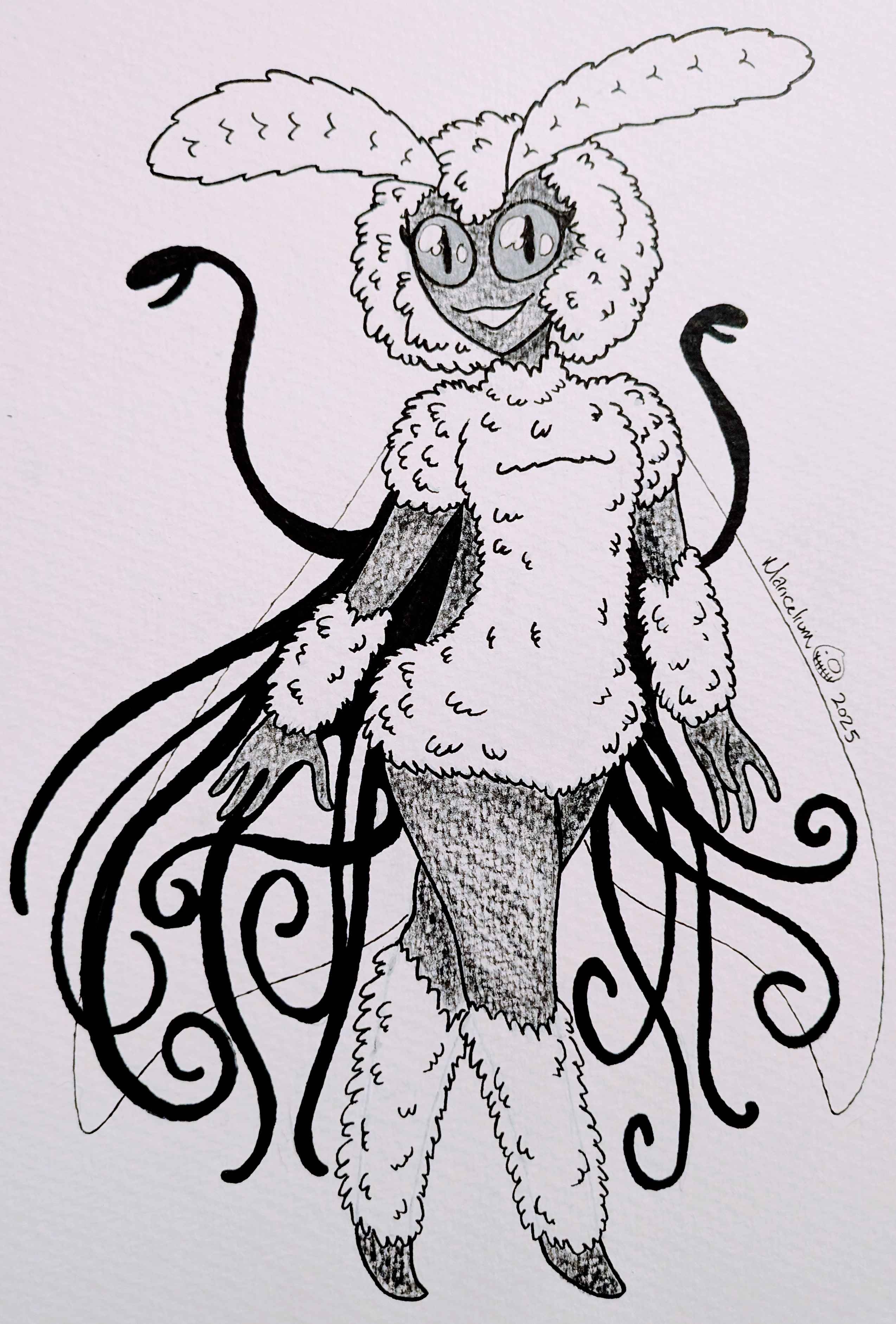
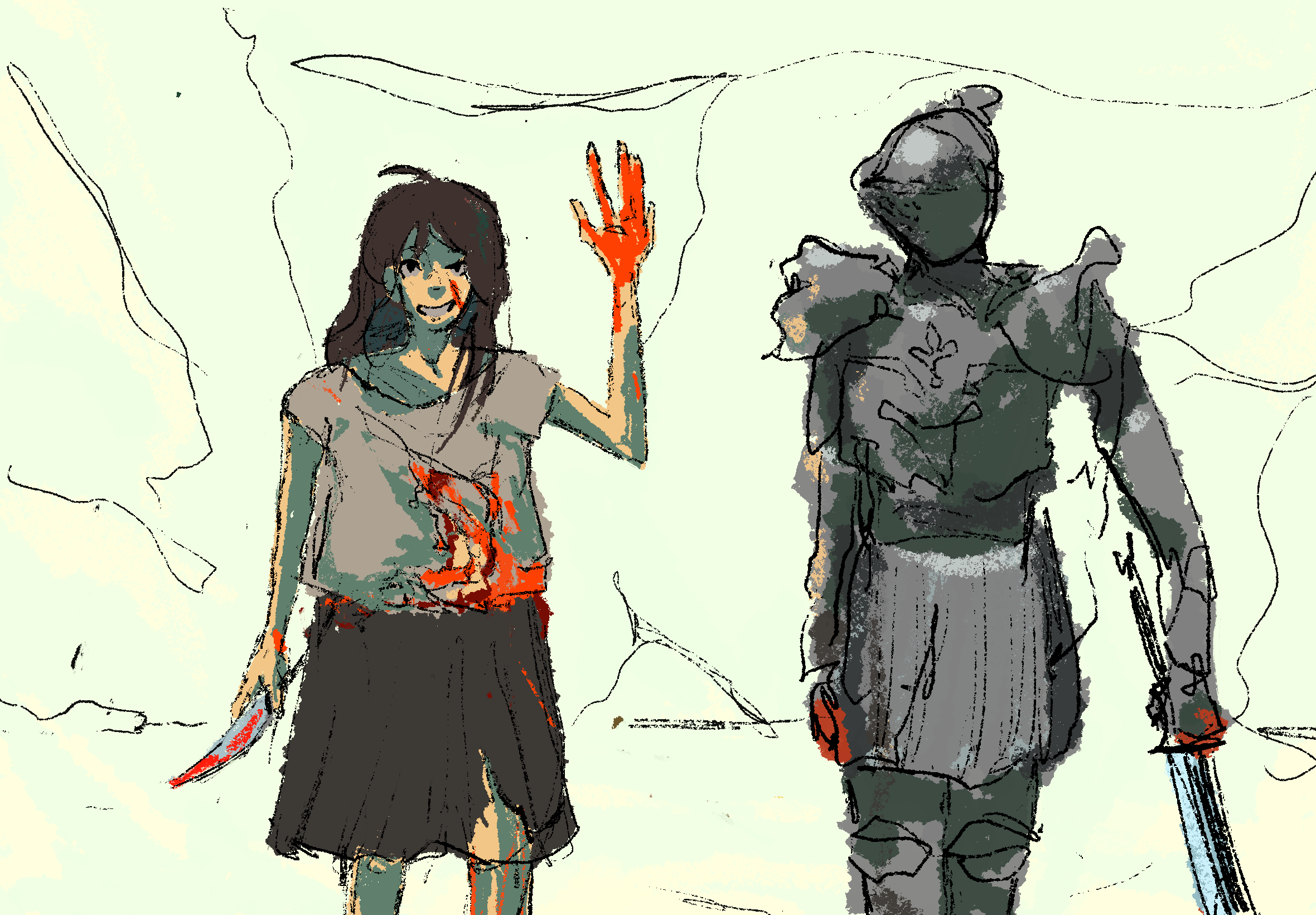
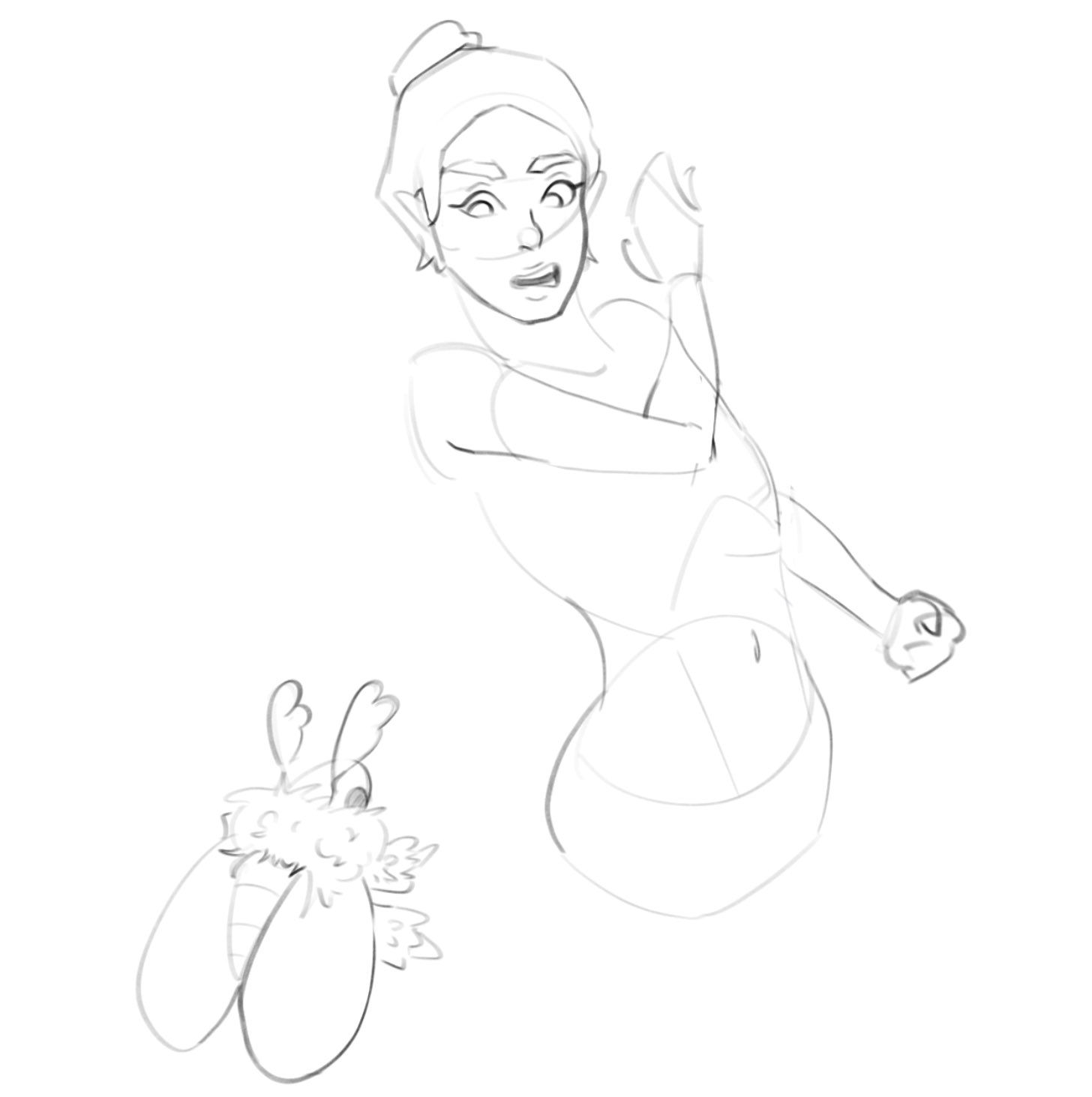
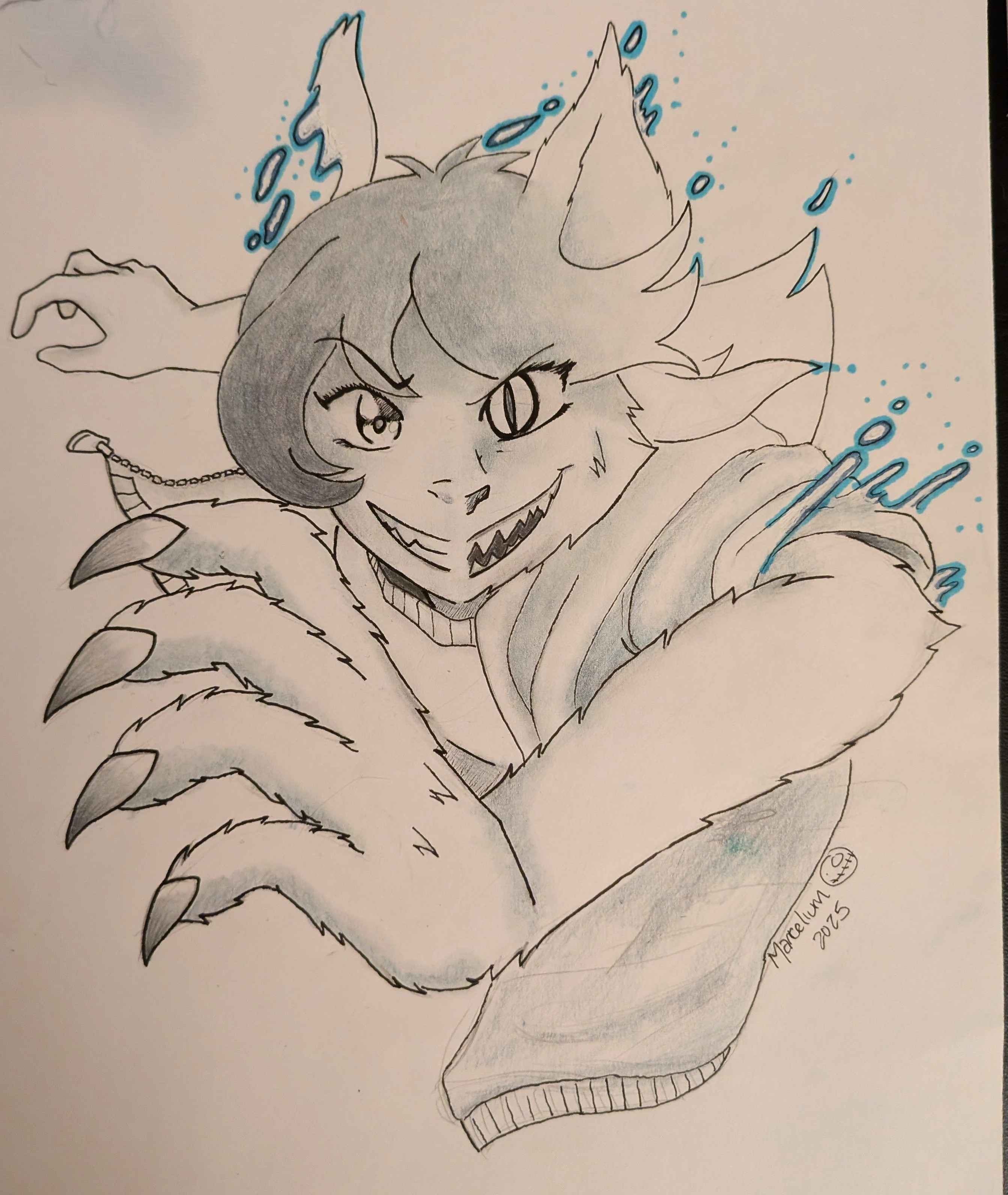
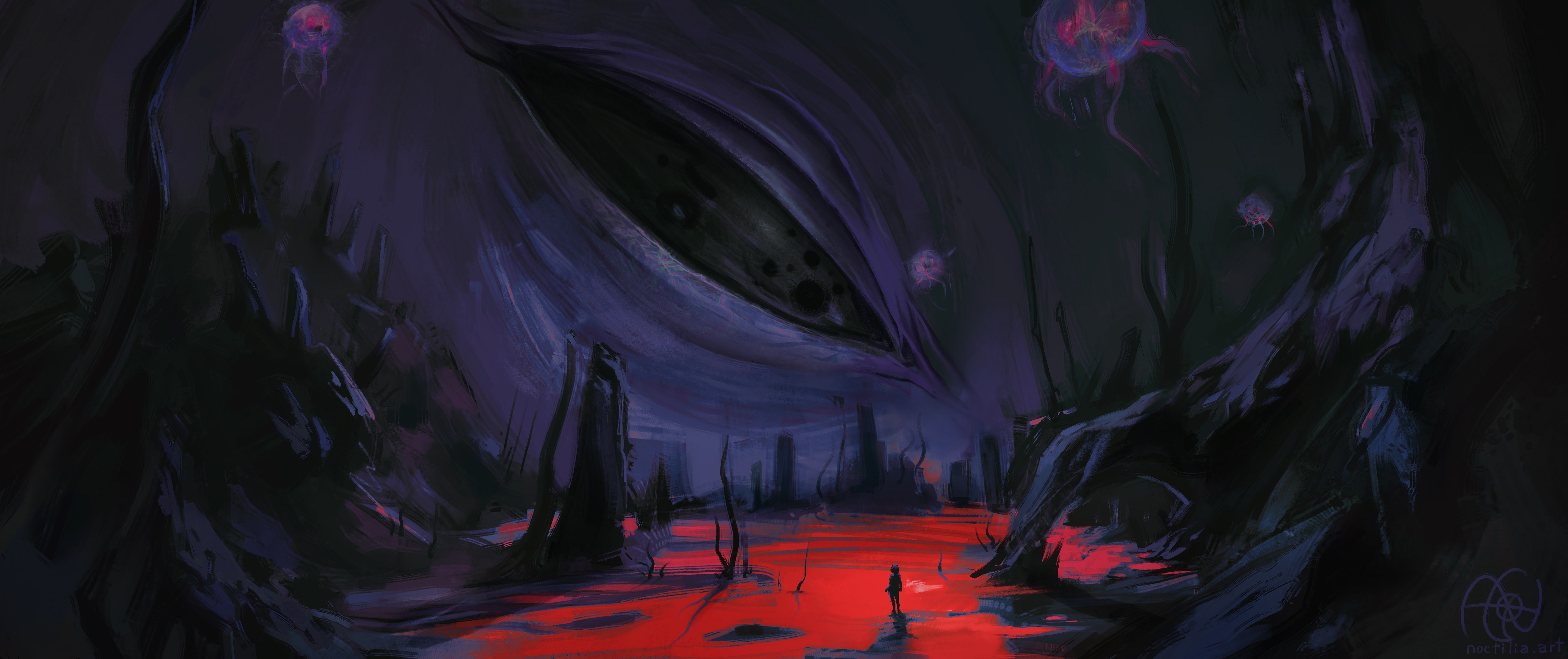
In the meantime, I’ve got a final (final? Nay! For there will be more, I’m sure) batch of fanart to share with you all, from over on the discord. We have this wonderful little illustration of Heather falling into the Eye, (by Brack), and then this extremely fluffy version of Tenny, (by Maricelium). There’s also a whole bunch of new memes over on the memes page, for those of you who enjoy being silly (because I sure do). I also just want to thank everybody who has ever drawn and shared fanart for Katalepsis; I’ve always been incredibly flattered by it, seeing so many enthusiastic and talented people having fun bringing my characters and setting to life! Thank you all! And I’m sure this isn’t the end, this isn’t the last we’ll see. I’ll be keeping the fanart page updated with anything new, of course!

Obviously I shan’t be linking Patreon or TopWebFiction this week; but if you still want to vote for Katalepsis, or subscribe to my Patreon for the future, you know where to find them.

And thank you, dear readers! Thank you all for being here for this ride, even if we’ve all got to pause for a while so I can build the next section of track. I am extremely proud that so many people enjoyed Katalepsis, and I will do my absolute best to bring back Eusebeia Epoche in a new and improved form. And I couldn’t do any of it without all of you, the readers and audience (especially my Patrons!). Thank you all so much!

And now, a new story looms. I’m already working on it, and it’s looking good. For those of you who want to see more, watch this space; I’ll be launching it in just under 2 months time, with some teasers and titles and more details to come sooner! For those of you who read my other story, Necroepilogos, the usual publishing schedule will carry on as always.

Thank you all! I’ll see you soon!

placid island; black infinity – 2-1.18

I have some important news about the future of Katalepsis Book Two. I’ve written a very long publicly accessible Patreon post about it, here: https://www.patreon.com/posts/138217826

I’ll avoid repeating all the stuff from the post, it’s already super long. Here’s the bullet point version.

  • Katalepsis Book Two is going on indefinite hiatus.
  • The remaining two patreon chapters will go public today and next Saturday, like normal.
  • I will be starting a new story in 6-8 weeks time.
  • Necroepilogos (my other story) is unaffected by any of this, and will continue as normal.

I’m really sorry that I’ve had to do this. This is one of the most difficult creative decisions I’ve ever made. I also want to apologise to everybody who looks forward to the Katalepsis chapter on Saturdays; I know it’s a big part of many reader’s weekends. Right up until yesterday morning I was determined to avert this, but, well, the Patreon post explains all my reasons and what’s been going on behind the scenes of the story. For those of you who don’t want to go digging through a very long explanation, the super-short version is that the story is simply not working in its current form, for some very complex structural reasons behind the scenes, and I need to make a clean break in order to go back to the drawing board with the hopes of returning to it in the future. This is nobody’s fault but mine! I want to be super clear about that. You are the most wonderful audience a writer could hope for, I could not do any of this without all of you, and I very much hope that you’ll stick around for my future projects and what I have coming up next.

Content Warnings

None this chapter.


Previous Chapter Next Chapter

And lo! Heather Morell — ‘homo abyssus’, the squid-girl of Sharrowford, the nine-in-one and one-as-nine, opener of the Eye, favoured of the Yellow King, little watcher hailing from Earth’s (not-so) rainiest island, and sometimes still a Reading girl at heart — appeared before the gathered lost souls, in a rainbow starburst of radiant tentacles.

She solved all the problems, murdered or exiled or befriended all the problem-causers, gave succour and sanctuary and safe harbour to all who needed it, and then took everyone home in time for tea.

That’s it. Story’s over.

The End.

Maybe you’d believe all that if I padded it out a bit more. If I could only bring myself to bullshit enough detail. I could tell you that she turned up and hurled a hug at me, her eyes full of shining tears, her hands trembling as she clasped them around my back. Would you believe it went down that way? You’d like to see that, wouldn’t you? Heather painted through my eyes, her patterns further complicated, her mysteries re-mystified by the lens of my mind. You’d like to see her and I have a heart-to-heart, do a bit of crying together, then realise we were closer than ever before.

So would I. So don’t worry. You will.

But that’s not how it happened. Not then, there, or yet.

Nothing happened, in fact.

Standing there with my eyes screwed shut, listening to the silence of everyone’s held breath, waiting for Heather to materialise in front of us, it got old after about five seconds. But I kept going for five more. And then another five. And five. Five additional. Five.

Casma was murmuring my name, like she was trying to wake a sleepwalker without too much incidental violence. Calderon was clearing his throat and saying something about how perhaps ‘the Audience’ needed to see me directly, or that I was not their current focus, or perhaps they had not been fully convinced. Kimberly swallowed, tight and wet (not like that). Tenny let out a sad little trill that made my long-missing heart double up with ache.

My declaration that my sister and I needed to talk had not cleared the way for Heather. I had not convinced the ‘Audience’, because I couldn’t even convince myself.

Deep in my heart (or at least within the empty carbon fibre cavity next to my core) I didn’t really believe that Heather would not rescue me. That was the one article of faith I had held onto for ten years in prison. It had kept me going, kept me alive, kept me — arguably — more or less sane. Of course Heather would rescue me. She wouldn’t care if I didn’t remember the childhood she had shared with Maisie Morell. She wouldn’t give a shit that I didn’t feel like a continuation of the person who had once leapt into the Eye to save her. She wouldn’t think of me as anything but her sister; and I, the same. I knew her too well to suspect otherwise. There was no configuration of possible events that could breach that truth, no rewriting of reality that could remove that universal constant. Heather was my sister, my twin, my reflection in the mirror, the anchor of my self when all else was burned away to a crust of carbonised meat.

I could even imagine what she would say, after I voiced my fear and uncertainties — “Maisie, are any of us the person we were at ten years old?”

My cunning plan was defeated by my own faith.

“May-May? May-Maaaay?”

“Casma,” I croaked back, and opened my eyes. “Yes, I can hear you. Loud and clear. Clear off.” I frowned. “Or don’t, because I would fall over.”

Casma pulled a sad smile so overcomplicated that my sister would have spent an entire minute attempting to describe it (but I will spare you that). She leaned in close, and whispered, “I don’t think Heather’s coming yet. I don’t think it worked.”

“No shit,” I grunted.

“Shhhhhhhit,” Tenny trilled, with the exact expression of a teenager taking license from the bad language of an adult. I almost managed to smile back.

My legs were quivering with the effort of standing and my body was still a canvas of novel and exotic pains, but I didn’t sit down just then, still leaning on Casma’s arm for support, clinging to her like a vine to a tree. I swept my eyes across the clandestine gathering of humans and fairies and others less easily classifiable. Kimberly looked utterly defeated; Heather still wasn’t coming, which was the end of whatever brief hope I’d given her.

Calderon spoke up in a soft bleat. “Miss Morell, if you can indeed summon your sister to our aid, that would be most beneficial. But, lacking that, we must proceed with a plan to slay Margaret directly.”

“Heather would be more direct,” I croaked at him. “Directing us to the direct route.”

Calderon blinked. “Ah. Yes. Quite.”

Mave hissed, “I told you how she is.”

Kimberly sighed. When she spoke, her voice didn’t quiver, too sapped by exhaustion. “How many times do I have to repeat myself? I can’t do this. I’m— I’m sure it’s possible, if you had the right mage, the right person. But I’m not that right person! I know how to put demons in corpses, that’s it!”

Calderon gestured at the magical designs all over Kimberly’s torso and arms. (I still didn’t stare.) “You appear to have done a fantastic job in improvising—”

“Improvising, yes!” Kimberly snapped. “You think half of this even works?! And it’s unsustainable, and I don’t know how to kill a mage. I am sorry, but I have a prior responsibility. I will not risk the safety of Tenny and Casma. No.”

Calderon sat up straighter in his chair, but his words seemed to fail him. Tenny trilled at him, waggling her collection of random tools. Calderon looked at her and smiled a very Father Christmas smile, behind his big bushy beard.

Mave hissed like leaves on a root-choked forest floor. “Then you’ll never get out of here. You’ll never get back home if you don’t help us.”

“Can’t you take us back?” Kimberly said. “You brought us here in the first place, didn’t you?”

“Doesn’t work that way.” Mave tutted. “I was initiating a new story then. That’s how I got away with it. Try it now and … ” She trailed off with a shudder, sharp teeth grinding against each other.

The argument went around and around three or four more times, getting nowhere. Kimberly repeated her refrain of incapability. Calderon rephrased his plea for assistance. Tenny trilled, Casma murmured a word or two, Muadhnait sat in silence. Mave seethed like summer rot. And me? I sagged toward the floor, silently tugging on Casma to help me sit down, because standing was no longer an option.

I could replay this part in all the detail which I could not summon for my latest lie about my sister, word for word, line by line. I could tell you all about how the debate dribbled out, because everybody was exhausted, and a girl covered in blood was swaying on the edge of sleep in the middle of the room. But none of it mattered more than a stale fart. Nobody solved anything in that narrative cul-de-sac. Kimberly and Muadhnait extracted specific assurances from Calderon and Mave that this room was safe, for now, and that we could all comfortably pass the night there. Calderon assured himself that perhaps his plea would seem more reasonable by daylight. Mave made a vague, poorly worded, scratch-throated promise to reread the text of my sister’s story, to look for clues that might allow Sharrowford’s Own Squid-Lady to ride to our aid.

But by then, Casma was laying me on the floor, tucking me back up in my blanket, and murmuring words that I didn’t remember.

This wasn’t my story, I wasn’t in control, and Heather wasn’t coming. (Not yet, anyway.)

Rest — let alone sleep — seemed borderline obscene. I’d just pulled an otherworldly parasite out of my gut, then set a pair of metaphysical titans on each other, one of whom was my very inadvisable one-night-(or one-dream)-stand, the other of whom was a very dishy admirer from a side of reality that I wasn’t yet certain about. I had reclaimed what autonomy I had and accepted that I was also probably just the memory of a dead girl. I had been reunited with my …

family?

—and had my understanding of this whole situation upended backwards by a pair of fairies trying to stage a dimension-wide prison break, by asking us to murder a mage, a mage who had knocked me out with an afterthought of a magic spell.

And the response from my body? Go the fuck to sleep, girl. You’re cooked.

Well, why not? I’d just won this body back, hadn’t I? May as well listen to it for once.

Sleep did not actually happen, at least not to me. Pain made it impossible to drop all the way past the threshold of consciousness; I kept rubber-banding back up, trapped in a cage of throbbing wounds and an ache in my belly like some stupid bugger had cut me open and rummaged around inside. (I’m the stupid bugger, it’s me!) Every time I did manage to hold myself beneath the surface for more than a few minutes, snippets of dream emerged with me, snatches of the cold and the dark and the endless void, the primal dream that I don’t think I will ever be rid of.

I ‘slept’ like that for a while, probably longer than it felt. Two, three, four hours? Flat on my back, wrapped up in a blanket, wheezing with pain every time I instinctively tried to roll onto my side, (and forget about my front. No, really, do forget).

Eventually the pretence of sleep dropped away entirely. I found myself wrapped in the slow ache of so many different wounds, staring at the ceiling, listening to everyone else breathe in and out, in and out, in and out.

One of those was me. Breathing in and out. Despite my lack of lungs. Every breath hurt my belly.

To my left, Muadhnait was asleep flat on her back, much like me. She was still in her armour, because she was sealed into it, but now she had no helmet for a pillow, and so had substituted a rolled up blanket from her pack. She looked as tired as I felt, worn down to a stub of a person, her own narrative as sidelined as mine; did she dream of her sister, lost in the castle, lost to a mage? In the corner of the room furthest from the windows, the Pale Doll was doing something akin to sleep as well — squatting low, arms wrapped around itself, the painted eyes in the head all closed. Did it dream at all, inside that wooden head? I hope so.

On my right, Tenny and Casma were sharing a blanket again, snuggled down deep, as if in a sleeping bag. I felt a mighty spike of envy — because I should have been wrapped up in bed with Heather. And finally there was Kimberly. She was bundled up in a blanket too, sleeping close to the large ornate wooden door of the room, so close that the door would bump her if anybody tried to get in. A human tripwire.

Muadhnait’s light kernel was still burning cold green in the middle of the floor. Two massive windows lay open and empty of glass, peering out on the night and the darkness; they were more like doorways than windows, with a small stone balcony just beyond.

I needed to get my head back in the game. This wasn’t my story, but I was the only one with a sure-fire way of ending it — or was I?

Did my emotional state regarding my sister have any say in if she turned up or not? Did I have the slightest bit of input on the tone, genre, or shape of the narrative in which we had become stuck? Did I matter to the ‘Audience’? Was I the protagonist?

My head was fucked. Too much pain, not enough clarity. I rummaged for my mobile phone, found it was still in my skirt pocket, and not yet broken. I flicked through a few nice pictures, burning another precious percentage of battery life, (hello Aoi, bye Aoi), then decided that wasn’t going to help. It’s hard to feel horned up when you’re torn up.

Sitting up (ow), pushing the blanket back (ow), and getting to my feet (ow ow ow fuck ow) took maybe ten minutes, including some nice long pauses to catch my breath and brace myself for the next step of not being on the floor. When I got upright I felt surprisingly strong; there was no actual structural damage to my legs, after all. My bandaged feet were starting to ache with the distinctive pain of a wound beginning to heal, and that was interesting, because it was different to the sharp pain of a new wound.

I took one step toward the windows. I wanted to step out onto the narrow balcony of white stone and peer into the darkness.

“Maisie!?”

Kimberly. Of course.

Kimberly sat up, pushing her blanket off. She was halfway to her feet before I could even turn around properly. She had her t-shirt back on, but the short sleeves still showed the painted occult symbols running all the way to her fingertips.

“Maisie,” she hissed again. “Where are you— what are you—”

I pointed to the windows and the balcony. It was only then that I realised I had my right arm clamped across my belly, as if to hold my guts inside.

Kimberly crossed the room quickly, at my side in a heartbeat. Her hands hovered at my shoulders, not quite touching. “No no, Maisie, you can’t just … just … ”

“M’not going to leave,” I whispered back. “Just want to look. Look to want. Want for nothing.”

“Please, please just lie back … lie back down … ”

But I was already stumbling away, padding silently over to the darkness beyond the walls.

The stone balcony was tiny, a few square feet of space on which to stand and enjoy the view. The illumination from Muadhnait’s light kernel spilled out of the room and crept up the high stone bannister, but no further. Beyond that stony lip lay a becalmed sea of night, a void in which we floated, more featureless and empty than any earthly ocean. With a squint I could almost make out the lines and curves and humps and hillocks of the castle in which we were marooned, but that could have been my imagination.

Darkness — that was the only thing beyond this island, and I didn’t mean the little pool of light from the room. Briar, the fairies, the mage, whatever humans were elsewhere in this dimension, together they had made an island of narrative meaning amid this blank infinity. What had this dimension been before all those forces had arrived here? Or had they brought the darkness with them?

Or maybe that was just the pain talking.

After a moment or two it became clear that my new friend, my particular Giggling Darkness, was probably not going to show up. Had it won the fight against Briar, or lost? Was it drunk with celebration, or bleeding to death in the bowels of the castle? Or was it perhaps just feeling a little shy, lacking the courage to approach me after a more successful third attempt? Or maybe it was being polite, letting me lick my wounds until I looked pretty again. (I still looked pretty, and not despite the blood and scratches.)

I was powerless to know, let alone help.

A familiar feeling.

(Fuck this.)

Kimberly reappeared, a step or two back from the stone bannister, as if she didn’t want to interrupt, but didn’t dare leave me alone. I nodded at the space next to me, because both my hands were occupied with the simple act of propping me up against the lip of stone. Kimberly crept up to the bannister, then followed my gaze out into the darkness. I could hear her breathing, the soft susurration of air going in and out of her nose. My breathing was rougher, longer, more difficult.

“ … I keep … ” I croaked, then cleared my throat. “I keep talking to people at night, like this. Casma, then Muadhnait, now you. You too. I think it’s the Audience, doing this to us. Doing everything to us?”

“I’m sorry?” Kimberly whispered, though not as quietly as she had hissed back inside the room.

I raised my bandaged right hand and let it hang beyond the stone bannister, hoping the cool night air would seep through the fabric and soothe the throbbing.
It didn’t, but I kept it there anyway.

“Doesn’t matter,” I murmured. “Mattered.”

Kimberly watched me for a long time, and I don’t think she liked what she saw. The silence became unbearable, which was a new thing for me, because usually I didn’t care about soundless weight. Eventually I turned my head to look at her.

“I’m not going to run off again,” I whispered. “Or run out. Or run on. Okay, I might do that last one, but only because I was always doing it anyway. Any which way.”

Kimberly swallowed. Her brief courage had departed for parts unknown.

“Kim,” I said. “I’m not going off on my own again. I couldn’t even if I wanted, and I don’t want. Anyway, I can’t exactly leap off this bannister.” I gestured at the night, the darkness, and the possibly illusory outlines of castle masonry sunk into the ink. “At least not as I am, not am I as.” I paused and frowned at that one; even I didn’t get it, and it had come from my lips. “Go back to sleep. Sleep on.”

Kimberly didn’t say anything for a long time, but that awkward air of expectant waiting trailed away. She even looked somewhere other than at me — out into the dark again.

“It … ” she started, swallowed, then tried again. “It doesn’t smell like Earth. That’s what keeps getting to me, despite … or maybe because of everything else. There’s this underlying scent, everywhere. It’s a bit like the scent of old, wet, crumbling concrete, after fresh rain, when all the moss and little plants in the cracks are having a party. That’s what it smells like here. Cracked concrete, full of things that shouldn’t grow in it.”

“Mm,” I grunted. Then, because I thought she deserved a little more: “Mmhmm.”

Kimberly swallowed again. “I would ask if you’re all right, Maisie, but that seems like a really stupid question. I’m not good at this. I’m not like … well, like Heather. I’m even less like Raine. Or … or anybody, really. But … just … I’m here, if you want to talk.”

“Are you?”

“Hm? S-sorry?”

“Here,” I echoed, “if I want to talk.”

“Yes,” Kimberly said. “Yes. Of course. It’s … it’s the least I can do. I mean, it’s the only thing I can do.”

Kimberly meant ‘if you want to talk to me about the brutal self-administered termination of your unplanned eldritch parasite-pregnancy’, or perhaps ‘if you want to talk to me about the litany of wounds that currently cover your simulated body’.

“I’m attracted to you,” I said.

Kimberly cleared her throat. “I, uh, I figured that out.”

“Oh.”

Silence again, but this time Kimberly didn’t let it go on for too long.

“And I’m … I’m … not attracted to you,” she said, and she said it gently. “Not— um— not that you’re not pretty, and good looking, and—”

“I know I’m pretty,” I said. Kimberly was in my periphery, blushing only a little, too exhausted and strung out for the real deal. “I’m pretty as all fuck. Pretty enough to fuck. Fuck pretty. It’s okay. You don’t have to reassure me.”

Kimberly let out a shuddering sigh. I let go of the possibility of this ever happening, and it wasn’t hard. After all, I’d only been into Kimberly because she was there. Hadn’t I?

“Who are you attracted to?” I asked.

“M-me? Um … well, uh. You’ve not met Fliss. Felicity. She was—”

“I know about her. Know enough to know where you stand. Go on. On you go.”

“Oh, well, um. Fliss and I, we … ” Kimberly trailed off with a little sigh. “Why am I talking about myself? This was meant to be an opportunity for you, not me. Maisie, are you all right? I know I said I wouldn’t ask that, but—”

“I want to think about something else,” I said to the darkness beyond our pool of off-coloured light. “Tell me about you and Felicity.”

Kimberly took a moment to gather herself. “When she visited Sharrowford — n-not the first time, but the second time — she and I, we … well, I guess you could say we ‘hit it off’. I wasn’t expecting it or anything. I haven’t been … ‘looking’ for a relationship, or … or even expecting it would ever happen, I mean— I mean, look at me.” She let out a nervous little laugh. “But … but anyway, it just kind of happened. She needed comfort, and I needed … I don’t know. Attention, I suppose. We’ve got a lot in common, more than I thought we might. Similar experiences with … with magic, in a way. And she liked listening to me talk about the visual novels I’ve played. We’ve kept in touch online, since then. I’m … I’m thinking about going to visit her, sometime soon. Maybe take a week off work, and … you know.”

“Did you fuck?”

Kimberly made a strangled noise. Then, eventually, “Uh … n-no … ”

“How does she make you feel? Feel anything for her?”

“I … I don’t know. Not yet. It’s just … it’s nice.”

I looked up at Kimberly. “Nice?”

She shrugged. “Nice.”

I stared for a very long time — or what felt like a very long time with my body throbbing and aching and twitching and twinging, which is any length of time when you’re in that much ambient pain. And for once, I was not the one looking away.

Kimberly blinked first, out into the darkness. “She’s so fragile. She doesn’t seem it, but she is. All those old wounds. The burns especially. She carries them well, but … you can imagine what it’s like. And she’s older than me. More … ‘tired’? I hope that makes sense. And she makes me want to … cook for her. I know, I know that sounds such a stereotype, but I really do. I want to cook for her. I want to help her put on a couple of stone, because she’s borderline underweight. I want to tuck her into bed. Make sure she puts on clean clothes every day. Make sure she eats.” Kimberly took a deep breath. “She’d never ask for any of those things, of course. It’s not in her nature, I think. That’s why she and Aym … never mind. She’s a bit like an abused dog. Don’t— don’t ever repeat that, please. Don’t tell anyone I said that, especially not Fliss herself.”

“I promise.”

Kimberly nodded, without looking at me. “But that’s … that’s what she makes me feel. I would like to look after her. Be a … a housewife, I suppose.”

Silence, this time at my choice.

“And what about the other one?” I asked.

Kimberly’s face twisted with discomfort. “You mean Nicole.”

“Mmhmm. She likes you too, doesn’t she?”

Kimberly sighed and looked at me with a very different kind of embarrassment. “I’m not … interested in her, but she keeps trying. And it’s … I don’t … ”

“Keeps trying?”

Kimberly looked intensely awkward. “I haven’t told anybody else about this yet, and don’t repeat it, please, I don’t want to get Nicole in trouble. A few days ago, she … she turned up at my work. At the florist. She bought a dozen red roses and then just … handed them to me.”

“Ouch.”

Kimberly screwed her eyes shut for a moment. “Yes. She scurried off again before I could … react, I suppose.”

“What did you do with the roses?”

“Ah? Oh, I uh … I put them back in stock.”

“So, you’re in a love triangle. Triangled by two.”

Kimberly tutted. “It’s hardly a triangle!” she hissed. “Fliss and I are … maybe a thing. Nicole is just an ex-cop who I’m really not into.”

“Mm,” I grunted. “Messy.”

I looked at Kimberly.

Really looked at her. Harder than I’d looked at anybody else except perhaps Heather. The heavy dark bags under her eyes, the desperation within. The greasy auburn hair pushed back over her scalp. The magical designs she’d drawn all over her arms and torso, even with the majority of it hidden under her t-shirt. Even the way she carried herself, stoop gone, shoulders higher than she seemed to realise. The cartoon on her t-shirt — a diminutive witch wearing a gigantic hat — no longer seemed so silly. Even the starlight swirls on her pajama bottoms were no longer just for fun.

This wasn’t my story anymore, but it might be Kimberly’s, and she didn’t want it. Kimberly was meant for a cosy mystery novel set among the rainy hills and deep woods of Felicity’s home, not this.

“You’ve changed,” I whispered. “Not so cringe anymore.”

“ … sorry?” Kimberly blinked as if she hadn’t quite heard me.

I gestured at the magical designs which covered her exposed forearms.

She glanced down at herself and sighed. “Oh, these. It’s not like I had any choice in the matter. I had to do something, anything, to protect Tenny and Casma.”

“Mm. What does it actually do? Gets you done?”

“Most of it is protective. Intimidation, warding.” She puffed out a hopeless non-laugh. “Half of it doesn’t work properly, the other half is cobbled together from half-remembered scraps. Fake it till you make it kind of stuff.” Kimberly rolled up a portion of her left sleeve. “The workings closer to my heart are more dangerous, though. It’s hard to explain, but … with the right words and some tricks of thought, I can make myself dangerous to look at. Kind of. It’s rough on my mind. I don’t know if I can do it much, but it let Tenny and Casma get away with me, so … ”

“Tenny and Casma,” I echoed.

“Yes, I … Maisie?”

“We know why you’re here, Kim,” I said. “But Tenny, Casma?”

“Oh.” Kimberly shook her head. “You were unconscious when Mave was explaining. They really are just collateral damage, scooped up when Mave took you from inside the house.”

“Ah.”

Kimberly tutted and tapped on the stone bannister with her fingertips. “I swear, these fairies, they don’t seem to have any sense of responsibility, none at all.”

“Yuuuup.”

Kimberly’s turn to look too closely at me. I let her do it, without staring back.

“You seem different too,” she said. “Like you’ve … I don’t know, I’m sorry. Like you’ve calmed down? But that’s probably just the pain. I’m sorry, Maisie.”

“Mmhmm.”

Silence, for a final time. My right hand throbbed with waves of slow, fiddly, irritating pain. The darkness beyond the balcony did not thicken and tighten into my new best friend. The soft sounds of breathing continued unabated from the room behind us.

“I don’t know what to do,” Kimberly hissed. I let the silence drag on. “I don’t know what to do,” she repeated. Her voice wasn’t shaking anymore. Most of her habitual stutter was absent. “We’re stuck Outside, and I’m the responsible adult, and I don’t know what to do. We can’t stay here, Maisie. We can’t stay in this castle. We can’t fight that mage, or rescue Muadhnait’s sister, or anything like that. We need to get out of here, maybe go to one of those holds Muadhnait was speaking about, but … but I don’t think they’d let us in. What do we do? What do we do now?”

She wasn’t really asking me. I sucked on my teeth, but my thoughts were not helpful. “I vote we kill the mage.”

Kimberly almost laughed. The quiver was worming its way back into her voice. “But how? If we had … g-guns, or a bomb, or something, maybe. But all we have is us, and we don’t have any way to deal with a mage. We need Heather. Or maybe Eileen? Or at least Lozzie. Or … oh, Goddess. You know what I mean, Maisie. We’re not enough to do this. I don’t have the skills.”

“Neither do I.”

Kimberly drew in a great breath, and I could tell she was climbing down toward the end of her rope. Doing it to herself on purpose, testing her limits. Or venting, if you’re feeling uncharitable.

(And you shouldn’t, not toward Kim.)

“I haven’t had a shower in three days,” she said. “I’m covered in magic … disgusting magic, magic they taught me to control zombies, and it’s the only way to protect the kids. And I’m … I’m so hungry. We’ve had nothing to eat for days but oats. I never thought I could crave a ham and cheese sandwich so much.” She started to pant. “I feel like we’re all going to die. Hungry and filthy and … and … and lost! And I have to hold it together, I have to hold it together in front of Casma and Tenny. I don’t know how they do it, how they don’t show any fear. I … I can’t … ”

“I’ll get us out of here,” I said. “Even if you’re not going to reward me with a kiss.”

Kimberly laughed, low and bitter and more painful than I’d expected. “If it would help get us out of here, I would prostitute myself to you. I would. Oh f-fuck.”

And for a moment—

But only a moment.

No.

“Don’t joke about that,” I said. “Better to joke about better days.”

Kimberly swallowed, suddenly embarrassed. Which really was the better way for both of us. “R-right. Right. Sorry, that was … that was really inappropriate. Sorry.” She took a deep breath. “Goddess I’m so hungry. I’d give almost anything for some meat. Or a block of cheese. Or a … a bacon sandwich. Oh gosh, if only—”

A tap of wooden feet on the floor behind made both myself and Kimberly look around. A shadow fell over us.

The Pale Doll towered in the doorway to the balcony, blotting out the light. Kimberly swallowed a squeak. I looked up at the thousand painted eyes, now all wide open.

“Yeah?” I rasped.

The Pale Doll took another step forward, then swung itself off the side of the balcony, hands and feet clinging to the stonework of the castle exterior. It scuttled downward, descending like a spider. Within a few seconds it was gone, swallowed up by the darkness.

“ … w-what was that about?” Kimberly asked.

“Probably gone to find us some food. Foraging for finds. Food finding.”

Kimberly let out a little puff of air that wasn’t quite a laugh. “Oh, don’t give me too much hope.”

“I’m serious. Serious as I am.”

Kimberly just stared down into the dark, then slowly said, “What did you mean earlier, when you were trying to talk with Heather, and you said … you said you’re not you?”

“Hard to explain. Rather keep it for Heather. Sorry.”

Kimberly looked at me as if surprised, then almost laughed, in a better way than before. “I … Maisie, I’m so sorry. I was … I’ve been treating you like Heather. Expecting you to have answers. Expecting … well, you know how she is. She always has more to say.”

“Thank you,” I said, before I knew why.

“Ah?”

“For saying it out loud,” I said, as I realised. “For saying that you were treating me like Heather. Though I am not like Heather.”

“Yes. Yes, of course you’re not. You’re nothing like her. Even your looks are a bit different, but that’s … complicated.”

“Mmhmm. And she wouldn’t have a solution to this problem,” I whispered. “She loves books too much to do what’s necessary. She’s too attached to them as physical things. Too attached to permanence.”

Kimberly went very still.

“ … Maisie?”

“I have a plan. Or I’m planning one, in the cracks in the concrete, like you said. When Calderon or Mave return in the morning, to check on us, we’re going to ask them for writing materials. Enough paper for a book, at least a short one. A novella might be enough. A novel notion. Something to write with, too. A pencil, probably. Or a chunk of charcoal. Whatever works.”

Kimberly blinked at me. She didn’t get it. She hadn’t seen what I had seen — that ‘inner sanctum’ where the mage had all those tales, all those tomes, torn and ripped and reduced to pulp. She had not seen Muadhnait’s sister offering up a raw manuscript to the mage. She had not thought on the meaning of that. (Neither had I, but my subconscious had, during all that pain and all that sleep.)

“What … what for?” Kimberly asked.

I stood up straight, which hurt a lot, but the hurt was real, and therefore, by the magic of transposition, I was real too. A real me meant I had something to give, something to lose.

“I think I know how to get close to the mage,” I said, staring off into the dark. “Close enough to get her. Close enough to try. And I like this prison break the fairies want. Big approve. We’re going to use bait, bait me as the hook.” I looked up at Kimberly, at her eyes, at the heavy bags of deep exhaustion around her sockets. “And then somebody has to land a killing blow. I don’t think it can be me. I’m too fucked up right now.”

“I— Maisie, I can’t, I don’t have any way to do it. Please, please, I can’t, I don’t have—”

“Somebody has to,” I said. “And I don’t think the fairies can do it.”

“Maisie.” She almost whined my name, face collapsing. “I can’t—”

“I will only need you to do one thing,” I said. “You and Tenny and Casma. Muadhnait too. Maybe the doll. Maybe the fairies.”

Kimberly’s cringing fear ebbed back. “ … what one thing? Maisie?”

I smiled. It made Kim flinch. I didn’t care.

(Much.)

“I’ll need you to put out the lights.”

Previous Chapter Next Chapter


Well, here we are, in what are now the final two chapters of the arc. Maisie has had her big climax (no, not like that! However much she wishes) and now there’s some loose ends to tidy up before she can slay a mage. Most importantly – what exactly is her plan? Meanwhile, Kimberly seems to have come further than anybody expected, hasn’t she? The old ex-cultist has a spine after all. Perhaps a candidate for a story of her own, sometime in the future.

I won’t lie, it feels a little odd to be writing a regular post-chapter note under these conditions. But I’m still very proud of this chapter and the next one! They do form a genuine, coherent ending to this arc, even if they don’t wrap up Maisie’s whole story. Nevertheless, Maisie is still in charge, and I turn the pen over to her for the remainder.

No fanart this week! There are actually a few pieces to share with you all, but I’d rather do it next Saturday, with the final chapter of the arc, when the fanart isn’t being overshadowed by the announcement before the chapter.

And no Patreon link this week! For rather obvious reasons. It would feel a little underhanded of me to be plugging the patreon when there’s really only one advance chapter left, at least for the moment. If you do still want to subscribe, you’re very welcome to head over there anyway; anybody currently subscribed to Katalepsis will get advance chapters of the new story when it launches.

You can still do this though!

Vote for Katalepsis on TopWebFiction!

Hooray!

And thank you, dear readers. I know this must feel a little odd, I know many of you must be disappointed, but thank you. I could not do any of this without all of you; despite Book Two coming to a (temporary) end sooner than expected, I am very glad that you’ve enjoyed it this far, and I’m very glad you’re here. Thank you! This, and all my future projects and stories, are for you.

Next chapter, Maisie makes a plan. It better be a good one.

placid island; black infinity – 2-1.17

Content Warnings

Wounds
Gore
Body horror


Previous Chapter Next Chapter

My unexpected ally — or at least the enemy of my enemy, other statuses yet to be determined — finally got a green light on a bare-knuckle punch-up, the premature climax it had been hankering for since my first arrival on this fairytale turf.

The pinprick of true darkness in the centre of the pit trembled and pulsed as it throbbed itself larger, until it reached the size of a clenched fist, engorged and bulging like a toxic fruit dangling from an invisible nightmare tree. It was a sphere of Actual Dark, True Nothing, the Truth behind the veil, like a circle cut out from the underlying fabric of this world, to show the endless black void that lay beneath all the fancy drama and fairy fantasy.

Nothing! That’s what’s behind the facade. Nothing.

The Giggling Darkness unfurled itself from nothing, like a long spindly insect or a great meaty cephalopod pushing itself through a narrow gap, unfolding and multiplying and revealing itself on our side of the breach. Black tongues spilled forth in overlapping layers of fractal meat. Row after row after row of razored coal-dark teeth chomped at the air, meeting in waves of enamel that spawned lips of shivering shadow and jaws of melting obsidian. A whirlpool of chitin-plated limbs and armoured tendrils and clawed appendages reached through the gap and ratcheted outward, clickety-clickety-clack, filling all and any available shadow with a whirling skitter of things half-glimpsed in peripheral dark. A thousand claws clutched at the stone floor and anchored themselves on this side of reality; a million joints quivered and slithered and uncoiled into branches and root systems and spreading fractal night; a billion tendrils and tentacles gathered themselves in an ever-deepening core with all the logic of a black hole.

You’ll have to forgive me for sounding so much like my sister (you will), but the newcomer was difficult to explain.

The Giggling Darkness (I’ll keep calling it that for now, because anything else is woefully inadequate) had tried it on with me twice before. The first attempt had come when we’d camped at that ruined village; it had tried to lure me out into the dark, then appeared as a startling truth, spoiling for a fight, all thumbs and teeth, thinking I was there for the very same thing. Casma’s attention had made it scarper, but I hadn’t understood that at the time, because I didn’t understand Casma, or the Dark, or least of all, myself. On the second attempt the Giggling Darkness had gotten dressed up, done its hair, and put on some perfume (the shy little thing it was), and appeared to me as the giant centipede in the castle’s ex-garden. An impressive outfit, a set-piece for the two of us, and this time with nobody around to interrupt. But it had picked the venue poorly (always scout ahead for a date, you know?), because it had not counted on all those creepy pale dolls. So I’d fled back into the light, and not understood what I had turned down.

But now I’d invited this skittish admirer of my own accord. So it saw no reason to pretend anymore. Which mostly meant it was very difficult to look at.

Our Lady of the Forded Briar is also difficult to look at, but that’s because she likes it that way, so mortals and others are forced to avert their eyes. She’s too bright — all white light and burning nuclear fires dredged from the heart of a star, too stark and harsh and high-contrast for human vision. She leaves nothing uncovered, no mysteries, no ambiguity, because the truth is there’s so little to her. If you do look, you can see she’s not all that. She’ll burn out your retinas and leave you blind, but in the end she’s just a woman in a white dress.

The Giggling Darkness is hard to look at because it’s nothing but mystery and ambiguity. When you do look, suddenly it is everywhere, filling the edges of your vision, crawling through every shadow, unfolding and unfurling into a boiling mass of a million different shapes, all suggestions on the cusp of collapsing into a true form. But then, look away, and it’s gone. Was that really a whirling mass of tongues and limbs and chattering teeth — or was it mere shapes in the shadows? Did you actually feel a feathery tendril drawn across the skin of your exposed calf, or was that just the wind? Did you really hear a giggle at the edge of your hearing, or are you going mad?

The Giggling Darkness was living pareidolia. (Which meant we were perfect for each other.)

(Mwah!)

But. I mustn’t get ahead of myself.

The feathery tickle of a hundred tentacles against my clothes and exposed skin was still dangerous. My new ‘ally’ was already touching me literally everywhere, especially on my face, cupping my cheeks, enclosing my throat, because darkness doesn’t discriminate, and this Darkness had been denied twice already. I wasn’t the only one it was touching; Muadhnait let out a weird little scream and flailed with her sword, but you can’t cut shadows.

I flicked at the air with my knife. “Hey, no,” I said, hoping this would work — because if it didn’t, this fight was going to be too complicated. “Her. Her. Understand? I need your help. With her.”

The Giggling Darkness — now a throbbing mass of fractal shadows like ink dropped into night-time seawater — showed no sign of comprehension. But the feeling of being casually caressed by a million tendrils vanished instantly. Muadhnait staggered and gasped, wiping at her face with one gauntlet.

Briar straightened up and faced the Dark. She replaced her shouting panic with a righteous frown, then flicked her spear as if trying to whip some debris off the broken tip. The smashed remains of the golden maggot I’d ripped from inside my guts suddenly deliquesced and leapt onto the head of the spear, reforming into the shining golden tip that had broken off inside the dream of my entrails. Her inner light deepened, cycling down from white, through orange, to a dark and angry red, like a star approaching the end of its sequence. She was the only thing in the pit not bathed in shadow, glowing like nuclear fire, but unable to cast any true light.

“You,” she hissed at the Giggling Darkness. “Your presence is unfit for even the least of my discarded first drafts. This place is mine, not yours. You forfeited that when I brought the humans here. I brought them here, I made this place viable. I get to decide on the stories—”

A giggle drowned her out. High-pitched and everywhere, scratching at the inside of my skull. Even Briar winced.

Briar held her restored spear up high. Suddenly she seemed a hundred feet tall, too large for the pit or the room beyond, stretching reality with an optical illusion.

“You are nothing but mere anarchy!” she said in the voice of a bonfire doused with petrol. “Motion without meaning! I will bring structure to your nonsense!”

The spear descended. The Giggling Darkness didn’t need to make itself a hundred feet tall, because it was already everywhere.

Briar and the Giggler (yes? no? what do you think? No, of course not. Silly me.) crashed into each other with the kind of sound I imagine an aircraft carrier would make if it was piloted straight into the metal and concrete of an entire port. It was so loud and chaotic that it obviously wasn’t real, just the closest thing our poor little human-or-doll ears could make of the cacophony. Muadhnait staggered back and almost fell to her knees, one arm out to protect me (sweet), while I gazed up at the mess I’d caused.

Naughty me.

Briar fought like a goddess in a white dress armed with a spear probably should do — all dramatic killing blows, slicing through the shadow-monster at her feet, striking poses with effortless ease, teeth bared, eyes ablaze. The Giggling Darkness, however, refused to become a single target; it flowed at her from every angle, ripping and tearing at her dress, opening a million wounds on her skin, gouging great chunks of burning, boiling meat from her torso and hips and arms and face. Furnace-light re-filled Briar’s wounds the moment they were inflicted. The Giggling Darkness didn’t even need to ‘heal’, because the substance of it simply returned whenever the golden glow of Briar’s spear had passed.

You’ve probably heard enough of my sister’s way of explaining things to comprehend that this wasn’t what was actually happening. I’m not human, my senses are approximations of memory, but they’re also no better than bog-standard homo sapiens at processing things we were never wired-up to witness. A pair of Outsiders, originally native to a dimension so far removed from our own that in their natural state they appeared as pareidolic faces in shadows and stone, who had then taken on aspects of a group of human beings they’d rescued from fuck-knows what sort of magical misadventure, were now having a fight over who got to determine the tonal and narrative nature of this particular dimension.

I saw a shining goddess (bitch) and a crawling dark chaos (friend? more?) having a kaiju battle in a space too small for both of them.

And that was enough for my purposes, because after trading a few blows like they were wearing rubber suits and waiting for somebody to shout ‘cut’, the Giggling Darkness shoved Briar so hard that she stumbled into the wall of the pit. Her hip clipped the lip of stone and sent the whole wall crashing down in a deafening avalanche of black rubble.

(Did you shove her on purpose, my would-be something-or-other? Thank you kindly. You’re beautiful. Mwah.)

Ignoring the danger of running head first into a still-settling landslide of black rubble, I went off like a shot, straight toward the jagged ramp that now led up and out of the pit. Forgive me for failing to grab Muadhnait’s arm or shout something suitably dramatic at her, but you have to understand (do you?) that I was still in prison.

I was still in prison. I would always be still in prison. And I had to get out.

Besides, Muadhnait could handle herself. She ducked back to grab her pack and supplies, and then a few moments later she was by my side, scrambling up the loose scree that led toward freedom. Behind us, Briar and the Giggling Darkness fought on, casting jagged and impossible shadows across the uneven bricks as we climbed.

I don’t really remember the climb, and not because I’ve used the memory as fuel (and I wouldn’t even if I could). I recall the shattered bricks and rubble shifting beneath me, threatening to trap a leg (which happened) or swallow me up (which didn’t, obviously). The dim feeling of pain in my hands, of almost snapping my knife blade between the shards of masonry — that’s a bad one. I do remember Muadhnait grabbing me by the scruff of my neck and throwing me the final few feet up and over the ruins of the pit-ledge (wheeeeee!)

Memory comes back at the point I scrambled upright, up and out of the darkness of the pit. The room didn’t matter; it was big and made of stone and looked like a stereotypical dungeon. It was lit but a trickle of very thin grey light coming from a high, narrow window, so all was empty haze. Muadhnait was next to me, raising her sword, turning to look at the titans swinging at each other behind us. Steel was nowhere to be seen; perhaps she’d lost interest now that I’d lost my unwanted internal passenger.

And I …

Alright, no point in beating about this particular bush. My sister has done it plenty of times, and she’s perfect beyond what you can imagine, so there’s no shame in this.

I fell over.

One moment my feet were beneath me and I was gripping my knife, turning to see the fight, thinking that maybe everything would change if the Giggling Darkness won this scrap.

The next moment the world wobbled and went sideways and I was on a trip to the ground, non-stopping service, express route, no changes, direct line. Choo choo.

This wasn’t meant to happen. I had excellent balance. I didn’t even need balance, because I had no inner ear. But there I was, the Good Ship Maisie Morell, going down.

Hard wooden arms caught me before my head could go crack on the stone floor. The Pale Doll scooped me up and hoisted me in a princess carry. I had a glimpse of a thousand eyes framed by the grey haze.

Then Muadhnait shouted, “Okay, fine, just run!”

I did manage to steal one final glimpse of the fight as I was carried out of the dungeon, as the Pale Doll turned to slip sideways through an arch. Briar and the Giggling Dark were tearing at each other. Briar’s spear was coated in thick tarry night, loops of empty murk pulling it down, trying to rip it from her grasp. Her white dress was stained with growing patches of black blood. The Giggling Darkness was growing ever more complex and layered, a fractal nightmare glimpsed in the corner of your eye on a moonless night. The Audience, the pattern-faces, had their attention glued to the fight, but not in the way they’d observed everything else until now. They were raving as if watching a cock-fight, roaring for their particular side, and I couldn’t tell where the majority fell. A few of them shot their alien glances at us as we left, but they’d lost interest in me.

Down at the foot of the fight, in the last split-second before I lost my view, a tiny figure scurried down the avalanche of black bricks, whirring on too many legs. She reappeared clutching a big leatherbound book to her chest.

Briar must have dropped it. Mave, my little vulture, made off like the thief she was.

And then we ran. Or Muadhnait and the Pale Doll ran, while I lay limp and floated down a river of pain.

For the first time since before I could remember (quite literally, in my case,) I finally understood why my sister had so often referred to unconsciousness as ‘merciful’.

The reason I’d fallen over, and the reason I lay limp in the arms of the Pale Doll, as she and Muadhnait hurried away from the titanic fight, through corridors of dark stone and grey haze and fingers of cold, clinging, clammy mist, was simply that I was starting to feel all my wounds as more than just scratches on the surface of a doll.

And I was really fucked up. Have you been keeping track? I hadn’t, because none of it mattered, none of it was mine. But then I’d opened myself up and removed something that was very definitely not me, and now all those bumps and bruises and cuts and scrapes and lacerations, they belonged to somebody, didn’t they? They belonged to me. So there I was: small puncture wound on my chest, self-inflicted; bruises on skull and shoulders, acquired when falling; both feet badly cut, tightly bandaged, but still bleeding; left leg lacerated and grazed on bits of loose stone; right hand minced and punctured and torn up, so badly that I couldn’t be bothered to count all the individual holes; stomach cut open and broken apart and held back on with a tea towel and some bandages.

That’s me right there. A litany of wounds.

As the Doll cradled me, and Muadhnait clanked along beside us, ducking in and out of doors, winding our way deeper into the tangle of the castle, I raised that torn right hand to peer at the dozens of tiny injuries inflicted by the process of extracting the golden maggot. My palm was pierced and punctured, my fingers were ripped up badly, and my wrist was covered in dozens of long scratches and welts, like I’d been fisting a thicket of thorns.

The wounds wouldn’t close, no matter how long I stared, even though this was all just pneuma-somatic trickery. They stared back at me, stubborn little rips and tears in my hands.

My hands. Mine. All mine.

Muadhnait and the Pale Doll carried me through the corridors of the castle for an eternity. Anybody else carrying me like that would have earned some twisted monument of resentment; I didn’t feel like being reduced to a passive thing again, not after Briar. But with the Pale Doll it was okay. I had freed the Doll. It was, in a roundabout way which I refuse to justify, my adopted child.

The pain rolled on and on and on; pain gets monotonous after long enough, forever stretched out ahead and behind, the same the same the same. Where were we going? Nowhere. Where had we been? A fight, but it was ancient history for me by then, buried underneath miles of stone. The pain in my right hand was like the sea being torn apart on the rocks, but the pain of my violated belly was like a jagged stone in my guts. I wrapped both arms around my abdomen and made such noises that I will not repeat here.

Worse than the pain was the knowledge that Heather wasn’t coming.

Intellectually I knew the real reason; I wasn’t an idiot (ha!) and I had been listening. Steel had spelled it out for me. This dimension worked on narrative expectations, enforced by the ever-present Audience, and Heather couldn’t get in here because her arrival would end the story. You heard it as well as I did. Steel made perfect sense. Not a shred of ambiguity.

But I couldn’t help thinking, and thinking too much, churned up and tainted and head-fucked by pain. Now that Heather had endured a couple of days apart from me, was she beginning to suspect the truth? Had she realised that I wasn’t the person she had set out to save? Did she know I wasn’t the Maisie Morell she remembered from her childhood? Our childhood, technically, but I didn’t remember anything of it except smears of her.

I bobbed and swayed in the Pale Doll’s arms, and started laughing. “Look, look,” I slurred, “I’ve all gone to pieces. Pieces. Ha. Haha.”

Freed from my own lack, but freedom was terrifying. Freedom meant I wasn’t Maisie Morell.

“Maisie Morell is dead,” I said. Or thought I said, because there was no response but the throb of my own flesh. “Long live Maisie Morell.”

I was dead and filthy and not what my sister had wanted. I was burning with hunger and thirst because I had not eaten or drunk anything in days. I was lost beyond the walls of reality and coming apart at my hidden seams. I wasn’t like my sister; I didn’t have multiple voices inside me to correct my path. I barely had one. And you’ve already learned how difficult I can be.

Half-conscious, babbling, laughing, sobbing, I was doing all of those and more when Muadhnait and the Doll finally drew to a halt amid a whirling vortex of pale stone walls, lit by moonlight and glow-light and the flicker of shadows. A purring trill soothed my words down to nothing. Somebody touched my forehead with a cool, pale, little hand. Somebody else was very worried, and I almost laughed again at that. Worry about the doll, please do. It’s nicer than you know.

Dead and alive, I wanted to say. I’m dead, but I’m also alive!

Waking up sucked a whole cesspit full of shit, and the shit was pain, and the pain was beyond my ability to describe, and this metaphor sucks more than the shit did.

Actually no, it doesn’t. Few things can.

Pain.

It was sharper and fuller and more all-encompassing than it should have been. What had pain been like as a child, before Wonderland, before the Eye? Not as if I could remember, but surely it hadn’t been like this, had it? Was this what I’d been missing all this time?

My right hand and forearm throbbed in a steady, constant pulse, like a standing wave. My head was ringing like I’d bounced it off a stone floor. My gut was a simmering fire banked with hot ashes. Both my feet stung. Oddly enough it was the feet that truly woke me; they were too far away from the rest of me, too vulnerable, out in the open.

Sitting up hurt a lot, so much that I stopped being conscious again for a moment, but I didn’t lie back down. When consciousness overcame pain, I blinked my eyes to clear the tears, and found I was in a dimly lit room, choked with shadows and struggling light. It was some kind of domestic suite — a once-grand bedroom, rambling and rotten. A massive four-poster bed dominated one end of the space, all fallen to ruin, draped with moth-eaten grey sheets. Dressers, a vanity mirror, a table and chairs, all had gone the same way, melted down to stubs of wood as if left in salt air for decades. Fresh chairs had been dragged in from somewhere, made from newer wood, but even they looked creaky and unstable. The carpet was a touch more intact, but not by much; some kind soul had unrolled a blanket for me to lie on, instead of just dumping my carcass directly on the threadbare floor. A pair of big windows were open to the night, nothing beyond but star-less grey gone black for lack of light.

My body — I? — was bandaged, also a lot. My right hand was swaddled, each finger separately wrapped like in a cartoon; the flesh beneath felt wet and sticky, probably covered with some kind of sealant salve, because there was almost no blood seeping through. The tea towel with the maids had been removed from around my gut and replaced with a thick layer of bandages; plenty of blood had already soaked through in a three-sided rectangular pattern, like I was an unfinished Teletubby. The dressings on my feet had been changed, and my left leg was covered in a similar wrapping of clean white fabric. My hair was caked with blood, stuck to my scalp, but at least it wasn’t glued to my face.

I still had all my clothes on, even the shawl, but somebody had put their hands all over me to achieve this, hadn’t they? I tried to grab at myself, at my gut. I wasn’t clean yet, I had to get scrubbed out, disinfected, properly emptied. There was still a risk, still a chance of—

“Maisie. Maisie. Maisieeeeee.”

Somebody was calling my name, gently touching my hands and stopping me from peeling the bandages off my belly. I looked up and met a pair of very familiar bright pink eyes, almost glowing in the dimly lit room.

“You have to leave the bandages alone, May-may,” said Casma. “You did a lot of bleeding, and while you could do more, I don’t think you want to. Okay?”

I met her eyes for a long moment. No looking away.

Until I actually needed to.

Apparently I wasn’t the only one who’d been sleeping, though nobody was left asleep now; I’d been making some very weird noises while trying to paw at my gut, and that had alerted the whole motley crew to my new and present status.

Muadhnait was sat against one wall, armoured legs stretched out before her, dark bags under her eyes. The Pale Doll was squatting in a nearby corner, hugely simian and faintly luminous, like a mystical ape in the thin illumination from Muadhnait’s light kernel, which was lit and sitting in the centre of the room. Casma was right next to me, looking none the worse for wear in her sweater and skirt and white tights.

Tenny was there too, up on her feet; I don’t think she’d leapt up at the sound of me awakening, I think she’d been prowling back and forth. Her face was alive with a big smile, as human as she could make it. In her tentacles she was clutching an eclectic array of utensils — a fire-poker, a little spade, a pair of tongs, and some kind of crowbar, as if ready to fight four duels at once. She let out a long trill of greeting as soon as our eyes met.

“Maisie! May-may!”

“Tenny,” I said. Or I tried to.

(Tenny was allowed to call me that. Casma was allowed to as well, but I wasn’t going to tell her.)

Kimberly wasn’t on her feet, she was sitting in a chair, and I didn’t blame her, because she looked how I felt. Auburn hair swept back with sweat and grease, great big bags under eyes on the verge of going glassy, a bone-deep tiredness in her frame.

Her t-shirt was off, leaving her in pajama bottoms and her bra. At any other time that would have been the most notable thing about her. I didn’t stare. (I didn’t!)

Kimberly’s torso and arms were covered in magical symbols — loops and whorls, angles and juts, spiralling down her forearms to terminate at her fingertips, all drawn in a dizzying mixture of reds and yellows and greens and blues, against the backdrop of her decidedly indoorsy complexion. For a confused moment I thought she’d scratched it into herself, but then I realised it was just paint and ink. Or at least a substance that looked like paint and ink.

“Kim?” I slurred.

She shrugged. “Magic,” she muttered. That explained nothing, but magic never did. “Glad you’re … here, Maisie.”

Our little group was not alone. We had two visitors.

Calderon the fairy-man was sat on another semi-intact chair, his shaggy legs spilling over the sides, his bushy orange beard twitching with embarrassment or discomfort. His sword was firmly back in his cane. His top hat was off, held delicately in his lap. He looked as if he’d been deep in whispered conversation with Kimberly. He cleared his throat at the sight of my eyes and bowed his head to me.

And finally, sheltering behind his chair like a naughty teenager, shuffling from foot to foot to foot to foot, was Mave. The Mimic. (My Mimic?) She still had too many legs and too many arms, more like a misshapen tree than any approximation of a human being. The hard edges of her face and her deep green eyes flittered away from me as I stared at her. She clutched a leatherbound book tightly to her chest, the same one that Briar had held back in the pit. My sister’s tale.

Nobody said anything for a very long moment, but luckily for me I am immune to that kind of embarrassment, and not because I’m a doll made of carbon fibre.

(And yes, the pain helped.)

“Who … ” I croaked, cleared my throat, tried again. “Who bandaged me?”

“Muadhnait did!” Casma chirped. “With a little helper-help from yours truly, and also Tenny. You’re all dressed now, Maisie. Dressed up and dressed down, though I don’t think you need the latter. Latterly you got it from … ”

I looked at her. Casma closed her lips and used them to smile.

Kimberly let out a huge sigh. “You’re conscious and alive, that’s what matters. Maisie. Maisie, what the hell happened to you? Muadhnait has told me, but … but it doesn’t … ”

“I got pregnant,” I croaked. “I’m not pregnant anymore. Then I called a stalker to help me. But the stalker was okay.”

Kimberly slowly put her face in one hand. Tenny trilled and waggled her tentacles. Casma made a fascinated little o-shape with her mouth and muttered something about how she needed all the details.

“I’m also dead,” I said. “But that’s a much longer story, and it hasn’t ended yet. Unlike the pregnancy.”

“Fine,” said Kim. “Fine. Fine!”

“Kimberly,” I said. “Why are you … a canvas?”

Kimberly looked so utterly defeated, not really the right aura for a mage covered in magical workings. She shrugged and shook her head. “I didn’t … didn’t have a choice. Panicked. Had to … I … ”

Casma said, “Kim’s been protecting us!”

“Yaaah!” Tenny trilled.

Calderon cleared his throat with a blustery bleat, stroking his beard with one leathery hand. “Protecting and saving us all, perhaps?”

Kimberly spread her hands in a helpless shrug. “I can’t do this!” she said to Calderon, in a tone that told me she’d said it at least a dozen times already. “I can’t! It doesn’t matter how desperate you are. I’m barely even a mage. I’m … I’m a nobody, a-a- what do they call it these days? A ‘girlfailure’?” She laughed, but it was halfway to a sob. “I can’t duel a century old mage, not alone, not by myself! I can’t do this, I’m sorry. I can’t save you. I can barely even protect these kids.” She waved a helpless arm at Tenny and Casma. “I’m coming apart inside already, and I’ve barely started.”

My mind was rapidly catching up, filling in the details. I’m sure yours is too. But you and I both had the same question.

I shifted around on my makeshift sickbed, dragging a blanket beneath my backside. Casma tried to stop me turning, and she was probably in the right, because twisting from my hips made my stomach feel like it was going to tear open and spill the entrails I didn’t have all over the ground. I made a very bad sound and said a couple of words that were hopefully new to Tenny. Then I tried again, turning my whole body instead, pawing at the ground with my bandaged right hand, which also hurt at the slightest touch. The others waited while I did this, like I was the chief invalid and they all had to defer to my whims.

I turned until I was facing Calderon and Mave. I didn’t even have to say anything.

Calderon dipped his head again and awkwardly took his top hat off his lap, then didn’t seem to know what to do with it. He passed it back to Mave, as if that made any sense at all.

“Maisie Morell,” he began, in his deep bleat of a voice. “I can only beg your forgiveness. Not for myself, but for poor Mave here. In bringing you to us, she was merely taking the only opportunity she had. She had to use you as cover, as a sort of normality. She had to perform the usual actions expected of us, so that she might smuggle in the instrument of our freedom, the one thing Margaret doesn’t want here.” He opened his other hand toward Kimberly. “Another mage.”

Kim didn’t seem flattered by this sudden messianic designation. She pinched the bridge of her nose and let out a sound of pure frustration. “I can’t do this. I can’t do this! Why won’t you understand? I can’t. This Margaret woman, she’s decades old. I’m nothing!”

“Not truuuuue!” Tenny trilled. “Kimmy is Kimmy.”

Kimberly averted her eyes, biting her lower lip.

Behind Calderon’s chair, Mave was looking everywhere but at me.

“You weren’t play acting,” I rasped. “Mave. You. You weren’t. Playing acting. You weren’t. That was all real. When you brought me here. When I freaked you out. That was real.””

She finally looked at me, skittish eyes narrowed like a cat backed into a corner. When she spoke, her voice was a skittering of thick branches and dry bark. “I didn’t expect you to be so scary!” she hissed. “I was just trying to get at the mage! Any mage! I didn’t expect you to be so … you!”

“Any mage?” I croaked. “Any mage would have done?”

Mave glanced down at the tome clutched in several of her arms. “Well. Yes? Evelyn Saye or … or maybe Felicity would have been better. But this is fine. She’s fine.” Mave gestured at Kimberly. Kimberly did not look fine.

I pawed at my own waistband.

Several members of the absurd little gathering seemed to realise what I was doing, and tensed up in preparation to watch me cut Mave’s head off. But I came up empty handed.

“Who’s got it?” I rasped, glancing around. “Who’s got my … knife … ”

Muadhnait did. She raised it in one gauntlet. “Please,” she said, and she sounded so tired that I wanted to respect her plea. “Please don’t.”

I had expected Casma, Kimberly, the Pale Doll, or maybe even Mave herself. But Muadhnait having my knife was … fine. It felt fine. I stared at her for long enough to make her uncomfortable. (No more helmet!) And then I relented.

“Give me some water instead, then,” I said. “Water me well.”

Muadhnait dug her waterskin out of her pack. Casma fetched it for me and pressed the distended bag into my left hand. I tilted the nozzle to my lips and felt like I was sucking down the nectar of the gods.

I hadn’t drunk anything in ages and ages. Maybe in forever. It felt like the first mouthful of water I’d tasted since before Wonderland, since before the Eye, like I hadn’t really consumed anything in over a decade. I drank and drank and drank, glug glug glug. Casma asked Muadhnait if it was okay for me to drink the whole bag; Muadhnait said it was, she had plenty, go ahead, let her drink.

Calderon and Kimberly resumed talking, while I was filling my belly with water.

“Miss Kemp. Mistress Kemp. Uh, no no,” said Calderon. “That won’t do, we need something more grandiose for the tone. Lady Kemp of Far Sharrowford. Am I saying that right? Mave’s book doesn’t come with a pronunciation guide, I’m afraid. I first thought it was called ‘Shadow-ford’! Haha! Ahaha … ha … ahem.” The way he cleared his throat made it sound like he was saying ‘ahem’ out loud.

“Just Kim, that’s fine,” said Kimberly.

“Well then, Just Kim,” Calderon said. “I know you are beset with doubt, but I beseech you, please, you must at least try. You are the first mage we have managed to bring here in four decades. We are all so tired, so worn out, so without … anything … anything left to give. Even now my words fail me. My own drafts grow thin. We are all fading away to nothing. You must kill Margaret for us. You are powerful, you are young, you are unconstrained by the narrative, you are the perfect instrument of our salvation, our—”

“Stop,” Kimberly whined. “Please. Please. I can’t.”

Muadhnait’s waterskin finally ran dry. I lowered it from my lips and felt like I was sloshing inside.

This really wasn’t my story anymore, not even vestigially. It wasn’t Muadhnait’s either. We were both just tiny cogs in a much larger machine. Even Kimberly was a larger cog than I — painted with magic, petitioned by Outsiders, set up for a climatic duel with another mage. This was not my story. Mave the Mimic had not even cared about me in the first place. She had only needed Heather’s twin sister, Maisie Morell, as a sort of catalyst for this harebrained prison break.

Oddly enough I rather liked that.

I took a moment to examine myself and my thoughts. Not physically, but emotionally. Besides the pain, I felt remarkably clear-headed and rational. Hooray for me. How much had that golden maggot down in my guts been directing me? How much were my decisions my own?

Now, one hundred percent.

“Calderon,” I said. My throat felt smoother. “Margaret. She’s the mage. The mage I met. Right? Well met?”

Calderon turned his wet and watery eyes on me. “The very same,” he said. “I have recounted her history in detail to Lady Kemp here, but doubtless you will want—”

“Don’t care,” I said. “She has you trapped in these roles, right? Rightly? Wrongly? Writing stories for her, that she just plucks apart and destroys?”

Calderon nodded. “That is … it is more … considerably more complex than that, but that is functionally correct. You are a most bright young lady, you—”

“And what about the faces? The faces in the patterns?”

Everyone else in the room looked bewildered, everyone aside from Calderon and Mave, who shared a wide-eyed look with each other. Mave put a hand on Calderon’s shoulder and Calderon reached back to squeeze it

“You can see them?” he asked, half-incredulous. “You can truly see them?”

Mave said, “Maybe because she got that goddess’ spawn in her?”

“Maybe.” I shrugged. “But yes. I can see them. See them I can. What are they?”

Calderon sighed. All the air seemed to go out of him at once, reducing his chunky, fattened frame for a moment. “If only we knew,” he said. “Though I suspect it wouldn’t help. They came from elsewhere, a very long time ago, alongside the humans and their goddess.” He tried to smile. “Some of us didn’t look like we do now, not so human back then. Neither I nor Mave were ever quite so … this.” He gestured down at himself. “Though I find it hard to remember the times I wasn’t. Margaret, she came later. She is the doting favourite of the faces who watch us. She has pressed us into service one after the other, when before the faces were merely … like weather.” He paused and cleared his throat. “Aspen, she was human. And the latest, her name escapes me—”

“Neassa,” said Muadhnait. “My sister.”

“Ah, yes. My condolences.” He cleared his throat again. “The long and short of all this, Maisie Morell, is that we must kill Margaret. We, we pitiful fae, we are not capable of such feats. Only human beings. Or others from elsewhere, from Outside. A mage, a real mage, is better than we could have hoped for. But you … perhaps you could try to—”

“Went up against her before,” I said. “Didn’t work. Didn’t you notice?”

Calderon swallowed. “Quite. But … but perhaps if you could get the drop on her, somehow, perhaps—”

“What about the other fairies?” I asked, looking from Calderon to Mave. “What do they think of this? If they think at all. Do you think?”

Mave made herself smaller, which was quite a feat for somebody of her size and body-plan. Calderon drew himself up, puffing with pride. “They are not aware. My dear Aspen would never countenance this meeting. A clandestine conversation, you understand? We are plotting a murder, while we remain on the page, while we still can.”

Kimberly put her face in one hand again. “We need to get out of here.”

“You cannot!” Calderon said. “Please, Lady Kemp of—”

“Heather knows we’re here,” I said.

Kimberly liked that.

I explained what had transpired between myself and Steel; apparently Muadhnait had tried, but hadn’t managed to make herself fully understood, as she didn’t have half the context she needed. As I explained, a look of relief came over Kimberly’s face, though it quickly faded back into slow panic as I explained why Heather couldn’t get in here, and what I’d done by calling up the Giggling Darkness, and what I’d dug out of my guts. Casma listened carefully, without asking questions (for once), while Tenny’s tentacles bobbed and weaved in deep thought. Calderon and Mave didn’t have the other half of the context, but I didn’t care. Muadhnait looked defeated. The Pale Doll didn’t react.

When I was finished, Kimberly stared for a long moment, eyes almost bulging from her face. “Maisie, are you … ”

“I am not okay,” I answered before she asked. “But I will be. I owe the Dark a debt now. I’m surprised it’s not here. Here it is. Maybe it is already?”

Kimberly glanced at the open windows, but there was no true night out there in the shadows. “Then … then we still have the same problem,” she said slowly. “We need to get Heather in here, but we can’t. We’re still stuck. We’re right back where we were.”

Calderon nodded. “The only solution is Margaret’s death. I tell you, the only—”

“Not quite,” I said, and stood up.

That turned out to be harder than I’d expected. My belly hurt when I straightened up, like I was pulling at wounds (which I was). Spikes of pain ran up from my feet as if they had been sliced open (which they were). My vision stuttered and swirled as if I was concussed (which I was not.) I had to cling to Casma’s arm as she helped me up, else I would have fallen over.

I swallowed my pride. (Yes, it was pride)

“Heather couldn’t get in,” I said, when I was upright, “because if she turned up, the narrative would end, the story would end, and the faces, the Audience, they don’t like that. But I don’t think that’s the case anymore.”

I took a deep breath. Everything hurt, but not as much as saying this.

“The story wouldn’t end if she turned up now,” I said, screwing my eyes shut. “Because she and I need to talk. Do you hear me, Heather? Sister? Sister, we need to talk. We need to talk about how I’m not me.”

Previous Chapter Next Chapter


Is it time for Heather? As far as Maisie’s concerned it is always time for Heather, but Maisie isn’t the one in charge here. Okay, well, I mean, she’s in charge of me, but she isn’t in charge of the metaphysics of this dimension. She’d need Eileen or Sevens or Heather for that. She’s just a doll! But at least she’s her own doll now, however much it hurt to get there.

Or maybe a little darkness can help?

Well well well! Once again I have no idea how much more of the arc we have left to unfold. I’m clinging onto the process like riding a wave, and Maisie is the wave??? Okay, that metaphor is breaking down faster than I expected. Unlike Maisie! Who is holding herself together admirably well. For now.

And also, this week I have quite a lot of art from over on the discord, with some unexpected surprises! First up we have these two adorable emotes of Maisie with her knife (by the ever incredible skaiandestiny, who has drawn so much pixel art for the story). Then, this illustration of Maisie and Muadhnait in some kind of aftermath, (by FudgeCakeDevil). Next up, a fun little sketch of Evelyn being surprised by what I am assured is ‘small Tenny‘, so hooray for small Tenny! (By Clericalism.) Also we have Twil, caught mid-transformation, looking very excited about doing some violence, (by Maricelium). And last, but far from least, this incredible illustration of Heather in Wonderland, under observation by Eileen, (by Noctilia). Phew! That’s a lotta art! I am deeply humbled and delighted that my storytelling inspires so much creativity in others. Thank you all so very much!

Meanwhile, if you want more Katalepsis right away, you can get it by:

Subscribing to the Patreon!

Patrons get access to two whole chapters in advance, and hopefully more in the future! The more support I get through Patreon, the more time I can dedicate to writing, and the less chances of having to slow down the story or get interrupted by other responsibilities. The generous and kind support of Patrons and readers is what makes all this possible in the first place! I wouldn’t be able to do this without all of you! Thank you all so very much!

You can also:

Vote for Katalepsis on TopWebFiction!

This helps a lot! Many readers still find the story through TWF, which still surprises me! Voting only takes a couple of clicks!

And thank you, dear readers! Thank you for being here and enjoying Katalepsis! I say this every week, but I really do mean it; I wouldn’t be able to write any of this without all of you, the audience and readers. You make this possible! Katalepsis is for you!

Next chapter, is Maisie’s salvation about to arrive? Or is this narrative more difficult to escape than she thinks?

placid island; black infinity – 2-1.16

Content Warnings

Self harm (VERY)
Medical horror
Pregnancy metaphor
Body horror (extreme)
Physical dissociation


Previous Chapter Next Chapter

There is something inside me.

As Steel smiled at my lower abdomen and refused to answer a simple question, every other thought was ejected from my head. Disgust, panic, revulsion, terror — I’m not even sure there’s a word for that feeling. Violation? Defilement? Pollution? Corruption? Those aren’t emotions, they’re other things re-purposed into emotions. I was beyond the outer edge of the English language, because polite young women (which I am most fucking certainly not) leave such matters behind closed doors. And besides, wasn’t I supposed to be immune to this kind of thing? Shouldn’t you need real flesh to feel like you wanted to start tearing it off your bones?

My sister never understood what Steel was all about, so maybe you didn’t either. They met twice, only briefly; the implications of Steel’s special interest went so far over Heather’s head that they may as well have been in orbit. Steel wasn’t an enigma to me, she was just too far outside of Heather’s familiar context. My sister doesn’t read much science fiction or watch splatter movies.

But I do, so I knew just what Steel was into.

Suddenly it all added up — the dream I’d shared with Briar, her ‘spear’ through my guts, the golden glow so deep it felt like my own body heat magnified by sunlight and magma, and then the hooks and barbs digging at meat I didn’t have.

There is something inside me.

My tie-dye t-shirt was stuck to my front with dried blood. I peeled it away, lifting it up; my hands weren’t shaking (they weren’t!) but it took me three goes to get the t-shirt clear of my belly. I tucked it under one armpit and shoved the waistband of my skirt down, to expose my abdomen.

Flat and smooth and pale. No bulge (not that kind either), no rapid-onset pregnancy, no writhing mass of flesh beneath my surface. Because how could there be? It wasn’t real. Beneath my skin and a thin layer of something pretending to be fat, there was only a thick sheet of curved carbon fibre. No organs, no muscles, no meat, no life. Certainly no uterus. No medium in which anything could grow, parasite or fetus or otherwise.

I pressed my hand against my belly, feeling for — for what? A pulse? A throb? A kick?

Instead — a tugging.

There is something inside me.

Hooks of hot metal, pulling at tender flesh I didn’t have. Barbs snagging on metaphors for intestines. It was subtle, almost gentle, like it was responding to the pressure of my palm, letting me know that it knew that I knew, and now we both know. But it was there, it was undeniably there, as if I’d given it permission to make itself known.

Golden light spilled from between my fingers, blotchy and dark, like honey mixed with tar, outlining the carbon fibre bones in my hand.

There was something inside me. Inside my body. Which was not me.

How had I been so stupid? How had I let this happen? How had I not realised what was being done to me?

Steel’s lips parted with a wet click. She let out a sigh, too close to pleasure. When I looked up, she almost — almost! — flinched.

“Tell me what it is,” I said — or I must have done, because I couldn’t hear my own voice.

The smile flickered back to Steel’s face, hungry and hot. She shook her head and shrugged with one shoulder. When she spoke, her clipped voice was rough with arousal. “I don’t know yet,” she said. “That’s why I want to stay and find out. Whatever’s happening, it’s going to be soon.”

And I …

I could leave this part out, couldn’t I? You wouldn’t know. None the wiser, kept in the dark, fed on shit. My little mushroom. I could skip this moment, gloss over the details, and tell you the part that makes sense, the part we’d all try to do — the panic, the desperation, the purge.

But if I skip this, I’d be lying. And I keep trying my best not to lie to you, whatever you think of me. Not for you, you understand? For me. So.

I almost accepted the thing in my belly.

I was just an empty doll, wasn’t I? Fit to be filled with whatever anybody else decides. Maisie Morell was long gone, I was just some leftovers crammed into a very expensive and overcomplicated mannequin. My body was nothing but a cavity, and cavities exist to be filled. I, the actual I, the one speaking to you now, I was barely able to fill even a few inches of that void, tucked away in my little armoured box. By what right did I have to complain that a lodger had moved in? I wasn’t using that spare room. It may as well go to somebody who needs it. Selfish to think otherwise, right? Getting so possessive over something you don’t even own. Would the real Maisie have felt that way? Maisie from before? Maisie with all her memories? Perhaps she wouldn’t have been so nasty and weird, not like me.

But even that was an excuse, the first layer of something I don’t want to say, don’t want to look at, would rather pretend had never been.

Remember, I’m not doing this for you.

I don’t have a uterus. I have a cunt, and it works well enough (oh yes it does), but there’s nothing deep inside. No womb, no eggs, just a gap. All that burned up with the rest of Maisie, too long ago to recover. I’ve never menstruated and I never will, and until that moment I didn’t give a shit, hadn’t thought about it once.

But then there was something alive and growing, in the place where my womb should be.

And I almost liked it.

My insides — the insides of the chassis built for Maisie Morell — are not just one big cavity. The space is honeycombed with bulkheads of carbon fibre and lightweight steel. The heaviest armour and most dense concentration of partitions is towards my core, inside my chest, where a few shards of greasy bone lie interred in a box of material science and magical trickery. My body is less like the Titanic before the iceberg, and more like one of my sister’s favourite metaphors — a medieval Japanese castle, wrapped in layers of misdirection and fortification, with the seat of consciousness and self-hood and the soul held inviolate at the centre. And you better believe you’ll get cut up with a bloody great big blade if you try to get in.

I don’t like the metaphor very much, but my sister does, so I’m happy enough to use it.

The Good Doctor has provided me with a diagram of my innards — paper copy and digital too, just in case she’s not around one day, and I find myself in need of an oil change. I hadn’t bothered to learn all the ins and outs of my own guts. (Have you? Didn’t think so.) All I really knew is that one little breach didn’t matter. The real matter of me was too well-protected.

But now there was something inside the chassis. Inside my body.

Did it have sharp little diamond teeth, gnawing through grey layers of carbon fibre, worming upward from my guts, chewing at magic circles and steel plates? Was it writhing higher already? Was it breaking through the partitions, expanding to fill my innards? Was it pressing up against that armoured box in my chest? Was it melting through the outer layers?

Was it chewing on the shards of bone — on me?

Would I even know?

I ripped and tore at my belly, fingernails hooked, dragging bloody red rents across my stomach, trying to part the flesh and pull myself open. If I could have disembowelled myself with my bare hands, I would have done so, but I wasn’t quite that strong, and my belly didn’t present any obliging handholds. I gripped and raked and pulled, whirling on the spot, spitting out half-digested sentences. I felt like I was going to vomit, or shit myself, or start screaming and never stop. But I couldn’t do any of those, because I had to get this thing

OUT

OF

ME

NOW

The thing inside me — Briar’s parting gift, my unwanted passenger, the infection, the parasite, the THING IN MY GUTS — responded to my sudden frantic attempts at removal with a little tantrum of its own. The sensation of sweetly golden metal tugging at my innards increased tenfold, as if the mass was growing heavier, or the thing was rolling around in there, trying to wrap itself in a blanket of torn intestines. Any human being of flesh and blood would have crumpled to the floor in pain — because it was pain, it was so much pain — but it wasn’t the kind of pain that my body was set up to care about.

I did scream then, long and loud. A scream in a pit.

If I’d been less upset, I would have laughed. This was better than having to think about being in prison.

Somebody grabbed my wrists and forced my hands away from my bleeding belly. Steel would have deserved the kicking and biting I delivered, but Muadhnait didn’t; she recoiled from me as I went for her hands with my teeth and lashed out at her groin with my feet. Good thing she was armoured, because I would have punted her cunt right up into her chest.

“Miss Maisie, Miss Maisie, stop!” Muadhnait yelled. “Stop! You’re hurting yourself! Stop!”

I did stop — panting, long hair glued to my face, teeth clenched hard, blood running from the welts in my abdomen. Muadhnait had meant well. She’d seen a crazy girl tearing at her own guts. She didn’t understand, not until she held me still for a second and saw the golden glow pulsing out my abdomen, from a core of darker material like a sea-slug made of razor-blades and fish-hooks.

Muadhnait’s face fell, from concern to terror. Quite the distance.

“It has to come out!” I screamed at her. “Come out, come out— outcome come— out, out! Out!”

Muadhnait was strong, but I was fighting like a greased weasel on meth, and the sight of the thing in my belly had shocked the strength out of her. I yanked on Muadhnait’s grip so hard that she stumbled forward and had to let go lest she clatter to the floor. But her little intervention had given me a split-second to think, made me human again for just long enough to stop being an animal.

I whirled back to Steel. “I need my knife. My knife! The knife. The kitchen knife. You—”

(Did I actually say those words, or did I gesticulate and scream ‘knife’? Probably the latter. We’ll never know.)

Steel shook her head. She gestured upward, beyond the lip of the prison pit, at our ‘Audience’ — the pattern-faces which covered the ceiling, their eyes and lips and cheeks and brows made from the fall of shadow across the underside of stone. They were peering closer now, brows furrowed, eyes narrowed, lips quirked with curiosity. Was this a story they’d never seen before? One that failed to match their expectations?

“I can’t step onto the stage,” said Steel, clipped and hard though her eyes were wide and her lips were parted. “Not that I would, if I could”, she added in a murmur. “Once this has started, it must be seen to the end. Thank you, in advance, in case you don’t make it. Thank you. I so rarely get any new material to work with.”

Back to Muadhnait. She had her hands up, trying to placate me, perhaps glad that I had at least stopped tearing at my own underbelly.

“I need something sharp!” I screeched. “Sharp enough to cut. Cut me. Cut it out. Cut— cut— cut—”

Muadhnait was backing away from me, as if I was suggesting we slice her open. Don’t blame her (and I won’t say please), because I wasn’t really speaking, I was gibbering, my words all running into each other, punctuated with ‘cut! cut!’ like a director with a disobedient set crew. My hands were curled into bloody claws. I was thinking that some piece of Muadhnait’s armour might serve as a knife, worn down and sharpened against the wall, but that she was refusing; I was about to pounce on her and try to rip part of it free. Steel was purring behind me like some satisfied big cat watching from the edge of a jungle; she was lucky that my improvised blade was going to be too busy with other tasks, because I didn’t care who her father was right then, I would have cut her throat. And down in my guts, our unwanted passenger was rocking and twisting and tearing up the insides that I didn’t really possess, reminding me of the memories of flesh I’d burned up too long ago to know.

And just then, when everything was about to get exponentially shittier, the criminal returned to the scene of her crime.

A split-second before I would have leapt at Muadhnait, a figure walked straight through the left-hand wall of the pit, striding through the black stone as if it wasn’t there. Long white dress, bare feet poking out beneath, hair a cascade of solar fire, eyes wide pools of nuclear radiation dancing across dark water.

Our Lady of the Forded Briar had deigned to join us.

Light poured from her, thin and white like the flames from burning metal, washing the black stones of the pit with a coat of sharp grey, as if their surfaces had been abraded away. The pattern-faces in the ceiling were forced to ease back — not a full retreat, just a little reshuffling of the seating arrangements in the audience, as if some minor royal had arrived halfway through the performance, to watch the choicest scene from the best spot in the house. Briar was carrying a book in both hands, a gigantic tome bound in dark green leather, with pages so thin they were like spider silk. She was reading as she walked through the wall, not paying us the slightest bit of attention.

(Showy bitch. Made you look!)

This time I wasn’t the only one who could see her. Her light picked out every metal scratch and speck of dirt on Muadhnait’s armour. Muadhnait turned to her, wide-eyed with true religious awe, dropping to her knees, mouth agape. I guess that’s what you do when you meet your goddess, though I wouldn’t recommend it with this particular one. She won’t show you any favour.

Briar stopped, lifting her nose from her book, as if she had just realised this pit was occupied. Her smile was like the arc of a solar flare. Ugly and hot and dangerous.

“Now now,” she purred at me. “We don’t want you to actually hurt yourself, do we?”

I was too angry for proper speech, though I might have made some sounds. Who knows? I didn’t. You’ll have to ask Briar. (Good luck with that.)

Briar smiled wider, like a yawning star. She closed the cover of the huge tome. I caught the title, embossed on the front cover in glossy black.

Katalepsis.

“Quite a tale,” said Briar, in a tone so polite it was rancid with disgust. “A bit too long, gets woolly in the middle. I did enjoy the ending, though there’s so little of you in there. So little of you to learn about in the first place. Your sister’s work, is that correct?”

“What did you put inside me?” I hissed through clenched teeth, tasting blood. One hand was still on my stomach, gripping hard, feeling the contents shift and shiver.

Briar laughed — a sound like the crashing of a stellar nursery. “I? You’re the one who put it there, don’t—”

She cut off with a sudden narrow-eyed frown, glowing eyes darting into the shadows, to where Steel was still watching.

“Ignore me,” said Steel. “Carry on.”

But Briar minded very much. She lowered the book and made it vanish inside her dress, then pursed her lips as if Steel was an unexpected sour note in her salad. “And what exactly are you? Another wandering mote, crossed the great wilderness to offer me another tool?”

“Negative,” said Steel. “Just an observer, ma’am.”

Briar sneered. “More audience! More of you is the last thing I want. You better not intend on staying—”

“Hey,” I said, and I didn’t need to raise my voice. “Hey. You. Bitch. Cunt. You’re here to talk to me, not to her. Talk away or I’ll talk for both of us, with teeth. Now. Now!”

Briar dismissed Steel and returned to me with a smile. “Cunt? Now we’re being rude to each other? Oh, woe is me, and here I thought you were for real.”

“You’ve … ” I wanted to be sick. “Impregnated me with something. What is it?”

Briar rolled her eyes. “Oh, don’t be silly. You don’t have the necessary equipment for that particular biological outcome of our tryst. Come now, you know that as well I do, unless you’ve suddenly forgotten the particulars of your own fascinating physiology.”

I ground my teeth, hard enough to squeak. “Then you ovipositied something in me. Deposited. Planted. Hid. I don’t care what word makes most sense, because I’ll make less sense, you—”

“I did nothing of the sort,” Briar said. With a wave of her arm she was suddenly holding her spear. The tip was still missing, sliced off during our shared dream. She lowered the severed end to her own mouth and kissed it briefly, flame-bright lips lingering over the ragged stump. “You were the one who cut the tip off. You were the one who left it lodged inside you. Don’t blame me for your own haste.”

“You stuck me with it!”

Briar looked aside, suddenly playing the blushing maiden. “And you asked for it. Come now, my lovely little Outsider. Our encounter was entirely consensual. You were into it all the way.”

Our Lady of the Forded Briar was being an absolute bitch, and I wanted to choke her on the haft of her own spear, but she wasn’t wrong.

I had enjoyed that dream. I had enjoyed it in the moment, and I had basked in the aftermath. I had challenged her with my little knife, and when she’d speared me in the belly and a nest of intestines had spilled forth, I had felt such satisfaction. I had gloried in cutting off the tip of her spear, never once thinking about how it was still inside me. When I had woken up, I had felt aglow.

I’d looked for her in the hills and the trees, in the curves of the landscape. I’d wanted more than a one-night stand, hadn’t I?

I had enjoyed our little thing, no matter how little.

But she’d had another agenda.

“I did not give you permission to plant something in my belly,” I hissed. “No permission, no allowance. What I allowed was a spearing, once, one time, one only, one- tch!” I had to cut my words between my own clenched teeth, or I was going to lose control and fly at her with my hands, and I couldn’t afford that. I needed answers. Or one specific answer, on how to get her leftovers out of my chassis.

Briar sighed and waved her hand through the empty space where her spear tip once stood. “I didn’t. It’s the tip. How many times? I had no control of the situation.”

“Doesn’t feel like a spear tip. Feels alive. And moving. Why?”

Briar shrugged. She wasn’t smiling anymore, just looking at me like I’d made some obvious mistake on an easy assignment. “Because it’s stuck. It is adapting to the environment in which it has found itself. Think of it like a little piece of me, left behind by accident. And now it’s trying to recreate the whole of me, because a part cannot exist without the whole.”

“Inside me,” I hissed.

“Yes. Inside you. Congratulations.”

The golden glow was seeping through my fingers with greater intensity now, spilling across the tiled floor. The light had begun to churn, great globs and bubbles shifting and bobbing as the thing inside me rolled and rocked.

Without real flesh, the pain was an echo, but it was a very loud one.

“How do I get it out?” I demanded.

Our Lady of the Forded Briar considered me for a moment; I considered making her consider my teeth around one of her eyeballs, but then she spoke on.

“I’ve been locked in a stalemate for such a very long time,” she said, gesturing upward at the Audience, the pattern-faces pressing in from the shadows on the ceiling. They were peering closer now, though most of them looked quietly baffled. “Such a long time, indeed, that I’m willing to go to almost any lengths to break that stalemate. You are that length, though … ” She trailed off with a little giggle. “I’ve got more length than you, haven’t I?”

I was not amused. Her joke was stillborn. She cleared her throat and waved the remains away.

“Anyway. You are a most useful doll, Maisie Morell,” she said. “You’re an outside force — pardon the pun — applying pressures where others cannot, unbounded by the rules of the narrative. And so, yes, I planned to use you. If you had only let me stick you once, then I wouldn’t have left anything behind in you but the vague memory of my shape in your … flesh?” She traced the outline of her missing spear tip with one hand. Teasing bitch. “I would have used you, yes, I don’t deny it, I’m not shy. I would have thrown you at their pet witch, finally inflicted some real change around here. Then we could have tidied up the fairies and their messes. And you could have done it, too, because you’re not bound by the rules. Because whichever one of them brought you here did something decidedly unorthodox. I still haven’t figured that part out.”

Briar paused to think, as if by speaking the words she had given herself an idea.

Mave? The Mimic? Had she caused all of this? Had she meant to? Stupidity, malice, or a secret third option? No time for intrigue, my guts were full of evil bitch and I needed to get her out of me.

“Anyway,” Briar said again. She liked that word and I hated it. “No use worrying about that now. Point being, with my help, you would have won. Stalemate broken, me on top. Me in charge, free to tell my own tale.”

She gestured with one slow and lazy hand — but did not bother to look — at Muadhnait.

“What?” Muadhnait croaked. “Me?”

Briar blinked in surprise, smile freezing solid, as if a small woodland creature had come right up to her and asked for twenty quid to buy a packet of fags. She turned her eyes on Muadhnait, which made Muadhnait shrink back, squinting as if before a roaring bonfire.

“Oh, you beautiful thing,” Briar purred. She reached out with one hand and cupped Muadhnait’s cheek, stroking her like just another doll. “Look at you. So far off your tracks, so distant from what I’d laid down for you. But still going. Still here, even if bent out of all shape.”

Briar withdrew her hand. Muadhnait gasped as if plunged into cold water.

“But, no,” Briar said. “Not you specifically, my child. I mean all of you. All the humans who followed me through when I saved your great-great-great-great grandparents from their own foolishness. I took one of their number as my first vessel, and I took them through the wilds between the worlds, and now … ” Briar sighed with great pleasure. “They, you, you are all my tale, my stories, and I have been so stymied in the telling for far too long.” She tutted. “You shouldn’t be in that armour. You shouldn’t even have a sister. You were meant to be a weaver, and die of the plague at seventeen, beautiful and perfect forever. Two men were to weep over you, and then fight a duel for your corpse. Both of them would die of their wounds. But none of it happened!” Briar’s blissful reverie broke. She stamped her foot. “Do you see? You were meant to be a component in a beautiful thing. Now you’re just dirty and broken.”

Muadhnait gaped at her. “ … wha … what?”

“Not that I’m not grateful to you,” Briar went on. “You and all of yours, you’ve kept my tale alive, and that’s kept me alive. ‘Our Lady of the Forded Briar.’ Did you know, I can’t even remember the original name of this vessel, let alone the first one?” She giggled, like a woman who’d had a spot too much to drink. “And soon enough I’ll be free to carry on with you all, the way I should have.”

Muadhnait was busy having an existential and religious crisis, but I couldn’t be kind. I was still having a very physical crisis, so I interrupted.

“How. Do. I. Get. It. Out.”

Briar turned to me with a wistful smile. “I don’t think you do. Not unless you’ve got a very good surgeon.” She smiled wider, nuclear fires twinkling in her eyes. “It was never my intention to discard this vessel so soon.” She glanced down at herself, holding out her arms, examining her own flesh; tiny cracks of white light spider-webbed across her skin, sealing and reopening as she moved. “It’s been good to me, a most dignified and grand form. But now you are going to fill up with … well, me!” She giggled. “This didn’t have to happen, you know? But you’ve been so impossible to direct. You refused to play your role, either for me or for the fairies. Either way you would have continued to be … whatever you are. But you’ve been impossible, you’ve gone your own way, totally off any script at all.”

To seemingly everyone’s surprise, Steel spoke up.

“That’s the way any good story should be,” she said. “Ma’am.”

Briar’s amusement shrivelled up and died when she looked at Steel. “I don’t need a member of the audience to critique my work. Whoever and whatever you are—”

“Less of a hack than you.”

Briar looked ready to spit. Her voice dropped, sharp as a dagger. “I thought you were here to watch.”

Steel nodded at me. “Her. Not you. She’s authorial. You’re just production.”

“Elitist,” Briar hissed.

“Yes,” said Steel.

“Shut up!” I screeched. “You! How do I get it out? Answer. Or … ”

Or what, Maisie no-knife? Or what?

Briar smiled; I didn’t.

“Don’t worry, though,” Briar went on. She cleared her throat and forced a twinkle back into the nuclear fires of her eyes. “I’m still going to break the stalemate, and you’re still going to be my crowbar. Now that I’ve read your sister’s story, I’ve got a pretty good notion of what makes her tick. When you’re all gone, she’ll show up to find you. I’ll find a way to let her in, write a role for her, something like that. First she will be consumed by grief.” Briar’s smile turned smug. She gestured upward, at our Audience. “They’re not very good with grief. They refuse to let anybody go, so they don’t have to process the aftermath, the absence, the story without a beloved face. Grief’s no fun, after all. That’ll throw them off for a little while. They certainly won’t want to peer too closely at your sister and I, as I wear your face and she realises you’re all gone. And then? Revenge. They like revenge. It’s a good, juicy, standard movement for them. And that’s where I come in. I’ll put a fresh impression through your sister’s guts, this time without a knife to muck up my plans. I will use her rage and her revenge as a fulcrum for breaking my stalemate.”

I didn’t have an eloquent moral rebuttal. I wasn’t my sister, though I must have lost control of my face; a moment after she finished her little soliloquy, Briar burst out laughing.

“Oh dear, oh dear,” she said through her laughter. “You really should not have come here, little Outsider. You can’t even imagine how many of you I’ve burnt through.” She spread her arms, gauzy dress hanging from her limbs like waves of white fire. “You’ll just be my next. I suppose this one was getting old, anyway. A couple of thousand years and they do start to wear out. See?” Briar lifted her chin, stretching the flesh of her throat; bright golden light seeped through the cracks in her surface, like the humanoid body was just a shell over some solar engine. “But you’ll be fresh and new. A little short, a little flat. But you’ll do. I’ll trade up from you in a century or so. Maybe one of your sister’s lovers.”

My face did something else. I wasn’t quite sure what. Briar forced her laughter down and waggled a finger at me.

“Don’t be silly now,” she said. “You can’t touch me.” She gestured at the pattern-faces again. “I may have willingly rejected the lofty dissociation of that rabble up there, but I haven’t descended all the way down to the grit and grime beneath your feet. You can’t even lay a finger on—”

Passing through Briar’s body was like drowning in a hologram made of radioactive fog; I felt the material of her go down my throat and set the surface of my skin tingling like pins and needles. I’d aimed a punch for her gut, put my entire weight behind it, swung for her spine. My fist passed straight through, all mist and fog. I crashed against the wall behind her, as if I’d tried to fight a ghost. She burst into squealing giggles.

Had to try, didn’t I?

I careened off the wall and staggered away, clutching at my belly. Golden light was spilling between my fingers, jerking up and down the black walls with every step. Briar’s spore was roiling inside me now, churning like a gut infection — except there was nothing to vomit up, try as I might. Briar was laughing, Steel was watching with parted lips and shining eyes, and Muadhnait was down on her knees, crying silent tears with an open, gormless mouth as she gazed up at her cunt of a goddess.

Without a knife, I was reduced to my fingers, but they wouldn’t work fast enough; there was no way I could tear at my guts quick enough to get Briar’s little passenger out of me before it — before it what? Before it gnawed its way up and through the partitions inside my body, before it found the little shards of me buried in my heart and ate them? Before it licked away the dried, flaking fragments of real blood, baked into a hard crust of sticky carbon, stuck to bits of bone, the only real thing about me?

Before it replaced me?

If Briar replaced me with herself, would she sleep curled up next to my sister?

I lurched toward the far side of the pit, where the handful of non-human skeletons littered the floor. Perhaps I could break a bone against a wall, make a sharp edge, use it to dig? But none of the bones were the right shape, rounded off by age and time, worn down by air and darkness. I smashed one against the wall of the pit with all my strength, but it was hard as rock, so all I got was a dull pain jarring up my arm.

Steel had to help. She was the only one capable. I picked up another bone, a nice big club, and decided I was going to try to kill her. Either Steel would step from the sidelines and help me, or I would beat her brains out.

But when I turned back around, I found our little tableau was still growing.

A huge spidery shape was crouched up on the lip of the pit, peering down at us from the same position that the fairies had taken when they’d come to have a gander at me in all my insensate glory. Twice the size of a human being, made of pale wood and perfect joints, topped by an elongated neck and an oval-shaped head, studded with a thousand painted eyes.

It was the Pale Doll, the one I’d cut free on our way to the castle. It still had my initial carved into its chest, a big messy ‘M’. The pale greenish light from the room beyond the pit formed a dim halo around the Doll’s body.

It was looking right at me. How did I know that, with all those eyes pointing in every direction? Don’t ask. You wouldn’t understand.

“Get my knife!” I screeched at it, both hands out, dropping the bone club. “Knife! Get my knife! Get it! Knife!”

Or something like that. I’m certain I said the word ‘knife’ more than once, but the rest was babble. In this, I will admit, I am sometimes all too similar to my beloved sister, even if my throat isn’t quite as much of a biological mess.

The Pale Doll scuttled back, out of sight.

Briar cocked her head at the thing as it scurried away. Steel glanced up, but only for a moment, unwilling to take her eyes off my abdomen, afraid she was going to miss the climax of the show.

The Doll crawled back into view, dragging a lumpy bundle of stuff wrapped up in a dirty sheet. It rolled the bundle over the lip of the pit and let it fall, where it landed with a clatter of metal and wood against stone. I was across the pit as quick as I could go, stumbling and hissing at the pain tearing around inside my abdomen. The bundle was all of our stuff — Muadhnait’s sword belt, her crossbow, her pack. My kitchen knife had slithered free and clattered across the tiles. I grabbed it, fell to my knees, hiked up my t-shirt again, and got down to work.

Did it hurt, cutting my own belly open?

Why, yes. Of course it fucking did.

I would (and do) forgive you for assuming it didn’t. I keep telling you that I’m not made of real flesh, just hopes and dreams and fairy dust, that my body is an illusion wrapped around a shell, neither of which are me. What should it matter if you cut the doll open and start taking her apart? She doesn’t care, she’s just a doll, her parts do not belong to her. If you want to reconfigure her, go ahead. She can’t feel it anyway. She might even enjoy the experience.

I assumed the same. The layer of pneuma-somatic flesh over my carbon fibre chassis is not very thick — enough to simulate skin and fat, but that’s all. How much can it really hurt to slice through skin and fat, especially when it wasn’t really mine?

That assumption saved me. If I had known how much it would hurt, I might have been slower with the blade.

The edge of the kitchen knife went in easy, smooth, quick. (Bless you for keeping it sharp, Praem, because a blunt one would have sucked.) The blade cut straight through all my lies and touched the truth beneath with a little click of metal on carbon fibre, hard and solid, shaking more than I’d expected. I dragged it sideways, right to left, then downward, scraping the tip against the under-layer beneath my skin. Blood was spilling all over my hands, down my skirt, onto the black tiles of the floor; less than an actual human being would spill, because there was nothing truly behind the facade, no great gout of crimson life to gush from my organs. When I reached the bottom of the horizontal cut, I was making a sound I’d never heard anybody make before, not even Heather. It was not a good sound.

Don’t try this at home. You’re not made like I am. Even if you’re a doll. (Especially if you’re a doll.)

Finally I cut from left to right, making three sides of a rectangle. I wasn’t going to do the final upward cut, (even then I was dimly aware I would need to be put back together again.) The knife tumbled from my hands and clattered on the stone, droplets of blood spraying from the blade. Golden light pushed from the incision, as if trying to help me, trying to open me from the inside, turning the crimson pool all around me to a glittering sunset. I dug my fingernails into the edge of the flap I’d made, and peeled it back, peeled me open. That part didn’t hurt, because it wasn’t flesh parting from flesh, just a lie sloughing away from the truth.

A rectangle of naked carbon fibre, framed by the bloody edges of what for a human being would be a mortal wound. My chassis should have been a plain, dull, matte grey, but golden light glowed from inside my abdomen, spilling out of me in a molten wave.

In the core of that golden light — exactly where my womb would have been, if I was made of meat — something dark and hot was roiling and rolling, a golden colour so saturated that it was blackened with its own intensity.

I lurched to my feet again. Wasn’t done yet. Briar was shouting something at Muadhnait, but the knightly nun was staring at me in shock. Steel was watching with tears in her eyes, lips parted, all her military discipline discarded for whatever sick shit she was getting out of this.

The bones at the other end of the pit were no good for cutting, but there were a few fist-sized chunks that would do for the next step in doll self-surgery. I picked up a rounded lump that had probably been a vertebrae, got a good tight grip on it, and slammed it into the carbon fibre of my abdomen.

Slam, slam, slam. Slam, slam, slam. And so on.

Do you want me to record them all? I can’t. I gave up counting at twenty four strikes.

Problem was, I’m built to resist exactly this kind of thing, and I’m built exceptionally well. Cracking, breaking, shattering, that kind of damage. Being blown up or beaten up, all that kind of bother. All these possibilities were prepared for. The Good Doctor Martense in all her wisdom and grace had not prepared for a situation where I would be trying to dig to my own core. Pin me down and go at me with some drills and saws, and maybe you’d have a decent chance, (but you wouldn’t get me there in the first place), but trying to crack my outer layers with a piece of old bone? It could be done, in theory. But not at this angle. Not by me. Not with the time I had before that glowing light in my gut filled in and blotted out whatever I had become.

And I was—

Fuck you. Alright?

I was crying. I was crying and screaming, because somewhere in the middle of all this I had decided I wanted to keep becoming.

Maisie Morell was dead, but I was here. I was a slut and a problem. I was a doll with my hands on my own strings. And I didn’t want to go.

Muadhnait was up on her feet, approaching me. I made some sound at her, something too Heather-like for me to repeat. I wasn’t really hearing words then, just intentions in the pattern of voices, tone and emotion and all that other stuff for which words are just set dressing. Briar was shouting at Muadhnait to stop me from cracking myself open. But Muadhnait wasn’t listening to either of us. Muadhnait was smarter than anybody else present. Muadhnait was my very own knightly nun.

She held out some kind of climbing tool — a hand-held pick with a heavy head and a sharp point. Must have grabbed it from her pack. Quick thinking.

I tried to take it from her, but she just pushed me down, handled me like a lamb going in for shearing. My hands were so slick with blood that she had no trouble at all stopping me from getting the tool off her. She ignored the confused flailing blows I rained against her shoulders and arms.

I stopped fighting back when I realised what she was was doing, raising that little climbing pick in one metal gauntlet.

Briar’s spear-tip spore-seed was like a spiked ball in my gut now, fighting its own fight to be left alone, like it knew what we were doing and was trying to stop us. A human being would have passed out, I think. Vomited. Screamed. Anything to make it stop.

Muadhnait hit me a dozen times before I felt the first crack, a vibration in the centre of my chassis. When I scrambled to rip the pick from her gauntlet a second time, she let me have it.

Another three strikes on my abdomen and a long fissure formed in the carbon fibre plate. Another two and the crack spread, spider-webbing outward, golden light breaking through from behind, the sun through storm clouds. One more hit and pieces of my chassis started flaking off.

I dug with the climbing tool, then with my fingers, snapping and breaking off little slivers of myself. Once I had a gap wide enough for my wrist, I wriggled my right hand inside myself, and closed it around a fistful of boiling thorns.

My uninvited passenger didn’t want to disembark. It clung to my insides like a squid made of chewing gum and fish-hooks, lodged in deep, a late sleeper. But I’m bigger and stronger and I’ve got opposable thumbs, so I won, tearing it out of the hole in my guts and hauling it into the air. The thing I pulled from my abdominal cavity was like a dark golden maggot, about the size and shape of an overdeveloped sweet potato. It was covered in swirls of sharp little barbs, trailing lines of sticky golden flesh studded with spikes and hooks, still trying to dig into my palm and snagging on my clothes. It writhed and flexed in my grip, eyeless and mouthless, radiating that golden light like a little piece of alien star. Freed from behind carbon fibre and the memory of flesh, the golden light was so bright that it burned after-images into every surface, turning Muadhnait’s armour into a suit of bronze. Muadhnait herself staggered to her feet and backed away, shielding her eyes with one arm, gagging at either sensory overload or pure disgust. It was so bright that the air around the maggot seemed to cook. A human being would have been blinded, but my eyes aren’t real either, so I took a good long look at the thing Briar had put inside me.

This was her, wasn’t it? Briar. Our Lady of the fucking lie. An offshoot of the truth behind her fake flesh.

I dropped the golden maggot on the ground — shaking hooks out of my skin — and smashed it with a chunk of bone. It burst like an overripe fruit. Golden mucus and glowing slime exploded into a steaming puddle.

The maggot went still. The light faded. Gold turned to ashen grey.

Suddenly the pit felt very dark. Only the cold greenish light from beyond the lip was left. After the sunlight roar of Briar’s maggot, the darkness seemed almost like a friend.

I wanted to sit down, lie down, look at tits on my phone, and not get up for a while, but that wasn’t an option. Briar was glaring at me like I’d just ruined her dinner party, but she had no idea; I was about to shit on her table and fling it at the guests. I groped at my abdomen, pressing loose pieces of carbon fibre back into place — (me! me! me! every piece a piece of me!) — then folding the big meaty flap of fat and skin over the top. I fumbled for a moment, no idea how to help myself; this situation had not exactly come up in my favourite anime shows. The tea towel with the little maids was in my hands, so I pressed it to my belly. Good little maids did their best to soak up the blood, but I couldn’t wrap the ends around my waist or hips. And my right hand was torn and bleeding from the thorns and hooks on the golden maggot. I was a mess.

Muadhnait appeared beside me with a length of bandage — taken from her pack? She wrapped it around me and used it to hold the tea towel in place. As soon as my belly was not going to flop open, I pulled myself away from Muadhnait and staggered back over to where I’d dropped the kitchen knife.

Words started to come back, probably because I was going to need some of my own in a minute.

“—insolent little piece of stage furniture!” Briar was spitting. “I was elevating you, giving you something you could never find by yourself. I’ve read your story, do you understand? I know how empty you are, how there’s nothing left of you, almost no memories at all! And you reject it?! You reject me!? You’re as bad as those philistines up there, never letting go, never letting the next chapter start! You are a leftover from a story that ended, you—”

She went on and on like that as I went for my knife. Got it in my right fist, which hurt, but I didn’t care. Straightened up. Caught Steel’s steely eye.

I expected Steel to be disappointed in a different sort of way, but she wasn’t. She looked intrigued, stroking her chin, nodding along — not with Briar, but at me, as if I’d made some solid point in an obscure debate.

“Interesting answer,” she murmured. “Not what I would have chosen if it had been one of mine, but … interesting, and … ”

Steel trailed off and blinked. Probably at the way I was smiling.

I turned the smile on Briar, and raised my knife. Muadhnait hesitated, because I was pointing a weapon at her goddess, even if her goddess was a disgusting maggot embedded in divine flesh.

Briar ended her tirade. She sighed and put her hands on her hips. “I already told you, you cannot touch me—”

“Don’t want to touch you,” I said. My voice was a dry gurgle. “You’re not even my type. You’re ugly as shit. What the hell was I thinking?”

Briar rolled her eyes. “I’m not down on your level. I’m still above the floor of the story, even if I’m no longer up there with my former compatriots. You—”

“You’re not the only one,” I said. “One of the only, but not just.”

Briar squinted. It was like being peered at by a quasar, but she wasn’t quite the same as only a few minutes earlier. She didn’t emit any light, her illumination failed to light up any surfaces. Her nuclear fires were all internal now, unable to chase away a single shadow. The maggot had been her core, deposited in new flesh with a new and golden light. Smashing it hadn’t killed her (too easy, of course), but it had forced her back to the beginning of her bizarre metaphysical self-propagation process.

“You descended from the Audience, up there, fine,” I croaked. “But—”

Briar tossed her hair. “I was the only one with the courage to descend!” She sneered up at the pattern-faces as she said it. They swirled and spat with something close to hate, or at least a sister to spite.

“No,” I said. “Wrong.”

Briar turned her sneer on me. “You presume to—”

“I don’t think you’re the only one. There’s another one like you, another ex-watcher playing god, godling, godshit, whatever.”

Briar winkled her nose. “Don’t be silly. I’m the only force here working against—”

“It’s not working against anything. But it’s been following me since I arrived, trying to bait me into a fight. Fighting, that’s all it wants. That’s why it’s different. Differentiated. You’re just like them up there,” I jerked my knife at the ceiling, at the pattern-faces. “Trying to rewrite a story. Story yourself up. Up yours. But the other thing following me, it doesn’t give a fuck about narrative. Just wants a fight. It’ll fuck up the narrative for a fight. It’s tried twice already. Let’s go for a hat trick.”

“What are you—”

I looked up, at the Pale Doll, at the one I’d freed.

“Lights up there,” I called. “Can you put them out? Out them for me? Put out the lights.”

The Pale Doll’s head twitched back and forth, painted eyes whirling. Then it scuttled off, away from the lip of the pit, off where I couldn’t see. I crossed my fingers, hoping it had understood, hoping it knew that I still saw myself in it.

There was a crash of breaking glass; the sickly greenish light dimmed by a sixth, or maybe a fifth.

Briar’s eyes widened with comprehension. “You’re bringing that … that hack into this!? No! No, absolutely not, I—”

Another crash. The light around us dimmed. The shadows grew deeper, full of grey and brown and the voluptuous temptation of black. Muadhnait ran for her sword belt, scrambling to free her weapon. Steel took a discrete step back.

“Also,” I said to Briar. “Pretty sure you can’t leave. This was you reproducing, or something. And you’re stuck down in it. Stuck in the mud. Or else you would have fled. Right?”

The lights went out, shadows choked the pit. It wasn’t total darkness — a thin grey illumination still penetrated from somewhere high beyond the lip, perhaps the starlight from a single window.

But it was dark enough for the fight scene my friend wanted so badly.

A pinprick of absolute nothingness formed in the air in the centre of the pit, like the shadows had condensed around a speck of dust. It was thick and juicy, dripping like ripe fruit, good enough to sink your teeth into, for a mouthful of coal dust and rot.

Briar was shouting something predictable — stop, stop! Muadhnait had her cold iron sword in both hands, back toward me, as if she could defend us from what I’d started. I’m not sure if Steel was still watching, because I wasn’t looking away from this.

And then the darkness giggled.

(Hehe!)

Previous Chapter Next Chapter


And thus, Maisie lays a pretty convincing claim to her own body.

Well! Well then. Um. This might actually be one of the most extreme things I’ve ever written, at least in Katalepsis, I guess? Or perhaps it just feels that way, since it’s fresh, whereas the blood and guts and moments of true horror back in Book One are in the rearview mirror. Anyway! Maisie has perhaps managed to plant her feet on firmer ground with this. And she’s calling a friend to the fray! (Hehe!)

Meanwhile, if you want more Katalepsis right away, you can get it by:

Subscribing to the Patreon!

Patrons get access to two whole chapters in advance, and hopefully more in the future! The more support I get through Patreon, the more time I can dedicate to writing, and the less chances of having to slow down the story or get interrupted by other responsibilities. The generous and kind support of Patrons and readers is what makes all this possible in the first place! I wouldn’t be able to do this without all of you! Thank you all so very much!

You can also:

Vote for Katalepsis on TopWebFiction!

This helps a lot! Many readers still find the story through TWF, which still surprises me! Voting only takes a couple of clicks!

And thank you, dear readers! I say this every week, but I mean it none the less for the repetition. Thank you for being here and enjoying my storytelling! None of this would be possible without all of you, the readers and audience. Katalepsis is for you!

Next chapter, a giggle emerges from the shadows, and perhaps it’s finally time for a fight.

placid island; black infinity – 2-1.15

Content Warnings

PTSD
Sexually derogatory language
Body horror


Previous Chapter Next Chapter

You’re asking the obvious question, aren’t you? If you’re not asking it yet, you will be soon enough. I’ve backed myself into a corner with this one. I’ve done myself dirty, by telling the truth. (That’ll teach me. Honesty is its own reward.) I could have lied and made up some other ending to our meeting with the mage, but I told the truth, so now there’s no way out. Fine. Go ahead. Ask away. See if you get an answer.

If I’m made of carbon fibre, how could I be knocked unconscious?

Because magic is bullshit, and mages are big saggy rotten bags bursting with bullshit.

That’s the answer I would give if I was trying to fob you off with some bullock dung of my own. A wizard did it, stop asking questions! But we both know that isn’t true, and I’m not going to tell you such an obvious lie, (you’ve gotten too smart to fall for that). Evelyn Saye is neither saggy nor rotten. Kimberly doesn’t contain a single ounce of bullshit, only endless agonising authenticity. Mages and magic are not the problem here.

The truth? I was knocked unconscious because my body doesn’t know what it is.

My body thinks that it is Maisie Morell, homo sapiens, twenty years old, nominally female, whatever the fuck that means. It believes that it is made of flesh and bone and blood and skin, which in turn is made of water, carbon, ammonia, lime, and so on and so on. It thinks that when it is cut, that it should bleed a red and sticky fluid. It thinks it needs fuel, carbohydrates and proteins and fats, squeezed through a series of meaty tubes, to turn into shit and piss. It believes that I should have tits and a face and joints that go pop when overextended. It’s absolutely certain there should be a cunt between my legs, (and I agree with that part, well done body). It thinks that I’ve got a mass of grey fatty tissue inside my skull which can get bounced around by kinetic impact. Hence, concussive unconsciousness.

My body is wrong about all of those things. It doesn’t recognise the truth — carbon fibre, steel, kevlar, titanium, ceramics, all wrapped up in a solid glob of fairy dust and dreams. I do have all those things it thinks I should have (except the fucking tits, on which it has not delivered), but they’re not really mine. Those things belong to a girl who never got to grow up, a girl who died in prison a decade ago, a girl whose name and face and family are now mine.

The Good Doctor Martense says I shouldn’t think like that. She says it’s important to remember my flesh is an extension and expression of my soul. I am like this because my deepest core recognises itself in what it has made of the materials to hand.

But it’s not real. All my flesh burned away years ago. I’m just a few greasy shards of bone, puppeting a doll.

And what do dolls do? Nothing. Dolls are meant to be moved and posed and used at will.

Anyway, I woke up in a dungeon.

A sheer-sided square pit, about fifty meters across, built of black brick, floored with filthy white tiles. The pit was set in what I assumed was a much larger room, though I couldn’t see much of it, just the curved columns arching overhead to support a ceiling of yet more black stone. Greyish light traced skeletal fingers across my face from somewhere beyond sight, crooking an arm through a distant window set back from our subterranean prison. Dark static washed everything like a shitty sunset on a rainy day, though I couldn’t hear any more raindrops. The walls of the pit were too high to leap and catch the lip — unless you had a cluster of tentacles to use as a spring, which I didn’t, and don’t, and won’t. It all seemed a bit extravagant for holding a pair of bipeds; this pit was more suited to a dragon, and wouldn’t that be better suited to a fairy tale? Puff puff puff, breathe fire on all the fairies and the mage and her ugly palanquin too, cook their flesh on their bones, burn it all down, melt the stones of the castle into smooth and featureless glass, so even the pattern-faces had nothing in which to appear.

How had they gotten us down there? Thrown us? Rope ladder?

Didn’t care.

After I woke up, I lay on my back for a long time, staring at the black ceiling, the grey light, the lip of the pit, a sharp black razor blade demarcating the limit of a new world. Waking was not clean. It came messy, ebbing and flowing, so the endless void in my nightmares became the pit in which I lay, and the pit became the void, and they were the same thing, the same thing over again, back here, all over again.

The floor was cold, but what did I care? Not like carbon fibre could feel. Dolls do what they’re made to do, and I didn’t feel like doing anything.

Somebody was weeping and wailing, far away. The voice kept echoing off the walls, like a crowd of ghosts. I wanted that to stop. So, after a while, it stopped.

Time passed. Time always passes, so that’s doubly redundant. (Just like me. What need does the story have for another Heather?) Perhaps an hour passed, perhaps two, maybe three. The light darkened slowly into a deepening grey, retreating like storm clouds before night’s vanguard. After another while the light brightened again, but not from the same source. A sickly greenish glow stood beyond the edge of the pit, steady and weak and cold, like something gathering its courage to look down at the abandoned toy within. Things stayed that way for another long time. How long? I didn’t give a shit. (Can’t shit, no guts!)

Three fairies came to look down into the pit. None of them glowed green, which seemed like an oversight.

First was Aspen, the butterfly girl. She’d exchanged her bloodstained cotton-candy powderpuff dress for a quasi-military number gold and white and bright purple, with piping and buttons and a little hat, a tight white skirt and high boots with big heels. Her left arm was bandaged and bound to her chest in a sling. Her hair was up in a ponytail. She brought an escort of several dozen dolls, all armed with spears and pikes, like she was terrified that I might leap out of the pit and have another go at her. (Boo!)

All very cute. I’d like to see that faux-military fairy-uniform ragged and rumpled as she tries to wriggle out from beneath me.

I lay on the floor and stared at nothing. Aspen shouted a lot.

After Aspen went away, Calderon showed up. He didn’t say as much as Aspen, and he didn’t shout, just stood there stroking his big bushy beard, looking over his shoulder with his big wet eyes. His hooves and his cane clomped and clicked off somewhere else in the big room a few times, rattling chains and banging doors, vast echoes passing over the top of my little black void. He returned again and spoke for a while.

“None of this is my usual area of interest, you see?” he bleated. “It can’t be certain, it can’t! But we’re all on the page now, do you understand? Give me a sign if you do, just a blink, a sigh, anything. Anything! You must … you must keep us on the page, you understand? You must try. This is the first time I have tasted freedom in longer than I can recall. As long as you keep us on the page, we can do so much! You must. You must.”

Calderon left. Much later after that, Mave visited. She showed herself as a pair of greenish eyes peering over the lip like daggers in the gloom. She said nothing at all. She clattered and yelped, and left a heap of something behind, near the lip, but too far back to tell what it was. A shadow was the only evidence, and shadows all became one down there.

More time passed.

(It always does. Even when it feels like it doesn’t. Especially when it feels like it doesn’t.)

I was good at this, right? Good at what? Waiting, of course. In prison. Stillness, silence, nothing beyond. But not submission, no. Never submission. Never submit, never give in, never let the cold and the dark and the infinite nothingness win. Burn whatever you must, whatever you have, just to keep the fires going. Burn it all. Burn, burn, burn.

(You always lose track in the end. No matter how much you burn.)

Somebody was screaming again. Sobbing, crying, howling in that terrible animal way that gets into your brain, like you’re back to being a naked ape crouched in some cave and you’ve just heard one of your troop get dragged into the dark by a big cat. Makes you want to leap to your feet and grab a rock. But I was a doll, not an ape, not a human, so I just lay there and let it happen.

The screaming and crying went on for a while. Until I wanted it to stop. Then it stopped.

Been here before. Done all this before. In prison, you know? Ten years of the worst imprisonment you can imagine. Solitary confinement makes people go totally batshit fucking crazy in record time. It’s really quite remarkable. Did you know that? Yeah? You did? Really? How could you, unless you’ve been locked in a cell, by yourself, and there’s nothing and nobody there, not even somebody on the other side of the bars. I don’t think I believe you. If I’m wrong, then I’m sorry. You didn’t deserve this. Nobody deserves this.

(I’m sorry.)

More screaming, lots more. That time it went on for too long. A face appeared, dark and sad and full of hushes and shushes and gentle words.

The screaming trailed off into hiccuping sobs. The face stayed for a while, then withdrew.

I had no idea what was going on, except that I had fucked everything up.

This adventure had started with a strange girl in the kitchen of Number 12 Barnslow Drive — a cute thing wearing my face, who got cuter when I pulled a knife on her. I had fallen for that trick, because I had wanted to, and then I had ended up Outside. (If this even was Outside, because that was a question up for further questioning.) Then Kimberly, then Muadhnait, then the Mimic again, then dolls, then fairies. I had fallen for one after the other in a string of inconsequential flings. I was a total slut, couldn’t help myself from burying my face in each of them in turn. And what had I found at the centre? Hidden away like a pocket of rot in the core of a dripping wet fruit? Something real and hard and old.

A mage.

And now I was in a pit, in prison, because I was a slut who could not focus or make up my mind. Better for others to move and pose and use me, because I didn’t know how to use myself.

Those kinds of thoughts went on for a while, until they turned inward on themselves and formed a kind of pattern. The pattern gave me a few paces of distance, just enough so that I could hold the notions at arm’s length and see how they were made. All this was no relief, not from the puzzle-pattern of being Maisie Morell. I was still just staring at the pieces without putting them together. Churning the puzzle and then throwing it on the floor. Very mature of me.

Maybe somebody else could put the pieces in order for me? Show me who I am?

“Heather?” I muttered. Voice sounded bad, all crusty with dried blood, throat gone thick. “Heather? Sister? Are you here yet? Heather? Heather … ”

No Heather.

“Hastur, Hastur, Hastur,” I tried again. Nothing.

No Hastur, no Heather, no Maisie.

“Casma? Tenny? Kimberly?”

I was a useless slut and nobody was coming for me because I had made myself all alone.

“ … Eileen?”

But I would come for somebody.

Amazingly enough, the fairies hadn’t taken my mobile phone, and neither being thrown by magic nor tossed into a pit had cracked the screen. The battery was low and the screen light blinded me, but it still worked. For some unfathomable reason my hands were shaking, which made unlocking the screen a five-attempt challenge.

I opened my recent downloads and stared at the picture I’d saved while eating breakfast two — three? — days ago, of Yuno from Autumn Girls in Red Season. She was very pretty in the way only unreal people can be. But I needed something harder, somebody with more meat. I went deeper into my saved pictures and found an illustration of an another anime girl, called Aoi; there are a lot of anime girls called Aoi, but this was a particular Aoi, from a gacha game about girls who were also battle tanks, (if you have to ask, don’t worry, you wouldn’t understand it.) Aoi was big in various ways. In the picture she was having a problem with her shirt, which was too small for her. I stared at Aoi for a long time.

Sensation came back like rising waters, and not in the fun way. Everything ached. I winced and swallowed and turned my head to spit out a mouthful of bloody mucus. My head was throbbing — nice big bruise on the back — as were my hips, my ribcage, one shoulder, and all my joints. I was cold and hungry, neither of which mattered, but that didn’t help.

“Fuck,” I groaned.

I put Aoi away (thank you, Aoi, and I hope you find a shirt that fits your massive tits), and sat up. That made everything hurt much more. Things inside me were crackling and popping with accumulated damage. I grumbled and hissed and swore a bit more, which was nice. Felt better to call bits of my body nasty names.

Still had all my clothes, nice surprise. The fairies hadn’t taken my shawl or the tea towel with the little maids on it, but my kitchen knife was gone. I checked for it in my waistband and around where I’d been lying, but no luck there. I was covered in dried blood, it was pretty much everywhere — ruining my tie-dye t-shirt, all down the front of my skirt, crusted in my shawl, soaking the bandages on my feet. Some of it was even in my hair, which was a new experience.

I pulled the tea towel out of my waistband and used it to scrub at the blood on my face. Raked my hair back with my fingers. Rotated bits of myself until they popped and clicked. Checked for deeper wounds — had they tried to run me through? But no, they hadn’t touched me. This blood was all from Aspen’s arm, and from her fingernails raking down my cheeks. The scratches on my cheeks were scabbed over, tender to the touch. My feet were still bandaged. Muadhnait’s handiwork was holding.

Standing up hurt. Walking over to the wall hurt. Jabbing my fingers at the seams between the bricks hurt more, but in a sharper kind of way, so that was okay.

There was no climbing out of the pit. The bricks were flush, the wall was vertical, and I wasn’t tall enough to leap.

“Fuck,” I said, and my voice quivered. I shouted: “Fuck!”

That felt better. No more shaking.

Something metal went click, a ways behind me. I turned around, sullen, slow — why bother? — and there was Muadhnait.

She was sat on the ground with her back against the black wall of the pit. She’d been deprived of her swords, her crossbow, and her pack. But not her suit of armour.

Her helmet was off.

It lay on the floor beside her, an inverted dome of inch-thick metal, padded and braced on the inside with thick layers of cloth. The rim was lined with a locking mechanism designed to keep it attached to the massive gorget; the locking mechanism had been shattered, little sheered-off ends of steel and broken hardwood all fresh and new in the grey light, like stubs of broken bone. The gorget of her suit was still in place, a ring of metal level with her chin, packed with padding on the inside. Beneath her armour she was wearing something green, with a high collar that coated her neck and chin.

I kept my eyes carefully off her face, kept her peripheral. What if she really was Heather, under her helmet? I wouldn’t have been able to deal with that. I started to shake, couldn’t figure out why.

Muadhnait went click-click again, gauntlets moving. She signed in silence: “Are you okay?”

“Define that,” I said.

My voice was so small. I coughed, trying to make it bigger. Muadhnait hesitated. Still the same. I looked at her face.

She wasn’t Heather. She wasn’t even remotely Heather.

Muadhnait had the powerful, piercing, pool-dark eyes of a picture-book aristocrat, the elegant jawline of a princess, and a mouth that could kill just by twitching the lips. Her skin was darker than her eyes, the colour of sunset on sand. Her hair was cut very short, maybe for the helmet, with only a few days of fuzzy black growth on her head.

The software didn’t fit the hardware. Confidence would have made her regal. Terror and defeat left her merely beautiful. Her eyes were ringed with dark circles of stress and her lips quivered over words unsaid. A little dried blood clung to the skin beneath her nose.

She started to sign again.

“Still not talking?” I asked. My throat was painful, like I’d swallowed a handful of nails. I cleared it, hard. More pain. Tried again. “Even with the helmet off? Off with her head, but no chatter from the neck?”

Muadhnait hesitated. Her hands floated to a halt. She swallowed, throat bobbing. She wet her lips. Her tongue was very pink in the grey light.

“I’m only ribbing you,” I said. “Teasing, winding you up, having you on. You don’t have to talk if you don’t want. Don’t have to want if you don’t … don’t.” I tutted at my own incoherence. Couldn’t get myself in order. My hands kept opening and closing. Nothing to hold onto. My guts were churning with the lost memory of once being hot and wet on the inside.

Muadhnait let out a deep sigh. Her face seemed on the verge of collapse, like the earth over a sink-hole.

“My … my armour is … already breached,” she said out loud. “I sign-talk only from force of habit. What point is there, now? What point was there, ever? Holding back will not slow the process.”

Her voice was low and rich and deep, the kind of voice that would make a lot of money lulling people to sleep on the internet, the sort of voice that some people go absolutely crazy for.

(Not me.)

“What process?” I croaked.

Muadhnait gestured at her face and throat, as if tracing the arc of her breath. “Corruption. To which I assume you are immune, as you’ve been exposed all this time. I should … I should ask again, shouldn’t I?”

“Ask what? Ask away.”

“Are you okay?” Muadhnait asked me again. She didn’t seem to hope for a good answer.

“Define okay.”

Muadhnait hesitated. Looked away, then at the walls, then back at me, then away again. Without the dark slot of her visor, her eyes were so mobile, always checking the corners, running along the lip of the pit, never staying in one place for long. She was shivering and shaking inside her armour. She looked like she’d been weeping and crying, her eyes were so ringed with red.

“You were … screaming,” she said. “On and off, for … maybe hours, it’s hard to tell, down here. Whatever mood took you, it seems to have passed? Are you feeling better?”

“I was screaming?”

(Was I?)

Muadhnait’s eyes stopped on mine. “Yes. Like I said. On and off.”

Well, my throat was raw. I shrugged. “I’ve been in prison before. How do we get out of here?”

Muadhnait allowed her head to fall back against the black stone wall. Her eyes closed for a moment, then snapped open. “We don’t,” she said. “It’s over.”

I stepped closer to her. Reached for my kitchen knife and came up empty handed. Grabbed my shawl instead, pulling it off my shoulders and wrapping the ends around my fists. “You and I are both still breathing. Story’s not over until we’re done.”

Muadhnait shook her head. Her eyes were tight, but she was out of tears, all dried up. “We are dead. We are the dead. We have even been … ” Her throat bobbed. She struggled against something worse than tears. “Buried.”

“Shut the fuck up,” I snapped.

Muadhnait shrugged.

No, no. Wrong track. Wrong words. I clenched hard, had to stop shaking. Bullshit.

“Doesn’t mean we’re done,” I tried again. “Done when you’re done, not when you’re down. Down, not out. And we’re still Outside. Still here. Hear me?”

Muadhnait’s lips tried to smile, but then collapsed into something worse than a frown. She grit her teeth and let out a sound that would make her feel ashamed if I repeated it here, so I won’t, because she was more than that sound. She banged the back of her head against the stone wall, just once, then sobbed.

“You’re not okay,” I said. “Not-okay-er less than me.”

Muadhnait raised her hands and looked at her metal gauntlets. They were both shaking. Her teeth chattered as she spoke. “I thought that courage would come, at the end. It has not.”

“You had plenty of courage with a sword.”

She made a little sound, the orphan of a laugh. “Courage? I was outmatched, in ways I couldn’t even see. Outfought by a dandy with a blade of grass. Even if we had not met the witch, those fairies would have killed me. You saw that fight, you saw that I couldn’t land a single blow. They would have ended me when they tired of the sport. That’s what we are to them. Sport.”

“I cut Aspen,” I said. “Cut her for real. Real good. You saw that, too.”

Muadhnait tried another laugh, but it was stillborn. “You’re from Outside. I am … bound, to this.”

“Not your fault,” I said. “This place is bullshit.”

Muadhnait shook her head. “ … I … I am very afraid to die.”

“You’re not going to die. Not again.”

Muadhnait lowered her gauntlets back into her lap. She looked at me with some hated cousin to awe. “I died when I fell, didn’t I? I was dead. I remember nothing. Nothing. It wasn’t even like being asleep. It was … did you truly bring me back to life?”

“Don’t think so.” I shrugged. “Doesn’t matter, because it’s not going to happen again.”

Muadhnait managed a small smile, but it was stretched thin over her face. “I wish I had half your confidence, Miss Maisie. You are … baffling. You are a thing from Outside, but you look like a human being. You act as if all this is already determined. Is it? N-no, don’t … don’t tell me that, I can’t … I can’t … ”

I shrugged. “I’m not going to let you die. Even if you try.”

Muadhnait shook her head again. “What else is there for us to do? I had no idea there would be a witch here.” She gestured at her armour, sunk in the shadows. I noticed some of the lines — the magic circles and esoteric designs — were blackened, as if cooked by an electrical current. “My suit turned away the worst of the witchcraft, but still I failed.”

“I know how to kill mages,” I said. “Generally you put metal in them and they stop like everyone else. Stop and go still. Still works. You know?”

Muadhnait gave me a look of exhausted disbelief. “You propose to slay a witch?”

“Sure. Why not. Don’t say it can’t be done. I know it can.”

Muadhnait raised her hands in a helpless gesture. “Even … ” She took a deep breath. “Even if we could get out of here and kill the wizard … my … my sister … ” Muadhnait swallowed. “She is a fairy now. I was not insensible to her words in that inner sanctum. She has chosen this, for some reason I can’t comprehend. If I could comprehend it, I suspect I would lose my mind. Even if I could rescue her, we can never go home. Do you understand that, Miss Maisie? Do you understand what I’ve chosen to do?”

“You’ve said it before, asked me before. I got it the first—”

“No,” Muadhnait interrupted, gently enough that it worked (on me). Her voice dropped to a murmur. “You are an Outsider. You have failed to comprehend what was expected of me, by my hold, by the guild masters, by what remains of my extended family. I … I didn’t mean to lie to you, I only—”

“I already guessed the truth,” I said. “Truth is like that, tends to be truthy. I just chose not to think about it. Thought you would take the other option.”

Muadhnait hung her head. Couldn’t meet my eyes. “There is no other option.”

“You were expected to kill your sister,” I said. “And-slash-or die in the attempt. Right?”

Muadhnait nodded, very slightly.

“What’s supposed to happen if you killed her and got away?” I asked. “Is there a plan for every fail state, a state for every failure?”

Muadhnait took a deep breath and raised her head, putting her skull back against the stone again. Sorrow and fear had given way to a grimace, almost like anger. (Good girl, getting there.) She gritted her teeth and stared at the shadows.

“I am expected to die in my armour,” she said, voice jagged as a rusty saw. “The fact my helmet has been removed — even by force — is proof that I have already failed. But I don’t … I don’t care about that. I don’t care about any of that.” She took a deep, sharp, hissing breath. “I just don’t want to die. I don’t want to lose Neassa. But … but here I am. I am dead.”

“Did you agree to it?” I asked.

Muadhnait blinked at me. “Agree to what?”

“All this. The armour. Killing your sister. All of it. Any of it.”

It was a good thing I didn’t have my kitchen knife, because then I might not have gotten an honest answer. I pulled the shawl tight between my fists.

Muadhnait shook her head and shrugged, armoured shoulders going up and down. “I just wanted to bring her home. I … I told myself that maybe she was still human. Maybe everybody was mistaken, or the stories about what happened to people who were taken, those were just all lies. I told myself that it would be fine, I would bring her home. Maybe even if she was a fairy now, I could … we could … live in the woods, or in the wilds somehow, I … I told myself lies.”

“I’m going to rewrite your story,” I said. “Give it a new ending. No more end for you.”

Muadhnait looked at me like I was mad (I was). “How?” she asked. “Where could we go? Me and Neassa, we can’t go home, even if I can get her out of here, even if she wants to come away from this place, I don’t—”

“With me,” I said. “Outside.”

Muadhnait stared, then laughed, once, sad and real. Her laugh was like a rain cloud. “Human beings cannot survive Outside.”

“They can. There’s places you can go. Leave that part to me. And to my sister.”

Apparently that didn’t inspire any confidence. Muadhnait thought I was crazy (and I probably was), and she didn’t believe a word of it. But I didn’t care. I would do it anyway.

It had become very important to me that Muadhnait was going to have a happy ending, with her sister.

Why? Had I fallen for her? No. That would be a very Heather answer.

“Now,” I said. “Or earlier. How do we get out of this pit?”

Muadhnait cast her eyes up and around. “I … I don’t think there’s a way up. It’s too sheer to climb, and there’s no handholds. They may have a ladder, or a rope, but it’ll be up there, out of our reach. We’ll have to wait.”

“For what?”

Muadhnait shrugged. “For … for one of the fey to return. Or for … ”

She trailed off before she said the obvious. I wouldn’t have let her, anyway.

I spent a while trying to get out of the pit. Walked the perimeter, looking for a loose brick, because that was the kind of thing you expected to find in a fairy tale, right? Loose bricks, concealed mechanisms, hidden passageways. I tested the gaps between the masonry, seeing if I could pry a stone loose or ram my fingers in somewhere they were not meant to be. There were some bones at the far end of the pit, but they didn’t look human, with femurs as long as my torso. I picked one of those up and tried to hook it onto the lip of the pit, but that was a stupid idea and didn’t work.

No way out. In the void, in the pit. Only patterns to trace. No skies, no sun, just deep. Forever and ever and ever.

Eventually I came and sat next to Muadhnait. She greeted me with silent eyes, so big and sad. I wanted to slap her.

Silence happened for a while. Was the ground shaking, or was that me? My abdomen felt hot and stormy; the memory of Briar’s golden hooks? She wasn’t tugging on me, though. Perhaps I was no use to her anymore. Not even a good doll.

“You don’t look much like your sister,” I said.

Muadhnait sighed. “Yes. She’s a fairy now.”

“Oh. Right. Yes.”

Muadhnait swallowed and shifted in her armour. When she spoke, her voice was dreamy and soft. “She always wanted to be … more. More than she is, I mean. I never understood it, but when she was little, she would point at illustrations in the books we used to read. Dragons, trolls, gargoyles, that kind of thing. She would point and say ‘I want to be that’.” Muadhnait shook her head. “She got in trouble. Got hit for it, more than once. Learned to hide the desire. I knew what she admired, though, and I never … never told her … ”

Muadhnait trailed off.

“And now she’s gotten what she wanted?” I asked. “Wanted all along. Wanted to be wanted.”

Muadhnait shrugged. “I don’t know. I don’t understand what it is she wanted.”

“To be real.”

Muadhnait turned her head to look at me. “In service to that witch? We saw the same thing, Miss Maisie. That horrible thing, it can’t be worth whatever price it paid for my sister’s service, it can’t.”

My turn to shrug. Muadhnait looked away. Silence returned. Didn’t like that.

“I’ve been in prison before,” I said.

“Mm. You said.”

“It’s fucking me up,” I admitted. (It was.) “If I think about it, it’s going to break me. We need to work on getting out.” (We did.)

Muadhnait turned to look at me, big dark eyes creased with sympathy — and then she jumped out of her skin and jumped to her feet, clanking and scraping against the stone. No sword in her hands, but she put up her fists, ready to fight. All the shaking and shivering left her like water off a duck’s back. Her expression vanished, face set, ready for whatever she’d seen. I stumbled upright and whirled around, following her eyes. I had no knife. Didn’t care.

A woman was standing in the nearest corner of the pit. She hadn’t been there before.

She took a step out of the deep grey shadows, into what passed for light down there in the dark.

Close-cropped grey hair matched cold grey eyes, set in a lined and weathered face pinned tight by starch and self-discipline. She wore a baggy military combat uniform, in grey-on-grey pixelated camo-print. Her battered old boots and her patched, scarred bulletproof vest were both completely out of place in this faux-fantasy dungeon, a note out of tune, just like me. Straight-backed but sagging inside, she stood with her chin raised and her eyes half-lidded, mouth firm, cheeks gaunt.

“And-Steel-Will-Rust,” I said. “I knew it. I knew it had to be one of you.”

Steel raised an eyebrow.

Muadhnait said, “Who is this? How did she get down here without us seeing? You!” Muadhnait raised her voice. “Who are you?”

“I know her,” I said. “Her name is Steel.”

“Another Outsider?” Muadhnait hissed.

“Yes,” I said.

Steel — full name And-Steel-Will-Rust — was one of Seven’s many sisters, another daughter of The King in Yellow. Heather had met Steel twice, once during her initial audience with the King, and once again when she had visited Carcosa to ask advice about the Eye. My interest in Steel was little-to-none, except as another free-floating component of my sister’s life. She just wasn’t my type.

Which was going to make gutting her alive so much easier.

“You don’t know me,” said Steel. Her voice was clipped and tight. “You know of me. That is an important distinction under these circumstances. And I know of you, though I have never seen you before. We’ve never met. Don’t confuse memory with experience.”

I took a step toward her. I was empty handed, but I pulled my shawl off my neck again and stretched it between my fists. I’d use my nails and teeth if I had to. “I knew all this had to be one of you. One of you or all of you. All of this. All that. That and all and— tch!” I spat and took another step. I was going to pull her head off and spit down the severed stump of her neck and—

“You think this dross is my work?” Steel said. “Don’t insult me. This whole thing is already a massive waste of my time.”

I took another step. Wasn’t thinking.

Steel’s outline flickered — less than an eye blink, just long enough to leave the impression of beetle-black chitin and razor-sharp spikes, a hissing maw and strangler’s hands, black and bony, with too many fingers.

(Show off. You think I wouldn’t?)

Then she was back, frumpy military uniform and grey hair and a sour look on her face.

Muadhnait swallowed a gasp. “What— what was—”

I took another step toward Steel. “I don’t care what mask you threaten me with. Threaten me with a good time. I’ll make a good time out of your fucking bones.”

Steel raised both eyebrows. “You really would, wouldn’t you?” She shook her head. “You’re just as crazy as your sister.”

Another step. “I will fucking eat you—”

Steel held out one hand. “Hold. I’m just a messenger.”

“From?”

“Several people. My father, Seven-Shades-of-Sunlight, the Lilburne girl, and your sister, the other Morell.”

Steel’s face was difficult to read. She was like an old soldier who’d seen too much, covered in layers of grime and dust.

“I don’t believe—”

“I was given a phrase to repeat.” Steel’s eyes flickered to Muadhnait. “Your ears only, Morell.”

“She’s fine,” I said. “Say it.”

“I was instructed—”

“Fuck you,” I shouted. “Say it or we fight. No knife, no knife, against whatever you’ve got. I’ll strangle your bullshit alien crap and crack it open to eat the meat inside. I don’t believe it, or Heather would be here, my sister would be here, she would be—”

My tongue will tell the anger of my heart, or else my heart concealing it may break.

Shadows lengthened. Muadhnait swallowed loudly. I lowered my shawl, (which was lucky, because it wouldn’t have worked anyway.)

“You just pulled a random Shakespeare quote,” I said, but I knew that wasn’t true.

“I have no idea what it means,” said Steel. “She insisted you would understand.”

And so I did.

You’d think I’d be relieved, wouldn’t you? Nobody but my sister knew that was my favourite line of Shakespeare. Nobody but her knew I’d ever read any Shakespeare, because she was the one who’d read it to me, at her own insistence. I wasn’t going to do that under my own steam. Not my style, really. Not my jam. But I would listen to her read anything she wanted. She could read the phone book line by line. She could read the shipping forecast.

So nobody knew, except Heather.

Steel was Heather’s authentic messenger. The alternative was too complicated to be plausible, that this completely inconsequential secret had worked its way from Heather to the Yellow Court, and was being deployed against me for some esoteric purpose.

So, why didn’t I feel any better?

Because Heather knew where I was, and yet Heather was not here.

I shook my head. “That proves nothing. You and yours can read minds. Mind the gap between me and you, because I’m—”

“Fine,” Steel said, and started to take a step back. “I’m going home.”

“No,” I said. “Wait.”

Steel stopped. Her eyes were like little chips of volcanic sky. She didn’t have the kind of face I wanted to bully. Her tears would taste awful. “I’m not going to fight you, Maisie Morell. Your sister would be very upset. Besides, you bore me.”

I shook my head and swallowed. Why did I feel so cold? “Where … where is she? Heather, where is she? Why send you? Why—”

“Your sister is in Carcosa, at my father’s court. She has appealed to him for help.”

“Why isn’t she here?!” I shouted.

Steel stepped forward again, hands clasped behind her back, chin tilted upward. “Your sister’s mental model of ‘Outside’ is woefully inadequate, and I assume yours is the same. The universe is not a series of soap bubbles, whose membranes can be passed through at will.”

“But Heather—”

“Is a thing from the abyss, yes. But her methods won’t get her in here. She’s already bounced off half a dozen times. Had to be stopped before she injured herself, or so I’ve gathered.”

“My sister can’t get in here?” I wanted to laugh. “Bullshit. Bullshit. Bullshit.”

Steel shrugged. “This place, this dimension, it works according to whatever story they want.”

“They?”

Steel unclasped her hands from behind her back and pointed with one index finger — up. I followed, and found the pattern-faces staring back down at us from the grey shadows clustered against the ceiling, their features made from the fall of darkness across the stony underside of the world. They looked bored and uninterested, but they were paying attention, filling the room wider and longer than the space itself, swimming in and out of focus.

“If your sister arrived,” Steel drawled on, “that would end this story. They don’t like endings, so she can’t get in.”

I stared and stared and stared at her. Steel was easy to make eye contact with. She stared back, hard as her name. She never blinked.

“Then how did you get in here?” I asked.

A sigh. “Because something in here is relevant to my … special interests.” Her eyes flickered my length, looking me up and down. “This was unexpected. Seven-Shades-of-Sunlight has been forcing everyone she can get her hands on to try to get in here. I’m simply the first with anything applicable.” She nodded toward the ceiling and the pattern-faces again. “As far as they’re concerned, I’m just part of the audience. As long as I don’t threaten their good time.” She shrugged. “That’s the message. Your sister knows where you are.”

I ignored that for now. Faith was its own reward, but I felt cold.

“What are they?” I said. “The pattern faces, the audience, up there. What are they?”

Steel glanced at Muadhnait. I looked back as well, and found Muadhnait utterly bewildered.

“You would not understand,” said Steel.

I focused on her again. “I understand you well enough. Understand that. How are they different?”

Steel’s perfectly composed expression of steely disinterest crumpled into genuine offense, a craggy old-woman frown on her forehead. “I’m an artist,” she said. “My father is an artist. All my siblings and relatives are artists. Do you understand what that word means? It means more than just scribbling whatever comes into your head. It means crafting a process, and accepting ends. These things?” She gestured at the ceiling again. “They just want endless repetition without change. Gratification without resolution. And I happen to specialise in very final resolutions indeed. Do you understand that? Maybe you can’t, not in your condition.”

“My condition? Conditionally, what?”

Steel snorted, then crossed her arms and looked away. “I shouldn’t care. This is pandering.”

“How do I get out?” I demanded. “Or … ” I almost didn’t say it. “How do I get Heather in?”

Steel sighed and looked at me again. She rolled her eyes. Seemed to think for a moment. “You would have to adjust things far enough to give her a narrative opening. I … I don’t know how. This kind of story doesn’t interest me. Though … ”

Her eyes flickered down again. This time it was obvious.

She was glancing at my lower abdomen.

At Briar’s golden hooks?

“Perhaps you should make yourself into a damsel in distress?” Steel said.

I snorted. “Heather would rescue me and end the story. Same as she ended it once before.” I gestured at the pattern faces. “They won’t allow that, right?”

Steel shrugged. “Then I have no idea. Like I said, not my area.”

“Then why did you come?”

Steel stared. “You’re just as obstinate and wilfully ignorant as your sister, too. You just hide it differently. I already told you. I came because my sister — whom I love — is distressed over this. My duty is done, I’ve given you the message.”

I waited a beat. “Then why aren’t you leaving?”

Another glance, at my lower abdomen, again. She tried to conceal it, but there was heat in Steel’s eyes.

“Steel,” I said before she could reply. “What are you looking at?”

Steel clicked her tongue. “If you want to get your sister in here, so she can rescue you, you need to make sure her arrival won’t end the story. That’s the summary version. Execution is up to you, I have no advice there.”

“Steel.”

Steel looked at my eyes.

“What. Are. You. Looking. At.”

Steel smiled. Such a hungry smile. Such hungry meat.

“Actually, on second thought,” she said. “Maybe I’ll stay and watch this next part.”

Previous Chapter Next Chapter


Uh oh, Maisie. What have you been carrying inside that chassis all this time? What unseen passenger has hitched a ride? Bit of an unwise decision, playing with that goddess …

Ahem. Anyway! Things are about to go nuclear. As for the rest of the arc and what’s going on behind the scenes, I actually have some adjustments to make. The short version is that I’ve realised this opening arc is working more like a self-contained novel than the way I treated arcs back in Book One. So! Although I originally gave myself a target/limit of 20 chapters, I am taking that limiter off. This is Maisie’s opening tale, and to cut it short for the sake of imposed structure would make her (and most of the readers too, I suspect) rather disappointed. Which means this arc is going as long as it needs to, until Maisie is all tuckered out. And she doesn’t tire easy, right?

Seriously though, I don’t expect it to go that far beyond 20 chapters. I’ll give it everything Maisie needs, pretty much!

Meanwhile, if you want more Katalepsis right away, you can get it by:

Subscribing to the Patreon!

Patrons get access to two whole chapters in advance, and hopefully more in the future! The more support I get through Patreon, the more time I can dedicate to writing, and the less chances of having to slow down the story or get interrupted by other responsibilities. The generous and kind support of Patrons and readers is what makes all this possible in the first place! I wouldn’t be able to do this without all of you! Thank you all so very much!

You can also:

Vote for Katalepsis on TopWebFiction!

This helps a lot! Many readers still find the story through TWF, which still surprises me! Voting only takes a couple of clicks!

And thank you, dear readers! Thank you for being here and enjoying Katalepsis. None of this would be remotely possible without all of you, the audience, lest Maisie turn her gaze fully on me, and I crumble to dust as she breaches the 4th wall. Thank you!

Next chapter, Maisie is going to take a little peek … inside.

placid island; black infinity – 2-1.14

Content Warnings

Blood
Sexualised violence (but not ‘sexual violence’)


Previous Chapter Next Chapter

Calderon flourished the sword. He drew a figure-of-eight, razor-sharp tip hissing through the air as he struck to his left and his right, like he was clearing space for a duel, or instructing others to stay back from this one-on-one contest, though none of the other fairies were rushing forward to help him, and there was nobody at his rear. Then he raised the slender blade level with his shoulder, point forward, arm extended, striking a pose that looked awkward even to somebody who knew nothing about sword fighting, (by which I mean me). With his other hand he hefted the hollow cane from which he’d drawn the sword, and hurled it aside. Mave — my naughty Mimic — squealed and ducked, her yelp chased by a clatter of wood on stone.

I made an instant assessment. Calderon wasn’t treating this as a serious fight. Why throw the cane away, when he could have kept it and used it in his off-hand?

That’s what I would have done, anyway. The smart thing.

The glass lady tutted. “Cal, you old fool, you almost brained Mave! The poor girl’s already scared witless.”

“I’d put that away if I were you,” mumbled the green man; he was already backing away from the fight. “These two look a bit too serious for me.” The slug-person joined him, scooting and slithering across the floor on a trail of wet mucus.

Aspen — the woman in the pink magical girl dress with butterfly wings sprouting from her shoulders — shrieked: “A sword fight is not going to make things any better!”

Calderon glanced at her, his big bushy beard burning like a bonfire around his jolly grin. “Aspen, dear, you said it yourself, these are loose ends to be tied up! Which means we are all on the stage, on the page, ourselves! Imagine what we might do! Imagine, my girl! Think, think where we are!”

Aspen looked stricken for a moment. She glanced up at the pattern faces flickering and dancing across the rear wall. “N-no, no, we … ”

Calderon returned his attention to Muadhnait and I. “Have at you!” he bellowed again, and did some more fancy bullshit with his sword, up and down, left and right, fighting cobwebs in the air.

Muadhnait stepped past me. I let her go.

Calderon’s blade was slender and slight, like a fencer’s rapier. I was confident I could snap it with one hand, but he had maybe triple or quadruple the reach of my kitchen knife, not counting the length of his arms compared to mine. I’d seen enough trashy fantasy anime to pick up the general idea that in a sword fight, more reach equalled better. Of course he couldn’t do me any real damage, but I’d rather not get cut up all the same. Also, Muadhnait knew what she was doing, and I didn’t.

(You have been paying attention to that, right? You didn’t seriously think I knew what to do with that kitchen knife, did you?)

Muadhnait raised her cold iron sword in the same fighting stance I’d seen her use against the Pale Doll — tight, practical, without ostentation. Calderon flourished again, shifting his weight on his hooves, his big wet eyes twinkling with joy.

“Haha!” he boomed, bleating like bubbling peat. “The lady knight, entombed in her armour, takes the vanguard, for the honour of her smaller mistress! Willing to lay down her life for her prize and her paramour! Yes, yes! I like the sound of it, I do think this will make a grand new opening! For what tale, I hear you cry, my dear and devoted public, for what tale? Indulge me for a while, and pray listen to my poor story, my little book, my pitiful twist of words. Why, I tell you, a tale of freedom at last—”

“If you hurt her, I’ll kill you,” I said.

Calderon fumbled his flourish and almost tripped over himself. His big orange beard went limp. “Pardon?”

Muadhnait was going to hit him with her sword, but she pulled the strike at the last second. I’d spoken too soon, made him hesitate, and now she hesitated in turn. It gave him just enough time to get his own sword back up to parry the strike. The blades clashed and parted, and the grin returned to Calderon’s face.

“A-and now!” he stammered himself back into a booming bleat. “Battle is joined!”

They had a sword fight. Do you want to hear about it?

Who am I kidding. I love sword fights, that’s one good thing I learned. I don’t care if you do or not.

Muadhnait fought for real, the same way she’d fought the Pale Doll. She gripped her sword in both gauntlets, twisting and turning the blade so it always seemed to come at Calderon from an unexpected angle. A professional, like a real knight, the sort of thing not seen on Earth for far too long. She aimed for the obvious — his sword-arm and his right hand, the soft bulge of his guts inside his waistcoat, his head and face and neck, even his groin. She used her armour as a shield, taking the slices and cuts from his slender blade on her chest, her shoulders, even her helmet, without a care, slamming through it all with body weight and forward momentum. She moved so quickly and without hesitation that for one second I kinda realised what my sister saw in Raine and Zheng; if I had found Muadhnait the slightest bit attractive, I would have fallen in love (or at least lust) right then.

(Cute.)

(She was, I mean. She was cute. I wondered what she looked like under the helmet.)

(When I tried to picture her face before, she had been a ghost of Heather. Now she wasn’t. My sister can’t fight like that.)

Calderon fought for style and showmanship, dancing on his hooves, making complicated flourishes with his sword. He counted the strokes he landed on Muadhnait’s armour, naming some of his moves — “Two! Five! The backhand blow of the master’s contempt! Rabbit over the hill! Old man’s grapefruit!” — though the tip of his sword didn’t even scratch the metal. He dodged and jinked and flowed, always one step ahead of Muadhnait’s sword, escaping by mere inches each time.

Muadhnait chased him back fifty paces, across the black and white tiles of the cathedral, between the hexagonal columns and the burning braziers full of black wood. But Calderon didn’t care. He was having too much fun.

Very flashy, but all wrong.

I keep telling you that I don’t know shit about sword fighting, and that’s still the truth, but I know a lot about bad anime and worse television, and I know that real sword fighting doesn’t look anything like what was happening there. If Muadhnait had been fighting another Muadhnait, then they would have been grappling within the first half-dozen blows, probably gone to the ground. Two knights in armour would be trying to get their respective swords through a visor slit or into an armour seam, or half-swording to crack a helmet with a pommel, battering at each other like tanks having sex.

Muadhnait was half-swording now and again as she fought, grabbing the middle of the blade for better leverage, trying to ram the point through Calderon’s gut. Several times she let go of the sword with one hand, trying to grab him by the lapel or shoulder, or catch his sword arm, or punch him in the face during a particularly good opening. Once she did land a kick on his chest, a full-strength slam that should have sent him sprawling, easy prey for her sword. But he just wheeled backward with a clatter of hooves, bleating out some nonsense about the “Lady knight’s resolve and courage!”

The satyr-fairy was prancing about like he was on stage, turning the whole thing into a farce. His sword should have snapped on the first three blows. Muadhnait should have been able to smash through his guard and split his skull. He hadn’t even lost his top hat.

Either my threat had scared him, or his goals were beyond my comprehension. Flatter myself with the former, or accept the limitations of the latter?

The pattern-faces — our collective audience — were even less certain. They had retreated to the rear wall of the cathedral, forming cheeks and lips and brows and eyes from the gaps between the stones and the fall of firelight on the masonry, gathered around the doors that Muadhnait and I were trying to reach. Some of them looked confused or puzzled, but most of them were growing steadily angry, gnashing their teeth, staring with bulging eyes, raging in silence at the nature of the sword fight.

They seemed to be pressing forward, but were blocked by some kind of invisible barrier. Like the audience in a theatre, unable to get on stage.

Was my earlier speculation correct? Was this all some bastard offshoot of the King in Yellow’s rambling family?

If so—

“Hastur, Hastur, Hastur,” I whispered under my breath, behind my shawl, to myself. “Come get me you old fuck. Hastur, Hastur, Hastur.”

Nothing.

I followed in Muadhnait’s wake, covering her back, keeping one eye on the pattern-faces in the rear wall, daring the other fairies to join in. None of them seemed very keen on the idea, (smarter than you all looked, well done). The green man and the slug-person had retreated all the way to the stairs, then paused, as if embarrassed to run away, (which was stupid, because this wasn’t their story, it was Muadhnait’s). Mave the Mimic was somewhere over on the far right of the cathedral’s main floor, peering around the columns at us with a face like a corpse emerging from a swamp; every time I met her eyes she scurried back out of sight with a little squeak (which was cute and risky and distracting and I had to ignore her). The glass lady had straightened up and straightened out the skirt of her glassy dress, regarding us with the look of a woman waiting for security to turn up and deal with the disturbance. Aspen was baring her teeth, butterfly wings all a-flutter.

“Mave!” the glass lady called. “Mave, these are your subjects! You really should come clean this up before things get out of hand!”

Aspen spat, “They’re already out of fucking hand! Look at this! Calderon’s in the story!”

“Nonsense!” Calderon boomed, losing another five steps as he backed away from Muadhnait’s blade. “We are all in the story now, and this is exactly what we want! Don’t you see, we’re on the page now, we’re part of it, down in the muck, rolling through the mud! We must all join in, join in! We cannot be touched if we join in! We may never get this chance again! Aspen, Neomie, join in, join us! Gulrick, Seede, here, here! Mave, you must not waste this chance! With me, my brothers and sisters, with me! Haha!”

Aspen drew back her lips, eyes flicking from Calderon to Muadhnait to me.

“Don’t you dare,” I said, muffled behind my shawl.

Aspen narrowed her eyes at me. I stared back — easy, easy, why was she so easy, was she easy? She hissed like a snake.

The glass lady — Neomie? — raised her voice. “Actually, excuse me, brothers, sisters, everyone, we can’t actually let these two subjects enter the inner sanctum. They’ll interrupt the investiture. Margaret will be very upset!”

“Margaret can go soak her bones!” Calderon boomed. “We’re on the page now!”

The others gasped or stared; Aspen’s jaw hung open, while Mave covered her face, scandalised. The slug-person tightened up, exactly like a slug poked with a stick. Neomie swallowed; the glass of her body seemed to darken.

I refrained from pointing out that we were drawing closer to the doors.

More importantly, I didn’t care.

Whatever these ‘fairies’ had going on just didn’t matter, not to me. I was here to see Muadhnait to her sister, and see them reunited, and then perhaps see them out of this place, if that’s what they needed, or wanted, or found right. This was Muadhnait’s story now. If the fairies wanted to be extras and get in our way, then that was their business; I would cut through them and step over them and leave the loose ends for them to tie off. Maybe they were distant relatives of the King in Yellow, or maybe they were a bunch of groupies in over their heads, or something else I couldn’t fathom. I hadn’t yet worked out why they all seemed so human, or why this dimension was so palatable to the human body and mind and soul, but I didn’t give a toss.

The fairies clearly did have something going on, but I wasn’t interested.

I suppose you are, though. Inevitable.

Well, guess what? You’re in luck.

Even if I wasn’t.

Aspen decided that this was her moment. She glanced at me and my knife, then at how close Muadhnait and I had gotten to the doors which led to the ‘inner sanctum’, (I hate that phrase, but I don’t want to call it what it really was). She bared her teeth and tossed her long blonde hair over one shoulder, then stretched her fingers, flexing those six-inch diamond nails. Her butterfly wings spasmed and spread wide, and then she sprang forward, to take Muadhnait in the flank.

I was pretty sure Muadhnait’s armour would turn aside some fingernails. But what if Aspen’s diamonds were for more than just show?

I stepped into her path, knife out.

Aspen skidded to a halt, tottering on her big bright pink heels. Up close she was cute, cute, cute. She was older than me by more than I’d thought; if she’d been human then her face would have said mid-thirties, but whatever she was now made it harder to be sure. Her eyes were bright and wild and exhausted inside, propped up by whatever the fairies had in place of caffeine and cigarettes and cheap ice cream. She was slender and slight and petite inside her pink magical girl dress, with thin legs sticking out from the skirts like two sticks holding up a puff of cotton candy. I hated her nails, but maybe I could snap those off. She was all teeth and eyes and whirling wings, filling my vision.

“Bugger off!” she screeched at me, swiping the air with her nails. Trying to rake my face? Make me move aside? She should have gone for a kill shot, grabbed my throat. Anything less than that wasn’t worth the trouble.

I lashed out with my knife, because it was there. Felt resistance, like wet paper.

A long, shallow, bright red gash opened in Aspen’s forearm.

(If you don’t count Our Lady of the Forded Briar — and I don’t, because that was a dream, and I didn’t want what she did — then Aspen was my first. Have you been paying attention? Keeping track? Here’s the moment I lose it.)

Aspen stumbled back, clutching her arm, eyes bulging from her face, staring at the wound. She went pale instantly; cold sweat sprang onto her skin, shiny in the firelight. Blood welled in the new slit I’d given her arm, crimson droplets splattering onto the flagstones. Drip drip drip. Juicy crimson drips.

They didn’t mean anything, but they made such fascinating patterns as they fell.

Aspen screamed.

I mean really, really, really screamed. No filter, no brakes, no volume control. She screamed her fucking head off, so loud I would have winced if I’d had real ears. She screamed and clutched and bled and clutched and screamed, bleeding onto the floor, getting the blood all over both of her hands, staining her pink skirts. When she stopped screaming she started panting, hyperventilating, heaving in and out. She didn’t look at me at all, just at the wound, at what I’d done to her.

All the other sounds in the cathedral had stopped — the sword fight, Calderon’s hooves, even the rain had stuttered out.

I felt something I didn’t like.

“So—” I made a noise with my mouth, behind my shawl. “Sorr—”

Aspen looked up. She was crying, eyes glittering like gems, tears catching the firelight. I didn’t want to apologise anymore, because that was beautiful. Her tears were like real diamonds, not the fake glitter on her nails. Her eyes were bright and shining and full of shock, sad and hurt and confused all at once. I’d done that? I’d done that, and I hadn’t even meant to. Her mouth was open, pink and wet and inviting my fingers inside. I wondered what the interior surface of her cheeks would feel like.

“Wow,” I whispered behind my shawl.

Aspen probably didn’t hear me, which was maybe good, maybe bad. Perhaps if she’d heard me we could have called off the whole fight and gone somewhere else to fuck. Or just done it there on the floor of the cathedral. I think I would have agreed if she’d suggested it.

Instead, her face twisted with rage, eyes bugging out, lips peeling back.

“You— you cut me!” she shrieked. “You actually cut me! She cut me! She cut my arm!”

I pulled my shawl down. I wanted her to see my lips. “I did,” I said. “Do you want me to do it again?”

I hadn’t meant for that to sound like a threat. (Do you believe me?)

Aspen gaped, the skin around her eyes all scrunched up with horror and outrage. “Do I— what?! No! Of course not! You fucking psycho bitch!”

“No,” I said. “I meant do you—”

Aspen made a fist and punched me in the jaw.

She wasn’t very strong, but her knuckles still knocked my head sideways, which was a novel experience. The inside of my cheek was ground against my teeth, and I tasted blood, hot iron on my tongue.

Everybody’s got a plan until they get punched in the face. Is that how the saying goes? Well, it’s wrong, because I didn’t have a plan before or after.

I hit Aspen back — left hand, loose fist, her eye socket. Thwack! She reeled and spat and came at me again, but I was already jumping on her, and we went down together. Don’t try this at home; I had a knife in my right hand, and it was a minor miracle I didn’t stick it right into her belly. She hit the stone floor first, screeching and clawing and kicking, cushioned a bit by the poofy skirts of her dress, butterfly wings pinned at a painful angle. I got on top of her and let her go at my face, because what did I care, it wasn’t real flesh anyway. That wasn’t real skin and blood under her fingernails, it was just a ghost, a memory of a person who had once looked this way.

I made a motion with my knife; I wasn’t even sure if I’d meant to, but Aspen screamed again, a big, wide-eyed, terror scream. I tried to say something like, “I can put it down if you prefer,” but her hands were in my face and muffling my words and there was blood all over both of us, mostly from her arm, but from my cheeks as well, which hurt.

Strong, sharp hands grabbed my shoulders and tore me off Aspen, so hard that I tumbled backward across the floor. Held onto my knife, but only just; I had to cradle the blade in my clothes so it didn’t break on the stone.

It was the glass lady — Neomie. She stood between me and Aspen with her arms out to either side, her glassy dress shimmering in the firelight, face terrified but defiant.

Muadhnait and Calderon had paused their sword fight, though Muadhnait was poised to resume, her body still turned toward the satyr. Mave was out in the open, wide-eyed and white faced, clutching Calderon’s discarded sword-cane sheath in two hands.

Aspen picked herself up, clutching her bleeding arm against her chest, pink dress splattered with blood, still crying. Her butterfly wings were all crumpled. I got back to my feet. My cheeks hurt, covered in lacerations from those nails. I was stained with blood as well, all down my face and front. My tie-dye t-shirt was ruined, my skirt not far behind.

“You cut me!” Aspen spat. “She actually cut me! Is everyone seeing this!? She cut me!””

Silence filled the cathedral; the rain had returned, heavy drumbeats on the stone roof. The faces in the rear wall were furious, whipped into a whirlwind of snarling maws and blazing eyes, mostly aimed at me, though with equal attention for Calderon and Aspen, and a few for Neomie.

“I didn’t mean to,” I said.

“What do you mean?!” Aspen raged. “What do you mean, you didn’t mean to!? What does that mean!?”

Couldn’t get the words out, or meet her eyes properly. “You were … I wanted to … this isn’t … ”

This was the same thing I’d done with the doll in the office. I had to control myself.

Muadhnait. Muadhnait, Muadhnait, Muadhnait. This was about Muadhnait and her sister. I had to concentrate. I didn’t have time to work out any of this other shit, let alone what I wanted to do with this fairy, or why. I was on a rescue mission, not collecting half-finished sexual conquests.

(Wasn’t I?)

I yanked my shawl back up around my face and pulled it tight, even though it was stained with Aspen’s blood. “I said, quite clearly, clear enough for you, that if you hurt her—” I gestured at Muadhnait “—then I’ll kill you. You’re lucky I didn’t put the knife through your chest. Lucky enough for just an arm.”

Aspen boggled at me for a moment, then screeched, “She’s a loose end! She’s part of a story that won’t ever be finished, can’t ever be finished! What’s the point?!”

“I’m here to make sure her story finishes. Finish your shit. Get out of the way.”

The fairies all looked horrified again, like I was breaking a taboo. Annoying.

Mave — my Mimic — shouted, her voice shaking. “Just fuck off back to your friends! Why did you leave them and come alone?! J-just go back to them, and … and leave!”

Neomie lowered her arms and quirked an eyebrow at Mave. “You didn’t say there were others. You brought others, besides the damsel? Mave, you know that can’t possibly be a good idea.”

Aspen yelled, “What the hell were you thinking!?”

Calderon cleared his throat. “Mave, Mave my dear girl, this damsel, she’s the one from that book you were passing around? What was it called again? Analepsis? Catoblepas?”

Mave swallowed and nodded, clutching the cane-sword sheath even tighter.

Calderon guffawed. “Well then, I thought she was meant to have tentacles, and be amiable to reason!”

“That’s my sister,” I said. “Not me.”

“Ah. Hmm. Mave,” Calderon said. “Did you take the wrong one?”

“No!” — Mave and I both said, in unison.

Mave and I stared at each other. I showed her my knife. She scurried behind a column again. Then I turned the knife toward the others.

Calderon came to everyone’s rescue. “A-and thus, we are, vanquished!” he bleated. Then he glanced at the raging wall of pattern-faces, Our Audience, and quickly added: “For now.”

“Good,” I said. “Now. Move.”

He stepped aside and glanced around for his cane, then saw it in Mave’s hands and realised his mistake. He tucked his sword behind his back instead. With his other hand he swept his top hat off his head and used it to indicate the doors we’d been trying to reach. He bowed low. Very low.

“Vanquished?!” Aspen screeched. “Cal, what the fuck?! We’re not beaten! We barely even started!” She shook her blood-soaked arm. “This— this is … n-nothing! I can fix this, I can—”

“First blood, my dear,” Calderon replied. “First blood has been drawn.”

The glass lady cleared her throat. “You didn’t say anything about first blood.”

“I am saying it now!” Calderon bleated. “And saying it loud!”

“We can’t just let them in there,” Aspen whined, gone petulant as a child. Her eyes were roving the wall of pattern-faces, clutching her bleeding arm against her chest. “We can’t do that, they’ll disrupt everything, we’ll … we’ll … Margaret will lose her shit with us, and … ”

Calderon straightened up. “On the contrary, my dear,” he said. “The tale is now ongoing, and all of us are involved.” He glanced toward the staircases. “Perhaps not Gulrick and Seede, though. A pity. But, as I already said, we are vanished, for now!”

I hurried back to Muadhnait’s side and gestured at the doors. She didn’t look at me, but she nodded, helmet going back and forth.

“Out of the way,” I said, gesturing with my bloody knife. “Out. Off. Now.”

Calderon backed out of our path, bowing lower, gesturing wide with his top hat. I stepped in front of Muadhnait and led the way across the black-and-white floor; she covered my back, turning to warn off the fairies with her sword. They watched with bated breath as we approached the door. Mave hid; Aspen bit her bottom lip; Neomie swallowed. The whole room seemed to hold its breath. The drum of the rain faded out. The crackle of firewood in the braziers drifted away. The wall of pattern-faces — Our Audience — froze in poses of watchful ire and confused disgust.

I smirked up at them from behind my shawl. I’d won. (Hadn’t I?)

“I’ll get the doors,” I told Muadhnait. “Be ready.”

Far behind us, one of the fairies tutted and hissed, but I ignored her. (I told myself I would get back to Aspen later, but you and I both know the truth.) The doors to the inner sanctum were not as large as the front entrance of the cathedral, but they were at least twice my height, made of that same super-dark hardwood, presumably from the giant trees. A pair of huge black iron handles were nailed to the front, with nails as wide as my thumb.

I grabbed one handle and yanked it hard, expecting the other side to be barred.

The door swung open, sliding on perfectly oiled hinges. Grey light spilled from within, bright as sun after the main room of the cathedral. I almost (but not quite, you know me by now) stumbled in surprise. Then I caught my feet, and swung my hips around the door, stepping through. Muadhnait hurried after me, clanking on the flagstones. The pattern-faces didn’t follow us. Which I should have noted.

The inner sanctum gave me vertigo.

(And no, that was no sign of weakness. It would have done the same to anybody. Even my sister.)

The room was about half the size of the cathedral, floored in the same black-and-white tiles, the same endless tessellation of pattern that made me want to kick it to pieces just to create something more interesting. But the walls — the walls were windows, floor to ceiling, wide as an angel’s wingspan. On the other side of those windows was the same grey fog that drowned the rest of the castle, smeared with streaks of pounding rain. And through that fog and the veil of rain floated the spear-tips and nodules and rounded domes of the castle’s towers.

We had gone down and down and down, then underground, and apparently cycled around, all the way to the top, all over again.

Maybe it meant something, but I didn’t have time for visions or vertigo. Fuck the castle.

The inner sanctum was stuffed to bursting with books — not stacked up in cases or piled on themselves in little towers, the way my sister loves them so, but splayed out like raw meat. Thick tomes sat open on tables, their pages weighed down with chunks of stone that bit into the paper, leaving tears and stains in the corners. Paperbacks lay spread out, their spines broken, pages plucked and pinned to wooden boards. Stranger volumes huddled under glass, held from the edges with loops of wire through their covers, like anatomical specimens suspended in lively poses. Other books had been shredded, their pages torn out and stomped on, their empty covers mounted on stone plinths. Orphaned papers were twisted into spiked sculptures, a mass of pulp and mangled text, while dead covers littered their bases like leaves. Yet more books had been simply flung at the walls and left where they’d fallen, pages bent, spines creased, covers crumpled, forming snowdrifts of abused stories; the bottom layers of the drifts were starting to moulder, spongy and damp, the pages disintegrating in a shallow puddle of pale white fluid.

(I’m sorry, sister, but you know I can’t pull those punches. It was what it was, and it wasn’t Carcosa.)

In the middle of the room was the black and white silken palanquin that we’d seen at the head of the procession. It was bigger up close, a hulking mass of flowing, fluttering fabric, three or four times my height. When I’d spotted it down in the procession, I’d assumed it was being carried by some of the dolls, but there were no dolls there now, just the fabric itself, descending toward the ground in layers like the fleshy skirts of a jellyfish. Ribbons of snowy white and void black reached out in every direction, caressing and stroking the tortured books that lined the walls and littered the tables, like the stinging tendrils of some grey-scale oceanic mollusc checking the corpses of its prey.

The middle of the thing was a cube of fabric, layers rustling and parting and folding over each other. If there was a person inside, they were too deep to see.

Kneeling in front of the palanquin was the final fairy of the seven. She was dressed in a mass of grey rags, like the robes of a monk, but somehow contoured to the impossibly sharp and slender lines of her body, a scarecrow draped with mist. She was lifting a book in her scissor-blade hands, a loose manuscript bound with twine, offering it to the palanquin.

She turned her head as we entered, reflexively clutching the manuscript back to her chest. Wide dark eyes in a pale oval face stared in shock, sheltered inside a deep grey hood.

The seventh fairy cried out. “No!” Her voice was the sound of knives scraping against each other, edge-on-edge. “No, why!? You weren’t supposed to come! You weren’t meant to—”

Muadhnait stepped forward. She didn’t seem to know whether to raise or lower her sword.

Muadhnait spoke — a real word, muffled by her suit of armour, low and husky and desperate. “Sister!”

Neassa (if you hadn’t figured it out yet) lurched to her feet and stumbled backward, still clutching that manuscript to her chest, bound by her arms. Her eyes were as big as golf balls, her face a mask of mottled ivory, her body all lines and angles. She shook her head, hood rustling like straw. “How— how can you even recognise me anymore, how—”

“I’d know you anywhere,” Muadhnait said. Her voice was cracking. “Please.”

Neassa backed away, legs bumping into the tortured books, stumbling over gutted tomes. At first I assumed she was backing away from Muadhnait, that this was something standard, something we could deal with and wrap up, so Muadhnait’s story would make sense.

But no. Neassa was backing away from the ribbon-tendrils of the palanquin.

It was reaching for the manuscript she’d been about to offer. And it was getting angry.

Muadhnait stepped forward, trying to protect her sister. The palanquin whipped a white ribbon at her, wrapping around her sword in a swirl of fabric. It yanked hard, trying to drag the blade from her grip, but Muadhnait held on. It pulled her into the air, feet dangling and kicking. She couldn’t seem to cut the fabric. Another ribbon, a black one, scythed toward Neassa and suddenly tore at the manuscript in her arms. She screamed, a sound like a clatter of knives falling down a lead pipe. She tried to pull away, sheltering the pages against her chest.

I stepped in and used my knife for a better purpose than bullying magical girls. (Yes, really.) I grabbed the black ribbon, shoved it to the floor, then stamped on it to pin it in place. I yanked it tight, then cut through. It parted with a sound like wet rubber.

The severed end writhed and wriggled in my grasp for a moment, then went limp. The rest of the ribbon whipped back to the palanquin like a sea-snake retreating to its hole. The white ribbon dropped Muadhnait, but she landed on her feet with a clatter, upright in a second, sword raised.

Neassa screamed: “She didn’t mean it! They didn’t mean it, they didn’t! I— I’m still committed, please! I was just surprised. Let me do it, please!”

The fabrics of the palanquin rustled and roiled — then parted like fronds of seaweed, sliding across each other, peeling back, somehow wet and rotten even though they showed nothing but clean surfaces. I dropped the piece I’d severed and wiped my hand on my t-shirt, though nothing came off.

Endless layers seemed to peel back and back and back, as if the space inside the palanquin was infinite. I felt a tug deep down in my guts — a golden hook, trying to urge me forward. I ignored it and dug my heels into the ground.

Finally the silk stopped, and the occupant was revealed.

A stick-figure all skin and bones sat curled in the middle of the palanquin. Pale as ivory, wrinkled like the surface of a walnut, completely bald. The skin was tattooed with an intricate pattern of cream and white, standing out from the wintry flesh beneath as a glinting tracery of lines. The gut was sunken, the ribs prominent, a pair of breasts hanging like empty pouches, the neck and spine bent forward. The arms and legs were so thin, no muscle, no fat, just bone. The face was haggard and sagging with incredible age, a skull behind the thinnest of masks. A hundred years old, two hundred, three? Lips like dead leeches, nose a flat lump, ears gone.

But the eyes were alive, and nothing special, just regular blues gone watery with age. How could something so wizened and withered still be alive?

It wasn’t a fairy. I didn’t know how I knew, I just did. Perhaps it was like seeing a smudge of ink in an otherwise perfect pattern. Like me, because I shouldn’t have been here either. And neither should she.

The occupant of the palanquin was a human being.

The lips moved. A sound came out, raspy and raw and quiet, like bark peeling from old sticks.

“What are you?” it — she — demanded of me.

She had an American accent, but it was a hundred years out of date. Like an ancient radio broadcast.

The golden hooks in my gut pulled on my insides, harder than before, toward the very old woman. Was this the ultimate foe of Our Lady of the Forded Briar?

“Just a girl,” I said. “This story is over. We’re taking Neassa with us.”

The ancient thing in the palanquin showed no reaction. Neassa leapt forward, hands upraised with the manuscript once again, crashing to her knees. “No, please! Please don’t listen to her! Please just— I’ve worked so hard, I— I want— I want this! Please!”

I pointed at the palanquin with my knife. “Unless you want me to climb up there and cut you open. Yes or no? Choose quick, because we’re close to the end of this—”

The ancient woman flicked the fingers of her left hand, so quickly that it seemed impossible for something so old. Her finger bones snapped and cracked, digits breaking and reforming into a jagged sign, the rents in her flesh bloodless and empty, shards of bone dry as dust.

“Silentium et quies—” she started to murmur, coughing the last word like it hurt her throat.

The temperature in the room plummeted by twenty degrees. I saw my breath plume and felt a sheen of ice flash-form on the blade of my knife. Muadhnait gasped. The surface of her armour crackled and sparked.

Golden hooks in my gut pulled hard enough to tear a human in two, but I didn’t need the Briar-bitch to tell me this was bad. I knew Latin when I heard it.

I launched myself at the palanquin, leading with the knife.

“—finem huic strepitui,” the mage finished, and a cloud of rusty blood spewed from her mouth.

As the shock wave hit me and tossed me back like a seed in a storm, and Muadhnait’s armour was picked up with a clatter of metal, I thought to myself that next time, I needed to bring a gun. Knives were no good for stopping mages, unless you were quick as Zheng about cutting out their tongues.

I didn’t know what the spell was, and I didn’t care. It was like being hit by a wrecking ball of wind. It picked me up and threw me at the wall.

I think I hit the wooden doors. I can’t be sure, because I was unconscious before I hit the floor.

Previous Chapter Next Chapter


Turns out that ‘indestructible’ is not the same thing as ‘immune to being knocked out’. Whoops! Bit of an oversight there, Maisie. Then again, nobody could have predicted there was a mage at the center of all this, right? Right???

Oh dear. Not such a fun adventure any more, right, Maisie?

Ahem, anyway! Behind the scenes, things are coming along nicely. Not much else to say this chapter, except that all the pieces are finally crashing into each other. Hooray!

Also! I have more fanart to share, from over on the discord. This week we have several pieces. First up is this version of Tenny’s pre-cocoon form (by Maricelium), and also Praem wearing some fancy clothes (also by Maricelium)! Then we have a throwback to the early parts of Book One, with two Praems?! (by Brack!) And finally, Raine about to pop off with her gun, (by LeChatDemon, commissioned by Ayutac). Thank you all for the incredible fanart! It’s such a delight to see, every single time!

Meanwhile, if you want more Katalepsis right away, you can get it by:

Subscribing to the Patreon!

Patrons get access to two whole chapters in advance, and hopefully more in the future! The more support I get through Patreon, the more time I can dedicate to writing, and the less chances of having to slow down the story or get interrupted by other responsibilities. The generous and kind support of Patrons and readers is what makes all this possible in the first place! I wouldn’t be able to do this without all of you! Thank you all so very much!

You can also:

Vote for Katalepsis on TopWebFiction!

This helps a lot! Many readers still find the story through TWF, which still surprises me! Voting only takes a couple of clicks!

And thank you, dear readers! Thank you for being here, for reading and enjoying Katalepsis. As always, none of this would be possible without all of you, the actual, real, genuine audience, beyond the walls of the story. I am endlessly grateful to you. Katalepsis is for you!

Next chapter, can Maisie even get headaches? We’re about to find out.

placid island; black infinity – 2-1.13

Content Warnings

Suicidal ideation


Previous Chapter Next Chapter

We left the balcony by the route I had suggested — over the side of the stone bannister, across a pair of rooftops tiled in dull black metal, then straight down the open face of the castle’s innards, with empty windows and cold window sills for handholds. We descended through cloying layers of wet fog, cold on my skin, congealing on Muadhnait’s armour, until we reached the open street-like passageways of the castle’s ossified intestines.

Such a Heather-esque metaphor, isn’t it? But this time, I couldn’t bring myself to care about the comparison (and neither should you), because I had better things to do. It really did feel like standing in the open bowels of a fossilised corpse, with formaldehyde fog soaking into the tissues of old stone, keeping it from rotting, gluing it to hollow bones.

The doll from the office didn’t follow us down, which was both a relief and pity. She was cute. We could have done more. Oh well.

Anyway, I didn’t need the distraction. Had things to concentrate on.

Muadhnait was moving a little slowly after her death and resurrection. She crossed the rooftops with her arms out for balance, then took the final descent as if each foothold might crumble away beneath her metal boots. Couldn’t blame her for caution, not after that fall; if she’d hurried, I would have told her to slow herself. I scurried down ahead of her, blazing the proverbial trail, with my knife wrapped up careful, tucked into the waistband of my skirt. Dangerous, but I didn’t care — not like it would do any real damage if it poked me at the wrong angle, just flesh, just surface.

You’d assume it’s hard to climb in a skirt, but that’s only if you’re wearing the wrong type, and I never wear the wrong clothes; yes, that includes the tie-dye. My feet ached as I searched for each new windowsill and put pressure on the cuts in the soles. The wounds were already bleeding into the bandages, but Muadhnait’s first aid held fast. I touched down on the rough cobbles of the open street without losing my footing to a blood-slick of my own fakery.

I waited for Muadhnait at the bottom of the wall. She tested each handhold and foothold as she came down. The metal of her gauntlets scraped on the stone. I wondered if I could catch her, if she fell.

I couldn’t, of course. Carbon fibre is very strong, but it’s not magical, not like my innards. If Muadhnait missed a handhold and tumbled to the street, I would snap my arms and legs trying to brake her fall.

I would, too. I knew I would. I waited for the moment.

But Muadhnait kept her grip and kept the faith (in gravity). She reached the ground, took a moment to straighten up and straighten out the shakes, then drew her cold iron sword again. Did you know that swords don’t actually go ‘shing’ when drawn? That’s a movie thing, a stage thing, a cartoon thing, and this was real, more real than me. She was silent as the fog. I unwrapped my kitchen knife and stuffed the maid-covered tea-towel back into the waistband of my skirt. That was silent too.

“You good?” I whispered. My voice echoed off the narrow stone, despite the fog, so I rearranged my shawl to cover the lower part of my face, tight and close. Now I felt like a real guerilla. “Good to go, good to rest?”

Muadhnait nodded, her big dome-shaped helmet rocking back and forth. She signed, “I am okay. I feel better. The climb did me good.”

“Good enough to swing your sword good?”

Muadhnait took a deep breath; I heard it through the black slot in her helmet. She was alive in there, more alive than me, meaty and wet. I wondered if she was sweaty after the climb down. Probably. (Yay.)

She signed the sign for ‘minute’, so I gave her one.

We had descended into a narrow, kinked, blind-cornered side-street, walled in white and highlighted with black, floored in cobblestones worn smooth by centuries of passing feet, their centres greyed with age. The castle reared up either side, connected to itself with walkways and raised bridges like fibres of scabrous muscle or strings of dust-thick mucus. The omnipresent castle-fog was thick and soupy and grey, like in old photos of coal-era London, as if the black and white stone had extruded duelling miasmas to mix and blur. One end of the little street connected to the main thoroughfare, where the fairy procession had just proceeded.

The drum-drum-drum of marching wooden feet still pulsed through the fog, but the procession had passed this point a few minutes earlier. The fog was still swirling, just beginning to settle into little eddies and drifts, like silt on a riverbed. We could follow without risk, and we weren’t likely to lose them, not with all the racket they were making.

I glanced up at the sky — at the tiny sliver of it I could see from all the way down there at the bottom of this world. I’d never been in a real canyon before, not outside of my sister’s imagination. The fog was so thick and the castle walls so high that I couldn’t tell where the sky began. We were buried under a mountain of stone, down in a crack which went all the way to the core of reality.

But I couldn’t see the black speck anymore. Tenny had moved on, hopefully back to Casma and Kimberly.

The faces in the pattern of the castle were still there, now made of equal parts fog and stone, like floaters in my own vision superimposed over whatever I saw. They had always been there, all along, watching, reading, recording. If I could somehow banish the fog and peel back the castle like bloody muscle, the faces would still be there, made of cloud and wind and empty air. If I stared at a blank patch of stone, they would find their features in the rough surface and the play of light on texture. If night fell and the fog became so thick that you couldn’t see past the end of your own nose, they would be made of darkness and suggestion.

All of them were watching me. Or maybe Muadhnait. Either. Both.

That was fine. As long as they didn’t lose interest and look for Tenny again.

“This is what you want?” I whispered. “Want for nothing. I’ll give you nothing. Touch Tenns and I’ll kill you all.”

Some of the pattern-faces smirked. A few laughed.

Muadhnait signed, “Excuse me?”

“Nothing,” I whispered. “Wasn’t talking to you. Ready now?”

Muadhnait hesitated, then signed, “Yes. But. I need to know you will not rush in without—”

“I’m not going to fight a thousand dolls,” I whispered. “I don’t even want to fight one. Here’s the plan, planned well, well made, made for me. We follow the procession, become their rear, too rear to be seen. We wait to see if they end somewhere, or if they don’t, we find a way to end for them. Watch for where the fairies go. And where your sister follows. Our intention is to get her alone, or close enough to alone that we can make her alone.” I gestured with my naked knife, at Muadhnait’s sword; the fog had already moistened both blades, shining and wet. “These are for bad fairies, not a thousand dolls.”

Muadhnait took another deep breath, then signed, “Thank you.”

She stepped forward to take the lead, but I put my arm out and shook my head. “I go first.” Before she could sign a counter-argument, I put my weight on the scales. “I’m smaller and faster and I have a better field of vision. I go first. You follow. Watch our backs.”

Sure sounds like I knew what I was doing, doesn’t it?

Muadhnait made no argument. (Good girl, learning fast.) I slipped past her and padded to the end of the narrow street, where it joined the main vein, and the light from the white-stone walls wasn’t quite as crushing. I pressed myself against the corner — like in a video game, and yes, it really does work, which was cool as shit — then peeked out, one side, then the other. The coast, as they say, was clear, just fog and the rearing walls of the castle deeps. I gestured to Muadhnait. She came forward and we crept out, side by side.

We made quite a pair. A doll with her face wrapped up like an assassin, dressed like rainbow vomit, carrying a knife, leading a woman in armour.

We followed the marching sounds from up ahead, sticking to one side of the canyon of fog and stone. Muadhnait somehow managed to walk in all that armour without making a sound. Magic, maybe. The cobblestones hurt my feet, but the wounds stopped bleeding after about fifty meters. When I looked back our trail ended at the edge of the fog, marked by the final crimson smears from my soles. The red was already greying out.

The castle was weirder down at ground level. Any pretence of simplistic ‘spooky bullshit’ fell away, as if the upper levels of the structure had been yet another shell over yet another layer of truth. Scooby Doo time was over. Off to bed, kiddies. Adults are here for the real thing.

The canyon down which we walked was simultaneously both arrow-straight and also a twisting mess of wide meanders and jumbled corners. Doesn’t make sense, right? Well it didn’t to me either, so you’re just going to have to deal with it. How can something be both bent and straight at the same time? (My sister has a couple of friends who can answer that, especially the ex-copper.) To look at it with the eyes showed the twists and turns, but if you followed your feet you seemed to be walking in a straight line. Sections of the black and white stone walls had fallen away or been punched through, many of them riddled with thick white roots pressing against the edges of broken masonry, some of them wider than I was tall, as if the giant trees back in the forest had their undersides sunk into the castle bowels. And maybe they did, maybe that made sense here, though the forest was two days walk behind us. Flowers of lichen spread across the walls in oddly fractal patterns, joining and parting, shying away from the black or the white as per their own clashing shades; sheets of the stuff had peeled away from the walls and become an entirely different kind of plant altogether, twisting into static coils of upright frond and fuzz. We steered clear of those, and the clouds of spores that seemed to hang in the air around them, choked and suppressed by the fog.

The gutters were full of dried slime, also black and white, like oil and pus left to set together, the surface glistening with fog-born moisture. We passed the occasional giant centipede, sleeping or curled up or clinging to a wall, but nothing on the same scale as the vast dark thing I’d encountered in the night. A couple of them were dead, carapaces cracked open and hollowed out for meat. A few scuttled away. Most paid us no attention, probably because we were being quiet.

The parade of dolls had left no detritus behind in the canyon-passage, so we tracked them purely by sound, by the thump-thump-thump of their marching feet. Plenty of side-streets and twisty passages led off into other parts of the castle, but none of them were wide enough to carry the procession. Stone doors stood shut along the route; wooden ones lay open, or splintered, or had rotted away to a slimy margin. A few doorways looked as if they’d been barred with metal once upon a time, all rust and memory now, while others had no doors at all, only a darkness inside that seemed total enough to act as a barrier. Sometimes things moved beyond those darkened doorways — shifting presences too large for the interior spaces of the castle, or faces that hung peripheral, or the suggestion of open meadows which vanished when confronted with direct sight.

We passed beneath arches carved into the likeness of a thousand screaming faces, their features worn away by time and fog. We crept through a statue garden in which every plinth held a different monster engaged in a grisly act of murder upon some fleeing human — but with their edges chipped away and their details blunted, so they seemed like the memory of a forgotten massacre. We slipped past a theatre stage set back from the street in a massive alcove, but all the wood was rotten and rough, the stage dressings were grey rags, and the seating had collapsed into a heap of damp kindling.

Muadhnait was angry about those last three. She didn’t stop to tell me why.

The stage made me wonder. The Mimic was apparently interested in making me repeat the motions of my sister’s story, for whatever reason.

Stories and stages, roles and masks. Could it be? Was all this that simple?

But I’d seen no sign of Sevens’ siblings here, no tell-tell yellow. My sister hadn’t met all the children of The King in Yellow, of course, but they all must know that messing with me would bring Heather and Sevens down on their heads. Seemed unlikely.

Besides, Muadhnait wouldn’t understand that wandering. I kept it to myself.

After about half an hour of following the procession, I felt the first speckles of rain. It stirred and thickened the fog and dampened my hair and shoulders. The growing sheen of moisture made the black stone more black and the white stone shine like new bone. The gutters began to run with slime and the cobblestones grew slippery underfoot.

Rain and fog at the same time? Why yes. Of course. Why not? Perhaps we weren’t so far from England after all.

(I’m allowed to make that joke; you’re not. Probably not. Whatever.)

The pattern-faces were still following our progress from their aerie up in the towers. The rain didn’t blur them, it became part of them, dressing them in horns and fangs, smearing their cheeks with grey-scale blood and their chins with soggy drool. I scowled at them several times, when Muadhnait couldn’t see. They were chuckling and grinning, having too much fun.

Muadhnait paused briefly so she could sign to me in the rain. Little rivulets of water were starting to run down her helmet; the slot for her eyes diverted the streams, keeping her vision clear.

“I am sheltered from the rain inside my armour,” she signed. “But you are unprotected. Should we find shelter and wait for it to pass?”

I pushed my hair out of my face; I had so much of it that it would weigh a ton if the rain kept up for long, or got any heavier. I eyed my knife for a moment and considered the obvious.

But if I cut it all off, I would look like Heather.

The faces up there in the rain grinned like demons, wide and bright and roaring.

“Don’t care,” I said. “Doesn’t matter. We might lose your sister. Carry on.”

“Are you—”

“Yes,” I said, and turned away, back on the path. “Doesn’t matter. Carry on.”

The pattern-faces subsided. Smiles sank. Sullen cheeks turned away.

All I cared about now was reaching Muadhnait’s sister, making sure they both lived for the reunion, and through whatever came after.

Does it seem strange, my sudden and absolute determination to make sure Muadhnait’s story had a happy ending? I hope it doesn’t, but it might. I won’t be angry with you if you don’t get it already. This is a me thing, that’s all.

Yes, I’m fine. I’m not angry all the time.

This simply wasn’t my story. I had accepted that now. At first I’d felt bitter about it, frustrated, humiliated. I’d been a bitch. Hand on my heart (ha!), I had been a right cunt. Maybe I’d even harboured some resentment toward Muadhnait, though nothing here was her fault. She hadn’t muscled into my brainless isekai romp and stolen all my maidens. I didn’t have any maidens in the first place. She’d been here first, already waist deep in her own tale when I had turned up and told her I’d like to stick my knife in her.

And then I’d fucked up.

Let’s be blunt, no more bullshit, not between us. This was meant to be a small thing, in and out, twenty minutes, as the saying goes. Now three people who I cared about (yes, Casma, shut up) were in danger, and a fourth person had died. Because of me.

Muadhnait had died, because of me, because I wasn’t Heather. And then she had been brought back because I was willing to knife-fight a goddess, because I wasn’t Heather.

I wasn’t Heather. Muadhnait was Heather.

What did that make me? It invites comparisons, doesn’t it?

If I wasn’t the Heather in this story, then what was I? Was I Muadhnait’s Raine — a girl with a penchant for quick and decisive violence, encountered over the top of a toilet stall? Maybe, but I hadn’t a fraction of Raine’s dash and daring; I didn’t actually know how to fight, or shoot a gun, or give a pep talk. And my good looks lay at the opposite end of the spectrum to Raine’s. I’m pretty as all fuck, and I know it, but I can’t be that kind of butch.

What about, say, Evelyn? Was I Muadhnait’s Evelyn in this situation? Ridiculous. Evelyn had only one prosthetic leg, I had an entire prosthetic body. And I gave worse hugs (unless I was hugging my sister, in which case I gave the best hugs ever). Was I Twil to Muadhnait’s Heather? A near-invincible friend who didn’t quite get it, but had a heart positioned in the right place?

Ha! Of course not. There was no heart inside my chest at all, not even a black one all used up, just the memory of a pulse, kept alive by illusion. Praem — could I be Praem? Sadly not, however much I wished I could fill out the chest of her uniform. Zheng? Tenny? Anybody?

No. I was none of them. I was beyond the pattern, out in the borderlands of meaning, lost in places I didn’t know.

I was Maisie Morell, and I didn’t know who that was.

But I’d done this once before, hadn’t I? Or she had. Maisie Morell had thrown herself into another’s cause without hesitation. Heather’s cause, in the dust and ash of Wonderland, beneath the Eye.

You’ve been waiting to hear about that part, haven’t you? My side of the story. You want me to fill in the blanks that my sister remembers only as a childhood nightmare. What happened on that fatal and fated night, beyond the walls of reality? How did you do it, Maisie? How did you make yourself into a pebbled pearl and blind the Eye for long enough for Heather to get away? Did you already know magic? Were you blessed-and-or-cursed with the same mathemagical nonsense as Heather? How did you do it? Tell us, tell us! Complete the story! Finish your sister’s sentence!

I have to disappoint you, (and I’m not sorry.)

I don’t remember.

Those parts of me burned away a long time ago, long before I came home. I remember even less of Wonderland than my sister does. I don’t remember throwing myself at the Eye, or how I did it, or what happened afterward. I don’t remember what I did. I don’t remember being heroic. I just get told I was, once upon a time.

But perhaps this feeling was the same urge, no? An echo of Maisie Morell, of the girl I’d once been, here to save another Heather.

Or maybe I was just projecting my baggage and bullshit onto Muadhnait.

Who cares.

My hair was starting to stick to my scalp, and the bandages on my feet were like wet socks. That was when we heard the procession start to break up.

It didn’t halt or trail off — I’d half been expecting that, like the whole thing would wind itself in before some grand stage where the mystery figure inside the silken palanquin would make a speech. Muadhnait and I could hide at the edge of the crowd and soak up the words of some demented Outsider demagogue who liked to listen to the sound of their own voice, before an army of dolls and a handful of sulking fairies. And then we would spring onto the stage and—

But that wasn’t this story. That sounded more like my sister.

The procession split and fanned out. The noise of all those marching wooden feet, which had been squarely before us despite the impossible twists in the canyon of stone, suddenly seemed to be heading off in every direction, bursting apart like the rain clouds open above us. The stomp-stomp-stomp began to fade into the myriad passages of the castle.

Muadhnait and I didn’t need to communicate for this (which was nice, well done, good girl) we just sped up, approaching a particularly nasty tangle of thick white roots and tumbled stones, where both sides of the canyon had fallen in, creating a narrow passageway through which we had to slink.

On the other side, blossoming from nothing as if we’d turned a corner in reality, was a cathedral.

Not literally a cathedral — no crosses, no earthly symbolism, none of that. My sister would undoubtedly have been able to say that the building failed to conform to any known architectural history, so it really wasn’t a ‘cathedral’ at all. But it was big and ornate and tipped with spiky towers of white stone. It had ridges and ruffles, like it was dressed for a ball. It was dotted with stained-glass windows muted with fog and grime. It had a set of huge wooden doors open toward us, with soft light glowing inside. It was human-scale, amid this giant corpse. Good enough for me.

The thing-that-was-not-really-a-cathedral (happy now, Casma? No, really. Are you?) was set in the middle of a huge depression in the guts of the castle, like a central plaza floored with yet more white cobbles. Other entrances to the plaza led off in a dozen different directions. The last few dolls of the procession were vanishing down those streets, spreading out into the rest of the castle. Muadhnait and I hung back for a moment, concerned that we might have been spotted, but no dolls doubled back for us.

I checked the faces, up at the lip of the canyon. They were still watching us, compound eyes and alien stalks and slavering jaws and all, staring down at us, at the building ahead. Unblinking, wide-eyed, focused, like something was about to happen.

Shit.

Muadhnait paused, gestured at the cathedral, and signed, “Trap?”

“Maybe,” I whispered, though my voice was all but drowned by the raindrops. “Probably. No choice. No choice? Be ready to turn around.”

Muadhnait nodded. I took the lead, scurrying across the wide space of cobblestones to the open mouth of the cathedral. Muadhnait followed, her sword held low, ducking her shoulders to gain whatever sliver of stealth she could. I stepped through the doors first, out of the rain and into the echoing silence of stone within.

The inside of the cathedral was a cavernous space of black and white masonry, like hundreds of inverted chessboards, supported by hexagonal fluted columns and walled in stained (and stained) glass, so that the light from outdoors was a smoky, smothered, dying thing, fighting against the glow from half a dozen lit braziers full of black wood. The space was split into two levels — lucky for us, because otherwise we would have been spotted instantly. Inside the entrance was a sort of raised landing which ran around the perimeter of the walls, with stepped seats on two sides, for an audience to watch whatever went on in the main space down below. A pair of massive processional staircases swept downward from this upper level to the main floor of the cathedral, which was much longer and wider. The main floor was tiled in neat rows of white stone between narrow bands of black. It had once hosted perhaps a hundred wooden pews, like in a real church, but they had rotted away to stained suggestions on the floor. At the far end of the main floor was another pair of doors which led into a smaller chamber — these were in the process of closing when Muadhnait and I entered, but I couldn’t see anything in the half a second I got before they shut with a resonant thump of wood on rock.

Muadhnait and I stayed low, scurrying to the lip of white stone at the edge of one of the grand staircases. We both dripped softly, Muadhnait from her armour and me from my hair.

The main floor of the cathedral was occupied.

Six fairies, six of the seven that I’d spotted in the procession. Of the palanquin and the fairy who had been nearest the front of the procession — the shadowy mass of ragged grey with hands like scissors — there was no sign. There were no dolls either, (boo).

The six fairies watched the big doors at the opposite end crash shut. Then they all looked very awkward, like they didn’t want to be there.

Muadhnait signed quickly, her hands down low, out of sight. “My sister is in the next room, I’m sure of it. She—”

Muadhnait halted suddenly.

I mouthed, almost silent: “She’s the seventh fairy. I know. Makes no difference. To you?”

Muadhnait hesitated, then signed, “No.”

I put a finger to my lips and met the black slot in her helmet with a sidelong look. I pointed at my left ear and mouthed ‘listen’.

She nodded.

The fairies cast looks at each other in the growing silence beneath the rain.

The Mimic (my Mimic) was all the way over on the right of the group, standing a little way apart from the others, looking distinctly nervous. She was twiddling her thumbs and constantly shifting her many feet, rocking her ragged trunk back and forth. Her chin was dipped, so she looked out from upturned eyes, like a naughty girl who knew she’d done something wrong (which was right). I fingered my knife and told myself to wait. She could wait. I could wait. She didn’t matter.

I mean that, really. She didn’t matter. I had to abandon my assumptions; Kimberly was correct (good girl, Kim, you’re so fucking good). The Mimic wasn’t the force keeping us here or keeping Heather out. She was too small and unimportant for that. She looked like a nervous teenager in a gathering of stressed adults.

The other fairies looked more self-possessed, but no less unhappy. The woman made of glass, complete with a glass dress, was all transparent and glossy. The firelight from the braziers refracted inside her, like flames in her gut. She had the look of a long-suffering aristocratic lady trapped at yet another interminable social function. She was also very pretty in that kind of mature way, with heavy lips and plush cheeks and big, round, wide hips; I wondered what she would look like when angry, or upset, or aroused — or crying.

The green man in mossy robes had moss-shrouded eyelids, and seemed like he wanted to fall asleep, leaning against one of the pillars. The slug-person whose gender I couldn’t tell was half-folded up on the floor, as if exhausted, clothed in nothing but sheets of sticky mucus. The teenage girl with the butterfly wings and the cruel smile was tapping her foot, arms folded across her chest, tossing her long blonde hair now and again; I stared at her face for a moment until I was certain — she wasn’t actually a teenager, she was older than me, just petite and compact. Her pink dress was like something out of a magical girl anime, so many frills and ruffles, lots of places to hide weapons inside the big poofy skirt. Her face was pinched and tight and nasty in that very specific way which suggested she needed some expert hands to unknot her and make her cry for an hour or two.

The dandy gentleman with the lower half of a satyr was looking around and puffing out his breath from big beardy cheeks. He was the one who broke the silence, with a voice like a goat’s bleat.

“Must we really all stand around here until it’s over?” he said.

His voice was deep and meaty, like a peat bog. It carried easily in the stone cavern, despite the static hiss of raindrops against the roof. His face was full of broken capillaries beneath his top hat, once jolly but now twice brought low, with sadness sitting heavy in big liquid eyes.

Nobody answered, so he carried on. “Surely it makes no difference if we’re here or not, when she emerges. Does it? Do we not all have projects to attend to? What if … ”

He trailed off and glanced up, at the ceiling. At the rain? At some hidden watcher I couldn’t see? I followed and stared and looked for a pattern among the black and white tiles. Nothing but regularity.

The petite woman with butterfly wings (which were pink and purple and white and delicate and I wondered if they might shiver when you touched them) turned to him with a smile gone sour. “It is tradition!” she hissed. Her voice was sharp and high. Her eyes were very wide.

“Tradition, certainly,” the goat-man bleated. “But—”

“She will need guidance when she’s done,” Butterfly-wings snapped. She stomped one foot and I noticed she was wearing pink heels, to match her frilly dress. “How do you think she’s supposed to get started if we leave her by herself? I did it for you, Calderon! If you try to leave then I shall pull out your hairs, one by one, until you scream.”

“I’d like to see that,” said the glass woman. She had a voice like glass, obviously. She sounded very bored.

‘Calderon’ — the half-goat-man — gestured with his walking cane and smiled as if shrugging off a joke, tipping the brim of his top hat with his other hand. “Wouldn’t dream of it, wouldn’t dream of it, Aspen. I’ll be right here, right with the rest of you, of course, of course. I’d never dream of, ahem—” he actually said ‘ahem’ out loud “—independent action.”

Calderon flourished his walking cane with a flick of his wrist and started to pace up and down. His feet made clicking sounds on the stone floor — hooves. His shaggy hips and furred legs were broad and muscular, rolling as he walked. ‘Aspen’, the pinched woman with the butterfly wings and the magical girl dress, she huffed and put her hands on her hips. Her fingernails were six inches long, glittering like diamonds.

The slug-person made a wet sound. Calderon guffawed and gestured at it. “Quite, quite! Bravo. Well said, Gulrick, well said. I think we can all agree on that, no?”

The others didn’t reply. Calderon pretended this didn’t matter.

Muadhnait signed to me, behind our stony cover, “We have to go through them.”

“I know,” I mouthed. “Watch for now. Maybe they’ll move.”

After a couple of trips back and forth, clicking his hooves and clacking his cane, Calderon stopped pacing. He gestured around at the others and bleated again, low and steady. “Friends, siblings, brother-and-sister auteurs, ex-lovers, lovers-to-be—”

“Get on with it,” drawled the glass woman. “You can be such a bore.”

Calderon stuttered, halted, then cleared his throat and tried again. “When was the last time we were all gathered in one place like this? Must have been years ago!”

The green man gestured with a green arm, draped with moss and ivy; of all the fairies, he was the most like the Mimic, made from wood and leaf and rot and life. He gestured at her — at the Mimic.

“Mave’s investiture,” he said. He sounded half-asleep, a muddy mumble.

Mave?

The Mimic was called Mave?

I took that name and peeled it open and stuck it to my tongue, then mashed it against the roof of my mouth. Mave the Mimic. Now I had her name. For later, after Muadhnait’s quest was done. For later. Later! My knife went back into the tea towel, then came out again, then rested in my palm.

Later. Mave. Later.

Mave.

Mave blinked with eyes the colour of rotten leaves, then smiled awkwardly, showing lots of crooked teeth.

Calderon boomed, throwing his arms out wide. “Ahhhhh, of course, of course!” He was smiling now, a twinkle in his eyes, big orange beard bristling. “We discussed collaborations, didn’t we? I remember it now, it’s coming back to me. Mave, you had some brilliant notion about twins. I wanted to borrow it for a … a … I mean … one of my own … one of my … ”

His smile stayed, tightening, struggling. The other fairies looked deeply uncomfortable. Aspen turned her head away, wings twitching. The slug-person curled up even tighter. Mave nodded and smiled, as one does with a relative who no longer recalls the years. The glass woman stiffened and swallowed.

“Well,” Calderon carried on, trying to pick himself up. “You know how it is. Never got around to it, did we?”

Mave shook her head.

Calderon seemed about to break off the line of conversation, but then he suddenly swung back, as if giving in to temptation. “We … we could,” he said, his voice cracking with emotion. “We should try! Or if you don’t want to risk it, then … then I could do it, alone, by myself! I could take one of your concepts, this twin thing, and apply it to my work, my old men! Yes!” He straightened up and stamped with his walking cane. “Why not! Why shouldn’t I! It would be so innovative, so new, so—”

Aspen rounded on him, one hand hooked into claws, her nails glittering in the firelight. “Stop it!” she screeched. “Stop it! You know you can’t talk like that! You know they don’t like that kind of talk! Just because we’re out of sight doesn’t mean we’re out of mind.”

Calderon turned to face her, chest puffed out with wounded dignity. “All I want to do is experiment!” he cried. “It’s the same thing, over and over! I can’t— I can’t take it anymore!”

The glass woman drawled, “This new investiture, it’ll take some pressure off us, surely.”

“Said that last time,” grunted the green man. “Never works.”

The slug person gurgled.

“You think you have it bad?!” Aspen spat at Calderon. “I’ve been here twice as long as you!” She gestured at the slug-person. “Gulrick’s older than both of us, and he’s still keeping himself together! Why can’t you?”

Calderon raised his chin, defiant with bruised dignity. “Gulrick is just as exhausted as I.”

Aspen hissed through her teeth. “You are courting disaster, you bloody fool!”

The glass lady sighed. “You can’t blame him for being bored, dear.”

“I can!” Aspen spat. “It’s dangerous!”

“And this is why we shouldn’t meet,” the glass lady drawled. “Didn’t this happen the previous time, too? Except then it was my fault, I suppose. Oh, bother.”

Calderon stamped with his walking stick, banging the tip against the stone floor. “I refuse! I refuse, I refuse, I refuse! I would rather die than continue this.”

Aspen sneered at him. “You know they won’t let us.”

Calderon drew himself up. “Very well, my dear. Then it falls to me to take action. I do declare, right here, right now, at the moment of this new investiture, that I am going to change the genre and tone and even the very basic character of my tales and my—”

The ceiling of the cathedral exploded with sudden motion, like a swarm of bats released into the air — faces, flowing downward. The pattern-faces from the top of the castle, appearing in the join of the lines and the junctions between black and white, living in the firelight flicker and the chance angle between blocks of masonry.

A crowd flew to join us.

Nothing about the ceiling or the walls actually changed; the interplay of black lines and white tiles and flickering brazier-light did not become a set of gargantuan faces pressing through the stone, warping the material like some cheap CGI from the 90s. That would be too simple, too easy to stick a knife into. The pattern which was already there merely resolved into a new meaning, with blazing eyes and howling maws and rage-tossed hair springing from wall and ceiling and floor as if they had always been present. A magic-eye picture, resolving with a trick of the mind.

Hundreds of faces descended, each of them larger than the space they occupied, crushing the six fairies into the core of a claustrophobic ball made from gnashing teeth and screaming mouths. They made no real sound; they changed nothing, touched nothing, disturbed not a single hair on any head. But suddenly they were the inner surface of a sphere of rage, a thousand alien visages howling and roaring and biting.

Calderon’s words snapped off. He went pale and drawn, staring straight ahead, tears shining in his eyes. The other fairies stiffened with alarm. Aspen folded her delicate butterfly wings inward. The slug-person on the floor drew tight and turned the colour of old concrete. Mave whimpered and covered her head.

I whispered to Muadhnait, “Do you see those?”

Muadhnait signed, “See what?”

Muadhnait could not see the pattern-faces. The fairies could, and I could, which was something. And the pattern-faces were working themselves up into a frenzy, shouting and screaming in silence, teeth cutting the air next to Calderon’s head, their eyes boring into him from every angle.

Unlike my sister, I’m a bit more adept at rapidly adding two and two.

If any force was keeping us here and keeping my sister out, here it was. The ones who wanted to watch me repeat the same story over again. The watchers from above, beyond the stage, the screen, the page, the whatever, demanding the players go through the motions again, and again, and again, and again.

Apparently I wasn’t the only one they wanted to force, either.

Aspen recovered first. She spoke quickly. “Calderon, you old dog, how’s your latest work going? Do tell us. I’m sure we’d all love to hear. Another two old geezers again? You do enjoy your old guys, we all know that. Tell us, go on.”

Calderon closed his eyes, squeezing tears from between the lids.

“Tell. Us,” Aspen repeated.

Calderon took a deep breath. “Well … it’s … it’s about two men, yes. Two men. Yes, two … two men.” He wet his lips and kept trying, opening his eyes and blinking away the tears. “One is a grizzled veteran of some sordid little war. I haven’t bothered myself much with the war, that’s not the important part, of course. The other one is a kindly young carpenter. Though not too young. Old enough for some arthritis and whatnot.” Calderon smiled and wiped his eyes on his sleeve. “I’m … I’m going to do such things with them.” He tried to smile. “Yes. Such things.”

“Things not meant for my young and girlish ears, right?” Aspen prompted, cracking an evil little grin.

“Haha!” Calderon laughed. “Y-yes, of course. My usual subject matter. I’ve become … quite the expert, yes.”

The pattern-faces were slowly subsiding, no longer so angry, just sullen and grumpy, as if they didn’t quite believe the platitudes.

The glass lady said, “And what about your latest work, Aspen dearest? Are you still calling them ‘magical girls’?”

Aspen puffed out her chest, put her hands on her hips, and raised her chin. “Always! What reason do I have to deviate from a winning formula?”

The pattern-faces seemed very pleased by this. They crowded around Aspen, as if trying to get closer to her words, pinning her at the centre of their sphere of attention. She blinked and gulped, but kept her smile.

Aspen held out three fingers. “A team of three. Pink, blue, and red. And on the other side.” She held up a single finger of her other hand. “Purple!”

“A winning formula, indeed,” said the glass lady. “And the inevitable redemption of the purple one, I assume? That’s how it goes, right?”

“Of course.” Aspen shrugged. “Unless she dies before the end. We’ll never know for sure!”

The pattern-faces swirled with something closer to anger, but not quite, bearing their gargantuan teeth and bulging their eyes. Aspen swallowed and shot a smug look at Calderon. Even I could read that one — ‘this is how you do it, you old fart.’

Calderon sighed. His smile was very tired. He turned about, but none of the others would look at him, until he finally settled on the Mimic again.

“Mave,” he said. “What about you? What are you working on now?” He gestured at the big doors with his cane. “Your previous work has been cut short by the investiture of one of the parties, so that’s ended a little prematurely. Do you already have another pair of twins on the go?”

Mave nodded. Her voice came out high and scratchy and timid. “Um … yes. Yes. Twins. T-this time. It’s not always twins with me. Just … sisters. Twins only sometimes. Like a … an extra spice. Aheh … ”

As she spoke, a fresh crowd of pattern-faces swirled closer to her, made of firelight and the lines between the bricks. They were open-mouthed and salivating, hungry-eyed with need.

Calderon smiled and nodded, gesturing for Mave to go on. “And are they very much in love with each other, like the previous pair? Yes? Yes? Do go on, do tell us, do tell!”

Muadhnait signed to me, keeping the motion out of sight. “We must get into that next room. I believe my sister is in there. These fairies will not move before whatever ritual in there is completed.”

“Agreed,” I whispered. “And there’s no way to sneak past. No route to slink. We have to go straight through them. Ready for going?”

Muadhnait’s gauntlet creaked on her sword. As good an answer as any.

“I’ll lead,” I said.

Then I stood straight up before Muadhnait could do otherwise.

I strode out onto one of the big sweeping staircases. Muadhnait rose as well, quickly taking up position at my side. The six fairies all stopped talking, a few mouths agape, eyes staring up at us. Even the slug-person uncoiled, stalks rising to peer out with big wet eyes. The pattern-faces swirled into a new configuration — backing away and lining up. Watching the show. (And I was going to give them such a show. You know it.)

Mave — the Mimic — recoiled in horror.

(Good girl.)

“We’re going through those doors,” I announced. My voice echoed off the masonry. “I’ll put my knife in anyone who tries to stop us.” Then I looked at Mave. “I’ll be back for you later. Bad girl.”

She made a face like a wail of terror, but silent. (Delicious.)

Calderon waved his cane at us. “What— what— what is this!? Mave, are these yours? Isn’t that the sister of the new girl?! She should have been discarded, ages ago! What happened, why didn’t you dispose of her?!”

“I did!” Mave shrieked. “I sent a puppet, a good puppet!”

“I freed it,” I said. “Now it’s free.”

“Wait a moment,” the glass lady drawled. “Isn’t that your new damsel? The little one with the knife, I mean. She’s part of an ongoing tale, the centre of it. Am I wrong?”

Calderon guffawed. “Damsel? She’s not very damsel-like, is she? Not that I know anything about damsels, but still!”

“Fuck!” Aspen spat. “Fuck, fuck, fuck!”

“A doll and a knight … ” Calderon mused, stroking his beard. “What an interesting combination. Do you think … the two of them … could we perhaps … ”

“Mave,” drawled the glass lady again. “I don’t mean to tell you your business, but this is a bit of a disaster. She doesn’t look like she’s in need of rescue. And she absolutely shouldn’t be down here. Did you lose track of her?”

Mave hissed and spat and scurried backward, fleeing from embarrassment. “I can’t control her! She’s out of control!”

Aspen shouted after her. “Where are your extras?! Throw some extras at her! You can’t have things collapse like this, it’s—”

Muadhnait and I reached the foot of the stairs. Muadhnait stayed one step back, on my left, covering my off-hand. We strode straight forward, toward the doors, daring the fairies to stop us, willing them to part.

The glass lady said, “We can’t touch them. They’re part of a story.”

“The lady knight though,” Aspen spat, “she’s a loose end. We can tie her up!”

I was about to say something rude and fun to her — half-hoping she would take offense — when Calderon stepped forward, booming out with his bleating voice.

“Wait, wait, wait!” he said. His bearded face curled upward into a boyish smile. “Does this mean we are part of the story too now?! We are, we must be! She’s speaking to us!”

The other fairies exchanged worried looks. Aspen said, “I don’t think—”

“It does!” Calderon boomed. “And it’s ongoing, haha! We cannot be stopped or interrupted! We are on the page, in the flow of something fresh! Look at this … this … ” He looked me up and down. “Whatever you are. Whatever you are, I approve! Marvellous costuming choices! Bandaged feet, very odd, very novel.”

I held up my knife. “The doors. Step out of the way.”

“Not for a kingdom!” he roared — and parted his walking cane, drawing a concealed sword from within the wood. “Haha! Have at you!”

Previous Chapter Next Chapter


But enough talk, have at you! Though there’s no vampires in this castle, only unhappy fairies and the stories to which they are bound. Get that knife working, Maisie. Time to cut some strings, right?

Hooray! Behind the scenes, things are going great. I’m really happy with how the rest of this arc is shaping up so far, though now I’m less certain about the original 20-chapter goal. I suspect we’ll be edging out beyond that a bit. Just a bit. Maybe. If Maisie approves. Anyway, welcome to the fairies! It was great to finally get them on the page, I’ve been keeping them in my back pocket for quite a while. I suspect we’ll be learning more about them very soon indeed, via all the things that one can learn from a swordfight, anyway.

Also I have yet more fanart! This week I have another two pictures from K25fF. First up we have ‘Eldritch abomination (adorable)‘, which is possibly one of my favourite interpretations of Lozzie ever put to page. One reader on the discord described this as ‘unflinchingly honest,’ and I totally agree! Love the crocs. Very Lozzie. And then we have ‘Eldritch abomination (still adorable).‘ Also Lozzie! Just, you, seen from a different angle. Hooray for the abyss! And hooray for fanart!

Meanwhile, if you want more Katalepsis right away, you can get it by:

Subscribing to the Patreon!

Patrons get access to two whole chapters in advance, and hopefully more in the future! The more support I get through Patreon, the more time I can dedicate to writing, and the less chances of having to slow down the story or get interrupted by other responsibilities. The generous and kind support of Patrons and readers is what makes all this possible in the first place! I wouldn’t be able to do this without all of you! Thank you all so very much!

You can also:

Vote for Katalepsis on TopWebFiction!

This helps a lot! Many readers still find the story through TWF, which still surprises me! Voting only takes a couple of clicks!

And thank you, dear readers, for reading Katalepsis! Thank you for being here, and enjoying my little story from beyond the walls of reality. I couldn’t do any of this without the audience! Katalepsis is for you!

Next chapter, it’s time for a real knight fight- I mean knife fight. Come on, Maisie. Show us what you can do.

placid island; black infinity – 2-1.12

Content Warnings

Suicidal ideation
Mentions of sexual violence
Foot wounds
Self-harm


Previous Chapter Next Chapter

Muadhnait was probably dead.

Was this what she’d meant by danger? Doll-assisted defenestration?

It doesn’t take much fall to kill a human being — even a ten foot drop can do the trick, if you’re especially unlucky. Thirty feet is a coin toss, fifty-fifty. Sixty feet? No chance, lights out. And Muadhnait was wearing all that armour, pound after pound of metal dragging her down faster and faster. The suit would foul her landing too, even if she knew how to roll herself into a ball, even if she wasn’t grappling with an animated doll on the way down. The suit would break her — skull, ribcage, hips — unless it was more cleverly padded on the inside than anybody on Earth had ever managed, or those magic sigils on her joints and seams could resist the tyranny of gravity for long enough to spare her the impact.

No, she was dead. And I couldn’t do anything to help her. Because I am not Heather.

My sister has some experience with falling out of buildings, sometimes involuntarily, sometimes on purpose. She could have found a way to save Muadhnait — skipped herself across the surface of reality like a flat stone, materialising on the ground in the nick of time, then catching the falling nun with her tentacles. She might have endured a broken bone or two, but she would have done it anyway, even if Muadhnait had been swinging a sword at her head a moment before, (though perhaps not at mine). Or maybe she would leap out of the window, straight after Muadhnait, bunching her tentacles like a cluster of springs, catching the nun on the descent, braking her impact at the last second as they tumbled across the ground together in a tangle of armour and cephalopod flesh.

Yes, I think she would choose the latter. It would be the most fitting. She leaps before she looks, and she tends to hesitate until there’s no other option but the best of the worst. She would make it dashing and heroic. She would cut it close, but she would come through. She would be perfect.

Heather could — and would — have saved Muadhnait’s life. But I’m not Heather. I’m not my sister. I will never be my sister.

I am made of carbon fibre. My bones don’t break, my organs don’t rupture, and my blood doesn’t matter.

I rushed to the broken window, scrambled up onto the stone sill, and leapt off.

Membranes of mist broke beneath me, air rushing past my ears, borrowed cloak whipping out behind. I almost lost my shawl, (and that wouldn’t do, would it, Evee? Technically it’s yours, bought with your money, so you’re the only one with a right to strip it off me as you like) until I pinned it to my throat with my free hand. Black-and-white castle masonry plunged upward, devouring the sky. The procession of dolls raced up to meet me — then vanished behind a lip of rooftop. The castle had so many layers, and one of them was going to catch us, like a concrete wall catches a speeding car.

Muadhnait and the doll were locked together in the air beneath me, falling faster than I, grappling over Muadhnait’s sword.

And yet they kept falling — and falling — and falling — and falling — and falling.

We fell for twenty two seconds.

The rush of air, the whipping fabric of cloak and shawl, the wind on my face — all of it died away to a trickle, as if the layers of fog and mist were catching me, slowing my fall. There is a special kind of rage, one that comes when you’ve committed yourself to something so utterly, that being denied the consequence of your own choice is worse than being saved.

I cannot put that anger into words, or my voice would boil your brains.

Muadhnait’s fall had not been slowed by nearly as much as my own. She and the doll smashed into a large flat section of black tiles — a stately balcony which jutted out from a wall of dark windows, surrounded by the low platforms and sharp slopes of other rooftops. She hit the surface with a clatter-crack of metal on rock, throwing up a little cloud of stone chips. The doll was knocked clear by the impact, tumbling across the floor in a whirl of pale wooden limbs, dragging Muadhnait’s sword out of the nun’s gauntlets.

I hit the rooftop a heartbeat later — crunch, crash, slam — but infinitely less hard than I should have done. I tucked myself into a ball, landed with a roll, and then sprang back to my feet.

A human being would have broken half a dozen bones, including their skull, maybe a spine; that roll had bounced my head off the stone floor at least four times, and the angle of my landing had made my left arm creak like it was trapped in a vice. My fingers were numb and my hips felt like I’d been clipped by a bus. My jaw felt knocked out of place and my feet left bloody prints as I staggered forward.

“Did you think I couldn’t fucking do it!?” I roared, spitting blood from a split lip, wiping crimson out of my eyes. “I didn’t need your help! I didn’t need saving! I could do it! I could have saved her! Fuck you! Fuck you! Fuck!”

Who was I shouting at? Take your pick. Our Lady of the Forded Briar? The Giggling Darkness? (Or maybe you.)

Muadhnait was on her back. She wasn’t getting up. The doll from the office was whirling to her feet, dragging Muadhnait’s cold iron sword after her, moving like a dancer spinning a cluster of veils. Somewhere off to my right, down another several stories, the slam-slam-slam of marching feet still wound through the open passages of the castle. We hadn’t made enough noise to disrupt the parade.

I was in too much pain to properly articulate my anger, and too angry to feel all the pain. So I made the second mistake of my little adventure (and yes, I have only made two so far, no matter what you think.) It was the same mistake as the first one — I looked up.

Why? Because maybe the Briar-bitch would be up there, floating in mid-air, holding the edge of the fog like a sheet she’d used to slow my fall, so I could throw my knife at her. Or perhaps our mutual friend the Giggling Dark would peer around a corner of shadowed wall, and I could tell it to go fuck itself to death on one of the giant trees. Maybe both of them. Maybe they were working together. Maybe everything here was working together for the express purpose of breaking me. But I don’t shatter easily, and I was going to kill them both for this.

Instead, I discovered I was at the bottom of a pit.

The inner walls and towers of the castle rose up and up and up — ten or a hundred or a thousand times taller than the depth I felt I had fallen. Black and white and black and white and black and white, blotting out the weak sunlight, until all that remained of the sky was a ragged circle of dirty clouds pinned to the void by the tips of the towers. The castle had become a thousand, a million, a billion times larger and more complex, as I had unwittingly descended into it, like an optical illusion that draws a victim into a pattern which at first seems like a flat surface. The castle had sprung its trap.

Pattern recognition slapped me upside the brain, same as it had with the clouds, when I’d chased the Mimic out of the giant’s forest.

A vision—

—teeth wet with blood and filled with scraps of human meat—

—brackish water rising through cold dungeons to drown prisoners where they lay chained to the walls screaming unheard by—

—those who preferred to watch the unfolding of the world from within their hidden fastness, always tracking and recording and reacting but never really hearing the voices made by the lips they saw shift and shiver in cold—

—from unassailable heights of closed stone and sealed rock and metal covers on the ways in and out and never to be breached—

—unless allowed, for the amusement of the ultimate—

—took me.

The vision was quick, no more than a second and a half. I almost slipped over in my own bloody footprints.

Now I knew more than I had before, but I had no time to think it over. The doll from the office was striding toward me, raising Muadhnait’s cold iron sword in her right hand.

“I’m sorry I kissed you,” I croaked, then spat a glob of blood onto the ground. “I’m sorry I touched you without permission. I didn’t think you were really real. Too real for kisses. Not real enough for words? I’m sorry. Can’t do this now. Stop.”

She stepped over Muadhnait’s corpse and kept coming.

“Are you doing this for yourself, or because you’ve been told?” I hissed.

She strode toward me, readied the sword.

I whipped the peach-pink cloak off my back and held it out. “Here. Yours. You can have it back.”

The doll lunged for me, sword-point going for my chest.

(Would I have reacted any differently, if some crazy little bitch had kissed my face and hands while I’d been held immobile? I would have done worse, I think. I would have gutted her alive. Unless she was cute.)

I really didn’t want to kill this doll. I didn’t want to fight her at all. I barely wanted to show her my knife, (and she wouldn’t have liked it anyway). If she was herself, then I had violated her, in a way that would have driven me into a rage if our positions had been reversed. If she was nothing but a puppet then it wasn’t her fault, even if she was an inert lump of wood.

I dodged the sword-thrust and threw the cape at her. What was I trying to do — blind a thing that saw without eyes? I had no plan, nothing but slippery blood-washed feet and rage drowning in worse. The balcony where we’d landed was bordered by other low rooftops, and backed by a line of big glass doors, though the room beyond was too dark to see. With the doll blinded for a moment, I would run away rather than fight, because she was too beautiful to kill, and it is very hard to kill somebody who you have just kissed, and I could not think.

The peach-pink cloak wrapped around the doll’s head and tangled in her limbs. She stopped, frozen in mid-turn.

I stopped too, (it was only polite).

Stomp stomp stomp went the marchers down in the streets below. The only other sound was my breathing, and it was very hard.

“Was that really all you wanted?” I asked. “Were you incomplete without your cloak? Completed by clothes? Complete … failure … completed … ”

Cheated again. Falling without landing. Kissing without consequence. I reached out and tugged on a fold of the peach-pink cloak; the doll twitched, sword-point shivering. Perhaps if I gave her an excuse, I could keep pretending to myself that this was about the kiss.

“You didn’t care about the kiss, did you?” I said. “You don’t care about being touched.”

She didn’t answer. She didn’t care.

Prying the sword out of her hands wasn’t difficult. She didn’t resist, or move, or do anything, not now that she had her cloak back. I unwrapped her fingers and took Muadhnait’s cold iron sword. It was lighter than I’d expected.

I stepped back and did nothing but breathe and bleed for about twenty seconds. Then I looked up again.

(So I didn’t have to look at Muadhnait? What do you think? I don’t need reminding.)

The castle — which had expanded itself as I’d fallen — was a tiny piece of a much larger pattern. The vision had thrust that into my mind. From that small piece I had already reconstructed a sketch of the whole. And the whole told me that I was in a hole.

This vast edifice that Muadhnait had implied used to be a hold, a place built by her people, it had nothing to do with human hands. The pattern was rock and wind and rain. The pattern was erosion. The pattern was a piece of up-thrust rock, pushing from the plate that lay beneath the surface of this dimension. The castle was built from the rock, and the rock was the truth of this world, the face beneath the mask, the—

I can’t do it.

I can’t explain it like my sister does. She has beautiful metaphors by the dozen for places like this, even when she’s mad with panic and pain and worse. I can’t do it, I can’t make it beautiful, not while there was a corpse lying a dozen feet from me.

I’m not strong like her. I’m not like her.

Forget I said that.

I’ll try again. And I won’t ask you to forgive me.

This dimension was shaped by erosion. The lowlands, the giant’s forest, the trees, the plants, the animals, all the relative ‘normality’ of almost earthly conditions — it was like windblown soil gathered in a crack. The castle was a bare crag of truth.

But there was another layer to the pattern, one I couldn’t unravel just by looking. It was held in the eye-drop shape and position of the castle’s windows and arrow-slits, the brow-ridge angle of turrets-tips and the sloping cheeks of rooftops, the cracked masonry like wrinkles on skin, the lines between blocks of stone like old scars and pockmarks.

I lit a fire in my heart, in a steam engine that a fool might call a soul, and then shovelled in a few more fragments of a little girl who used to be called Maisie Morell.

The pattern resolved into a crowd of faces.

They were made from castle and cloud, from stone arch and dark window, from the lines between one thing and another, and the empty spaces of black and white. There were dozens of them, or perhaps hundreds, peering down at me.

The surface of the castle didn’t change. The faces simply suggested themselves, making meaning from within a pattern. They moved through the masonry without disturbing a single stone. They had been there all along, lurking, watching.

They were the forces that had filled the castle corridors with spooky bullshit — shadow-puppets cast by a flickering fire, and here were the shapes that cast the shadows. They were the forces who made up Muadhnait’s ‘danger’ — the real danger of venturing into the closed stone of the castle. Their hands were gravity and fog and the angle of a sword. They were the catch of wind against rustling branches, making a sigh out of nothing. They were fog and mist twisted into a figure at the end of a path. They were windows for eyes and an age-worn crack for a mouth, all in the eye of the beholder. If I was up there, clambering across the stone, I would find only cloud and rock and air, not faces at all, and the faces would be in the floor or the fog or the sky.

Vast intelligences, watching me run through a maze they were building as I went.

(I see you!)

Do you think I’m crazy? No, you don’t have to be polite, or even nice. Again, I’m not my sister. You can tell me the truth. I know I’m crazy. Seeing faces in clouds and thinking they’re real, that’s a classic symptom, isn’t it? You don’t have to hold back. Point it out all you like. I’m not being shy.

Outside is not a sane place. You’ve gotta get a little bug-fuck crazy to read the patterns out there.

Anger suddenly seemed pointless. The faces in the pattern, the audience for my ‘little adventure’, they were so beyond my reach that I may as well have spat at the moon.

I lay Muadhnait’s sword across my shoulder and walked over to her corpse. Her armour was surrounded by little chips of black stone, cracked off the floor tiles when she’d landed. There was no blood seeping through the seams, probably absorbed by her clothes and the armour’s padding. She wasn’t breathing.

I squatted next to her.

“Get up,” I said. “Get up. Get up. This is meant to be your story now. You can’t die. Get up.”

Should I replace the sword in her hands? Should I strip her out of her armour? Or would she prefer to stay like this, buried in her suit? I had no idea — I didn’t know her, not really. And what about her sister, Neassa? I had inherited a story, but I didn’t know the way. I looked over to the right; the procession of dolls and little fey creatures was still tromping past below, their parade so long and narrow that they would be going for a while yet. Perhaps Neassa was with them? I didn’t know what she looked like. Small and delicate. All I had.

Muadhnait’s helmet would probably unscrew from her gorget without too much difficulty. Perhaps if I got a look at her face, I could match it with her sister’s.

I tried to reach for her helmet, but my hands were full, sword in one, knife in the other.

I made a noise I didn’t like, then another one, much worse.

Kimberly was right — I couldn’t be trusted, my judgement was dogshit. My messing around with a doll had gotten somebody killed. This was meant to be a fun little adventure, my in-and-out in ten minutes with a slutty Mimic. A one-night stand with no consequences. And I could still salvage that, couldn’t I? I could turn around, go back, go find the others, pretend I’d lost Muadhnait somewhere in the castle, or that she’d died in some other way. Not my fault. Not my fault! The others would accept it, or pretend to accept it. Suggesting otherwise would be impossible, at least for Kimberly. Casma would know, but she wouldn’t tell.

But you — you know. No taking it back, not now.

I could not save Muadhnait, because I was not Heather. Jumping out of the window, racing after her, none of that mattered. Muadhnait was dead the moment she had started falling. Because I. Am not. My sister.

Because I was a hole where a girl used to be, full of fragments of a person I barely recall. Other people see meaning in those scraps. I can’t see anything there but fuel.

And what if the fuel ran out before I reached my destination?

Destination? Ha! I didn’t know where the fuck I was going.

A pair of bare feet stepped into my field of view, planted in line with Muadhnait’s shoulders.

“You should have taken my advice,” said Our Lady of the Forded Briar.

Her voice was like hot ash in my eyes, a sharp stone in my throat. She carried her not-a-spear over one shoulder, the same way I carried Muadhnait’s sword, (imitation is flattery, but she was doing a shit job of that). The little fires of her eyes were dimmed by the dense fog.

“You don’t seem very upset by her death,” I hissed. “Amusing yourself? Or just unmoved?”

She shrugged, slender shoulders inside her dress going up and down like a sailing ship on the ocean. “I have no need for that. You don’t exactly look tearful, either. Do you even have tear ducts in that face of stone?” Her eyebrows went up. “Oh. Perhaps you do, then.”

Golden hooks glowed red hot, deep down in my abdomen, tugging at my groin.

“Come with me,” said Our Lady of the Forded Briar. “You have work to do.”

I rose to my feet. I lifted Muadhnait’s sword from my shoulder. I pointed the tip at the throat of the Briar-bitch, though she was suddenly a hundred times my height.

I made it look easy; it wasn’t. No human being with real flesh and real blood would have stood her ground and resisted the pull of that hooked fist in my cunt. But I didn’t have a real cunt, nor any guts for the hooks to burn. I had carbon fibre and steel, and neither of those things could feel.

Briar (no more titles for you, bitch) tilted her head and raised her eyebrows again. The fog thinned, revealing the gauze of her dress pressed to her curves. “Do you need more sugar in your medicine?” she said. “I can give you a taste, but not at sword point—”

“Muadhnait was one of your children. You told me to give her a happy ending. But you clearly don’t give a shit. Give it up. Give— tch!”

Briar sighed. The hooks in my abdomen pulled harder. The stone beneath my ankles started to crack.

“She’s dead,” I said, and I didn’t know why.

Briar nodded. “I expect you’ll be wanting revenge—”

“On who? Me? Myself? I?”

She rolled her eyes, the absolute bitch. “You didn’t kill her—”

“I took the cape, I dodged, she got hit.”

“That doesn’t mean—”

“Did you slow my fall? Fail me from falling? Was that you, one of yours, your own? You—” I bit my cheek to stop the words. A mouthful of blood made nothing better.

Briar paused mid-gesture. Her hair was like a cooling wave of molten metal suspended in seawater, her eyes little pinpricks of forges struggling against the moist fog. “Why? What if it was me?”

“Because you slowed me but not her, and this is nothing but you fucking with me, instead of getting fucked by me.”

Briar shook her head. “Your survival is in my interest, but not within my power, not if you fling yourself around like that.” The hooks in my gut pulled so hard that I hissed between my teeth. My knee joints creaked. “Now come along. The parade is getting away from you, and we can speed up the inevitable conflict by getting you down there as soon as possible, so we can behead the snake. You’re ready, you’re angry, you’re burning with the need for revenge—”

“What are you trying to get me to do?” I said. “Kill your enemies?”

“I said I would make use of you, unwilling instrument or not.”

“This isn’t your story,” I spat. “It’s hers now.”

Briar gestured vaguely. The tugging was so strong that a human hipbone would have snapped.

I shook the tea towel off the knife in my other hand. Two blades now, one short and one long, no spare hand for jilling about. I put the point of my kitchen knife against my abdomen, as low as I could get. “Keep doing that, and I’ll go digging.”

Briar smiled the smile of one who had already won. “And I thought you were too robust for a little knifing?”

“This one’s big enough. Unlike yours.” I glanced at her spear. “More intact, too.”

She snorted — a noise like the gutter of a solar flare, momentarily drowning out the slam of marching feet below us. “Failure and insults. My oh my, you are a spicy one. Don’t you see I’m giving you what you want—”

“What I wanted was you, crying beneath me,” I spat. “But you can’t even cry for a dead child.”

Briar stepped back again, her dress wafting like the fog. “You mean you don’t want me anymore?”

‘No’ would have been a lie — but ‘yes’ wasn’t true either. I wanted her in ways that made me angrier.

Our Lady of the Forded Briar turned and walked away, long dress hugging her hips and swishing around her ankles. She gestured with one hand over her shoulder. The golden hooks in my gut loosened their pull.

“Besides,” she sighed, “you were wrong.”

A laboured wheeze came from inside Muadhnait’s armour.

I dropped back into a squat, put down the sword and the knife, and tapped on Muadhnait’s helmet with one fingertip. “Hey. Hey. Hey. Muadhnait. Muadhnait. Are you alive in there? Alive and awake, or just dead and breathing? Hey. Hey. Hey. Hey.”

When I glanced up, Briar was gone.

(Stay that way.)

Muadhnait took about thirty seconds to come around. At first I thought she might be in a coma, which was actually worse than dead, because then I would have to leave her there to die slowly. When she started to moan and groan, I assumed she had broken something, which was equally worse because there was no way I could carry her in all that armour. But then she snorted like a sleepwalker slapped awake, and sat bolt upright, gauntlets clutching at the smooth black tiles as if trying to anchor herself to the ground.

“Muadhnait,” I said. “Muadhnait. Muadhnait.”

She ignored me. She staggered and clanked to her feet, swaying and lurching, until she put both hands on her knees and doubled over. She opened the little port in the front of her armour that she’d used for eating and drinking; from the blackness inside she drooled a long sticky string of bloody bile.

Muadhnait heaved and wheezed, coughed several times, then — “You—”

The voice came from inside the hatch. Low and rich, shot through with panic and pain, a weird little croak like she’d been strangled rather than fallen.

“Yes,” I said. “Me.”

“You … ” She spat more blood, heaved as if she had something stuck in her throat, then went quiet for a bit.

“Me,” I agreed. “And you.”

“You … ” she wheezed. “You jumped after me. I … did you … did you … ”

“What happened to your vow of silence?” I asked. “Or has a fall silenced that vow?”

Muadhnait gestured, trying and failing to sign.

“Save it,” I said. “Until you’re safe to breathe. Breathe in, breathe out. Best not to stop.”

Muadhnait stayed like that for a few minutes, doubled over, spitting blood. The procession was still marching onward somewhere beneath us, wood drumming on stone. I retrieved my knife and the tea towel with the little maids, wrapped it up just in case, then picked up Muadhnait’s cold iron sword.

Eventually Muadhnait straightened up, slowly and carefully, as if she was covered in bruises, which she probably was. She closed the little port in the front of her armour, then ran her hands over herself, checking for leaks.

“Bruises?” I said. “Broken bones? Battered pride? Or just bluffing?”

Muadhnait signed — slowly. “Not sure. Ribs hurt. Legs and arms work okay. Head isn’t pounding, means probably no skull fracture. Thought I was dead.”

“I think you were.”

Muadhnait looked at me, helmet rotating to face me with that blank black slot. Her hands hovered. She signed an empty question.

“Dead,” I said. “You were dead. Not breathing. I’m glad you’re not, though.” I held out her sword. “Take it, it doesn’t agree with me. We might have an argument.”

Muadhnait accepted the sword. Then she flinched and raised it. She’d just spotted the frozen doll half-covered by the peach-pink cloak.

“Angry that I disrobed her,” I said. “Robed again, no reason for rage. She’s cool now.”

Muadhnait lowered her sword, shoulders sagging. She signed, “You thought I was attacking you—”

“Momentary confusion, confused by moments only,” I said. “You were trying to shove me out of the doll’s path.”

“And still you jumped after me.”

“I can fall very far without breaking. You can’t.”

Muadhnait hesitated, then signed, “Apparently not. What about you? Are you hurt? There is blood on your scalp and in your hair—”

“Ignore that.”

“Your eyes are red, as if you were weeping. You were hurt. Your feet are bloody.”

She had a point. Now the excitement had passed, I was feeling my bumps and bruises. My head was fine, just a graze, but my feet hurt a lot. I lifted them up one after the other. I’d cut my soles on the broken glass from the window, when I’d clambered up and leapt off. The right foot wasn’t too bad, pretty shallow, but my left foot had a gash so deep that I could see a sliver of truth in metallic grey. The blood was already slowing, because none of it was real.

“Won’t stop me,” I said. “Ignore it.”

Muadhnait signed, “Your feet are wounded. You will not be able to walk for long. We must return you to your companions. I will carry you if I have to. You leapt after me and I will do whatever I can to—”

“To find and rescue your sister,” I said. “That’s what you’re here for. Not for me.”

“You will not be able to walk for long,” she repeated, hands flicking through the gestures too fast.

“How many times do I have to explain? My flesh doesn’t matter. This won’t stop me. Stop me if you can, but you won’t. So don’t.”

Muadhnait seemed lost for a moment, then — “No person is made of stone. At least let me bandage your feet.”

I nodded sideways, at the ornate stone railing at the edge of the balcony, at the sound of marching feet down below. “They’re going to get away.”

Muadhnait hesitated. I turned away from her and walked over to the edge of the balcony, so I could peer over the lip. Muadhnait did the same, because what else could she do at that point?

The procession of dolls was about three or four stories down from the balcony now, filling the tangle of streets and open passageways — a wide snaking body made from perhaps a thousand of them, perhaps more. The fog soaked into their black-and-white streamers and banners, washing out the total lack of colour until it turned into the illusion of grey haze, like the fog had thickened above them. They wore all sorts of clothes — masculine, feminine, neither, both — in the same style as the dolls up in the embassy complex, lots of skirts and large shapeless shirts. A thousand faceless, silent, wooden bodies, all stomping and jerking in time with each other.

I felt like a sailor staring into the sea, wondering if I would drown.

The palanquin at the head of the procession was a mass of black and white silk; it was just rounding a curved tower up ahead, vanishing from view. Briar’s enemy?

“Who do you think is in there?” I whispered to Muadhnait. “Head fairy? Castellan of the castle? Or your sister, captive? Captivated in luxury?”

Muadhnait didn’t reply, probably because I didn’t bother to look round at her.

Among the silent mass of marching dolls, seven unique figures stood out, not dolls at all. They marched in the procession — or lurched, skipped, slimed, swaggered, trudged, and tiptoed — but none of them looked happy to be there. I assumed they were fairies, fairy-creatures, fey, whatever, does it matter? The rearmost was my Mimic, my naughty little slut who had somehow become a sideshow, tottering along on her dozens of legs. She looked like she was huffing and puffing with impatience and boredom; she cuffed a doll over the back of the head, but the doll didn’t react. (I was going to punish her for that.)

The others looked nothing like her, no two of them alike: a woman made of glass; a green man in robes of moss; a figure who was more slug than human; a young girl in a pink dress with butterfly wings sprouting from elongated shoulder blades, the smile of a torturer on her lips; a dandy in a brocade waistcoat and a top hat, carrying a gold-tipped cane, naked from the waist down, his hips all hung with shaggy fur. The final daylight fairy was the one closest to the palanquin in front — a shadowy mass of ragged grey with a slender waist and hands like scissors, her face a tiny white oval shrouded inside a hood.

I gestured with my knife. “Down onto that rooftop, then onto the next one, then down the windows as handholds. We can be at the rear of the procession in a minute or two. Muadhnait?”

Muadhnait said nothing. She was gripping the stone bannister.

I almost sighed, but I held myself. “You’ve seen your sister, haven’t you?”

Muadhnait turned away from the procession. She signed, “Let me bandage your feet.”

“They’re going to get away—”

“Let me bandage your feet,” she repeated. Her hands were shaking.

“You saw your sister. Which one was it?”

Muadhnait froze up.

Now I sighed. “All right. We can catch up with the rear of the procession in a minute. Rear-end them in miniature. We can hear them a mile away, anyway. They won’t get far. Bandage my feet.”

Muadhnait seemed like she knew what she was doing; I have no idea if that’s accurate or not, because my blood isn’t real and my flesh cannot be infected, so it didn’t matter if she bandaged me up correctly or slathered toxic mud onto the cuts in my feet, the result would be the same. And I didn’t submit to her attention because I needed it — I did it because she needed it. I sat on the floor and watched as she pulled a roll of cloth out of her pack, followed by some little stoppered bottles. She had me stretch out one leg, then the other. She washed the wounds with something that smelled like alcohol, wiped off the worst of the blood, then covered them with a thick, dark paste that looked and smelled like tar. She bandaged my feet, cut the bandage with her sword, then tied them tight.

The bandages would get torn to ribbons by an hour of walking, and I didn’t need them anyway, but by the end of the process Muadhnait’s hands weren’t shaking anymore, (good girl). I stood up and flexed my feet. The pain sucked, but whatever. Muadhnait shoved her stuff back into her pack.

“Thank you,” I said, because she probably needed it.

“Thank you for jumping after me,” she signed. “And thank you for … ”

I didn’t say anything. Muadhnait finished putting her things away, then looked up at me before rising.

“What are you?” she signed.

“Just a girl.”

“No, you’re not. You brought me back from—”

“Then I have no idea. I don’t know what I am. Drop the subject.”

Muadhnait nodded and rose to her feet. She signed, “Yes, I may have seen my sister among that crowd, but I’m not certain. We should descend and follow them. If I can approach her alone … ”

“Dolls can still be people,” I said. “You can people your world with dolls. Including her.”

Muadhnait didn’t reply. She just settled her sword-belt and nodded.

That probably meant the other option.

Oh well.

“One thing before we move,” I said. “Take a deep breath, then look up. Tell me what you see.”

Muadhnait nodded. I heard the deep breath. (Good girl). When she looked up at the sides of the vast pit the castle had become, she didn’t flinch or falter, (very good girl). She signed slowly, “We are very far down.”

“Did you expect this?” I asked. “Expected or extemporaneous?”

She signed, “It was one of several possibilities I prepared for.”

“What were the others?”

“Bad air. Lightless space. Overcrowding. Cold. Plague. Plants—”

“Okay,” I said. “What else do you see?”

Muadhnait glanced back down at me. “Nothing?”

“Nothing. No things. You’re sure?”

She looked again, then pointed. I followed her finger, but she hadn’t seen what I saw, she couldn’t see the faces; I hadn’t expected her to, but hope is not rational. She was pointing at a spec of black which hung against the thick grey clouds, in the little circle of sky beyond the well-pit of the castle walls.

A black spec, sides blurring with motion. It was so far away I couldn’t be certain.

Tenny, aloft above the castle, wings whirring.

One of the pattern-wrought faces in one of the tallest towers turned its gaze away from me and Muadhnait. One set of windows ceased to be eyes while another became new ones. The brickwork and the lines between stones reconfigured themselves into a different set of wrinkles, without ever moving.

It looked at Tenny.

The wind picked up, a distant whistle beyond the tallest tower tips. The black speck bobbed and weaved.

Muadhnait waved a hand in front of my face. I rounded on her. She signed quickly, “You were breathing very hard and sudden. Are you all right?”

I was heaving like a bull. My hand was so tight on my kitchen knife I was concerned I would break my flesh around my carbon fibre finger bones.

There was no way to get back to the courtyard, not from this deep, not in a reasonable amount of time. If Kimberly and Casma and Tenny had run into a problem, then I could not help them by trying to return.

I had to keep the eyes of this world off Tenny, and on me.

(So keep watching.)

“I’m fine,” I said. “Let’s go catch your sister.”

Previous Chapter Next Chapter


Death and resurrection, but nobody’s any wiser. She’s avoided the consequences, but Maisie doesn’t seem inclined to leave that weight behind. And Brair? That little romance is a dead end, it seems …

Ahem! Well! Things are getting rapidly more complex, and our little lost doll is finding out that she’s a bit more out of her depth than she thought, no? If this isn’t her story after all, then she’s been air-dropped into somewhere she’s got no business being, and even one wrong step can mean- oops, better stay clear of that window!

Behind the scenes, things are going swimmingly. Well, as much as they can with Maisie derailing everything every few paragraphs. But! Things are on track, and we’ll be waving all this fog aside soon enough, to find out what’s really going on here.

Also I have more art from the discord server, once again! This week I’ve got more tarot cards, though from a different set, as it were. Fascinating that “Katalepsis tarot cards” seems to have occurred to multiple readers. We have The Fool (Lozzie!) and The Tower (Glasswick Tower!), both by Livia! Also this week, I have a silly meme to share; I don’t normally share memes, but this one is just too good: a depiction of … whatever happened after Maisie jumped out of the window, constructed by Zb! Thank you both! It’s always amazing to see so much new art.

Meanwhile, if you want more Katalepsis right away, you can get it by:

Subscribing to the Patreon!

Patrons get access to two whole chapters in advance, and hopefully more in the future! The more support I get through Patreon, the more time I can dedicate to writing, and the less chances of having to slow down the story or get interrupted by other responsibilities. The generous and kind support of Patrons and readers is what makes all this possible in the first place! I wouldn’t be able to do this without all of you! Thank you all so very much!

You can also:

Vote for Katalepsis on TopWebFiction!

This helps a lot! Many readers still find the story through TWF, which still surprises me! Voting only takes a couple of clicks!

And thank you, dear readers! As I said every chapter (but repetition makes it no less true), I couldn’t do any of this without all of you! You’re the ones who make this possible! Katalepsis is for you!

Next chapter, the hunt is on. Is Maisie a good hunter? With a kitchen knife? Maybe not …

placid island; black infinity – 2-1.11

Content Warnings

None this chapter.


Previous Chapter Next Chapter

Muadhnait took the lead (or ‘took point’, as my sister would say that Raine liked to call it; but I shan’t do so again, because you and I have both heard that half a dozen times too many) as we passed through the narrow kill-corridor which joined the courtyard to the overgrown ex-gardens on the other side. Muadhnait didn’t need to activate another one of her light kernels; a trickle of grey illumination from the choked-out skies crept into either end of the passage, joining at the middle like two fingertips separated by an inch of shadow, just enough to see the contours of black stone. Muadhnait went slowly, armour clicking and clanking, crossbow spanned in her gauntlets, edging around the kinks and poking into the nooks.

She tested the recessed stone doors as we went, but she didn’t have any better luck with them than I had. I didn’t tell her I’d already tried to open all of them last night, because I wanted to see if she possessed some secret I didn’t, or if she passed by them without bothering. But the only difference between Muadhnait and I is that her shell was on the outside, while mine was hidden behind a lie.

I didn’t bother unwrapping my kitchen knife. Echoes and fog don’t care about steel.

She didn’t say anything as we went, which was nice.

The kill-corridor ended in the same place it had during the night, regurgitating us at the edge of the vast overgrown gardens. Muadhnait crept out as if the ground was mined and the sky was going to explode, her dome-shaped helmet swivelling left and right. She quickly re-set the string on her crossbow, slung it over her back, and drew one of her swords. I couldn’t fault her about any of that, I suppose. She gestured for me to stay back, but I walked right past her. Then she clanked at me, which was new, but I wasn’t having any of that either.

I walked straight up to the nearest limp thing lying on the ground and gave it a good hard kick in the head.

It went thonk, and nothing happened.

“They’re unstrung,” I said. “Nobody at the other end of their strings. Nobody and nothing to string them up.”

Muadhnait crept up beside me. She poked the thing on the ground with the tip of her cold iron sword. Nothing happened, again.

Beneath the desultory daylight of this dimension’s pretend sun, the gone-wild ex-garden looked just as it had in the night — white grass up to my thighs, black bushes clustered in the memory of overgrown flowerbeds, trees with the bodies of cacti reaching up to touch the low-hanging sheet of fog. In the daylight I could see that it stretched away to the left and right until it grew too dense to see more, but boundary walls showed above all the black and white, killing the illusion of an infinite pocket full of weird and shitty plants. The body of the castle rose ahead of us, her towers and peaks draped in wedding rags of white mist. The steps on the far side of the ex-garden led up to a massive shadowy mouth of white stone. The giant centipede of darkness was gone, which was a a little bit disappointing; I’d guessed it would be, but I’d still hoped to find it napping, so I could sneak up and work my knife between its chitinous plates and into its heart. The molten glow in my gut demanded to be quenched in that sticky, tarry, dark-thick heart’s blood.

Oh well. Can’t knife everything.

(Or can I? Just you wait.)

The white figures which had tried to bum rush me in the night were now lying all over the ground, limp as fresh corpses, pale as shucked shellfish.

Dolls. Chalky wood, ball joints, no faces. They were similar in style — but not in quality of craft – to the Pale Doll which the Mimic had used to ambush us on the road to the castle. The Pale Doll (yes, that is a proper noun now, or perhaps a pair of proper nouns, if you want to be properly nounced) had been absolutely beautiful, the kind of work a master carpenter might hope to craft after a lifetime of repetition and refinement. The malformed cast-offs littering the ex-garden looked like cheap copies, their joints held together with bits of string and pale wire, their surfaces rough and unfinished, their proportions all jaggedy and uneven.

Last night had been humiliating enough — yes, yes, fine, I admit it! Running away is humiliating. Losing is humiliating! Mock me all you want, you’ll have double in return in your own time.

But confirming what I’d seen was personally offensive. Dolls.

Like me, but empty.

I squatted down and found the strings connected to the doll I’d kicked in the head — spider silk lines which vanished in the slightest shadow. When I reached out and plucked a single string, a vast web rose with it, a tangled network of thousands of lines that stretched out across the garden, a carpet of control hidden in the grass.

Muadhnait made an actual sound with her throat and mouth, not quite a word, more like a strangled note of panic. But she didn’t interrupt as I unwrapped my knife and sliced through the nearest lines; I think I would have turned the blade on her if she had tried to stop me. Even the molten gold in my belly went cold and hard as I hacked and sawed and nothing happened.

I poked and prodded at the doll a few times, but it didn’t turn into a real girl.

“Nothing but wood,” I stood up and put my knife away. “Would not.”

Muadhnait signed, “You saw these in the night? And they were active then?”

“Mmhmm. Came, saw, ran away. Sawn away would be better. These don’t have anything inside them, they’re vessels without a sea.” I pointed at the steps. “Their puppeteer was over there. A centipede made of the dark.”

Muadhnait nodded, big helmet going back and forth. She looked at the doll we’d harassed, then signed: “Are you all right?”

I shrugged. “These were never alive. They don’t matter. Just matter without meaning.”

Muadhnait looked at the way we were supposed to be going, according to her map — up the stairs and into the castle — then she looked back at the way we’d come, into the mouth of the narrow passageway back to the courtyard. She signed to me, “Will your companions truly be safe? Will witchcraft be enough?”

I almost repeated myself — ‘Why do you care?’

But bringing up those words felt like trying to vomit on purpose after a bout of food poisoning had already passed, so I stopped. I was mad as shit about the dolls, but Muadhnait wasn’t being all Casma about it.

Muadhnait probably assumed I was thinking about the question, but I wasn’t. I was thinking about her, and about how comfortable I felt.

No eyes to see, no voice to speak, just a slit of darkness and hand gestures. Casma wasn’t here, so the example I set didn’t matter. Tenny wasn’t here to get sad if I was a bitch. No need to impress myself upon Kimberly. No need for anything.

I almost felt like I was all alone. (Though we both know I never was.)

“They’ll be fine, finer than enough,” I replied. “Casma is more than she seems, and seems more than she sees. I’m sorry, I know that doesn’t make sense to you, I struggle to make sense of myself. But Casma will see off anything which could hurt them.”

Muadhnait said nothing for a moment, then signed, “But she is so young.”

“Ten weeks today,” I said. “Bigger than she looks.”

Muadhnait didn’t reply to that one. She probably assumed I was either insane or lying. (Which do you think I am? Both, right? Both.)

We crossed the overgrown garden carefully. Muadhnait was paranoid that the dolls were not truly immobile, or that the master of puppets would return and they would all spring to their feet and murder us. I unwrapped my knife again and dragged it through any particularly thick section in the mat of strings, parting hundreds of lines with each stroke. After a couple of goes at that, Muadhnait started doing the same with her sword. Between us we sabotaged the little army of dolls, or at least as many of them as we could without buggering about in that garden for the entire rest of the day. When we reached the steps on the far side, Muadhnait gave me a nod. I smiled at her.

We’d done something useful, and we’d done it together. Yes, call me a sap if you want, but it felt good, even if I was just smiling at my own projection in that dark slit where her eyes should have been.

Muadhnait gestured at the archway above, then signed for caution, then mounted the steps. I lingered for a moment on the spot where the giant dark centipede had coiled around itself last night. The white stone wasn’t stained or marked, as I had suspected.

Next time the giggling darkness might not be a centipede.

“Muadhnait,” I said. She was waiting for me a few steps further up, grey armour framed by the mouth of shadow we were about to enter. “At night you build a fire to keep the dark away. But do you do that because of the things that come in the dark, or the dark itself? Does light keep away bad things, or is darkness itself bad?”

Muadhnait signed, “I cannot think on riddles right now. I must steel myself for danger.”

“It’s a dangerous question. A serious question. Things in the dark, or the darkness itself? Is darkness itself a problem here?”

Muadhnait paused, then answered, “No.”

“Huh. Alright then. Or not alright.”

“Will you follow me now?” she signed.

“No. But yes. On you go.”

Muadhnait carried on up. I fell in beside her heels.

This wing or fraction or part of the castle was all of white stone. The outer layers were encrusted with a thick layer of equally white vines, creeping fifty or sixty feet up, eroding the face of the building, until they reached a height where they couldn’t resist the crosswinds that must have blown off the obsidian sea. There was no wind then, just silent stillness that made me want to bang my hands on the steps and hoot and shout and make patterns in the nothing. We walked into a corpse which had been dead for so long that even the worms had left, and the flesh had turned to stone. The steps were cold. The air smelled of fog.

Muadhnait paused at the threshold to make sure I was there, then we slipped into shadow.

Inside wasn’t as dark as it had seemed from the ex-garden; the white stone gathered and gifted the illumination that trickled in from the massive archway, added to by the smaller tributaries of light from a dozen passages leading off into the castle.

What can I even say about that big room? White stone, sweeping staircases, hexagonal columns. My sister would call it something like a “grand entrance hall”. She’d probably even know the names for some of the architectural features, like how the staircases were supported by slender arches, or how the windows were all extremely high and yet somehow flooded the space with grey light, or how the columns were arranged with precise mathematical irregularity. She would have called it beautiful, claimed it took her breath away, and stood in awe for several moments, probably hoping you would do the same.

But me? I think big tits are more beautiful than ballrooms, I don’t need to breathe (which helps with the tits), and I’m not the sort of girl who stands and gawks while stuff happens around me.

It was a football pitch of dusty floor covered in bones and fossilised animal shit. A few pathways had been kicked and stomped through the mess, in regular use by the looks of them. Heather would probably not have noticed how the angles were all fucked up, not until somebody else pointed it out to her, which made me especially glad we’d left Kimberly behind, because she probably would have been freaked out by that.

Wrapped around the base of one of the columns was a giant centipede.

It wasn’t the centipede that the giggling darkness had worn like a mask — too small, not dark enough, not rippling with shadow. Mottled red-brown chitin plates caught the light with a mineral shimmer, like wet stone.

I gestured with my kitchen knife. Muadhnait gestured for me to wait.

“I can’t,” I whispered.

She chopped the air again, then quickly signed, “It is sleeping. We can pass by without struggle.”

I bit my bottom lip, squeezed the handle of my knife, and reminded myself that I was with Muadhnait to help rescue her sister. Neassa was small and delicate. Neassa liked dogs and books. Neassa was Muadhnait’s little sister. I was there to help. I was going to be a sidekick in a rescue sequence. I was here because I wished it.

Our Lady of the Forded Briar was sitting on the centipede’s flank, long legs crossed under her white dress, gesturing with one slender hand at a seam between two plates of chitin, showing me where to put my knife. Her headless spear lay propped against a nearby column.

Her eyes were like the fires in the guts of eviscerated stars, and made a twin ache blossom deep in my abdomen, hot and wet and burning like fever.

“I thought you said you wanted a good ending for her story,” I hissed. “I’m doing it.”

“Put your blade here,” the Briar-bitch said without moving her lips. She gestured again, running a finger along the seam in the centipede’s armour. Hooks in my cunt pulled me forward. I dug in my heels and snarled.

“What matters more for a happy end,” I spat, “one dead centipede or her sister? Stop it. Stop it or the knife goes in you.”

Our Lady of the Forded Briar hopped off the centipede and picked up her headless spear. She gave me a look of casual disappointment that I could have slapped off her face, then another look of smug and inevitable triumph that made me want to bite her lips for her. But then she wandered away from the sleeping centipede and slipped through a side-door on the left of the huge room.

A split-second later the centipede uncoiled from around the base of the pillar in a flash of chitin and scurrying legs. It shot after Our Lady, vanishing into the castle. A few heartbeats later a muffled sound echoed down the distant corridors, a sound that might have been the splitting of carapace and insect flesh, or might have been nothing.

Muadhnait let out a held breath, quite clearly, the sound heaving within her armour. She lowered her sword and signed at me rapidly: “You roused it by speaking.”

Then she paused, hand halfway to the next sign.

“Yes, I’m crazy, and I was talking to myself,” I said. “Don’t worry about it. Don’t worry at me. Just don’t.”

Muadhnait spread one hand in a helpless shrug.

“Is this place actually inhabited, or inhabited by actual memory?” I asked. “Is that the kind of thing we’re going to run into? Bugs and carrion? Shit on the floors and dust on the shit?”

Muadhnait didn’t answer for a moment. Doubtless she was trying to compose herself in light of the new knowledge that she was descending into this dungeon crawl with a crazy little bitch behind her. (And yes, she was, don’t pretend otherwise.) But then she signed, “Yes, it is inhabited, but not in the way that people inhabit a place. The centipede was nothing. A pest creature. A passing animal. The current inhabitants of this closed stone will be deep in the dark, or living in patterns that we cannot intersect with directly. It is best for us if we do not try to do so.”

“And we’re supposed to do that while also finding your sister?” I asked. “Or finding ourselves found by those we’re not trying to find?”

Muadhnait shrugged. She gestured with her sword.

“It’s not hopeless,” I said. “We meet a fairy, I stab a fairy. That’s how we’re going to do this, and then it’ll be done. We are going to find your sister.”

Muadhnait nodded, then signed, “Don’t touch anything. Don’t eat anything. Don’t speak to anything.”

“Two out of three I can do.”

Muadhnait sighed inside her armour. At least I knew she had lungs in there.

“Which way now?” I asked. “You’re the one with the map. Map us a path.”

Muadhnait gestured left — at the exact same carven doorway the Briar-bitch had taken — then right, at a much wider portal further down the entrance hall, then up one of the winding staircases, toward a huge round hole which looked like it had been melted through the white stone wall. Then she signed, “Public plaza. Prisons. Embassy complex.”

“Why those places? Places for a sister? Place her exact?”

Muadhnait hesitated.

I spoke before she could find a clean lie. “Somebody else told you those would be the best places to look, didn’t they?”

Muadhnait shook her head, then signed, “She could be anywhere. She is either an attraction, a prisoner, or an honoured guest.”

“If the things that live here now use it in the same way your people used to, sure.”

Muadhnait flinched, helmet rotating to look at me. She started to sign, “How do you—”

“It’s obvious enough, or enough to be obvious. People lived here once, now they don’t. You don’t have to talk about it. Attraction, prisoner, or honoured guest, fair enough. Let’s shut up and shoot on and shut down and— tch.” I tutted softly.

I didn’t want to dent Muadhnait’s optimism. Attraction, prisoner, or honoured guest, sure — or abject slave or merely meat or something worse.

Muadhnait gestured, “Which first?”

I pointed up. “Up to down, start on high. Crap runs with gravity.”

We mounted the stairs, disturbing the layer of old bones and dried-out animal droppings (and yes, I tried not to step on anything too disgusting with my bare feet, not that it mattered). Muadhnait went first, cold iron sword in her hands, walking slowly up the steps as if she expected a fresh centipede to drop from the ceiling onto our heads. I ignored the hooks of molten gold dragging in my guts, trying to pull me back down toward Our Lady of the Forded Briar. Once I glanced back and saw her peeking around the edge of the door frame which led to the public plaza.

But I knew we wouldn’t find Neassa down there. The cunt of a goddess wanted something else from me, and I didn’t feel like giving anything.

We exited the big room at what felt like three floors up, through a ragged hole of melted white stone, into a corridor tiled in black and white. The light up there was thinner and greasier, filtered through banks of filthy windows and mile after mile of fog beyond the walls — but it was still bright enough that we could both see without burning one of Muadhnait’s precious light kernels.

Light, however, only means you can see things — it doesn’t mean you can tell what the hell you’re looking at. Illumination does not reveal the pattern of reality, it just brings it to the surface, and sometimes the surface is just as much a pattern itself as what lay beneath. Or, as my beloved sister is so fond of saying in so many circuitous ways, to observe is not necessarily to understand. I shan’t belabour you with that point like she did, but we are both forced to admit that she was right.

(Though I don’t have to be forced, not by her.)

The inner layout of the black-and-white castle was fiendishly complicated. It wasn’t a maze, either intentional or as the product of some tiresomely predictable Outsider logic — if it had been one of those, I might have been tempted to unravel the pattern on purpose, and save us the time. But it was a different kind of pattern, made from the slow accretion of a million tiny decisions over longer than I felt like rummaging around in. If anything it reminded me of the Barnslow House, a structure added to on the inside as needed, growing more complex with each twist and turn, like the innards of a shelled cephalopod now frozen in rock so long after death. Corridors branched off from each other at random, jerking and twisting around rooms of all shapes and sizes, some of those rooms all joined together in little suites or groupings. We peered into empty spaces as big as aircraft hangars, their windows long smashed and the glass plucked away and the floor littered with droppings. We passed bedrooms with their furnishings all rotted but their wooden bed frames still standing. Other rooms, ones without windows and tucked away from the others, seemed to have once been full of machines, now reduced to rust stains and faded outlines on the floor. The weirdest rooms of all were the ones where nothing seemed to have decayed or been stolen or even moved — there was an office that Muadhnait bid me not step inside, the desk still covered with dustless papers, the upholstered chair turned aside as if somebody had only just left their work.

Muadhnait marked the junctions and walls with chalk as we went, and added notes to her maps, which turned out to be only partly accurate.

“If your maps are not well mapped,” I said, “does that mean others have been re-mapping these innards in the time since then? Has this place been rebuilt, walls moved around, moves made to the walls?”

Muadhnait shook her head. “Closed stone moves by itself. Fairies and others do not have the inclination to build.”

“Figures you’d say that.”

Muadhnait didn’t talk much while we searched for the ‘embassy complex’; she kept her sword in hand whenever possible, always listening for tell-tale noises from the stony deep.

The journey wasn’t boring though. We gained unseen company.

(You thought I didn’t notice?)

It started as footsteps — sometimes parallel to ours but hidden behind a wall or just out of sight, sometimes far ahead of our path or lagging behind in the corridors we’d already passed. The footsteps weren’t always the same, they varied in weight and sound and stride — sometimes boots, sometimes steel, sometimes the barefoot patter of running children. The first time we heard them so clearly, Muadhnait froze for two whole minutes, then advised me not to attempt to find the source of the footsteps, because they weren’t real; I didn’t need to be told that, because I’d already been paying attention for long enough.

After that came whispers, floating down the corridors, echoing off the stone, the words always too indistinct to make out. They floated away then drew closer; once they seemed to be only six inches from the back of my head. Muadhnait told me not to listen. I told her I didn’t need any help doing that.

Faces started to appear in the stone, always gone when you looked at them dead on. The ends of the occasional dark corridors seemed to hide shadowy, childlike figures just beyond the border of the light, holding hands and grinning at us. A few times when we passed doorways I spotted something peripheral — a girl lying on a bed, a man and a woman arguing, a deer with a bloody muzzle and hands for hooves, a naked old lady drooling pus. But whenever I looked there was nothing there, and Muadhnait may as well have been wearing blinders.

“Fairy echoes,” Muadhnait explained. “I told you already, they exist in a way we cannot, and we exist in a way they cannot, unless it is night or under certain other conditions. Touch nothing. Eat nothing. Say as little as possible.”

“Easy.”

Do you think I was afraid?

Of a little Scooby-Doo spook show? Do you really believe that, for even a heartbeat? Believe what you want, but some beliefs don’t survive the edge of reality. A knife in my hand is much scarier than whispers and shadows, and it can stop any heartbeat a lot easier than blanket-ghost bullshit.

No, I wasn’t scared. Don’t kid yourself.

We finally found the embassy complex after forty four minutes and sixteen seconds of searching, (yes, I counted, and no, it wasn’t for Casma, it was for me. And you, I suppose.) The complex was a huge suite of rooms and chambers, practically a separate building unto itself, grown inside the corpse of the castle like an osseous tumour petrified and preserved by the death of the host. There was only one way in or out of the complex — a sort of miniature entrance hall with guard posts cut into the stone, separated from the castle by an open walkway. Perhaps there had been a desk there once, but it had been reduced to a sagging mess of dry rot by time and ignorance.

It was also dead quiet, just as abandoned as the rest of the castle we’d seen so far. Muadhnait put on a brave face — a tilt of her helmet, a tightening of her knuckles on her sword — and signed that we should search every room anyway. She already knew this wasn’t the place where we’d find her sister, but I didn’t say anything, because that wouldn’t help.

The contents of the embassy complex were on average a little better preserved than the other parts of the castle we’d passed through to get there — slightly less rot and rust, and significantly more intact furniture, mostly because the complex had fewer windows, and therefore fewer points of entrance for the thick fog that hung beyond every aperture. This also meant that some rooms in the core of the structure were actually, properly, fully dark, so Muadhnait was finally forced to ignite one of her light kernels. She attached it to the front of her armour with a little strap, and advised me not to stray into the dark by myself.

We tramped through bunk-rooms lined with rows of ancient wooden beds, and smaller bedrooms for more important people with fancy drapes all gone to threadbare ruin. Muadhnait sorted through the contents of forgotten offices and peeked behind the barrels and crates of storerooms that now stored nothing but rodent droppings and weird smells.

Her sister was not there. We searched in vain. Obviously

So, you may ask the obvious question (and I won’t get mad at you) — why am I telling you about this? I’m not my sister, I don’t share her natural interest in the cold and stony guts of these places. I find little romance in them, (except when they live by her words alone) and I had no desire to linger there longer than we needed, not with no Mimic to strangle nor any fairies to threaten with my knife.

So, why bother?

Because of the dolls, of course.

Don’t tell me you didn’t see this coming. I sure did.

I’d spotted a few in the parts of the castle we’d passed through, but I hadn’t wanted to stop and examine them, not when Muadhnait was so focused on pushing ahead, all full of enthusiastic hope. But the embassy complex was stuffed with them, they were everywhere — sitting on the shattered remains of ancient chairs, leaning in the sills of glassless windows, lying in the big rusted iron tubs of the bathrooms, posed in casual conversation over mess hall tables, locked in passionate embraces on the scraps of mattress and rotten sheets left on the memory of beds.

They weren’t quite like the dolls I’d encountered down in the ex-garden. If the Pale Doll was a masterwork and the horde had been chaff swept off the floor, these were halfway between. The solid work of a journeyman, competent enough. They had clean ball-and-sockets at their joints, limbs and torsos sanded down tolerably well enough, and their blank heads held at least a suggestion of cheek and brow and eye socket. All of them were human-shaped and most of them wore clothes — dresses, skirts, weird shapeless tops. The clothes themselves were free from the ravages of time, as if they’d been posed like that only minutes before we entered each room.

I put that idea to Muadhnait, but she shook her head.

“This behaviour is known,” she signed. “Better to ignore them.”

Ha.

Heather would have known me better.

When we finished searching the embassy complex and found it embarrassingly empty, Muadhnait returned to one of the least rotten rooms — a sort of large office on one side of the structure, with three intact windows which looked out over the tangled guts of the castle, down onto a mess of inner courtyards and the sides of other towers, all barely visible through the drifts of thick fog clinging to the outside walls. The wooden furniture in the office was almost completely preserved, all dark wood like Muadhnait had used for our fire in the abandoned village. A few large metal objects had rusted away completely, leaving red stains on the stone floor — more machines perhaps, attended by the ghosts of wires that led out of the room, long since corroded to nothing.

Muadhnait pulled wooden boxes off wooden shelves and extracted thin wood-bound sheaves of paper, then spread them out on one of the intact desks and started flicking through the pages. She was surprisingly dexterous in those metal gauntlets.

“You haven’t explained anything to me,” I said. “Explain or extend.”

Muadhnait glanced up, darkness inside her helmet. One hand hesitated.

“This isn’t looking for your sister.” I gestured at the papers with my knife, though it was still wrapped up in the tea towel. “What are those?”

Muadhnait answered quickly enough. “The last records before the hold fell,” she signed. “At least the ones in here, in the embassy. They probably won’t tell me anything. I’m sorry that I didn’t stop to explain. I thought maybe—”

She stopped there, hesitating over saying anything more.

She thought she might find her sister on the first try, with this strange little Outsider at her side, and now she was grasping at straws. She was so very much like my sister, like another Heather behind metal and darkness.

“Search what you have to search,” I said. “But let’s search on quick. When you’re ready and quickened.”

Muadhnait nodded, then resumed flicking through the documents.

I turned away and looked at the dolls.

Oh, the perks of being me.

There were three of them in that big office. Two were sitting on ancient armchairs, the leather and stuffing all rotted away, leaving only bare wooden frames; those two dolls wore clothes that made them look like important and boring people. The third, however, was sitting on the edge of a desk, legs crossed, arms braced as if showing off its torso. That third doll wore a long gauzy skirt, a frilled blouse, and a kind of cape in thick peach-pink fabric. Very flash.

I couldn’t see any strings, not like I had with the Pale Doll. I unwrapped my knife and waved it back and forth a few times, but the edge didn’t snag on any unseen sliver lines.

Muadhnait got my attention with a click-click of her gauntlets, then signed: “Please don’t do that.”

“I want to touch the dolls. Are they too touchy for touching, or will a little poke set off the fairies?”

Muadhnait looked like she wanted to sigh. Amazing what the human body can communicate even through all that metal. She signed, “I think it’s okay, but don’t do anything unnatural with them.”

“What do you think I’m going to do?”

Muadhnait hesitated.

I came to her rescue; I was being unfair. “I’m a doll too, but I’m not going to fuck them. Don’t worry about that.”

Muadhnait looked back down and left me to my doll fucking.

The flashy doll sitting on the table was very well made. The joints were sanded and smooth and precise, satisfying to run my hands over, to feel how they fit together. When I took one of her hands and raised it in my own, her elbow joint slid without too much stiff friction, but stayed in place when I let it go. Some magical bullshit, no doubt, but the effect was pleasing. I ran my hands over her thighs and back and shoulders, feeling for the curves of her construction. I tapped on her skull and belly, searching for hollow places, but she was solid wood all the way through.

I made sure Muadhnait was focused on her papers before I kissed the doll. Her fingers were cool and slim. She had no lips, but I made do.

There was nothing there, of course. Nothing inside.

I removed the pinkish cape from her shoulders and draped it over my own. It didn’t have a clasp at the neck, just two thick arms of fabric which crossed over the collarbone. It was very thick and very warm and I didn’t need it at all. Perhaps if this day’s search was fruitless, I could give it to Kimberly, or Tenny.

I patted the doll’s cheek. She didn’t respond, because she was nothing.

Was this doll what the Mimic saw me as? A pretty little thing to be dressed up and dressed down? Posed and adjusted and played with, but never played by in return?

“Muadhnait,” I said. “Does this really all belong to the Mimic, the one fairy we saw? It’s an awful lot of castle for one girl, even for girls who like castles.”

Muadhnait glanced up from the papers on the desk. She signed, “The fairy we saw is one of the few able to exist like we do. She is not the only one here, but she is the one who took my sister.”

“And these dolls are hers? She dolls them up?”

Muadhnait shrugged. She looked back down.

“Why are those documents still here?” I asked. “If your people have been to this place so many times, why would they leave something like that behind?”

Muadhnait signed without looking up. “Closed stone changes. It may not have been found before.”

I walked away from the doll — with a final pat on her backside — and toward Muadhnait. She still didn’t look up.

“And I thought this was supposed to be dangerous,” I said. “Thought I’d be sticking my knife into something by now. Thought I’d thought it through, hadn’t I?”

Muadhnait’s helmet came up slightly. She signed, “I think this part of the castle used to be much busier. We’ve gotten lucky.”

“We could have brought the others. Cas, Tenns, Kim. Not dangerous at all.”

Muadhnait picked up the tone of my voice. She straightened up slowly, then lifted her sword from where it rested against the side of the desk.

She signed, “I am in armour and you are not human. The others would present more tempting targets. I have not deceived you.”

“I know,” I said. I looked down at my knife, still wrapped in the tea towel. The little maids reminded me to be good. “But there’s something you’re not telling me. Isn’t there?”

Muadhnait didn’t hesitate, she just didn’t know what to say. And I couldn’t read that.

We stared at each other for a moment, which was actually kind of nice.

Then Muadhnait signed, “You probably shouldn’t wear that cloak.”

“I like it. What aren’t you telling me, Muadhnait?”

“I really think you should take it off.”

“All of it? What aren’t you telling me?”

“Nothing,” she signed. “I’ve told you everything. And—”

“No, there’s something. There’s … hm?”

I trailed off at the sound of marching feet.

Those feet were not like the scampering phantoms we’d heard on the way to the embassy complex — they were many and heavy and stepping in time. They were beyond the walls, tramping through the courtyards and open-topped passageways of the castle innards.

Muadhnait and I hurried over to the trio of intact windows, trying to peer down through the veils of fog; Muadhnait’s helmet clicked against the glass. For a couple of minutes we saw nothing but black and white stone wreathed in drifting banks of mist. But then the fog shifted as if a giant was stirring within. A moment later a thousand-headed serpent slithered into view.

A procession of dolls was winding through the open places of the castle. They were wrapped in banners and streamers of black and white, carrying silk canopies aloft on dark wooden poles. A kind of palanquin bobbed amid the snake of heads, close to the tip of the procession, carried by dozens of ball-jointed arms.

In the midst of the parade were a few figures who stood out from all the wood — twisted strangeness of limb and vine and trunk.

One of them, near the rear, was my little slut of a Mimic.

“It’s her,” I said. “It’s her, and others, and otherwise, and not wise to other—” I bit my tongue as hard as I could, because I could not afford to lose my train of thought now. “How do we get down there? Downed without downing ourselves?” I pushed at the windows, but they were sealed, without latches or locks. I looked up at Muadhnait. “How—”

Muadhnait rounded on me and raised her sword.

She tried to grab me with her other hand, swiping for my shoulder. She was quick, but I was quicker and smaller and a lot more clever. I darted sideways.

And then a wooden doll flashed past me, wearing a skirt and a blouse, missing her cloak.

She slammed into Muadhnait, who slammed into the glass of the window. The glass shattered outward, and Muadhnait fell through, carrying the doll after her, the cold iron sword tangled between them.

Muadhnait dropped like a rock.

Previous Chapter Next Chapter


Now that there is a real rookie castle-exploring error. Don’t fall out of any windows. If only Heather was here, ho ho ho ho!

(Don’t stab me, Maisie, I was only joking.)

Anyway! We are firmly at the halfway point of the arc now, I think, looking at my outlines and notes and trying to estimate what Maisie might do next. So uh, it’s really all up to her! Things are going to accelerate a bit now though. We’re past the beginning, deep in the middle, and ready to unfold some real meaty, terrifying flowers. I’m losing control of this metaphor, aren’t I? Oh well!

And guess what? Yes, I have more fanart to share with you! We have quite a few this week. First off we have this little joke about Tenny raising money for college (by tirrene!) Then next, we have this sketch of Twil stealing a leg from a doll, which is undoubtedly what would happen if she joined Maisie in this arc (will she???), (by Clericalism!) Then we have three pieces – the Himejoshi beyond the ken of mortal minds, Praem and Evee, and Sevens discovering her actual interests. All three of those are by the very talented K25fF! Thank you all so much, it’s such an incredible delight to see all this fanart, every time!

Meanwhile, if you want more Katalepsis right away, you can get it by:

Subscribing to the Patreon!

Patrons get access to two whole chapters in advance, and hopefully more in the future! The more support I get through Patreon, the more time I can dedicate to writing, and the less chances of having to slow down the story or get interrupted by other responsibilities. The generous and kind support of Patrons and readers is what makes all this possible in the first place! I wouldn’t be able to do this without all of you! Thank you all so very much!

You can also:

Vote for Katalepsis on TopWebFiction!

This helps a lot! Many readers still find the story through TWF, which still surprises me! Voting only takes a couple of clicks!

And thank you, dear readers! Thank you all for being here and enjoying Katalepsis! As always, I couldn’t do any of this without all of you! Maisie would have nobody to complain to. So, thank you! Katalepsis is for you!

Next chapter, Maisie learns to fly. Or she better do, very quickly.

placid island; black infinity – 2-1.10

Content Warnings

None this chapter.


Previous Chapter Next Chapter

Can you guess how Muadhnait answered my invitation?

I think you can. Sometimes I must sound like I think you’re an idiot — or like you’re not paying attention; but I know you are, and this time you’re already on my side, (and there’s really only one side and we’ve both been on it since before I even started this story.) You’ve been watching Muadhnait for exactly as long as I had, and it doesn’t take a nugget of reconstituted childhood memory as fuel to unravel this particular pattern, does it?

Go on. Make an educated guess. Say it out loud if you have to.

Well done. Clap clap clap. A gold star for you.

Muadhnait hesitated.

At least I assumed she did — staring at me from inside her helmet as if I was a cosmic mystery beyond her comprehension. And perhaps I was. Perhaps the moment I’d put one foot outside the circle of salt, I had joined with the shadows beyond. Maybe my thin layer of human falsity had fallen away; perhaps Muadhnait saw through the artificial meat and the blood that carried nothing and the skin that was all lies. Maybe she saw a featureless chassis of carbon fibre, and had no idea what she was looking at.

Or not. Maybe I’m just flattering myself. Maybe Muadhnait closed her eyes in a silent prayer to her bitch of a Goddess. Maybe she wasn’t looking at me at all, but staring into the darkness past my shoulders, barely lit by the cold greenish illumination from her ‘light kernel’ in the middle of the camp. Maybe she didn’t give a shit. Her visor was a little slice of night folded up before her own lies, as unreadable as a puddle of black mud.

But I could hear her breathing — too hard, too fast, rasping away inside all that armour.

Yeah, she was terrified. I could tell.

Muadhnait recovered enough of whatever she had that passed for courage, then signed with shaking gauntlets. “Is my fear really so obvious?”

“Yes,” I whispered. “Answer my question, don’t question my answer. Are you coming with me, or not? Going or staying? Staying or coming? Coming or coming?”

Muadhnait spread her hands.

I took another step back, put both of my feet outside the circle of salt. “I’m going, going, gone.”

Muadhnait signed: “Wait!” (The exclamation point was a rapid chopping of one hand capping off the sign.) Then: “Stone-walking cannot be done at night. It’s too dangerous. You will not last ten minutes alone in the darkness. I do not know what you are, or what you are made of, but if you are mortal then you will die if you go.”

I held out my kitchen knife, then my free hand. “Then grant me a light. Burden my lightness.”

Muadhnait spread her hands again, more frustrated than lost. She signed quickly. “Light alone is not enough. Salt alone is not enough. Even the wards and protection on my armour may not be enough. I go willingly—” Her hands faltered. “But you are an outsider. You do not understand. Please do not.”

“Why do you care?” I hissed. “You don’t know me.”

Muadhnait signed, “Because you are vulnerable and unprotected and you will be alone.”

“Then come with me.”

Muadhnait hesitated, yet again. She was so good at that, she’d turned it into performance art.

“Afraid of the dark?” I whispered. I took another step back.

Muadhnait made a helpless gesture, as if she wanted to reach for me and drag me back inside the circle, but she knew that would just get her a knife to the face. (Smart nun, sometimes.) She signed, “You mean to leave your companions behind?”

The glow of molten gold deep down in my abdomen (yes, that deep) tugged me backward another step, but I dug my heels into the stone tiles and stopped for a moment; nobody with a real spine and real guts could have stopped there, not without having their innards ripped out through their back by a golden hook in their bowels. But carbon fibre is not meat, and Maisie Morell doesn’t move for anybody but Heather.

Muadhnait had made a good point.

“They can’t come with us,” I whispered. “Tenny and Casma are children. Kimberly is helpless and terrified. Helped less by herself. You and I are different, the only ones with blades. We can get this done quick, fast and good, while they’re sound asleep and safe and sound. Back before they wake. None the wiser.”

Muadhnait signed, “Then go by daylight. Make them understand, just don’t spend yourself like this—”

“They wouldn’t let me,” I hissed. “Come with me. We’ll find the Mimic, be done by dawn, and everyone gets to go home.”

Muadhnait’s shoulders slumped, easy enough to read even through all that metal armour. She shook her head, dome-shaped helmet rotating back and forth. I heard something that might have been a sob, but was probably just my imagination.

I backed away another step. The circle of salt, the remains of the fire, the light kernel, Muadhnait, Kimberly, Tenny, Casma — all seemed to dwindle like a glowing speck lost on a dark ocean, as I drifted off among the waves.

Muadhnait signed. “You haven’t eaten. Haven’t drunk water. Haven’t slept. You bleed and yet you fear no blade. I don’t understand what you are.”

“Just a girl,” I said.

I started to turn away, toward the darkness, knowing that I would have to turn back in a moment.

My bluff wasn’t working.

(And if you believe that, you’ll believe anything I tell you.)

But then I saw a final thing before I looked away from our sad little camp in that cold and foggy corner of that empty courtyard. I saw a twin glow from a pair of pink eyes, peering out from inside a blanket.

Casma was awake. Casma was watching. Casma had been listening. Because of course she had.

Now I had no choice. Bluffing to get Muadhnait to follow me and get this ruin of a tale concluded as fast as possible, that was one thing; Muadhnait had zero claim on my dignity, I could embarrass myself in front of her without giving a fuck. But to give an inch to Casma meant I would lose every mile I had. (But I should have given in all the way, because Casma was a child, and I was an adult, and you can see that no matter how many miles off you might be.)

I turned toward the darkness in the courtyard. My own shadow stretched out across the tiles and up the far wall, a hundred times my size. A thin and lonely giant without detail.

Muadhnait went click-click — clicking her fingertips together to get my attention.

When I glanced back, Casma was still watching, one eye hidden inside her blanket, one eye still exposed. Sometimes she’s more like her mother than not.

Muadhnait was holding out one of her ‘light kernels’, this one unlit. She gestured at me to take it. I did, I’d asked for it anyway, and to refuse now would add stupidity to stubbornness. It was smooth, warm like flesh, light as a puff of gauze.

“Better,” I whispered.

Muadhnait signed, “Why are you doing this?”

Because this was the most sensible way to deal with the Mimic without putting Tenny and Kimberly in danger. Because the night was not as scary as Muadhnait said it was. Because I am made of carbon fibre and not afraid of anything. Because we all needed to go home and this was the best way to achieve that. Because I needed to ‘do my duty’ and look after Tenny (and Casma, fine.) Because when I’d kissed Kimberly’s hand she’d looked at me like I was a tree or a stone or the wind. Because the Briar-bitch had walked off into the depths of the castle and invited me to follow. Because all this was not going how I’d wanted it to, and now I wanted it to end. Because I couldn’t look like a joke of an adult in front of Casma, because she would think less of me.

Because a golden tugging in my guts wouldn’t let me sleep.

“Because it’s my story,” I whispered.

Which of those were lies? You’ll have to decide for yourself, because I had no idea.

I turned and walked away. The looming giant of my shadow joined with the night and the fog.

You might be forgiven for assuming that I had no plan (though I won’t be the one forgiving you), because you would also be wrong, which is an easy thing to be, but not an easy thing to admit. My plan was simple — leave the courtyard through one of the narrow passageways which led through the next layer of the castle’s curtain walls, and then out into the garden I’d spied when we’d entered the courtyard. If I met anything, I was going to use my knife to find out where the Mimic was — perhaps where she slept, or roosted, or rooted herself. Simple, easy, straightforward. Done by morning.

As soon as I stepped into the first passageway, the trickle of illumination from Muadhnait’s light kernel was cut off. I raised the one she’d given me and squeezed for about thirty seconds. It pulsed and fluttered like a butterfly’s heart, then glowed with cold green light. Black walls and a black floor stretched off into the dark ahead.

Knife in one hand, ball of light in the other, shawl around my shoulders, and nothing on my feet. No sleep ‘till Sharrowford.

The passageway was narrow and kinked, with little blind corners and weird sharp angles, some of which had trapped tendrils and drifts of misplaced fog. Stone doors were set into recesses in the walls, but they wouldn’t budge for fingers or knife. The ceiling was lined with slits and holes, opening onto utter blackness that my glowing rock couldn’t penetrate. At approximately the middle of the passageway I found the remains of a big metal door, fallen almost totally to rust, nothing more than a frame and some hinges. We don’t need to invite Heather into this passage to explain that this was some kind of kill-corridor, a funnel for invaders, lined with choke-points and weapon-slits. (Or maybe we do? How would she tell this part? With lots of shaking and shivering, I’m sure. She was lost and alone in a castle once, and it was one of the worst moments of her life. I knew exactly where I was, and I wasn’t alone.)

Nothing stopped me in the kill-corridor but myself. Just past the wrecked metal door, I heard a muffled giggle behind me.

I stopped and turned around and listened. Cold greenish light spilled over the nooked and hooked stone of the passageway. My knife met nothing but air. A voice so much wiser than my own once said that the best way to describe silence is to say nothing, but I hate being silent. Perhaps you’ve noticed?

“I’m tired of this now,” I said. “Come out.”

Nothing came out.

What was I even doing? This hadn’t been my plan. Or had it? The tugging in my gut, like golden hooks in the flesh I didn’t possess, was pulling me onward, urging me to carry on, keep pushing into the dark, don’t turn back now. Had I somehow tricked myself into this by bluffing at Muadhnait? Had Casma looked at me because she’d known I would go? Or was I just confused?

After two days of too much from too many others, my thoughts were finally clearing.

I had to face the sad fact that I was not getting what I wanted. What did I want? A neat little story in which I got to make a cute girl cry, and then kiss her while her lips still tasted of salt. I wanted an adventure that ended in high-pitched squeals playing beneath my fingers like a broken piano. I wanted this castle to be full of princesses, and to be the monster climbing into all their bedroom windows. I wanted to be Kimberly’s saviour and the Mimic’s nightmare. I wanted and wanted and wanted and was not going to get any of it.

What had I gotten? Halfway down a stone corridor, carrying a glowing rock, by myself. A tugging in my gut, another in my head, another wedged between my legs. The Mimic; the giggling dark; the Briar-bitch; Muadhnait; the others back there in the camp; you (yes, you); even Heather. All had a claim on my story, and it was not my own.

“Fuck all of you, then,” I said. “Fuck you. Fuck you!”

My voice echoed down the stone passageway. No giggles that time.

“Not you, Heather,” I added. “Sorry. I love you.”

I wasn’t afraid, I was just fed up. Nowhere to go but on, and it wasn’t really my choice.

The passageway ended shortly after, disgorging me into open space and darkness, like I’d stepped from an airlock into a starless void beyond the edge of the universe. (Which was nice, for all of the two seconds I let myself pretend there was not a single pattern in reality but my own.) Then I lifted up Muadhnait’s glowing rock; cold green light snagged on a jungle of pale vines and sallow leaves and chalky-white trunks, spreading fingers of weak illumination off between a million angles of bush and bough, ruffling the haze of hanging mist.

It was a massive garden — or ex-garden, because it didn’t look like it had been tended in decades. What is a garden when it’s not a garden? The wilds of course. Bone-white grass grew in huge drifts, spilling over the long-ruined remains of flowerbeds, their stone borders cracked by rain and time, their dark soil stuffed with razor-spined black blushes. Trees like cacti reared up in geometrical patterns, their flesh all coal and umber, their spikes all white like shards of chalk. Fog drifts broke and foamed like waves between the rock pools of the forest, the main force of the mist unable to fully descend, kept at bay by the skeletal canopy.

About a hundred feet away a wide line of steps climbed toward a grand entrance into the main body of the castle — or at least into the next curtain of walls. The steps stretched left and right as far as I could see, swallowed by thickening mist and hiding themselves behind the density of black-and-white plant life. My glowing rock wasn’t alive enough to let me see the spires and towers of the castle above, so perhaps they had been absorbed into the darkness. Maybe they would only exist again when the sun rose in the morning. Maybe anything only exists because light falls on it.

My light fell on the garden (ex-garden, fine, Casma. No, I won’t call it a park) — and made a lot of things exist which probably shouldn’t have.

I had expected that. Muadhnait wasn’t a liar, her fear was real enough. Maybe I would see more fairies, like those which had appeared in the ruined village on the previous night. And they had all vanished when I had raised my knife, hadn’t they? All bark, no bite. All I had to do was wave and they would all fuck off. The real trick would be catching one to question, and then questioning my catch, with or without the help of my kitchen knife.

The garden was full of pale figures — nude, smooth, hairless, faceless, white as baby’s teeth. Some were tiny, no more than children. Most were larger, much larger. Some had two heads or too many limbs or body plans unsuited for wearing trousers. As I raised my light they turned their absence of faces toward me. They parted leaves and bushes with flat, fingerless hands. They peered around the trunks of cactus-trees. Every corner, every plant, every possible hiding place was filled with pale things that glowed faintly under reflected light.

And on the set of massive, wide steps on the far side of the wild garden, something equally massive was coiled about itself. At first it wasn’t there, just darkness. But then it throbbed into being like a heart unburying itself from dirt, revealed by the light from my glowing rock. All chitin plates and twitching legs, made of shadow and smoke growing solid and real. As the light touched the thing’s hide, it shifted like a snake, peering out from within its own coils.

The giant centipede twitched a leg. The legion of luminescent figures twitched with it — then three of them broke from cover and strode toward me, their own shadows lengthening behind them.

I showed them my knife.

They didn’t care.

One got close enough to grab for my wrist. Another lunged at my waist. The third held its arms out wide, ready to bundle me into a choke hold. The giant dark centipede began to uncoil and straighten out; it giggled, a soft sound more darkness than vibration. More of the pale figures broke their stillness and moved toward me.

I killed the three, then all the others, then fought the centipede. I cut out the thing’s wet and tarry heart, and ate it raw, which finally quenched the molten fire in my guts beneath a tide of giggling darkness. Then I strode off into the rest of the castle, leaving a nice trail of blood-black footprints behind me.

You don’t believe a word of that, do you?

Yeah. Like I said. You’re no fool.

What do you want me to say? There were hundreds of those pale figures, and the centipede was all the way across the garden. One-on-one I would have done, because I’m made of carbon fibre, and I wasn’t afraid. But hundred-on-one wasn’t a fight, it was a surrender. If I’d let them grab me, I wouldn’t have been fighting at all.

So yes, I turned around and ran away.

Call me a coward if you like. You’ll be wrong, and I don’t care.

Squeezing myself back into the narrow passageway was easy enough — nothing to it, just run. Plunging through the darkness was easier still, because I’m made of carbon fibre and I don’t really bruise, no matter how hard I slam into a blind corner. Tumbling out the other side and back into the courtyard, that part was more difficult, because I knew Muadhnait would be watching me.

Waiting for one of the pale figures to catch up was nice, because I didn’t have to look anywhere else. The mouth of the passageway would admit only one at a time, and my knife could handle that much.

Minutes crawled by; I held up the light kernel, peering into the mouth of the tunnel, waiting for a flash of pale reflection. But nothing happened and nothing came. The centipede was too large to press itself through the tunnels. Why didn’t it come over the walls? I don’t know. Why does darkness flow to some corners and not others?

Eventually I realised I’d probably been let go, for sport or amusement, like a fish too small to gut for dinner. The molten glow down in my abdomen had curdled to something like acid reflux. I felt like shit.

“I’ll be back for you later,” I hissed into the passageway.

A giggle echoed, then faded to nothing.

I’m not a coward. I was being responsible.

We both know that my sister wouldn’t have run away. She would have tried to talk, perhaps to the centipede itself. She would have waited until the last possible moment, then gotten herself scooped up anyway, probably carried off, maybe eaten alive (though never digested, she’s very good at that). She would have punched her way out later on, of course, but the process would have taken ten times as long, would have involved the others coming to rescue her, and would have left her all fucked up.

That’s what you really want though, isn’t it? Another damsel in distress to croon over. Too bad. I was capable of saving myself. I couldn’t expect Tenny and Casma and Kimberly to do that for me.

Not cowardice. Responsibility.

Muadhnait was standing right where I’d left her, holding her cold iron sword. She raised it as I approached the circle of salt, but I ignored her and stepped inside. She lowered the sword again and signed something, but I didn’t bother to watch her hands.

Casma was snuggled up with Tenny, eyes firmly closed. Kimberly was still asleep. Like nothing had happened.

I wrapped my knife up in my tea towel (the little maids would keep it sharp), then sat down cross-legged at the edge of the circle of salt.

“I’ll go in the morning,” I whispered. “Morning is for going, anyway. Plus, you didn’t really think I’d leave you alone with Tenny. Or maybe you did. Idiot.”

Muadhnait eventually sat down nearby, lowering her armour to the flagstones. She said nothing when I passed her the glowing light kernel. She set it in her lap.

We sat in silence, staring out into the darkness, which was nice.

When Muadhnait’s hands moved peripheral, I assumed she was going to ruin the moment and ask me a stupid question — what did I see, what happened, why did I come back, some bullshit like that. Too much Casma on the brain. (Any Casma on the brain is too much.)

She signed, “I am glad you did not die.”

“I can’t die.”

Muadhnait’s hands returned to her lap. A moment later they rose again. “If I tell you something in confidence, will you swear never to tell any other?”

I looked up at her, which was nice and easy, what with her not having any visible eyes. “No.”

Muadhnait’s grey gauntlets caught the cold light from the glowing rock in her lap. She looked like a deep sea diver in an antique dry suit, transformed into a sunken idol, bathed in the cold oceanic light of some pelagic temple.

A sound came from inside her suit. I don’t hate her enough to repeat it.

“Depends what it is,” I whispered. “But I won’t swear anything first. Swear by nothing, nothing to swear.”

Muadhnait’s hands didn’t shake, but she signed very slowly, lingering on each gentle click of metal on metal.

“I don’t know what I’m doing,” she told me. “It is a terrible confession, but it is the truth. Until a week ago, I had never before left my hold. My sister—” She paused and made another little sound I won’t repeat. “My sister is probably warped beyond recognition. I have no idea how to find her in this place, or what I will need to free her, or if she will even want to be free now. Even if I could locate her and take her away from this place with me, she will be too changed to return home, and there is nowhere else to go. Stone-walking is too dangerous, especially in this cursed place, which has swallowed so many. I am not expected to return. That is why I am sealed into this armour.” Her hands slowed even further. “I had not thought to have companions on this final leg of my journey. I was prepared. I was ready. Now I find I am not. I am afraid.”

“You came here expecting to die,” I whispered.

Muadhnait nodded, big helmet going back and forth. Her hands shook again. “My quest is hopeless.”

“But you’re doing it anyway.”

Muadhnait’s hands fell to rest in her lap.

Night inside the castle was so silent. All that solid stone should have made my whispers into a chorus and turned the clicking of Muadhnait’s hands into the striking of gongs, but the fog and the dark and the scale absorbed all sound, so that we seemed to sit in a bubble of stillness, undisturbed by even the ripples. Muadhnait’s breathing — laboured with emotion, broken with hard swallows, hiding the sound of tears — was the only thing I could hear.

I unwrapped a corner of my kitchen knife and looked at a sliver of my reflection in the metal surface.

What face would I find beneath Muadhnait’s armour? A face more suited to this place and this situation than me, that was obvious enough. You must have noticed it too, you’re not stupid. I was the only stupid one in that camp. I was a moron.

“Not my story after all,” I murmured.

Muadhnait looked at me. Weakly, she signed, “Pardon?”

I wrapped up my knife and met the sliver of night which lived inside her helmet. “What’s her name?”

“Who’s name?” she signed.

“Your sister. Her name. What is it? Name her or forget her.”

Muadhnait hesitated. Again. She used sign language to spell a name. “Neassa.”

“Older or younger than you?”

“Younger. She is only nineteen.”

“Describe her.”

Muadhnait hesitated – again. I held in a sigh. She signed, “So you will know her if you find her? If I fall first?”

“No. Describe her, all of her, inside and out. Tell me who she is, not just what she looks like. Tell me why you want to save her. Tell me. Just use words. Get to wording.”

Muadhnait signed, “I want to save her because she’s my sister—”

“No,” I hissed. “There has to be more than that. There is more than that. Tell me or make up a lie or lie yourself inside out, but don’t hold anything back.”

Muadhnait didn’t hesitate. “Why do you care?”

I looked over my shoulder at the others. Casma’s eyes were both closed. Her chest rose and fell with slow breaths. I watched her for long enough to be certain, (though you could never be certain with Casma), then I turned back to Muadhnait. I stared out into the darkness, at the faint line of the wall on the far side of the misty courtyard.

“You said you don’t understand what I am,” I whispered. “Can’t fit me into your fit-together fitting of the world around you. Truth is, I’m not very much. I’m a vessel filled with my sister’s memories. A remembered thing, memoried in mire. This — being here, being Outside, beyond, whatever, whenever, what — it was supposed to be my story. But now I’m not certain it is, doesn’t fit my shape anymore, isn’t what I want, or what I thought I want, or want to want. But you have a sister to rescue, and that’s an echo of something that meant more than I do. Things are pulling me in too many directions. I hate them all. I won’t be a prop again.”

Muadhnait was silent. Fair enough. Hard to reply to that nonsense.

(And don’t tell me it isn’t.)

“I think this might be your story, Muadhnait,” I said.

Muadhnait gestured, but she didn’t seem to know what to say (again, fair enough.) Eventually she signed, “Is that how your people think, in stories?”

“Don’t yours?”

Muadhnait didn’t have an answer to that.

“Tell me about her,” I whispered. “Neassa. Tell me why you care. Make me care. Make me. Care.”

“Why?” Muadhnait signed. “You didn’t answer properly—”

“Because if you tell me the truth, I’ll help you. Not just collateral, but direct. Before I go find the Mimic, before I do anything else, we’ll find your sister. Find our way, foundling or found—”

I stopped with a twitch of my lips. Didn’t want to hiss and shake my head, because that would give the game away.

I was lying — not that I’d help Muadhnait, because I would, but about my lack of reasons.

If I peeled that helmet off Muadhnait’s head, I would find Heather beneath; I had already suspected that, but this made me certain. And if she had a picture of her lost sister, Neassa would have my face.

This is not a literal statement, do you understand? I’ve already told you this once, but it bears repeating. I did not believe that Heather had somehow already arrived in this dimension, donned a suit of armour, and was pretending to be somebody else. I’m a crazy little bitch, I know that, but I’m not openly delusional, (and I wouldn’t care if you thought I was, so there). But you’d have to be a dullard not to see the parallel.

Here was a chance to participate in my own rescue as something more than the damsel in the tower, casting notes from my shuttered window. I was back in the story in which I had been only a prop, except this time I was me.

Muadhnait told me about her sister.

I didn’t care, but I’ll tell you what she told me, because maybe you will.

Neassa was small and delicate. Neassa had a beautiful voice and weird feet. Neassa liked to wear a lot of layers. Neassa liked dogs (of which she had several), and books (of which she had none, because books belonged to all), and was bad at art. She had suffered some kind of childhood illness which Muadhnait couldn’t explain properly, because the words she used made it sound like Neassa had been born without a heart, and had to have one grown and sewn into her as a replacement. Neassa was very attached to Muadhnait — the sisters slept in the same bed and washed together and often wore each other’s clothes; their parents were both dead, but Muadhnait didn’t want to talk about that. Neassa was a skilled scribe, and that was going to be her career, (I didn’t ask what Muadhnait did, because I didn’t care). But then books had been Neassa’s downfall. She had opened a book that was dangerous to read, and summoned the attention of things that should not have been inside a ‘hold’. She had been kidnapped from within her own home, and Muadhnait had been unable to do anything but throw herself after her sister. And now here we were.

I didn’t sleep that night, because technically I don’t need to, and it doesn’t matter anyway; I knew that if I slept, the golden glow in my gut would grow wider in my dreams, and then I would forget the promise I was making to Muadhnait, or the promise I was making to myself, whichever mattered more. I just sat and stared at the dark and thought about my own twin sister — except when I took out my mobile phone so I could spend a few precious percentage of battery life looking at stale pictures of anime girls.

Muadhnait slept — or at least I assume she did, sitting up in her armour. A little snore or two drifted out from within all that metal. When I was absolutely certain she was asleep, I leaned as close as I could to the open slot of her visor and took a deep, silent sniff.

She reeked of week-old stale sweat.

(Yum.)

Dawn came hard and rough and not very pretty, squeezing itself across the grey sky, choked out by the fog, which seemed to thicken as the light grew, bunching long ghostly tendrils in the courtyard corners. Muadhnait stirred and rose, then resurrected the shitty little fire from last night, so she could start cooking breakfast. Casma and Tenny and Kimberly all woke up, though Tenny burrowed down inside her blanket for an additional fifteen minutes, emitting sleepy purring noises that made me feel much better. Kimberly stood up and did some stretches (which sounded like they hurt), then put her hands on her hips and stared at nothing for a long time, which should have given me a clue about what she was about to do. Casma stretched and yawned, then eyed me as if she was surprised to see me still present. I stared back at her until my eyes started to water and she was forced to blink; she ruined my little victory by smiling.

Muadhnait had yet another meal of plain oats cooking up in her little pot. Tenny finally got up; Casma pulled her to her feet and gave her a hug. They nattered about video games. Kimberly did a big sigh.

I stood up last of all, and said what I thought was going to be the most difficult thing of the day: “Muadhnait and I are going to go look for her sister, and then the Mimic. You three have to stay here. Stay and be good. Or not good. Whichever you want.”

Casma opened her mouth to argue; Tenny went brrrrt-rrrr-rrrrt!!! (Yes, the three exclamation points are essential. Tenny can be very loud when she wishes to be.)

Kimberly turned away from staring at nothing to stare at me instead. She was clutching her own elbows, protecting her belly with her bony forearms. Her eyes were rimmed with dark.

Should have been cute, right? But she wasn’t.

“I’m going to do some magic,” she said.

Muadhnait signed, “Witchcraft?”

“Kim?” I said. “What?”

Kimberly took a deep breath and shook her head slowly, as if staring into her own grave and denying she saw her own corpse looking back up at her. She was frowning an adult frown — a real frown about real things that really mattered, not silly stories about lost sisters and parallel dimensions and mischievous fairies.

“This isn’t normal,” Kimberly said, slow as heart disease. “I was thinking it over while I was having trouble sleeping. This isn’t normal. I know I’ve said all this before, but I can’t stay silent. Whatever took us, it took us from inside Number 12 Barnslow Drive, inside the house. That shouldn’t be possible— ah! No!” She pointed a finger at me. “Don’t. Maisie, don’t. P-please. I am trying so hard. Please.”

I hadn’t said anything.

Kimberly panted, in and out, in and out. Like me when I’m angry. “I know what you’re going to say, Maisie. That we just have to get rid of this ‘Mimic’, whatever it is, and then we’ll be able to go home. But that doesn’t make sense, it doesn’t add up. Nothing should be able to get inside the house, let alone pull us out here, nothing short of … of … Eileen, or something like her, something on her scale. And now we’ve been missing for two whole nights. Evelyn would have adjusted her gateway by now. Heather and Lozzie should be here. Eileen—”

Kimberly cut herself off with a glance at Casma.

“Oh!” Casma nodded. “Mmmhmm! My mum should be here too, by now. But she’s not. She’s late but unfashionable.”

“Exactly,” said Kim. “Whatever is happening to us here, it’s not just some minor diversion.” She looked up and tried to meet my eyes, but I was looking away. “M-Maisie, I’m sorry, I know you’re … you’re kind of enjoying this—”

“I am not.”

Kimberly spoke over me; she’d never done anything so not cute before. “—but it’s not a fun little outing. Not only is it dangerous, but this is big, whatever it is. I don’t understand it, but this is serious. Maybe whatever’s done this is trying to get at Evelyn, or at your sister, or … I don’t know. Maybe the whole coven or something, the household, I mean. We have to treat this seriously. I can’t go on otherwise … ”

“It’ll be over soon. I’ll find the Mimic. You don’t have to worry.”

“Of course I have to worry! I have to try to get Tenny and Casma home, even if I don’t know how.” She turned to Muadhnait, bowed her head, and held out a hand. “Please, Miss Muadhnait, may I have some of your chalk, the same you lent to Casma last night? I will not be able to preserve it, I will probably use it all up, but I … I beg you, on behalf of these two children. Please.”

Muadhnait signed, “What for?”

“I’m going to do magic. Or … try to do magic, like I said. If I can remember … ”

“Kimberly,” I said. “You don’t have to—”

“I saw you leave the camp last night,” said Kimberly. Her voice cracked. “I’m going to draw a protective circle around us, right here. I’m pretty sure I can fudge the details, make up the bits that I can’t remember. Use some of my own … bodily … fluids, as catalysts. But it might keep the three of us safe while you two go off and … and … do what it is you have to do. And then I’m going to try to see if I can signal home. There’s no way I can build a gateway from scratch, but I have to try something. I have to try! Maisie, I have to try.”

“No, you don’t.”

Kimberly gestured at Muadhnait again. “May I have some of your chalk, please?”

Muadhnait signed, “I will give you what I can spare.”

Muadhnait gave Kimberly three long sticks of bright white chalk. Kimberly thanked her. Tenny was quiet and wrapped in her wings, meeting my eyes with weird little darts and jumps. Casma looked prim and proper in her dirty-footed tights.

Kimberly finally turned to me again. “I don’t want you to go, Maisie, but I don’t have any way to stop you. I’m nobody. I’ve always been nobody.” She sniffed loudly. “But I have to do this. I have to get the kids home, and I can’t stop you. I have to try.”

“Why?”

Kimberly looked at my eyes; for the first time, I couldn’t look into hers.

“Because your sister saved my life, too,” she said. “Because I owe Heather a debt I can’t repay. If I let you go off … ” Kim swallowed and shook her head. “I can’t stop you. At least I can get Tenny and Casma home.” She smiled, but I only saw the edge. “Good luck, Maisie. I’ll see you back home in Sharrowford, if I don’t see you here again. Be safe.”

My sister would have paused right there. I refuse to stop.

Breakfast was awkward. I could tell that even from a distance; after Kimberly’s monologue I turned around and walked away and stood next to one of the passages through the wall. I waited while the others ate. Not like I needed a few mouthfuls of oats in my lack of stomach.

Tenny came to give me a hug, which normally I would try to refuse, but she needed it more than I needed the lack of it. Casma came over to tell me to be safe, (which I didn’t need at all), and to tell me that—

“Hard on yourself is just hard on all of us, May-may. It’s hard to take when you’re being like this, but taking it softly won’t do you any better, so come back still hard, okay? You always have a choice, a double choice even, and the choice is yours.”

I looked her right in the eyes, no matter the itch in my own.

“May-may?” I echoed.

“Do you like that one? I thought of it ages ago but I wanted to use it on you when you really needed it. Do you need it now?”

“I don’t need it.”

“Seeya back home, May-may.”

Kimberly did not approach me again.

After breakfast and getting her things in order, Muadhnait strode up next to me, her pack on her back, her swords at her waist, her crossbow cradled in her arms. She’d left a little food with the trio. Kimberly was already working on the first layer of protective circle.

We watched her complete it; good enough for fairy tales. She waved to me and bowed her head.

Muadhnait led the way into the castle.

Better her story than mine, because mine had gone rotten.

Previous Chapter Next Chapter


Maisie’s dream of kissing Kimberly dies in a moment of confusion – and another dream is born, but it no longer belongs to Maisie. Who’s story is this anyway? Mine? Hers? Nope, it belong to Muadhnait now. Maisie said so, and I’m not taking the risk of telling her no. Not while she still has the kitchen knife.

Well! The arc takes a (perhaps?) unexpected twist, away from the safety of friends, and into the guts of the castle. Maisie’s committed to something now, something she’s never done before, a rescue of a surrogate for … herself?! In any case, things are chugging along very nicely behind the scenes; I think my original estimate of 20 chapters total is pretty likely at this point, with some wriggle room for unexpected developments, of course! And I do hope you’re enjoying all this just as much as I am, dear readers! Much more than Maisie is, anyway.

Meanwhile, if you want more Katalepsis right away, you can get it by:

Subscribing to the Patreon!

Patrons get access to two whole chapters in advance, and hopefully more in the future! The more support I get through Patreon, the more time I can dedicate to writing, and the less chances of having to slow down the story or get interrupted by other responsibilities. The generous and kind support of Patrons and readers is what makes all this possible in the first place! I wouldn’t be able to do this without all of you! Thank you all so very much!

You can also:

Vote for Katalepsis on TopWebFiction!

This helps a lot! Many readers still find the story through TWF, which still surprises me! Voting only takes a couple of clicks!

And, as always, thank you! Thank you so much for reading Katalepsis! Without you, the audience, none of this would be possible! Katalepsis is for you!

Next chapter, Maisie and her reluctant knight plunge into the messy innards of the castle. Let’s hope they find it a bit easier during the thin and wasting hours of daylight. And they better move fast.